
Taylor series in numerical computations review cont Class
- Slides: 12
Taylor series in numerical computations (review, cont. ) Class V
Last time We reviewed a definition of Taylor series. We considered examples of Taylor expansions for several well known functions and applied them to estimate the values of some of them at specific values of their arguments, ln(1. 1) and exp(8). The conclusion we drew: a Taylor series converges rapidly near the point of expansion and slowly (or not at all) at more remote points. We looked at the behavior of a few partial sums of a Taylor series for sin(x) and exp(x) that confirmed the above conclusion: more terms are needed with x deviating from the expansion point. We reformulated Taylor series for F(x+h).
In this lecture: We will continue consider other examples of Taylor series, their properties and some useful applications
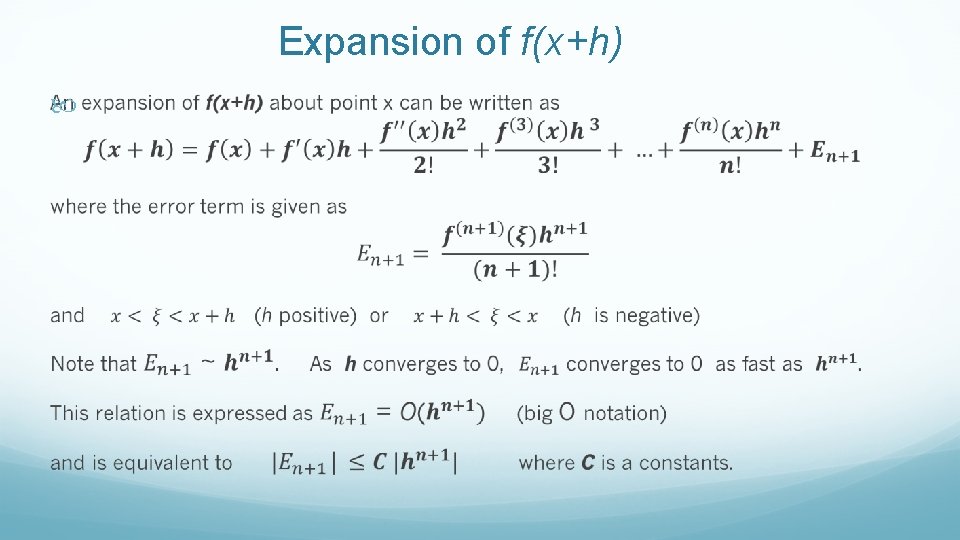
Expansion of f(x+h)
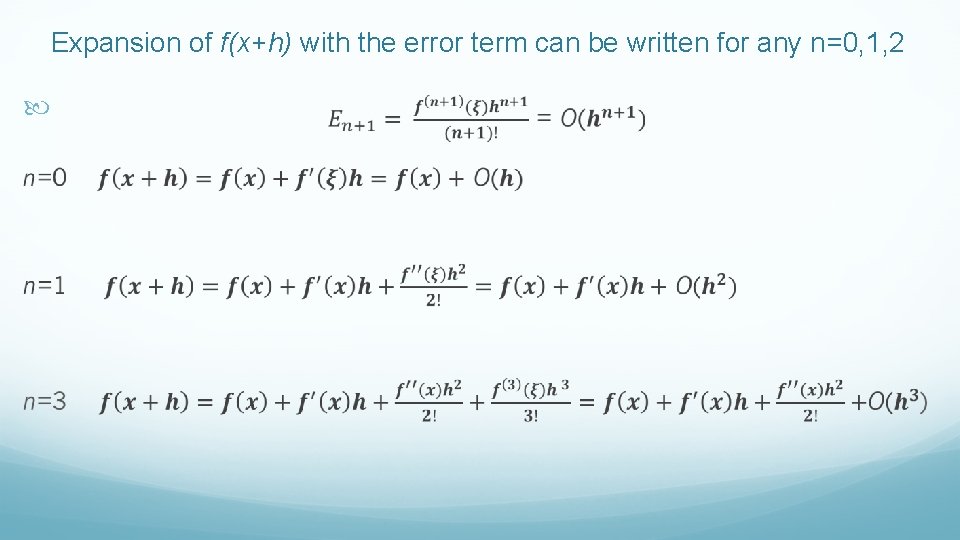
Expansion of f(x+h) with the error term can be written for any n=0, 1, 2
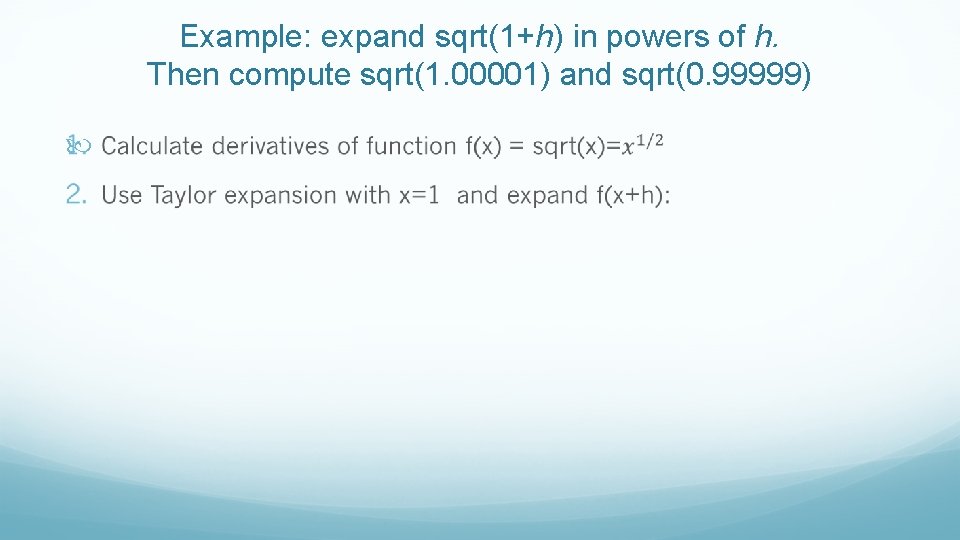
Example: expand sqrt(1+h) in powers of h. Then compute sqrt(1. 00001) and sqrt(0. 99999)
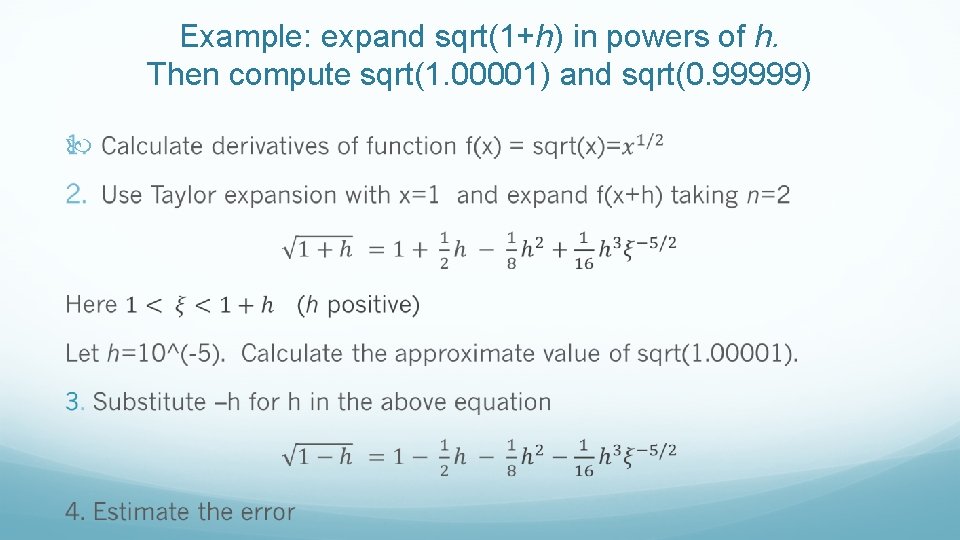
Example: expand sqrt(1+h) in powers of h. Then compute sqrt(1. 00001) and sqrt(0. 99999)
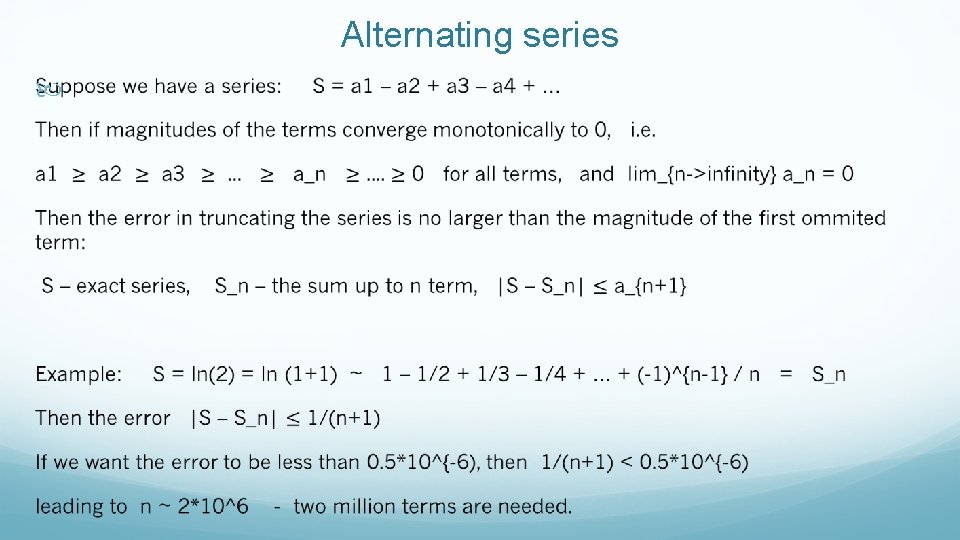
Alternating series
Example: estimate sin(x)/x, limit of x -> 0?
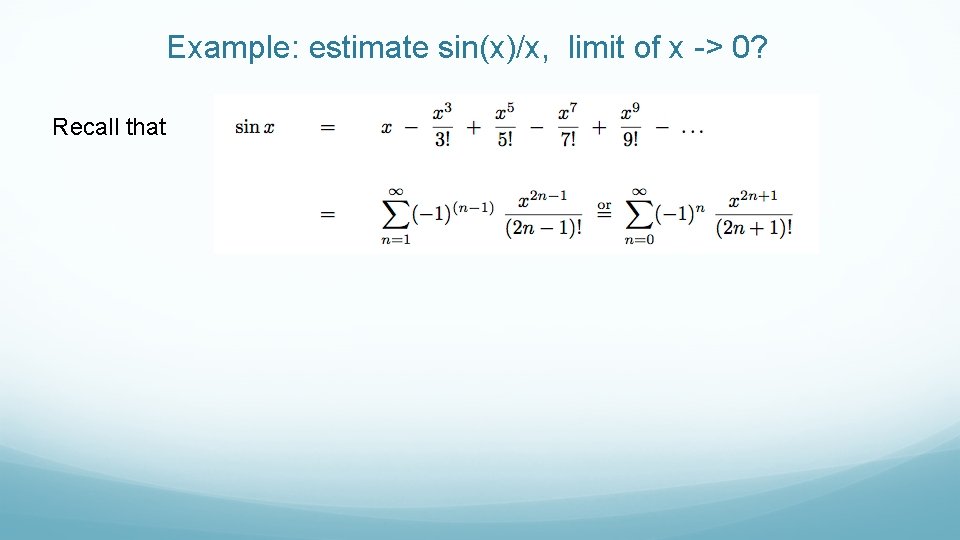
Example: estimate sin(x)/x, limit of x -> 0? Recall that
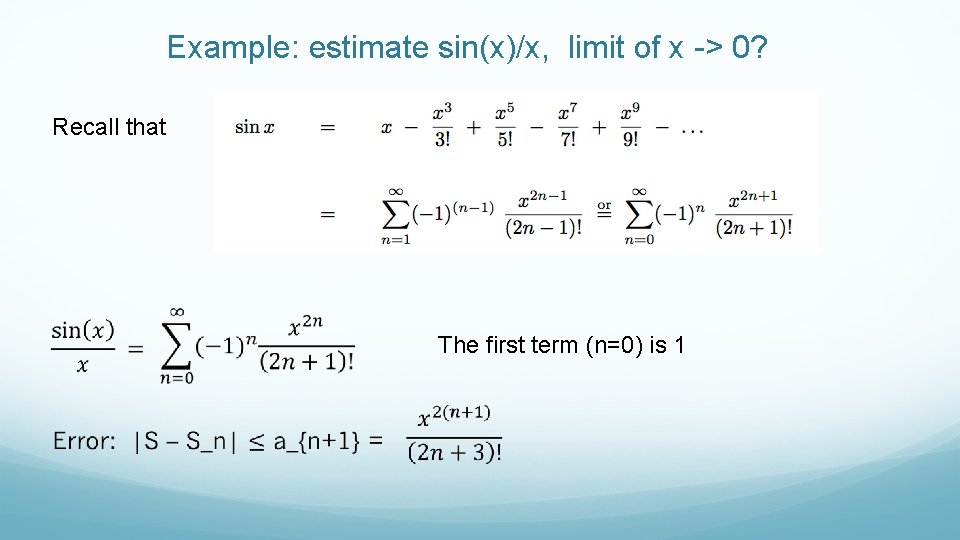
Example: estimate sin(x)/x, limit of x -> 0? Recall that The first term (n=0) is 1
Example: estimate sin(x) - x