
Taylor Ch 2 Projectiles and drag and basic
Taylor Ch 2: Projectiles (and drag) and, basic ODE math. 1
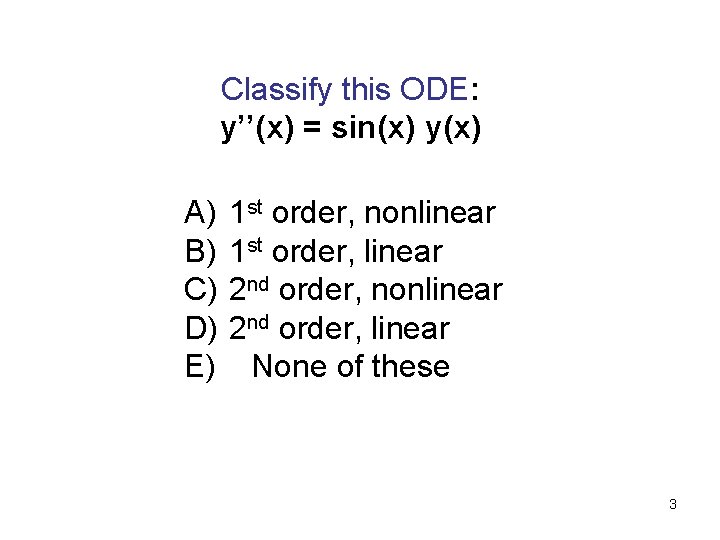
Classify this ODE: y’’(x) = sin(x) y(x) A) 1 st order, nonlinear B) 1 st order, linear C) 2 nd order, nonlinear D) 2 nd order, linear E) None of these 3
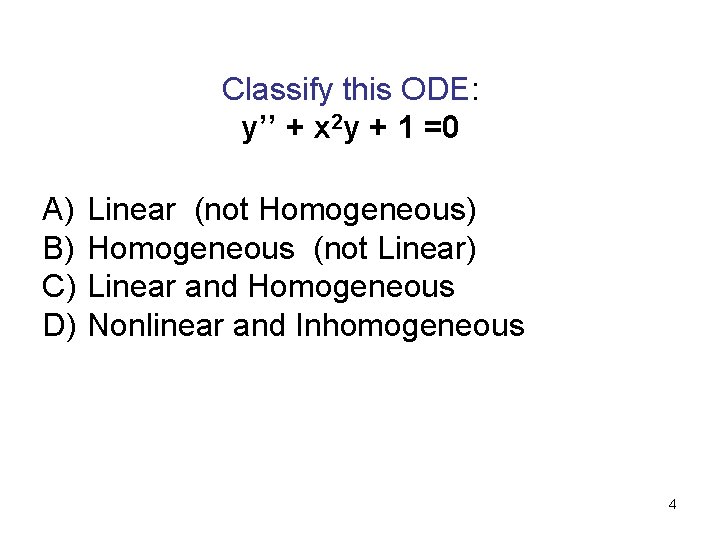
Classify this ODE: y’’ + x 2 y + 1 =0 A) Linear (not Homogeneous) B) Homogeneous (not Linear) C) Linear and Homogeneous D) Nonlinear and Inhomogeneous 4
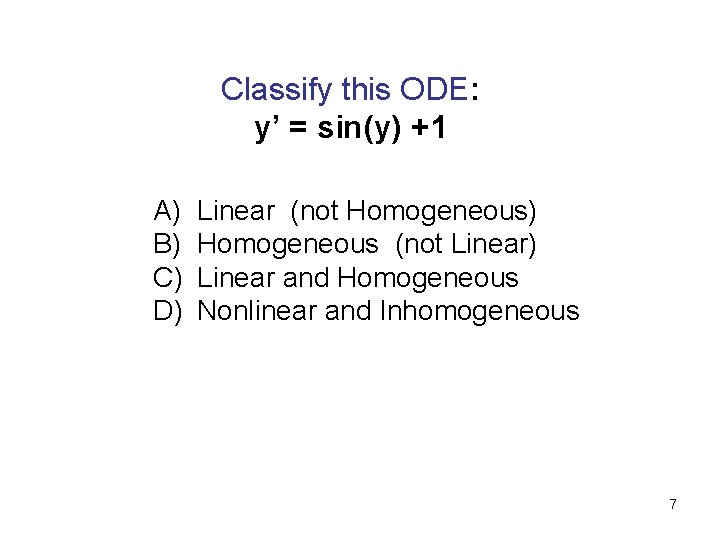
Classify this ODE: y’ = sin(y) +1 A) Linear (not Homogeneous) B) Homogeneous (not Linear) C) Linear and Homogeneous D) Nonlinear and Inhomogeneous 7
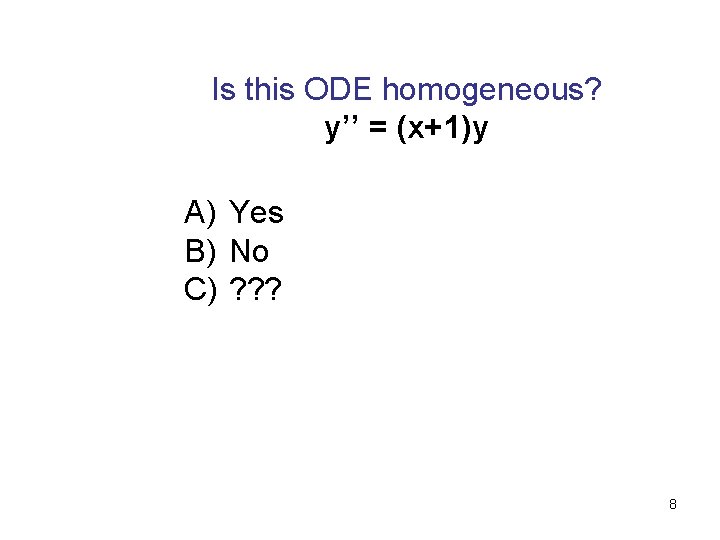
Is this ODE homogeneous? y’’ = (x+1)y A) Yes B) No C) ? ? ? 8
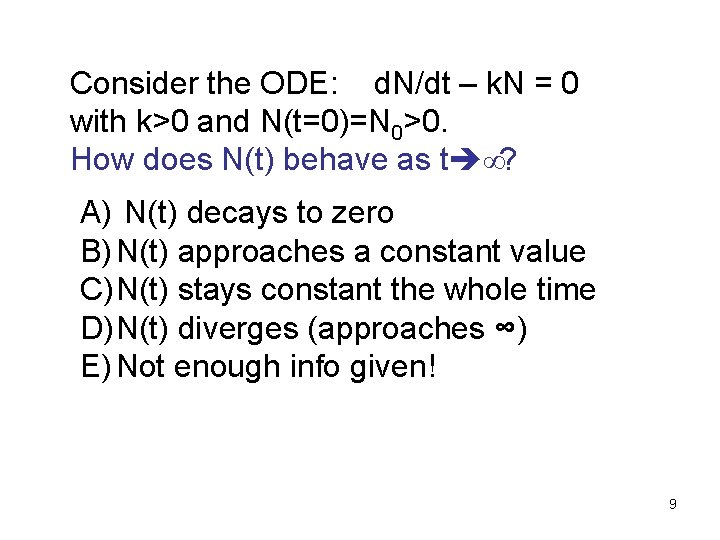
Consider the ODE: d. N/dt – k. N = 0 with k>0 and N(t=0)=N 0>0. How does N(t) behave as t ∞? A) N(t) decays to zero B) N(t) approaches a constant value C) N(t) stays constant the whole time D) N(t) diverges (approaches ∞) E) Not enough info given! 9
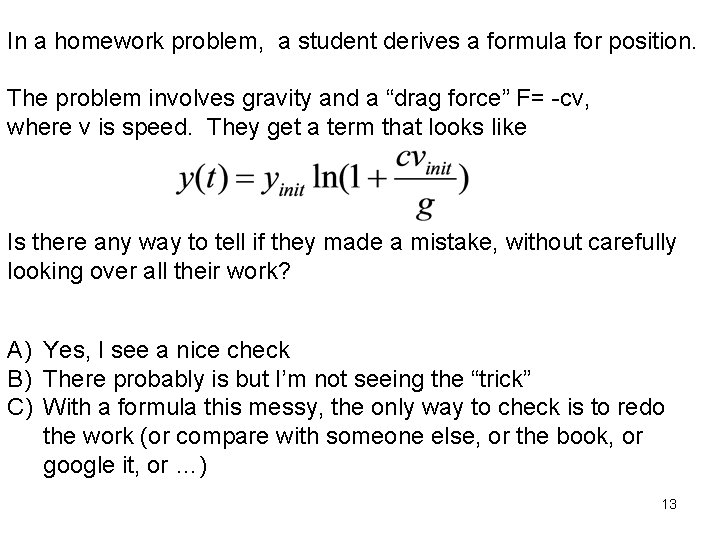
In a homework problem, a student derives a formula for position. The problem involves gravity and a “drag force” F= -cv, where v is speed. They get a term that looks like Is there any way to tell if they made a mistake, without carefully looking over all their work? A) Yes, I see a nice check B) There probably is but I’m not seeing the “trick” C) With a formula this messy, the only way to check is to redo the work (or compare with someone else, or the book, or google it, or …) 13
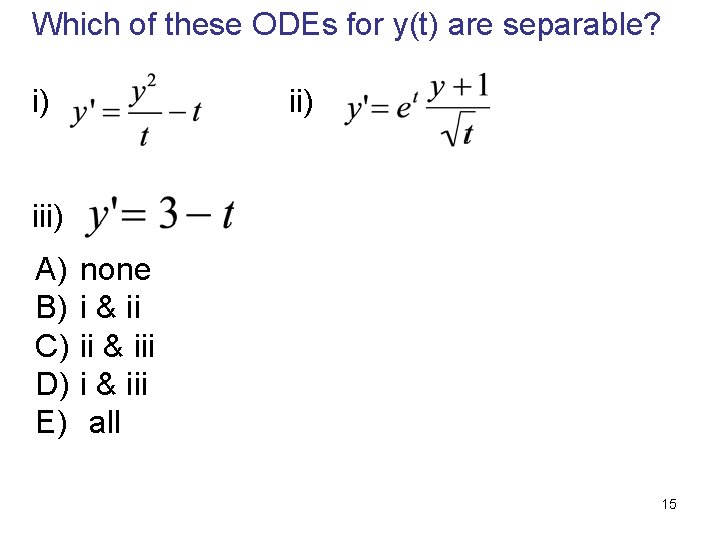
Which of these ODEs for y(t) are separable? i) ii) iii) A) none B) i & ii C) ii & iii D) i & iii E) all 15
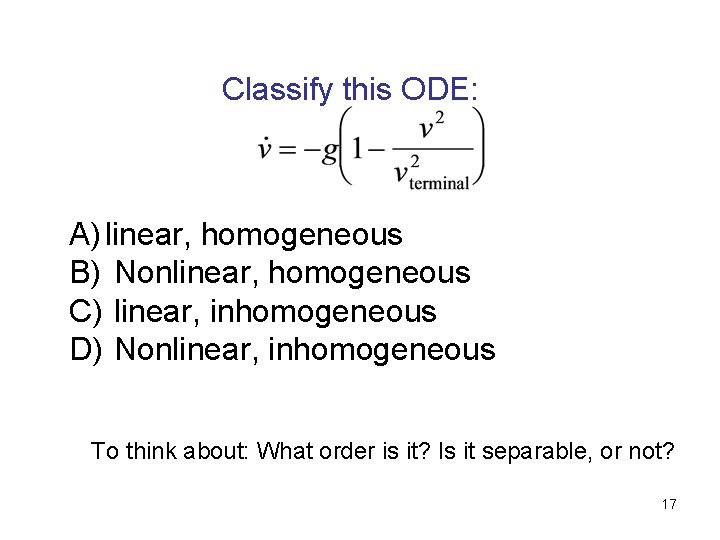
Classify this ODE: A) linear, homogeneous B) Nonlinear, homogeneous C) linear, inhomogeneous D) Nonlinear, inhomogeneous To think about: What order is it? Is it separable, or not? 17
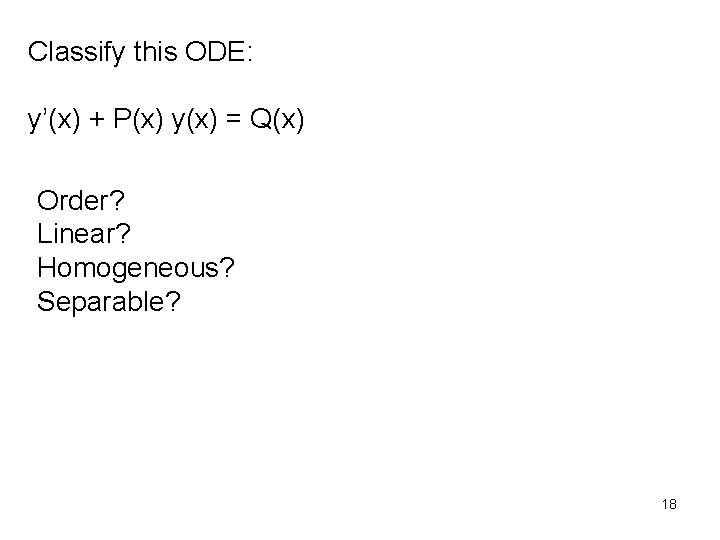
Classify this ODE: y’(x) + P(x) y(x) = Q(x) Order? Linear? Homogeneous? Separable? 18
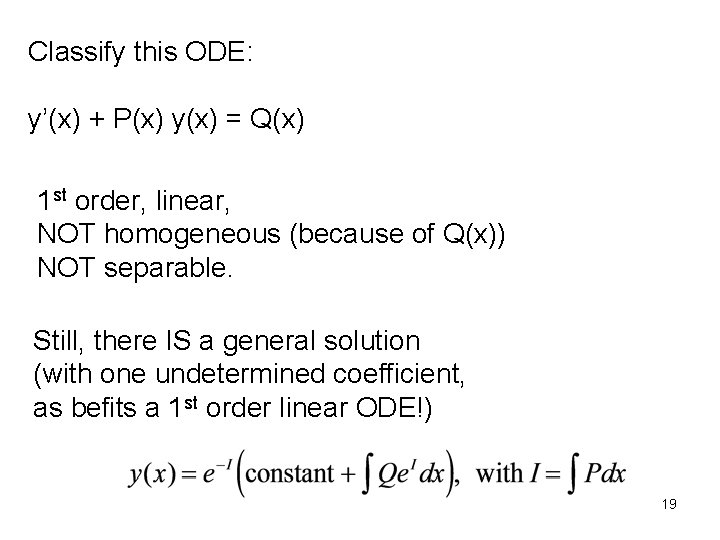
Classify this ODE: y’(x) + P(x) y(x) = Q(x) 1 st order, linear, NOT homogeneous (because of Q(x)) NOT separable. Still, there IS a general solution (with one undetermined coefficient, as befits a 1 st order linear ODE!) 19
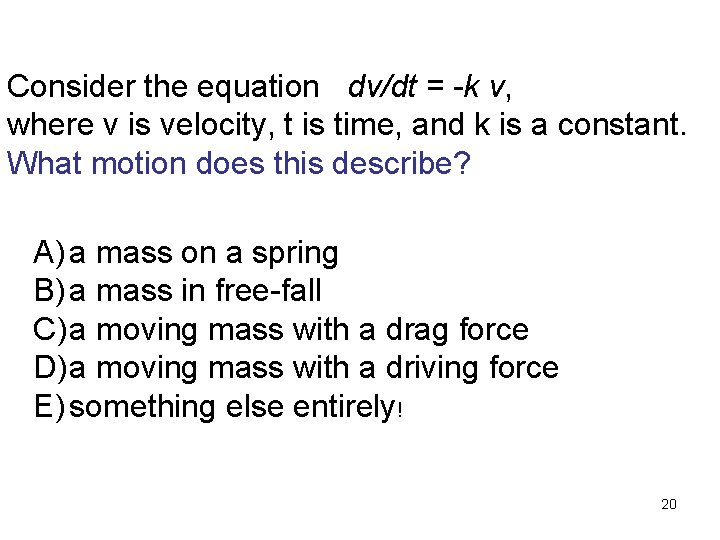
Consider the equation dv/dt = -k v, where v is velocity, t is time, and k is a constant. What motion does this describe? A) a mass on a spring B) a mass in free-fall C) a moving mass with a drag force D) a moving mass with a driving force E) something else entirely! 20
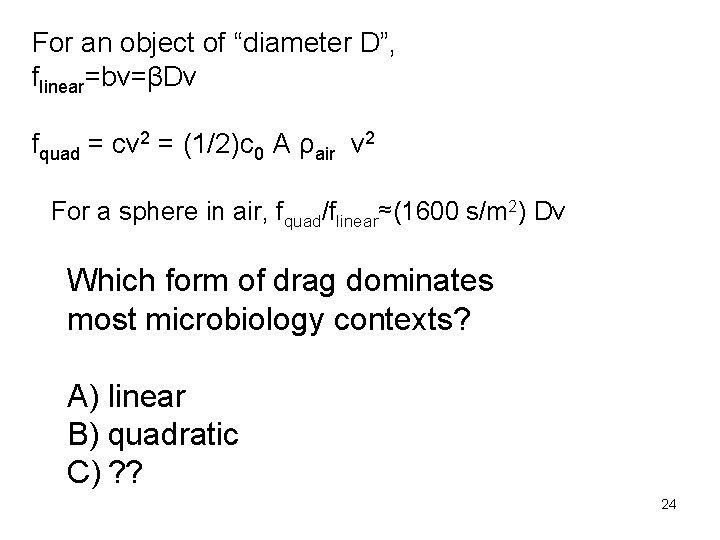
For an object of “diameter D”, flinear=bv=βDv fquad = cv 2 = (1/2)c 0 A ρair v 2 For a sphere in air, fquad/flinear≈(1600 s/m 2) Dv Which form of drag dominates most microbiology contexts? A) linear B) quadratic C) ? ? 24
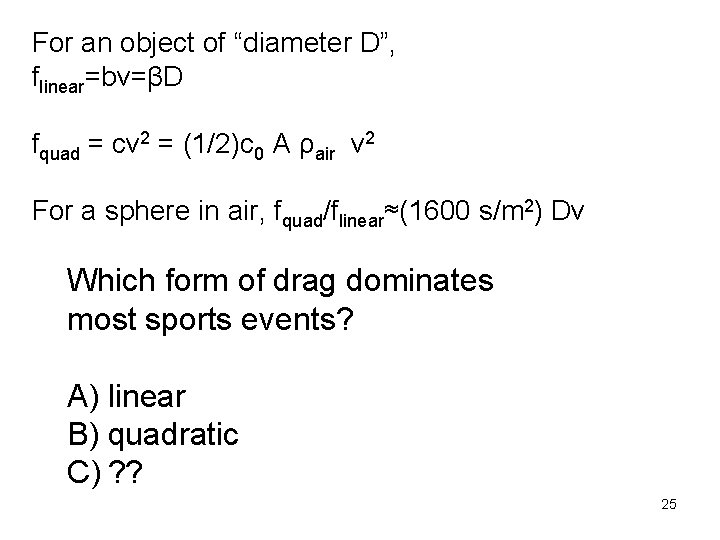
For an object of “diameter D”, flinear=bv=βD fquad = cv 2 = (1/2)c 0 A ρair v 2 For a sphere in air, fquad/flinear≈(1600 s/m 2) Dv Which form of drag dominates most sports events? A) linear B) quadratic C) ? ? 25
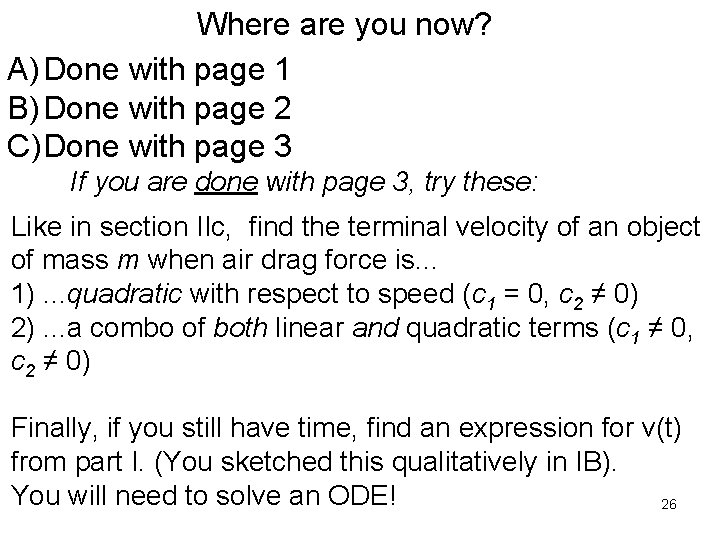
Where are you now? A) Done with page 1 B) Done with page 2 C) Done with page 3 If you are done with page 3, try these: Like in section IIc, find the terminal velocity of an object of mass m when air drag force is. . . 1). . . quadratic with respect to speed (c 1 = 0, c 2 ≠ 0) 2). . . a combo of both linear and quadratic terms (c 1 ≠ 0, c 2 ≠ 0) Finally, if you still have time, find an expression for v(t) from part I. (You sketched this qualitatively in IB). You will need to solve an ODE! 26
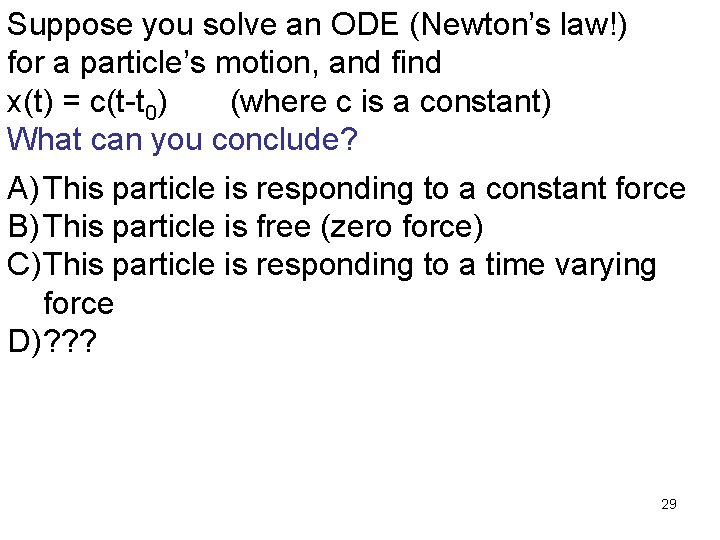
Suppose you solve an ODE (Newton’s law!) for a particle’s motion, and find x(t) = c(t-t 0) (where c is a constant) What can you conclude? A) This particle is responding to a constant force B) This particle is free (zero force) C) This particle is responding to a time varying force D) ? ? ? 29

Drag force is: Consider a mass moving UP (Let’s define DOWN as the +y direction ) Which eq’n of motion is correct? v (moving up) fdrag mg +y 30

Drag force is: Consider a mass moving UP (Let’s define DOWN as the +y direction ) Which eq’n of motion is correct? v (moving up) fdrag mg +y 31
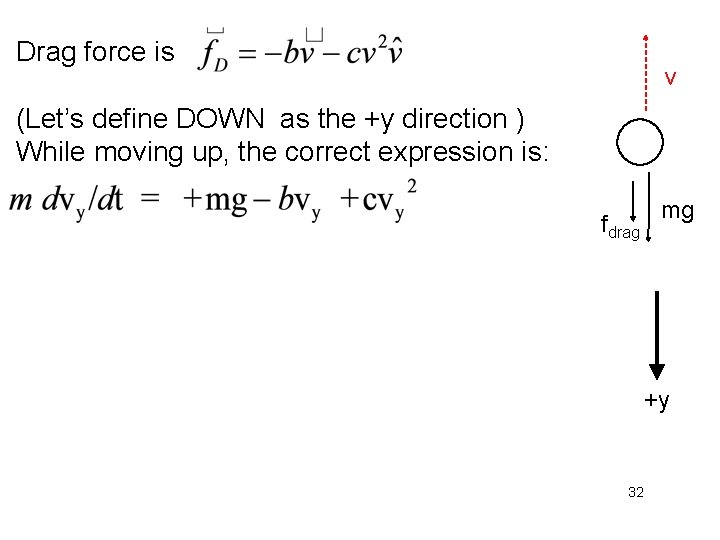
Drag force is v (Let’s define DOWN as the +y direction ) While moving up, the correct expression is: fdrag mg +y 32

Drag force is (Still define DOWN as the +y direction ) While moving up, the correct expression was: fdrag If the object is now moving DOWN, which term(s) in that equation will change sign? A) mg (only) mg B) the linear term (only) C) the quadratic one (only) D) more than one term changes sign E) NONE of the terms changes sign. v 33 +y
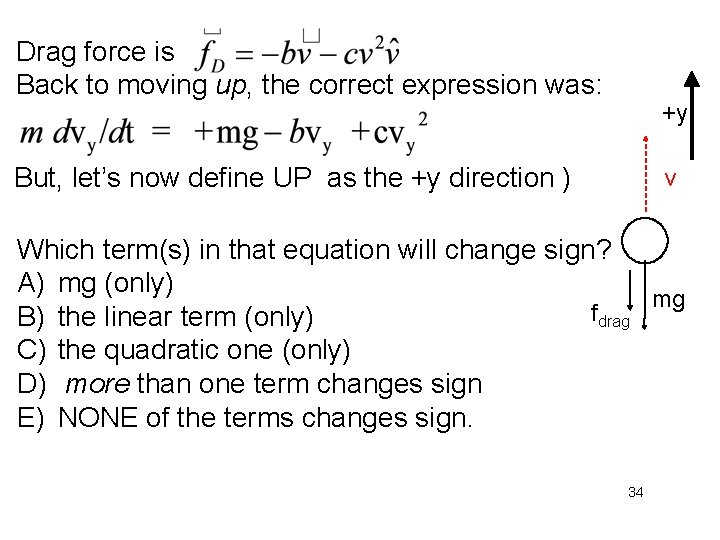
Drag force is Back to moving up, the correct expression was: +y But, let’s now define UP as the +y direction ) v Which term(s) in that equation will change sign? A) mg (only) mg fdrag B) the linear term (only) C) the quadratic one (only) D) more than one term changes sign E) NONE of the terms changes sign. 34
Assuming you have two solid spheres made of the same material, but one has a larger diameter. When dropped in air, which one will reach the higher terminal velocity, the bigger one or the smaller one? A) B) C) D) The bigger one The smaller one both are the same ? ? ? 35
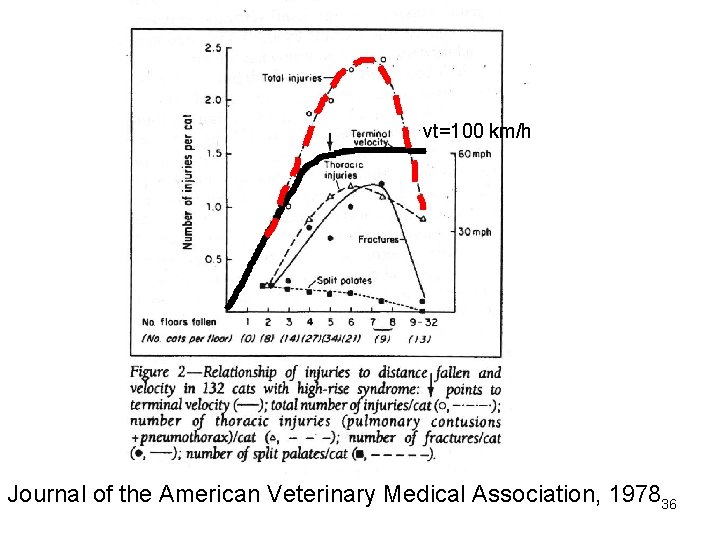
vt=100 km/h Journal of the American Veterinary Medical Association, 197836
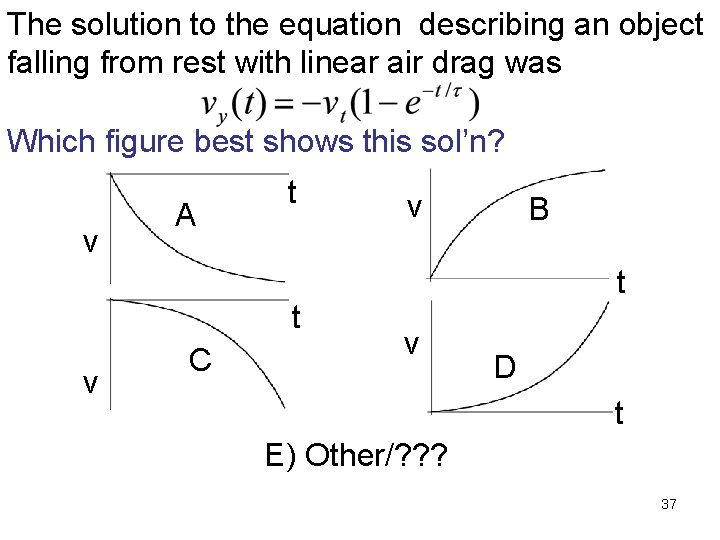
The solution to the equation describing an object falling from rest with linear air drag was Which figure best shows this sol’n? v A t t v C v B t v D t E) Other/? ? ? 37
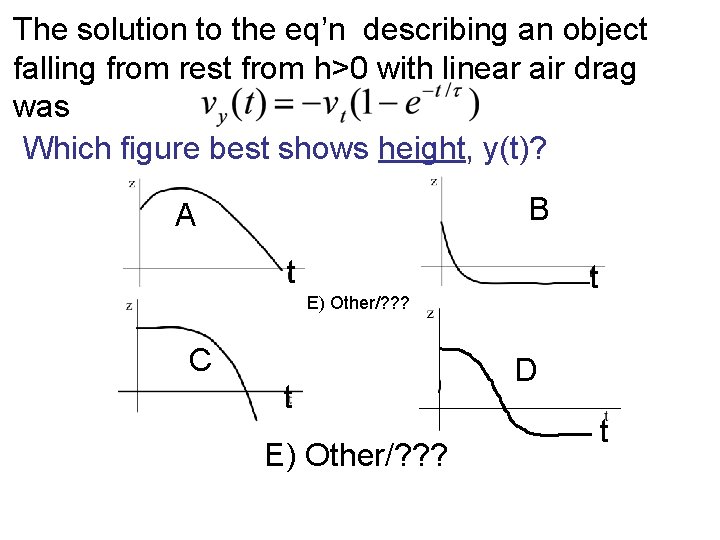
The solution to the eq’n describing an object falling from rest from h>0 with linear air drag was Which figure best shows height, y(t)? B A t t E) Other/? ? ? C t E) Other/? ? ? D t
A tennis ball is hit directly upwards with initial speed v 0. Compare the time T to reach the top (height H) to the time and height in an ideal (vacuum) world. A) T>Tvacuum, H≈Hvacuum B) T>Tvacuum, H<Hvacuum C) T≈Tvacuum, H<Hvacuum D) T<Tvacuum, H<Hvacuum E) Some other combination!! 41

A tennis ball is hit directly upwards with initial speed v 0. Compare the time T to reach the top (height H) to the time and height in an ideal (vacuum) world. A) T>Tvacuum, H≈Hvacuum B) T>Tvacuum, H<Hvacuum C) T≈Tvacuum, H<Hvacuum D) T<Tvacuum, H<Hvacuum E) Some other combination!! v(t) t 42
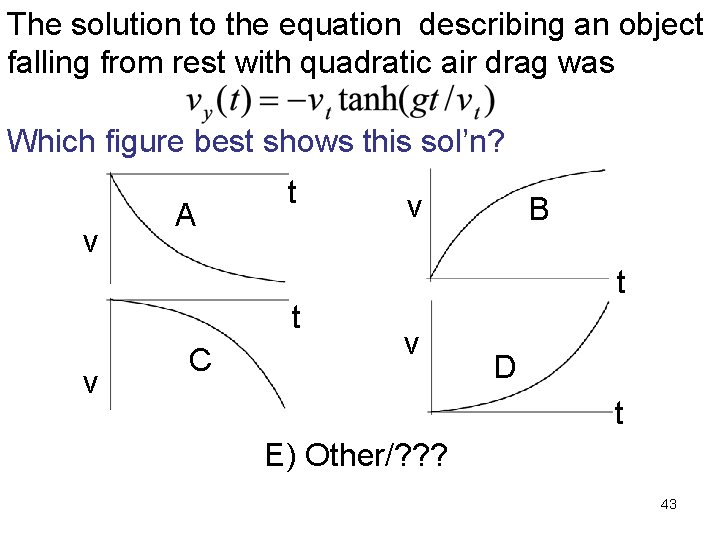
The solution to the equation describing an object falling from rest with quadratic air drag was Which figure best shows this sol’n? v A t t v C v B t v D t E) Other/? ? ? 43
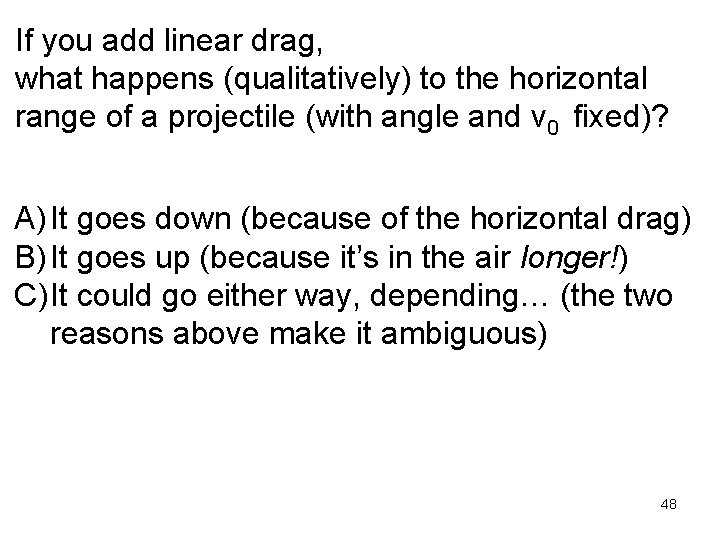
If you add linear drag, what happens (qualitatively) to the horizontal range of a projectile (with angle and v 0 fixed)? A) It goes down (because of the horizontal drag) B) It goes up (because it’s in the air longer!) C) It could go either way, depending… (the two reasons above make it ambiguous) 48
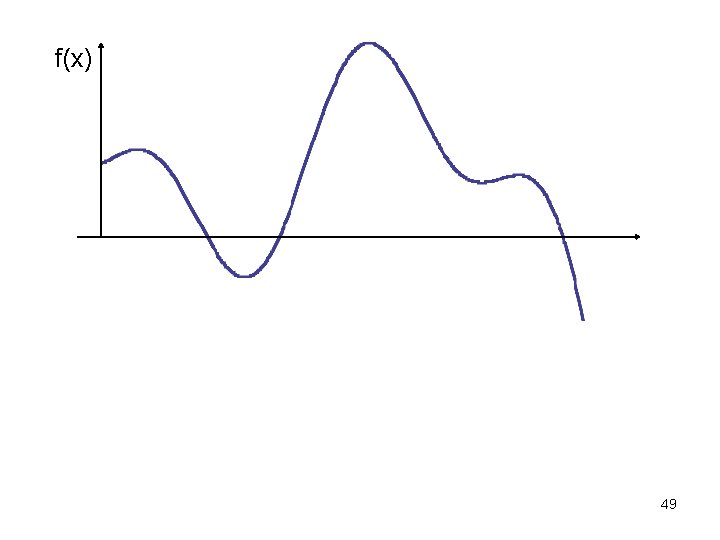
f(x) 49
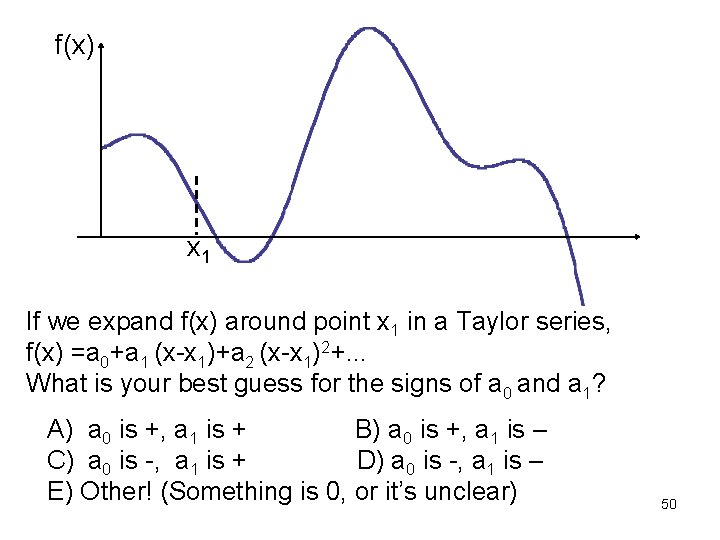
f(x) x 1 If we expand f(x) around point x 1 in a Taylor series, f(x) =a 0+a 1 (x-x 1)+a 2 (x-x 1)2+. . . What is your best guess for the signs of a 0 and a 1? A) a 0 is +, a 1 is + B) a 0 is +, a 1 is – C) a 0 is -, a 1 is + D) a 0 is -, a 1 is – E) Other! (Something is 0, or it’s unclear) 50
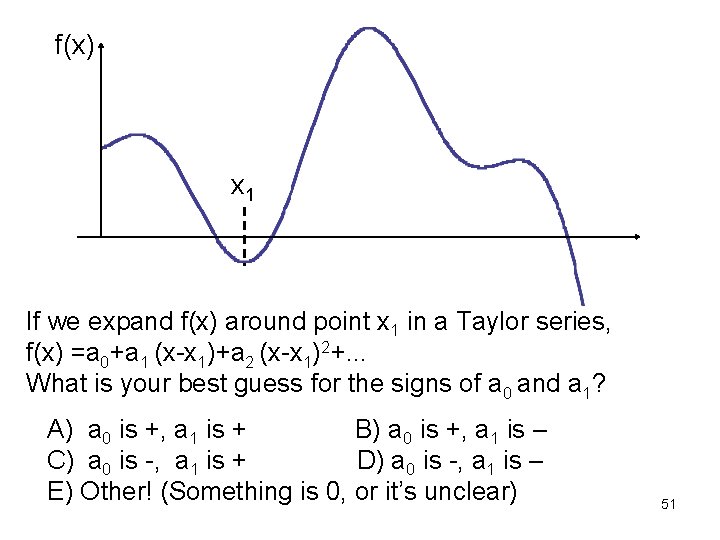
f(x) x 1 If we expand f(x) around point x 1 in a Taylor series, f(x) =a 0+a 1 (x-x 1)+a 2 (x-x 1)2+. . . What is your best guess for the signs of a 0 and a 1? A) a 0 is +, a 1 is + B) a 0 is +, a 1 is – C) a 0 is -, a 1 is + D) a 0 is -, a 1 is – E) Other! (Something is 0, or it’s unclear) 51
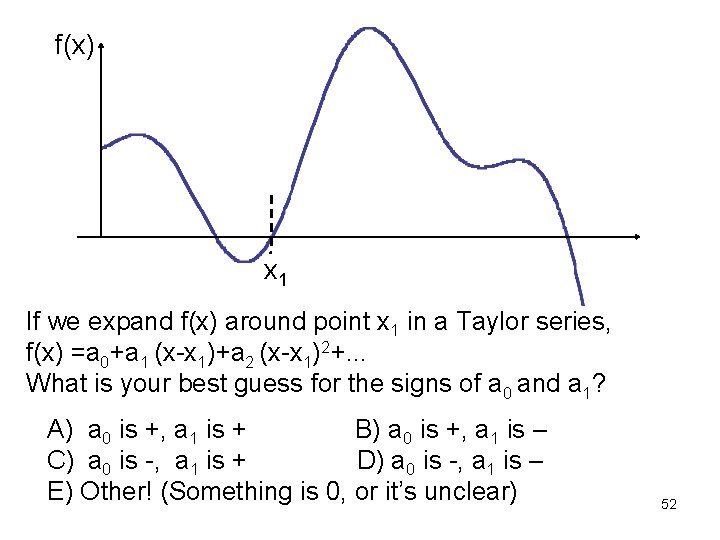
f(x) x 1 If we expand f(x) around point x 1 in a Taylor series, f(x) =a 0+a 1 (x-x 1)+a 2 (x-x 1)2+. . . What is your best guess for the signs of a 0 and a 1? A) a 0 is +, a 1 is + B) a 0 is +, a 1 is – C) a 0 is -, a 1 is + D) a 0 is -, a 1 is – E) Other! (Something is 0, or it’s unclear) 52
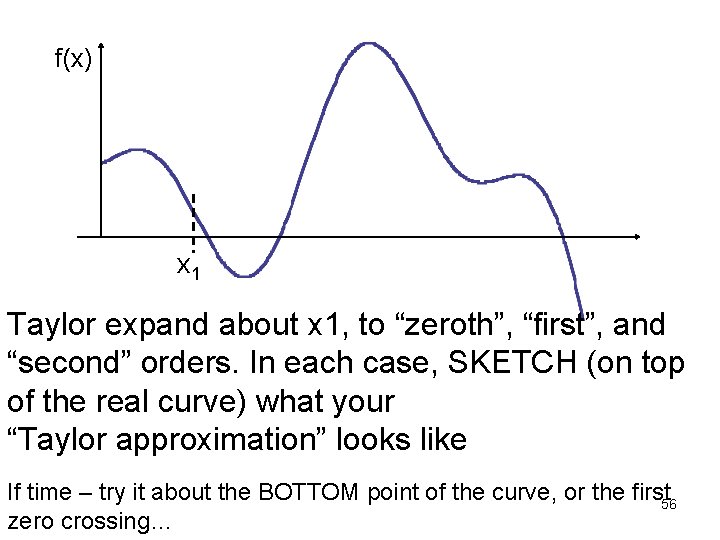
f(x) x 1 Taylor expand about x 1, to “zeroth”, “first”, and “second” orders. In each case, SKETCH (on top of the real curve) what your “Taylor approximation” looks like If time – try it about the BOTTOM point of the curve, or the first 56 zero crossing…
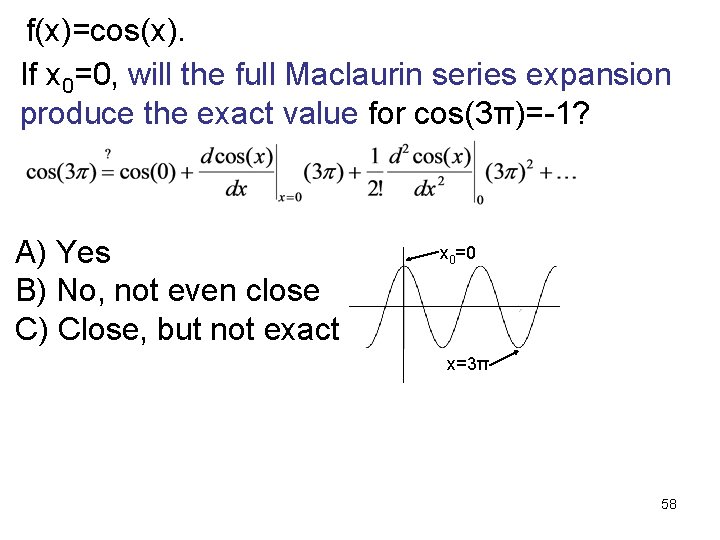
f(x)=cos(x). If x 0=0, will the full Maclaurin series expansion produce the exact value for cos(3π)=-1? A) Yes B) No, not even close C) Close, but not exact x 0=0 x=3π 58
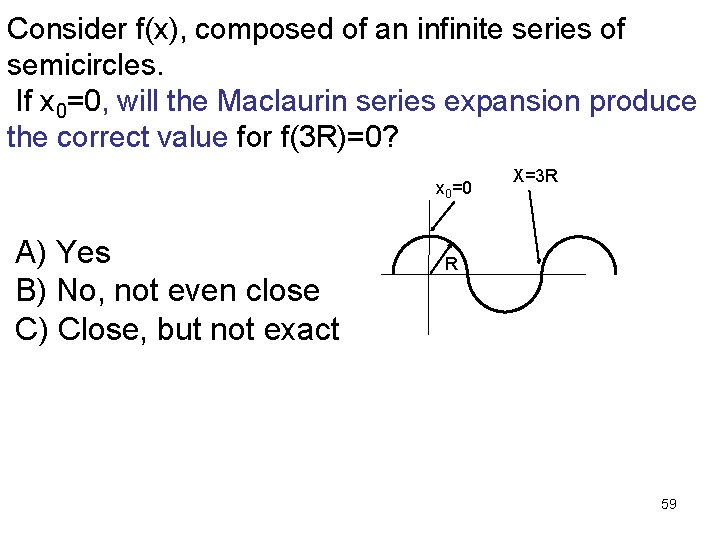
Consider f(x), composed of an infinite series of semicircles. If x 0=0, will the Maclaurin series expansion produce the correct value for f(3 R)=0? x 0=0 A) Yes B) No, not even close C) Close, but not exact X=3 R R 59
Where are you now? A) Done with page 1 B) Done with page 2 C) Done with page 3 If you are done with page 3, try these: Rewrite your code to solve for v[t] for an object falling with quadratic drag force. (You used NDSolve to do this for the falling penny now you know, roughly what NDSolve was doing!) 61
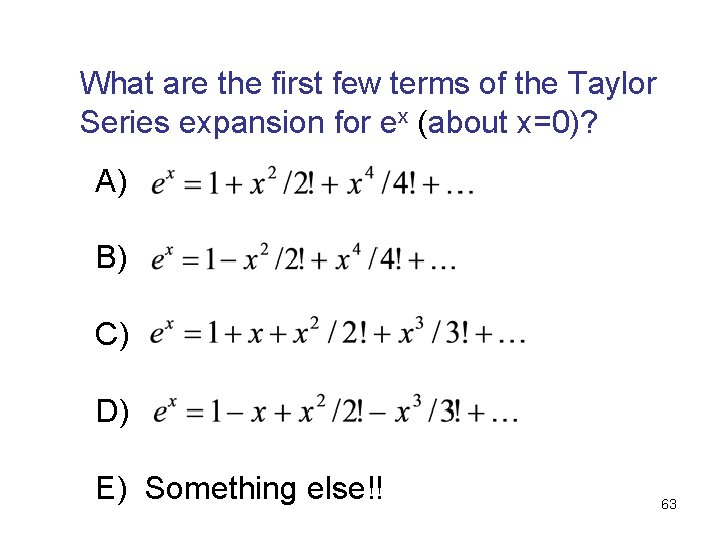
What are the first few terms of the Taylor Series expansion for ex (about x=0)? A) B) C) D) E) Something else!! 63
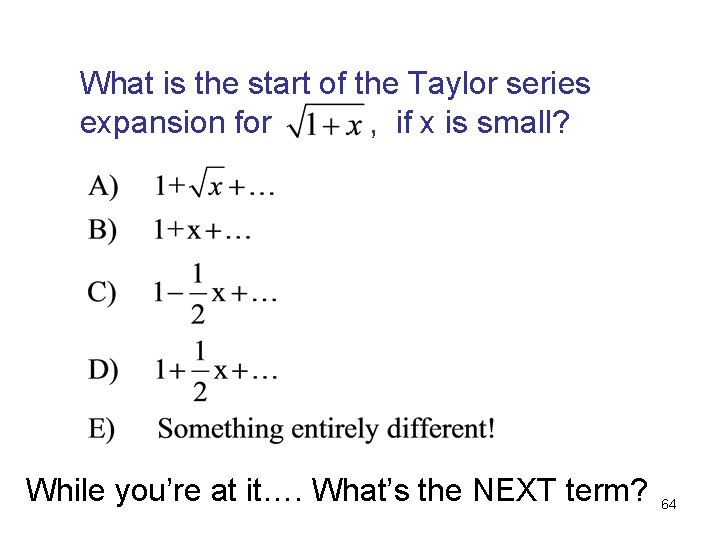
What is the start of the Taylor series expansion for , if x is small? While you’re at it…. What’s the NEXT term? 64
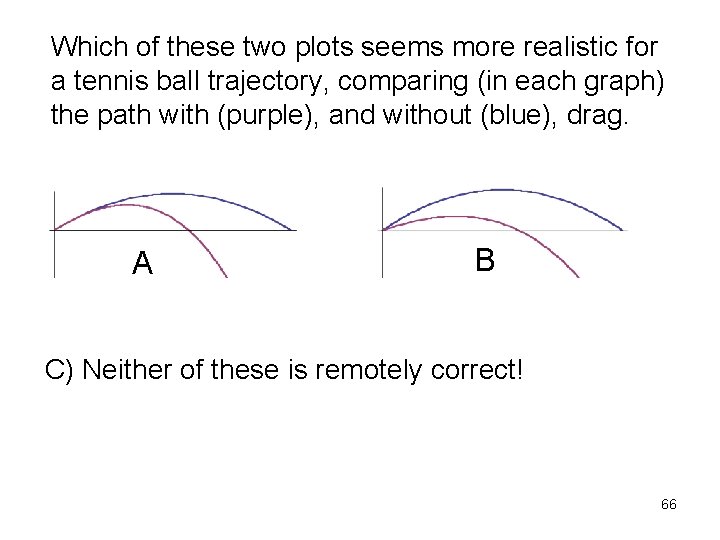
Which of these two plots seems more realistic for a tennis ball trajectory, comparing (in each graph) the path with (purple), and without (blue), drag. A B C) Neither of these is remotely correct! 66
- Slides: 40