
Taylor 5 Linguistic Encyclopedic Knowledge Is encyclopedic knowledge
- Slides: 14
Taylor 5 Linguistic & Encyclopedic Knowledge
Is encyclopedic knowledge important? • How is background knowledge incorporated into the characterization of word meanings? • “Autonomous linguistics assumes a clean separation between a speaker’s world knowledge and his purely linguistic knowledge”. According to this view, “the mental dictionary is is not an encyclopedia” • BUT: Where do you draw the line?
What Cog Lx says about encyclopedic knowledge • Word meaning “is broadly encyclopedic in scope. Our concept of dog is not independent of our knowledge about dogs. ” • Background information is “a network of shared, conventionalized, to some extent perhaps idealized knowledge, embedded in a pattern of cultural beliefs and practices. ”
5. 1 Domains & Schemas • Meanings are not independently existing entities. • Meanings require context. • “A linguistic form gets its meaning by profiling, or highlighting a particular region or configuration in the relevant domain. ”
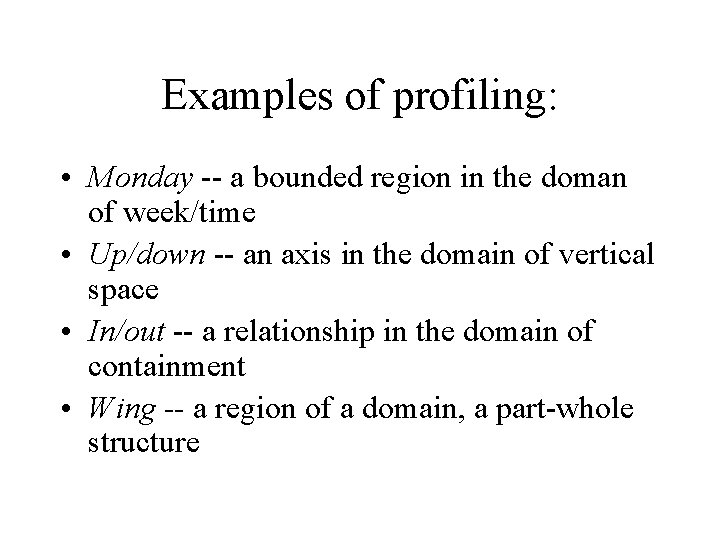
Examples of profiling: • Monday -- a bounded region in the doman of week/time • Up/down -- an axis in the domain of vertical space • In/out -- a relationship in the domain of containment • Wing -- a region of a domain, a part-whole structure
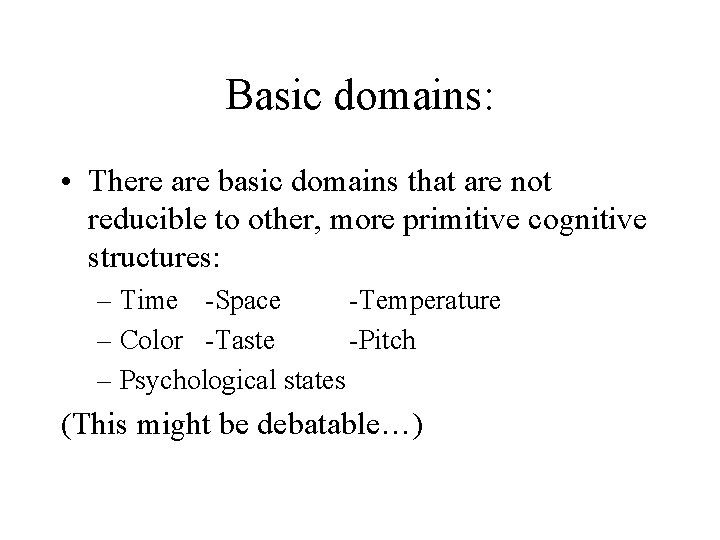
Basic domains: • There are basic domains that are not reducible to other, more primitive cognitive structures: – Time -Space -Temperature – Color -Taste -Pitch – Psychological states (This might be debatable…)
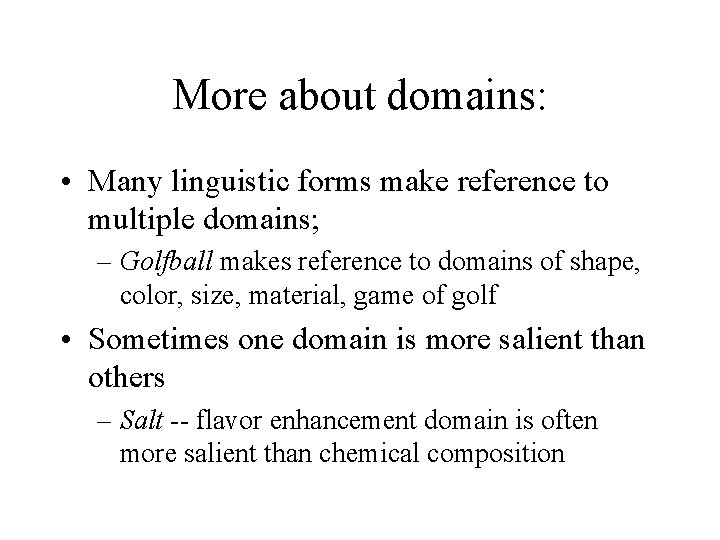
More about domains: • Many linguistic forms make reference to multiple domains; – Golfball makes reference to domains of shape, color, size, material, game of golf • Sometimes one domain is more salient than others – Salt -- flavor enhancement domain is often more salient than chemical composition
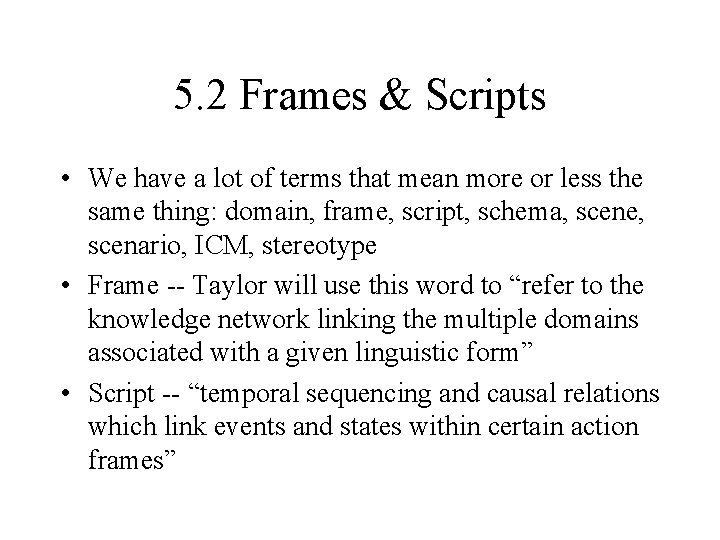
5. 2 Frames & Scripts • We have a lot of terms that mean more or less the same thing: domain, frame, script, schema, scene, scenario, ICM, stereotype • Frame -- Taylor will use this word to “refer to the knowledge network linking the multiple domains associated with a given linguistic form” • Script -- “temporal sequencing and causal relations which link events and states within certain action frames”
More about frames & scripts • There is no “clear dividing line between linguistically relevant and linguistically irrelevant knowledge”. • Frames “are configurations of culture-based, conventionalized knowledge”.
5. 3 Perspectivization [Note: most cog linguists prefer the term “construal”] • A given use of a word may highlight one or another component of a frame – My birthday falls on a Monday (highlights order of days) – I have a Monday morning feeling (highlights weekend vs. workweek) – My car was made on a Monday (highlights transition from weekend to work ethic)
5. 4 Frames & scripts in language comprehension • Encyclopedic knowledge is needed in order to correctly interpret linguistic forms. For example alligator shoes are üA. made from alligator skin -Not. B. worn by alligators, C. for walking on alligators, D. worn during the alligator time, etc.
Computing meaning • The alligator shoes example is meant to demonstrate that meaning and grammaticality cannot be computed in terms of binary features
5. 5 Fake • Is a fake gun a gun? • Note that: – Only human beings can create fakes – There has to be something at stake to motivate a deception • Fake is uninterpretable without encyclopedic knowledge
5. 6 Real • Mary’s husband is a real bachelor. • Real “highlights attributes conventionally associated with a frame, while at the same time releasing the category from otherwise necessary conditions for membership” • This requires encylopedic knowledge. [Note also that real has a function that is the opposite of that of technically/strictly speaking]