
Tay Sachs Disease Group 5 Bhandari M Bhola
Tay Sachs Disease Group 5: Bhandari, M. , Bhola, M. , Desai, R. , Joshi, D. , & Shamim, A.
Table of Contents 1. Introduction 2. Signs & Symptoms 3. Epidemiology 4. Risk Factors 5. Inheritance 6. Pathophysiology 7. Diagnosis 8. Treatment 9. Conclusion
What is Tay Sachs? ■ Rare genetic disorder ■ Deletion of Hex A enzyme ■ Destroys the nervous system in a progressive manner (GHR, 2012)
SIGNS & SYMPTOMS What to look out for
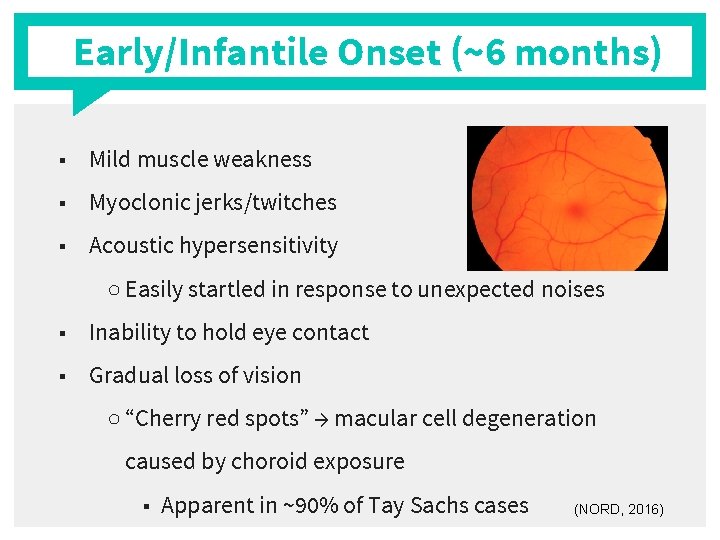
Early/Infantile Onset (~6 months) ■ Mild muscle weakness ■ Myoclonic jerks/twitches ■ Acoustic hypersensitivity ○ Easily startled in response to unexpected noises ■ Inability to hold eye contact ■ Gradual loss of vision ○ “Cherry red spots” → macular cell degeneration caused by choroid exposure ■ Apparent in ~90% of Tay Sachs cases (NORD, 2016)
Childhood Onset (~2 -10 years) ■ Lack of coordination and motor skills ○ Clumsiness ○ Unable to walk properly ■ Reduction in intellectual abilities ■ May develop retinitis pigmentosa ○ Degeneration of the retina ■ Loss of speech (NORD, 2016)
Late Onset (Adolescence--) ■ Reduction in motor coordination ○ Muscle weakness ○ Involuntary muscle contractions ○ Tremors ■ Slurred speech ■ Changes in mood and mental health ■ Unable to complete daily tasks (NORD, 2016)
EPIDEMIOLOGY Distribution and determinants of Tay-Sachs disease

Genetic Risk Factors Individuals of the following ethnicities are at a higher risk for being affected by Tay-Sachs or being heterozygous for the mutated allele: ■ Ashkenazi Jewish ■ French-Canadians of Quebec ■ Old Order Amish in Pennsylvania ■ Cajuns of Louisiana ■ Family history of condition (Koeslag, 1984)
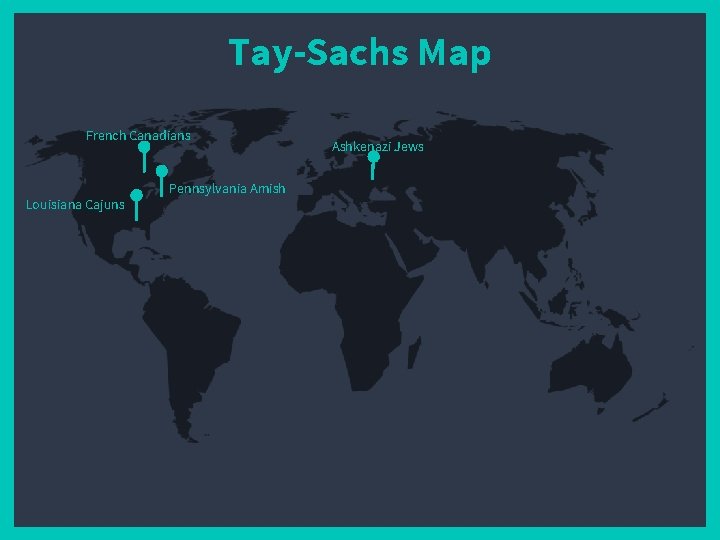
Tay-Sachs Map French Canadians Louisiana Cajuns Pennsylvania Amish Ashkenazi Jews
Theories ● Heterozygote advantage ○ Being a carrier of mutated gene provides resistance against tuberculosis ● Random genetic drift ○ Change in allele frequencies due to chance ● Founder effect ○ Isolated populations ○ Small initial population: high genetic mutation frequency ● Reproductive compensation ○ Parents who have children affected by Tay-Sachs may continue reproducing (Withrock, 2015)(Chakravarti, 1978)
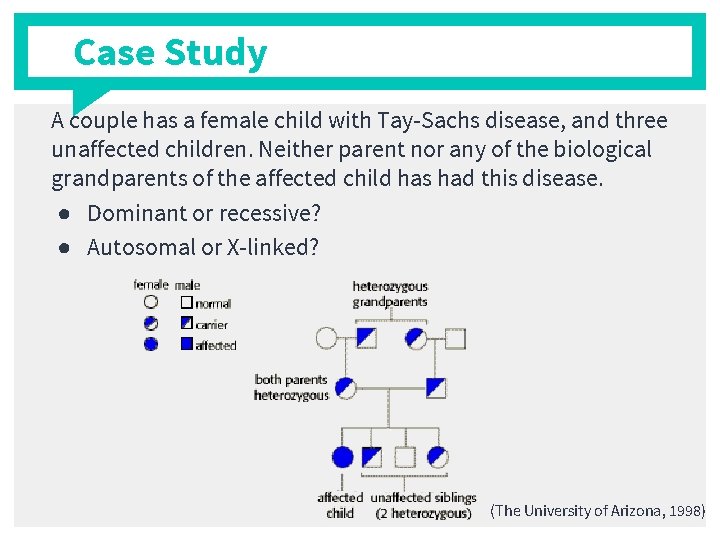
Case Study A couple has a female child with Tay-Sachs disease, and three unaffected children. Neither parent nor any of the biological grandparents of the affected child has had this disease. ● Dominant or recessive? ● Autosomal or X-linked? (The University of Arizona, 1998)

Genetic Inheritance
PATHOPHYSIOLOGY Underlying Mechanisms of Disease
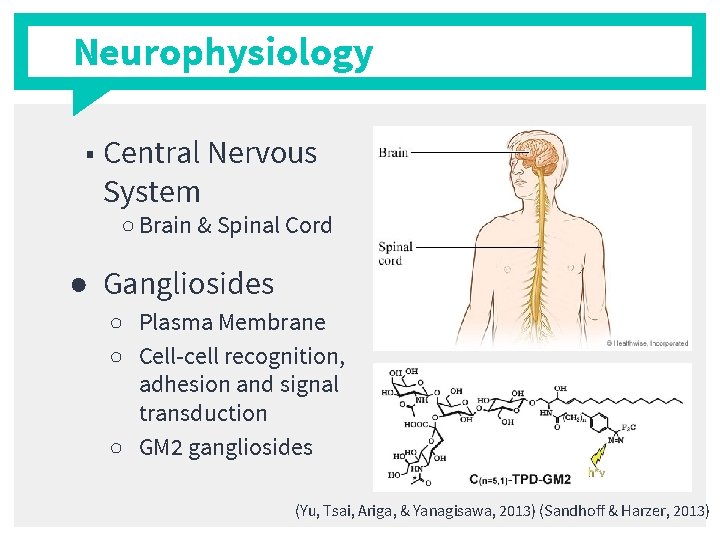
Neurophysiology ■ Central Nervous System ○ Brain & Spinal Cord ● Gangliosides ○ Plasma Membrane ○ Cell-cell recognition, adhesion and signal transduction ○ GM 2 gangliosides (Yu, Tsai, Ariga, & Yanagisawa, 2013) (Sandhoff & Harzer, 2013)

HEXA Gene Chromosome 15 15 q 24. 1 Encodes β Hexosaminidase A (Genetics Home Reference, 2017) (Neudorfer et al. , 2005)
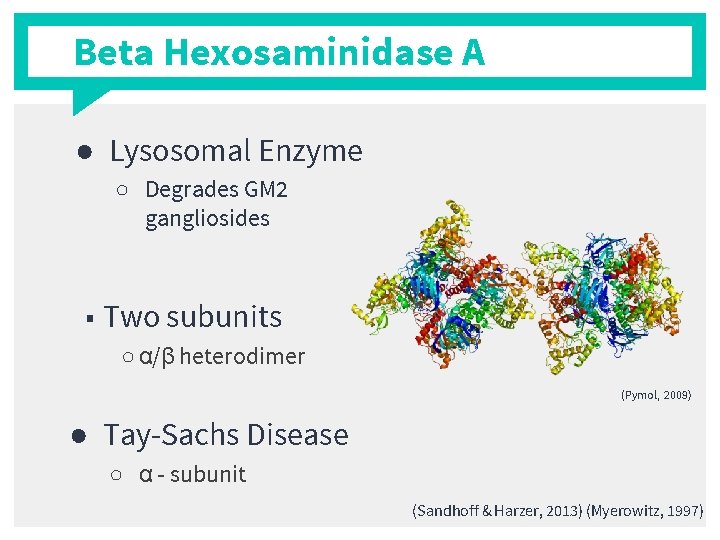
Beta Hexosaminidase A ● Lysosomal Enzyme ○ Degrades GM 2 gangliosides ■ Two subunits ○ α/β heterodimer (Pymol, 2009) ● Tay-Sachs Disease ○ α - subunit (Sandhoff & Harzer, 2013) (Myerowitz, 1997)
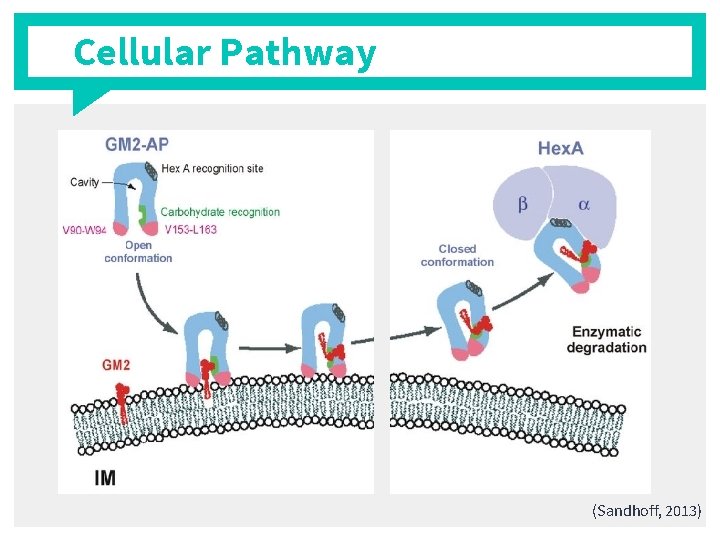
Cellular Pathway (Sandhoff, 2013)
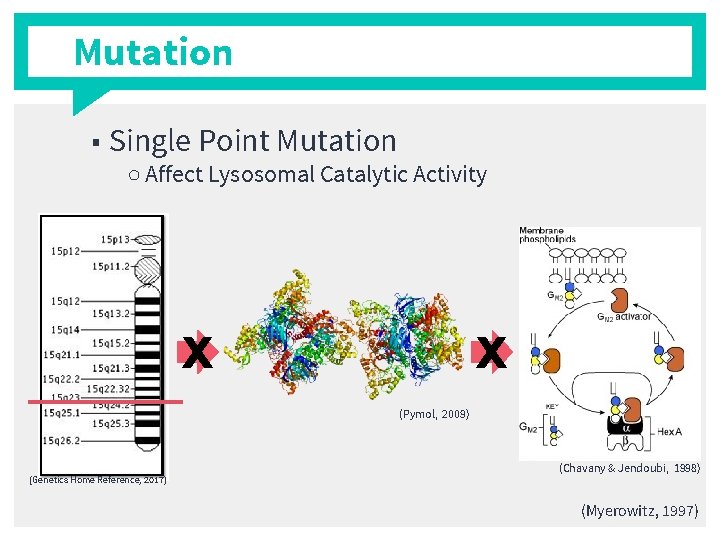
Mutation ■ Single Point Mutation ○ Affect Lysosomal Catalytic Activity x x (Pymol, 2009) (Genetics Home Reference, 2017) (Chavany & Jendoubi, 1998) (Myerowitz, 1997)
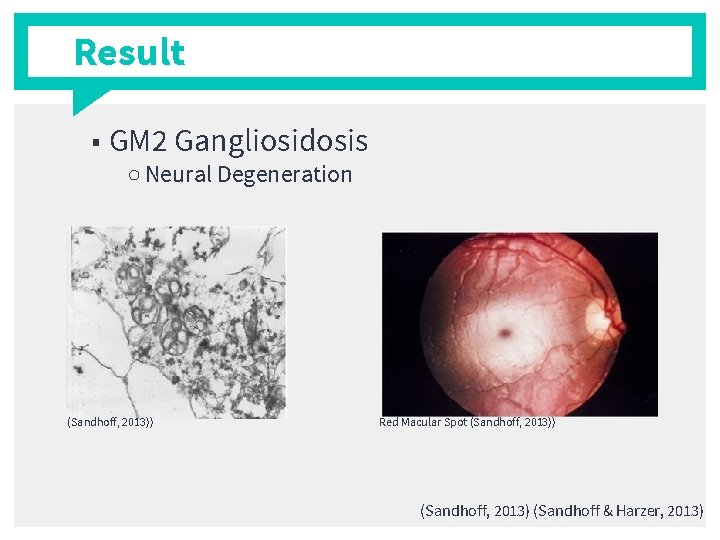
Result ■ GM 2 Gangliosidosis ○ Neural Degeneration (Sandhoff, 2013)) Red Macular Spot (Sandhoff, 2013)) (Sandhoff, 2013) (Sandhoff & Harzer, 2013)
DIAGNOSIS Various screening methods
Diagnosis ■ Blood tests ○ Measures hexosaminidase A levels in the body ○ Reduced levels in people with Tay-Sachs ● Molecular genetic testing ○ Detect mutation in HEXA gene ● Testing prenatally ○ Chorionic villi sampling (CVS) ○ Amniocentesis (NIH, 2011) (NORD, 2016)
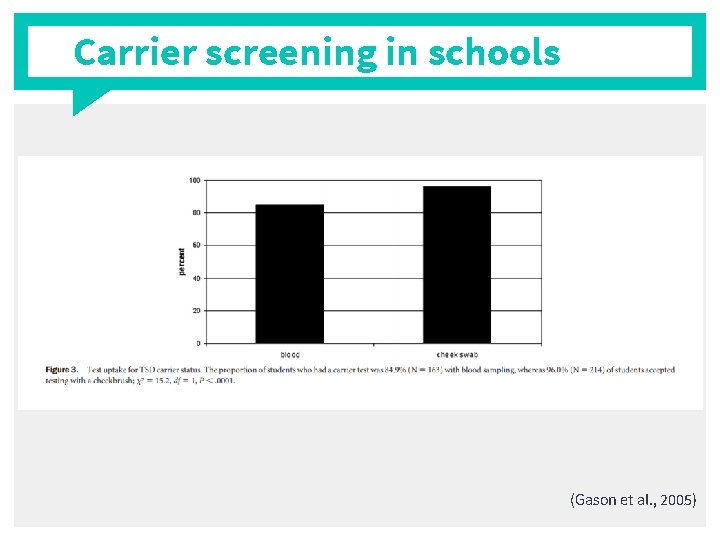
Carrier screening in schools (Gason et al. , 2005)
TREATMENT Treatment aimed at relieving symptoms
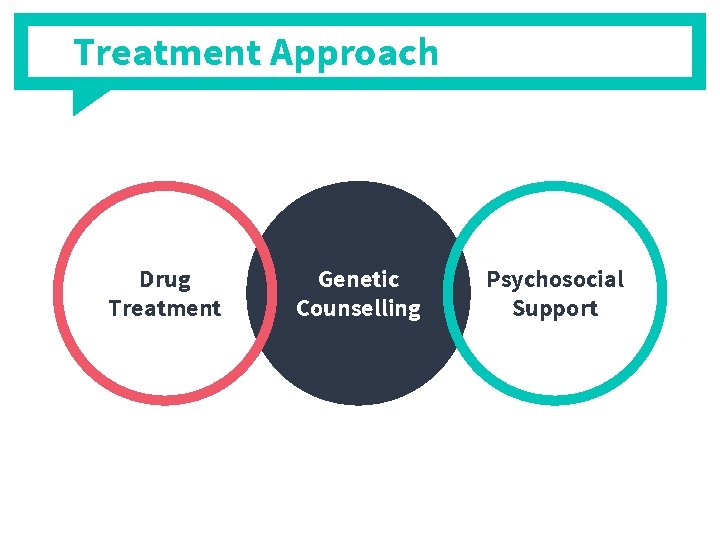
Treatment Approach Drug Treatment Genetic Counselling Psychosocial Support
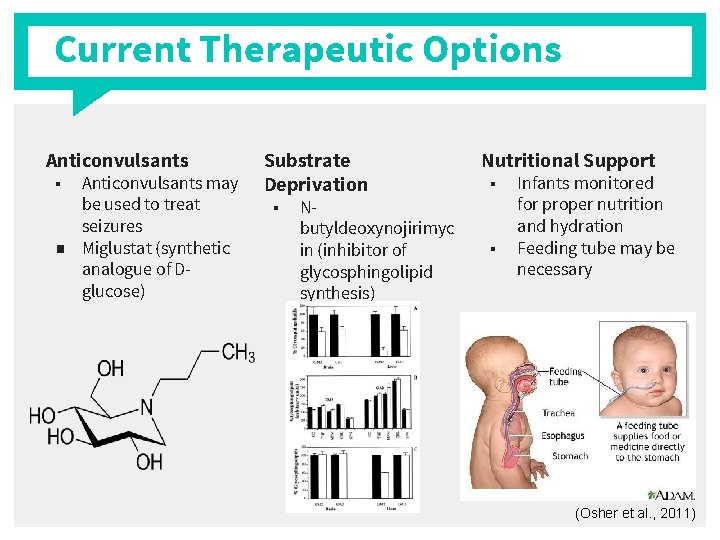
Current Therapeutic Options Anticonvulsants ■ Anticonvulsants may be used to treat seizures ■ Miglustat (synthetic analogue of Dglucose) Substrate Deprivation ■ Nbutyldeoxynojirimyc in (inhibitor of glycosphingolipid synthesis) Nutritional Support ■ ■ Infants monitored for proper nutrition and hydration Feeding tube may be necessary (Osher et al. , 2011)
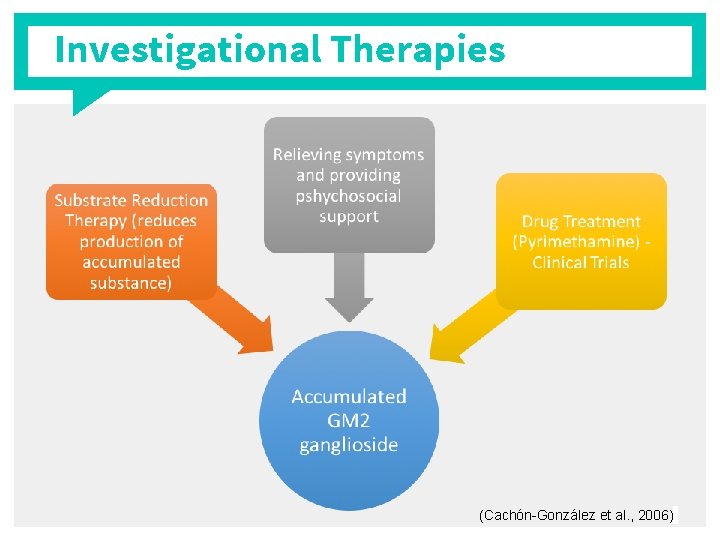
Investigational Therapies (Cachón-González et al. , 2006)
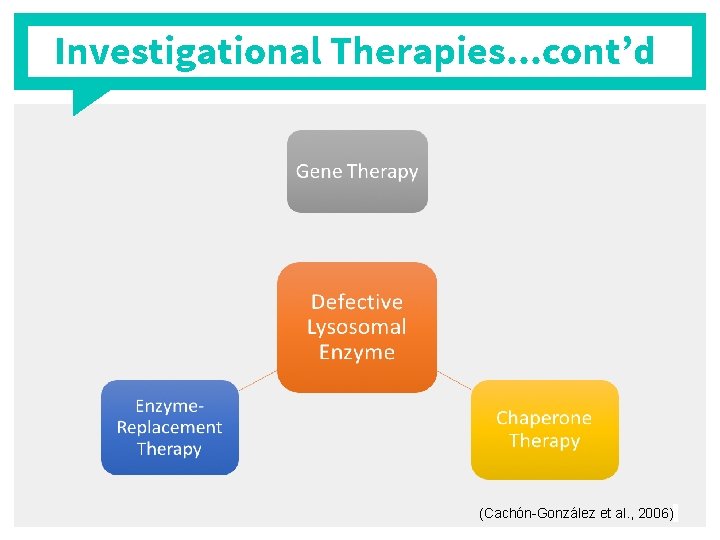
Investigational Therapies. . . cont’d (Cachón-González et al. , 2006)
Conclusion What can we do moving forward?
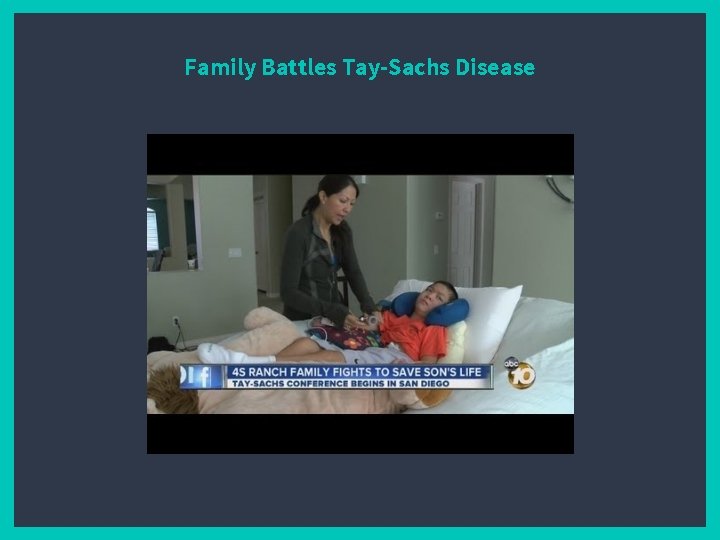
Family Battles Tay-Sachs Disease
National Tay-Sachs & Allied Diseases Association 4 key areas of focus: ● Education ● Advocacy ● Research ● Family Services (NTSAD, n. a. )
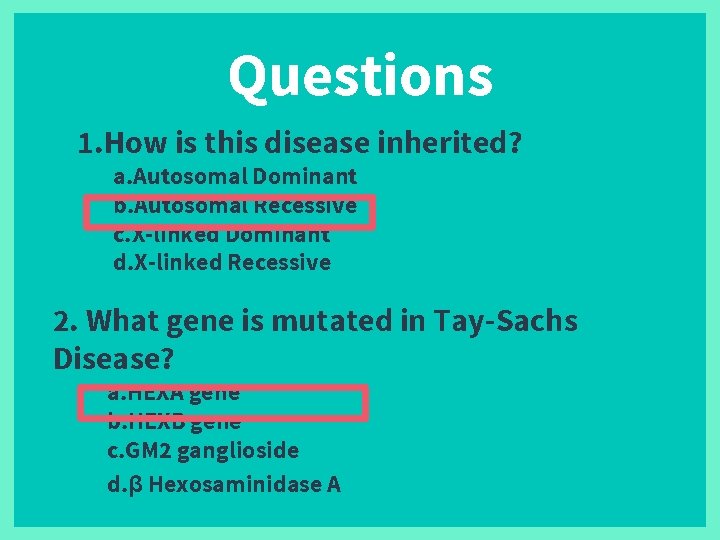
Questions 1. How is this disease inherited? a. Autosomal Dominant b. Autosomal Recessive c. X-linked Dominant d. X-linked Recessive 2. What gene is mutated in Tay-Sachs Disease? a. HEXA gene b. HEXB gene c. GM 2 ganglioside d. β Hexosaminidase A

Thanks! Any questions?
References About NTSAD. (n. d. ). Retrieved from https: //www. ntsad. org/index. php/about Chakravarti, A. and Chakraborty R. (1978). Elevated frequency of Tay-Sachs disease among Ashkenazic Jews unlikely by genetic drift alone. Am J Hum Genet, 30(3): 256 -261. https: //www. ncbi. nlm. nih. gov/pmc/articles/PMC 1685578/ Cachón-González, M. B. , Wang, S. Z. , Lynch, A. , Ziegler, R. , Cheng, S. H. , & Cox, T. M. (2006). Effective gene therapy in an authentic model of Tay-Sachs-related diseases. Proceedings of the National Academy of Sciences , 103(27), 10373 -10378. Frisch, A. et. al. (2004). Origin and spread of the 1278 ins. TATC mutation causing Tay-Sachs disease in Ashkenazi Jews: genetic drift as a robust and parsimonious hypothesis. Human Genetics, 114 (4): 366 -376. Doi 10. 1007/s 00439 -003 -1072 -8 http: //link. springer. com/article/10. 1007%2 Fs 00439 -003 -1072 -8 Gason, A. A. , Metcalfe, S. A. , Delatycki, M. B. , Petrou, V. , Sheffield, E. , Bankier, A. , & Aitken, M. (2005). Tay Sachs disease carrier screening in schools: educational alternatives and cheekbrush sampling. Genetics in Medicine, 7(9), 626 -632. GHR. (2012). Tay-Sachs disease - Genetics Home Reference. Retrieved March 05, 2017, from https: //ghr. nlm. nih. gov/condition/tay-sachs-disease#diagnosis Jeyakumar, M. , Butters, T. D. , Cortina-Borja, M. , Hunnam, V. , Proia, R. L. , Perry, V. H. , . . . & Platt, F. M. (1999). Delayed symptom onset and increased life expectancy in Sandhoff disease mice treated with N-butyldeoxynojirimycin. Proceedings of the National Academy of Sciences , 96(11), 6388 -6393. Koeslag, J. H. and Schach, S. R. (1984), Tay–Sachs disease and the role of reproductive compensation in the maintenance of ethnic variations in the incidence of autosomal recessive disease. Annals of Human Genetics, 48: 275– 281. doi: 10. 1111/j. 1469 -1809. 1984. tb 01025. x Learning About Tay-Sachs Disease. (2011, March 17). Retrieved from https: //www. genome. gov/10001220/learning-about-taysachs-disease/ Lew, R. M. , Burnett, L. , Proos, A. L. , Barlow ‐Stewart, K. , Delatycki, M. B. , Bankier, A. , … & Fietz, M. (2015). Ashkenazi Jewish population screening for Tay–Sachs disease: The International and Australian experience. Journal of paediatrics and child health, 51(3), 271 -279. NORD. (2016). Tay Sachs Disease. Retrieved March 05, 2017, from https: //rarediseases. org/rare-diseases/tay-sachs-disease/ Osher, E. , Fattal-Valevski, A. , Sagie, L. , Urshanski, N. , Amir-Levi, Y. , Katzburg, S. , . . . & Navon, R. (2011). Pyrimethamine increases β-hexosaminidase A activity in patients with Late Onset Tay Sachs. Molecular genetics and metabolism, 102(3), 356 -363. Tay Sachs disease (2017). Genetics Home Reference. https: //ghr. nlm. nih. gov/condition/tay-sachs-disease Tay Sachs Disease. (n. d. ). Retrieved from https: //rarediseases. org/rare-diseases/tay-sachs-disease/
- Slides: 34