
TAXSCAPES A Journey of Ideas Insights in a


- Slides: 48
TAXSCAPES A Journey of Ideas & Insights in a Challenging Tax World 2015 Issues Forum May 14 -15, 2015
FORTIFY Taxes & Infrastructure Moderators: Katharine Mottley, American Council of Engineering Companies/ Ashley Wilson, U. S. Chamber of Commerce Panelists: Alex Hergott, Deputy Staff Director at Senate Environment & Public Works Committee Nick Wyatt, Professional Tax Staff, Senate Finance Majority Staff Victoria Glover, Legislative Assistant, Senator Dean Heller (R-NV) Brian Appel, Legislative Director, Senator Mike Bennet (D-CO)
CUSTOMIZE Small Business & Tax Reform Moderator: Dorothy Coleman, National Association of Manufacturers Panelists: Beth Bell, Tax Counsel, Senator Ben Cardin (D-MD) Melissa Bonicelli, Venn Strategies Katherine Breaks, KPMG
CUSTOMIZE Small Business & Tax Reform Moderator: Dorothy Coleman, National Association of Manufacturers Panelists: Beth Bell, Tax Counsel, Senator Ben Cardin (D-MD) Melissa Bonicelli, Venn Strategies Katherine Breaks, KPMG
Tax Reform and Small Business Issues Forum Katherine M, Breaks Tax Managing Director Washington National Tax Washington, DC May 14, 2015
Notice The following information is not intended to be “written advice concerning one or more Federal tax matters” subject to the requirements of section 10. 37(a)(2) of Treasury Department Circular 230. You (and your employees, representatives, or agents) may disclose to any and all persons, without limitation, the tax treatment or tax structure, or both, of any transaction described in the associated materials we provide to you, including, but not limited to, any tax opinions, memoranda, or other tax analyses contained in those materials. The information contained herein is of a general nature and based on authorities that are subject to change. Applicability of the information to specific situations should be determined through consultation with your tax adviser. © 2015 KPMG LLP, a Delaware limited liability partnership and the U. S. member firm of the KPMG network of independent member firms affiliated with KPMG International Cooperative (“KPMG International”), a Swiss entity. All rights reserved. 6
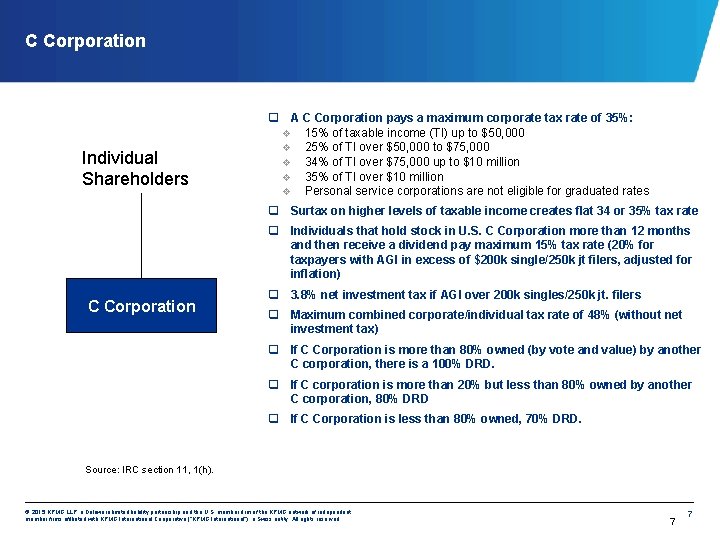
C Corporation Individual Shareholders q A C Corporation pays a maximum corporate tax rate of 35%: v 15% of taxable income (TI) up to $50, 000 v 25% of TI over $50, 000 to $75, 000 v 34% of TI over $75, 000 up to $10 million v 35% of TI over $10 million v Personal service corporations are not eligible for graduated rates q Surtax on higher levels of taxable income creates flat 34 or 35% tax rate q Individuals that hold stock in U. S. C Corporation more than 12 months and then receive a dividend pay maximum 15% tax rate (20% for taxpayers with AGI in excess of $200 k single/250 k jt filers, adjusted for inflation) C Corporation q 3. 8% net investment tax if AGI over 200 k singles/250 k jt. filers q Maximum combined corporate/individual tax rate of 48% (without net investment tax) q If C Corporation is more than 80% owned (by vote and value) by another C corporation, there is a 100% DRD. q If C corporation is more than 20% but less than 80% owned by another C corporation, 80% DRD q If C Corporation is less than 80% owned, 70% DRD. Source: IRC section 11, 1(h). © 2015 KPMG LLP, a Delaware limited liability partnership and the U. S. member firm of the KPMG network of independent member firms affiliated with KPMG International Cooperative (“KPMG International”), a Swiss entity. All rights reserved. 7 7
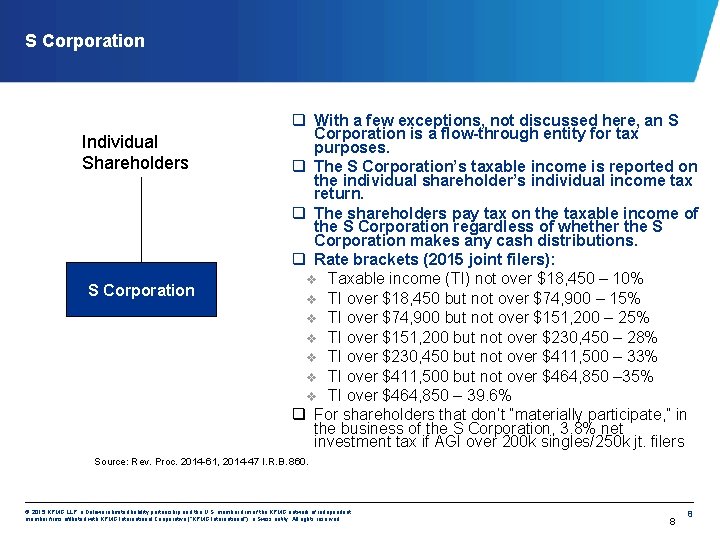
S Corporation Individual Shareholders S Corporation q With a few exceptions, not discussed here, an S Corporation is a flow-through entity for tax purposes. q The S Corporation’s taxable income is reported on the individual shareholder’s individual income tax return. q The shareholders pay tax on the taxable income of the S Corporation regardless of whether the S Corporation makes any cash distributions. q Rate brackets (2015 joint filers): v Taxable income (TI) not over $18, 450 – 10% v TI over $18, 450 but not over $74, 900 – 15% v TI over $74, 900 but not over $151, 200 – 25% v TI over $151, 200 but not over $230, 450 – 28% v TI over $230, 450 but not over $411, 500 – 33% v TI over $411, 500 but not over $464, 850 – 35% v TI over $464, 850 – 39. 6% q For shareholders that don’t “materially participate, ” in the business of the S Corporation, 3. 8% net investment tax if AGI over 200 k singles/250 k jt. filers Source: Rev. Proc. 2014 -61, 2014 -47 I. R. B. 860. © 2015 KPMG LLP, a Delaware limited liability partnership and the U. S. member firm of the KPMG network of independent member firms affiliated with KPMG International Cooperative (“KPMG International”), a Swiss entity. All rights reserved. 8 8
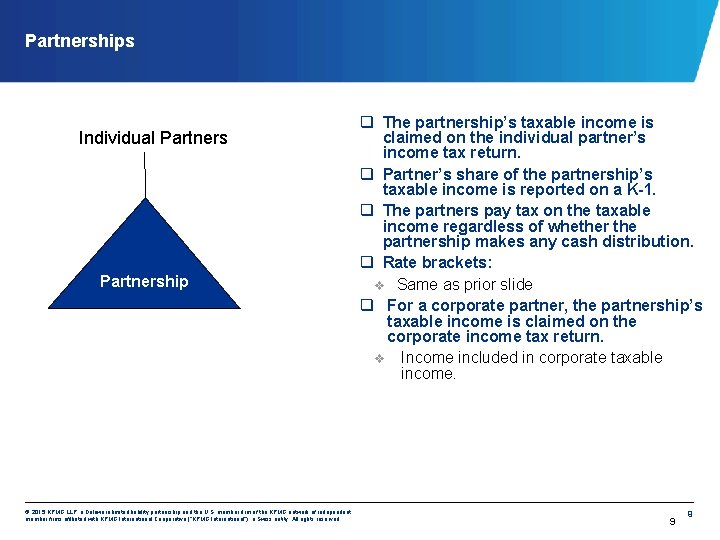
Partnerships Individual Partnership © 2015 KPMG LLP, a Delaware limited liability partnership and the U. S. member firm of the KPMG network of independent member firms affiliated with KPMG International Cooperative (“KPMG International”), a Swiss entity. All rights reserved. q The partnership’s taxable income is claimed on the individual partner’s income tax return. q Partner’s share of the partnership’s taxable income is reported on a K-1. q The partners pay tax on the taxable income regardless of whether the partnership makes any cash distribution. q Rate brackets: v Same as prior slide q For a corporate partner, the partnership’s taxable income is claimed on the corporate income tax return. v Income included in corporate taxable income. 9 9
Corporate tax reform q Baucus/Camp proposed to reduce the corporate tax rate by reducing or eliminating tax deductions and other benefits v Some of the larger revenue raisers: v Extend depreciable lives v Phaseout manufacturing deduction (Camp only) v Amortizing R&E expenses v Amortizing advertising expenses q Neither proposal recommended changes to individual tax rates q There have been a number of proposals offered to reduce the tax rate on business income reported on individual returns © 2015 KPMG LLP, a Delaware limited liability partnership and the U. S. member firm of the KPMG network of independent member firms affiliated with KPMG International Cooperative (“KPMG International”), a Swiss entity. All rights reserved. 10 10
Thank you Presentation by Katherine M. Breaks
• • © 2015 KPMG LLP, a Delaware limited liability partnership and the U. S. member firm of the KPMG network of independent member firms affiliated with KPMG International Cooperative (“KPMG International”), a Swiss entity. All rights reserved. The KPMG name, logo and “cutting through complexity” are registered trademarks or trademarks of KPMG International.
CENTER Moderator: Jodi Knauer, Bula Wellness
IMAGINE The Challenges of Entrepreneurship Moderator: Anne Canfield, President, Canfield & Associates; Managing Director, Canfield Press Panelists: Anjali Kataria, President, Mytonomy Amy Millman, President and Founder, Springboard Enterprises
RESOLVE Keynote Panel The United States Tax Court Moderator: Libby Coffin, United Technologies Panelists: Hon. Tamara Ashford, U. S. Tax Court Hon. Kathleen Kerrigan, U. S. Tax Court Hon. Cary Pugh, U. S. Tax Court
INFLUENCE Congressional Leadership Staff Moderator: Arshi Siddiqui, Akin Gump Panelists: Brendan Dunn, Policy Advisor and Counsel, Office of Senate Majority Leader, Mitch Mc. Connell (R-KY) Ellen Doneski, Chief Advisor on Tax and Economic Policy, Office of the Senate Minority Leader, Harry Reid (D-NV) Brad Bailey, Assistant to the Speaker for Policy, Office of House Speaker John Boehner (R-OH) Katherine Monge, Counsel, Office of the Democratic Leader Nancy Pelosi (D-CA)
REPLENISH Retirement Savings, Pensions & Investment Moderator: Barbara Pate, Davis & Harman Panelists: Mike Quickel, Senior Policy Advisor, Senator Mike Crapo (R-ID) Gideon Bragin, Legislative Assistant, Senator Sherrod Brown (D-OH)
TRAVERSE International Tax Moderator: Catherine Schultz, NFTC Panelists: Linda Evans, IBM Pam Olson, Pricewaterhouse. Coopers Barbara Angus, E&Y Anna Taylor, Tax Counsel, Sen. Chuck Schumer (DNY) Janet Boyd, Dow Chemical
Overview of international tax developments May 15, 2015 Pam Olson U. S. Deputy Tax Leader & WNTS Leader pam. olson@us. pwc. com Pw. C
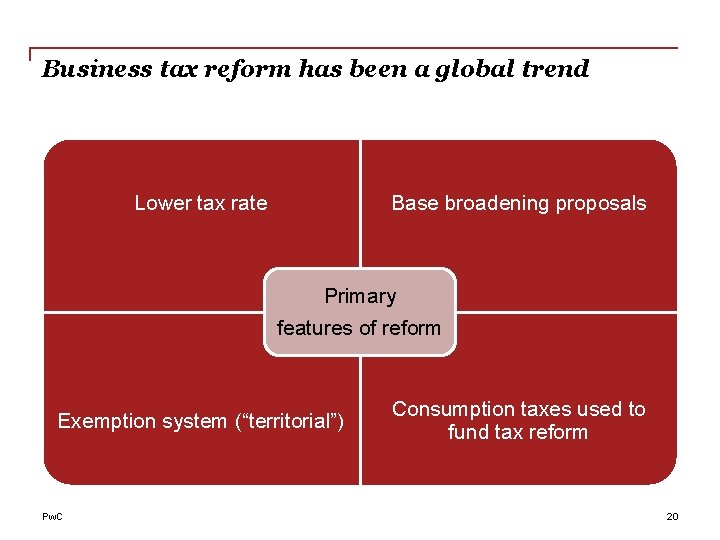
Business tax reform has been a global trend Lower tax rate Base broadening proposals Primary features of reform Exemption system (“territorial”) Pw. C Consumption taxes used to fund tax reform 20
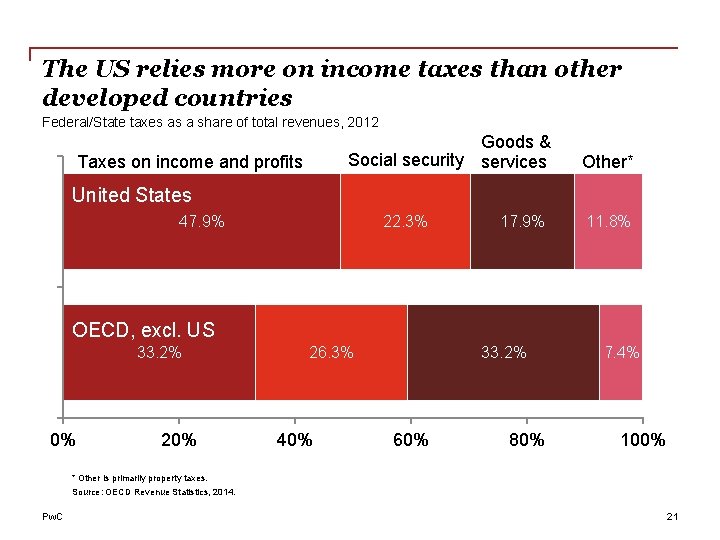
The US relies more on income taxes than other developed countries Federal/State taxes as a share of total revenues, 2012 Goods & Social security services Taxes on income and profits Other* United States 47. 9% 22. 3% 17. 9% 11. 8% OECD, excl. US 33. 2% 0% 26. 3% 40% 33. 2% 60% 80% 7. 4% 100% * Other is primarily property taxes. Source: OECD Revenue Statistics, 2014. Pw. C 21
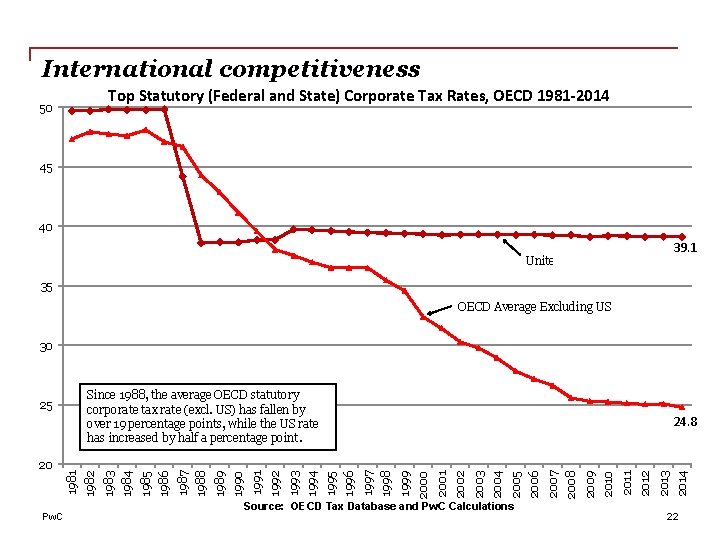
International competitiveness Top Statutory (Federal and State) Corporate Tax Rates, OECD 1981 -2014 50 45 40 39. 1 United States 35 OECD Average Excluding US 30 Pw. C 2014 2013 2012 2011 2010 2009 2007 2008 Source: OECD Tax Database and Pw. C Calculations 2006 2005 2004 2003 2002 2001 2000 1999 1998 1997 1996 24. 8 1995 1994 1993 1992 1991 1990 1989 1988 1987 1986 1985 1984 1983 1981 20 1982 Since 1988, the average OECD statutory corporate tax rate (excl. US) has fallen by over 19 percentage points, while the US rate has increased by half a percentage point. 25 22
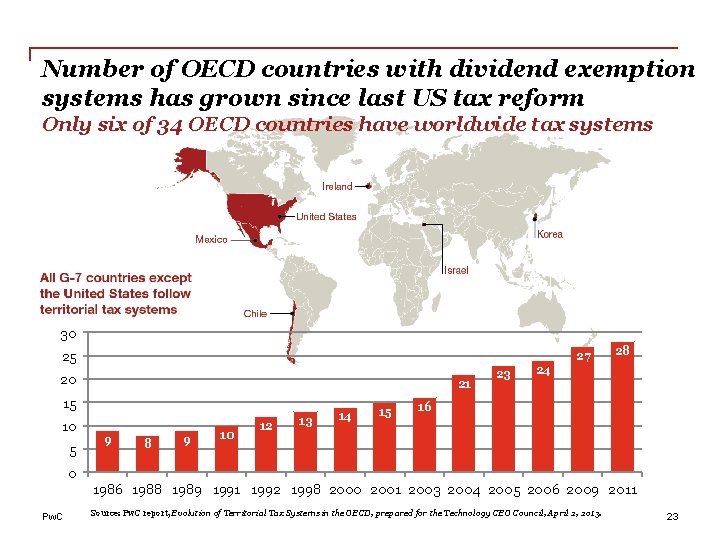
Number of OECD countries with dividend exemption systems has grown since last US tax reform Only six of 34 OECD countries have worldwide tax systems 30 25 27 20 21 15 10 5 9 8 9 10 12 13 14 15 23 28 24 16 0 1986 1988 1989 1991 1992 1998 2000 2001 2003 2004 2005 2006 2009 2011 Pw. C Source: Pw. C report, Evolution of Territorial Tax Systems in the OECD, prepared for the Technology CEO Council, April 2, 2013. 23
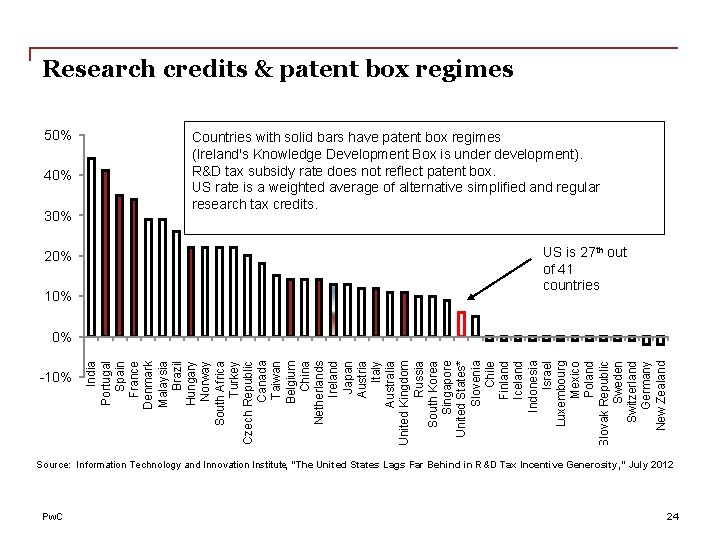
Research credits & patent box regimes 50% 40% 30% 20% 10% Countries with solid bars have patent box regimes (Ireland's Knowledge Development Box is under development). R&D tax subsidy rate does not reflect patent box. US rate is a weighted average of alternative simplified and regular research tax credits. US is 27 th out of 41 countries -10% India Portugal Spain France Denmark Malaysia Brazil Hungary Norway South Africa Turkey Czech Republic Canada Taiwan Belgium China Netherlands Ireland Japan Austria Italy Australia United Kingdom Russia South Korea Singapore United States* Slovenia Chile Finland Iceland Indonesia Israel Luxembourg Mexico Poland Slovak Republic Sweden Switzerland Germany New Zealand 0% Source: Information Technology and Innovation Institute, "The United States Lags Far Behind in R&D Tax Incentive Generosity, " July 2012 Pw. C 24
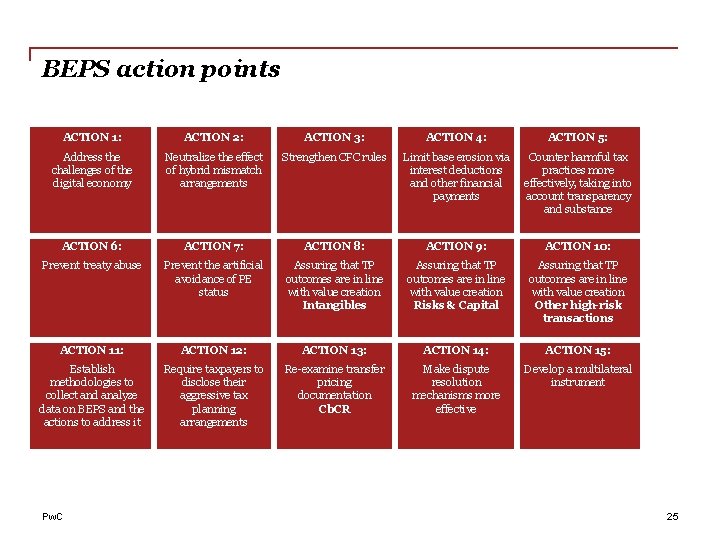
BEPS action points ACTION 1: ACTION 2: ACTION 3: ACTION 4: ACTION 5: Address the challenges of the digital economy Neutralize the effect of hybrid mismatch arrangements Strengthen CFC rules Limit base erosion via interest deductions and other financial payments Counter harmful tax practices more effectively, taking into account transparency and substance ACTION 6: ACTION 7: ACTION 8: ACTION 9: ACTION 10: Prevent treaty abuse Prevent the artificial avoidance of PE status Assuring that TP outcomes are in line with value creation Intangibles Assuring that TP outcomes are in line with value creation Risks & Capital Assuring that TP outcomes are in line with value creation Other high-risk transactions ACTION 11: ACTION 12: ACTION 13: ACTION 14: ACTION 15: Establish methodologies to collect and analyze data on BEPS and the actions to address it Require taxpayers to disclose their aggressive tax planning arrangements Re-examine transfer pricing documentation Cb. CR Make dispute resolution mechanisms more effective Develop a multilateral instrument Pw. C 25
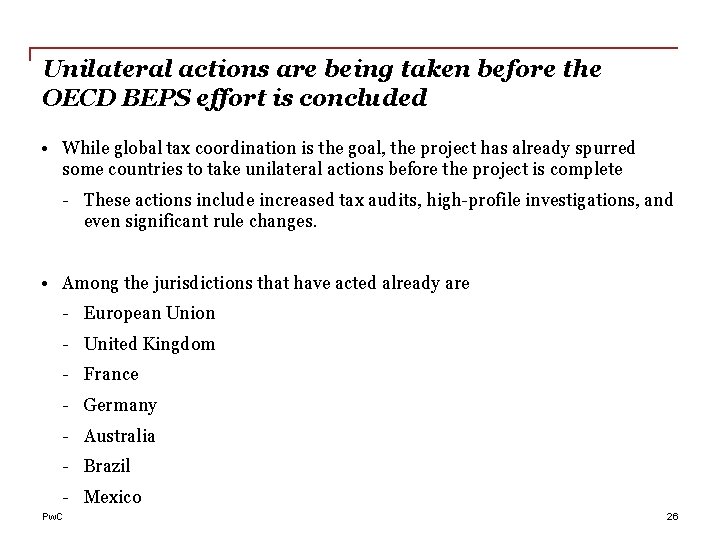
Unilateral actions are being taken before the OECD BEPS effort is concluded • While global tax coordination is the goal, the project has already spurred some countries to take unilateral actions before the project is complete - These actions include increased tax audits, high-profile investigations, and even significant rule changes. • Among the jurisdictions that have acted already are - European Union - United Kingdom - France - Germany - Australia - Brazil - Mexico Pw. C 26
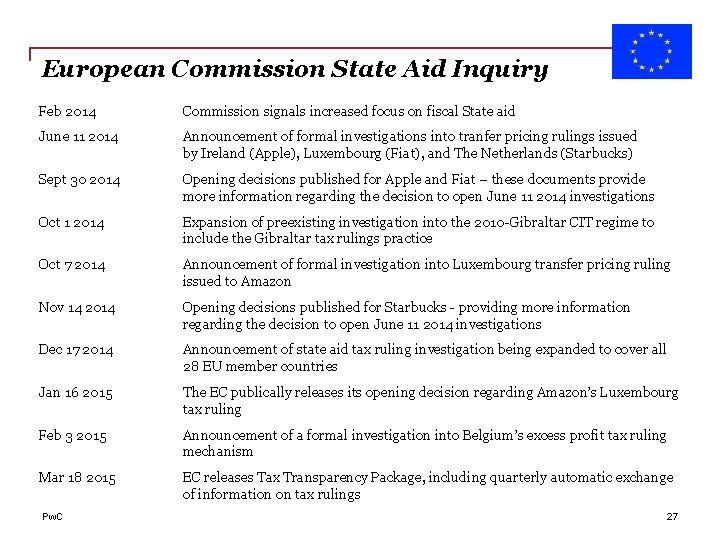
European Commission State Aid Inquiry Feb 2014 Commission signals increased focus on fiscal State aid June 11 2014 Announcement of formal investigations into tranfer pricing rulings issued by Ireland (Apple), Luxembourg (Fiat), and The Netherlands (Starbucks) Sept 30 2014 Opening decisions published for Apple and Fiat – these documents provide more information regarding the decision to open June 11 2014 investigations Oct 1 2014 Expansion of preexisting investigation into the 2010 -Gibraltar CIT regime to include the Gibraltar tax rulings practice Oct 7 2014 Announcement of formal investigation into Luxembourg transfer pricing ruling issued to Amazon Nov 14 2014 Opening decisions published for Starbucks - providing more information regarding the decision to open June 11 2014 investigations Dec 17 2014 Announcement of state aid tax ruling investigation being expanded to cover all 28 EU member countries Jan 16 2015 The EC publically releases its opening decision regarding Amazon’s Luxembourg tax ruling Feb 3 2015 Announcement of a formal investigation into Belgium’s excess profit tax ruling mechanism Mar 18 2015 EC releases Tax Transparency Package, including quarterly automatic exchange of information on tax rulings Pw. C 27
OECD BEPS project – Status, 2015 outlook, and next steps 15 May 2015
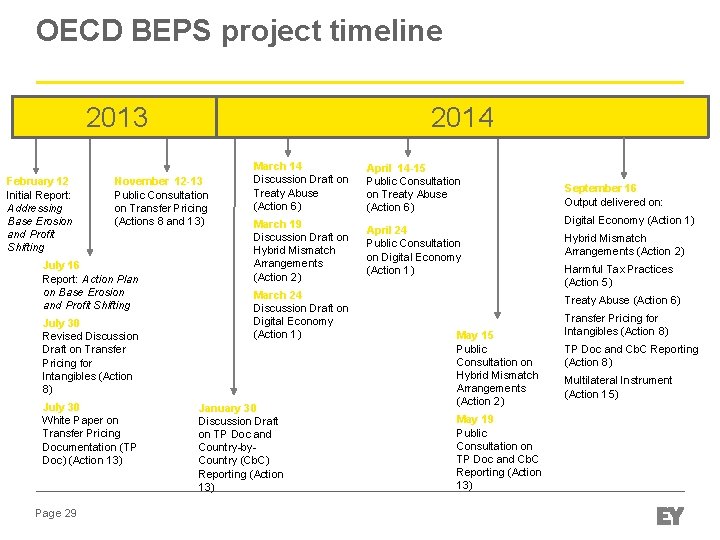
OECD BEPS project timeline 2013 February 12 Initial Report: Addressing Base Erosion and Profit Shifting November 12 -13 Public Consultation on Transfer Pricing (Actions 8 and 13) July 16 Report: Action Plan on Base Erosion and Profit Shifting July 30 Revised Discussion Draft on Transfer Pricing for Intangibles (Action 8) July 30 White Paper on Transfer Pricing Documentation (TP Doc) (Action 13) Page 29 2014 March 14 Discussion Draft on Treaty Abuse (Action 6) April 14 -15 Public Consultation on Treaty Abuse (Action 6) March 19 Discussion Draft on Hybrid Mismatch Arrangements (Action 2) April 24 Public Consultation on Digital Economy (Action 1) March 24 Discussion Draft on Digital Economy (Action 1) January 30 Discussion Draft on TP Doc and Country-by. Country (Cb. C) Reporting (Action 13) September 16 Output delivered on: Digital Economy (Action 1) Hybrid Mismatch Arrangements (Action 2) Harmful Tax Practices (Action 5) Treaty Abuse (Action 6) May 15 Public Consultation on Hybrid Mismatch Arrangements (Action 2) May 19 Public Consultation on TP Doc and Cb. C Reporting (Action 13) Transfer Pricing for Intangibles (Action 8) TP Doc and Cb. C Reporting (Action 8) Multilateral Instrument (Action 15)
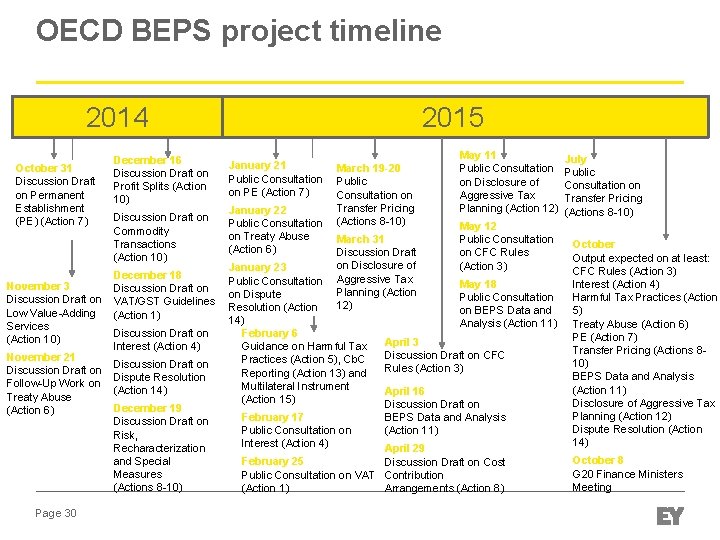
OECD BEPS project timeline 2014 October 31 Discussion Draft on Permanent Establishment (PE) (Action 7) November 3 Discussion Draft on Low Value-Adding Services (Action 10) November 21 Discussion Draft on Follow-Up Work on Treaty Abuse (Action 6) Page 30 December 16 Discussion Draft on Profit Splits (Action 10) Discussion Draft on Commodity Transactions (Action 10) December 18 Discussion Draft on VAT/GST Guidelines (Action 1) Discussion Draft on Interest (Action 4) Discussion Draft on Dispute Resolution (Action 14) December 19 Discussion Draft on Risk, Recharacterization and Special Measures (Actions 8 -10) 2015 January 21 Public Consultation on PE (Action 7) January 22 Public Consultation on Treaty Abuse (Action 6) March 19 -20 Public Consultation on Transfer Pricing (Actions 8 -10) March 31 Discussion Draft on Disclosure of Aggressive Tax Planning (Action 12) January 23 Public Consultation on Dispute Resolution (Action 14) February 6 Guidance on Harmful Tax Practices (Action 5), Cb. C Reporting (Action 13) and Multilateral Instrument (Action 15) February 17 Public Consultation on Interest (Action 4) May 11 Public Consultation on Disclosure of Aggressive Tax Planning (Action 12) May 12 Public Consultation on CFC Rules (Action 3) May 18 Public Consultation on BEPS Data and Analysis (Action 11) April 3 Discussion Draft on CFC Rules (Action 3) April 16 Discussion Draft on BEPS Data and Analysis (Action 11) April 29 February 25 Discussion Draft on Cost Public Consultation on VAT Contribution (Action 1) Arrangements (Action 8) July Public Consultation on Transfer Pricing (Actions 8 -10) October Output expected on at least: CFC Rules (Action 3) Interest (Action 4) Harmful Tax Practices (Action 5) Treaty Abuse (Action 6) PE (Action 7) Transfer Pricing (Actions 810) BEPS Data and Analysis (Action 11) Disclosure of Aggressive Tax Planning (Action 12) Dispute Resolution (Action 14) October 8 G 20 Finance Ministers Meeting
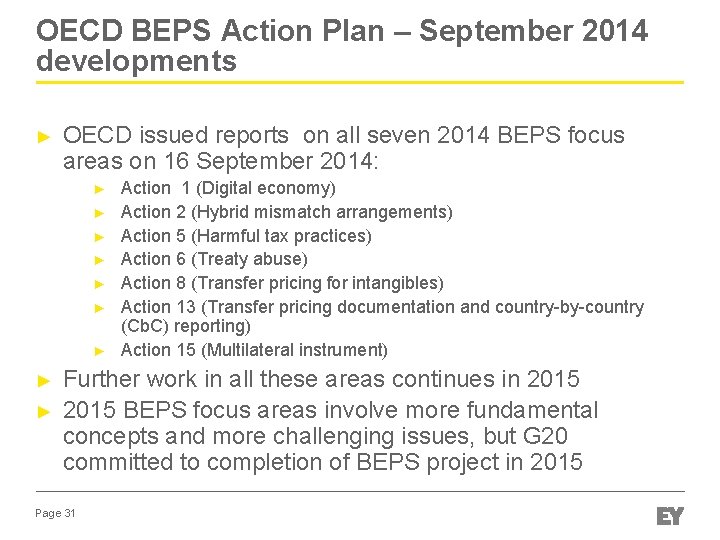
OECD BEPS Action Plan – September 2014 developments ► OECD issued reports on all seven 2014 BEPS focus areas on 16 September 2014: ► ► ► ► ► Action 1 (Digital economy) Action 2 (Hybrid mismatch arrangements) Action 5 (Harmful tax practices) Action 6 (Treaty abuse) Action 8 (Transfer pricing for intangibles) Action 13 (Transfer pricing documentation and country-by-country (Cb. C) reporting) Action 15 (Multilateral instrument) Further work in all these areas continues in 2015 BEPS focus areas involve more fundamental concepts and more challenging issues, but G 20 committed to completion of BEPS project in 2015 Page 31
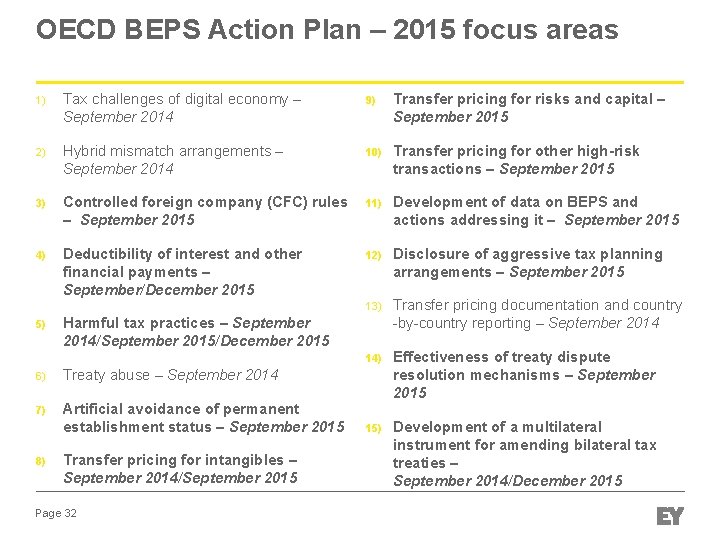
OECD BEPS Action Plan – 2015 focus areas 1) Tax challenges of digital economy – September 2014 9) Transfer pricing for risks and capital – September 2015 2) Hybrid mismatch arrangements – September 2014 10) Transfer pricing for other high-risk transactions – September 2015 3) Controlled foreign company (CFC) rules – September 2015 11) Development of data on BEPS and actions addressing it – September 2015 4) Deductibility of interest and other financial payments – September/December 2015 12) Disclosure of aggressive tax planning arrangements – September 2015 13) Transfer pricing documentation and country -by-country reporting – September 2014 14) Effectiveness of treaty dispute resolution mechanisms – September 2015 15) Development of a multilateral instrument for amending bilateral tax treaties – September 2014/December 2015 5) Harmful tax practices – September 2014/September 2015/December 2015 6) Treaty abuse – September 2014 7) Artificial avoidance of permanent establishment status – September 2015 8) Transfer pricing for intangibles – September 2014/September 2015 Page 32
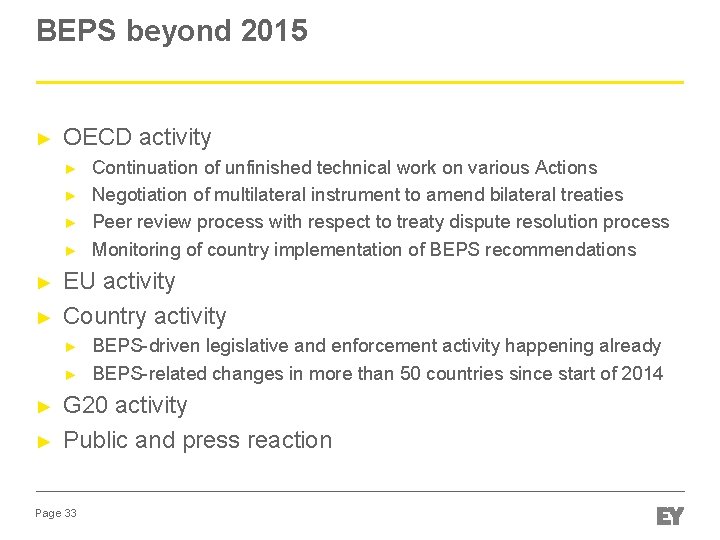
BEPS beyond 2015 ► OECD activity ► ► ► EU activity Country activity ► ► Continuation of unfinished technical work on various Actions Negotiation of multilateral instrument to amend bilateral treaties Peer review process with respect to treaty dispute resolution process Monitoring of country implementation of BEPS recommendations BEPS-driven legislative and enforcement activity happening already BEPS-related changes in more than 50 countries since start of 2014 G 20 activity Public and press reaction Page 33
Tax Coalition Issues Forum - International Tax Panel May 2015 Digital Global Tax Developments Linda Evans, Director Global Tax Policy © 2015 IBM Corporation
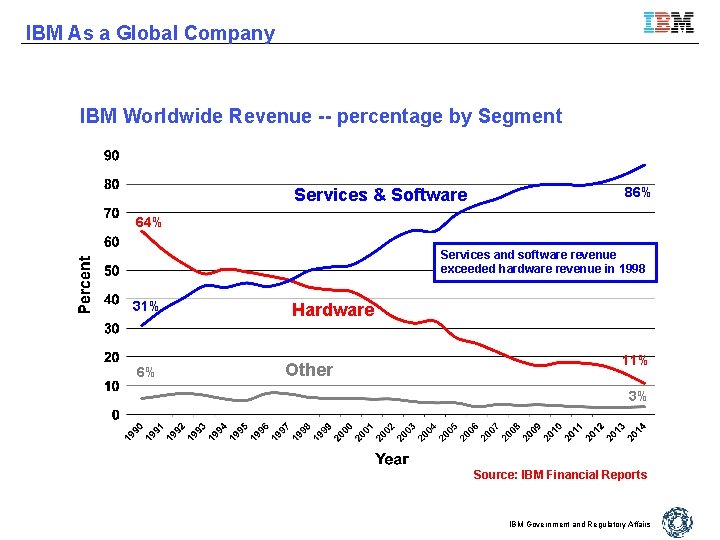
IBM As a Global Company IBM Worldwide Revenue -- percentage by Segment Services & Software 86% 64% Services and software revenue exceeded hardware revenue in 1998 31% 6% Hardware Other 11% 3% Source: IBM Financial Reports IBM Government and Regulatory Affairs
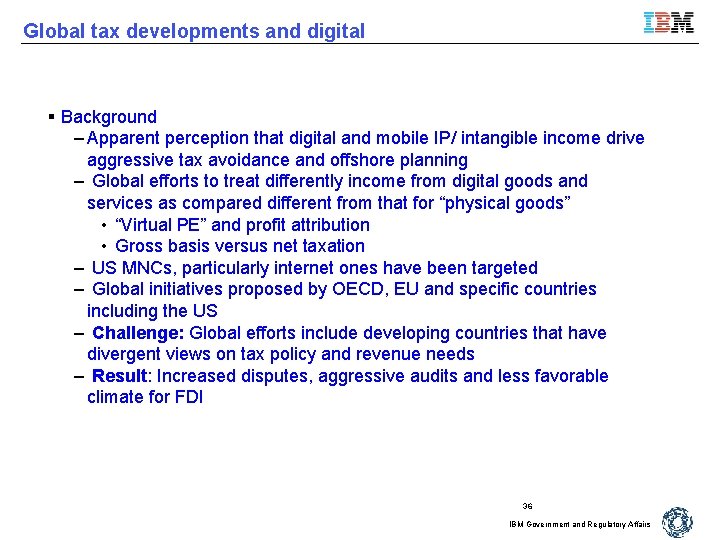
Global tax developments and digital § Background – Apparent perception that digital and mobile IP/ intangible income drive aggressive tax avoidance and offshore planning – Global efforts to treat differently income from digital goods and services as compared different from that for “physical goods” • “Virtual PE” and profit attribution • Gross basis versus net taxation – US MNCs, particularly internet ones have been targeted – Global initiatives proposed by OECD, EU and specific countries including the US – Challenge: Global efforts include developing countries that have divergent views on tax policy and revenue needs – Result: Increased disputes, aggressive audits and less favorable climate for FDI 36 IBM Government and Regulatory Affairs
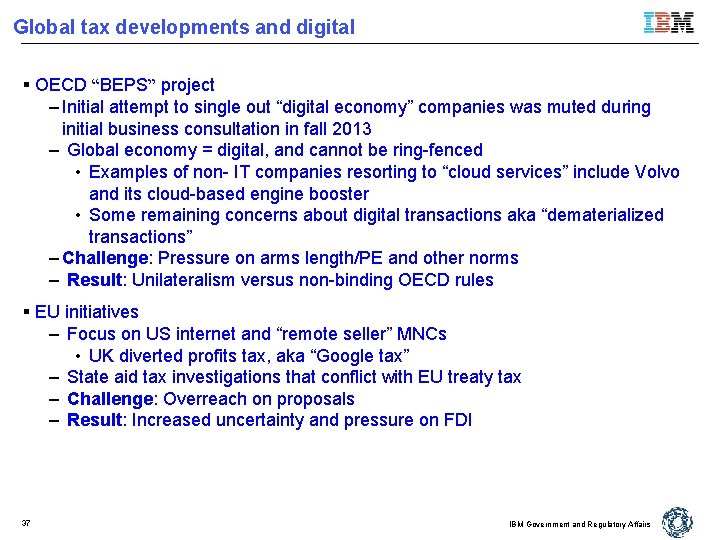
Global tax developments and digital § OECD “BEPS” project – Initial attempt to single out “digital economy” companies was muted during initial business consultation in fall 2013 – Global economy = digital, and cannot be ring-fenced • Examples of non- IT companies resorting to “cloud services” include Volvo and its cloud-based engine booster • Some remaining concerns about digital transactions aka “dematerialized transactions” – Challenge: Pressure on arms length/PE and other norms – Result: Unilateralism versus non-binding OECD rules § EU initiatives – Focus on US internet and “remote seller” MNCs • UK diverted profits tax, aka “Google tax” – State aid tax investigations that conflict with EU treaty tax – Challenge: Overreach on proposals – Result: Increased uncertainty and pressure on FDI 37 IBM Government and Regulatory Affairs
Global tax developments and digital § US developments – Obama 2015 and 2016 budgets create new category of taxable foreign digital income: • income from lease/sale of digital copyrighted article or digital services where foreign sub uses IP developed by related party unless in same country • digital copyrighted article includes software, as well as movies/books – But, there is no definition of digital § Issues: – Why is software on a disc different from software hosted on a server and accessed remotely = services – Services, whether digital or “traditional” are services – Digitally-based transactions mirror brick and mortar methods and tax treatment should not vary – Challenge: Unilateral action ahead of BEPS – Result: US MNCs are penalized/made even less competitive 38 IBM Government and Regulatory Affairs
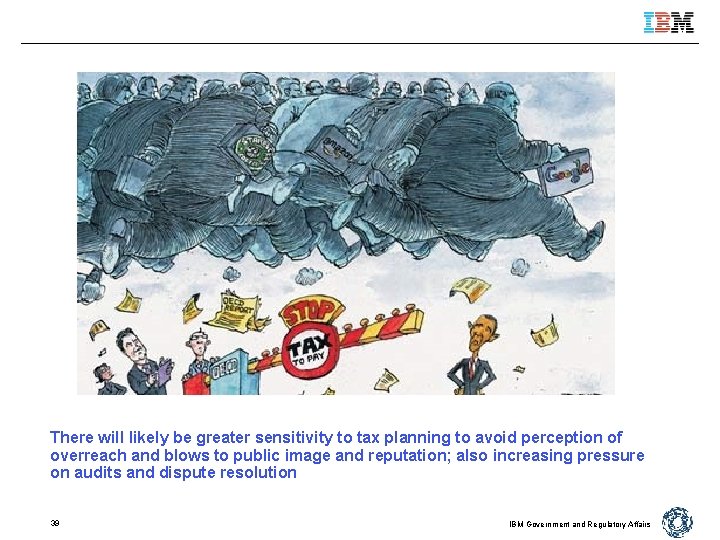
There will likely be greater sensitivity to tax planning to avoid perception of overreach and blows to public image and reputation; also increasing pressure on audits and dispute resolution 39 IBM Government and Regulatory Affairs
Global Tax Developments for Manufacturers Janet Boyd, Director of Government Relations and Legislative Council Tax Coalition Issues Forum International Tax Panel May 15, 2015 Page 40
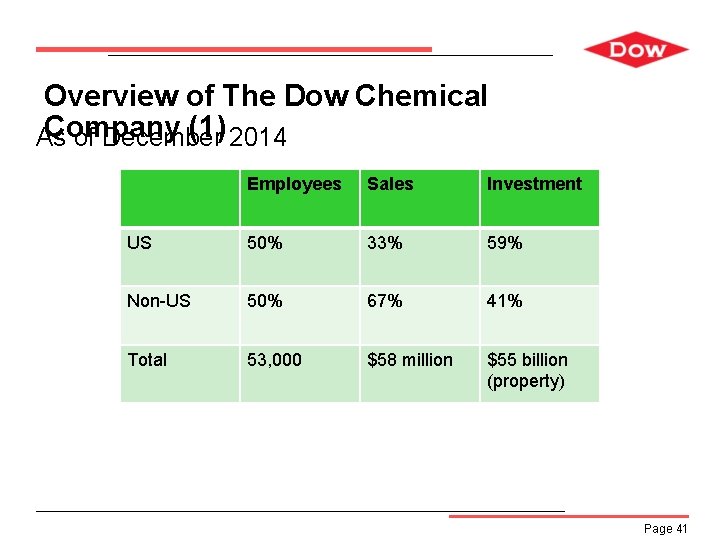
Overview of The Dow Chemical Company (1) 2014 As of December Employees Sales Investment US 50% 33% 59% Non-US 50% 67% 41% Total 53, 000 $58 million $55 billion (property) Page 41
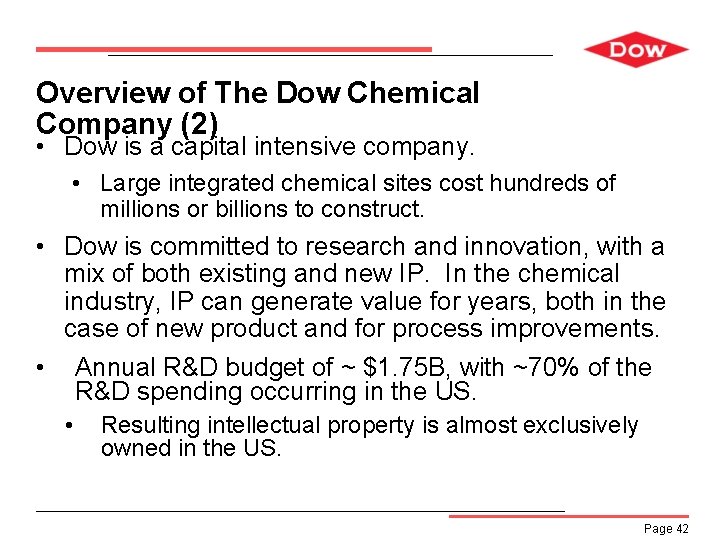
Overview of The Dow Chemical Company (2) • Dow is a capital intensive company. • Large integrated chemical sites cost hundreds of millions or billions to construct. • Dow is committed to research and innovation, with a mix of both existing and new IP. In the chemical industry, IP can generate value for years, both in the case of new product and for process improvements. • Annual R&D budget of ~ $1. 75 B, with ~70% of the R&D spending occurring in the US. • Resulting intellectual property is almost exclusively owned in the US. DOW CONFIDENTIAL - Do not share without permission Page 42
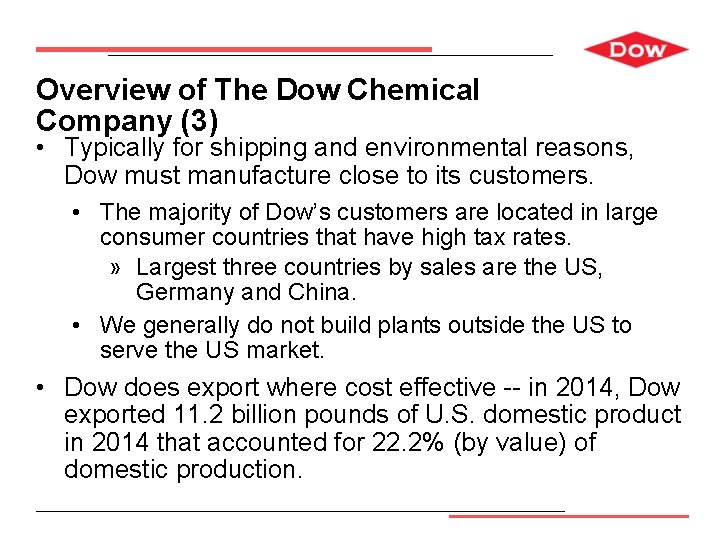
Overview of The Dow Chemical Company (3) • Typically for shipping and environmental reasons, Dow must manufacture close to its customers. • The majority of Dow’s customers are located in large consumer countries that have high tax rates. » Largest three countries by sales are the US, Germany and China. • We generally do not build plants outside the US to serve the US market. • Dow does export where cost effective -- in 2014, Dow exported 11. 2 billion pounds of U. S. domestic product in 2014 that accounted for 22. 2% (by value) of domestic production. DOW CONFIDENTIAL - Do not share without permission Page 43
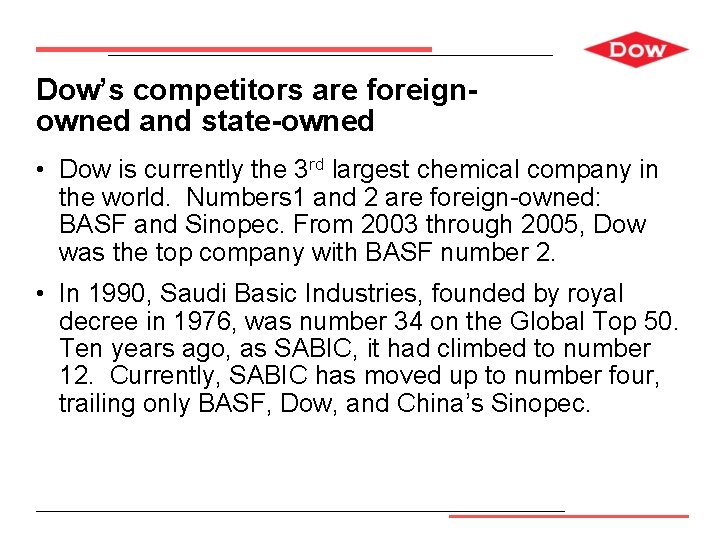
Dow’s competitors are foreignowned and state-owned • Dow is currently the 3 rd largest chemical company in the world. Numbers 1 and 2 are foreign-owned: BASF and Sinopec. From 2003 through 2005, Dow was the top company with BASF number 2. • In 1990, Saudi Basic Industries, founded by royal decree in 1976, was number 34 on the Global Top 50. Ten years ago, as SABIC, it had climbed to number 12. Currently, SABIC has moved up to number four, trailing only BASF, Dow, and China’s Sinopec. DOW CONFIDENTIAL - Do not share without permission Page 44
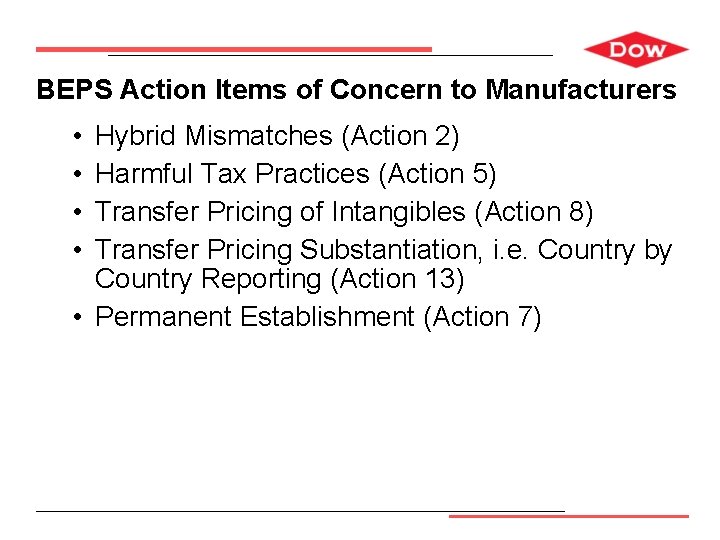
BEPS Action Items of Concern to Manufacturers • • Hybrid Mismatches (Action 2) Harmful Tax Practices (Action 5) Transfer Pricing of Intangibles (Action 8) Transfer Pricing Substantiation, i. e. Country by Country Reporting (Action 13) • Permanent Establishment (Action 7) Page 45
BEPS Action Items of Concern to Manufacturers • One-off, conflicting implementation efforts • Lack of adequate dispute resolution capability, particularly in developing countries • For US based companies, the inability of US to pass legislation to ensure competitive positioning • Reporting requirements that could give business sensitive, confidential information to competitors and NGOs • Undercutting of traditional notions of transfer pricing • Conflicting rules on interest deductions Page 46
ENERGIZE Keynote Speaker Olga Hartwell, Senior Vice President & Tax Director, GE Introduction by Lisa Wolski, GE
THANK YOU!!