
Taxonomy The science of naming organisms Why Classify


- Slides: 32
Taxonomy The science of naming organisms.
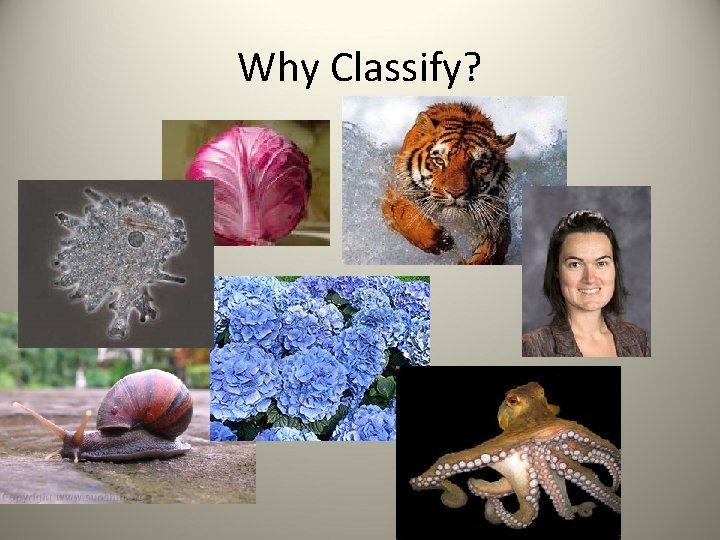
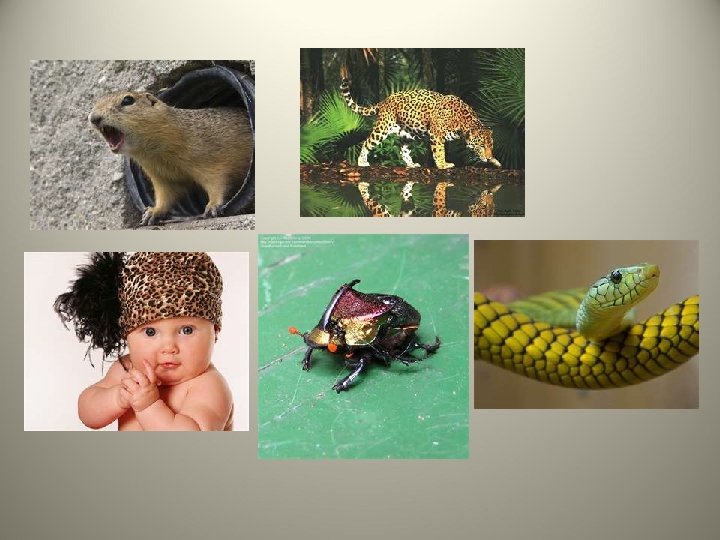
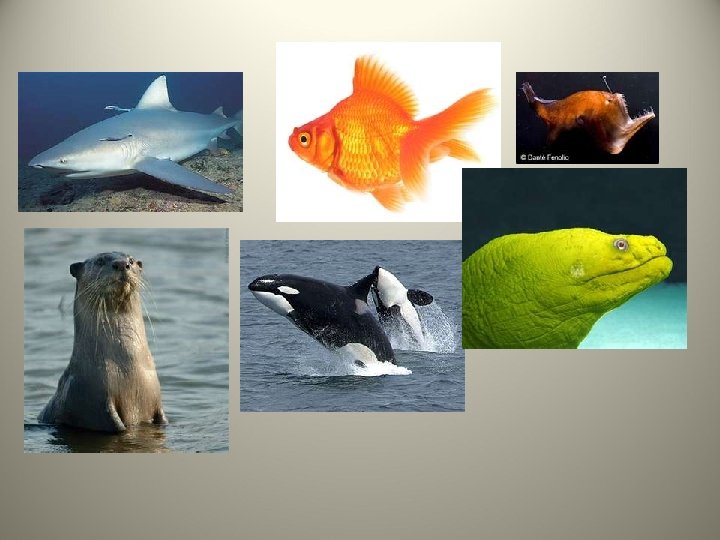
Why Classify?
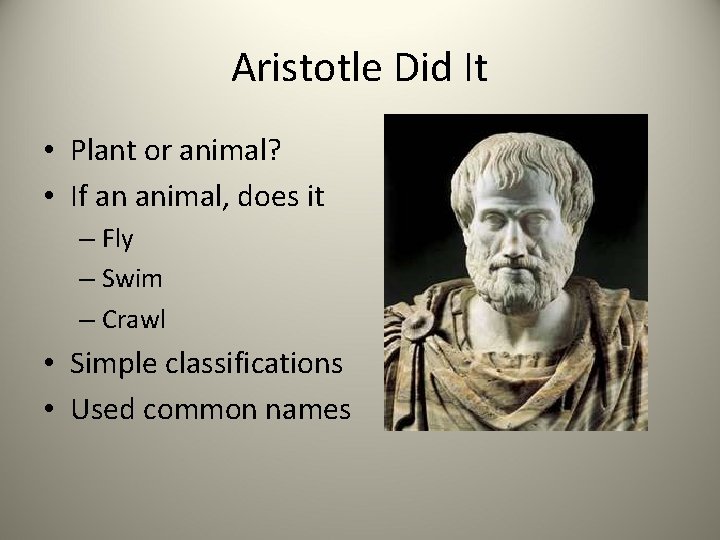
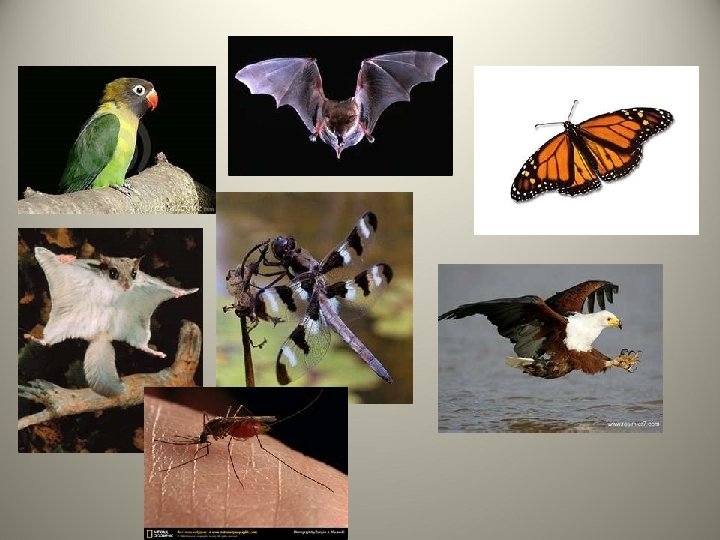
Aristotle Did It • Plant or animal? • If an animal, does it – Fly – Swim – Crawl • Simple classifications • Used common names
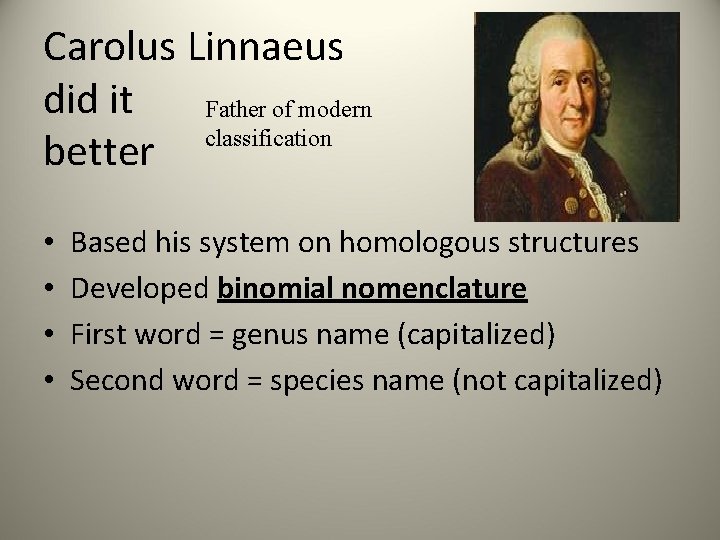
Carolus Linnaeus did it Father of modern classification better • • Based his system on homologous structures Developed binomial nomenclature First word = genus name (capitalized) Second word = species name (not capitalized)
Why binomial nomenclature? • Much easier than a 10+ word name under old “polynomial system” • Same no matter where you go • Less confusion • Names used to be… “Oak with deeply divided leaves that have no hairs on their undersides and not teeth around their edges. ”
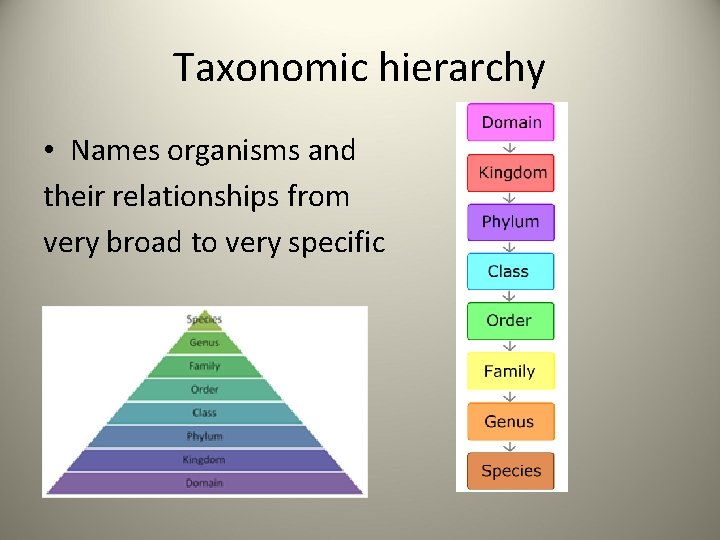
Taxonomic hierarchy • Names organisms and their relationships from very broad to very specific
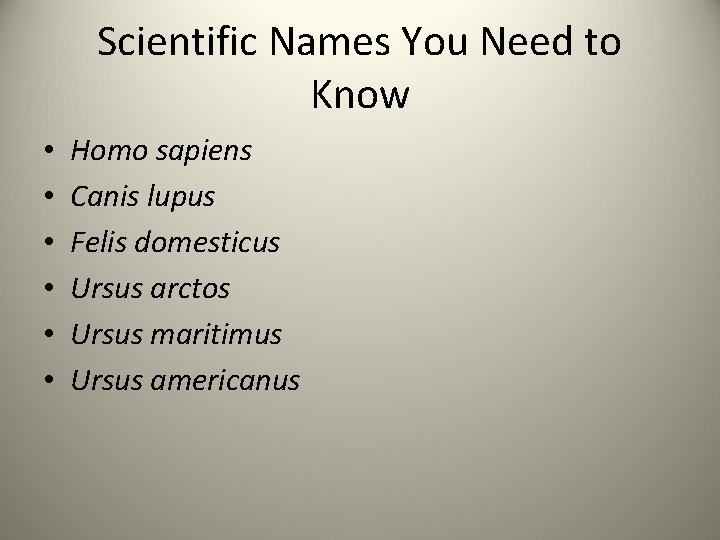
Scientific Names You Need to Know • • • Homo sapiens Canis lupus Felis domesticus Ursus arctos Ursus maritimus Ursus americanus
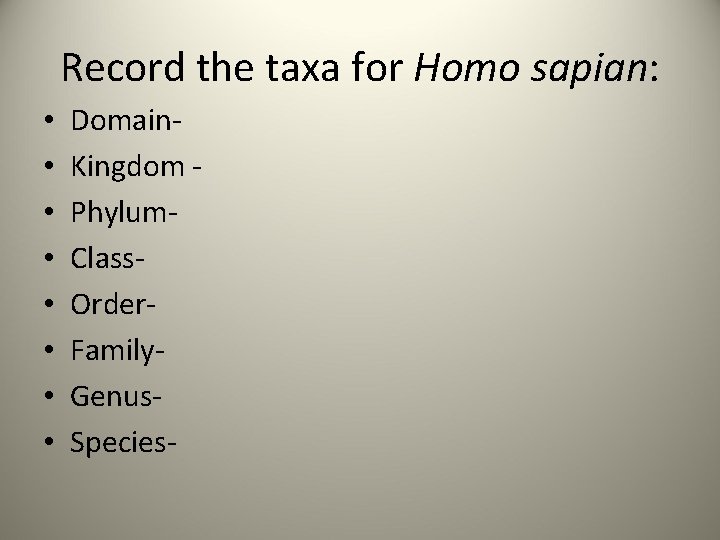
Record the taxa for Homo sapian: • • Domain. Kingdom Phylum. Class. Order. Family. Genus. Species-
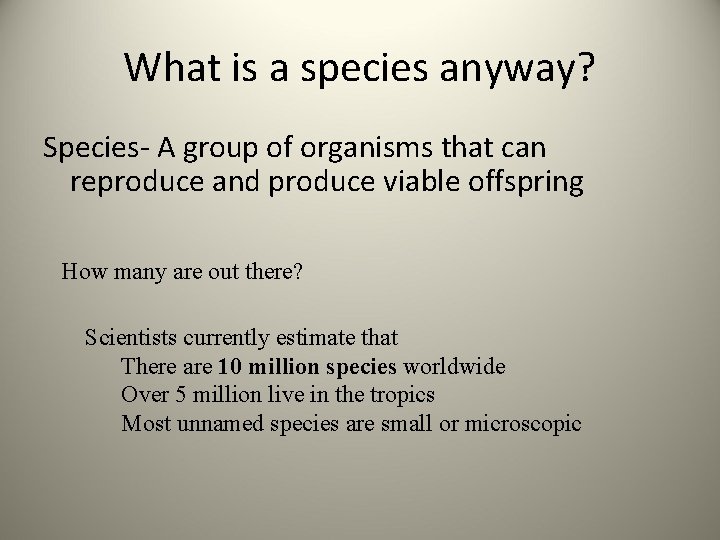
What is a species anyway? Species- A group of organisms that can reproduce and produce viable offspring How many are out there? Scientists currently estimate that There are 10 million species worldwide Over 5 million live in the tropics Most unnamed species are small or microscopic
Why is taxonomy useful? • Helps prevent confusion among scientists • Helps to show organisms are related • Can be used to reconstruct phylogenies – evolutionary histories – of an organism or group
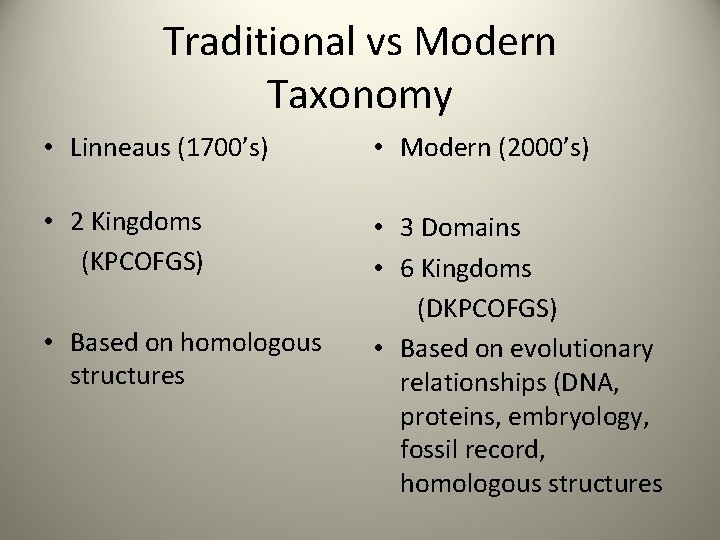
Traditional vs Modern Taxonomy • Linneaus (1700’s) • Modern (2000’s) • 2 Kingdoms (KPCOFGS) • 3 Domains • 6 Kingdoms (DKPCOFGS) • Based on evolutionary relationships (DNA, proteins, embryology, fossil record, homologous structures • Based on homologous structures
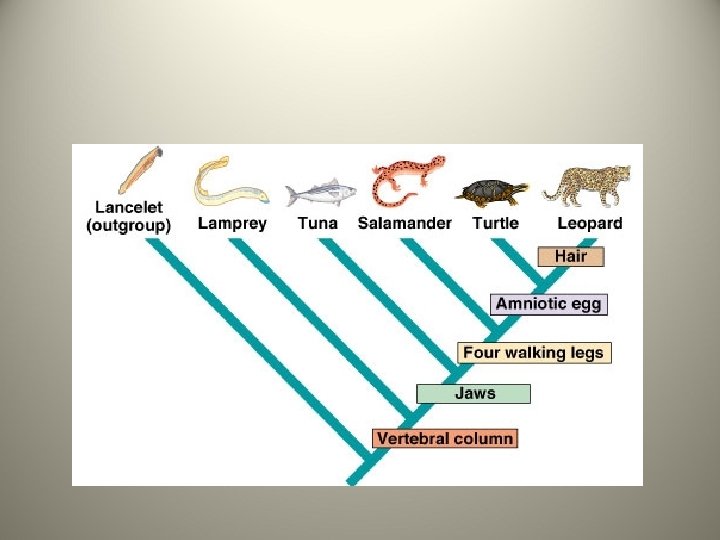
A note on cladograms Cladogram- diagram that show evolutionary relationships (phylogenies) • Graph showing when different groups diverged from a common ancestral line • Points where they diverge are often noted with a feature that was different between ancestral group and a “new” feature in the group that split off.
Bird Cladogram
Dichotomous Keys Important Things About Using A Dichotomous Key 1. Start at the beginning 2. Decide which of the two statements is best (READ BOTH STATEMENTS!!!)
Dichotomous Key Activity • Activity Objectives: • Create a dichotomous classification key to key out 8 individual conifer specimens • Name each specimen using proper punctuation and capitalization associated with binomial nomenclature.
Classification vs. Cladogram
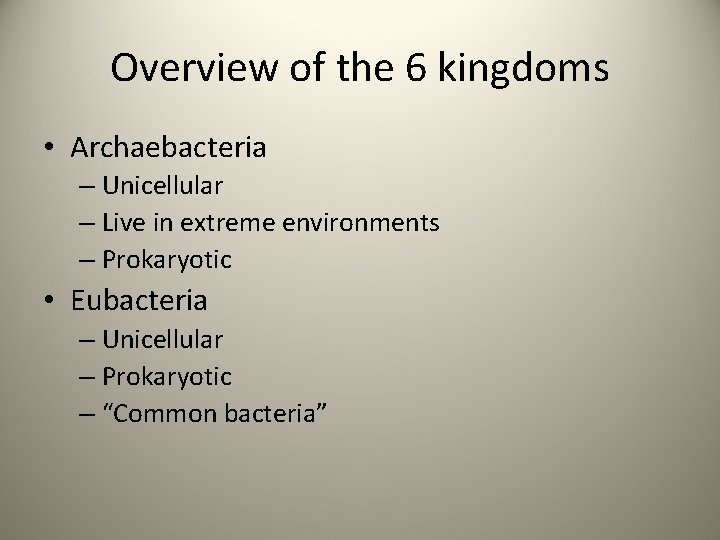
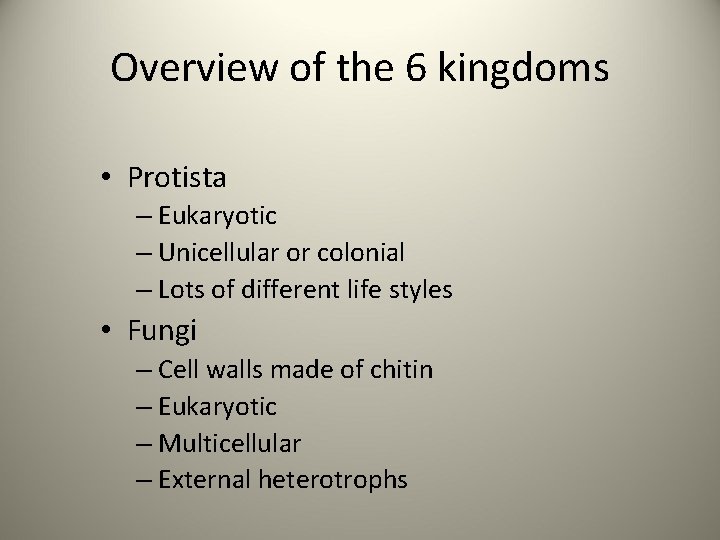
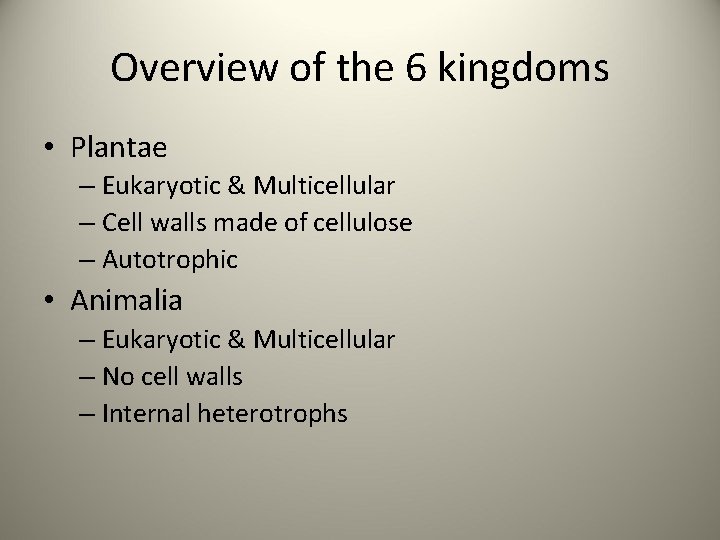
The 6 kingdoms • Bacteria - 1. Eubacteria • Archaea – 2. Archaebacteria • Eukaryotes – 3. Fungi – 4. Protista – 5. Animal – 6. Plantae
Overview of the 6 kingdoms • Archaebacteria – Unicellular – Live in extreme environments – Prokaryotic • Eubacteria – Unicellular – Prokaryotic – “Common bacteria”
Overview of the 6 kingdoms • Protista – Eukaryotic – Unicellular or colonial – Lots of different life styles • Fungi – Cell walls made of chitin – Eukaryotic – Multicellular – External heterotrophs
Overview of the 6 kingdoms • Plantae – Eukaryotic & Multicellular – Cell walls made of cellulose – Autotrophic • Animalia – Eukaryotic & Multicellular – No cell walls – Internal heterotrophs
Vocab to review • • • Taxonomy Classification Dom, King, Phyl, Class, Order, Family, Genus, Species Binomial Nomenclature Autotrophs/ Heterotrophs 6 Kingdoms. Eukaryotes/Prokaryote Dichotomous Key Cladogram
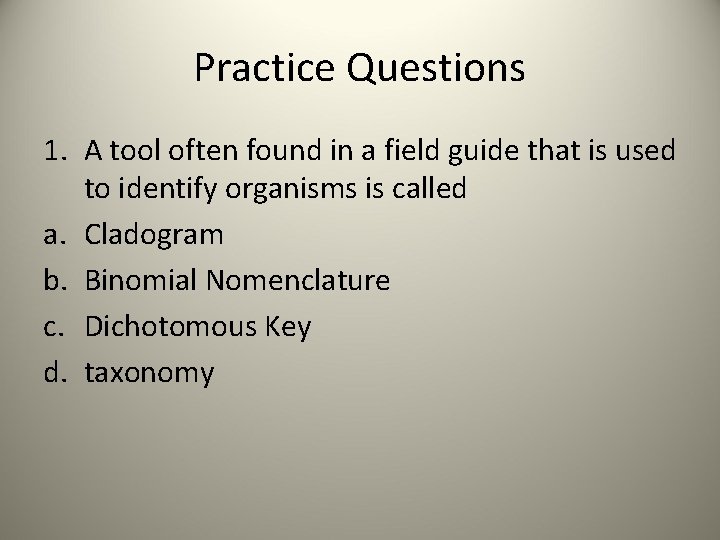
Practice Questions 1. A tool often found in a field guide that is used to identify organisms is called a. Cladogram b. Binomial Nomenclature c. Dichotomous Key d. taxonomy
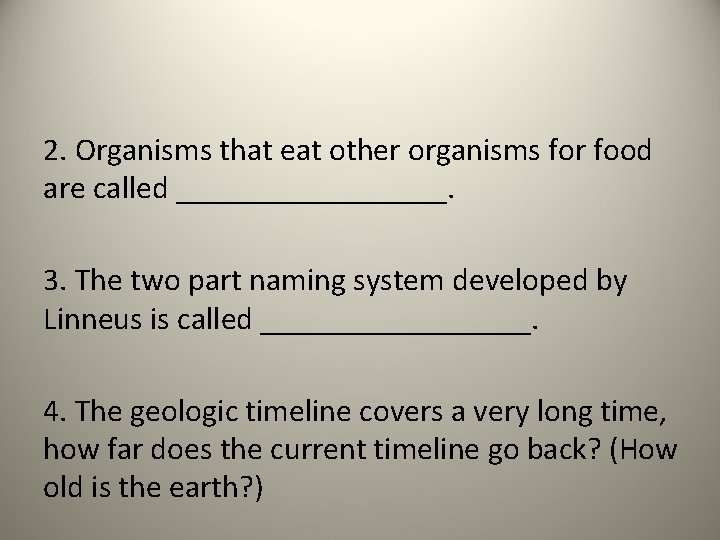
2. Organisms that eat other organisms for food are called _________. 3. The two part naming system developed by Linneus is called _________. 4. The geologic timeline covers a very long time, how far does the current timeline go back? (How old is the earth? )
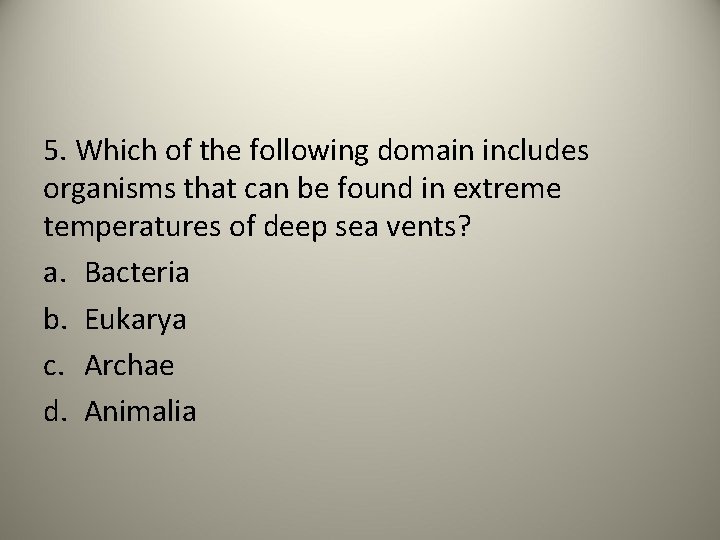
5. Which of the following domain includes organisms that can be found in extreme temperatures of deep sea vents? a. Bacteria b. Eukarya c. Archae d. Animalia
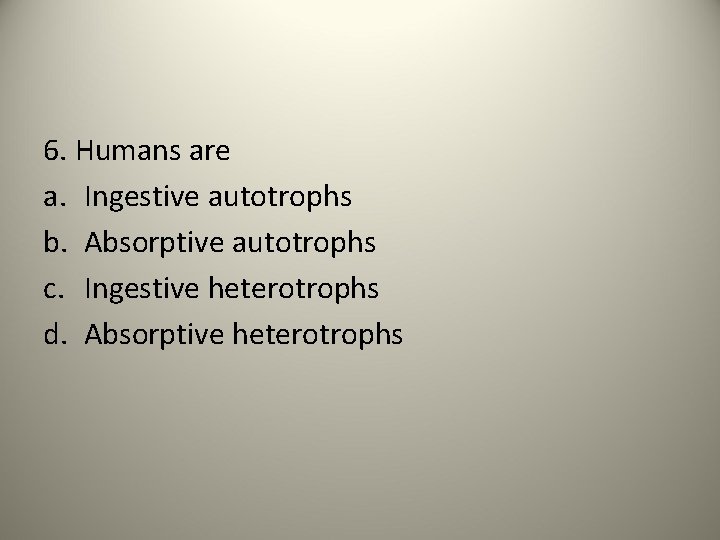
6. Humans are a. Ingestive autotrophs b. Absorptive autotrophs c. Ingestive heterotrophs d. Absorptive heterotrophs
7. In Aristotole’s system of classification, animals are grouped according to their a. Size b. Habitat c. Structrue d. ancestors
8. Unicellular eukaryotes belong to the kingdom _______? 9. Unicellular prokaryotes that are found in the back of your refrigerator are called ______? 10. Organisms that lack a nuclear membrane are called ________?