
TAXONOMY The Science of Classifying Organisms Why do


- Slides: 28
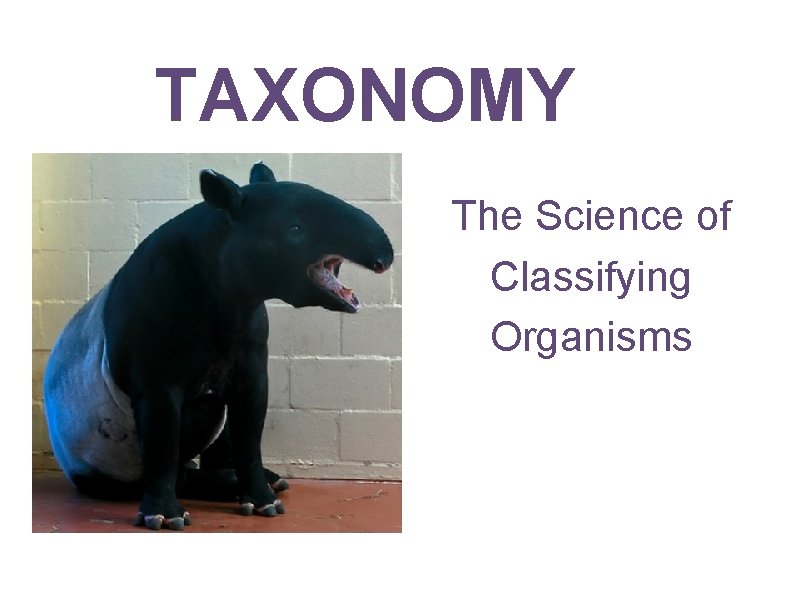
TAXONOMY The Science of Classifying Organisms
Why do we need to classify? ●Imagine a store…. . how do you know where to find the milk or the cereal? Are they in the same aisle? How is the store “organized”? Are all stores similar? ●Imagine your computer or mp 3 player…. . are all of your songs and files in a single folder or do you have them grouped in some way?
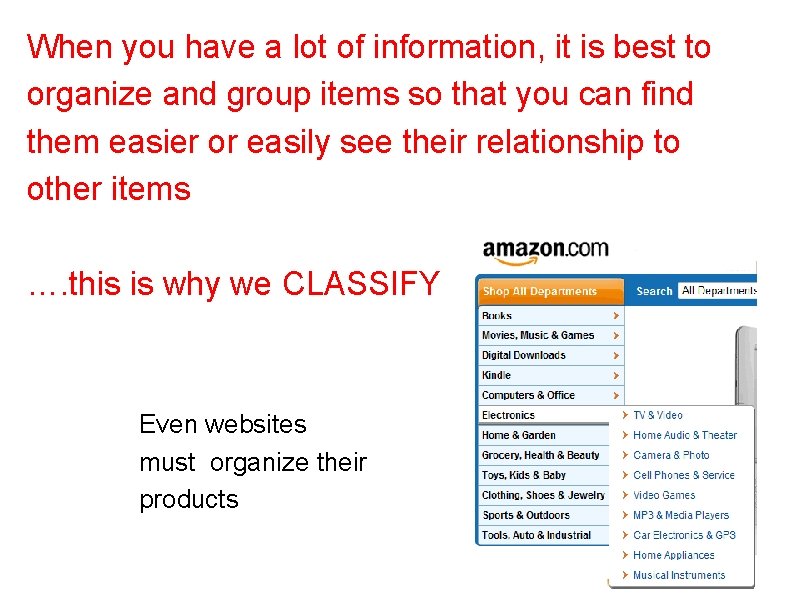
When you have a lot of information, it is best to organize and group items so that you can find them easier or easily see their relationship to other items …. this is why we CLASSIFY Even websites must organize their products
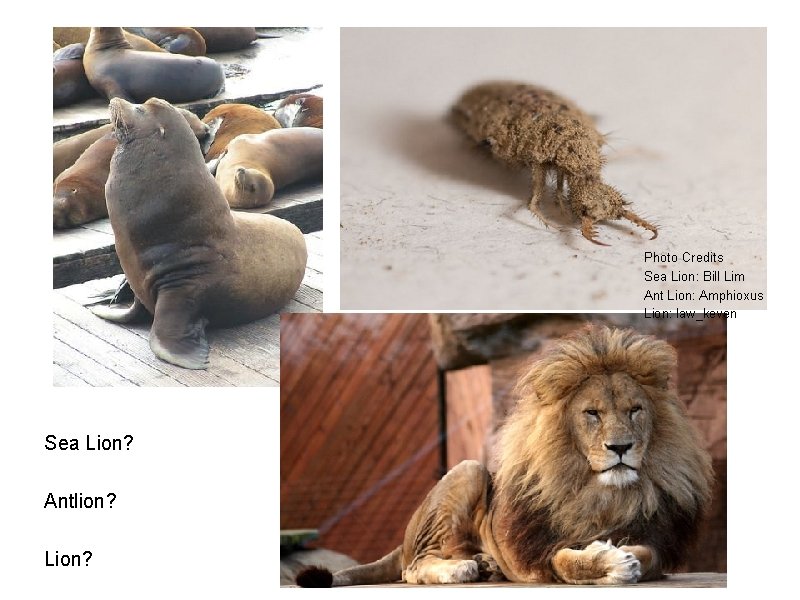
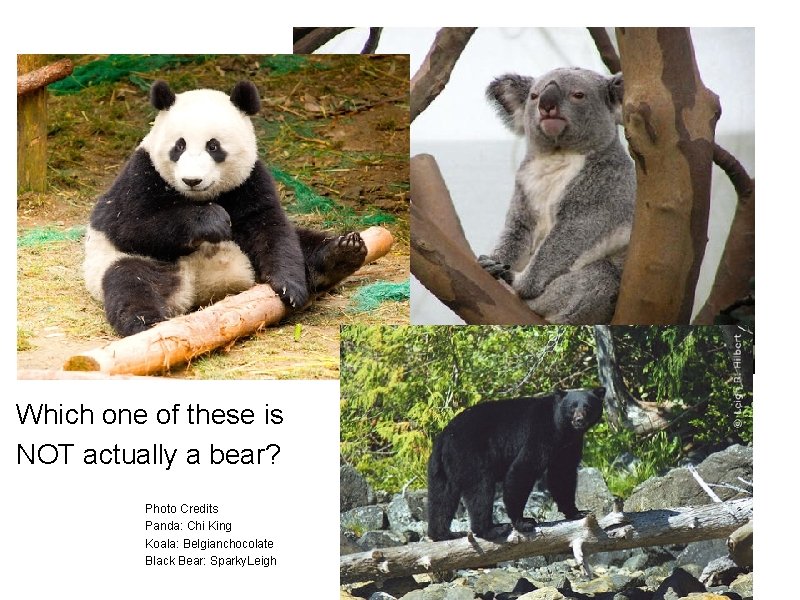
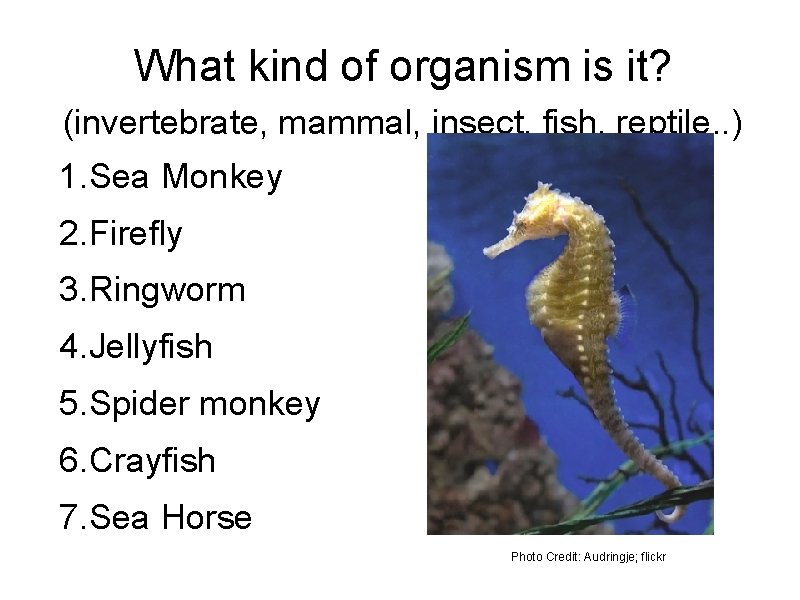
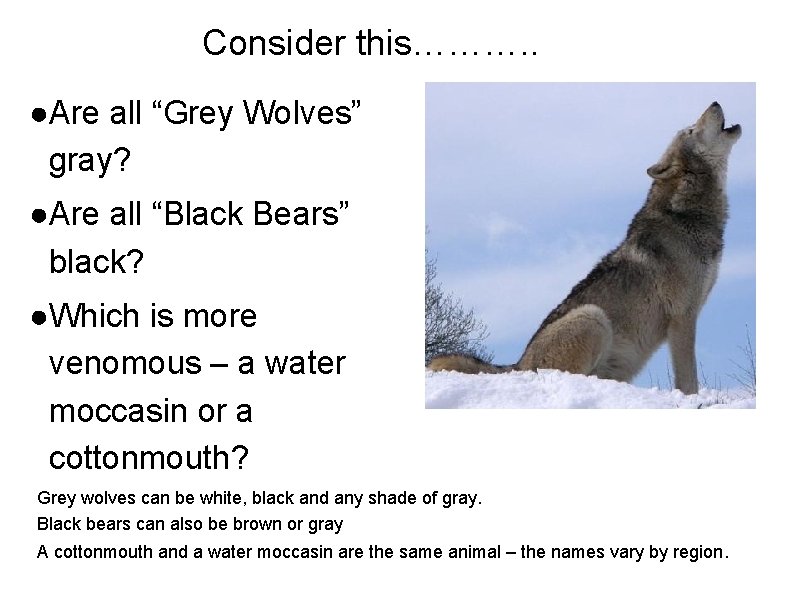
Scientists also need a way to *NAME* organisms ●The “common names” used by people can sometimes be misleading or confusing ●In order to communicate effectively, biologists need a CONSISTENT naming protocol. *Check out these slides of confusing names…. .
Photo Credits Sea Lion: Bill Lim Ant Lion: Amphioxus Lion: law_keven Sea Lion? Antlion? Lion?
Which one of these is NOT actually a bear? Photo Credits Panda: Chi King Koala: Belgianchocolate Black Bear: Sparky. Leigh
What kind of organism is it? (invertebrate, mammal, insect, fish, reptile. . ) 1. Sea Monkey 2. Firefly 3. Ringworm 4. Jellyfish 5. Spider monkey 6. Crayfish 7. Sea Horse Photo Credit: Audringje; flickr
Consider this………. . ●Are all “Grey Wolves” gray? ●Are all “Black Bears” black? ●Which is more venomous – a water moccasin or a cottonmouth? Grey wolves can be white, black and any shade of gray. Black bears can also be brown or gray A cottonmouth and a water moccasin are the same animal – the names vary by region.
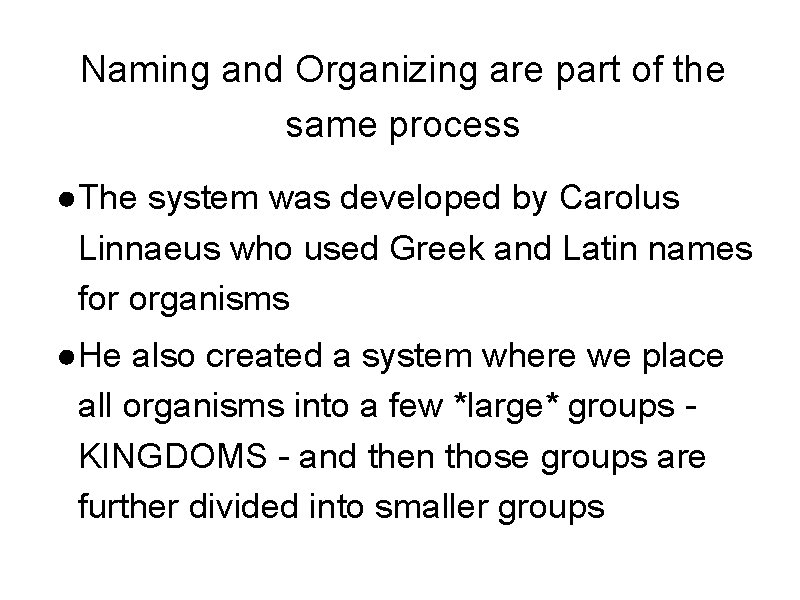
Naming and Organizing are part of the same process ●The system was developed by Carolus Linnaeus who used Greek and Latin names for organisms ●He also created a system where we place all organisms into a few *large* groups - KINGDOMS - and then those groups are further divided into smaller groups
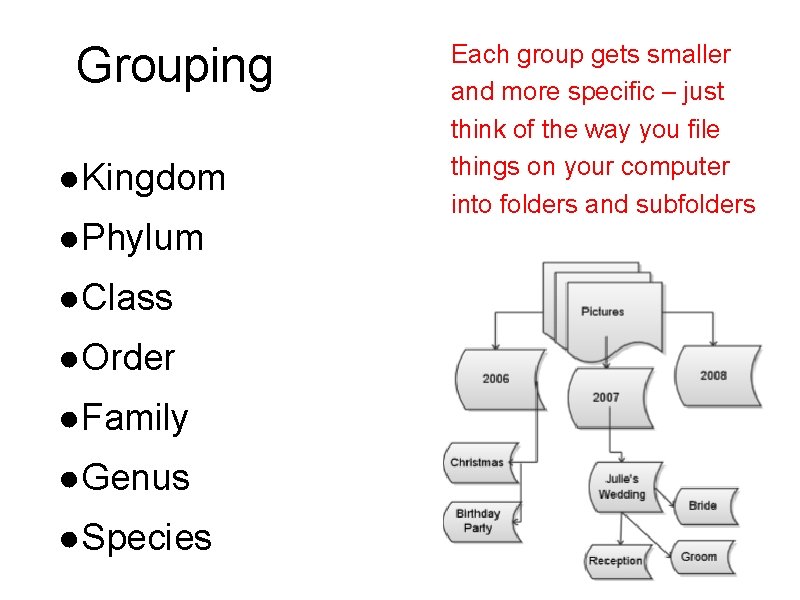
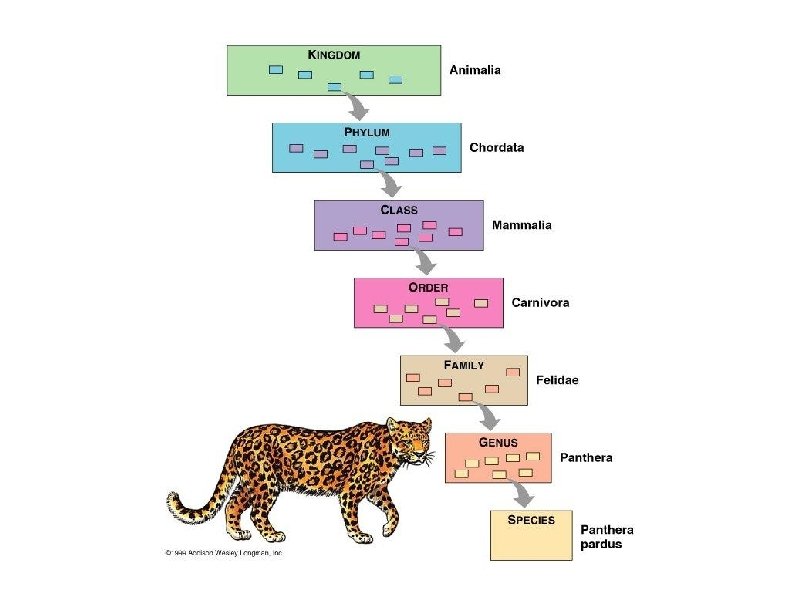
Grouping ●Kingdom ●Phylum ●Class ●Order ●Family ●Genus ●Species Each group gets smaller and more specific – just think of the way you file things on your computer into folders and subfolders
To help you remember the list KING PHILIP CAME OVER FOR GREAT SOUP
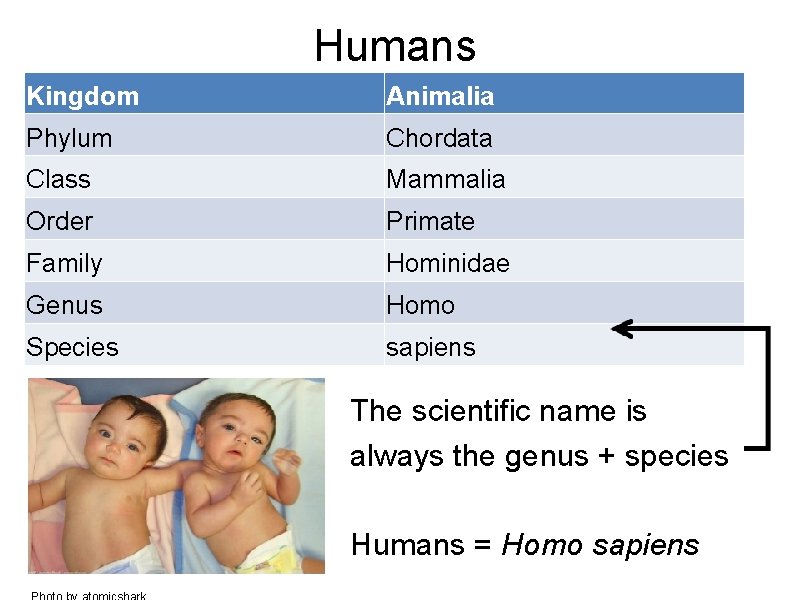
Humans Kingdom Animalia Phylum Chordata Class Mammalia Order Primate Family Hominidae Genus Homo Species sapiens The scientific name is always the genus + species Humans = Homo sapiens
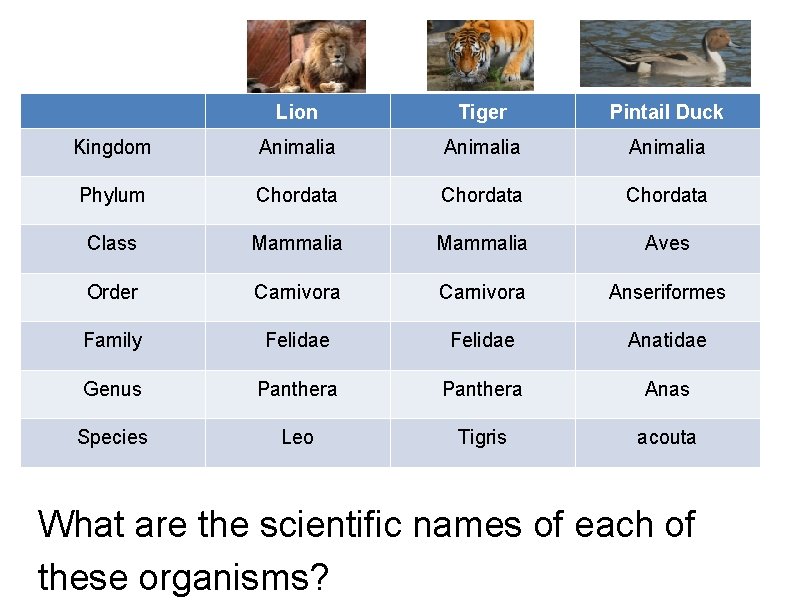
Lion Tiger Pintail Duck Kingdom Animalia Phylum Chordata Class Mammalia Aves Order Carnivora Anseriformes Family Felidae Anatidae Genus Panthera Anas Species Leo Tigris acouta What are the scientific names of each of these organisms?
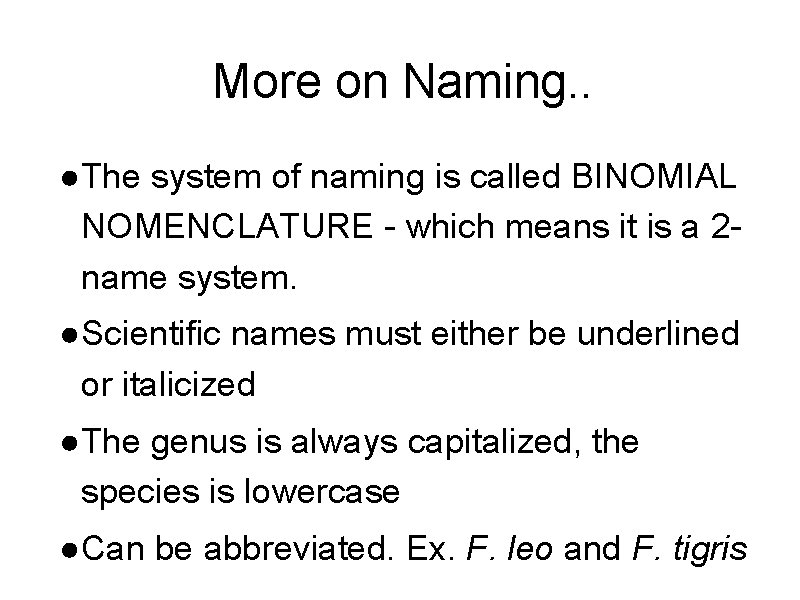
More on Naming. . ●The system of naming is called BINOMIAL NOMENCLATURE - which means it is a 2 name system. ●Scientific names must either be underlined or italicized ●The genus is always capitalized, the species is lowercase ●Can be abbreviated. Ex. F. leo and F. tigris
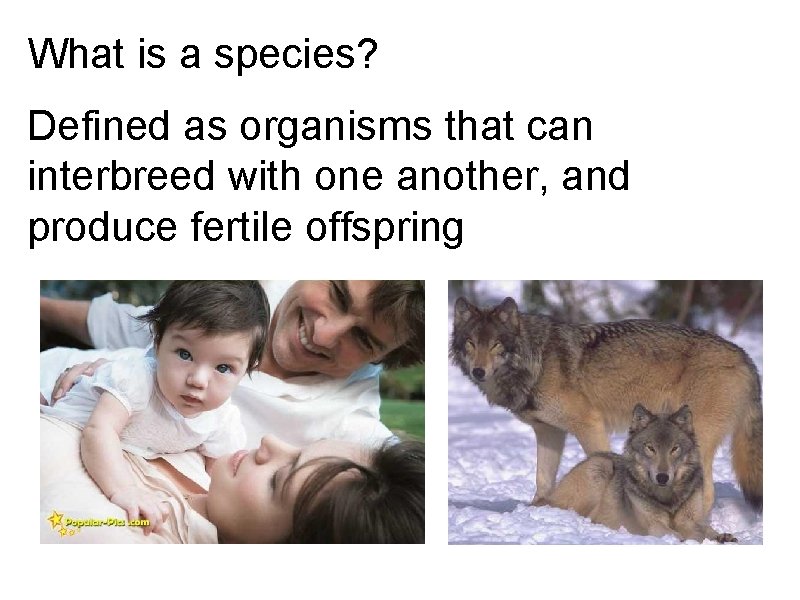
What is a species? Defined as organisms that can interbreed with one another, and produce fertile offspring
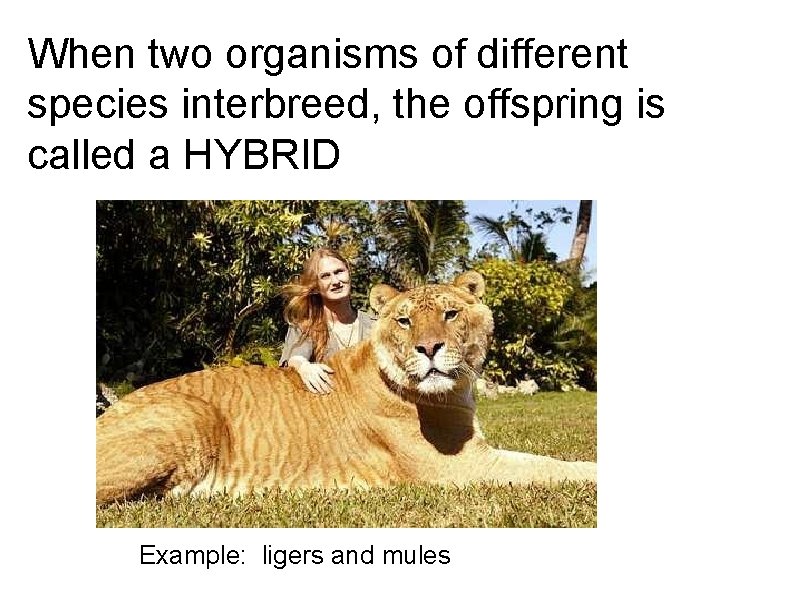
When two organisms of different species interbreed, the offspring is called a HYBRID Example: ligers and mules
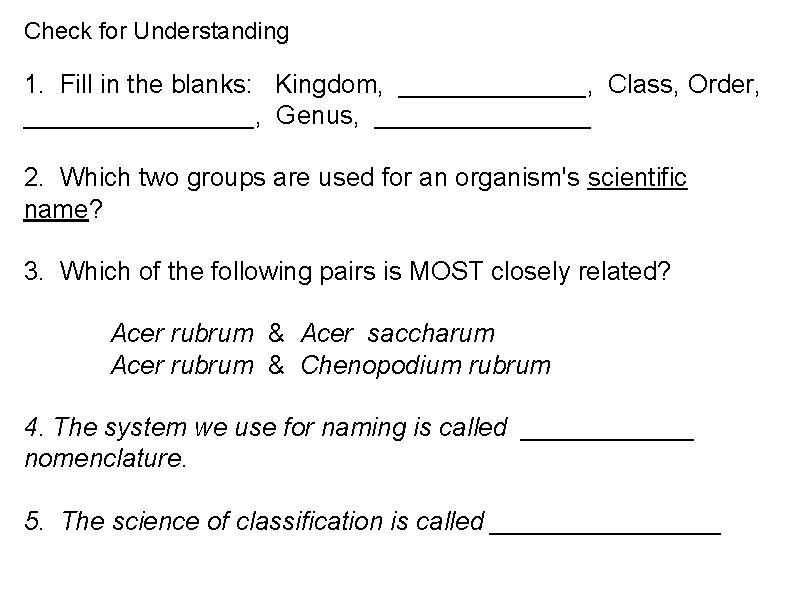
Check for Understanding 1. Fill in the blanks: Kingdom, _______, Class, Order, ________, Genus, ________ 2. Which two groups are used for an organism's scientific name? 3. Which of the following pairs is MOST closely related? Acer rubrum & Acer saccharum Acer rubrum & Chenopodium rubrum 4. The system we use for naming is called ______ nomenclature. 5. The science of classification is called ________
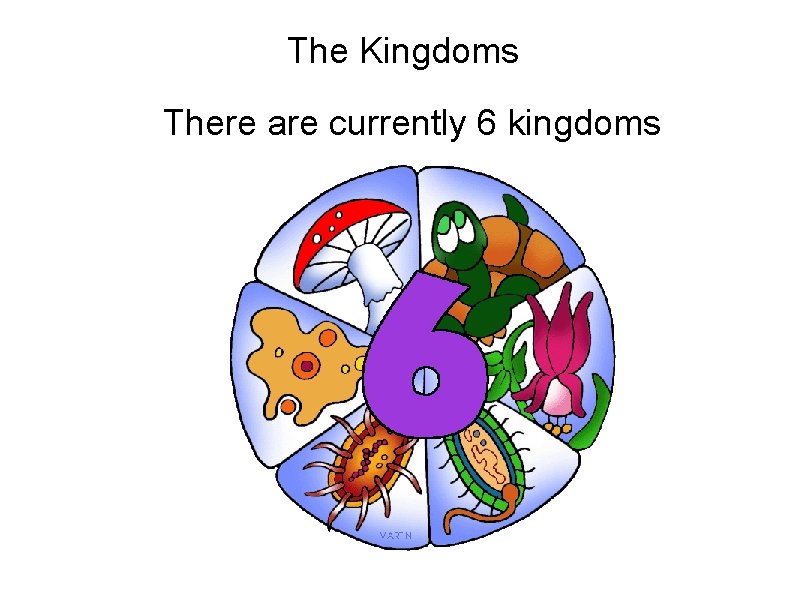
The Kingdoms There are currently 6 kingdoms
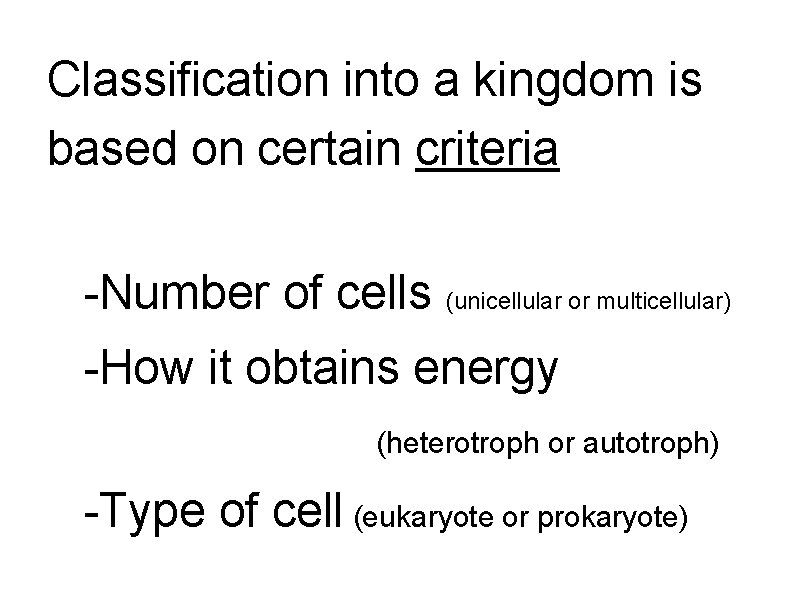
Classification into a kingdom is based on certain criteria -Number of cells (unicellular or multicellular) -How it obtains energy (heterotroph or autotroph) -Type of cell (eukaryote or prokaryote)
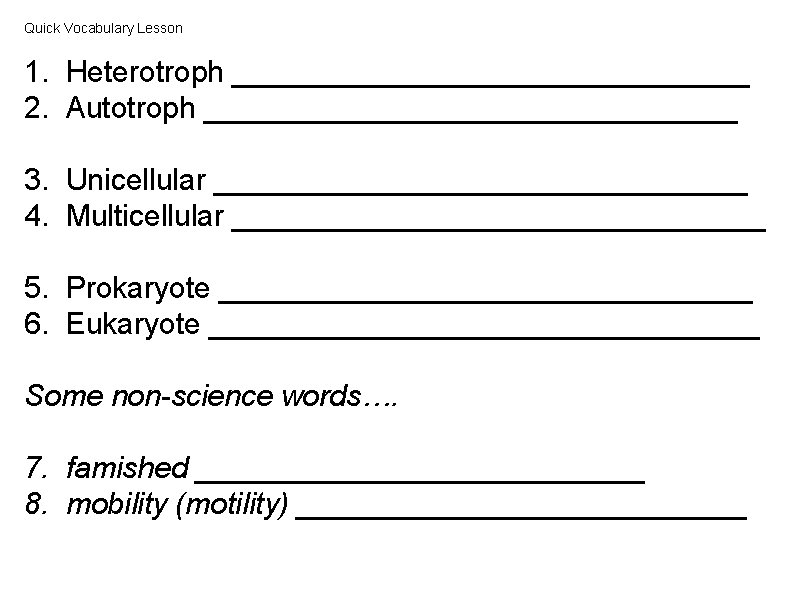
Quick Vocabulary Lesson 1. Heterotroph ________________ 2. Autotroph ________________ 3. Unicellular ________________ 4. Multicellular ________________ 5. Prokaryote ________________ 6. Eukaryote _________________ Some non-science words…. 7. famished ______________ 8. mobility (motility) ______________
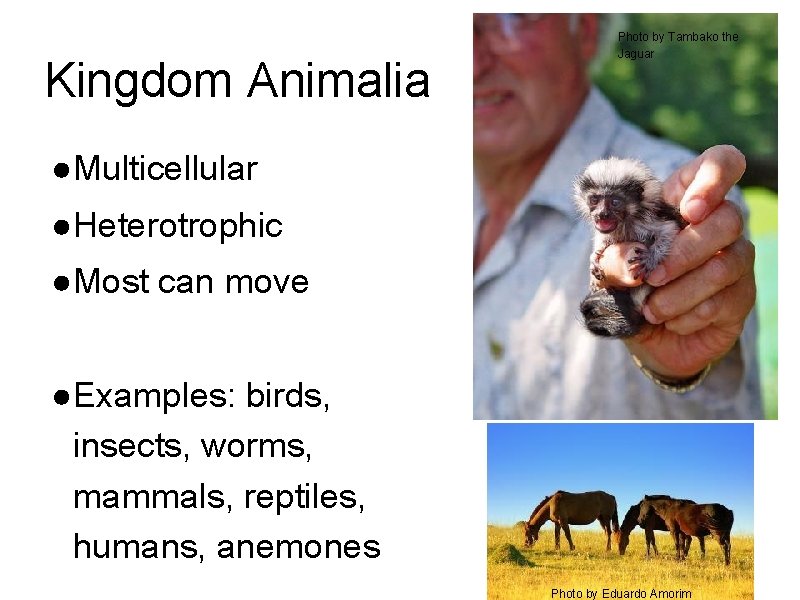
Kingdom Animalia Photo by Tambako the Jaguar ●Multicellular ●Heterotrophic ●Most can move ●Examples: birds, insects, worms, mammals, reptiles, humans, anemones Photo by Eduardo Amorim
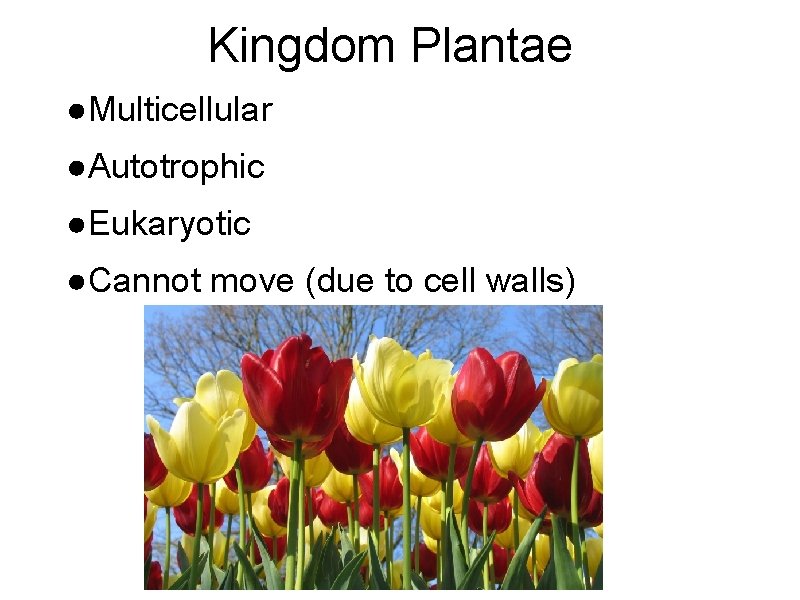
Kingdom Plantae ●Multicellular ●Autotrophic ●Eukaryotic ●Cannot move (due to cell walls)
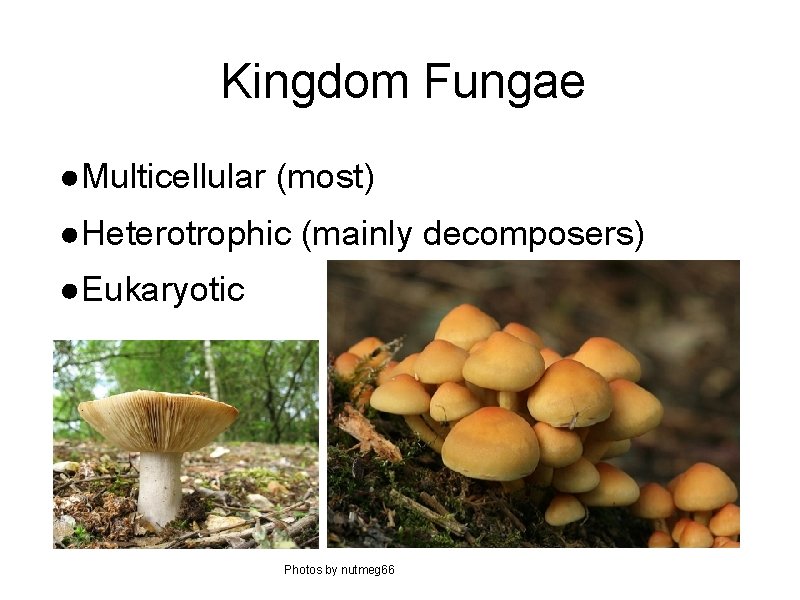
Kingdom Fungae ●Multicellular (most) ●Heterotrophic (mainly decomposers) ●Eukaryotic Photos by nutmeg 66
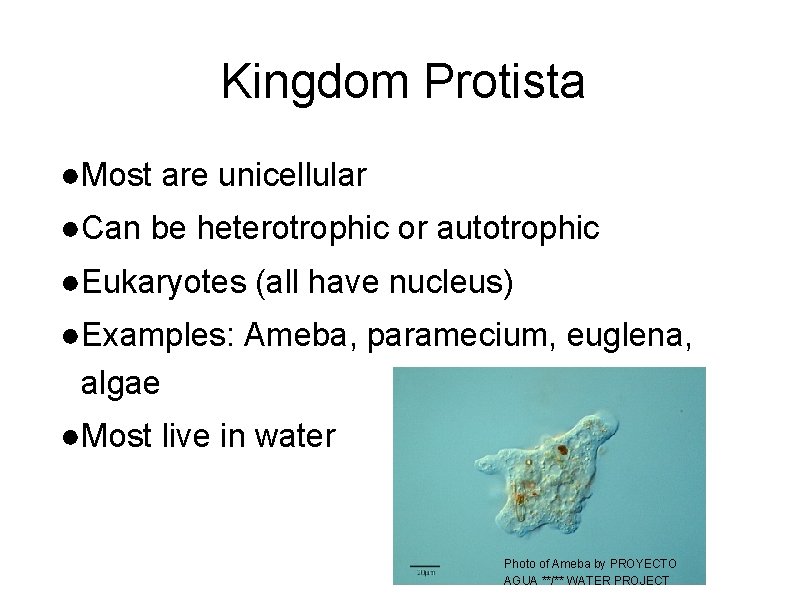
Kingdom Protista ●Most are unicellular ●Can be heterotrophic or autotrophic ●Eukaryotes (all have nucleus) ●Examples: Ameba, paramecium, euglena, algae ●Most live in water Photo of Ameba by PROYECTO AGUA **/** WATER PROJECT
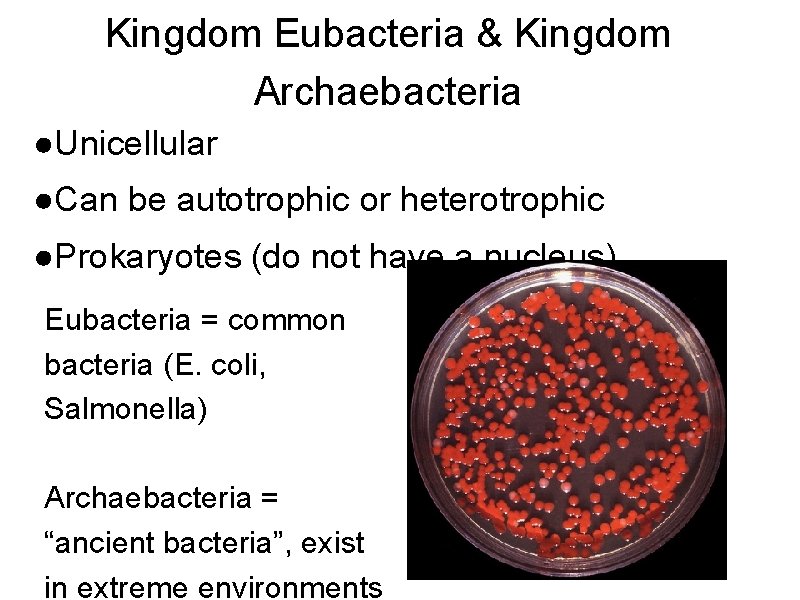
Kingdom Eubacteria & Kingdom Archaebacteria ●Unicellular ●Can be autotrophic or heterotrophic ●Prokaryotes (do not have a nucleus) Eubacteria = common bacteria (E. coli, Salmonella) Archaebacteria = “ancient bacteria”, exist in extreme environments
Three Domain System Recently, scientists have added a group above Kingdom. Three groups, called DOMAINS, contain each of the six kingdoms. Domain Eukarya - includes organisms composed of eukaryotic cells (plants, animals, fungi, protists) Domain Bacteria - includes all prokaryotic cells, Kingdom Eubacteria Domain Archaea - includes only "ancient" bacteria, Archaebacteria