
Taxonomy The science of classifying organisms Carolus Linnaeus
- Slides: 14
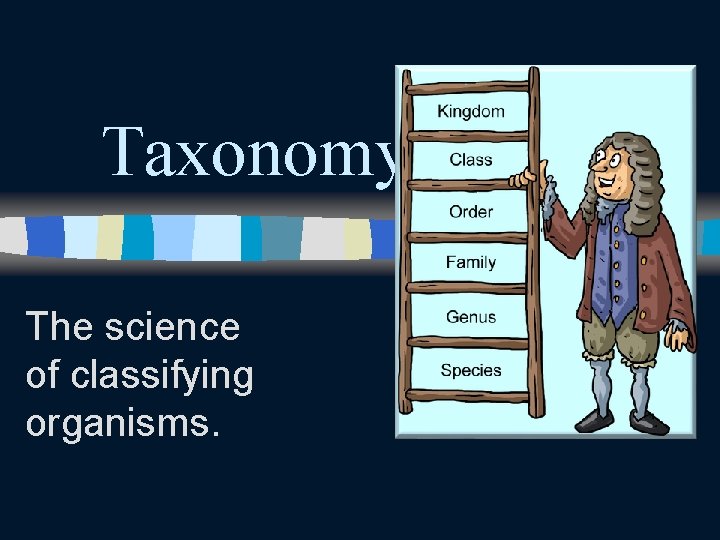
Taxonomy The science of classifying organisms.
Carolus Linnaeus n Described organisms with two word names, instead of polynomials n Developed binomial nomenclature n First word = genus name n Second word = species name
Binomial Nomenclature n Homo sapiens n Canis lupus n Felis domesticus n Pan pan ü Always written with Genus name capitalized, species name is lowercase. ü Either italicized or underlined.
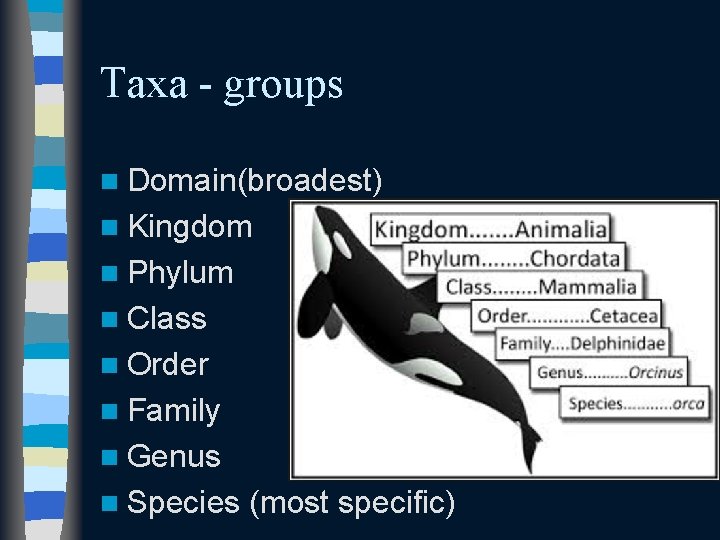
Taxa - groups n Domain(broadest) n Kingdom n Phylum n Class n Order n Family n Genus n Species (most specific)
Notes assignment: n Look up the classification for humans for all eight hierarchies and write into your notebook.
What is a species? n Biological species concept – a group of living organisms consisting of similar individuals capable of exchanging genes or interbreeding. – Problems • Hybrids • Sterile offspring of two different species • Asexual organisms
How many are out there? n Scientists currently estimate that – There are 10 million species worldwide – Over 5 million live in the tropics – Most unnamed species are small or microscopic
Why is taxonomy useful? n Helps prevent confusion among scientists n Helps to show organisms are related n Can be used to reconstruct phylogenies – evolutionary histories – of an organism or group
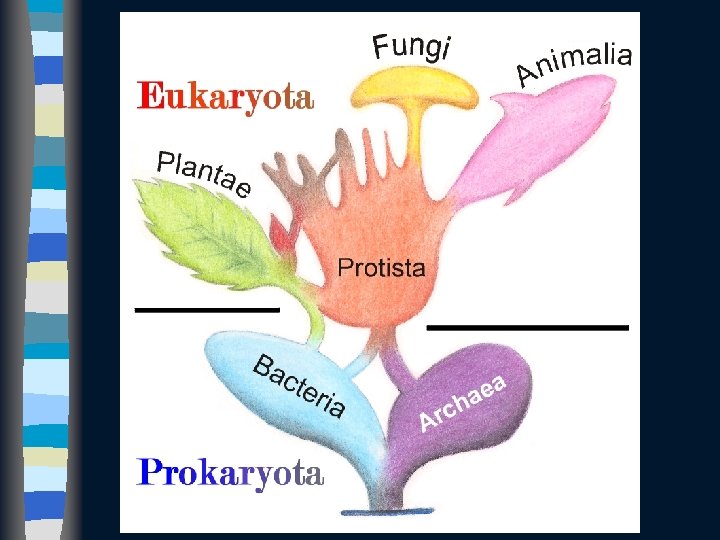
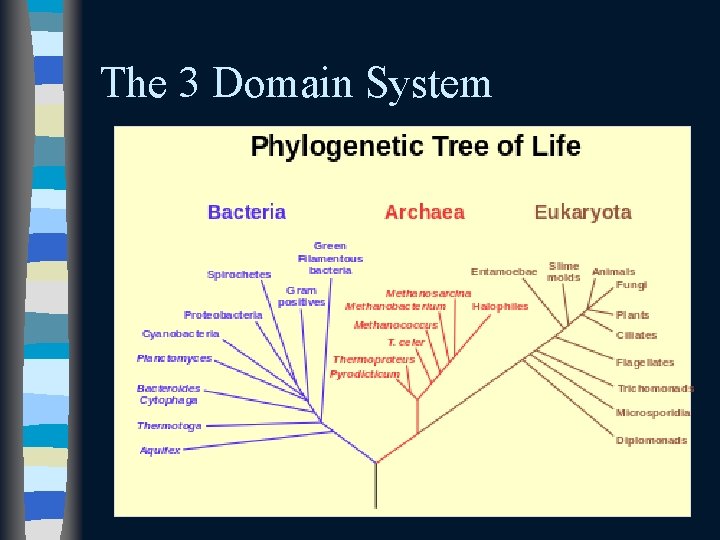
The 3 Domain System
The 6 kingdoms n Prokaryotes Monera) (Used to be 1 kingdom, 1. Archaebacteria 2. Eubacteria n Eukaryotes 3. Fungi 4. Protista 5. Animal 6. Plantae
Overview of the 6 kingdoms 1. Archaebacteria – Unicellular – Live in extreme environments – Prokaryotic 2. Eubacteria – Unicellular – Prokaryotic – “Common bacteria”
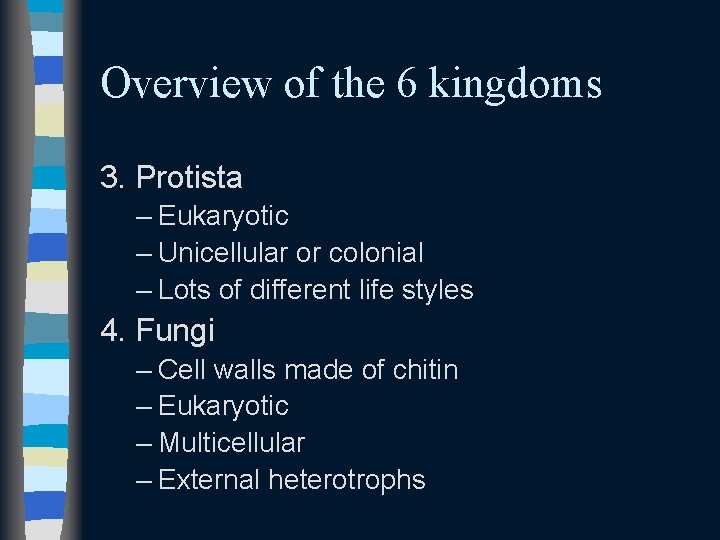
Overview of the 6 kingdoms 3. Protista – Eukaryotic – Unicellular or colonial – Lots of different life styles 4. Fungi – Cell walls made of chitin – Eukaryotic – Multicellular – External heterotrophs
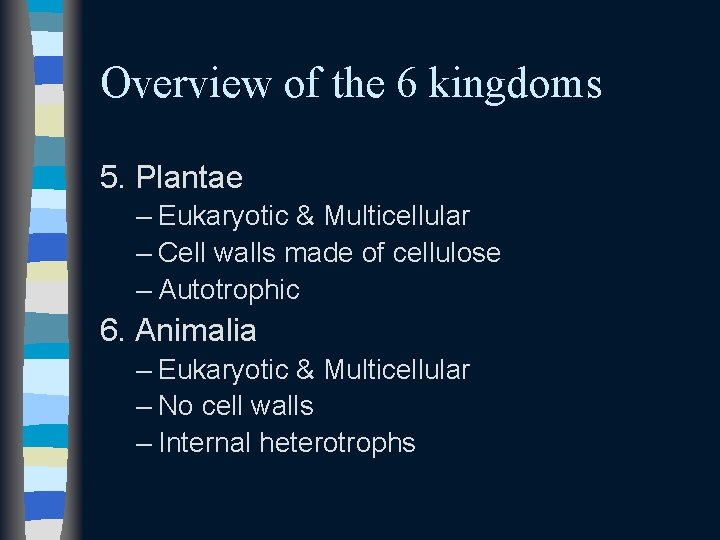
Overview of the 6 kingdoms 5. Plantae – Eukaryotic & Multicellular – Cell walls made of cellulose – Autotrophic 6. Animalia – Eukaryotic & Multicellular – No cell walls – Internal heterotrophs