
Taxonomy and Classification Why do we need to

- Slides: 55
Taxonomy and Classification
Why do we need to classify? ● Imagine a store…. . how do you know where to find the milk or the cereal? Are they in the same aisle? How is the store “organized”? Are all stores similar? ● Imagine your computer or mp 3 player…. . are all of your songs and files in a single folder or do you have them grouped in some way? 2
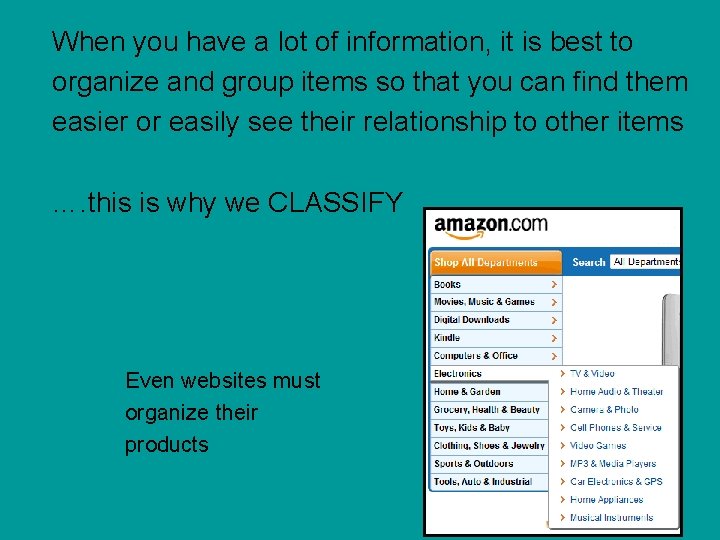
When you have a lot of information, it is best to organize and group items so that you can find them easier or easily see their relationship to other items …. this is why we CLASSIFY Even websites must organize their products 3
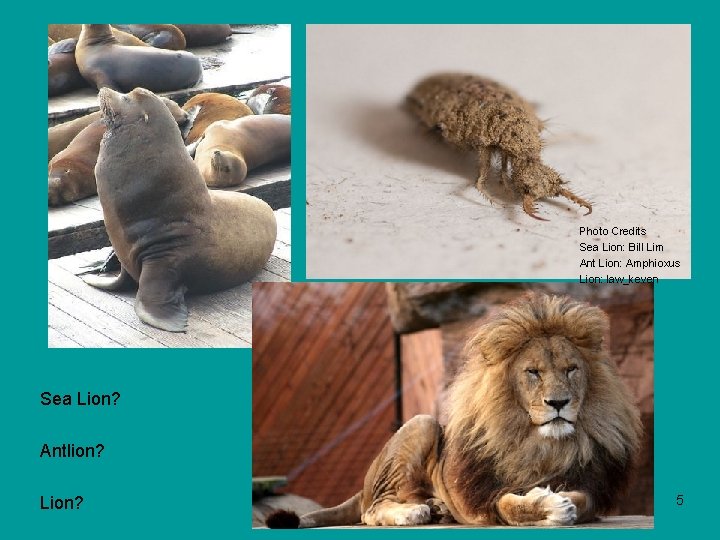
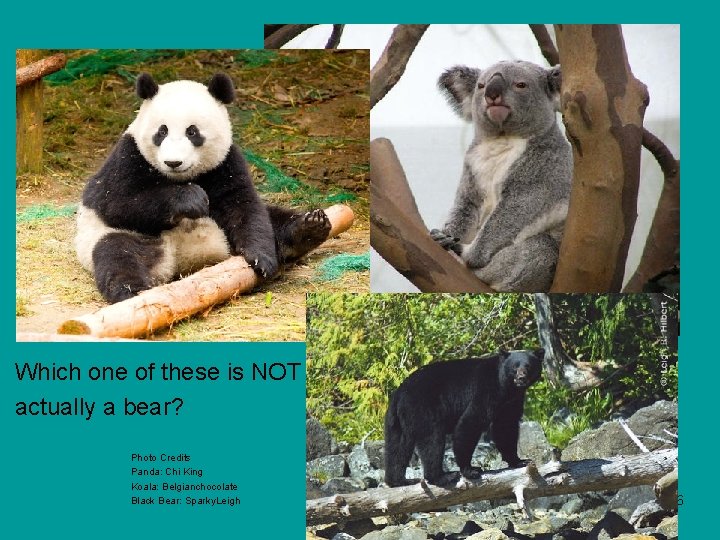
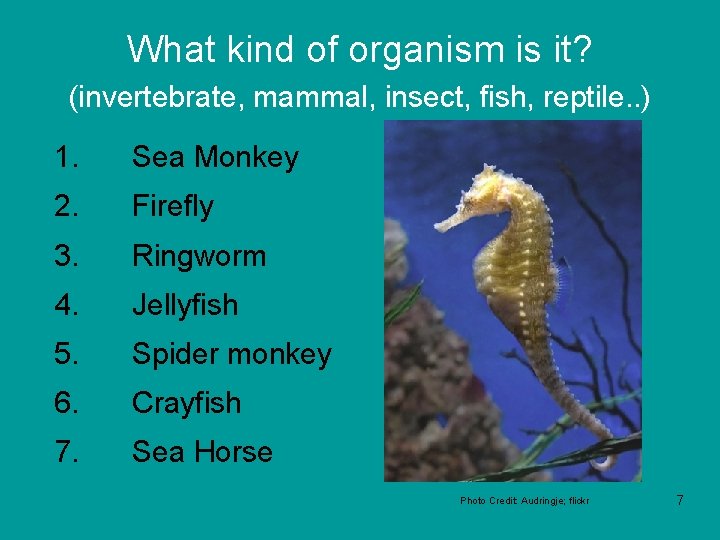
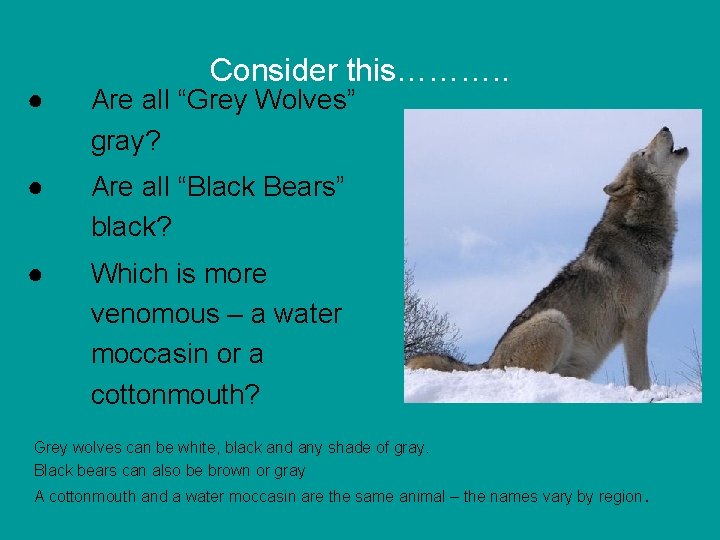
Scientists also need a way to *NAME* organisms ● The “common names” used by people can sometimes be misleading or confusing ● In order to communicate effectively, biologists need a CONSISTENT naming protocol. *Check out these slides of confusing names…. . 4
Photo Credits Sea Lion: Bill Lim Ant Lion: Amphioxus Lion: law_keven Sea Lion? Antlion? Lion? 5
Which one of these is NOT actually a bear? Photo Credits Panda: Chi King Koala: Belgianchocolate Black Bear: Sparky. Leigh 6
What kind of organism is it? (invertebrate, mammal, insect, fish, reptile. . ) 1. Sea Monkey 2. Firefly 3. Ringworm 4. Jellyfish 5. Spider monkey 6. Crayfish 7. Sea Horse Photo Credit: Audringje; flickr 7
Consider this………. . ● Are all “Grey Wolves” gray? ● Are all “Black Bears” black? ● Which is more venomous – a water moccasin or a cottonmouth? Grey wolves can be white, black and any shade of gray. Black bears can also be brown or gray A cottonmouth and a water moccasin are the same animal – the names vary by region.
Why Classify • Biologists want to better understand organisms so they organize them. • One tool that they use to do this is classification—the grouping of objects or information based on similarities. • Taxonomy is the branch of biology that groups and names organisms based on studies of their different characteristics. • Biologists who study taxonomy are called taxonomists.
Keeping track of species • The Greek philosopher Aristotle (384 -322 B. C. ) developed the first widely accepted system of biological classification. • He classified all the organisms he knew into two groups: plants and animals. • >1 million species named, up to 15 million more. • Taxonomy is not new; cultures have been naming plants and animals around them for 1000’s of years. • It’s practical to have names.
Which one is easier? “Watch out—there’s a bear behind that rock! OR “Watch out--there is a large, furry, four-legged creature with long claws, a big mouth set in a short, stout muzzle, attached to a round head containing small eyes and short triangular ears behind that rock!”
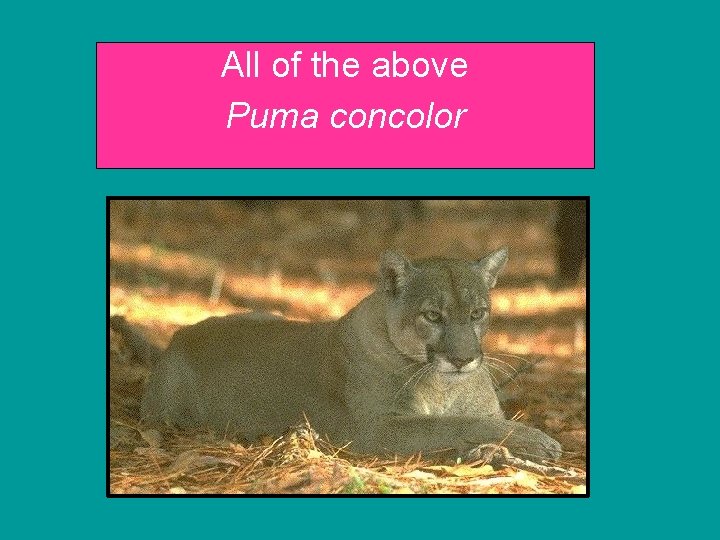
Q. What is the largest wild felid (cat) in the United States? Mountain Lion Cougar Panther Painter Puma Catamount
All of the above Puma concolor
Who devised a system for classification? • • Carolus Linneaus (1707 -1778) a swedish naturalist. Devised a two part naming system known as binomial nomenclature.
Binomial Nomenclature • Standard two-part system for naming things. • In this system, the first word identifies the genus of the organism. • A genus (genera-plural) consists of a group of similar species. • The second word, which sometimes describes a characteristic of the organism, is called the specific epithet. Linnaeus described and named > 6, 000 animals and >4, 000 plants using Latin Scientific name does not replace, but instead further defines common name
Scientific and common names • Taxonomists are required to use Latin because the language is no longer used in conversation and, therefore, does not change. • Scientific names should be italicized in print and underlined when handwritten. • The first letter of the genus name is uppercase, but the first letter of the specific epithet is lowercase. Passer domesticus
• Even though the genus and species are thorough sometimes more is needed. • Varities are splits of species. Example peaches & nectarines are both from a peach tree. Subspecies are variations of species that occur in different regions. •
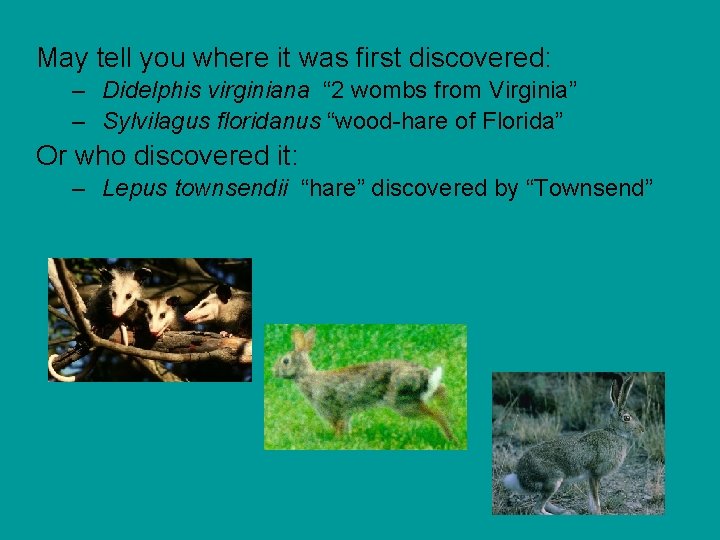
May tell you where it was first discovered: – Didelphis virginiana “ 2 wombs from Virginia” – Sylvilagus floridanus “wood-hare of Florida” Or who discovered it: – Lepus townsendii “hare” discovered by “Townsend”
Modern Classification • Expanding on Linnaeus’s work, today’s taxonomists try to identify the underlying evolutionary relationships of organisms and use the information gathered as a basis for classification. • Grouping organisms on the basis of their evolutionary relationships makes it easier to understand biological diversity. • Taxonomists group similar organisms, both living and extinct. Classification provides a framework in which to study the relationships among living and extinct species.
How Living Things Are Classified • In any classification system, items are categorized, making them easier to find and discuss. • Although biologists group organisms, they subdivide the groups on the basis of more specific criteria. • A group of organisms is called a taxon (plural, taxa). • Organisms are ranked in taxa that range from having very broad characteristics to very specific ones. • The broader a taxon, the more general its characteristics, and the more species it contains.
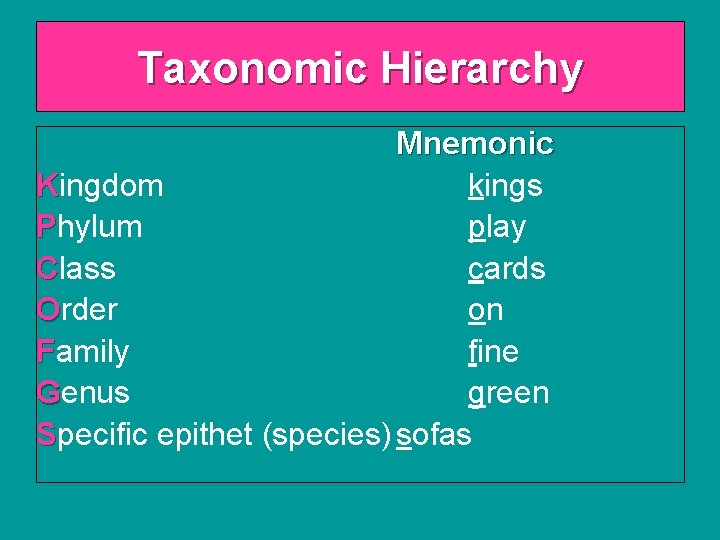
Taxonomic Hierarchy Mnemonic Kingdom kings Phylum play Class cards Order on Family fine Genus green Specific epithet (species) sofas
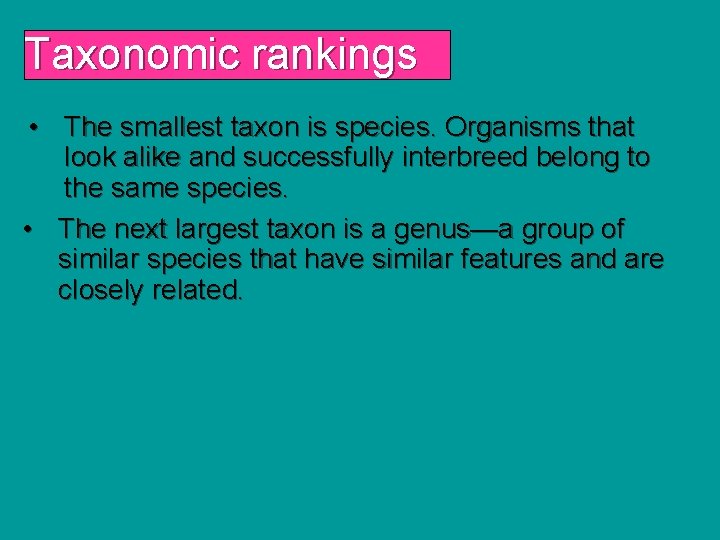
Taxonomic rankings • The smallest taxon is species. Organisms that look alike and successfully interbreed belong to the same species. • The next largest taxon is a genus—a group of similar species that have similar features and are closely related.
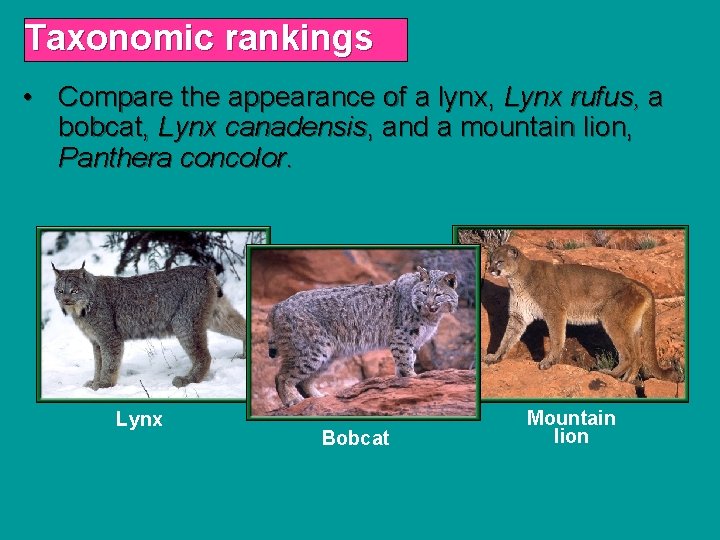
Taxonomic rankings • Compare the appearance of a lynx, Lynx rufus, a bobcat, Lynx canadensis, and a mountain lion, Panthera concolor. Lynx Bobcat Mountain lion
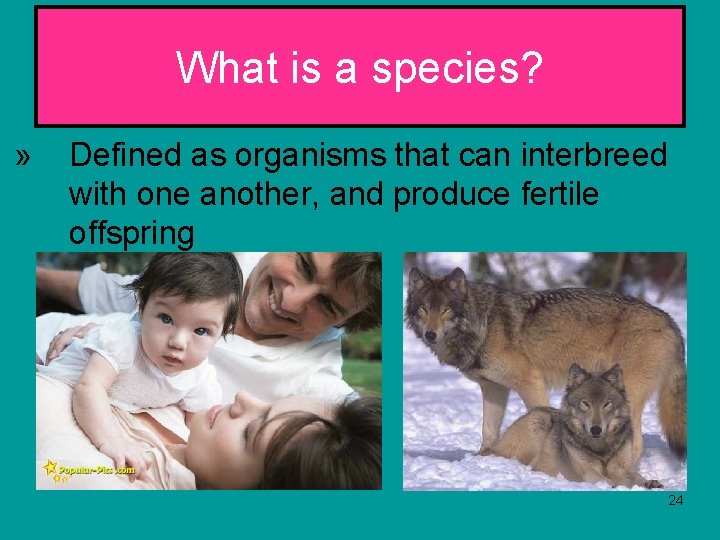
What is a species? » Defined as organisms that can interbreed with one another, and produce fertile offspring 24
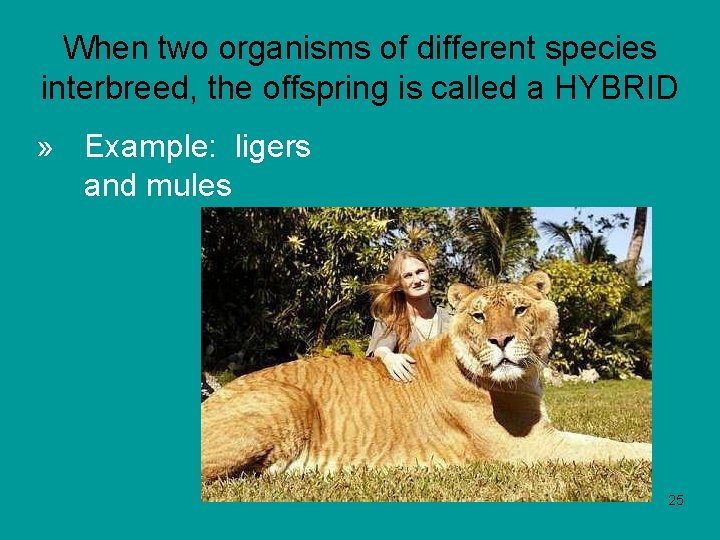
When two organisms of different species interbreed, the offspring is called a HYBRID » Example: ligers and mules 25
Taxonomic goals Place organisms into logical categories – system must be capable of being used for information retrieval, so anyone can properly identify any organism Place organisms into categories that show ancestor-descendant relationships
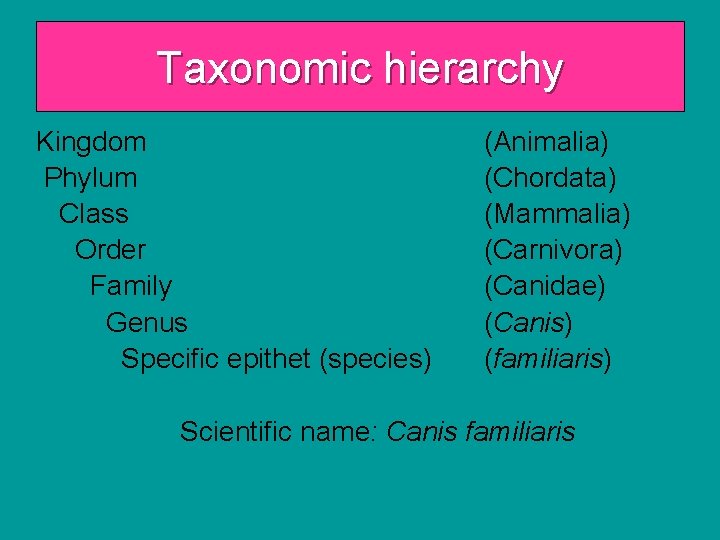
Taxonomic hierarchy Kingdom Phylum Class Order Family Genus Specific epithet (species) (Animalia) (Chordata) (Mammalia) (Carnivora) (Canidae) (Canis) (familiaris) Scientific name: Canis familiaris
THIS IS NOT MY DOG!!!!
Phylogenetic Classification: Models • The evolutionary history of a species is called its phylogeny. • A classification system that shows the evolutionary history of species is a phylogenetic classification and reveals the evolutionary relationships of species. • One biological system of classification that is based on phylogeny is cladistics. • Scientists who use cladistics assume that as groups of organisms diverge and evolve from a common ancestral group, they retain some unique inherited characteristics that taxonomists call derived traits.
Check for Understanding 1. Fill in the blanks: Kingdom, _______, Class, Order, ________, Genus, ________ 2. Which two groups are used for an organism's scientific name? 3. Which of the following pairs is MOST closely related? Acer rubrum & Acer saccharum Acer rubrum & Chenopodium rubrum 4. The system we use for naming is called ______ nomenclature. 5. The science of classification is called ________
Six Kingdom System
Classification into a kingdom is based on certain criteria -Number of cells (unicellular or multicellular) -How it obtains energy (heterotroph or autotroph) -Type of cell (eukaryote or prokaryote) 32
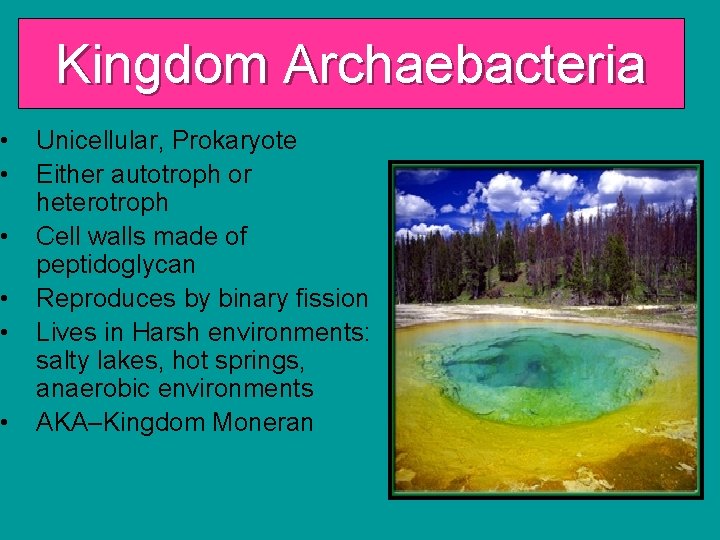
• • • Kingdom Archaebacteria Unicellular, Prokaryote Either autotroph or heterotroph Cell walls made of peptidoglycan Reproduces by binary fission Lives in Harsh environments: salty lakes, hot springs, anaerobic environments AKA–Kingdom Moneran
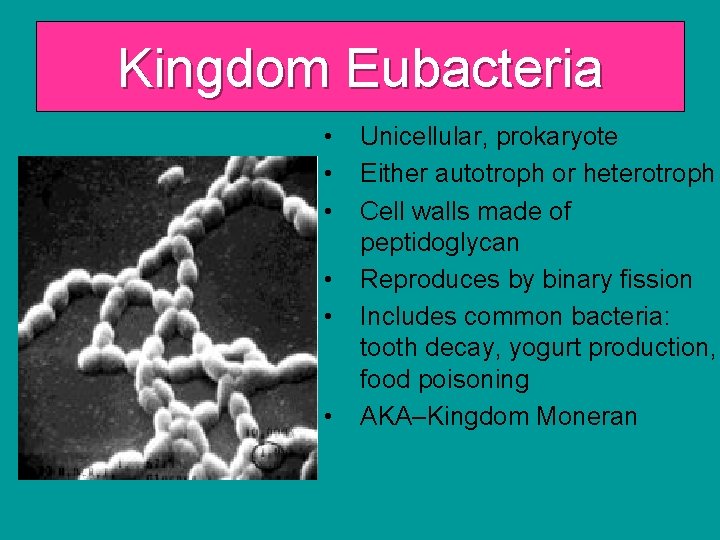
Kingdom Eubacteria • • • Unicellular, prokaryote Either autotroph or heterotroph Cell walls made of peptidoglycan Reproduces by binary fission Includes common bacteria: tooth decay, yogurt production, food poisoning AKA–Kingdom Moneran
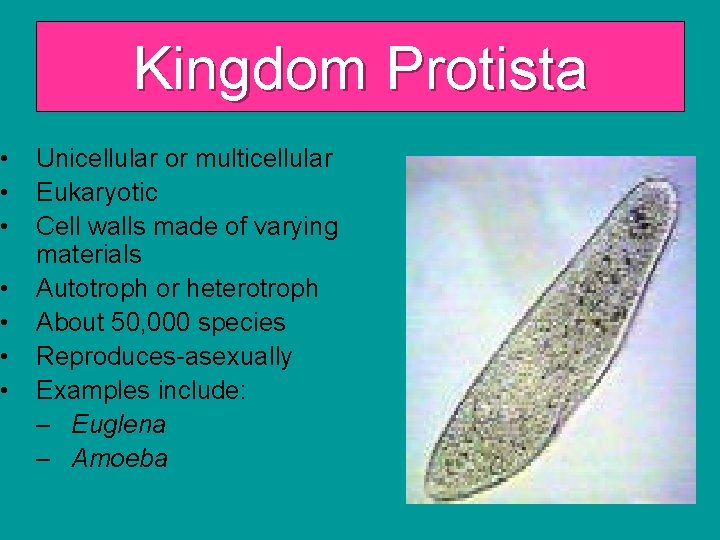
• • Kingdom Protista Unicellular or multicellular Eukaryotic Cell walls made of varying materials Autotroph or heterotroph About 50, 000 species Reproduces-asexually Examples include: – Euglena – Amoeba
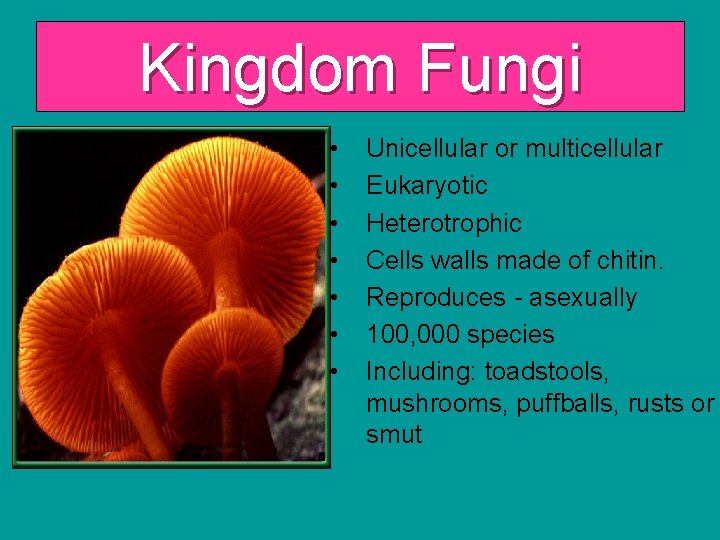
Kingdom Fungi • • Unicellular or multicellular Eukaryotic Heterotrophic Cells walls made of chitin. Reproduces - asexually 100, 000 species Including: toadstools, mushrooms, puffballs, rusts or smut
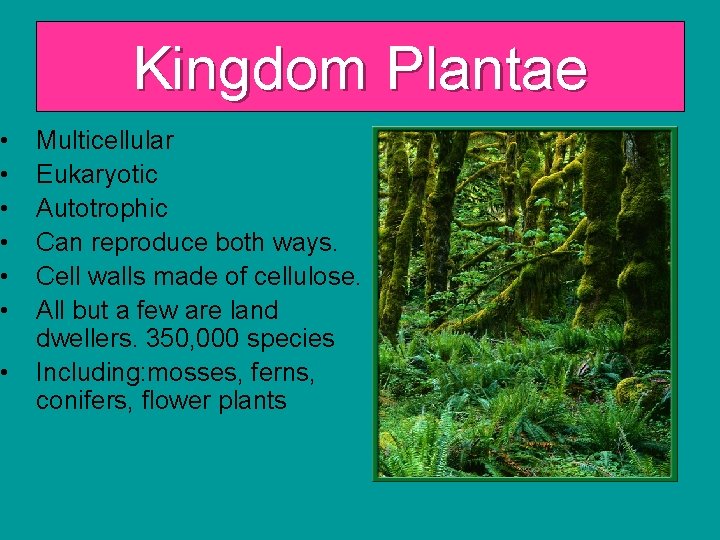
• • Kingdom Plantae Multicellular Eukaryotic Autotrophic Can reproduce both ways. Cell walls made of cellulose. All but a few are land dwellers. 350, 000 species Including: mosses, ferns, conifers, flower plants
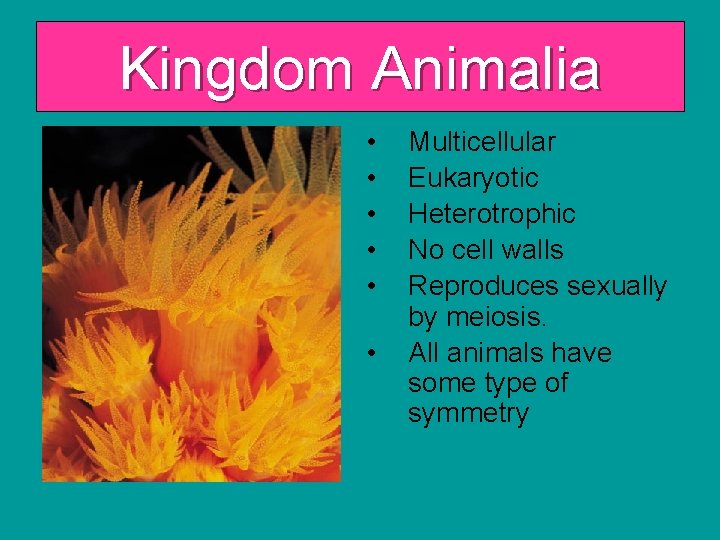
Kingdom Animalia • • • Multicellular Eukaryotic Heterotrophic No cell walls Reproduces sexually by meiosis. All animals have some type of symmetry
Three Domain System » Recently, scientists have added a group above Kingdom. Three groups, called DOMAINS, contain each of the six kingdoms. » Domain Eukarya - includes organisms composed of eukaryotic cells (plants, animals, fungi, protists) » Domain Bacteria - includes all prokaryotic cells, Kingdom Eubacteria » Domain Archaea - includes only "ancient" bacteria, Archaebacteria 39
ECOLOGY the study of interactions that take place between organisms and their environment. ■ The biosphere is the portion of Earth that supports living things. *The nonliving parts of an organism’s environment are the abiotic factors. *All the living organisms that inhabit an environment are called biotic factors. 40
Ecology • Biodiversity refers to the variety of species in a specific area. Warmer regions of Earth are more Biodiverse. Ways biodiversity is LOST • Extinction is the disappearance of a species when the last of its members dies. • A species is considered to be an endangered species when its numbers become so low that extinction is possible. • When the population of a species is likely to become endangered, it is said to be a threatened species. 41
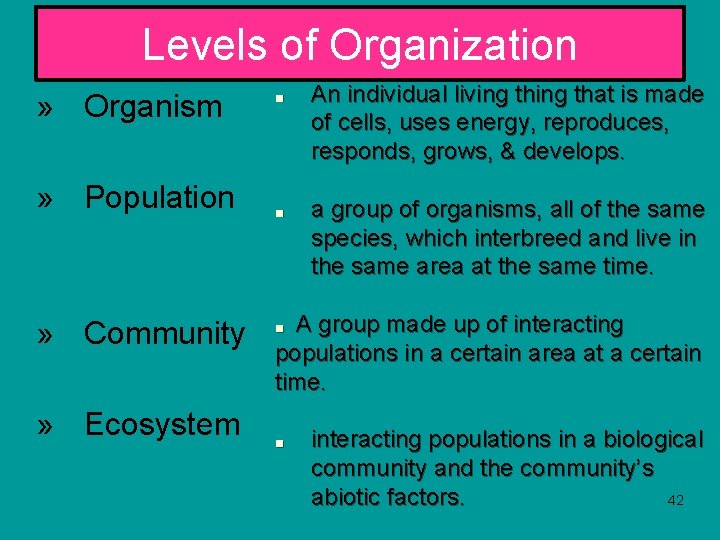
Levels of Organization » Organism » Population » Community » Ecosystem ■ ■ An individual living that is made of cells, uses energy, reproduces, responds, grows, & develops. a group of organisms, all of the same species, which interbreed and live in the same area at the same time. A group made up of interacting populations in a certain area at a certain time. ■ ■ interacting populations in a biological community and the community’s abiotic factors. 42
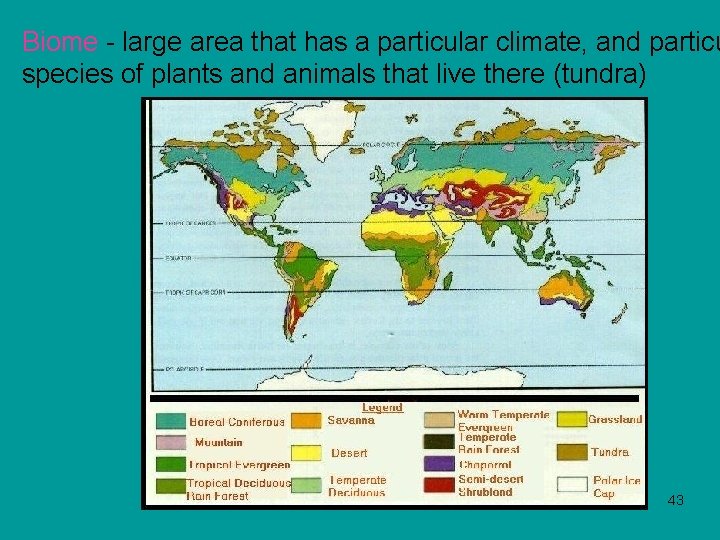
Biome - large area that has a particular climate, and particu species of plants and animals that live there (tundra) 43
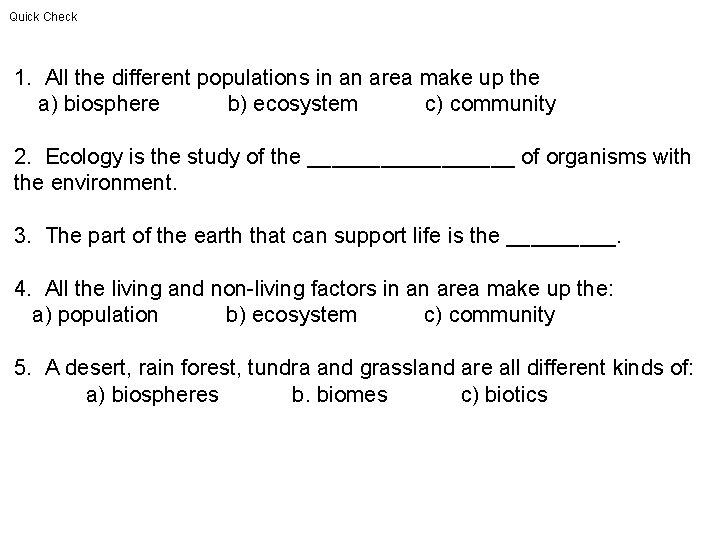
Quick Check 1. All the different populations in an area make up the a) biosphere b) ecosystem c) community 2. Ecology is the study of the _________ of organisms with the environment. 3. The part of the earth that can support life is the _____. 4. All the living and non-living factors in an area make up the: a) population b) ecosystem c) community 5. A desert, rain forest, tundra and grassland are all different kinds of: a) biospheres b. biomes c) biotics
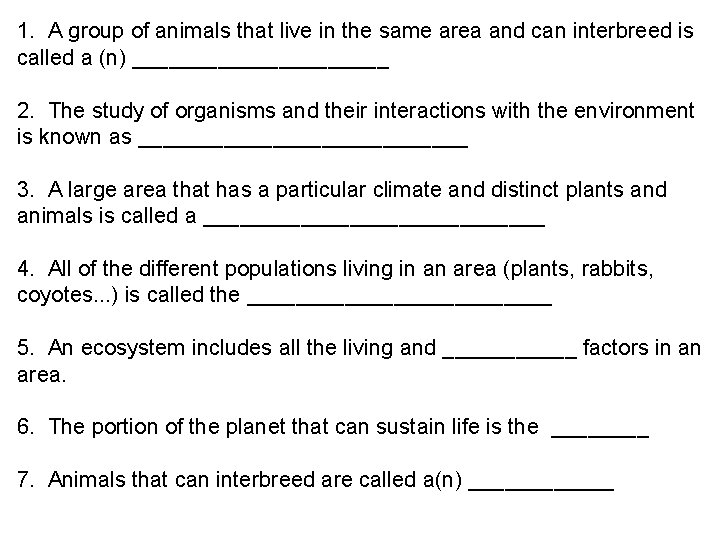
1. A group of animals that live in the same area and can interbreed is called a (n) ___________ 2. The study of organisms and their interactions with the environment is known as ______________ 3. A large area that has a particular climate and distinct plants and animals is called a ______________ 4. All of the different populations living in an area (plants, rabbits, coyotes. . . ) is called the _____________ 5. An ecosystem includes all the living and ______ factors in an area. 6. The portion of the planet that can sustain life is the ____ 7. Animals that can interbreed are called a(n) ______
Organism LIFE ■ ■ ■ A habitat is the place where an organism lives out its life. A niche is the role or position a species has in its environment—how it meets its specific needs for food and shelter, how and where it survives, and where it reproduces in its environment. The relationship in which there is a close and permanent association between organisms of 46 different species is called symbiosis.
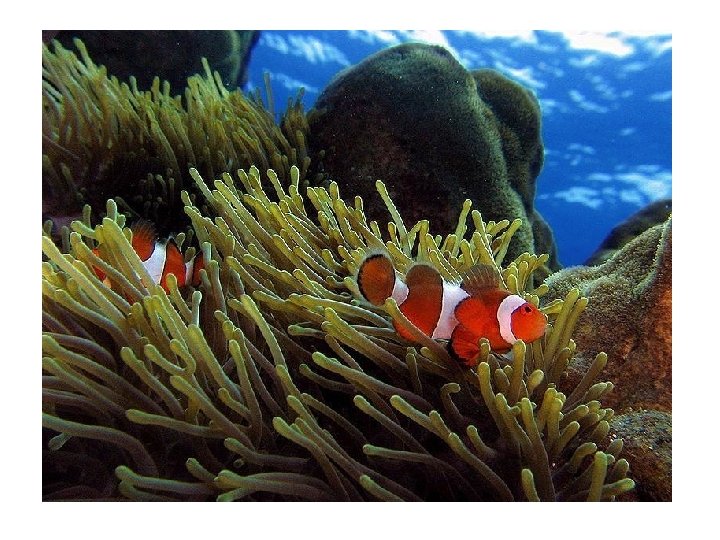
Predation – one organism (predator) captures & feeds on another organism. (prey) Symbiosis – two species live closely together Mutualism – both species benefit (insects pollinate flowers) –Commensalism – only one member benefits and the other is neither helped or harmed (remora & shark) –Parasitism – one organism lives in or on another and harms it (blood sucking tick) – 47
Types of Consumers Herbivores- plant eaters. (cows, horses, deer) Carnivores- flesh eaters. (tigers, lions, wolves) Omnivores- both plant & flesh eaters (humans & bears) Scavenger- feed on dead plant or animal. (vultures) Detritivores / Decomposers - break down organic matter. (bacteria or fungi) 49
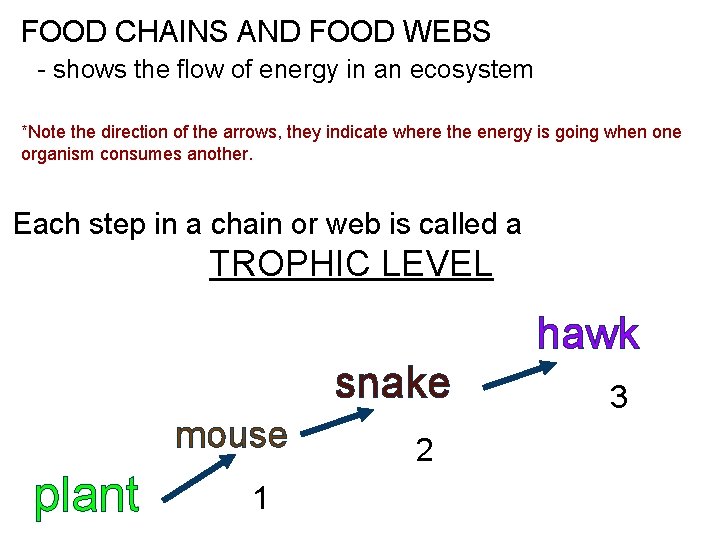
FOOD CHAINS AND FOOD WEBS - shows the flow of energy in an ecosystem *Note the direction of the arrows, they indicate where the energy is going when one organism consumes another. Each step in a chain or web is called a TROPHIC LEVEL hawk snake mouse plant 1 2 3
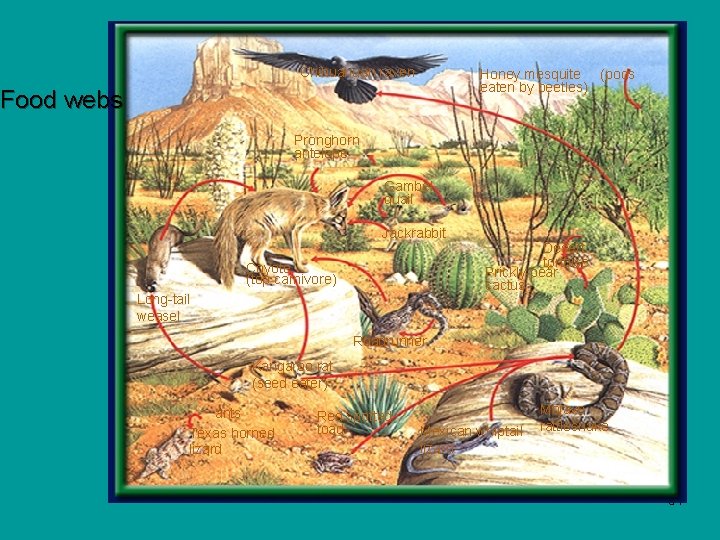
Chihuahuan raven Honey mesquite (pods eaten by beetles) Food webs Pronghorn antelope Gambel quail Jackrabbit Coyote (top carnivore) Long-tail weasel Desert tortoise Prickly pear cactus Roadrunner Kangaroo rat (seed eater) ants Texas horned lizard Red spotted toad Mexican whiptail lizard Mojave rattlesnake 51
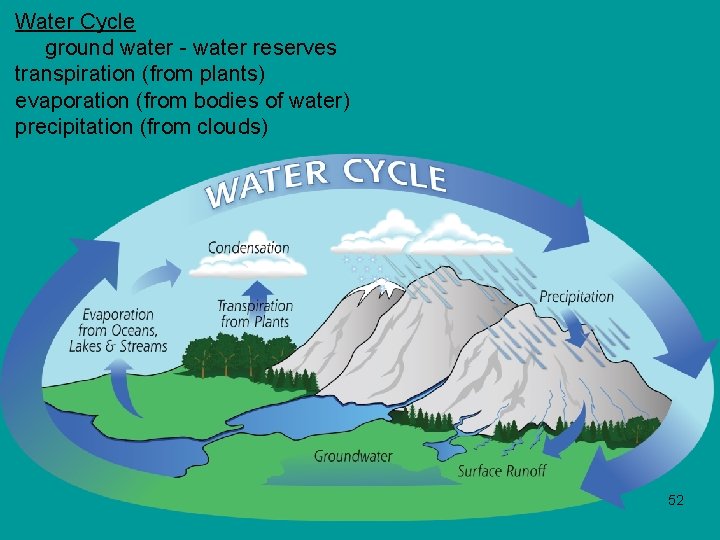
Water Cycle ground water - water reserves transpiration (from plants) evaporation (from bodies of water) precipitation (from clouds) 52
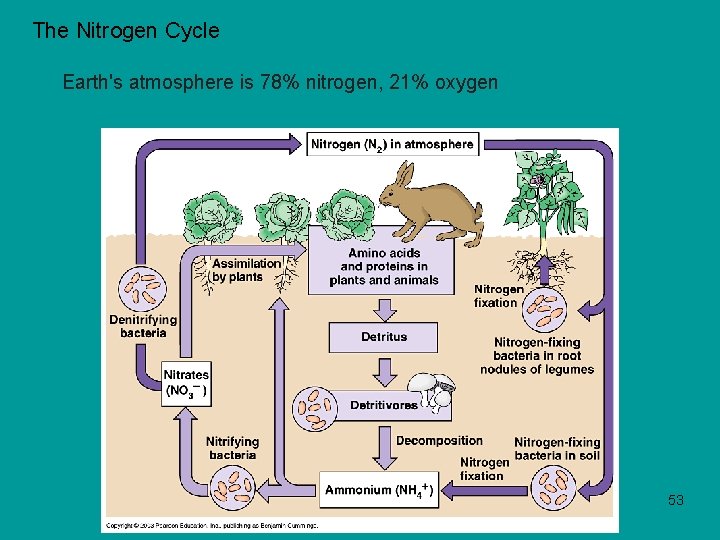
The Nitrogen Cycle Earth's atmosphere is 78% nitrogen, 21% oxygen 53
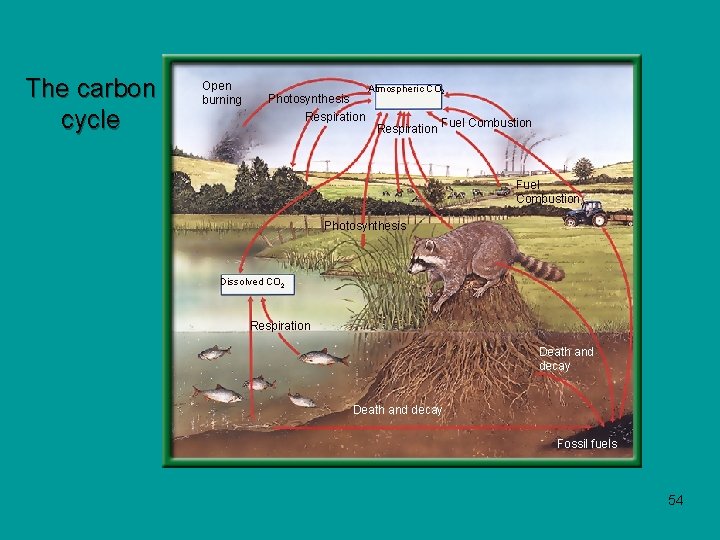
The carbon cycle Open burning Photosynthesis Respiration Atmospheric CO 2 Respiration Fuel Combustion Photosynthesis Dissolved CO 2 Respiration Death and decay Fossil fuels 54
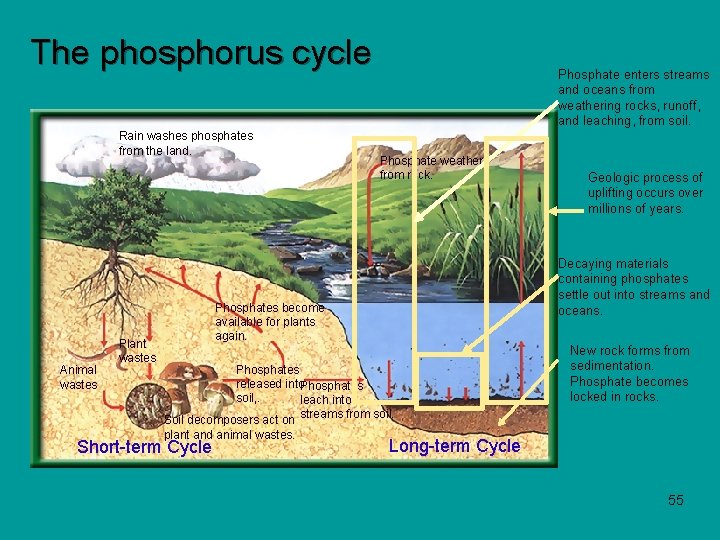
The phosphorus cycle Rain washes phosphates from the land. Animal wastes Plant wastes Phosphate enters streams and oceans from weathering rocks, runoff, and leaching, from soil. Phosphate weathers from rock. Decaying materials containing phosphates settle out into streams and oceans. Phosphates become available for plants again. Phosphates released into. Phosphates soil, . leach into Soil decomposers act on streams from soil. plant and animal wastes. Short-term Cycle Geologic process of uplifting occurs over millions of years. New rock forms from sedimentation. Phosphate becomes locked in rocks. Long-term Cycle 55