
Taxonomical details Order Rosales Family Rosaceae Subfamily Prunoideae
Taxonomical details Order = Rosales Family = Rosaceae Sub-family = Prunoideae Genus = Prunus Sub genus = Amygdalus Species = persica Basic chromosome = 8 Somatic number =16
Introduction: • Peach along with its smooth-skin mutant, the nectarine, is a temperate juicy fruit of excellent appearance and quality. • It comes to the market early in the season, particularly the low chilling peaches and growers get remunerative prices. • Peaches originated in China, some traders carried over the stones of peaches from China to Kashmir. • Peaches were introduced by Mr. Alexander Coutts in Himachal Pradesh in 1870. • Some low chilling varieties of peach were also introduced at Punjab Agricultural University, Ludhiana during 1968 from California.
AREA AND PRODUCTION • The major peach producing countries are Italy, USA, Spain, China, France, Greece and Japan. • In India, peach is grown on a commercial scale in mid hills of Himachal Pradesh, Jammu and Kashmir, Uttarakhand, as well as in a limited scale in north-eastern states. • In Himachal Pradesh, peaches are commercially grown in Rajgarh area of District Sirmour, which is also known as peach bowl of India. • Low chill varieties of peaches are commercially grown in Punjab, Haryana and Eastern U. P. • In India , peach occupies an area of 35531 hectares with a total production of 237921 MT ( FAO, 2010 -11). • In Himachal Pradesh the area under this fruit is 5195 ha and production is 5162 MT (Annon. 2010).
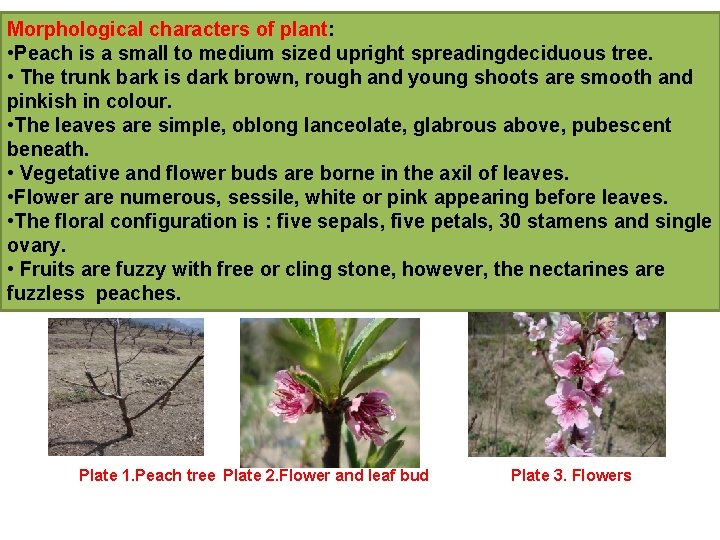
Morphological characters of plant: • Peach is a small to medium sized upright spreadingdeciduous tree. • The trunk bark is dark brown, rough and young shoots are smooth and pinkish in colour. • The leaves are simple, oblong lanceolate, glabrous above, pubescent beneath. • Vegetative and flower buds are borne in the axil of leaves. • Flower are numerous, sessile, white or pink appearing before leaves. • The floral configuration is : five sepals, five petals, 30 stamens and single ovary. • Fruits are fuzzy with free or cling stone, however, the nectarines are fuzzless peaches. Plate 1. Peach tree Plate 2. Flower and leaf bud Plate 3. Flowers
Climate and Soil • Peaches require humid climate with cold winter and dry summer. • It is moderately winter hardy and swelling buds are injured at -6. 5°C. • Peach needs about 500 to 800 hours of chilling. • Chilling requirement is easily met in areas located between 900 to 1600 m above mean sea level. • Low chilling varieties, which require 250 to 300 chilling hours • The limiting factors in peach cultivation are : 1. the minimum winter temperature 2. chilling hours, spring frosts, 3. hailstorms, high humidity 4. desiccating winds during summer. • Deep sandy loam soil rich in organic matter is best • Highly susceptible to water logging. • The p. H of the soil 5. 8 and 6. 8.
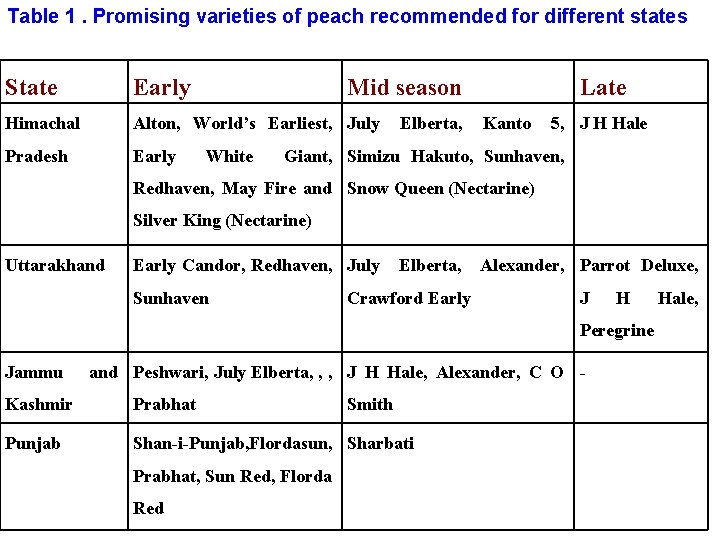
Table 1. Promising varieties of peach recommended for different states State Early Mid season Himachal Alton, World’s Earliest, July Pradesh Early White Elberta, Late Kanto 5, J H Hale Giant, Simizu Hakuto, Sunhaven, Redhaven, May Fire and Snow Queen (Nectarine) Silver King (Nectarine) Uttarakhand Early Candor, Redhaven, July Sunhaven Elberta, Crawford Early Alexander, Parrot Deluxe, J H Peregrine Jammu and Peshwari, July Elberta, , , J H Hale, Alexander, C O - Kashmir Prabhat Punjab Shan-i-Punjab, Flordasun, Sharbati Prabhat, Sun Red, Florda Red Smith Hale,
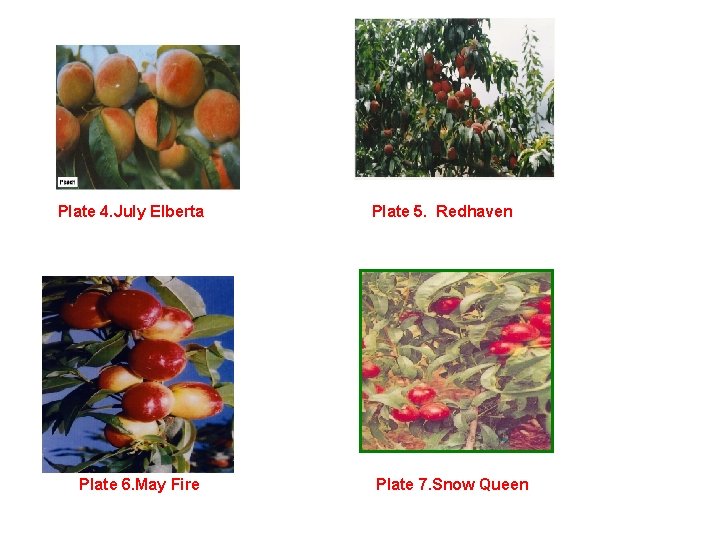
Plate 4. July Elberta Plate 6. May Fire Plate 5. Redhaven Plate 7. Snow Queen
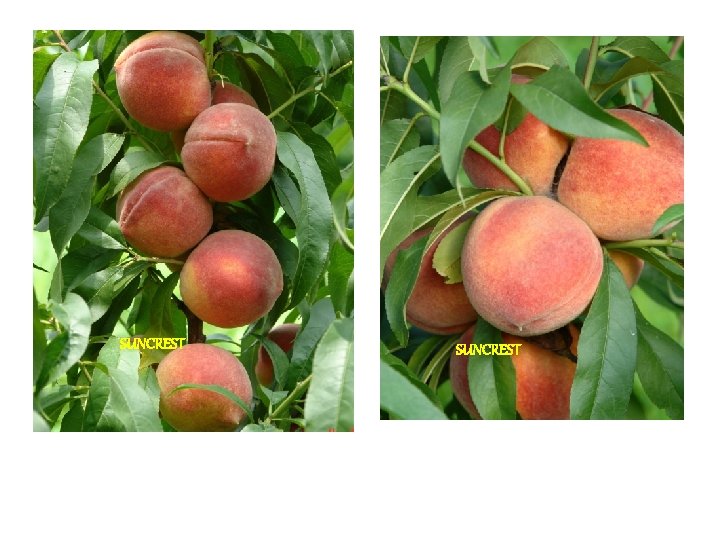
SUNCREST
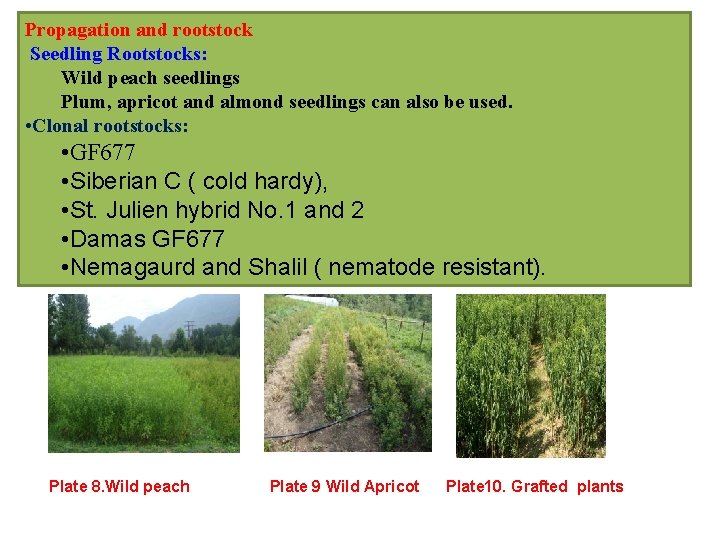
Propagation and rootstock Seedling Rootstocks: Wild peach seedlings Plum, apricot and almond seedlings can also be used. • Clonal rootstocks: • GF 677 • Siberian C ( cold hardy), • St. Julien hybrid No. 1 and 2 • Damas GF 677 • Nemagaurd and Shalil ( nematode resistant). Plate 8. Wild peach Plate 9 Wild Apricot Plate 10. Grafted plants
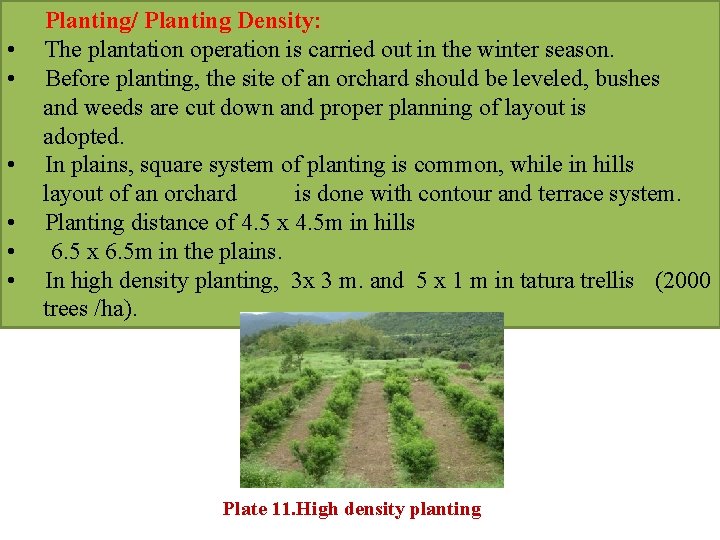
• • • Planting/ Planting Density: The plantation operation is carried out in the winter season. Before planting, the site of an orchard should be leveled, bushes and weeds are cut down and proper planning of layout is adopted. In plains, square system of planting is common, while in hills layout of an orchard is done with contour and terrace system. Planting distance of 4. 5 x 4. 5 m in hills 6. 5 x 6. 5 m in the plains. In high density planting, 3 x 3 m. and 5 x 1 m in tatura trellis (2000 trees /ha). Plate 11. High density planting
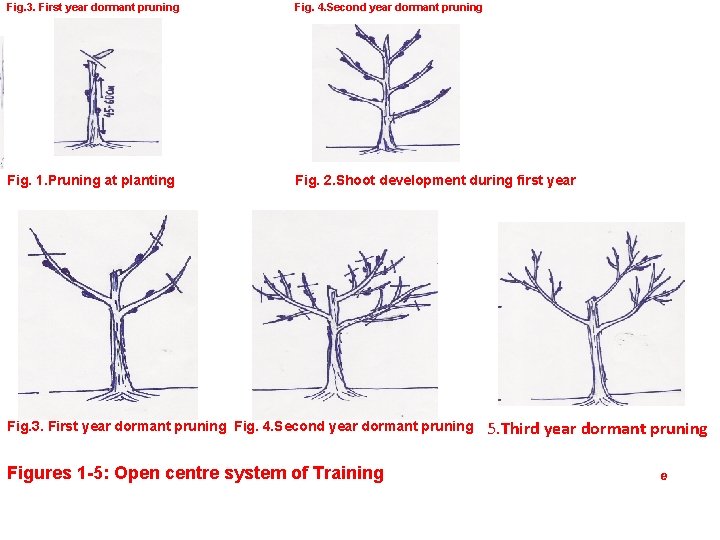
Fig. 3. First year dormant pruning Fig. 4. Second year dormant pruning Fig. 1. Pruning at planting Fig. 2. Shoot development during first year Fig. 3. First year dormant pruning Fig. 4. Second year dormant pruning Figures 1 -5: Open centre system of Training 5. Third year dormant pruning e
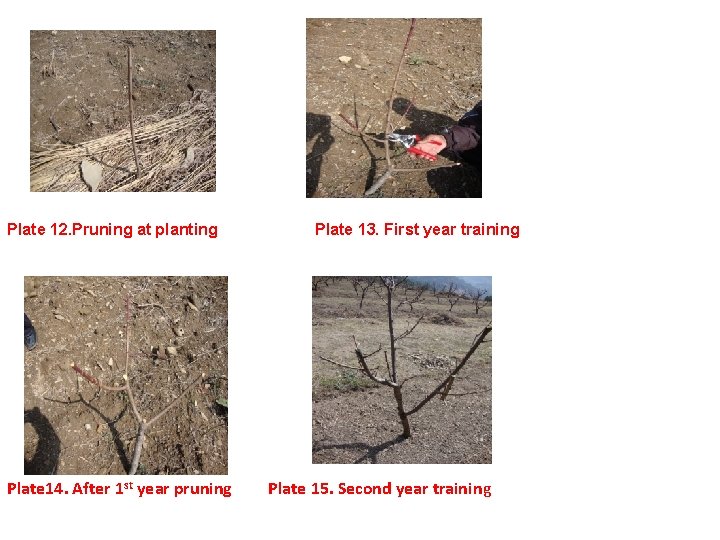
Plate 12. Pruning at planting Plate 14. After 1 st year pruning Plate 13. First year training Plate 15. Second year training
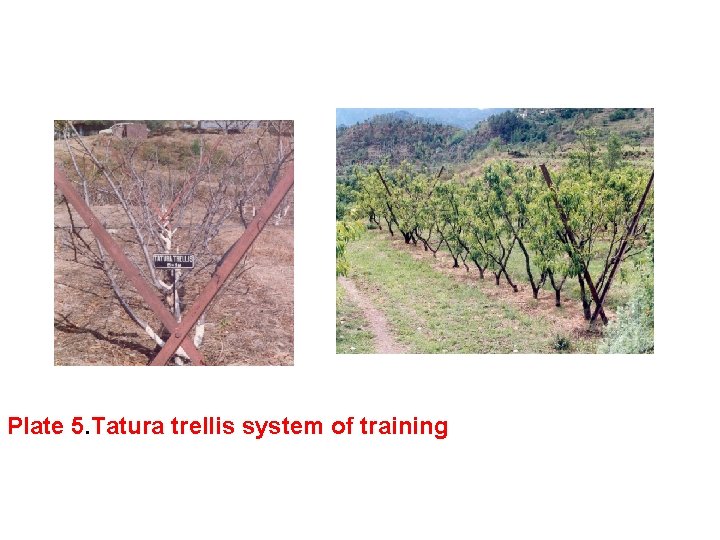
Plate 5. Tatura trellis system of training
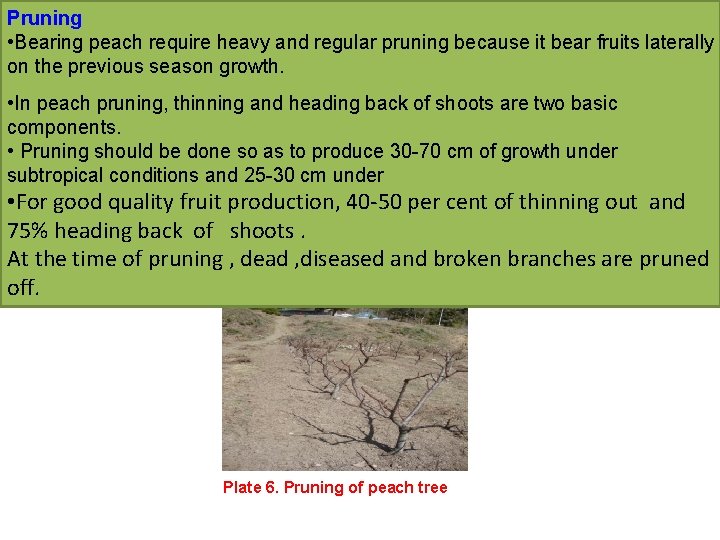
Pruning • Bearing peach require heavy and regular pruning because it bear fruits laterally on the previous season growth. • In peach pruning, thinning and heading back of shoots are two basic components. • Pruning should be done so as to produce 30 -70 cm of growth under subtropical conditions and 25 -30 cm under • For good quality fruit production, 40 -50 per cent of thinning out and 75% heading back of shoots. At the time of pruning , dead , diseased and broken branches are pruned off. Plate 6. Pruning of peach tree
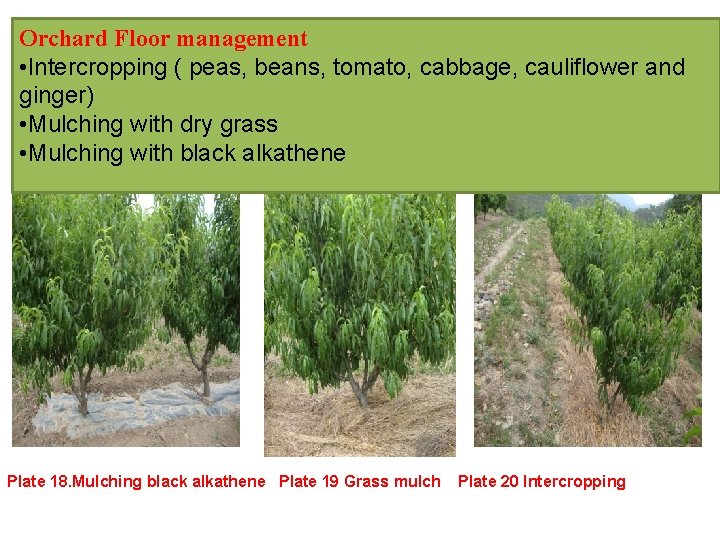
Orchard Floor management • Intercropping ( peas, beans, tomato, cabbage, cauliflower and ginger) • Mulching with dry grass • Mulching with black alkathene Plate 18. Mulching black alkathene Plate 19 Grass mulch Plate 20 Intercropping
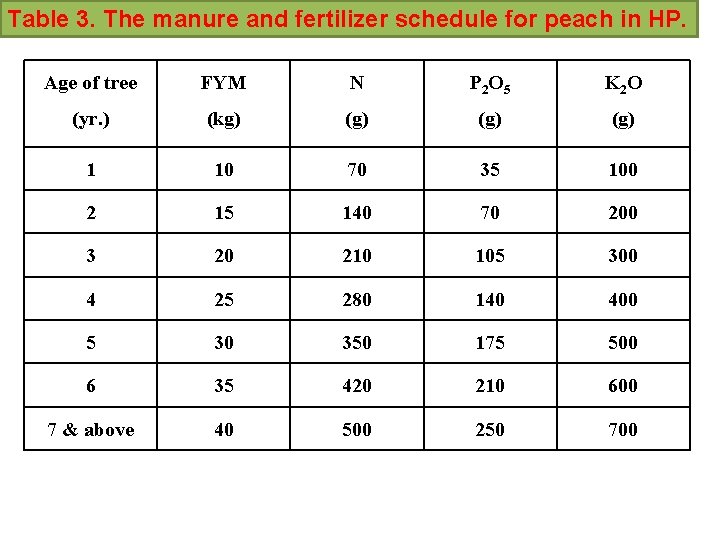
Table 3. The manure and fertilizer schedule for peach in HP. Age of tree FYM N P 2 O 5 K 2 O (yr. ) (kg) (g) (g) 1 10 70 35 100 2 15 140 70 200 3 20 210 105 300 4 25 280 140 400 5 30 350 175 500 6 35 420 210 600 7 & above 40 500 250 700
Irrigation • Irrigation is very essential for harvesting the peaches of better size and quality. • A sufficient moisture in the soil before the emergence of leaves and flowers is required for proper fruit-set and growth. • Frequent irrigations are needed during the fruit development. Lack of irrigation, particularly, during dry and hot summer result in fruit drop, reduced fruit size and quality. • In the hills, at least two- three irrigations and in plains, weekly irrigation should be given during the fruit development period. • In general, for quality fruit production irrigation at 80% of field capacity is recommended.
Crop Regulation • Heavy flowering and fruiting resulting in small sized, poor quality fruits. • The criteria for fruit thinning in peach are based on leaf to fruit ratio of 30 -40 leaves per fruit. • Application of Ethephon (300 ppm) at petal fall in July Elberta is recommended for optimum fruit thinning. • In Redhaven peach, Ethephon (600 ppm) 20 -30 days after fruit set when the fruitlets are 20 -25 cm in diameter, should be used for thinning. • Hand thinning at 5 -7. 5 cm fruit spacing before pit hardening stage is equally effective.
Maturity, Harvesting. Storage and post- harvest management • Various indices are: • Days from full bloom, • Calendar dates, fruit size, • Firmness, • Pit discoloration, • Freeness of pit • Change of ground colour. • Days required from flowering to maturity vary in different cultivars varies from 78 to 127 days. • Early season varieties like Flordasun takes 81 • Alexander 86 days, • mid season. July Elberta 101 days • late season cv. Elberta takes 127 days from full bloom to harvest. • Hand picking is the standard method for harvesting fruits. • The picking containers are lined with cushion materials to avoid cuts and bruises.
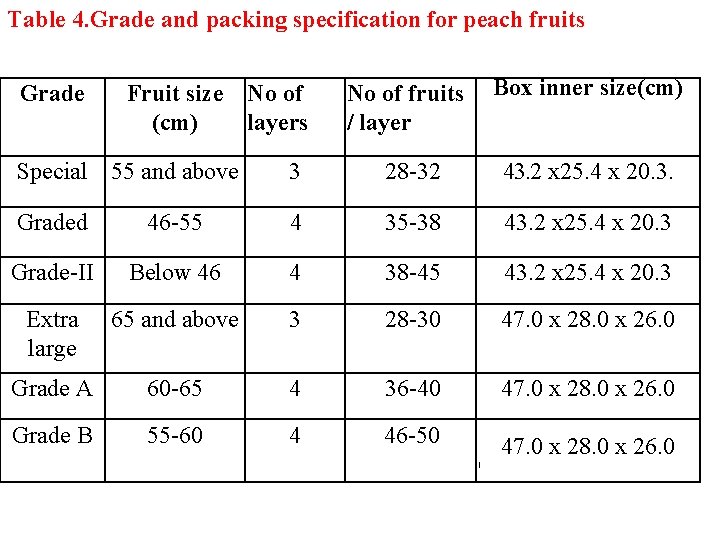
Table 4. Grade and packing specification for peach fruits Grade Fruit size (cm) No of layers Box inner size(cm) No of fruits / layer Special 55 and above 3 28 -32 43. 2 x 25. 4 x 20. 3. Graded 46 -55 4 35 -38 43. 2 x 25. 4 x 20. 3 Grade-II Below 46 4 38 -45 43. 2 x 25. 4 x 20. 3 Extra large 65 and above 3 28 -30 47. 0 x 28. 0 x 26. 0 Grade A 60 -65 4 36 -40 47. 0 x 28. 0 x 26. 0 Grade B 55 -60 4 46 -50 47. 0 x 28. 0 x 26. 0 I
- Slides: 20