
Taxes and the Economy To understand the role


- Slides: 31
Taxes and the Economy To understand the role of taxes in our economy
Two Basic Principles of Taxation l Benefits received principle – people benefit from the taxes they pay
Two Basic Principles of Taxation l Benefits received principle – people benefit from the taxes they pay – Ex. We pay a large tax on gas, and that tax foes to maintain the roads which we use to drive on
Two Basic Principles of Taxation l Benefits received principle – people benefit from the taxes they pay – l Ex. We pay a large tax on gas, and that tax foes to maintain the roads which we use to drive on Ability to pay principle – those who have the greatest income should pay the highest tax rates
Two Basic Principles of Taxation l Benefits received principle – people benefit from the taxes they pay – l Ex. We pay a large tax on gas, and that tax foes to maintain the roads which we use to drive on Ability to pay principle – those who have the greatest income should pay the highest tax rates – Ex. Our income tax system
Two Other Characteristics l Sometimes the gov’t will give tax breaks to encourage growth, this is known as the productivity principle
Two Other Characteristics l Sometimes the gov’t will give tax breaks to encourage growth, this is known as the productivity principle – Ex. Gov’t will cut 10% of taxes if business upgrades equipment
Two Other Characteristics l Sometimes the gov’t will give tax breaks to encourage growth, this is known as the productivity principle – l Ex. Gov’t will cut 10% of taxes if business upgrades equipment Because the gov’t creates the taxes, they try to be hush-hush
Two Other Characteristics l Sometimes the gov’t will give tax breaks to encourage growth, this is known as the productivity principle – l Ex. Gov’t will cut 10% of taxes if business upgrades equipment Because the gov’t creates the taxes, they try to be hush-hush – They will pass taxes upon those who are least likely to be offended
Two Other Characteristics l Sometimes the gov’t will give tax breaks to encourage growth, this is known as the productivity principle – l Ex. Gov’t will cut 10% of taxes if business upgrades equipment Because the gov’t creates the taxes, they try to be hush-hush – – They will pass taxes upon those who are least likely to be offended Ex. Taxes on sale of alcohol and liquor “sin taxes”
The Burden of Taxes l Three ways to classify taxes
The Burden of Taxes l Three ways to classify taxes – Progressive – more you make, the more they take
The Burden of Taxes l Three ways to classify taxes – – Progressive – more you make, the more they take Regressive – less you make the more they take
The Burden of Taxes l Three ways to classify taxes – – – Progressive – more you make, the more they take Regressive – less you make the more they take Proportional – all pay the same percentage of their income
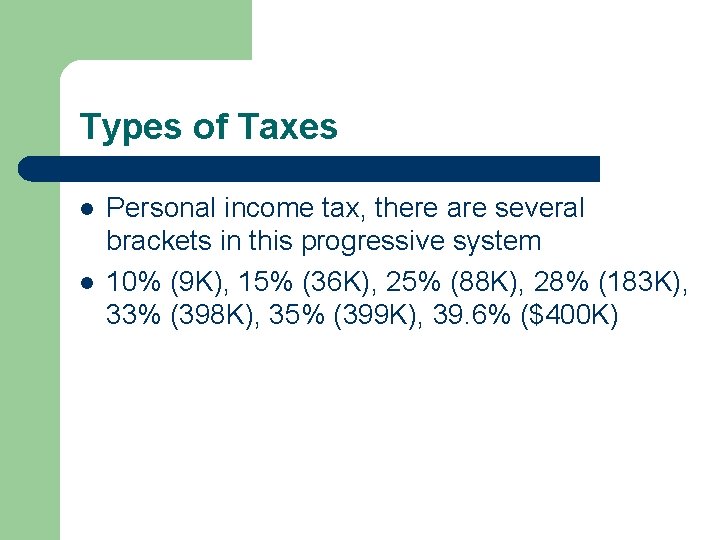
Types of Taxes l l Personal income tax, there are several brackets in this progressive system 10% (9 K), 15% (36 K), 25% (88 K), 28% (183 K), 33% (398 K), 35% (399 K), 39. 6% ($400 K)
Types of Taxes l Personal income tax, there are 3 brackets in this progressive system – Greatest source of income
Types of Taxes l Personal income tax, there are 3 brackets in this progressive system – l Greatest source of income Social Insurance Taxes, proportional tax is the 2 nd greatest source of income
Types of Taxes l Personal income tax, there are 3 brackets in this progressive system – l l Greatest source of income Social Insurance Taxes, proportional tax is the 2 nd greatest source of income Corporate income tax, 3 rd greatest, range up to 36% of profits
State and Local Taxes l Sales tax is most important for the state
State and Local Taxes l l Sales tax is most important for the state Property tax for the local
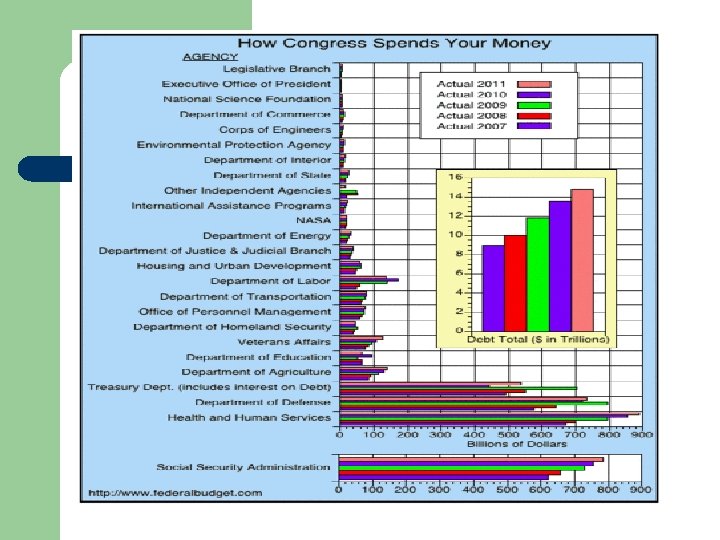
Where does the money go?
Where does the money go? l Remember, the gov’t is not out to turn a profit
Where does the money go? l l Remember, the gov’t is not out to turn a profit Also, elected officials are try to please voters (what is good politically is not always good economically)
Where does the money go? l l l Remember, the gov’t is not out to turn a profit Also, elected officials are try to please voters (what is good politically is not always good economically) About $1 out of $5 of the GDP is spent by the gov’t in 2001, Today it is about $1 out of every $3 of the GDP
President and the Budget l President prepares and delivers the budget to Congress
President and the Budget l l President prepares and delivers the budget to Congress By October 1 st , that must be passed
President and the Budget l l l President prepares and delivers the budget to Congress By October 1 st , that must be passed Problem: In the 20 th century, the gov’t generally spent more money that it took in (deficit)
President and the Budget l l l President prepares and delivers the budget to Congress By October 1 st , that must be passed Problem: In the 20 th century, the gov’t generally spent more money that it took in (deficit) – Now they must collect more in taxes to begin to pay off debts
President and the Budget l l l President prepares and delivers the budget to Congress By October 1 st , that must be passed Problem: In the 20 th century, the gov’t generally spent more money that it took in (deficit) – – Now they must collect more in taxes to begin to pay off debts However, we have problems meeting the budget each year (war on terror)