
Taxation and Subsidies Purpose and Effect taxation A
Taxation and Subsidies Purpose and Effect
taxation A tax is a government policy that allows the government to obtain a sum of money from consumers or firms for various purposes. Its purpose 1. For government to obtain funds to run the country 2. For government to reduce or curb the consumption or use of an undesirable good (eg. demerit goods like cigarette, alcohol etc) 3. To help government to reduce the income difference by redistributing monies from higher income earners to lower income earners. [demerit good - a good whereby if the government left it to the free market, will be over produced to the extent that it gives of negative externalities and causing markets failure)
Taxation 1. For government to obtain funds to run the country - By using direct tax - eg income tax, tax on property etc. (direct tax meaning the one has to pay the government directly) - By using indirect tax - eg Goods and Service Tax (GST), Electronic Road Pricing (ERP) (indirect tax meaning someone will pay the tax to the government on your behalf eg. the 711 store, petrol station etc.

Taxation Demerit goods like cigarettes and alcohol affect the environment negatively as well as give rise to social ills. Because of this, the government needs to reduce their consumption (ie. reduce their quantity demanded. P How Taxes reduce demand for a demerit good S 1 S 0 E 1 P 1 When an indirect is applied (eg. GST), this will increase the cost of production of a firm. (or a producers). As such, owing to the tax, the supply curve will shift leftward from S 0 to S 1 as now less is being produced at every price level owing to the tax. E 0 P 0 D Q 1 Q 0 Assuming that the initial market equilibrium (E 0) the market clearing price and output is P 0 and Q 0 respectively. Owing to the tax, the prices will increase from P 0 to P 1 and output will be cut back from Q 0 to Q 1. With a tax, the government objective of reduction of the Q demerit good is achieved as its consumption is now decreased from Q 0 to Q 1.
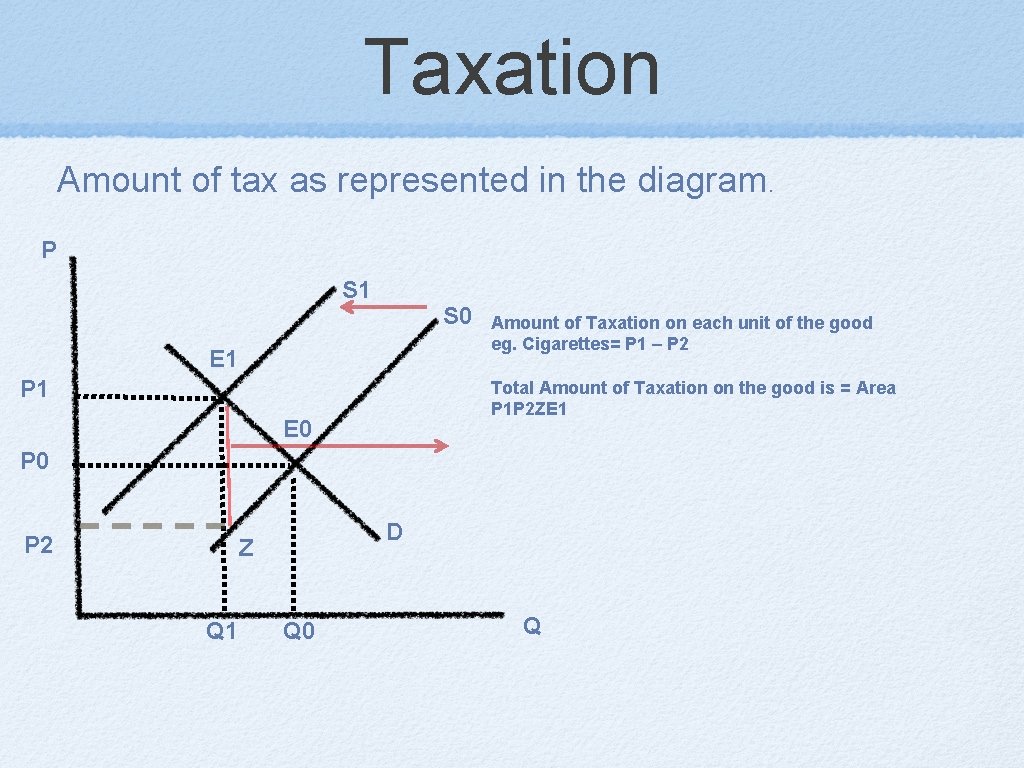
Taxation Amount of tax as represented in the diagram. P S 1 S 0 E 1 P 1 Amount of Taxation on each unit of the good eg. Cigarettes= P 1 – P 2 Total Amount of Taxation on the good is = Area P 1 P 2 ZE 1 E 0 P 2 D Z Q 1 Q 0 Q
Taxation 3. For the re-distribution of wealth. - The difference in incomes between the highest earners and lowest earners in a country is called the income gap. - If the income gap is too wide, this means that the rich are getting richer and poor are getting poorer. The governments needs to ensure that the people’s incomes are as equitable as possible so that they poor will not be exploited. - Taxes have the ability to take some from the richer to help supplement the poorer people’s income.
subsidies Subsidies are given to help promote the consumption or production of a merit good that gives off positive externalities to society. A merit good is a good that when left to the free market will be under consumed or underproduced.
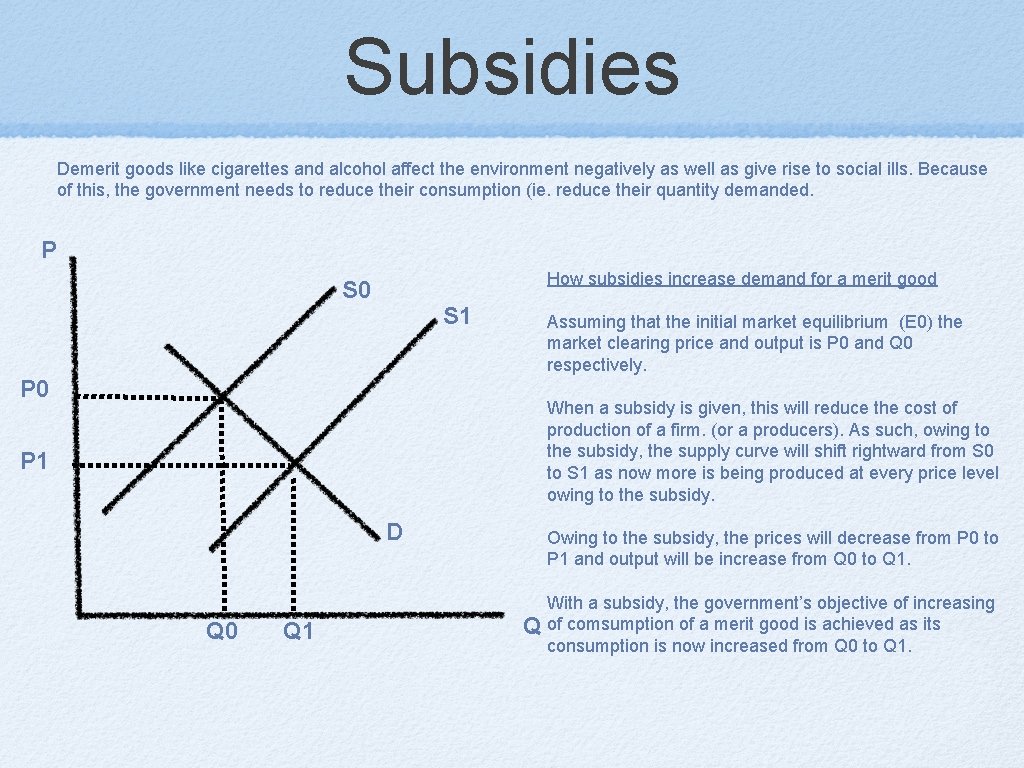
Subsidies Demerit goods like cigarettes and alcohol affect the environment negatively as well as give rise to social ills. Because of this, the government needs to reduce their consumption (ie. reduce their quantity demanded. P How subsidies increase demand for a merit good S 0 S 1 P 0 Assuming that the initial market equilibrium (E 0) the market clearing price and output is P 0 and Q 0 respectively. When a subsidy is given, this will reduce the cost of production of a firm. (or a producers). As such, owing to the subsidy, the supply curve will shift rightward from S 0 to S 1 as now more is being produced at every price level owing to the subsidy. P 1 D Q 0 Q 1 Owing to the subsidy, the prices will decrease from P 0 to P 1 and output will be increase from Q 0 to Q 1. With a subsidy, the government’s objective of increasing Q of comsumption of a merit good is achieved as its consumption is now increased from Q 0 to Q 1.
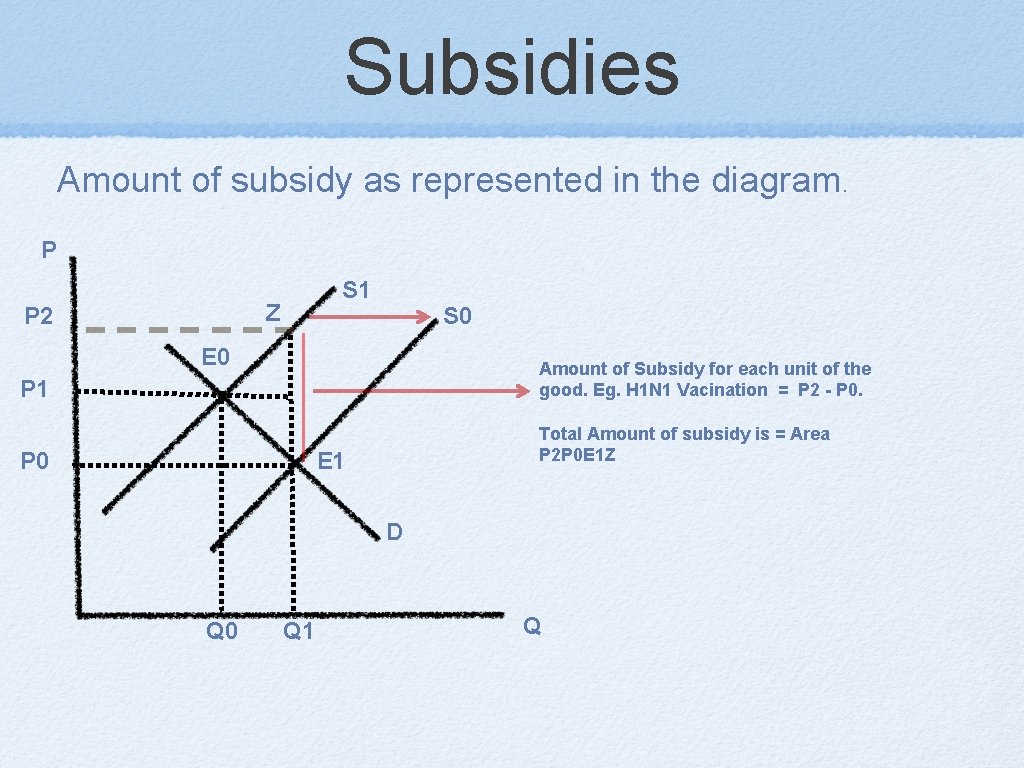
Subsidies Amount of subsidy as represented in the diagram. P S 1 Z P 2 S 0 E 0 Amount of Subsidy for each unit of the good. Eg. H 1 N 1 Vacination = P 2 - P 0. P 1 Total Amount of subsidy is = Area P 2 P 0 E 1 Z E 1 P 0 D Q 0 Q 1 Q
- Slides: 9