
Tax Value Method Outline of presentation Part A




- Slides: 37
Tax Value Method
Outline of presentation Part A: Four instances for benefit Part B: Observations on the four instances Part C: What benefits arise? Part D: Reform alternatives to TVM Part E: Future actions Part F: Summary Tax Value Method
Assumptions for presentation n Presentation focuses on outcomes and benefits sought from TVM, plus reform alternatives and reform actions n Presentation assumes that a case has been made for reform of the income tax system (“The Essential Thesis”) n Presentation assumes operation of TVM is understood (“The Mechanism”) Tax Value Method
Part A: Four instances for benefit Tax Value Method
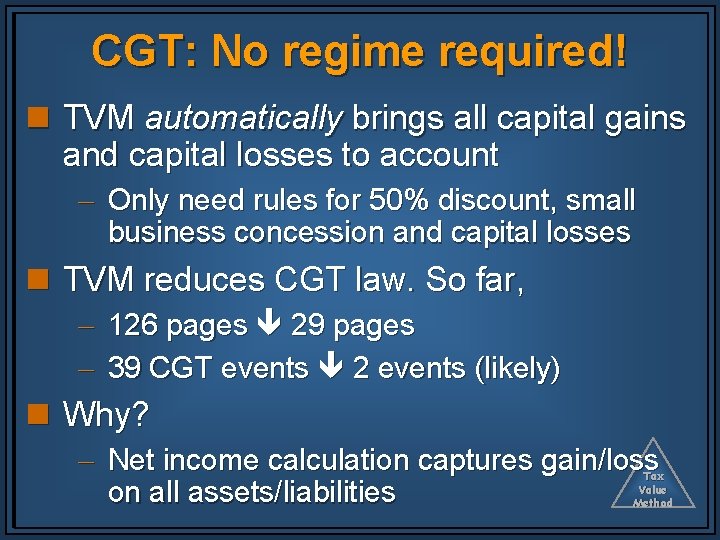
CGT: No regime required! n TVM automatically brings all capital gains and capital losses to account - Only need rules for 50% discount, small business concession and capital losses n TVM reduces CGT law. So far, - 126 pages 29 pages - 39 CGT events 2 events (likely) n Why? - Net income calculation captures gain/loss on all assets/liabilities Tax Value Method
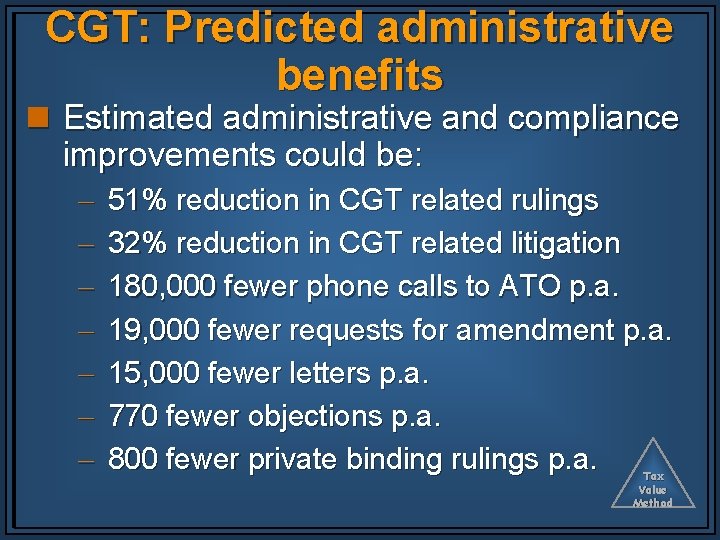
CGT: Predicted administrative benefits n Estimated administrative and compliance improvements could be: - 51% reduction in CGT related rulings 32% reduction in CGT related litigation 180, 000 fewer phone calls to ATO p. a. 19, 000 fewer requests for amendment p. a. 15, 000 fewer letters p. a. 770 fewer objections p. a. 800 fewer private binding rulings p. a. Tax Value Method
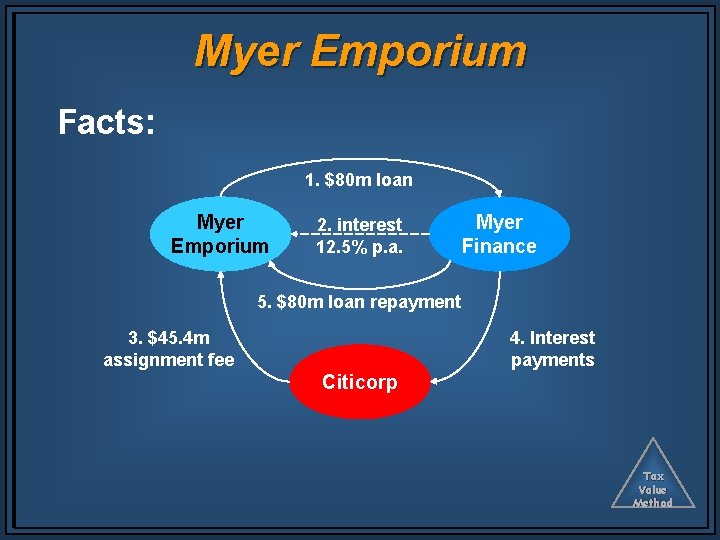
Myer Emporium Facts: 1. $80 m loan Myer Emporium 2. interest 12. 5% p. a. Myer Finance 5. $80 m loan repayment 3. $45. 4 m assignment fee 4. Interest payments Citicorp Tax Value Method
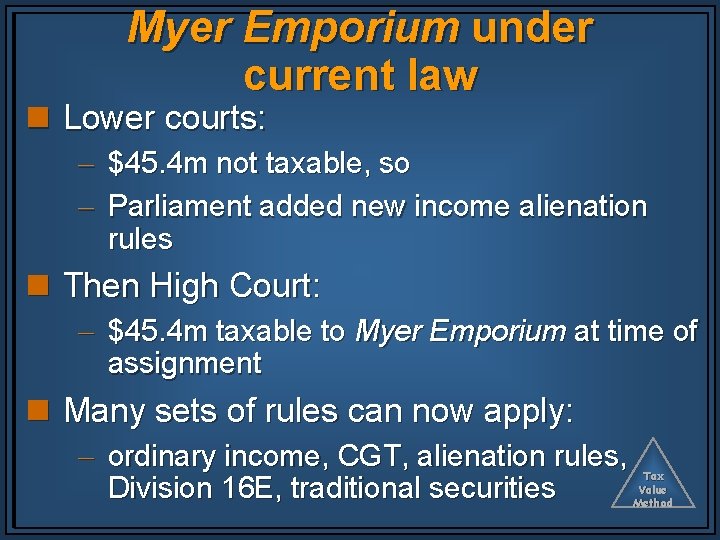
Myer Emporium under current law n Lower courts: - $45. 4 m not taxable, so - Parliament added new income alienation rules n Then High Court: - $45. 4 m taxable to Myer Emporium at time of assignment n Many sets of rules can now apply: - ordinary income, CGT, alienation rules, Division 16 E, traditional securities Tax Value Method
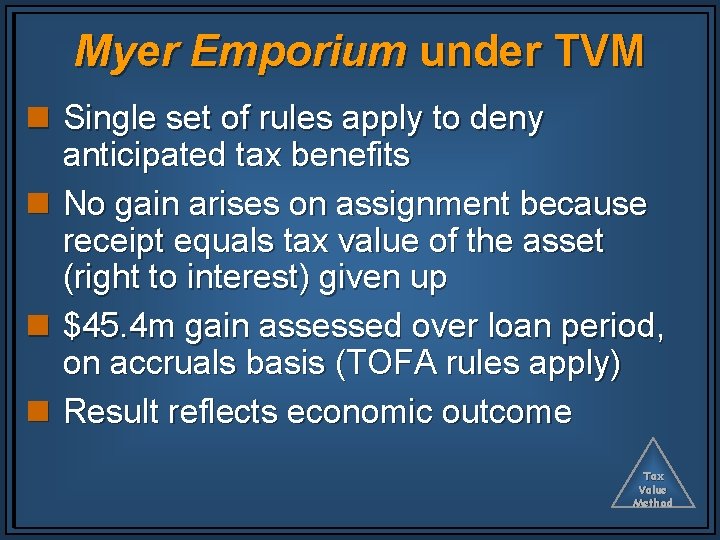
Myer Emporium under TVM n Single set of rules apply to deny anticipated tax benefits n No gain arises on assignment because receipt equals tax value of the asset (right to interest) given up n $45. 4 m gain assessed over loan period, on accruals basis (TOFA rules apply) n Result reflects economic outcome Tax Value Method
Consolidation of Company Groups n Under consolidation proposals, allocation of tax values to assets and liabilities is complex because - consolidation requires the tax value of assets to be restated - assets/liabilities do not have a unique tax value under current law - complex law required to specify multiple tax values of certain assets - varied valuation rules apply Tax Value Method
Consolidation under TVM n Simpler to apply - Assets/liabilities have a unique tax value under TVM - Easier to restate this tax value on commencement of consolidation - Simpler drafting of consolidation legislation. Legislation less complex Tax Value Method
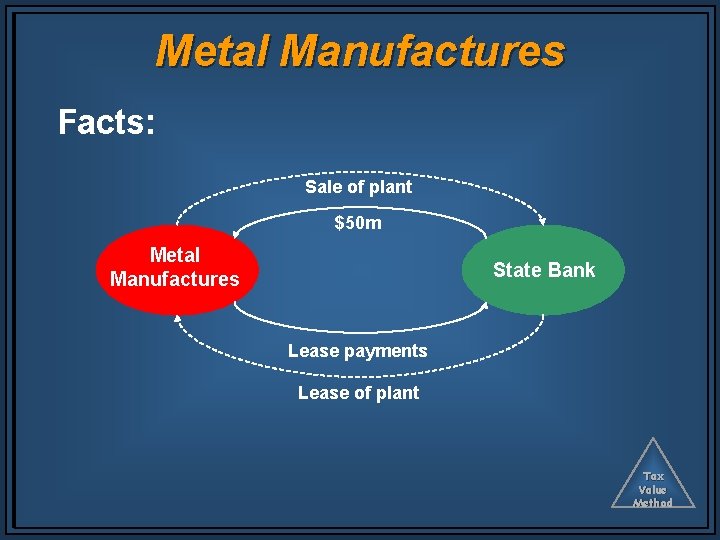
Metal Manufactures Facts: Sale of plant $50 m Metal Manufactures State Bank Lease payments Lease of plant Tax Value Method
Metal Manufactures under current law n Commissioner argued portion of lease rental was a non-deductible capital expense n Full Federal Court: - finance lease could not be characterised as loan - lease payments were fully deductible. No portion was a capital expense n Effective outcome is a deduction for loan repayments n Will the Parliament make a legislative Tax Value Method
Metal Manufactures under TVM n Characterisation of the arrangement irrelevant n TVM effectively divides rental payments: - notional interest ‘deductible’ - notional principal not ‘deductible’ n Reflects economic outcome because only actual losses recognised n Specific amendments to the law not required Tax Value Method
Part B: Observations on four instances Tax Value Method
These four instances deal with. . . n Current legislation - e. g. CGT n Current case law - e. g. Myer Emporium n Current policy development - e. g. Consolidation of company groups n Possible future policy development - e. g. Sale and lease-back transactions/ Metal Manufactures Tax Value Method
What do the four instances show… Myer Emporium n Current income recognition faults are eliminated n Case law and litigation should be reduced n Tax scheme opportunities and incentives reduced - asymmetry and timing anomalies eliminated - some schemes not have tax advantages, so not happen Tax Value Method
What do the four instances show… CGT and “Myer Emporium” Rules n TVM reduces volume of law n Legislation shorter and simpler because: - one way of doing things standardised core rules no overlapping n Other areas will be shorter, or removed, for the same reasons (e. g. debt forgiveness rules) Tax Value Method
What do the four instances show… Consolidations n TVM improves current policy process n One way of doing things: - cohesive platform for policy development - simpler legislation means easier development - easier to identify policy departures - simplifies support products (e. g. publications explaining obligations) Tax Value Method
What do the four instances show… Sale and leaseback transactions n Future policy issues do not arise (or can be better handled) - advantage of standard core rules and cohesive principles n Reduces need to amend legislation n Demonstrates ability to deal with economic/ commercial developments (even those not presently anticipated) Tax Value Method
What are wider implications? n Instances identified demonstrate positive outcomes from TVM proposal n Further instances where positive outcomes arise can be identified e. g. write off of IRU’s n Issue remains whether these outcomes will extrapolate into benefits for the income tax system per se Tax Value Method
Part C: What benefits arise from these instances? Tax Value Method
Benefits to legislation n Clearer and more coherent structure - e. g. better consolidations provisions n Better drafted provisions n Shorter and less complex - fewer provisions to assess specific circumstances (e. g. no specific CGT rules) n No gaps, no overlaps Tax Value Method
Benefits to law design n Standardised definition of income and core rules - cohesive platform for policy development (clear benchmark for assessing appropriate income and expenditure recognition) - easier to explain effect of policy decisions - easier to implement actual policy intent - no need to reinvent the wheel n Appropriate default treatment - fewer amendments Tax Value Method
Benefits to law users n One way of doing things - easier to analyse transactions and avoid errors - easier to understand explain the law - easier to discern policy intent n Reduced volume of law n Less new law to learn and teach n Less support material - fewer rulings, cases Tax Value Method
Benefits to taxpayers n Law more certain n More appropriate assessments - closer to economic outcomes (e. g. no timing anomalies) n Less tax litigation (and less dispute) n Impact: - improved certainty in making business decisions - less resources diverted to tax planning and audits - improved support products Tax Value Method
Part D: Reform alternatives to TVM? Tax Value Method
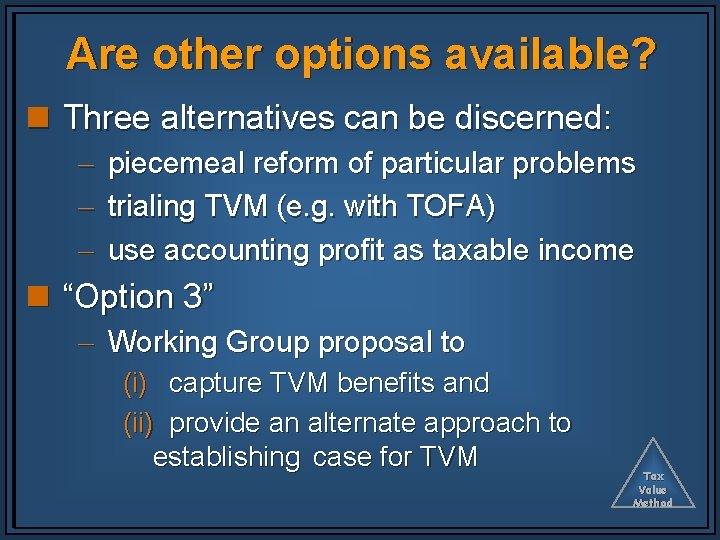
Are other options available? n Three alternatives can be discerned: - piecemeal reform of particular problems trialing TVM (e. g. with TOFA) use accounting profit as taxable income n “Option 3” - Working Group proposal to (i) capture TVM benefits and (ii) provide an alternate approach to establishing case for TVM Tax Value Method
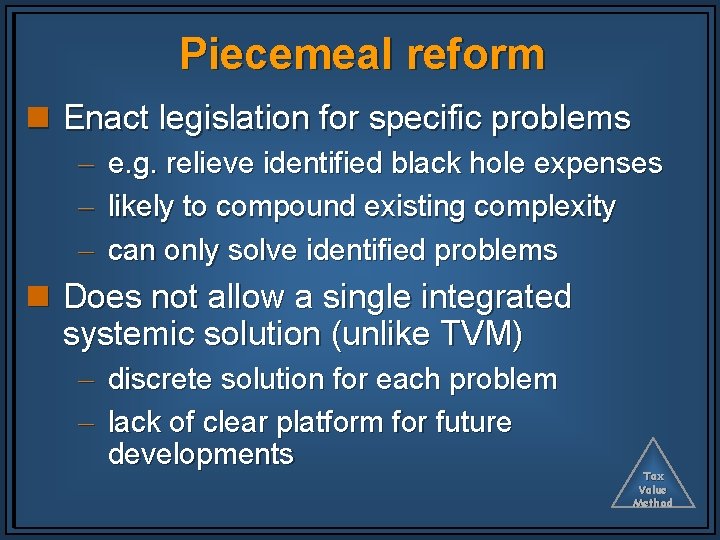
Piecemeal reform n Enact legislation for specific problems - e. g. relieve identified black hole expenses likely to compound existing complexity can only solve identified problems n Does not allow a single integrated systemic solution (unlike TVM) - discrete solution for each problem - lack of clear platform for future developments Tax Value Method
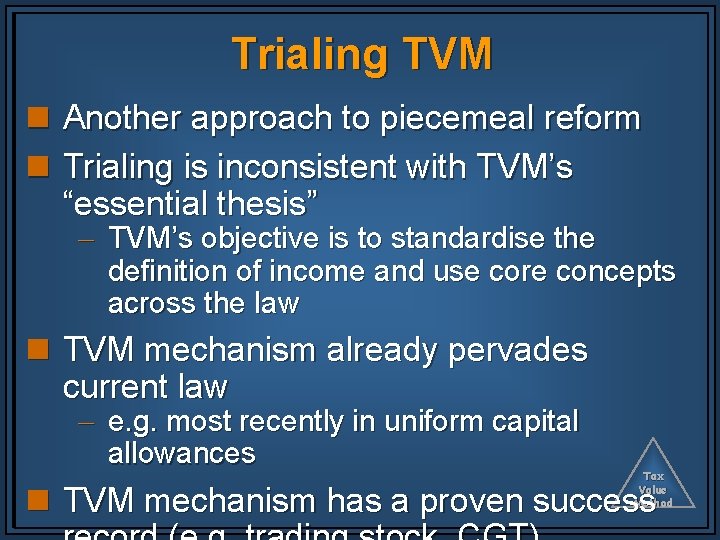
Trialing TVM n Another approach to piecemeal reform n Trialing is inconsistent with TVM’s “essential thesis” - TVM’s objective is to standardise the definition of income and use core concepts across the law n TVM mechanism already pervades current law - e. g. most recently in uniform capital allowances Tax Value Method n TVM mechanism has a proven success
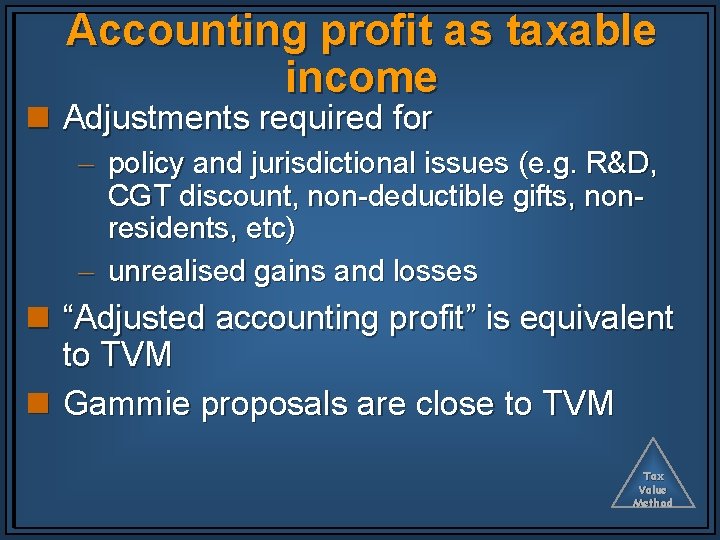
Accounting profit as taxable income n Adjustments required for - policy and jurisdictional issues (e. g. R&D, CGT discount, non-deductible gifts, nonresidents, etc) - unrealised gains and losses n “Adjusted accounting profit” is equivalent to TVM n Gammie proposals are close to TVM Tax Value Method
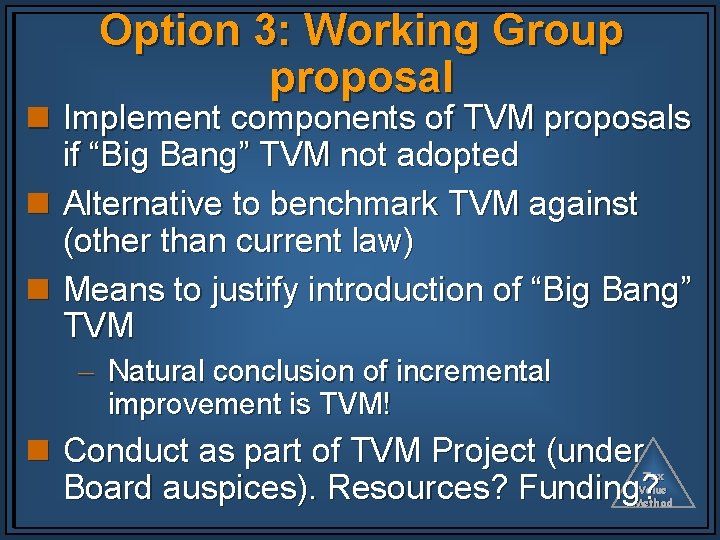
Option 3: Working Group proposal n Implement components of TVM proposals if “Big Bang” TVM not adopted n Alternative to benchmark TVM against (other than current law) n Means to justify introduction of “Big Bang” TVM - Natural conclusion of incremental improvement is TVM! n Conduct as part of TVM Project (under Board auspices). Resources? Funding? Tax Value Method
Part E: Future actions Tax Value Method
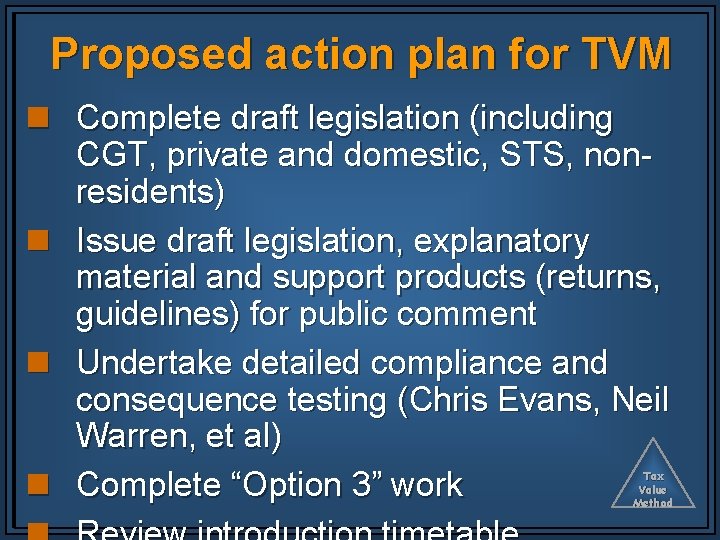
Proposed action plan for TVM n Complete draft legislation (including CGT, private and domestic, STS, nonresidents) n Issue draft legislation, explanatory material and support products (returns, guidelines) for public comment n Undertake detailed compliance and consequence testing (Chris Evans, Neil Warren, et al) n Complete “Option 3” work Tax Value Method
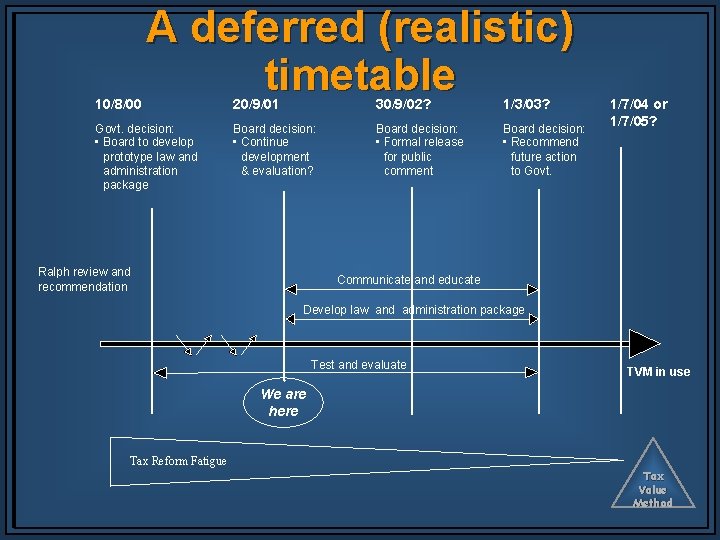
10/8/00 A deferred (realistic) timetable Govt. decision: • Board to develop prototype law and administration package 20/9/01 30/9/02? 1/3/03? Board decision: • Continue development & evaluation? Board decision: • Formal release for public comment Board decision: • Recommend future action to Govt. Ralph review and recommendation 1/7/04 or 1/7/05? Communicate and educate Develop law and administration package Test and evaluate TVM in use We are here Tax Reform Fatigue Tax Value Method
Part F: Summary Tax Value Method
What are the benefits of TVM? n TVM has benefits, but must be weighed against costs n TVM Project has benefits: - “spin-off” technology - insight into current tax system n Income tax system has three basic components: assessing, entities and administration - TVM Project is vehicle to improve the assessing function Tax Value Method