
Tax structure in india Before 1 st July
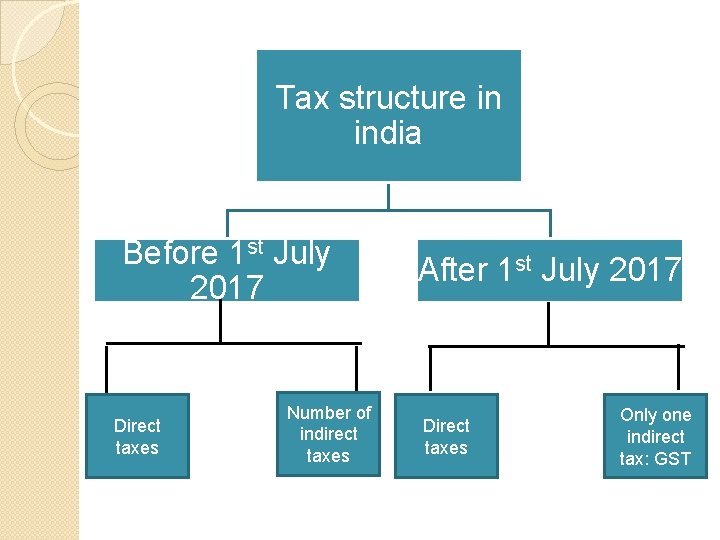
Tax structure in india Before 1 st July 2017 Direct taxes Number of indirect taxes After 1 st July 2017 Direct taxes Only one indirect tax: GST
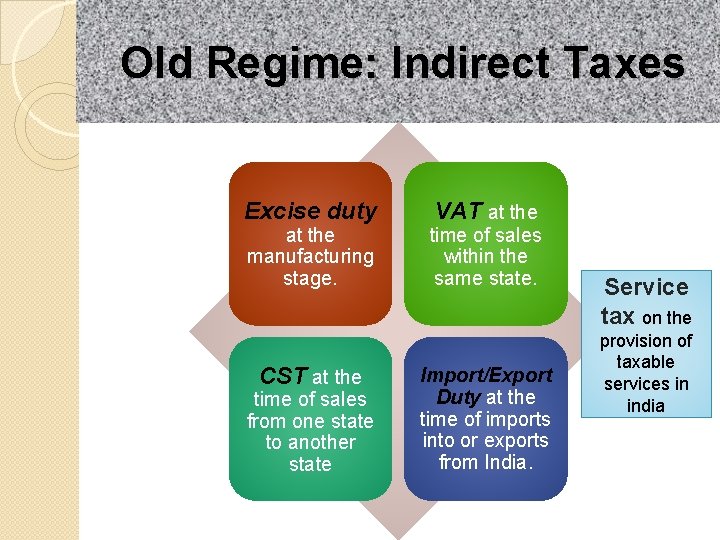
Old Regime: Indirect Taxes Excise duty at the manufacturing stage. CST at the time of sales from one state to another state VAT at the time of sales within the same state. Import/Export Duty at the time of imports into or exports from India. Service tax on the provision of taxable services in india

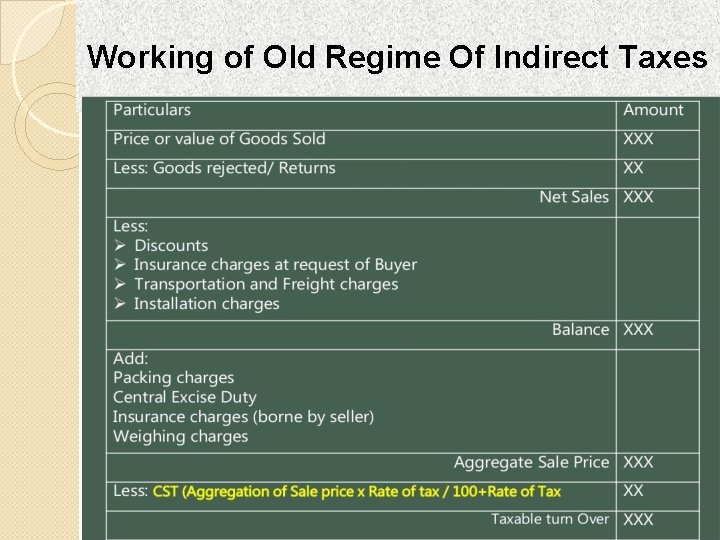
Working of Old Regime Of Indirect Taxes
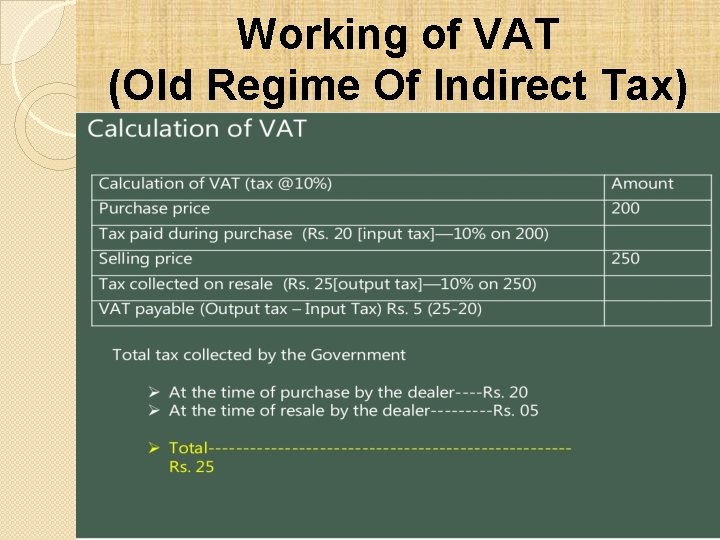
Working of VAT (Old Regime Of Indirect Tax)
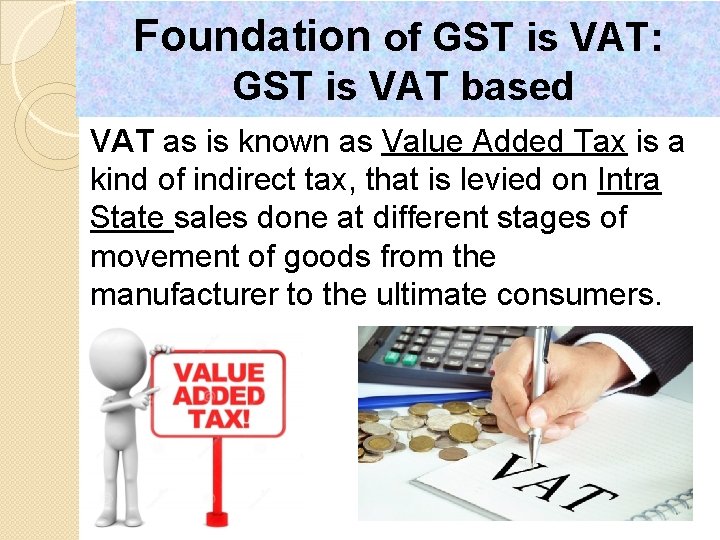
Foundation of GST is VAT: GST is VAT based VAT as is known as Value Added Tax is a kind of indirect tax, that is levied on Intra State sales done at different stages of movement of goods from the manufacturer to the ultimate consumers.
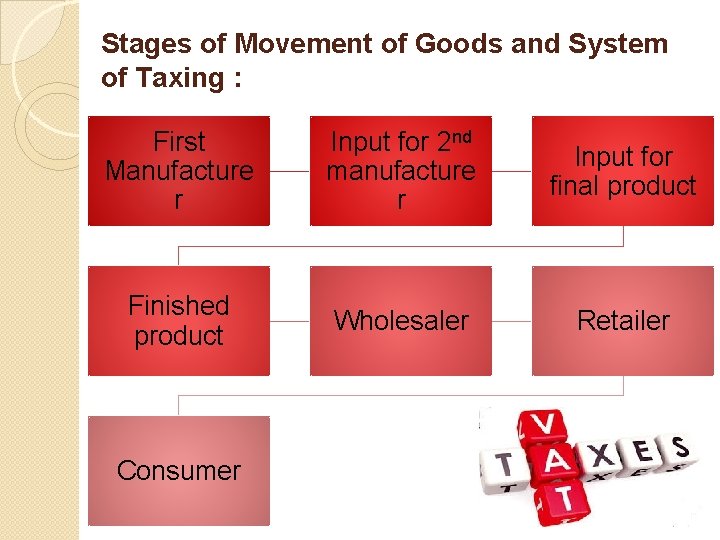
Stages of Movement of Goods and System of Taxing : First Manufacture r Input for 2 nd manufacture r Input for final product Finished product Wholesaler Retailer Consumer
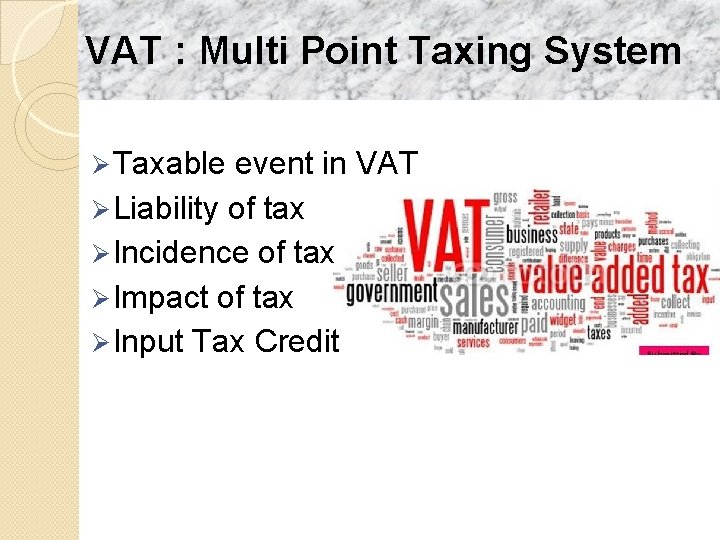
VAT : Multi Point Taxing System Ø Taxable event in VAT Ø Liability of tax Ø Incidence of tax Ø Impact of tax Ø Input Tax Credit
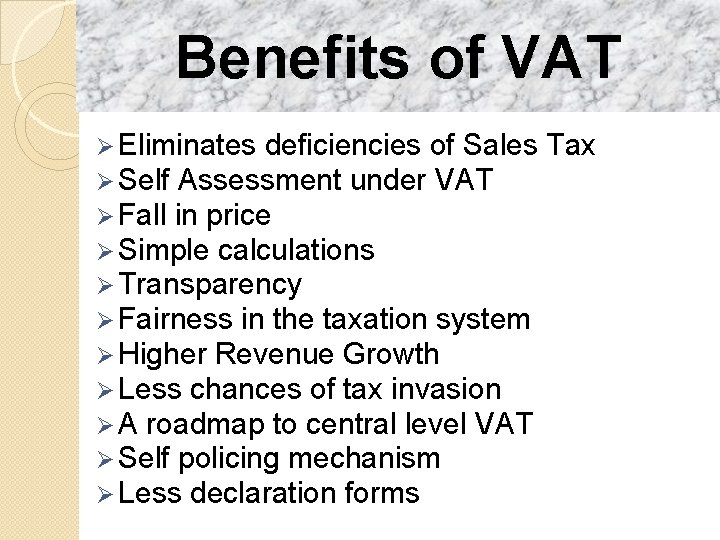
Benefits of VAT Ø Eliminates deficiencies of Sales Ø Self Assessment under VAT Ø Fall in price Ø Simple calculations Ø Transparency Ø Fairness in the taxation system Ø Higher Revenue Growth Ø Less chances of tax invasion Ø A roadmap to central level VAT Ø Self policing mechanism Ø Less declaration forms Tax
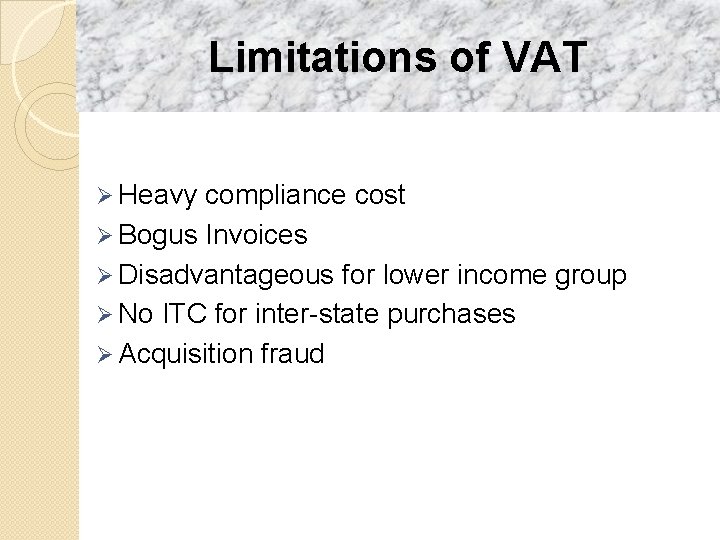
Limitations of VAT Ø Heavy compliance cost Ø Bogus Invoices Ø Disadvantageous for lower income group Ø No ITC for inter-state purchases Ø Acquisition fraud
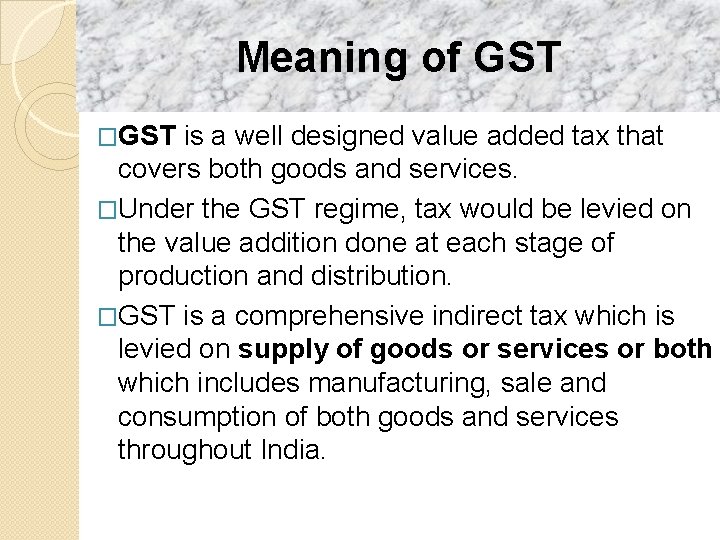
Meaning of GST �GST is a well designed value added tax that covers both goods and services. �Under the GST regime, tax would be levied on the value addition done at each stage of production and distribution. �GST is a comprehensive indirect tax which is levied on supply of goods or services or both which includes manufacturing, sale and consumption of both goods and services throughout India.
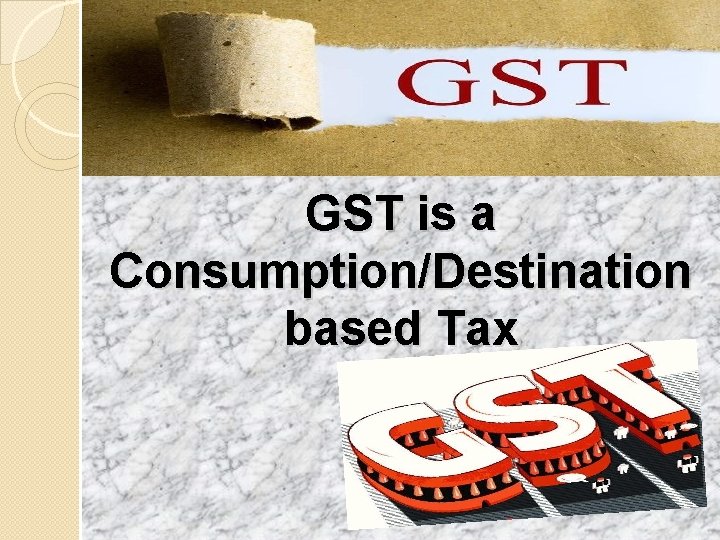
GST is a Consumption/Destination based Tax
� GST covers all the intermediaries involved in the supply chain. At every stage beginning from the production to distribution and ultimately till the goods or services reach the final consumer, GST would be levied. � But this does not lead to double taxation, as when one intermediary pays GST on his output supply, he is allowed to claim the credit of GST paid by him on his input supply. � GST being a destination based tax is levied on consumption basis i. e. the tax is levied when goods or services are consumed and the income of tax revenues accrue to the place where goods or services are consumed.
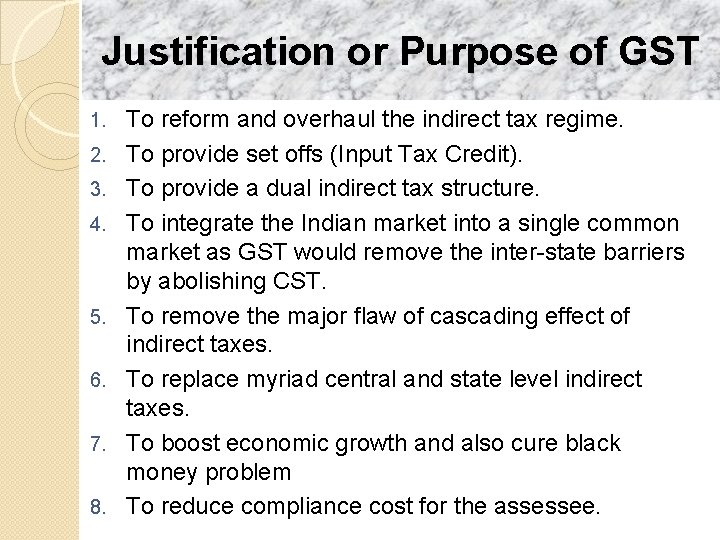
Justification or Purpose of GST 1. 2. 3. 4. 5. 6. 7. 8. To reform and overhaul the indirect tax regime. To provide set offs (Input Tax Credit). To provide a dual indirect tax structure. To integrate the Indian market into a single common market as GST would remove the inter-state barriers by abolishing CST. To remove the major flaw of cascading effect of indirect taxes. To replace myriad central and state level indirect taxes. To boost economic growth and also cure black money problem To reduce compliance cost for the assessee.
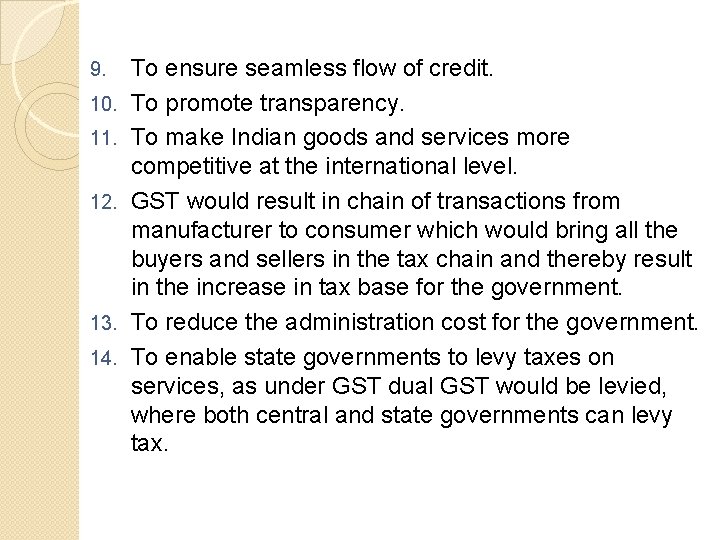
9. 10. 11. 12. 13. 14. To ensure seamless flow of credit. To promote transparency. To make Indian goods and services more competitive at the international level. GST would result in chain of transactions from manufacturer to consumer which would bring all the buyers and sellers in the tax chain and thereby result in the increase in tax base for the government. To reduce the administration cost for the government. To enable state governments to levy taxes on services, as under GST dual GST would be levied, where both central and state governments can levy tax.
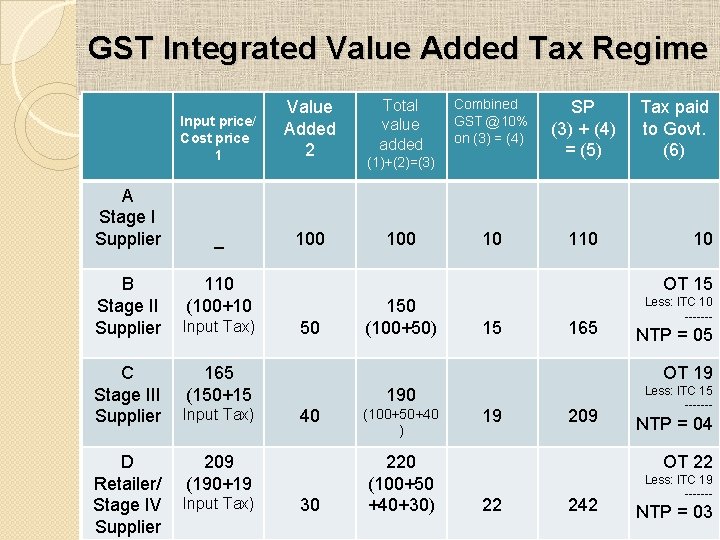
GST Integrated Value Added Tax Regime A Stage I Supplier B Stage II Supplier C Stage III Supplier D Retailer/ Stage IV Supplier Input price/ Cost price 1 Value Added 2 _ 100 110 (100+10 Input Tax) 50 SP (3) + (4) = (5) 10 110 (1)+(2)=(3) 100 Tax paid to Govt. (6) 10 150 (100+50) 15 165 Less: ITC 10 ------- NTP = 05 OT 19 190 40 209 (190+19 Input Tax) Combined GST @10% on (3) = (4) OT 15 165 (150+15 Input Tax) Total value added 30 (100+50+40 ) 220 (100+50 +40+30) 19 209 Less: ITC 15 ------- NTP = 04 OT 22 22 242 Less: ITC 19 ------- NTP = 03
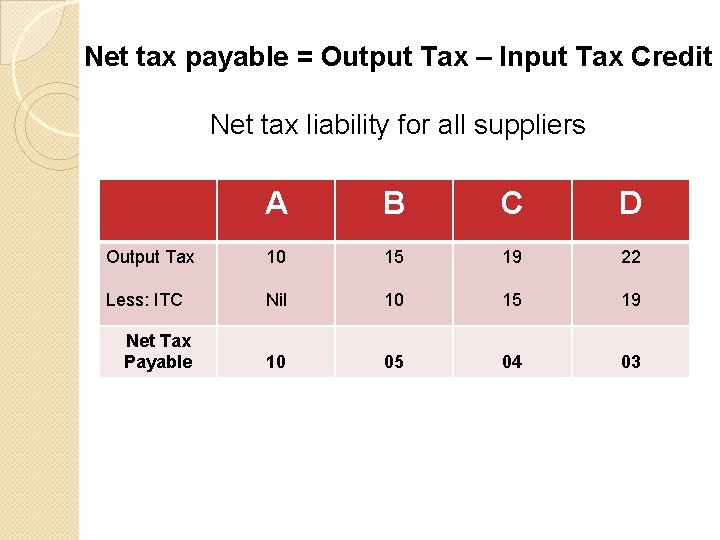
Net tax payable = Output Tax – Input Tax Credit Net tax liability for all suppliers A B C D Output Tax 10 15 19 22 Less: ITC Nil 10 15 19 10 05 04 03 Net Tax Payable
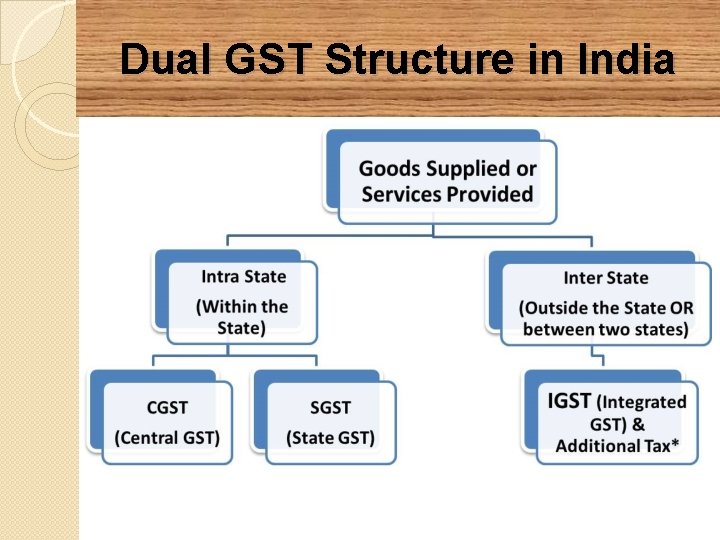
Dual GST Structure in India
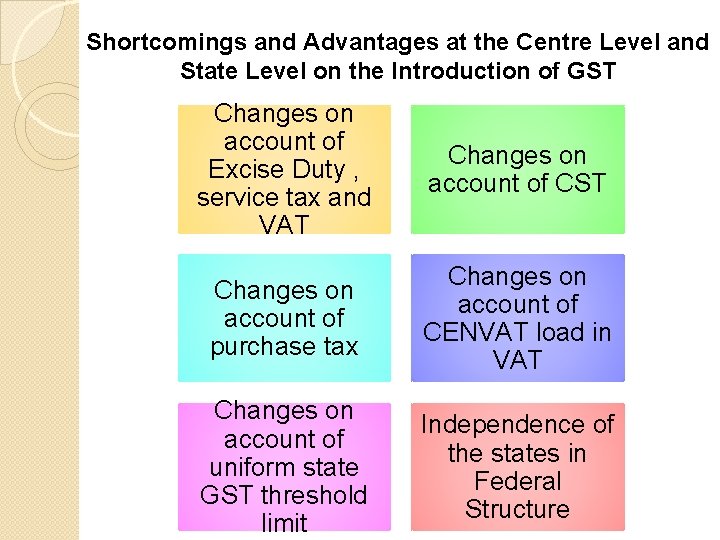
Shortcomings and Advantages at the Centre Level and State Level on the Introduction of GST Changes on account of Excise Duty , service tax and VAT Changes on account of CST Changes on account of purchase tax Changes on account of CENVAT load in VAT Changes on account of uniform state GST threshold limit Independence of the states in Federal Structure
Compensation to the States The Goods and Services Tax (Compensation to States) Act. 2017 deals with payment of compensation to the states for any loss of revenue on account of implementation of the GST for a period of five years, in accordance with the provisions of Section 18 of the Constitution Act, 2016.

- Slides: 22