
Tax Software Development in a Multi Jurisdictional Environment
- Slides: 23
Tax Software Development in a Multi -Jurisdictional Environment John Glaubitz, Vertex Chair, OASIS Tax. XML Business Analysis Subcommittee john. glaubitz@vertexinc. com 1/2/2022 13 th XBRL International Conference 1
Agenda • Tax Compliance • Information Exchange in Compliance • The Role of Tax Software Solutions • Issues and Challenges • Standardization and Semantic Interoperability • Benefits • Approach 1/2/2022 13 th XBRL International Conference 2
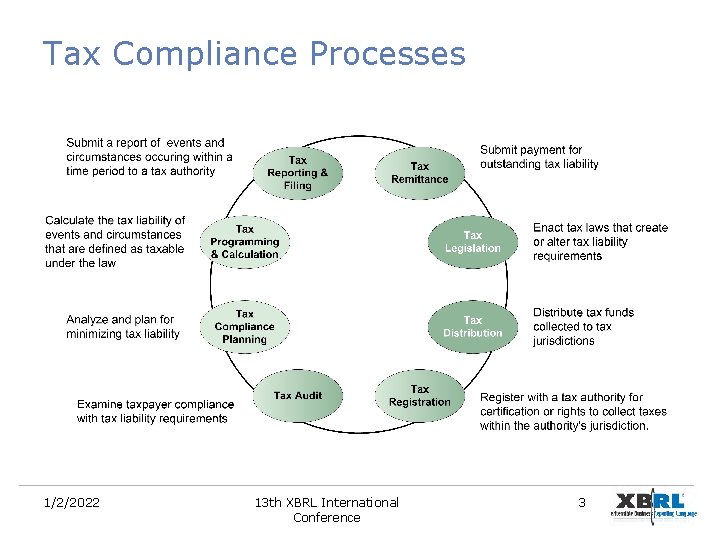
Tax Compliance Processes 1/2/2022 13 th XBRL International Conference 3
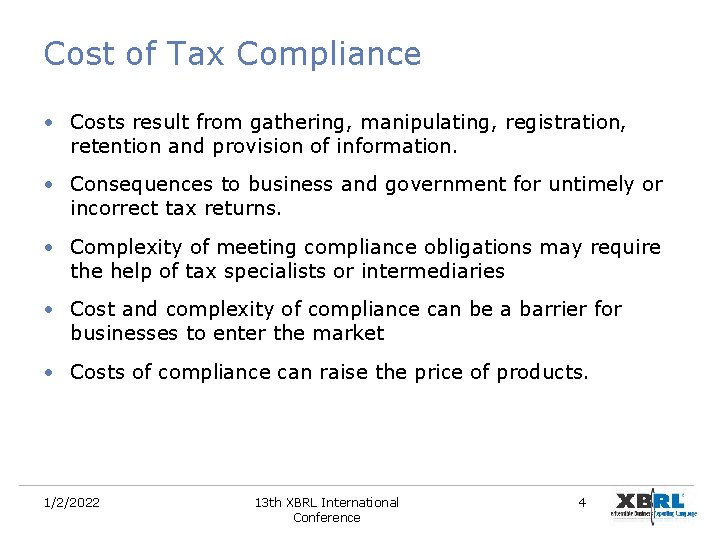
Cost of Tax Compliance • Costs result from gathering, manipulating, registration, retention and provision of information. • Consequences to business and government for untimely or incorrect tax returns. • Complexity of meeting compliance obligations may require the help of tax specialists or intermediaries • Cost and complexity of compliance can be a barrier for businesses to enter the market • Costs of compliance can raise the price of products. 1/2/2022 13 th XBRL International Conference 4
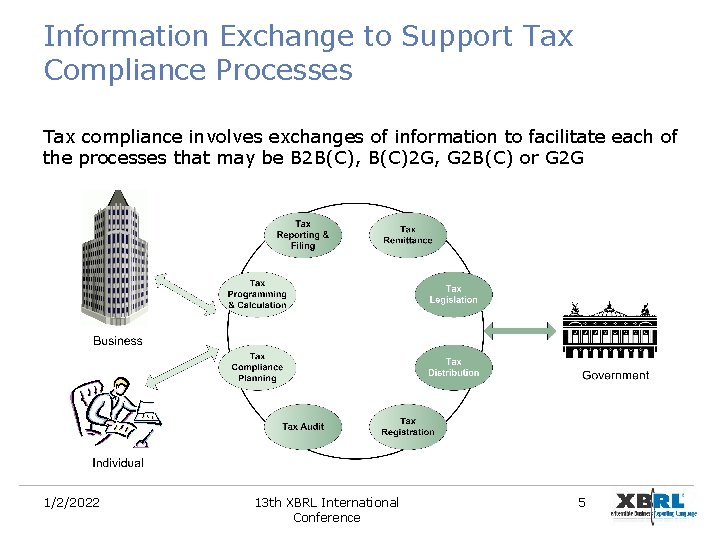
Information Exchange to Support Tax Compliance Processes Tax compliance involves exchanges of information to facilitate each of the processes that may be B 2 B(C), B(C)2 G, G 2 B(C) or G 2 G 1/2/2022 13 th XBRL International Conference 5
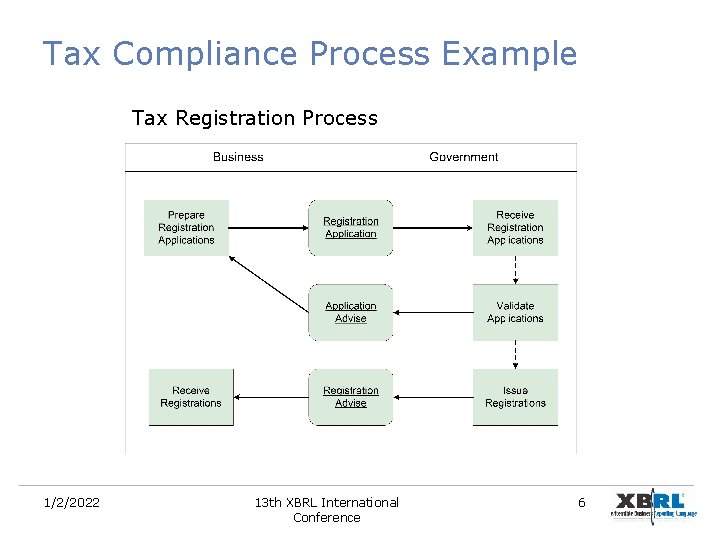
Tax Compliance Process Example Tax Registration Process 1/2/2022 13 th XBRL International Conference 6
Communication through Messages • Business processes are facilitated by information communicated through messages • Common processes can utilize common discrete messages. • Communication relies on agreement of meaning and content between parties 1/2/2022 13 th XBRL International Conference 7
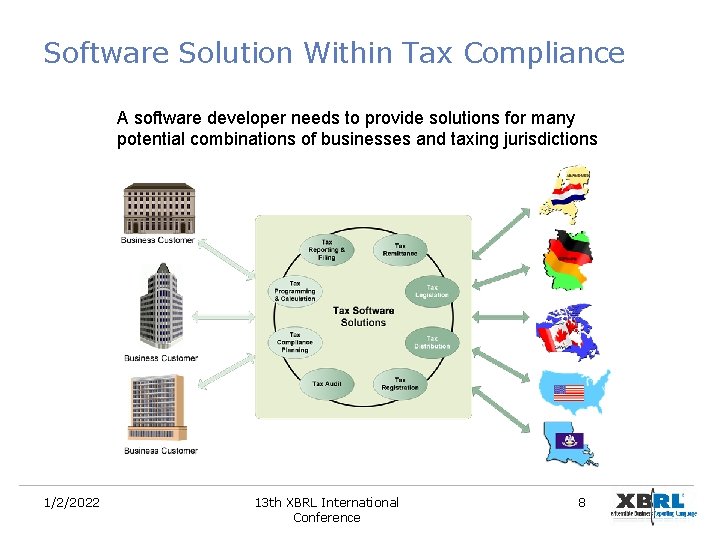
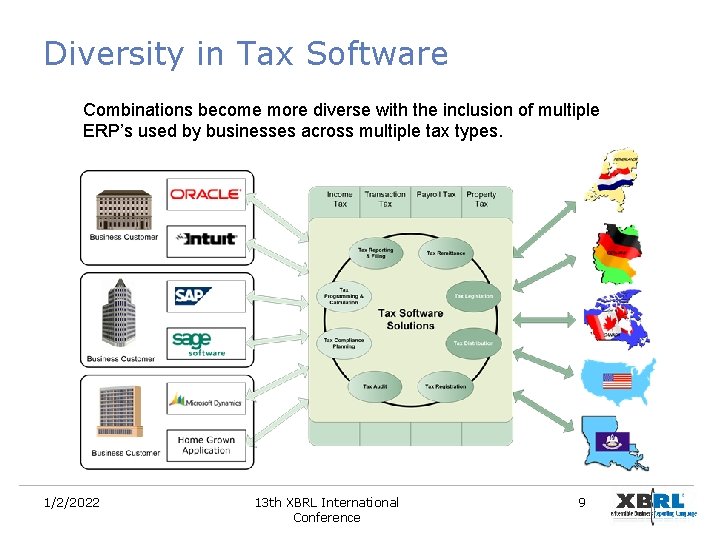
Software Solution Within Tax Compliance A software developer needs to provide solutions for many potential combinations of businesses and taxing jurisdictions 1/2/2022 13 th XBRL International Conference 8
Diversity in Tax Software Combinations become more diverse with the inclusion of multiple ERP’s used by businesses across multiple tax types. 1/2/2022 13 th XBRL International Conference 9
Role of Software Solution in Tax Compliance • Deliver functionality to facilitate business processes • Buffer the Customer from complexity • Assume the burden of dealing with diversity • Handle impact of new Technology, Security requirements and Compliance requirements • Minimize total cost of Compliance 1/2/2022 13 th XBRL International Conference 10
Software Solution Challenges • Provide a tax compliance solution that: • Minimizes Ambiguity • Enables Tracability • Enforces Security • Provides Completeness of Requirement • Is Adaptable to new requirements • Is Cost Effective • Handle the diversity of terminology and meaning across the various Jurisdictions, ERP’s, Business Verticals, Tax Types and Tax processes. 1/2/2022 13 th XBRL International Conference 11
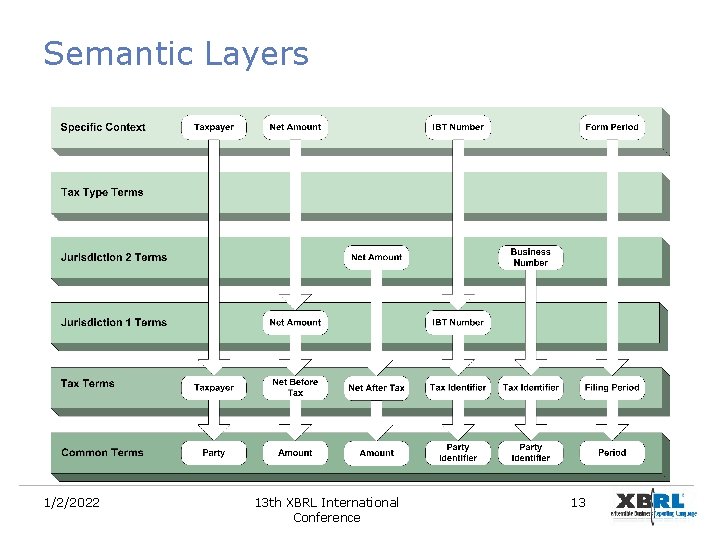
Semantic Interoperability • Equal terms may have different meanings within different regulations • Different terms may have the same meaning. • For efficient exchange of information it is necessary to agree upon the syntax and semantics (meaning) of terms • There is a penalty for misinterpretation • Challenge is to standardise in a manner that both allows compliance within existing regulation and adheres as much as possible to the existing business processes. 1/2/2022 13 th XBRL International Conference 12
Semantic Layers 1/2/2022 13 th XBRL International Conference 13
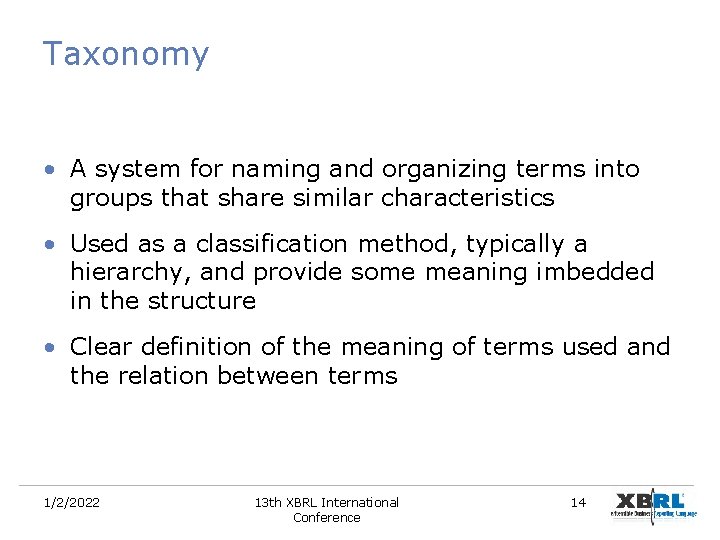
Taxonomy • A system for naming and organizing terms into groups that share similar characteristics • Used as a classification method, typically a hierarchy, and provide some meaning imbedded in the structure • Clear definition of the meaning of terms used and the relation between terms 1/2/2022 13 th XBRL International Conference 14
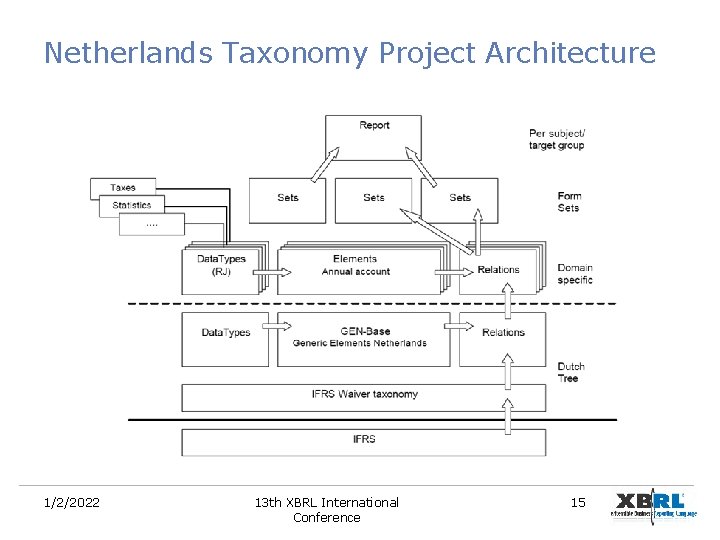
Netherlands Taxonomy Project Architecture 1/2/2022 13 th XBRL International Conference 15
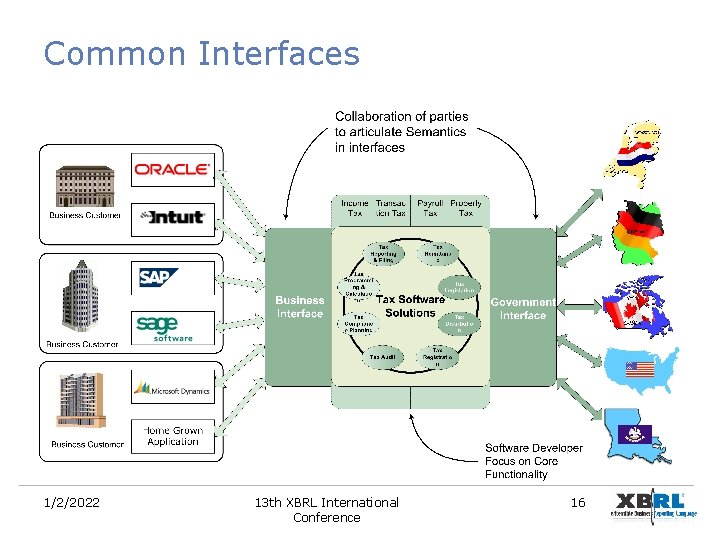
Common Interfaces 1/2/2022 13 th XBRL International Conference 16
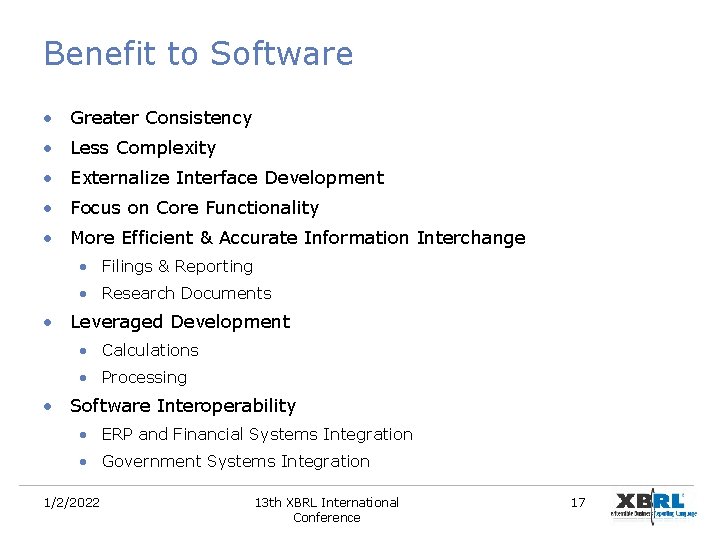
Benefit to Software • Greater Consistency • Less Complexity • Externalize Interface Development • Focus on Core Functionality • More Efficient & Accurate Information Interchange • Filings & Reporting • Research Documents • Leveraged Development • Calculations • Processing • Software Interoperability • ERP and Financial Systems Integration • Government Systems Integration 1/2/2022 13 th XBRL International Conference 17
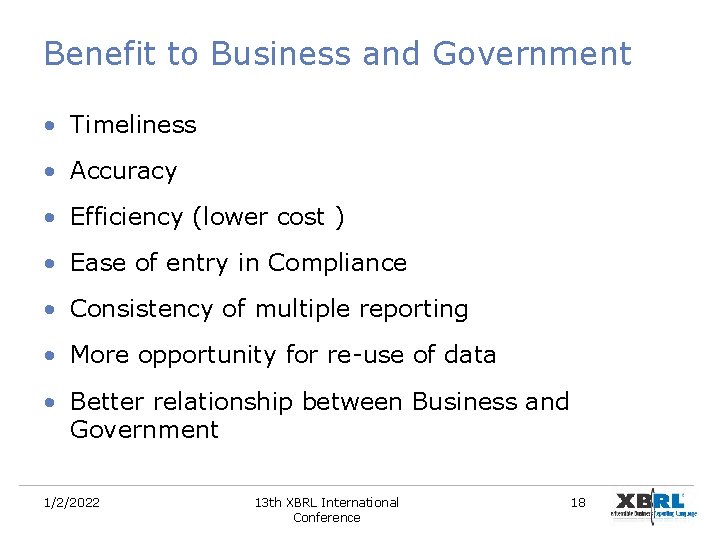
Benefit to Business and Government • Timeliness • Accuracy • Efficiency (lower cost ) • Ease of entry in Compliance • Consistency of multiple reporting • More opportunity for re-use of data • Better relationship between Business and Government 1/2/2022 13 th XBRL International Conference 18
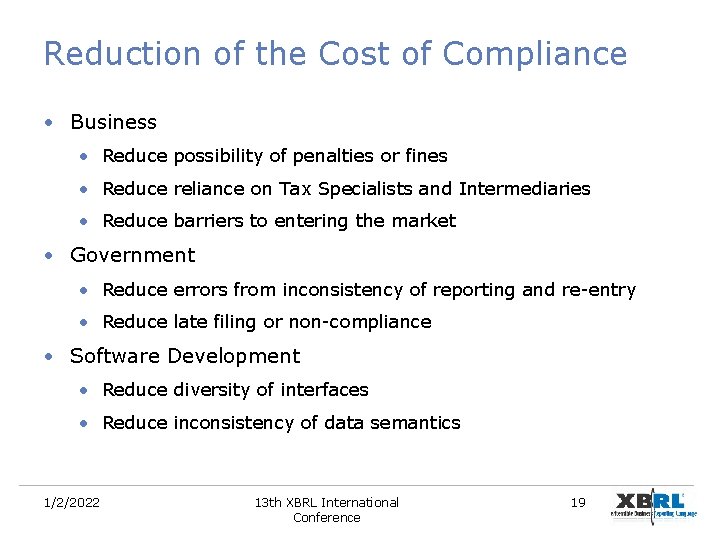
Reduction of the Cost of Compliance • Business • Reduce possibility of penalties or fines • Reduce reliance on Tax Specialists and Intermediaries • Reduce barriers to entering the market • Government • Reduce errors from inconsistency of reporting and re-entry • Reduce late filing or non-compliance • Software Development • Reduce diversity of interfaces • Reduce inconsistency of data semantics 1/2/2022 13 th XBRL International Conference 19
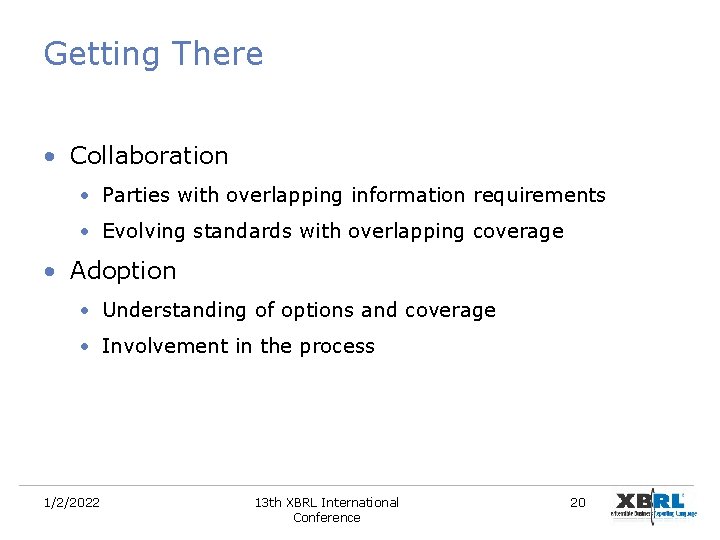
Getting There • Collaboration • Parties with overlapping information requirements • Evolving standards with overlapping coverage • Adoption • Understanding of options and coverage • Involvement in the process 1/2/2022 13 th XBRL International Conference 20
OASIS Tax. XML Approach • International resource of tax knowledge comprised of representatives from Government, Business and software development • Look to evaluate, influence, specify and recommend XML specifications and standards as they relate to the processes and information exchanges involved in tax compliance. • Reliance on incorporating XML standards already defined for the common business vocabulary. • The benefits sought by The Committee include reductions in development of jurisdictionally specific interchange standards for software developers and tax administrations. 1/2/2022 13 th XBRL International Conference 21
Impact on Software Developers • Continuous involvement in the Standards Process to be aware of business and technical directions and to provide perspective and requirements of software development to the evolution of standards. • Acceptance of adopted standards and ability to deliver solutions using available standards • Change the paradigm from design, build and control proprietary interfaces to incorporation and internal management of open standards. 1/2/2022 13 th XBRL International Conference 22
Questions john. glaubitz@vertexinc. com 1/2/2022 13 th XBRL International Conference 23