
Tax evasion as a coordination game The role

![The model • Continuum of citizens/agents ~U [0, 1] • Agent i’s problem: maximize](https://slidetodoc.com/presentation_image_h2/b0ca853f5132fee2a5b8f85f38d1434a/image-7.jpg "The model • Continuum of citizens/agents ~U [0, 1] • Agent i’s problem: maximize")
- Slides: 16
Tax evasion as a coordination game. The role of expectations and externalities Miguel A. Sanchez Villalba October 2004
A short history of tax evasion • Early days: “It is sinful to deceive the government regarding taxes and duties”-The Talmud • Early 20 th century: “The avoidance of taxes is the only intellectual pursuit that still carries any reward”--John M. Keynes • Late 70 s: “The vast majority of the public had come to believe that everybody else was engaging in tax avoidance or outright tax evasion”--Michael J. Graetz 2/13/2022 2
Road map • • • The problem Related literature The model Results Policy Final remarks 2/13/2022 3
The problem • Citizen decides how much income to declare • The optimal declaration depends on the government’s type and on the economywide average declared income • Government’s policy rule contingent on average evasion externalities • Heterogeneous info. sets expectations • Coordination or “global” game 2/13/2022 4
Related literature • Benjamini and Maital (1983) Difference: Uncertainty about average evasion and audit intensity • Morris and Shin (2002) Difference: Need for coordination among agents is generated by the government 2/13/2022 5
My contribution • More structure to the externality: Policy rule contingent on average evasion • Systemic approach: Citizen vs. Other Citizens and vs. Government • Tax evasion as a coordination game: Citizens want to pay the government a high enough “bribe” so that it does not audit 2/13/2022 6
The model • Continuum of citizens/agents ~U [0, 1] • Agent i’s problem: maximize expected utility by choosing how much income to declare • No “ghosts” • Pre-tax income • Declared income 2/13/2022 7
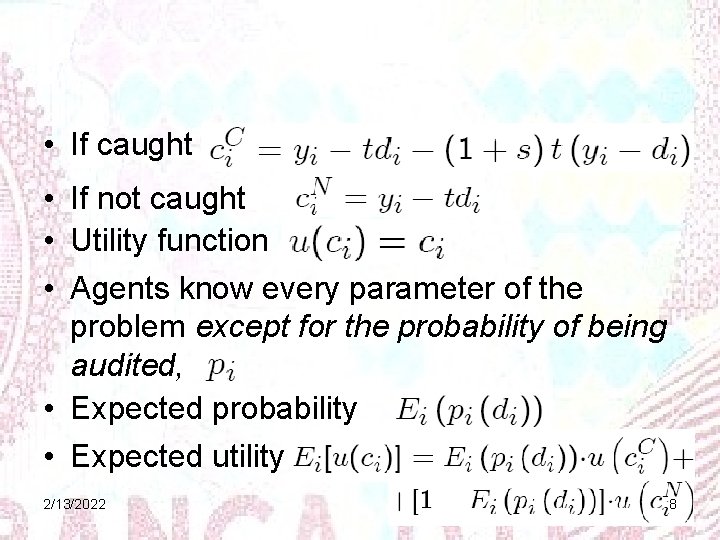
• If caught • If not caught • Utility function • Agents know every parameter of the problem except for the probability of being audited, • Expected probability • Expected utility 2/13/2022 8
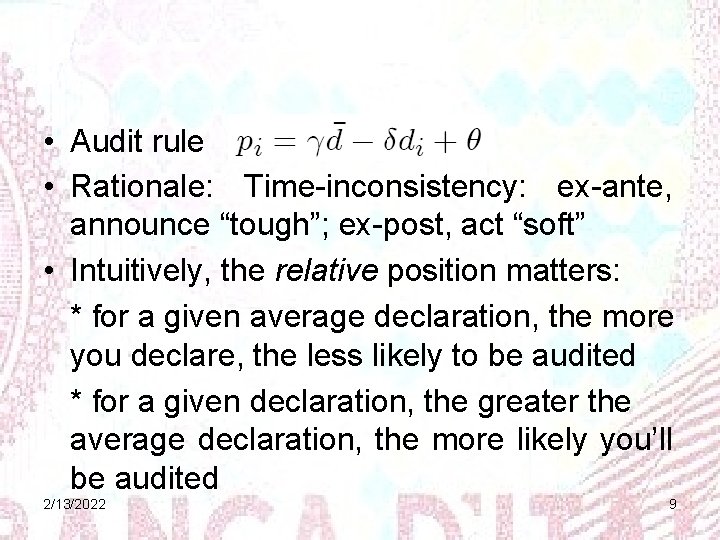
• Audit rule • Rationale: Time-inconsistency: ex-ante, announce “tough”; ex-post, act “soft” • Intuitively, the relative position matters: * for a given average declaration, the more you declare, the less likely to be audited * for a given declaration, the greater the average declaration, the more likely you’ll be audited 2/13/2022 9
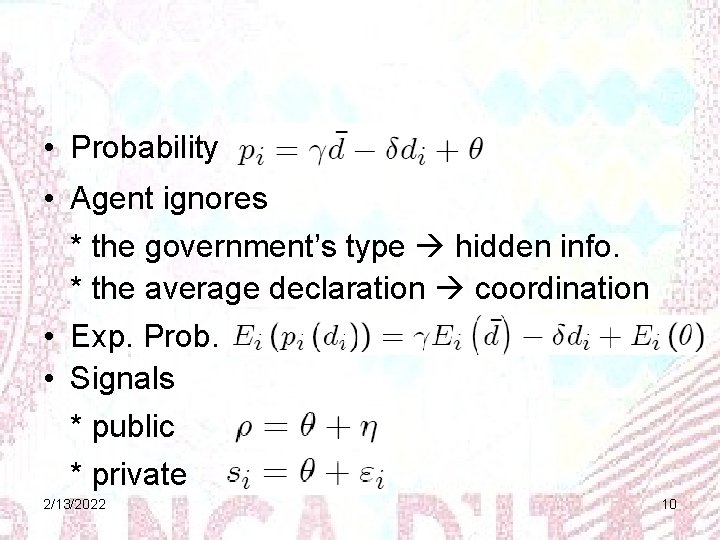
• Probability • Agent ignores * the government’s type hidden info. * the average declaration coordination • Exp. Prob. • Signals * public * private 2/13/2022 10
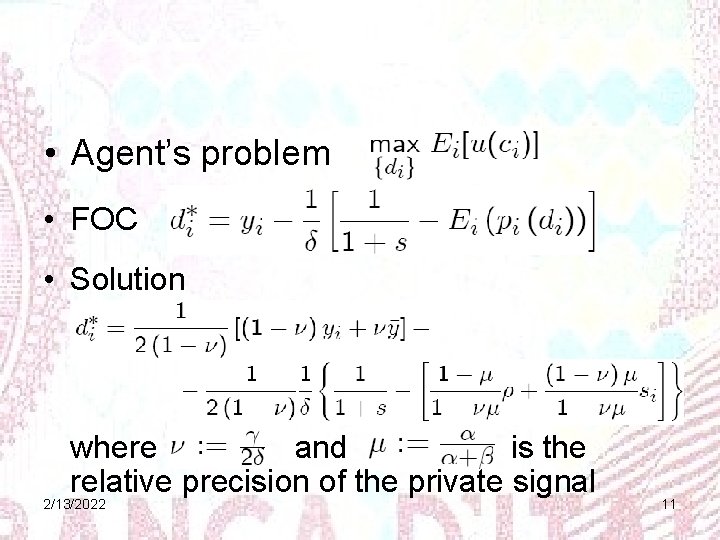
• Agent’s problem • FOC • Solution where and is the relative precision of the private signal 2/13/2022 11
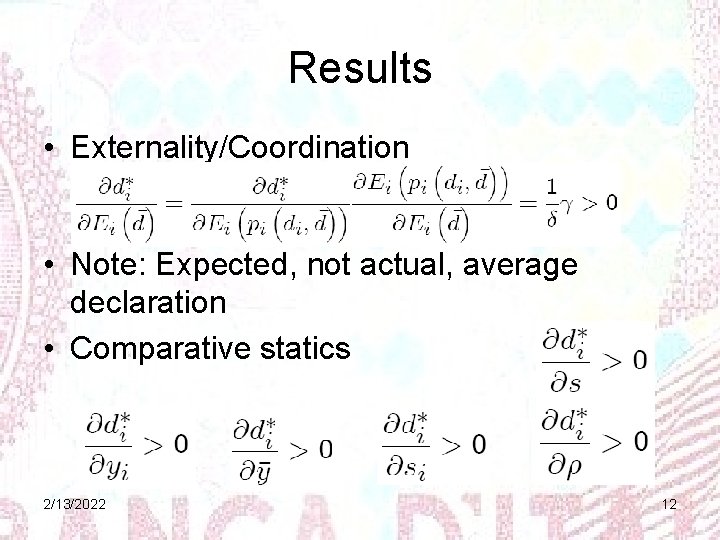
Results • Externality/Coordination • Note: Expected, not actual, average declaration • Comparative statics 2/13/2022 12
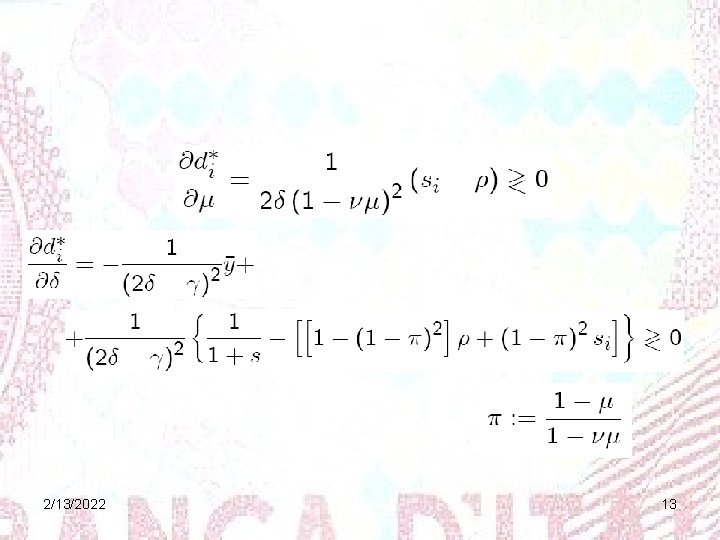
2/13/2022 13
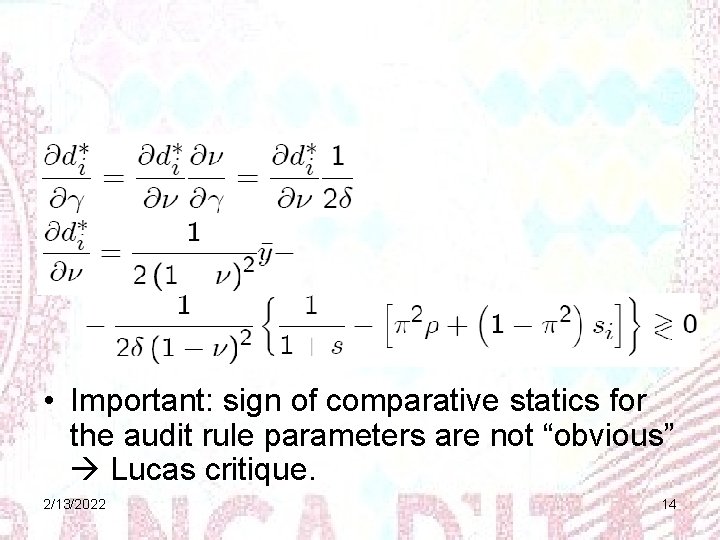
• Important: sign of comparative statics for the audit rule parameters are not “obvious” Lucas critique. 2/13/2022 14
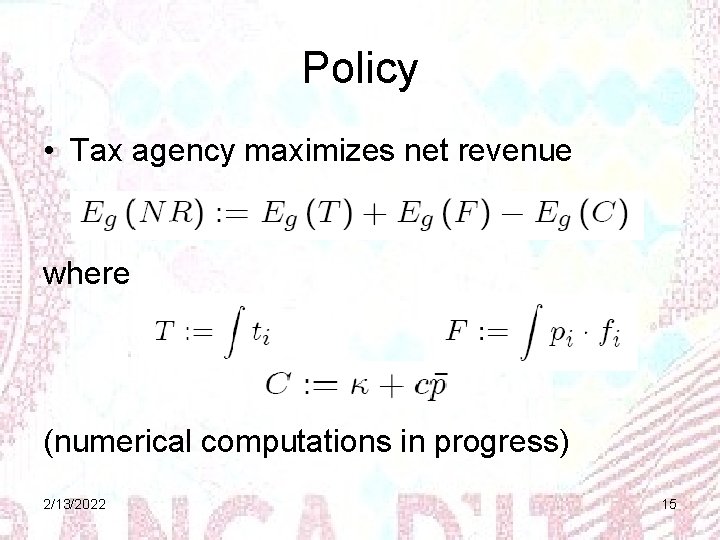
Policy • Tax agency maximizes net revenue where (numerical computations in progress) 2/13/2022 15
Final remarks • Systemic approach: Citizen vs. Other Citizens vs. Government • Policy rule: Commitment device and externality generator • Role of expectations. Lucas critique • Moral hazard 2/13/2022 16