
Tax Cuts and Jobs Act MIDTOWN RALEIGH ALLIANCE

Tax Cuts and Jobs Act MIDTOWN RALEIGH ALLIANCE February 15, 2018
Disclaimer This material has been prepared for informational purposes only, and is not intended to provide, and should not be relied on for, tax, legal or accounting advice. The application and impact of laws can vary widely based on the specific facts involved. You should consult your tax, legal and accounting advisors before engaging in any transaction.
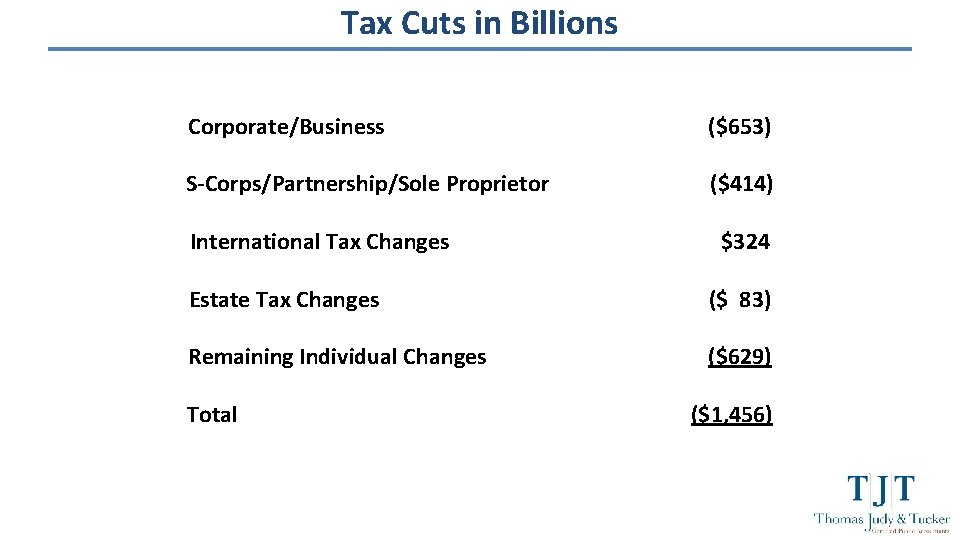
Tax Cuts in Billions Corporate/Business ($653) S-Corps/Partnership/Sole Proprietor ($414) International Tax Changes $324 Estate Tax Changes ($ 83) Remaining Individual Changes ($629) Total ($1, 456)
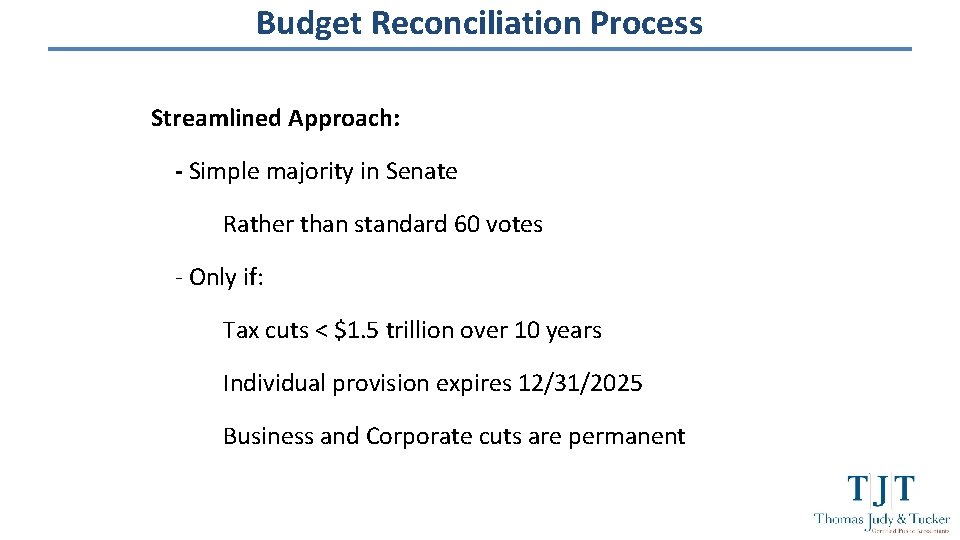
Budget Reconciliation Process Streamlined Approach: - Simple majority in Senate Rather than standard 60 votes - Only if: Tax cuts < $1. 5 trillion over 10 years Individual provision expires 12/31/2025 Business and Corporate cuts are permanent
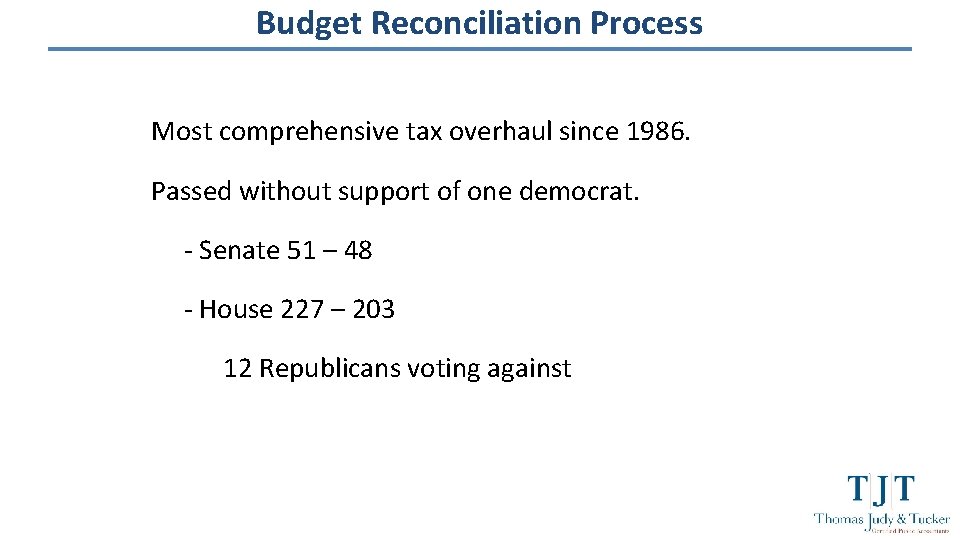
Budget Reconciliation Process Most comprehensive tax overhaul since 1986. Passed without support of one democrat. - Senate 51 – 48 - House 227 – 203 12 Republicans voting against
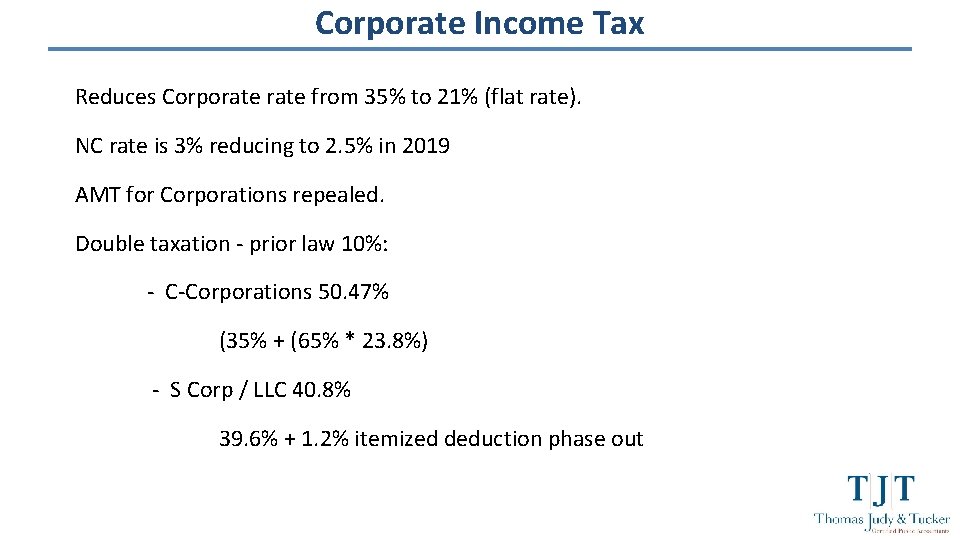
Corporate Income Tax Reduces Corporate from 35% to 21% (flat rate). NC rate is 3% reducing to 2. 5% in 2019 AMT for Corporations repealed. Double taxation - prior law 10%: - C-Corporations 50. 47% (35% + (65% * 23. 8%) - S Corp / LLC 40. 8% 39. 6% + 1. 2% itemized deduction phase out
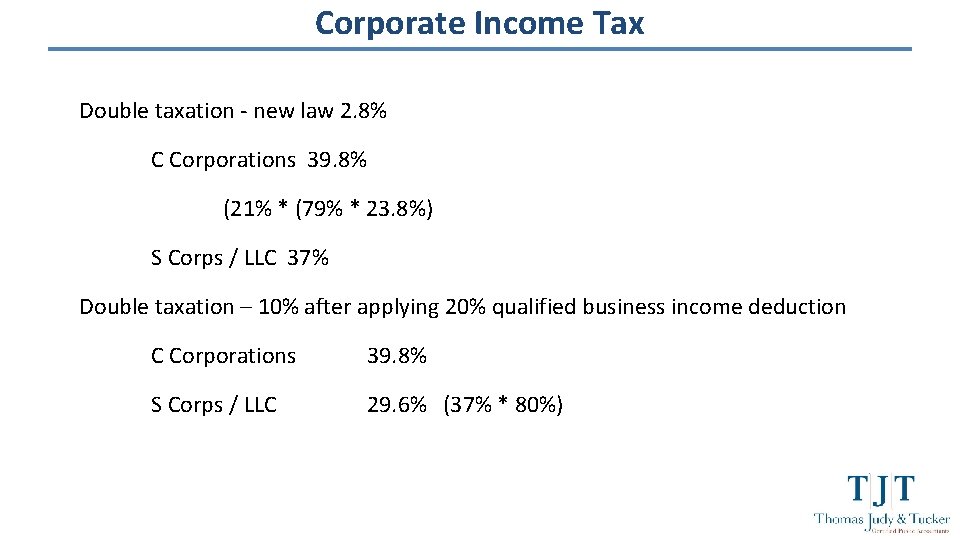
Corporate Income Tax Double taxation - new law 2. 8% C Corporations 39. 8% (21% * (79% * 23. 8%) S Corps / LLC 37% Double taxation – 10% after applying 20% qualified business income deduction C Corporations 39. 8% S Corps / LLC 29. 6% (37% * 80%)
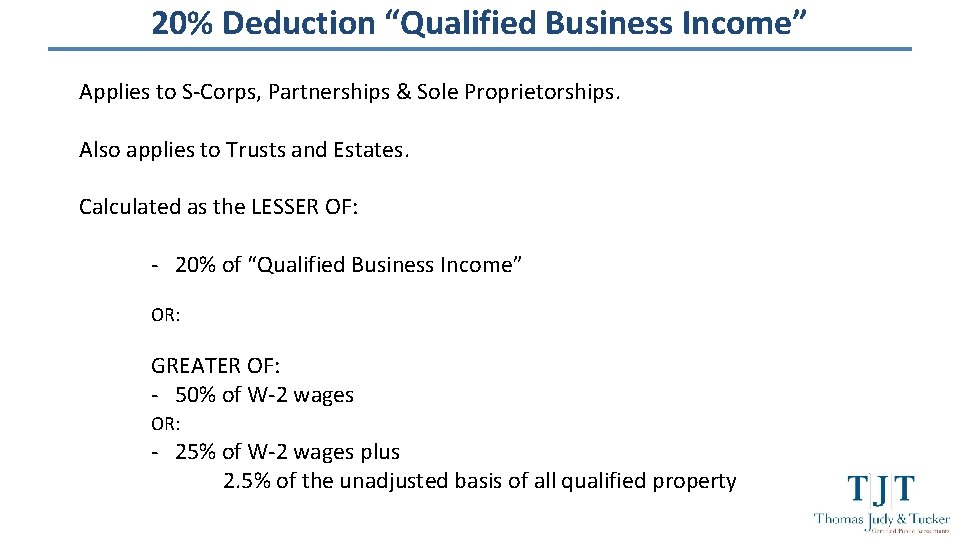
20% Deduction “Qualified Business Income” Applies to S-Corps, Partnerships & Sole Proprietorships. Also applies to Trusts and Estates. Calculated as the LESSER OF: - 20% of “Qualified Business Income” OR: GREATER OF: - 50% of W-2 wages OR: - 25% of W-2 wages plus 2. 5% of the unadjusted basis of all qualified property
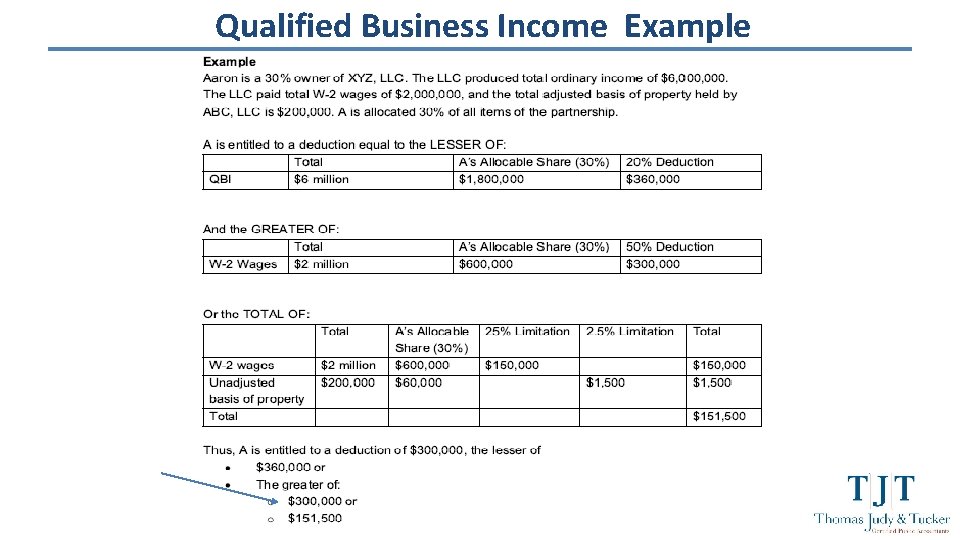
Qualified Business Income Example
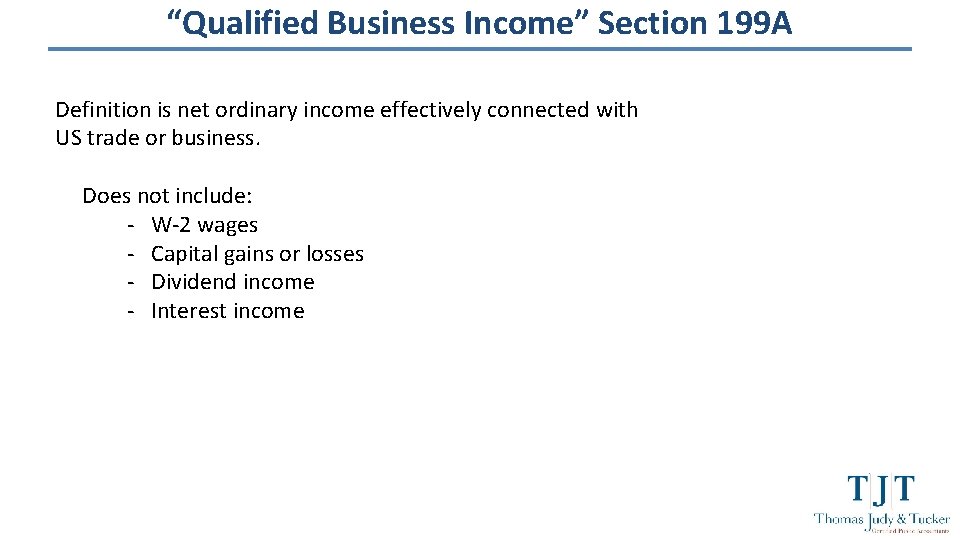
“Qualified Business Income” Section 199 A Definition is net ordinary income effectively connected with US trade or business. Does not include: - W-2 wages - Capital gains or losses - Dividend income - Interest income
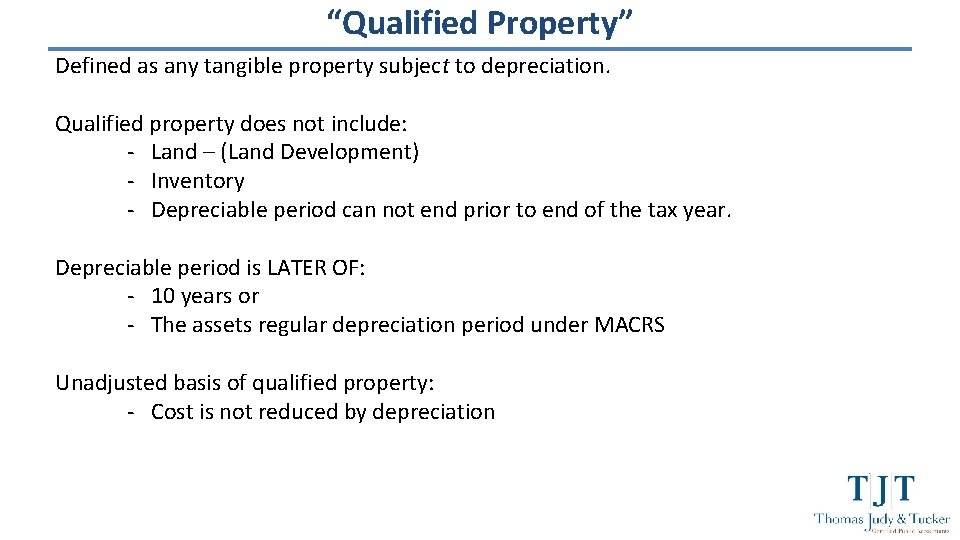
“Qualified Property” Defined as any tangible property subject to depreciation. Qualified property does not include: - Land – (Land Development) - Inventory - Depreciable period can not end prior to end of the tax year. Depreciable period is LATER OF: - 10 years or - The assets regular depreciation period under MACRS Unadjusted basis of qualified property: - Cost is not reduced by depreciation
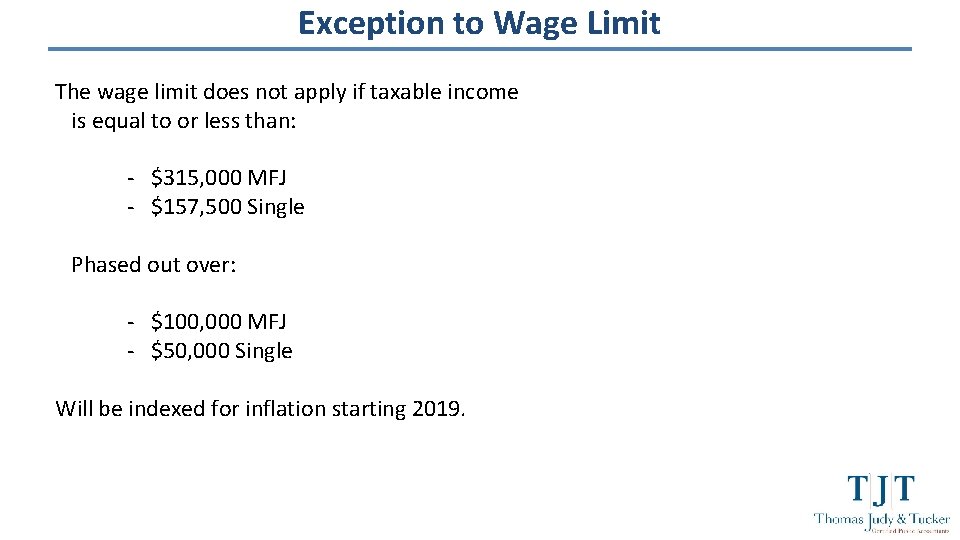
Exception to Wage Limit The wage limit does not apply if taxable income is equal to or less than: - $315, 000 MFJ - $157, 500 Single Phased out over: - $100, 000 MFJ - $50, 000 Single Will be indexed for inflation starting 2019.
20% Deduction – N/A to Service Businesses Service trade or businesses include: - Fields of health, law, accounting, actuarial science, performing arts, consulting, athletics, financial services, brokerage services - Any business where the principal assets is the reputation or skill of one or more of its employees. Exception: Architects and Engineers allowed 20% deduction 20% Deduction allowed up to taxable income limits - $315, 000 MFJ - $157, 500 Single
Interest Deduction Limitation Applies to companies over $25 M in Sales - Must combine related party companies Limited to 30% of “Adjusted Taxable Income”. - Net business income plus: - Interest expense - Depreciation - Amortization / Depletion Disallowed interest can be carried forward. Real estate businesses can elect out of these rules. - Then must use Alternative Depreciation System.
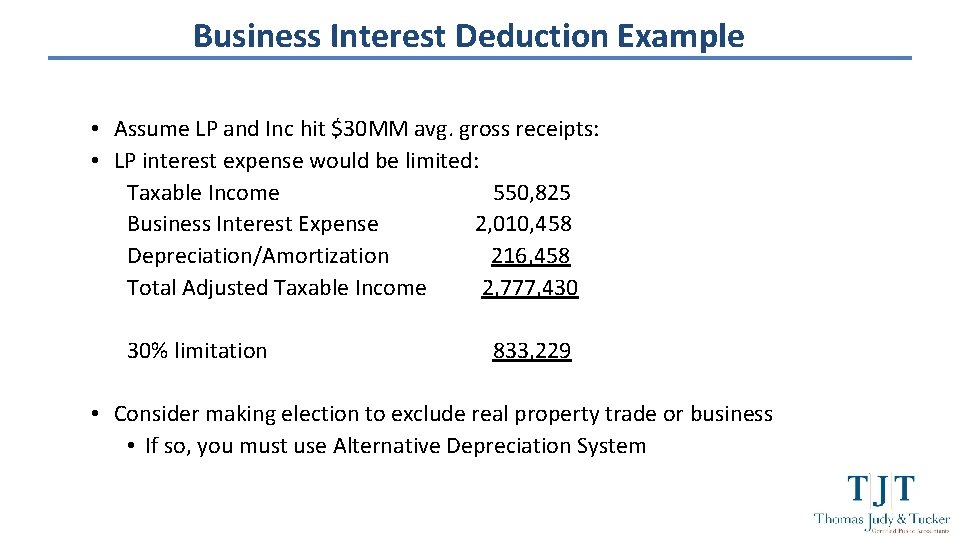
Business Interest Deduction Example • Assume LP and Inc hit $30 MM avg. gross receipts: • LP interest expense would be limited: Taxable Income 550, 825 Business Interest Expense 2, 010, 458 Depreciation/Amortization 216, 458 Total Adjusted Taxable Income 2, 777, 430 30% limitation 833, 229 • Consider making election to exclude real property trade or business • If so, you must use Alternative Depreciation System
Other Business Changes Cash basis allowed if average gross income < $25 M: - Can use cash basis of accounting, even with inventory. - Not required to capitalize 263 A costs. - Interest limitation of 30% “adjusted taxable income” does not apply. Net Operating Losses - No longer able to carryback, able to carryforward indefinitely. - NOL carryforward will offset 80% of current year income. Business meals still 50% deductible. Entertainment no longer deductible.
Key changes to Depreciation
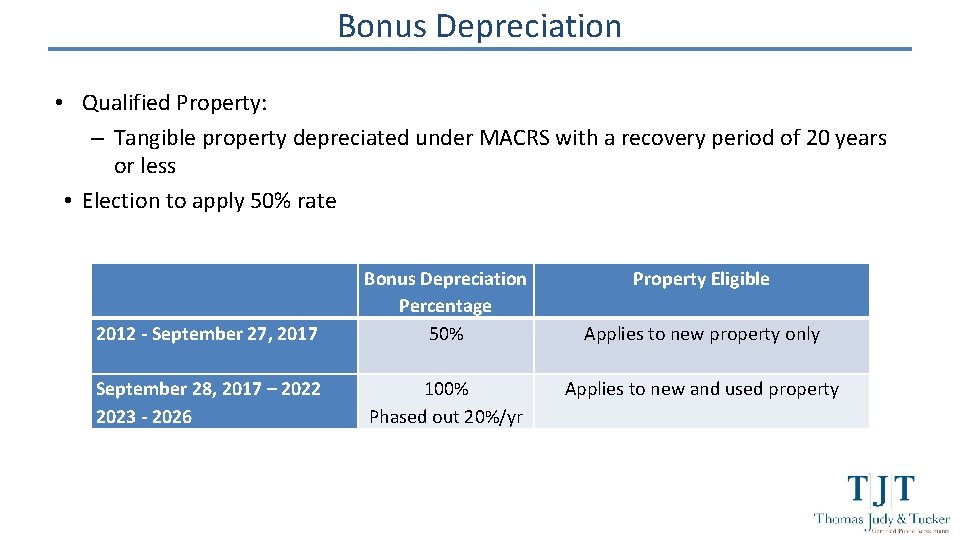
Bonus Depreciation • Qualified Property: – Tangible property depreciated under MACRS with a recovery period of 20 years or less • Election to apply 50% rate 2012 - September 27, 2017 Bonus Depreciation Percentage 50% September 28, 2017 – 2022 2023 - 2026 100% Phased out 20%/yr Property Eligible Applies to new property only Applies to new and used property
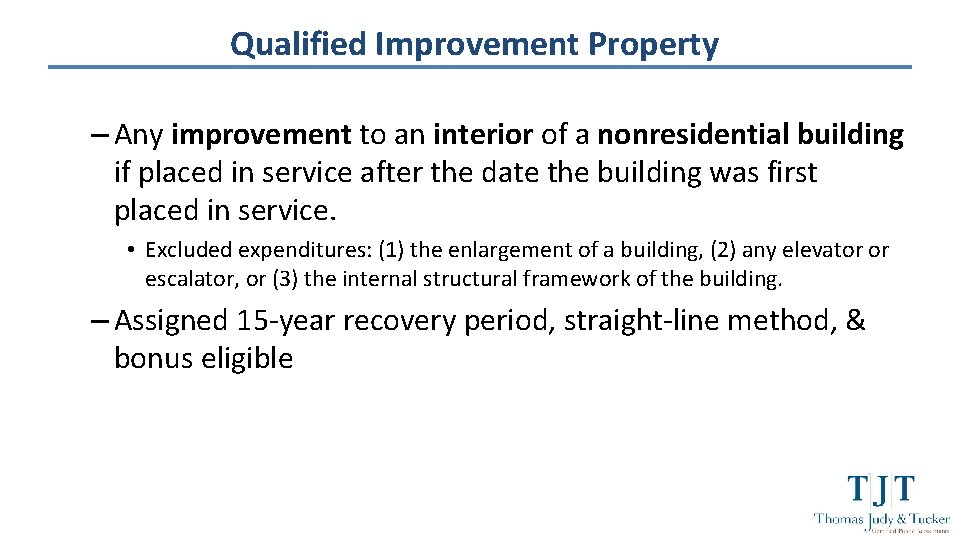
Qualified Improvement Property – Any improvement to an interior of a nonresidential building if placed in service after the date the building was first placed in service. • Excluded expenditures: (1) the enlargement of a building, (2) any elevator or escalator, or (3) the internal structural framework of the building. – Assigned 15 -year recovery period, straight-line method, & bonus eligible
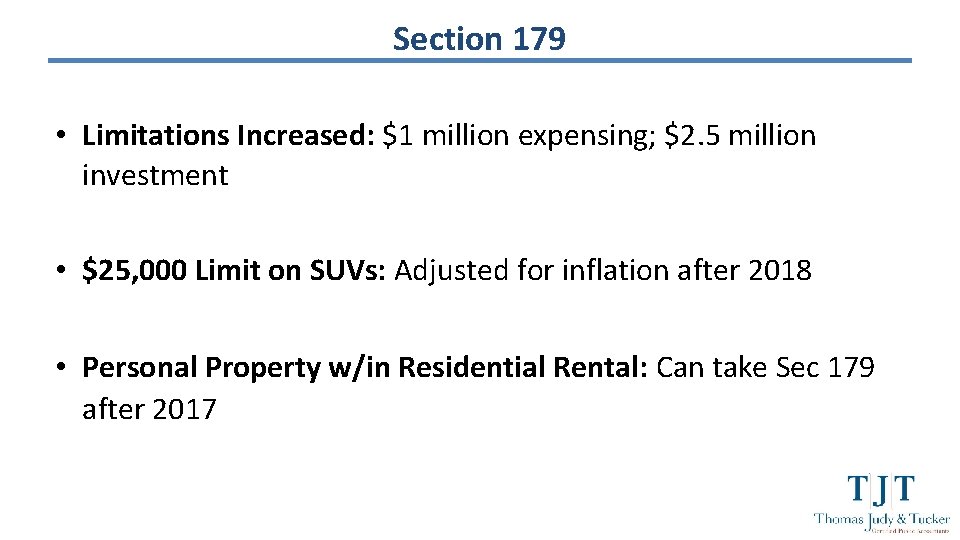
Section 179 • Limitations Increased: $1 million expensing; $2. 5 million investment • $25, 000 Limit on SUVs: Adjusted for inflation after 2018 • Personal Property w/in Residential Rental: Can take Sec 179 after 2017
Section 179 vs Bonus • Choosing Section 179: – If we don’t want to take the net income into a loss position – If bonus not allowed (i. e. Roofs, HVACs, etc. ) • Choosing Bonus Deprecation Instead of 179 – Passive investors – Trusts
Individual Tax Reform Most Provisions Expire 2025
Individual Tax Reform – Quick 6 1. 2. 3. 4. 5. 6. Qualified Charitable Distributions from IRAs 529 Plans for all school ages Child Tax Credits Increased Kiddie Tax Rates – Same as trust rates New divorces alimony Non-Deductible Estate tax increased to $11. 2 million ($22. 4 million per married couple) – TAX TIP – revisit estate plan to determine impact; trust still make sense for asset protection from creditors and other
Itemized Deductions • Property and State tax deduction limited to $10, 000 – Makes state tax credits more valuable – solar, historic, foreign – TAX TIP –NC one of few states in country offer FTC – double benefit • Home mortgage interest limited to $750, 00 for new mortgages created after 12/15/17 – can refinance • Interest on Home Equity Indebtedness not allowed except if the debt was used for improvements. (Tracing rules still apply) • No more 2% miscellaneous itemized deductions • No more 3% of AGI phase outs—positive for high income taxpayers • Fewer itemizing – bunching expenses every other year
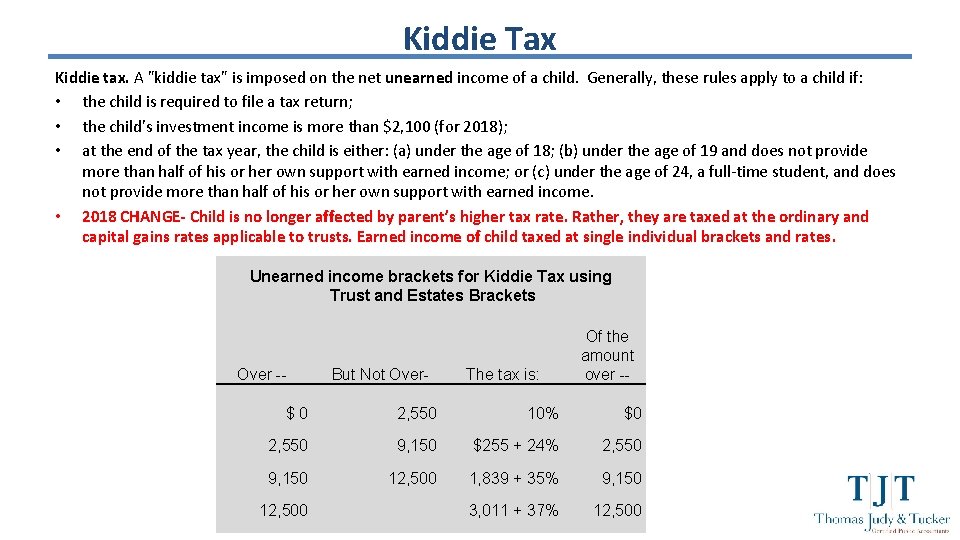
Kiddie Tax Kiddie tax. A "kiddie tax" is imposed on the net unearned income of a child. Generally, these rules apply to a child if: • the child is required to file a tax return; • the child's investment income is more than $2, 100 (for 2018); • at the end of the tax year, the child is either: (a) under the age of 18; (b) under the age of 19 and does not provide more than half of his or her own support with earned income; or (c) under the age of 24, a full-time student, and does not provide more than half of his or her own support with earned income. • 2018 CHANGE- Child is no longer affected by parent’s higher tax rate. Rather, they are taxed at the ordinary and capital gains rates applicable to trusts. Earned income of child taxed at single individual brackets and rates. Unearned income brackets for Kiddie Tax using Trust and Estates Brackets Over -- But Not Over- The tax is: Of the amount over -- $0 2, 550 10% $0 2, 550 9, 150 $255 + 24% 2, 550 9, 150 12, 500 1, 839 + 35% 9, 150 3, 011 + 37% 12, 500
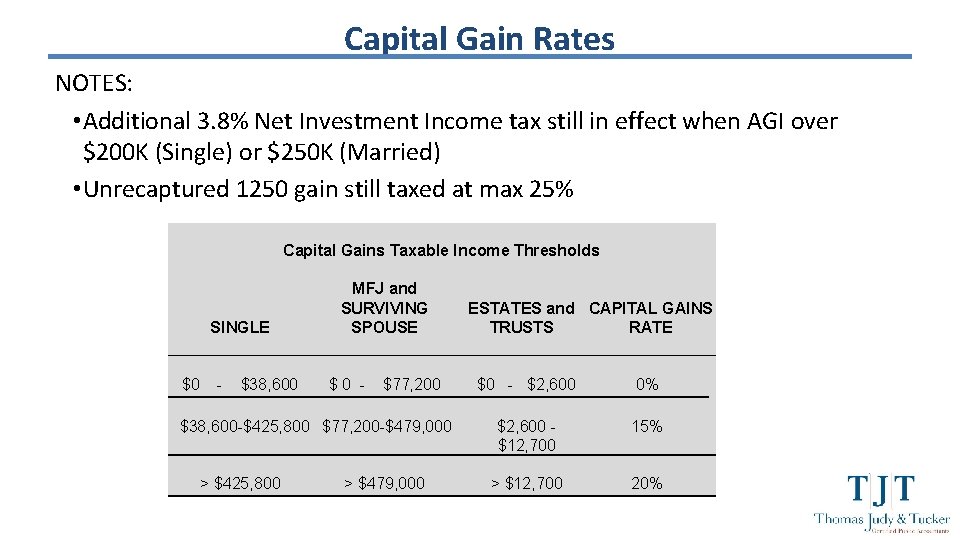
Capital Gain Rates NOTES: • Additional 3. 8% Net Investment Income tax still in effect when AGI over $200 K (Single) or $250 K (Married) • Unrecaptured 1250 gain still taxed at max 25% Capital Gains Taxable Income Thresholds SINGLE $0 - $38, 600 MFJ and SURVIVING SPOUSE $0 - $77, 200 $38, 600 -$425, 800 $77, 200 -$479, 000 > $425, 800 > $479, 000 ESTATES and CAPITAL GAINS TRUSTS RATE $0 - $2, 600 0% $2, 600 $12, 700 15% > $12, 700 20%
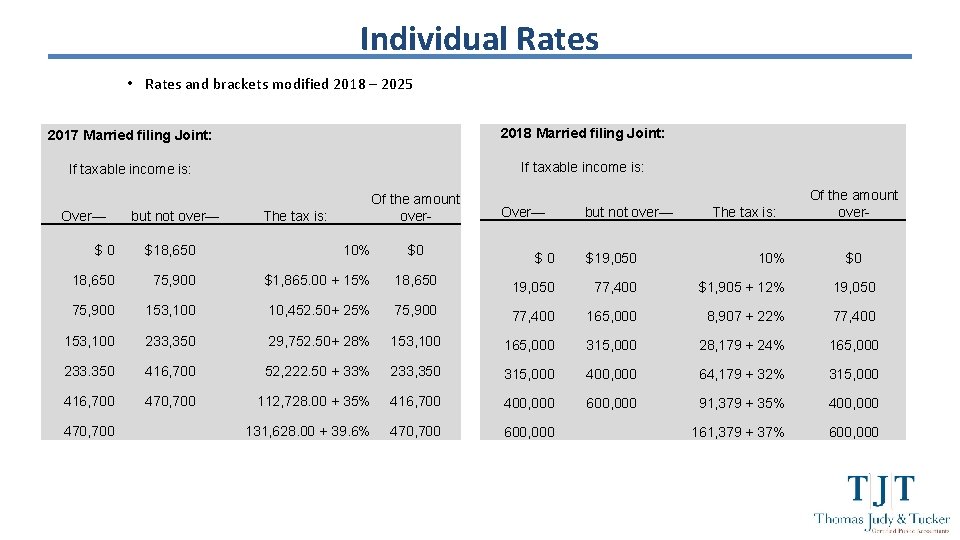
Individual Rates • Rates and brackets modified 2018 – 2025 2017 Married filing Joint: 2018 Married filing Joint: If taxable income is: Over— but not over— Of the amount over- The tax is: $0 $18, 650 10% 18, 650 75, 900 $1, 865. 00 + 15% 75, 900 153, 100 $0 Over— but not over— The tax is: Of the amount over- $0 $19, 050 10% 18, 650 19, 050 77, 400 $1, 905 + 12% 19, 050 10, 452. 50+ 25% 75, 900 77, 400 165, 000 8, 907 + 22% 77, 400 233, 350 29, 752. 50+ 28% 153, 100 165, 000 315, 000 28, 179 + 24% 165, 000 233. 350 416, 700 52, 222. 50 + 33% 233, 350 315, 000 400, 000 64, 179 + 32% 315, 000 416, 700 470, 700 112, 728. 00 + 35% 416, 700 400, 000 600, 000 91, 379 + 35% 400, 000 131, 628. 00 + 39. 6% 470, 700 600, 000 161, 379 + 37% 600, 000 470, 700 $0
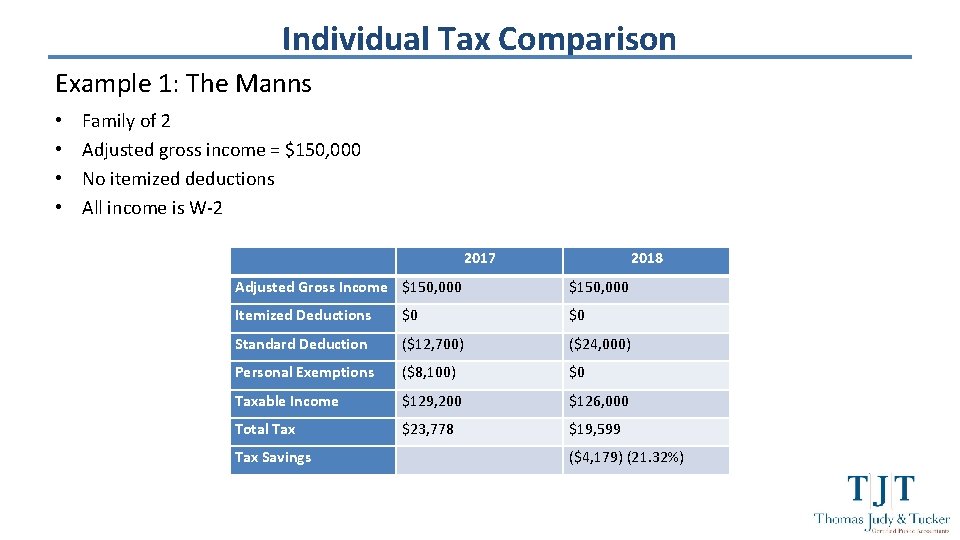
Individual Tax Comparison Example 1: The Manns • • Family of 2 Adjusted gross income = $150, 000 No itemized deductions All income is W-2 2017 2018 Adjusted Gross Income $150, 000 Itemized Deductions $0 $0 Standard Deduction ($12, 700) ($24, 000) Personal Exemptions ($8, 100) $0 Taxable Income $129, 200 $126, 000 Total Tax $23, 778 $19, 599 Tax Savings ($4, 179) (21. 32%)
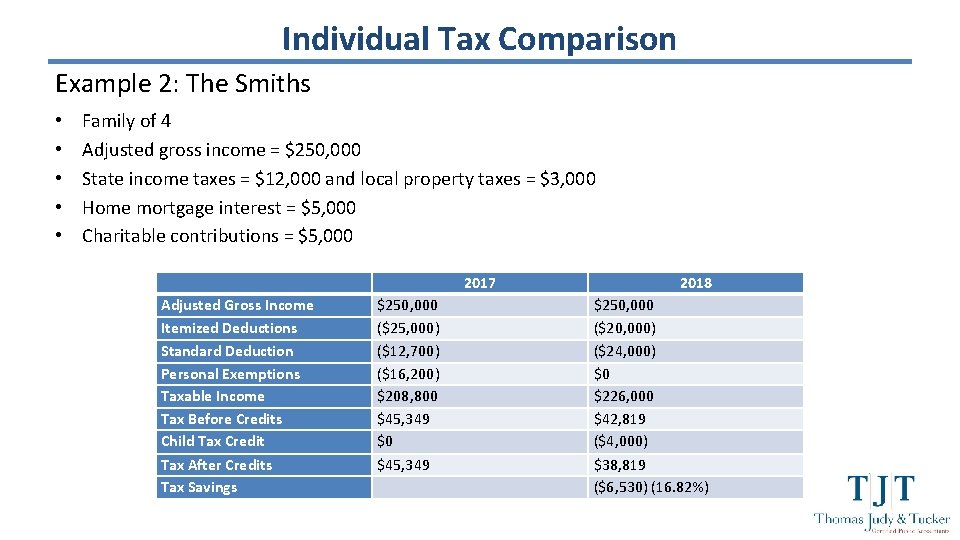
Individual Tax Comparison Example 2: The Smiths • • • Family of 4 Adjusted gross income = $250, 000 State income taxes = $12, 000 and local property taxes = $3, 000 Home mortgage interest = $5, 000 Charitable contributions = $5, 000 Adjusted Gross Income Itemized Deductions Standard Deduction Personal Exemptions Taxable Income Tax Before Credits Child Tax Credit Tax After Credits Tax Savings 2017 $250, 000 ($25, 000) ($12, 700) ($16, 200) $208, 800 $45, 349 $0 $45, 349 2018 $250, 000 ($20, 000) ($24, 000) $0 $226, 000 $42, 819 ($4, 000) $38, 819 ($6, 530) (16. 82%)
Other Thoughts Regarding Entity Choice
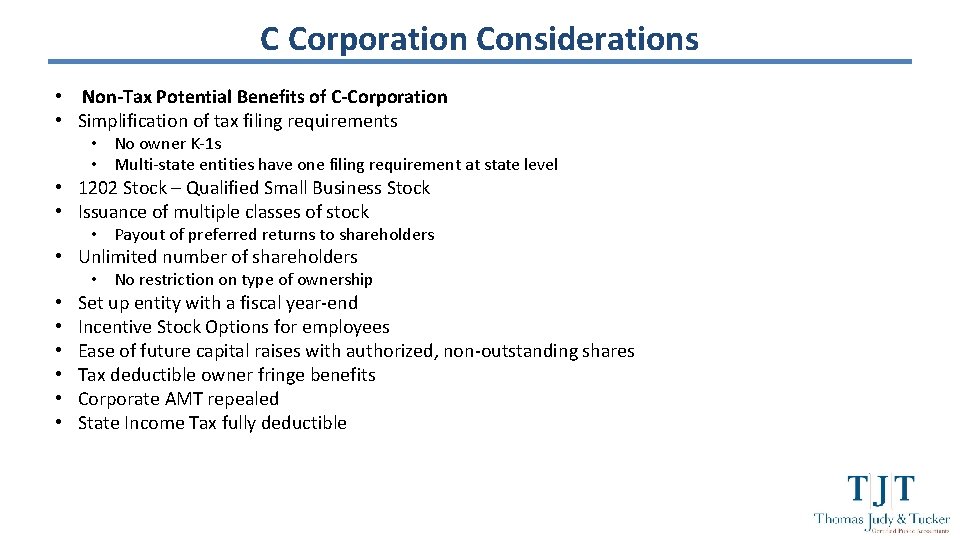
C Corporation Considerations • Non-Tax Potential Benefits of C-Corporation • Simplification of tax filing requirements • No owner K-1 s • Multi-state entities have one filing requirement at state level • 1202 Stock – Qualified Small Business Stock • Issuance of multiple classes of stock • Payout of preferred returns to shareholders • Unlimited number of shareholders • No restriction on type of ownership • • • Set up entity with a fiscal year-end Incentive Stock Options for employees Ease of future capital raises with authorized, non-outstanding shares Tax deductible owner fringe benefits Corporate AMT repealed State Income Tax fully deductible
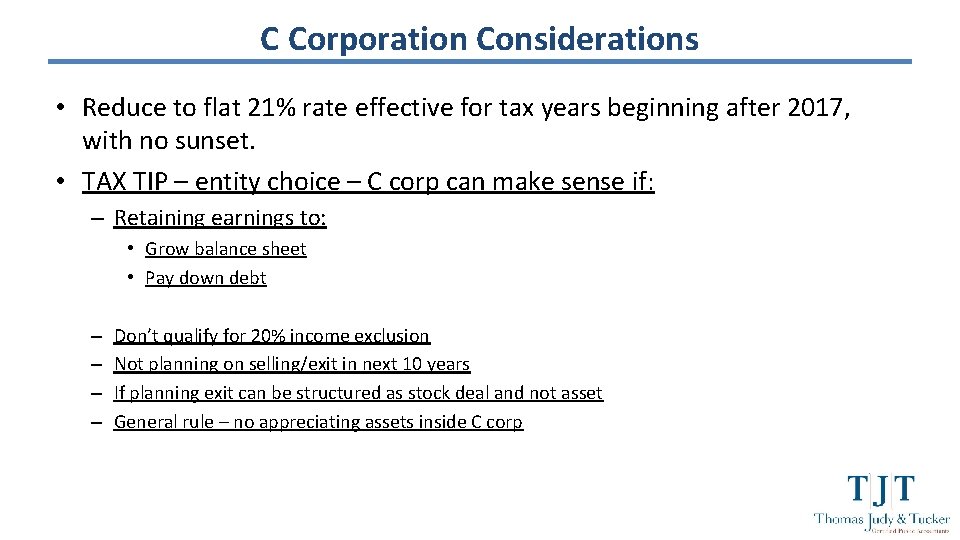
C Corporation Considerations • Reduce to flat 21% rate effective for tax years beginning after 2017, with no sunset. • TAX TIP – entity choice – C corp can make sense if: – Retaining earnings to: • Grow balance sheet • Pay down debt – – Don’t qualify for 20% income exclusion Not planning on selling/exit in next 10 years If planning exit can be structured as stock deal and not asset General rule – no appreciating assets inside C corp
- Slides: 33