
Tax Cuts and Jobs Act Entity Choice and
Tax Cuts and Jobs Act: Entity Choice and Sec 199 A QBI Deduction Part I Nicole R. Suk, CPA November 29, 2018 #WBInsights 18 1
Agenda Part I – Entity Selection • Entity choices • Tax implications of conversion • Examples Part II – Sec 199 A Qualified Business Income Deduction • What is 199 A • How is 199 A calculated • Examples • Reporting and Planning #WBInsights 18 2 2
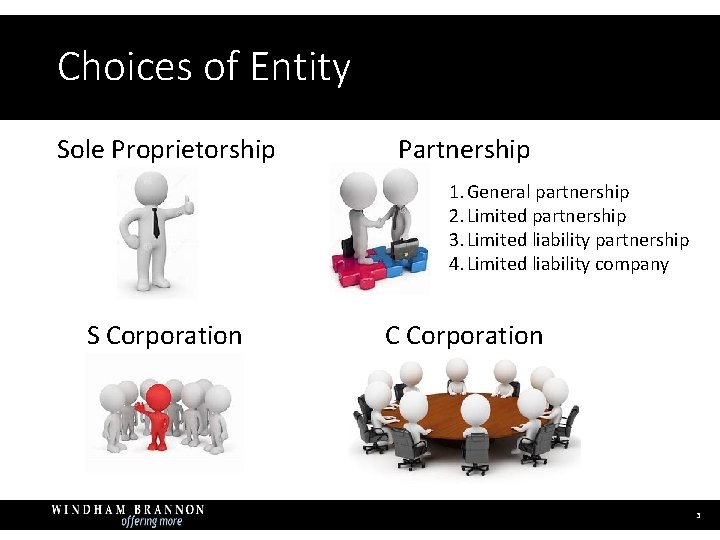
Choices of Entity Sole Proprietorship Partnership 1. General partnership 2. Limited partnership 3. Limited liability partnership 4. Limited liability company S Corporation C Corporation #WBInsights 18 3 3
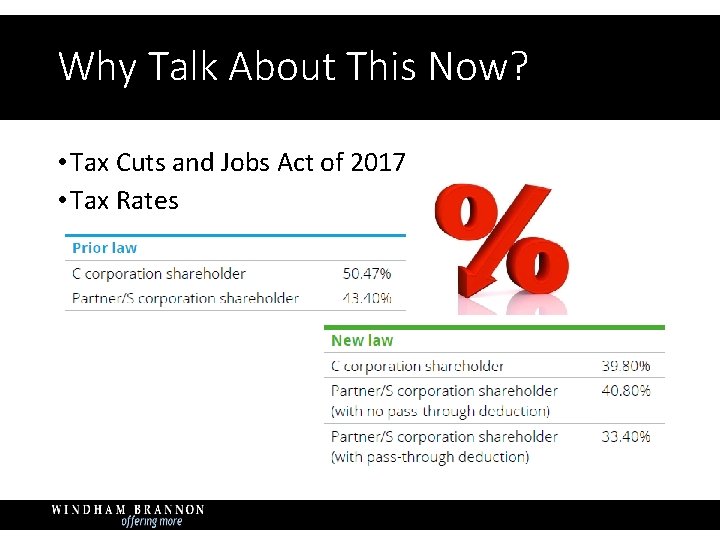
Why Talk About This Now? • Tax Cuts and Jobs Act of 2017 • Tax Rates #WBInsights 18 4
Predictions • Penn Wharton Budget Model (PWBM) • Predicts 235, 780 US business will switch from passthrough entity to C-corporation • 77% of whom have income of at least $500, 000 • The biggest switchers will include doctors, lawyers and investors, especially if owners can afford to defer receipt of business income to a later year • Projects that about 17. 5% of all pass-through Ordinary Business Income will switch to Ccorporations #WBInsights 18 5 5
Pass-Through Entities • Reduces double taxation • No income tax at entity level • Owners are taxed on their portion of the net income of the business • No tax on cash distributions • Possible self-employment tax on earnings • Individual tax rate reduced to 37% max – sunsets in 2025 • Possible 20% QBI deduction • Losses can offset other personal income #WBInsights 18 6 6
C Corporations • Taxed at corporate level • Double taxation when net earnings are distributed to the shareholder as a dividend. • May retain the profits - be aware of the accumulated earnings tax • Permanent 21% rate reduction • No AMT tax #WBInsights 18 7 7
Key TCJA Provisions to Consider • Key pass-through provisions such as qualification to claim Sec 199 A deductions • Key individual provisions such as owner tax rate • Comparison of pass-through provisions to corporate provisions • International provisions #WBInsights 18 8
Other Provisions to Consider • Amount of annual distributions now and in future • Character and timing of income recognized (LTCG) • State income tax liabilities • Exit strategy and timing consideration for shareholder and/or partners • Current and future cash needs of business #WBInsights 18 9
Sole Proprietorship • Includes single member LLCs • Disregarded for federal income tax and all items of income and deductions are reported on owner’s income tax return • Self-employment tax on income • Sole proprietorship often avoided due to unlimited personal liability • Higher IRS audit rate on Schedule C #WBInsights 18 10 10
Partnership • Includes general partnerships, limited partnerships, limited liability partnerships and limited liability companies (if multiple owners) • Tax free distribution of taxed profits • Flexibility in allocating income as long as allocation has substantial economic effect • Sec 754 election available • May be subject to self-employment tax • No restrictions on types of partners #WBInsights 18 11 11
S Corporation • Income passes through and is taxed to shareholders • Avoids “double” taxation • Tax free distribution of taxed profits • No more than 100 shareholders • Restrictions on types of shareholders • Must only have one class of stock • Differences in voting rights are ignored #WBInsights 18 12 12
S Corporation • No SE tax • “Reasonable compensation” to SH; not based on ownership • Income and distributions must be allocated to shareholders in accordance with stock ownership • Limitation on taking losses (basis) • Basis obtained from capital contributions and loans from shareholder to corporation • No basis in corporate debt • No 3. 8% NIT on sale of “active” stock #WBInsights 18 13 13
C Corporation • Limited liability • No restrictions of shareholders • Income taxed at corporate level • Potential double taxation if corporation pays dividends to shareholders • Dividends and sale of stock subject to 3. 8% NIT #WBInsights 18 14 14
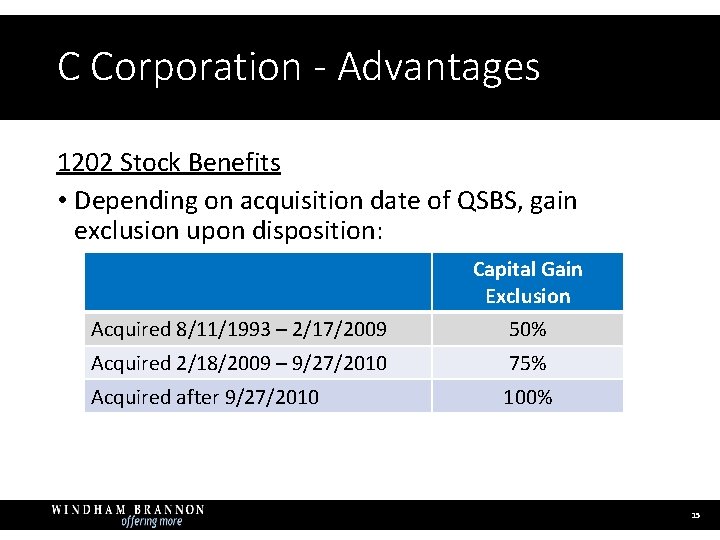
C Corporation - Advantages 1202 Stock Benefits • Depending on acquisition date of QSBS, gain exclusion upon disposition: Capital Gain Exclusion Acquired 8/11/1993 – 2/17/2009 50% Acquired 2/18/2009 – 9/27/2010 75% Acquired after 9/27/2010 100% #WBInsights 18 15 15
C Corporation - Advantages • Excluded gain limited to the greater of $10 M or 10 x the adjusted basis of the investment. • Five criteria must be met to be QSBS: 1. Stock must be held for more than 5 years, 2. Stock acquired directly from C corporation, 3. Aggregate gross assets can not exceed $50 M at any time prior to QSBS issuance, 4. The C corporation and shareholders must consent to supply documentation regarding QSBS, and 5. The C corporation is a qualified active trade or business. #WBInsights 18 16 16
C Corporation - Advantages • Section 1045 provides non-corporate taxpayers a tax deferred rollover of gain on QSBS stock held more than 6 months • New QSBS stock must be acquired within 60 day period after sale • Replacement investment can be made through acquisition of partnership interest #WBInsights 18 17 17
C Corporation - Disadvantages Accumulated Earnings Tax • 20% tax penalty on undistributed taxable income less amounts retained for “reasonable” needs • Accumulate up to $250 K, $150 K for service businesses • Tax is assessed by IRS and burden of proof falls to corporation • Solutions - pay higher salaries to shareholders, document business needs, S corporation election #WBInsights 18 18 18
C Corporation Personal holding company 1. 60% or more of gross income is passive AND 2. 50% of the stock owned by 5 or fewer individuals during last 6 months of the taxable year. • Tax on 20% of undistributed income • When income is finally distributed will be taxed again at shareholder level • Conversion to S corporation eliminates this tax #WBInsights 18 19 19
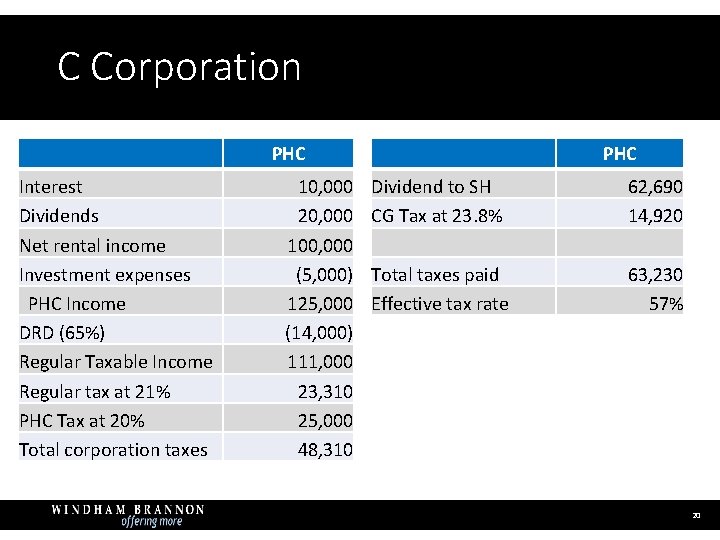
C Corporation PHC Interest Dividends Net rental income Investment expenses PHC Income DRD (65%) Regular Taxable Income Regular tax at 21% PHC Tax at 20% Total corporation taxes 10, 000 20, 000 100, 000 (5, 000) 125, 000 (14, 000) 111, 000 23, 310 25, 000 48, 310 #WBInsights 18 PHC Dividend to SH CG Tax at 23. 8% 62, 690 14, 920 Total taxes paid Effective tax rate 63, 230 57% 20 20
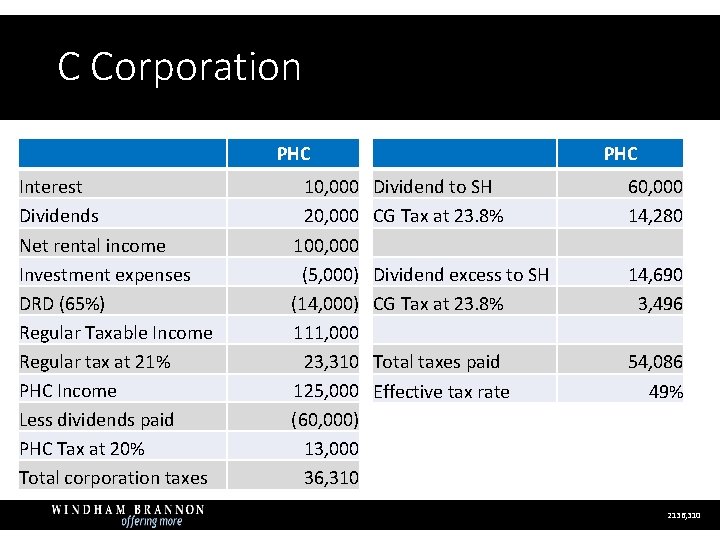
C Corporation PHC Interest Dividends Net rental income Investment expenses DRD (65%) Regular Taxable Income Regular tax at 21% PHC Income Less dividends paid PHC Tax at 20% Total corporation taxes 10, 000 20, 000 100, 000 (5, 000) (14, 000) 111, 000 23, 310 125, 000 (60, 000) 13, 000 36, 310 #WBInsights 18 PHC Dividend to SH CG Tax at 23. 8% 60, 000 14, 280 Dividend excess to SH CG Tax at 23. 8% 14, 690 3, 496 Total taxes paid Effective tax rate 54, 086 49% 21 2136, 310
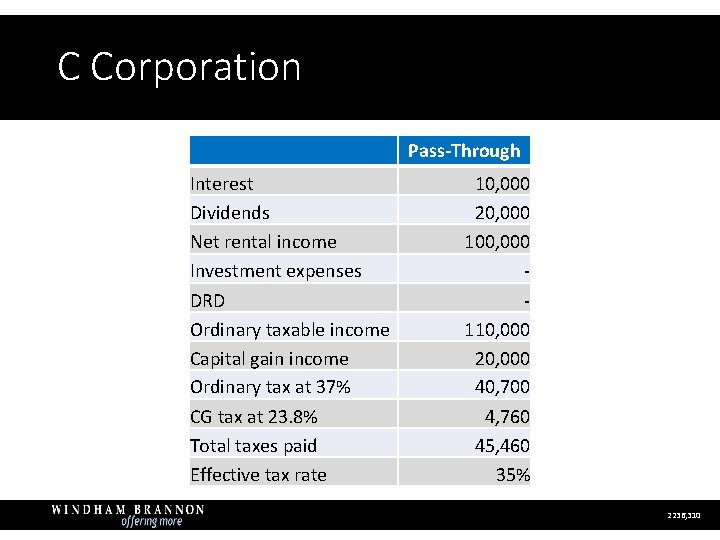
C Corporation Pass-Through Interest 10, 000 Dividends 20, 000 Net rental income 100, 000 Investment expenses DRD Ordinary taxable income 110, 000 Capital gain income 20, 000 Ordinary tax at 37% 40, 700 CG tax at 23. 8% 4, 760 Total taxes paid 45, 460 Effective tax rate 35% #WBInsights 18 22 2236, 310
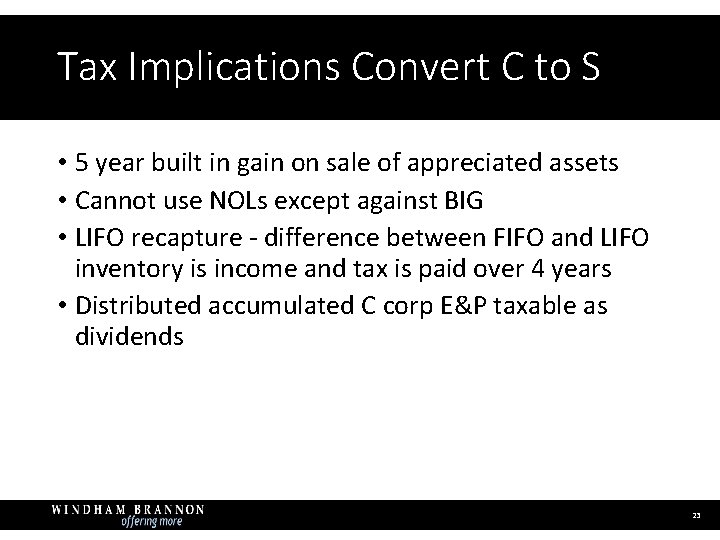
Tax Implications Convert C to S • 5 year built in gain on sale of appreciated assets • Cannot use NOLs except against BIG • LIFO recapture - difference between FIFO and LIFO inventory is income and tax is paid over 4 years • Distributed accumulated C corp E&P taxable as dividends #WBInsights 18 23 23
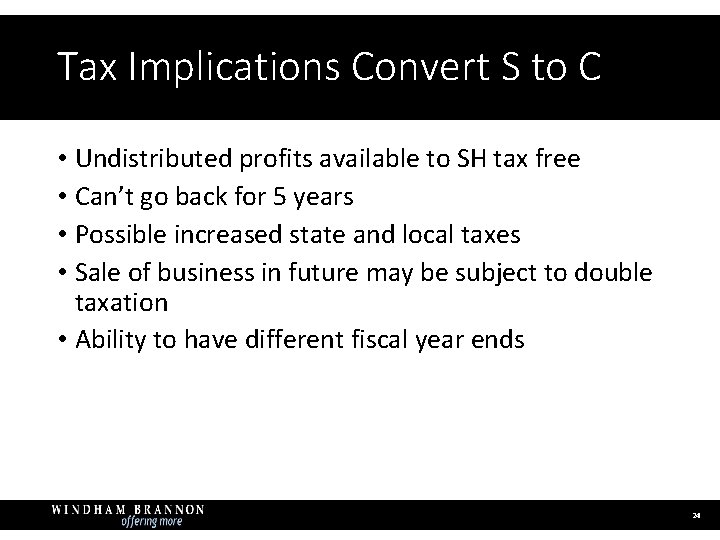
Tax Implications Convert S to C • Undistributed profits available to SH tax free • Can’t go back for 5 years • Possible increased state and local taxes • Sale of business in future may be subject to double taxation • Ability to have different fiscal year ends #WBInsights 18 24 24
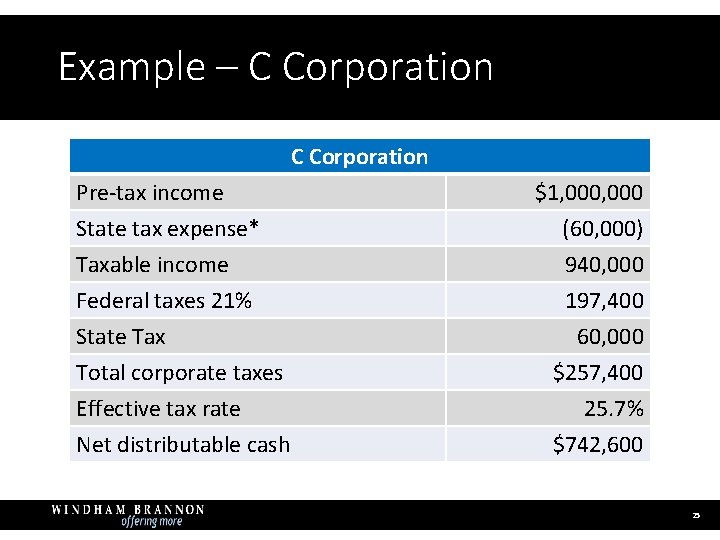
Example – C Corporation Pre-tax income State tax expense* Taxable income $1, 000 (60, 000) 940, 000 Federal taxes 21% State Tax Total corporate taxes Effective tax rate Net distributable cash #WBInsights 18 197, 400 60, 000 $257, 400 25. 7% $742, 600 25 25
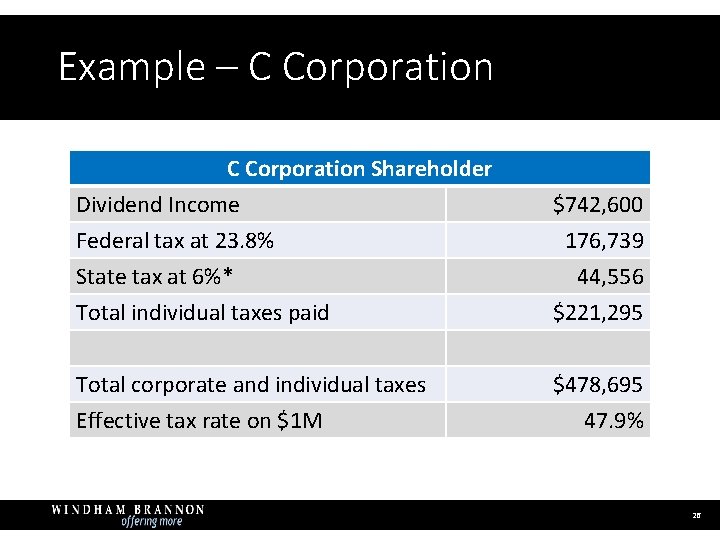
Example – C Corporation Shareholder Dividend Income Federal tax at 23. 8% State tax at 6%* $742, 600 176, 739 44, 556 Total individual taxes paid $221, 295 Total corporate and individual taxes Effective tax rate on $1 M $478, 695 47. 9% #WBInsights 18 26 26
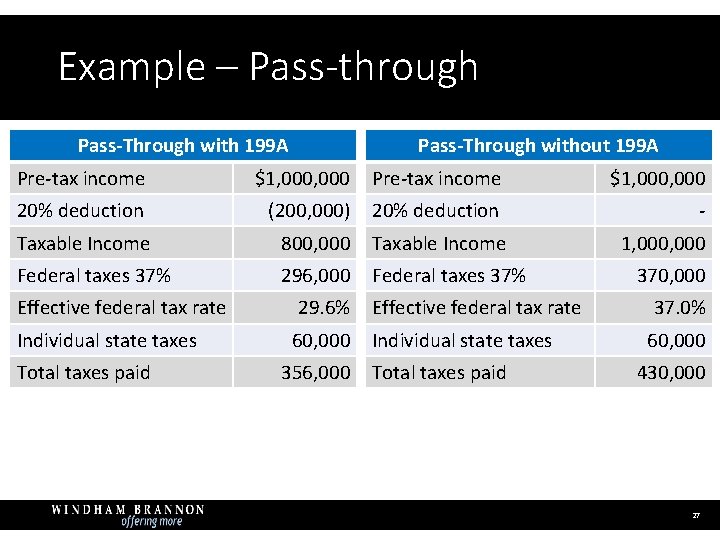
Example – Pass-through Pass-Through with 199 A Pass-Through without 199 A Pre-tax income $1, 000, 000 20% deduction (200, 000) 20% deduction - Taxable Income 800, 000 Taxable Income 1, 000 Federal taxes 37% 296, 000 Federal taxes 37% 370, 000 Effective federal tax rate 29. 6% Effective federal tax rate 37. 0% Individual state taxes 60, 000 Total taxes paid 356, 000 #WBInsights 18 Total taxes paid 430, 000 27 27
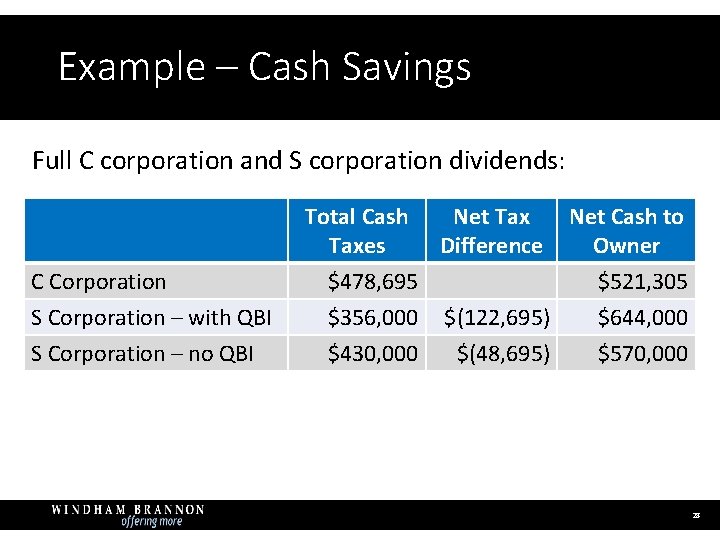
Example – Cash Savings Full C corporation and S corporation dividends: Total Cash Taxes C Corporation S Corporation – with QBI S Corporation – no QBI #WBInsights 18 $478, 695 $356, 000 $430, 000 Net Tax Difference Net Cash to Owner $(122, 695) $(48, 695) $521, 305 $644, 000 $570, 000 28 28
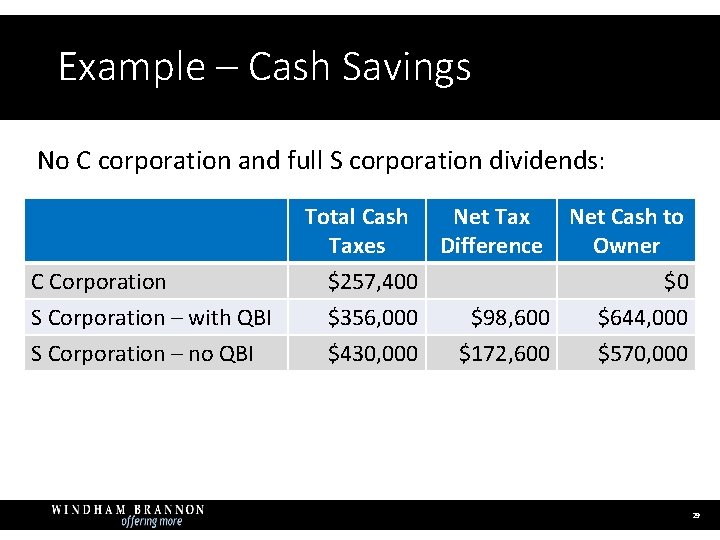
Example – Cash Savings No C corporation and full S corporation dividends: Total Cash Taxes C Corporation S Corporation – with QBI S Corporation – no QBI #WBInsights 18 $257, 400 $356, 000 $430, 000 Net Tax Difference Net Cash to Owner $98, 600 $172, 600 $0 $644, 000 $570, 000 29 29
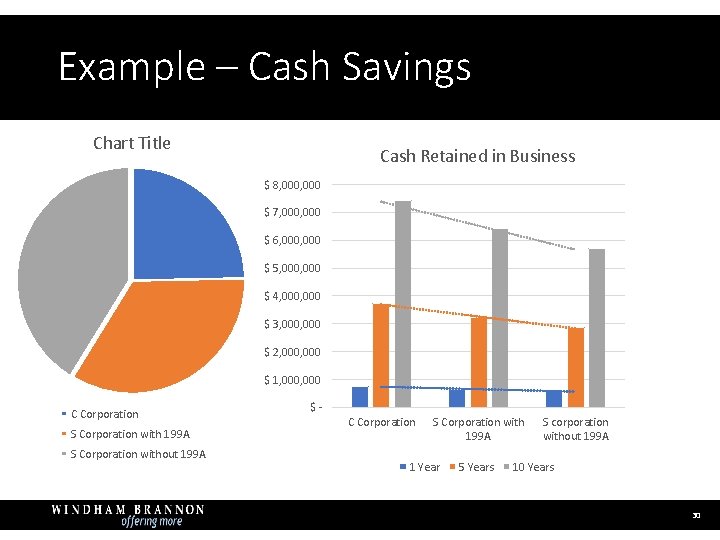
Example – Cash Savings Chart Title Cash Retained in Business $ 8, 000 $ 7, 000 $ 6, 000 $ 5, 000 $ 4, 000 $ 3, 000 $ 2, 000 $ 1, 000 C Corporation $ C Corporation S Corporation with 199 A S Corporation without 199 A S Corporation with 199 A 1 Year #WBInsights 18 5 Years S corporation without 199 A 10 Years 30 30
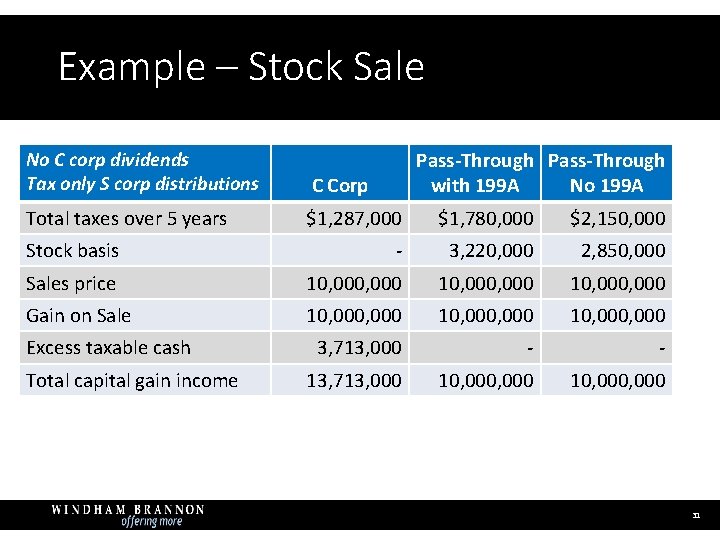
Example – Stock Sale Pass-Through with 199 A No C corp dividends Tax only S corp distributions C Corp Total taxes over 5 years $1, 287, 000 $1, 780, 000 $2, 150, 000 - 3, 220, 000 2, 850, 000 Sales price 10, 000, 000 10, 000 Gain on Sale 10, 000, 000 10, 000 3, 713, 000 - - 13, 713, 000 10, 000, 000 Stock basis Excess taxable cash Total capital gain income #WBInsights 18 31 31
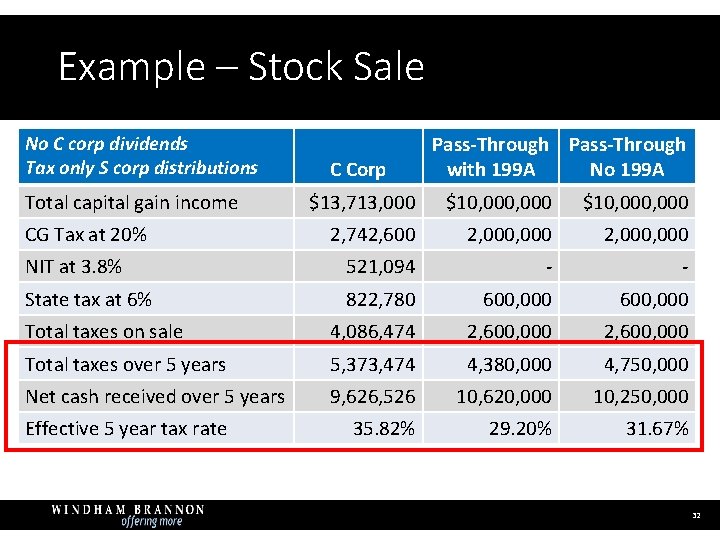
Example – Stock Sale No C corp dividends Tax only S corp distributions Total capital gain income C Corp Pass-Through with 199 A No 199 A $13, 713, 000 $10, 000, 000 2, 742, 600 2, 000, 000 NIT at 3. 8% 521, 094 - - State tax at 6% 822, 780 600, 000 Total taxes on sale 4, 086, 474 2, 600, 000 Total taxes over 5 years 5, 373, 474 4, 380, 000 4, 750, 000 Net cash received over 5 years 9, 626, 526 10, 620, 000 10, 250, 000 35. 82% 29. 20% 31. 67% CG Tax at 20% Effective 5 year tax rate #WBInsights 18 32 32
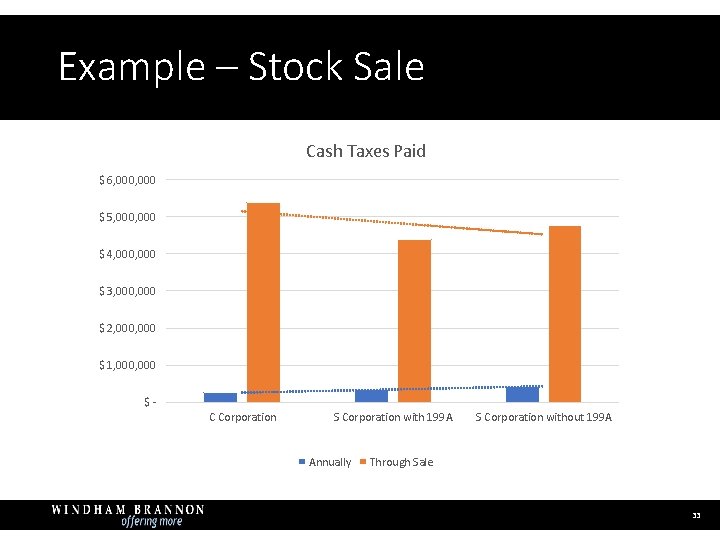
Example – Stock Sale Cash Taxes Paid $ 6, 000 $ 5, 000 $ 4, 000 $ 3, 000 $ 2, 000 $ 1, 000 $ C Corporation S Corporation with 199 A Annually #WBInsights 18 S Corporation without 199 A Through Sale 33 33
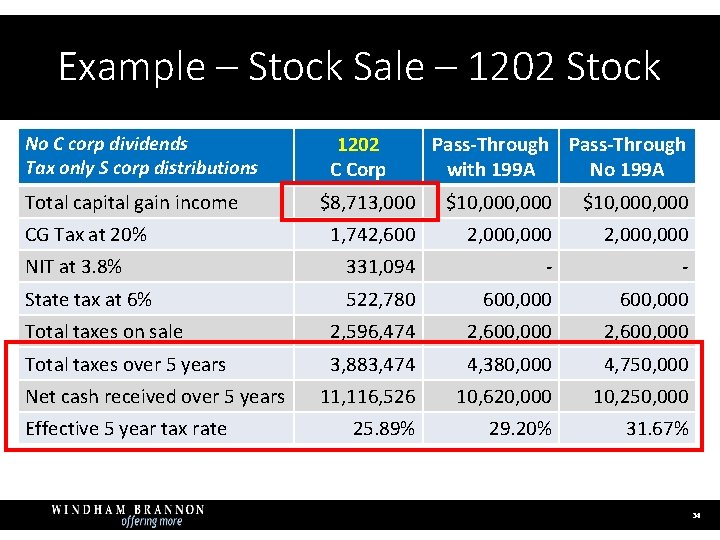
Example – Stock Sale – 1202 Stock 1202 C Corp No C corp dividends Tax only S corp distributions Total capital gain income Pass-Through with 199 A No 199 A $8, 713, 000 $10, 000, 000 1, 742, 600 2, 000, 000 NIT at 3. 8% 331, 094 - - State tax at 6% 522, 780 600, 000 Total taxes on sale 2, 596, 474 2, 600, 000 Total taxes over 5 years 3, 883, 474 4, 380, 000 4, 750, 000 11, 116, 526 10, 620, 000 10, 250, 000 25. 89% 29. 20% 31. 67% CG Tax at 20% Net cash received over 5 years Effective 5 year tax rate #WBInsights 18 34 34
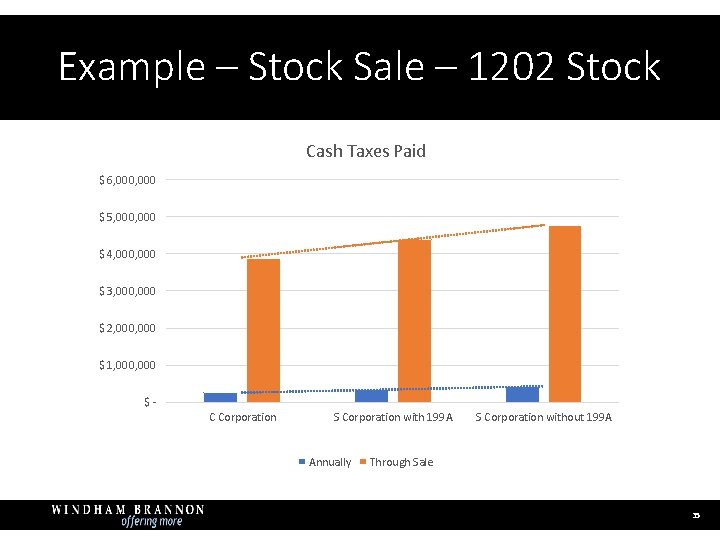
Example – Stock Sale – 1202 Stock Cash Taxes Paid $ 6, 000 $ 5, 000 $ 4, 000 $ 3, 000 $ 2, 000 $ 1, 000 $ C Corporation S Corporation with 199 A Annually #WBInsights 18 S Corporation without 199 A Through Sale 35 35
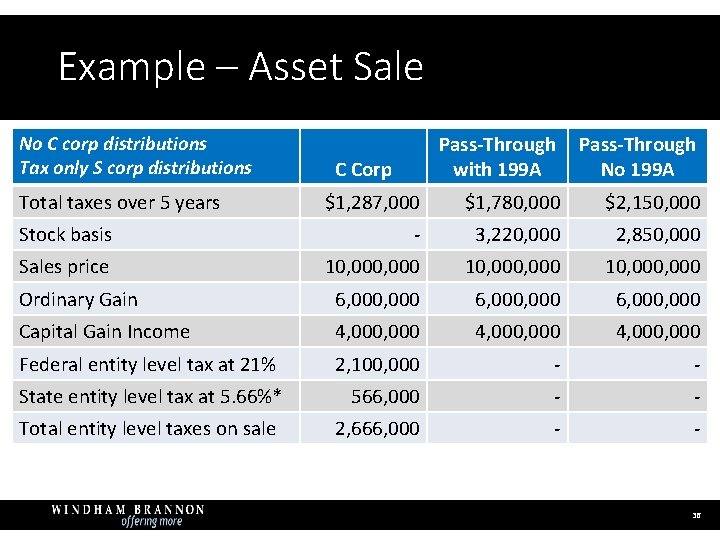
Example – Asset Sale Pass-Through with 199 A Pass-Through No 199 A $1, 287, 000 $1, 780, 000 $2, 150, 000 Stock basis - 3, 220, 000 2, 850, 000 Sales price 10, 000, 000 10, 000 Ordinary Gain 6, 000, 000 6, 000 Capital Gain Income 4, 000, 000 4, 000 Federal entity level tax at 21% 2, 100, 000 - - 566, 000 - - 2, 666, 000 - - No C corp distributions Tax only S corp distributions Total taxes over 5 years C Corp State entity level tax at 5. 66%* Total entity level taxes on sale #WBInsights 18 36 36
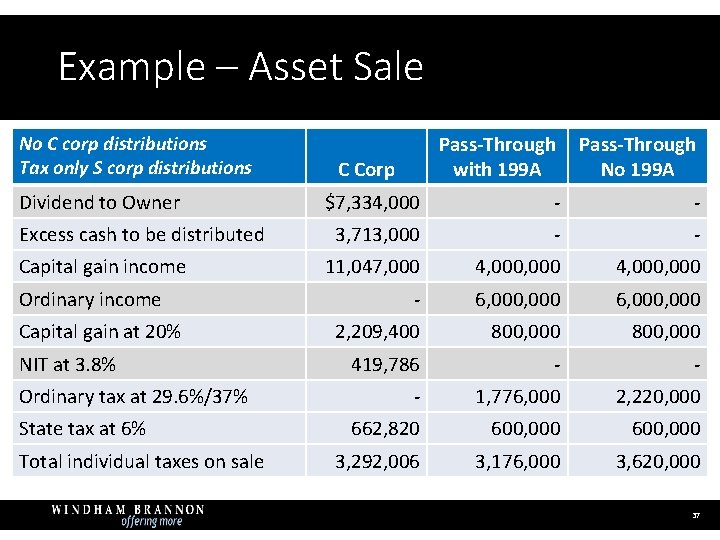
Example – Asset Sale Pass-Through with 199 A Pass-Through No 199 A $7, 334, 000 - - 3, 713, 000 - - 11, 047, 000 4, 000, 000 - 6, 000, 000 2, 209, 400 800, 000 419, 786 - - - 1, 776, 000 2, 220, 000 662, 820 600, 000 3, 292, 006 3, 176, 000 3, 620, 000 No C corp distributions Tax only S corp distributions Dividend to Owner C Corp Excess cash to be distributed Capital gain income Ordinary income Capital gain at 20% NIT at 3. 8% Ordinary tax at 29. 6%/37% State tax at 6% Total individual taxes on sale #WBInsights 18 37 37
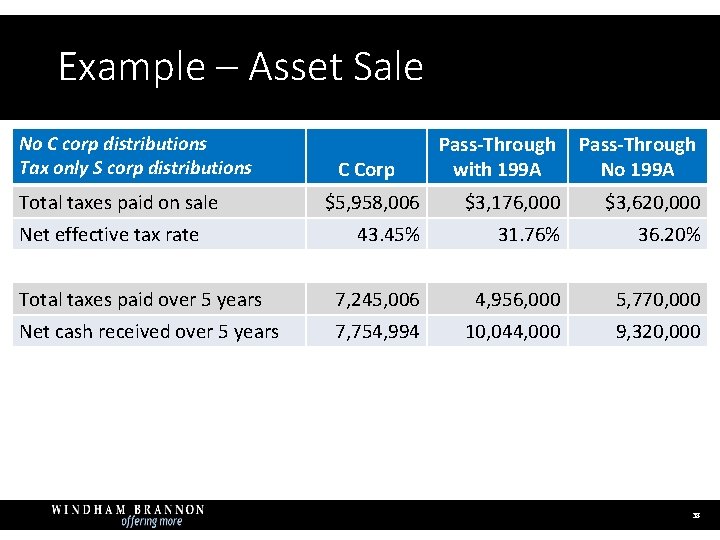
Example – Asset Sale Pass-Through with 199 A Pass-Through No 199 A $5, 958, 006 $3, 176, 000 $3, 620, 000 43. 45% 31. 76% 36. 20% Total taxes paid over 5 years 7, 245, 006 4, 956, 000 5, 770, 000 Net cash received over 5 years 7, 754, 994 10, 044, 000 9, 320, 000 No C corp distributions Tax only S corp distributions Total taxes paid on sale C Corp Net effective tax rate #WBInsights 18 38 38
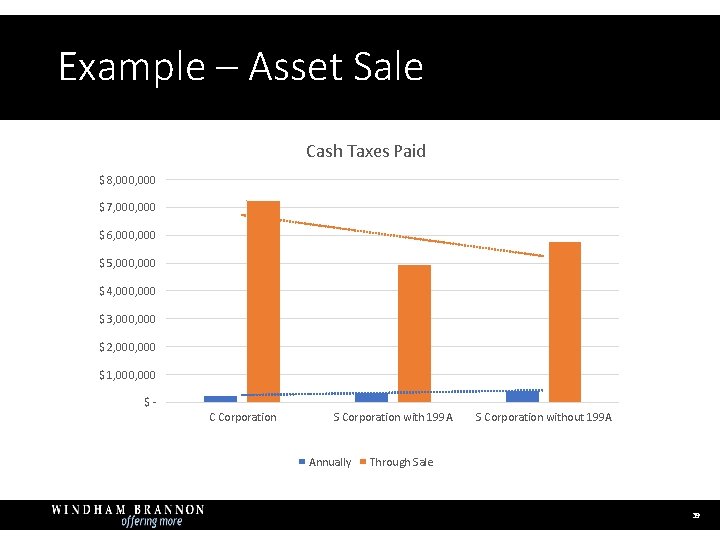
Example – Asset Sale Cash Taxes Paid $ 8, 000 $ 7, 000 $ 6, 000 $ 5, 000 $ 4, 000 $ 3, 000 $ 2, 000 $ 1, 000 $ C Corporation S Corporation with 199 A Annually #WBInsights 18 S Corporation without 199 A Through Sale 39 39
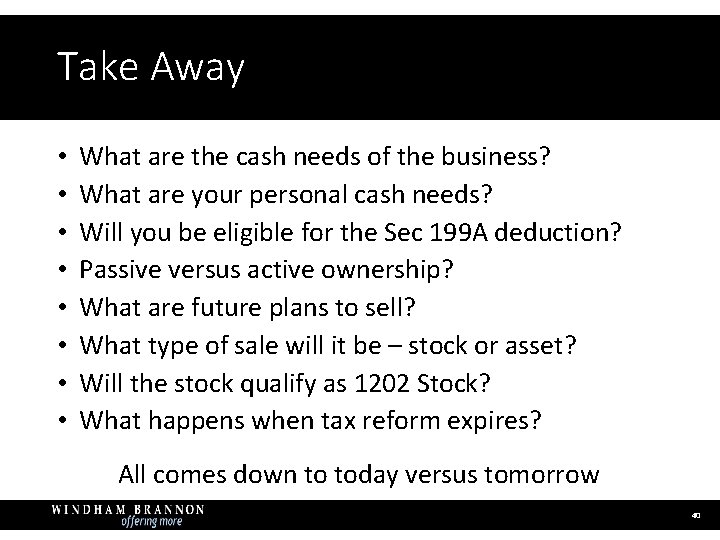
Take Away • • What are the cash needs of the business? What are your personal cash needs? Will you be eligible for the Sec 199 A deduction? Passive versus active ownership? What are future plans to sell? What type of sale will it be – stock or asset? Will the stock qualify as 1202 Stock? What happens when tax reform expires? All comes down to today versus tomorrow #WBInsights 18 40 40
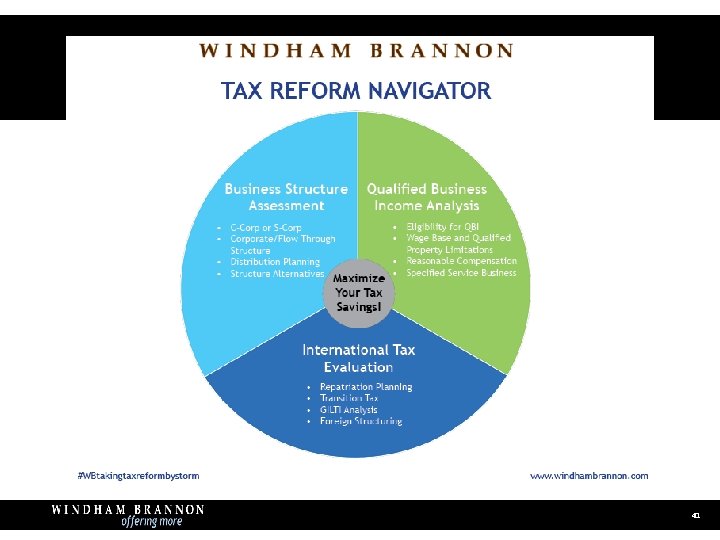
#WBInsights 18 41 41
Questions? Nicole Suk, CPA Principal Windham Brannon 3630 Peachtree Road Suite 600 Atlanta, Georgia 30326 Main: 404. 898. 2000 Direct: 678. 510. 2785 Fax: 404. 898. 2010 Email: nsuk@windhambrannon. com #WBInsights 18 42 42
Tax Cuts and Jobs Act: Entity Choice and Sec 199 A QBI Deduction Part II Nicole R. Suk, CPA November 29, 2018 #WBInsights 18 43
Agenda Part I – Entity Selection • Entity choices • Tax implications of conversion • Examples Part II – Sec 199 A Qualified Business Income Deduction • What is 199 A • How is 199 A calculated • Examples • Reporting and Planning #WBInsights 18 44 44
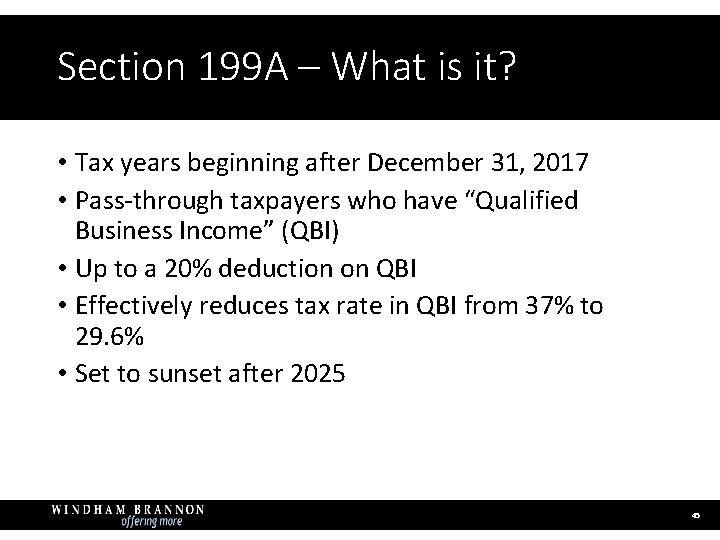
Section 199 A – What is it? • Tax years beginning after December 31, 2017 • Pass-through taxpayers who have “Qualified Business Income” (QBI) • Up to a 20% deduction on QBI • Effectively reduces tax rate in QBI from 37% to 29. 6% • Set to sunset after 2025 #WBInsights 18 45 45
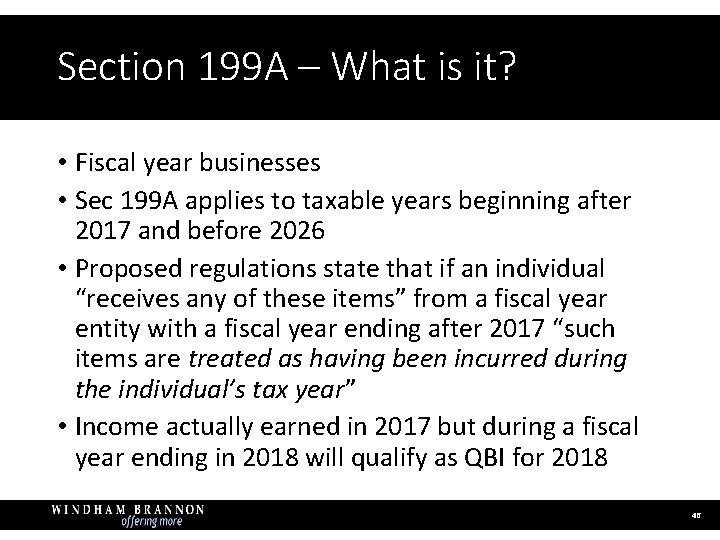
Section 199 A – What is it? • Fiscal year businesses • Sec 199 A applies to taxable years beginning after 2017 and before 2026 • Proposed regulations state that if an individual “receives any of these items” from a fiscal year entity with a fiscal year ending after 2017 “such items are treated as having been incurred during the individual’s tax year” • Income actually earned in 2017 but during a fiscal year ending in 2018 will qualify as QBI for 2018 #WBInsights 18 46 46
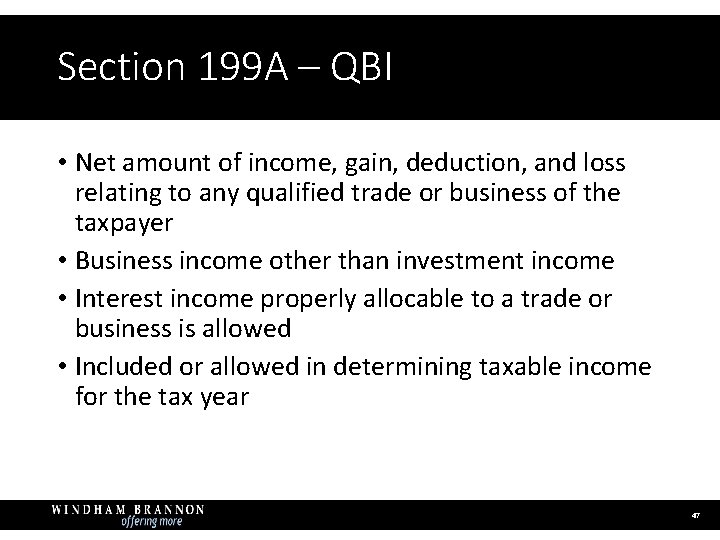
Section 199 A – QBI • Net amount of income, gain, deduction, and loss relating to any qualified trade or business of the taxpayer • Business income other than investment income • Interest income properly allocable to a trade or business is allowed • Included or allowed in determining taxable income for the tax year #WBInsights 18 47 47
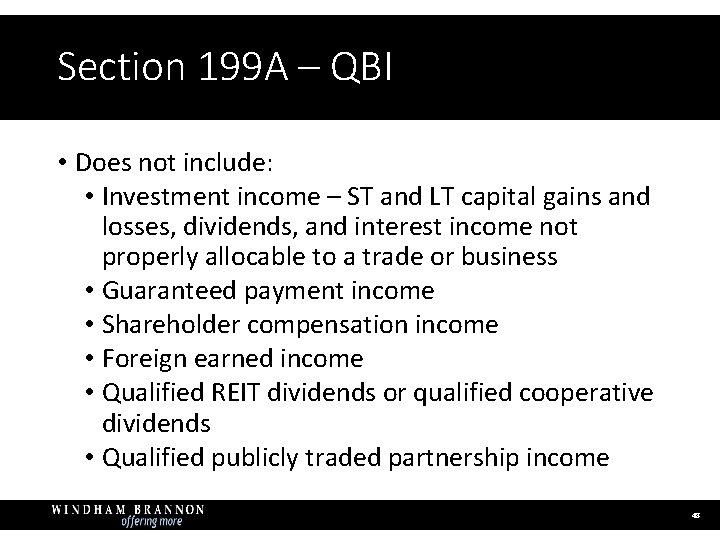
Section 199 A – QBI • Does not include: • Investment income – ST and LT capital gains and losses, dividends, and interest income not properly allocable to a trade or business • Guaranteed payment income • Shareholder compensation income • Foreign earned income • Qualified REIT dividends or qualified cooperative dividends • Qualified publicly traded partnership income #WBInsights 18 48 48
Section 199 A – QBI • Passive and active ownership eligible • Available for non-corporate taxpayers including trusts and estates • Grantor trusts – treated as if individual owns directly • Income from specified businesses may not be eligible for the deduction #WBInsights 18 49 49
Section 199 A – Specified Businesses • Trade or business involving the performance of services other than engineering or architecture • Investment and investment management, trading, or dealing in securities • Performance of services in the fields of health, law, accounting, performing arts, consulting, athletics, financial services, brokerage services #WBInsights 18 50 50
Section 199 A – Specified Businesses • “Any trade or business where the principal asset of such trade or business is the reputation or skill of one or more of its employees or owners” • Narrow interpretation • Endorsing products or services • Using individual’s image, likeness, name, signature, voice, trademark or other symbols associated with the individual • Appearing at an event or on radio, TV or other media format #WBInsights 18 51 51
Section 199 A – Specified Businesses • De minimis rule for mixed businesses – not a SSTB if less than 10% of gross receipts from specified field (5% if gross receipts over $25 M) • “Cracking and packing” • 50% and 80% Tests • An SSTB includes any business 1. With 50% or more common ownership (directly or indirectly) and 2. That provides 80% or more of its property or services to an SSTB #WBInsights 18 52 52
Section 199 A - Calculation • If total individual taxable income is less than $315, 000 MFJ or $157, 500 single – eligible regardless of business type • If a specified business, phase out of deduction between $315, 000 - $415, 000 MFJ and $157, 500 - $207, 500 single, subject to other limitation calculations • Specified business over those limits – no deduction #WBInsights 18 53 53
Section 199 A - Calculation • Deduction is lesser of: • 20% of the taxpayer’s combined QBI • 20% of the excess of taxable income over net capital gains • Not to exceed the greater of • 50% of the allocable W-2 wages paid OR • the sum of 25% of the allocable share W-2 wages paid PLUS 2. 5% of the allocable share of unadjusted basis of all qualified property (QP) #WBInsights 18 54 54
Section 199 A – W-2 Wages • Management company exception • Can take into account W-2 wages paid by another person “provided the W-2 wages were paid to common law employees or officers of the individual or entity for employment by the individual or entity” • Allocate wages of an employee among multiple businesses in the same manner expenses are allocated • “Reasonable method” #WBInsights 18 55 55
Section 199 A – Qualified Property • Depreciable tangible property used in trade or business (not land) • Unadjusted basis immediately after acquisition • Depreciation period has not ended – later of 10 years or applicable recovery period • Property acquired within 60 days of year-end or disposed of within 120 days without being used in the business at least 45 days not qualified #WBInsights 18 56 56
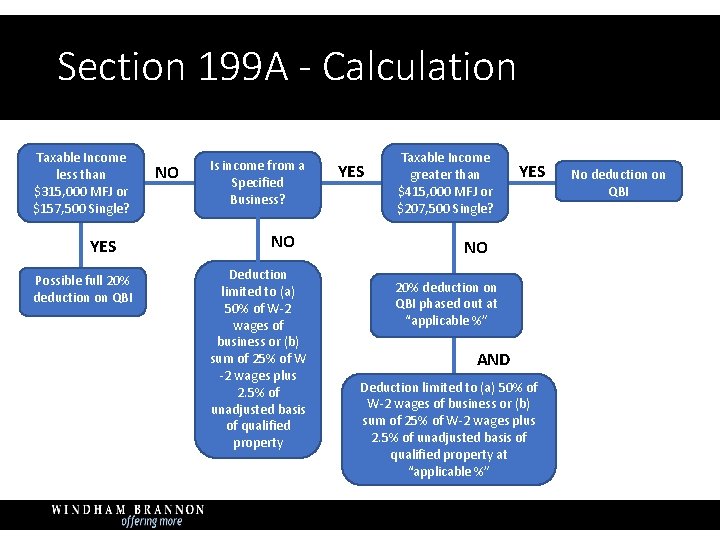
Section 199 A - Calculation Taxable Income less than $315, 000 MFJ or $157, 500 Single? YES Possible full 20% deduction on QBI NO Is income from a Specified Business? NO Deduction limited to (a) 50% of W-2 wages of business or (b) sum of 25% of W -2 wages plus 2. 5% of unadjusted basis of qualified property YES Taxable Income greater than $415, 000 MFJ or $207, 500 Single? YES No deduction on QBI NO 20% deduction on QBI phased out at “applicable %” AND Deduction limited to (a) 50% of W-2 wages of business or (b) sum of 25% of W-2 wages plus 2. 5% of unadjusted basis of qualified property at “applicable %” 57 #WBInsights 18 57
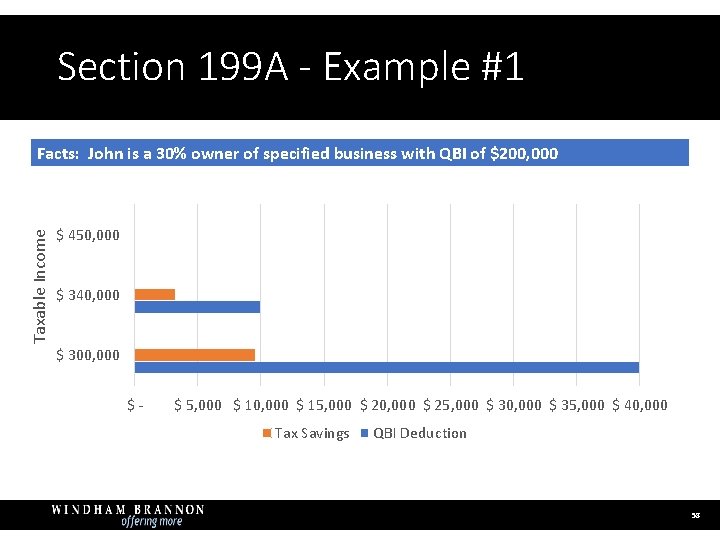
Section 199 A - Example #1 Taxable Income Facts: John is a 30% owner of specified business with QBI of $200, 000 $ 450, 000 $ 340, 000 $ 300, 000 $ - $ 5, 000 $ 10, 000 $ 15, 000 $ 20, 000 $ 25, 000 $ 30, 000 $ 35, 000 $ 40, 000 Tax Savings #WBInsights 18 QBI Deduction 58 58
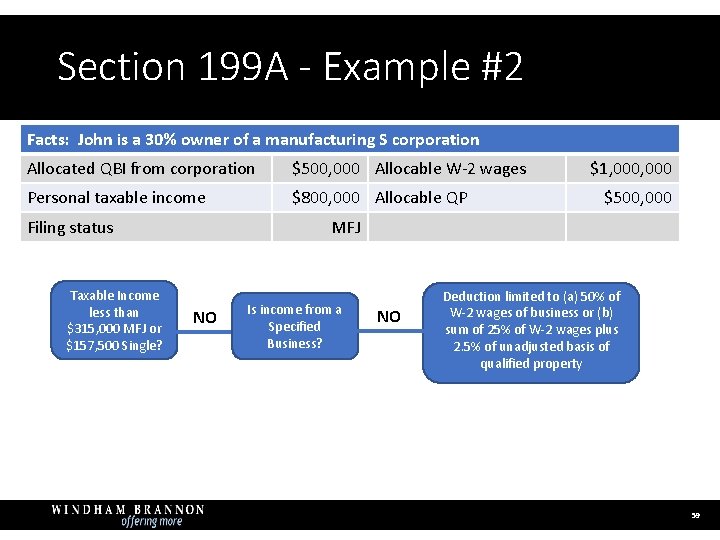
Section 199 A - Example #2 Facts: John is a 30% owner of a manufacturing S corporation Allocated QBI from corporation $500, 000 Allocable W-2 wages Personal taxable income $800, 000 Allocable QP Filing status Taxable Income less than $315, 000 MFJ or $157, 500 Single? $1, 000 $500, 000 MFJ NO Is income from a Specified Business? #WBInsights 18 NO Deduction limited to (a) 50% of W-2 wages of business or (b) sum of 25% of W-2 wages plus 2. 5% of unadjusted basis of qualified property 59 59
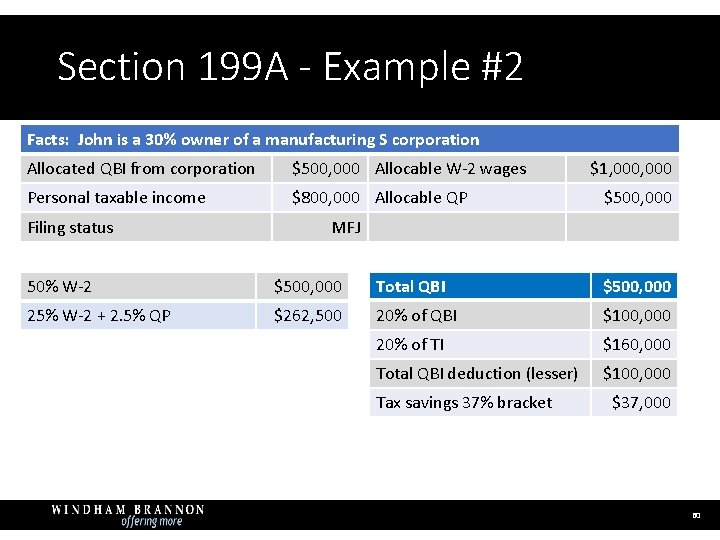
Section 199 A - Example #2 Facts: John is a 30% owner of a manufacturing S corporation Allocated QBI from corporation $500, 000 Allocable W-2 wages Personal taxable income $800, 000 Allocable QP Filing status $1, 000 $500, 000 MFJ 50% W-2 $500, 000 Total QBI $500, 000 25% W-2 + 2. 5% QP $262, 500 20% of QBI $100, 000 20% of TI $160, 000 Total QBI deduction (lesser) $100, 000 Tax savings 37% bracket #WBInsights 18 60 $37, 000 60
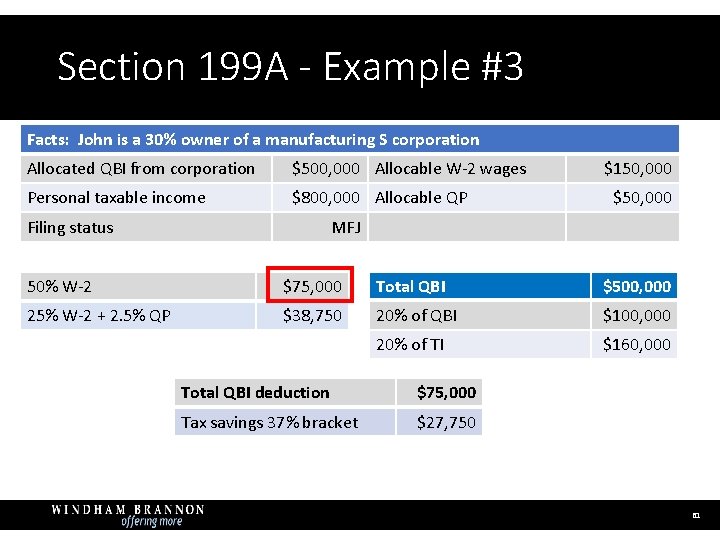
Section 199 A - Example #3 Facts: John is a 30% owner of a manufacturing S corporation Allocated QBI from corporation $500, 000 Allocable W-2 wages Personal taxable income $800, 000 Allocable QP Filing status $150, 000 $50, 000 MFJ 50% W-2 $75, 000 Total QBI $500, 000 25% W-2 + 2. 5% QP $38, 750 20% of QBI $100, 000 20% of TI $160, 000 Total QBI deduction $75, 000 Tax savings 37% bracket $27, 750 #WBInsights 18 61 61
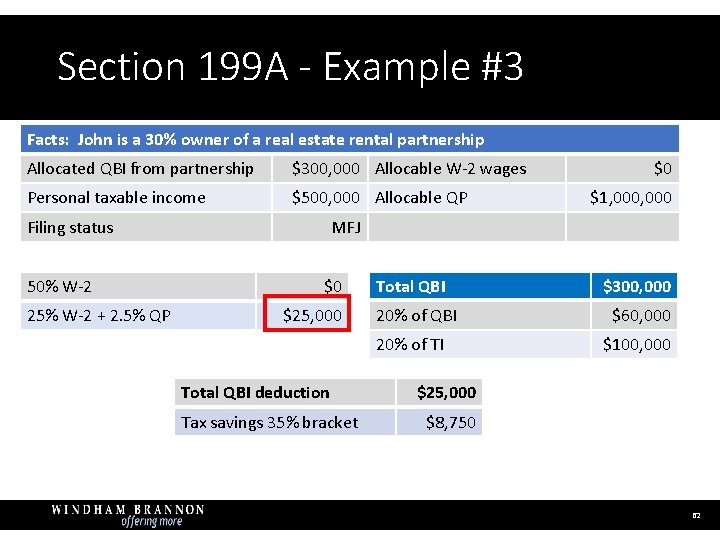
Section 199 A - Example #3 Facts: John is a 30% owner of a real estate rental partnership Allocated QBI from partnership $300, 000 Allocable W-2 wages Personal taxable income $500, 000 Allocable QP Filing status 50% W-2 25% W-2 + 2. 5% QP $0 $1, 000 MFJ $0 $25, 000 Total QBI $300, 000 20% of QBI $60, 000 20% of TI Total QBI deduction Tax savings 35% bracket #WBInsights 18 $100, 000 $25, 000 $8, 750 62 62
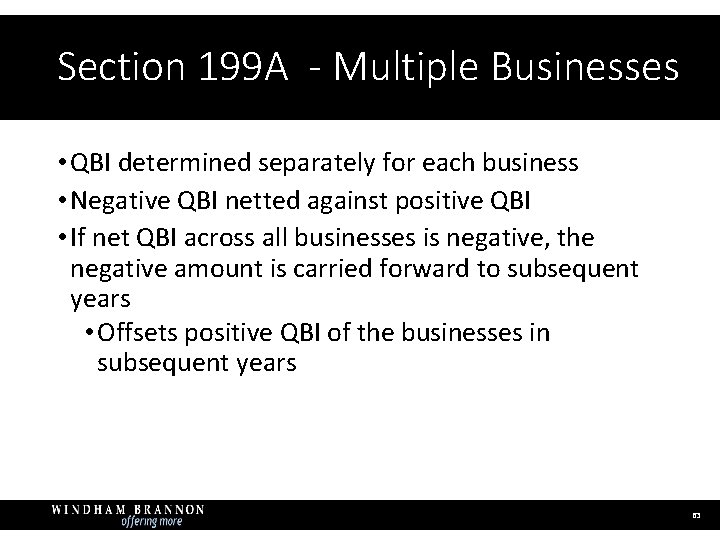
Section 199 A - Multiple Businesses • QBI determined separately for each business • Negative QBI netted against positive QBI • If net QBI across all businesses is negative, the negative amount is carried forward to subsequent years • Offsets positive QBI of the businesses in subsequent years #WBInsights 18 63 63
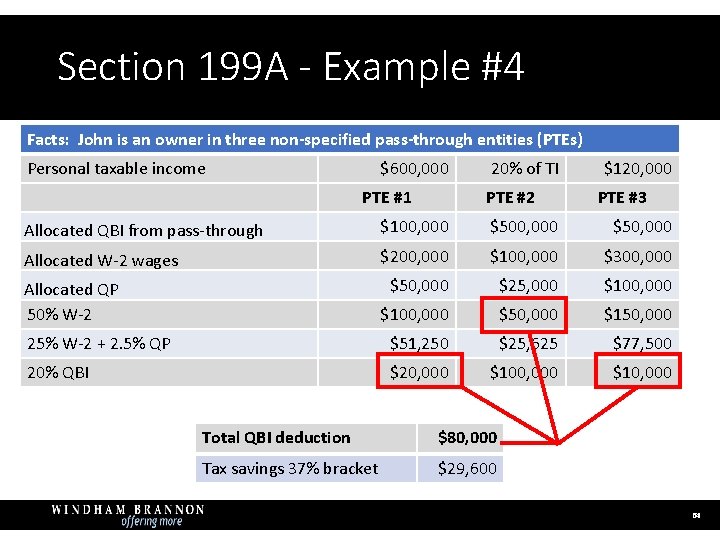
Section 199 A - Example #4 Facts: John is an owner in three non-specified pass-through entities (PTEs) Personal taxable income $600, 000 PTE #1 20% of TI PTE #2 $120, 000 PTE #3 Allocated QBI from pass-through $100, 000 $50, 000 Allocated W-2 wages $200, 000 $100, 000 $300, 000 $50, 000 $25, 000 $100, 000 $50, 000 $150, 000 25% W-2 + 2. 5% QP $51, 250 $25, 625 $77, 500 20% QBI $20, 000 $10, 000 Allocated QP 50% W-2 Total QBI deduction $80, 000 Tax savings 37% bracket $29, 600 #WBInsights 18 64 64
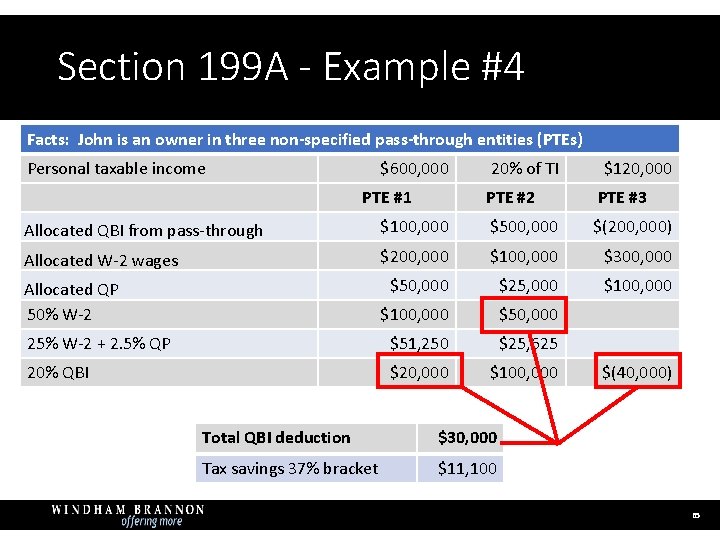
Section 199 A - Example #4 Facts: John is an owner in three non-specified pass-through entities (PTEs) Personal taxable income $600, 000 PTE #1 20% of TI $120, 000 PTE #2 PTE #3 Allocated QBI from pass-through $100, 000 $500, 000 $(200, 000) Allocated W-2 wages $200, 000 $100, 000 $300, 000 $50, 000 $25, 000 $100, 000 $50, 000 25% W-2 + 2. 5% QP $51, 250 $25, 625 20% QBI $20, 000 $100, 000 Allocated QP 50% W-2 Total QBI deduction $30, 000 Tax savings 37% bracket $11, 100 #WBInsights 18 65 $(40, 000) 65
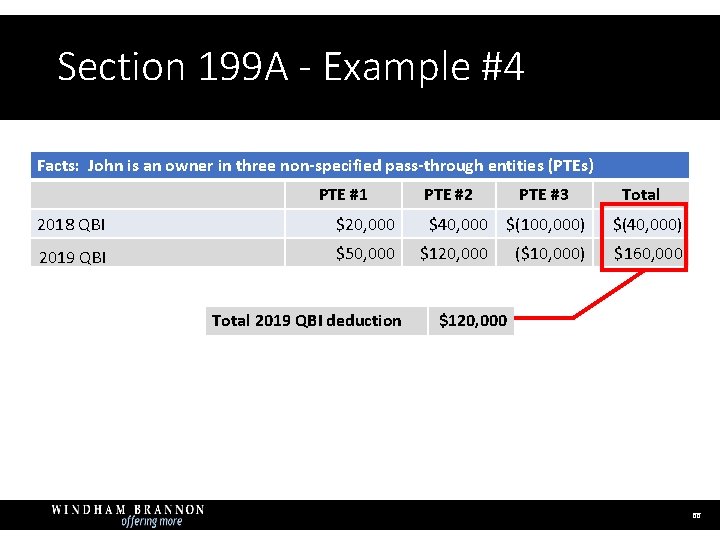
Section 199 A - Example #4 Facts: John is an owner in three non-specified pass-through entities (PTEs) PTE #1 PTE #2 PTE #3 Total 2018 QBI $20, 000 $40, 000 $(100, 000) $(40, 000) 2019 QBI $50, 000 $120, 000 ($10, 000) $160, 000 Total 2019 QBI deduction #WBInsights 18 $120, 000 66 66
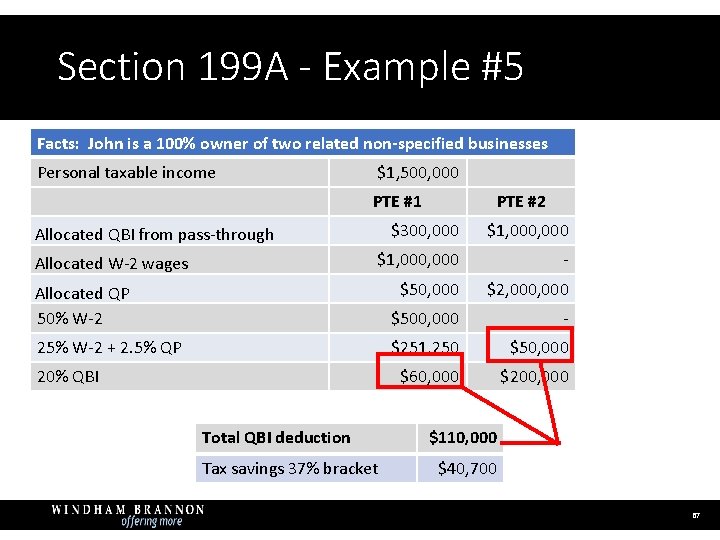
Section 199 A - Example #5 Facts: John is a 100% owner of two related non-specified businesses Personal taxable income $1, 500, 000 PTE #1 $300, 000 $1, 000, 000 - $50, 000 $2, 000 $500, 000 - $251, 250 $50, 000 $60, 000 $200, 000 Allocated QBI from pass-through Allocated W-2 wages Allocated QP 50% W-2 25% W-2 + 2. 5% QP 20% QBI Total QBI deduction Tax savings 37% bracket #WBInsights 18 PTE #2 $110, 000 $40, 700 67 67
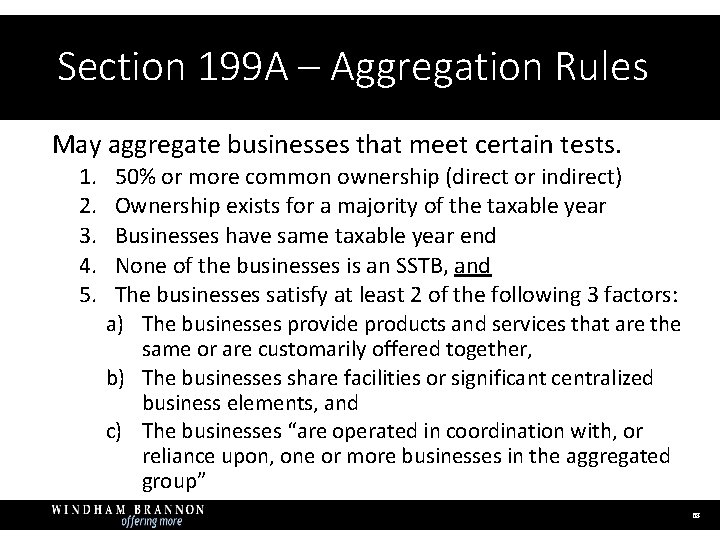
Section 199 A – Aggregation Rules May aggregate businesses that meet certain tests. 1. 2. 3. 4. 5. 50% or more common ownership (direct or indirect) Ownership exists for a majority of the taxable year Businesses have same taxable year end None of the businesses is an SSTB, and The businesses satisfy at least 2 of the following 3 factors: a) The businesses provide products and services that are the same or are customarily offered together, b) The businesses share facilities or significant centralized business elements, and c) The businesses “are operated in coordination with, or reliance upon, one or more businesses in the aggregated group” #WBInsights 18 68 68
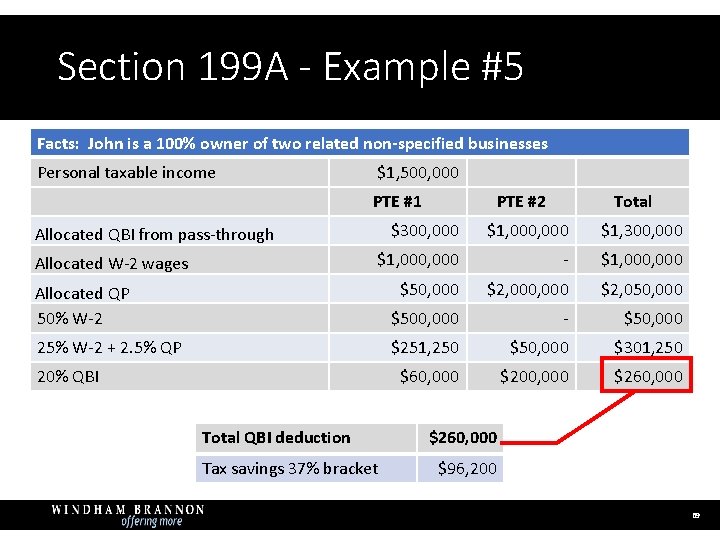
Section 199 A - Example #5 Facts: John is a 100% owner of two related non-specified businesses Personal taxable income $1, 500, 000 PTE #1 $1, 000 $1, 300, 000 $1, 000 - $1, 000 $50, 000 $2, 050, 000 $500, 000 - $50, 000 $251, 250 $50, 000 $301, 250 $60, 000 $200, 000 $260, 000 Allocated QP 50% W-2 25% W-2 + 2. 5% QP 20% QBI Total QBI deduction Tax savings 37% bracket #WBInsights 18 Total $300, 000 Allocated QBI from pass-through Allocated W-2 wages PTE #2 $260, 000 $96, 200 69 69
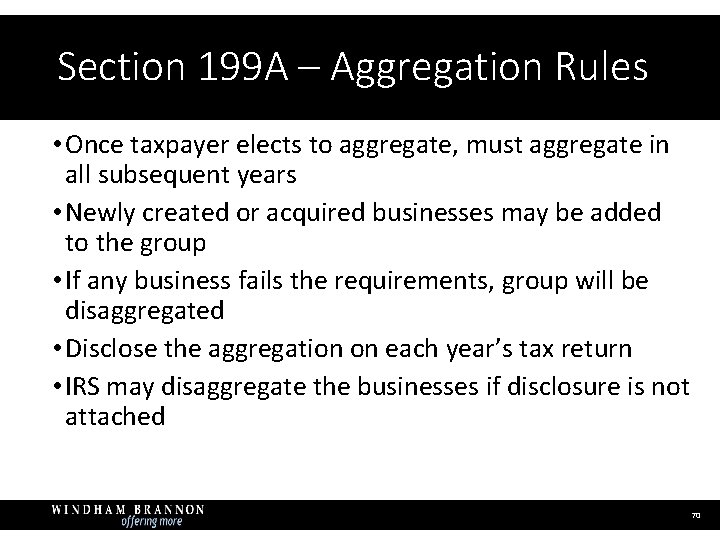
Section 199 A – Aggregation Rules • Once taxpayer elects to aggregate, must aggregate in all subsequent years • Newly created or acquired businesses may be added to the group • If any business fails the requirements, group will be disaggregated • Disclose the aggregation on each year’s tax return • IRS may disaggregate the businesses if disclosure is not attached #WBInsights 18 70 70
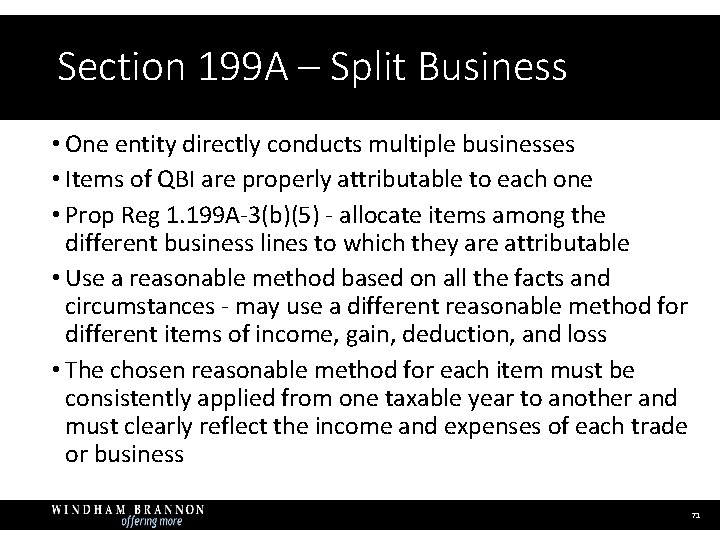
Section 199 A – Split Business • One entity directly conducts multiple businesses • Items of QBI are properly attributable to each one • Prop Reg 1. 199 A-3(b)(5) - allocate items among the different business lines to which they are attributable • Use a reasonable method based on all the facts and circumstances - may use a different reasonable method for different items of income, gain, deduction, and loss • The chosen reasonable method for each item must be consistently applied from one taxable year to another and must clearly reflect the income and expenses of each trade or business #WBInsights 18 71 71
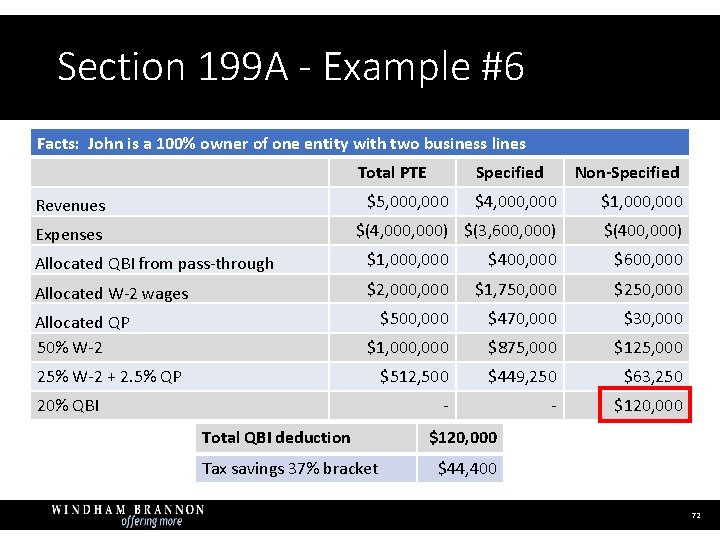
Section 199 A - Example #6 Facts: John is a 100% owner of one entity with two business lines Total PTE Specified $5, 000 Revenues Expenses Non-Specified $4, 000 $1, 000 $(4, 000) $(3, 600, 000) $(400, 000) Allocated QBI from pass-through $1, 000 $400, 000 $600, 000 Allocated W-2 wages $2, 000 $1, 750, 000 $250, 000 $500, 000 $470, 000 $30, 000 $1, 000 $875, 000 $125, 000 $512, 500 $449, 250 $63, 250 - - $120, 000 Allocated QP 50% W-2 25% W-2 + 2. 5% QP 20% QBI Total QBI deduction Tax savings 37% bracket #WBInsights 18 $120, 000 $44, 400 72 72
Section 199 A – Sale of a Business • Asset sale • Depreciation recapture is ordinary income • Limited by W-2 wages and QP basis • 1. 199 A-2 does not directly address sale of property • Applicable QP includes property “used at any point during the taxable year in the trade or business's production of QBI” • QP basis at date of sale #WBInsights 18 73 73
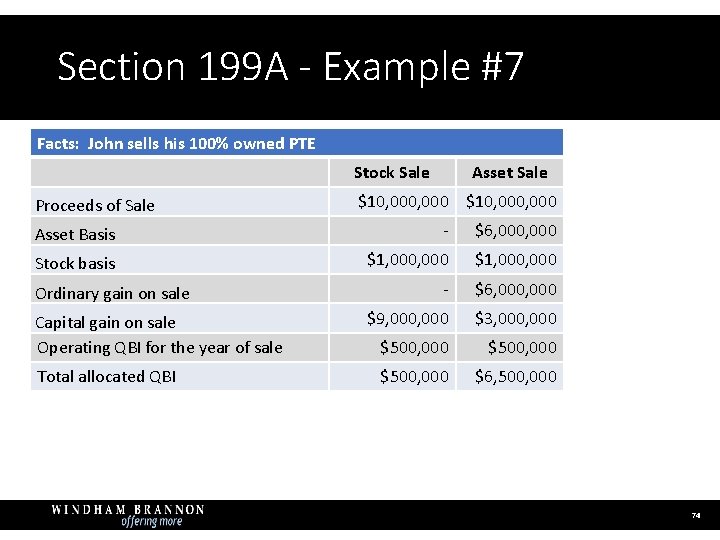
Section 199 A - Example #7 Facts: John sells his 100% owned PTE Stock Sale Asset Sale $10, 000, 000 Proceeds of Sale Asset Basis - $6, 000 Stock basis $1, 000, 000 - $6, 000 $9, 000 $3, 000 $500, 000 $6, 500, 000 Ordinary gain on sale Capital gain on sale Operating QBI for the year of sale Total allocated QBI #WBInsights 18 74 74
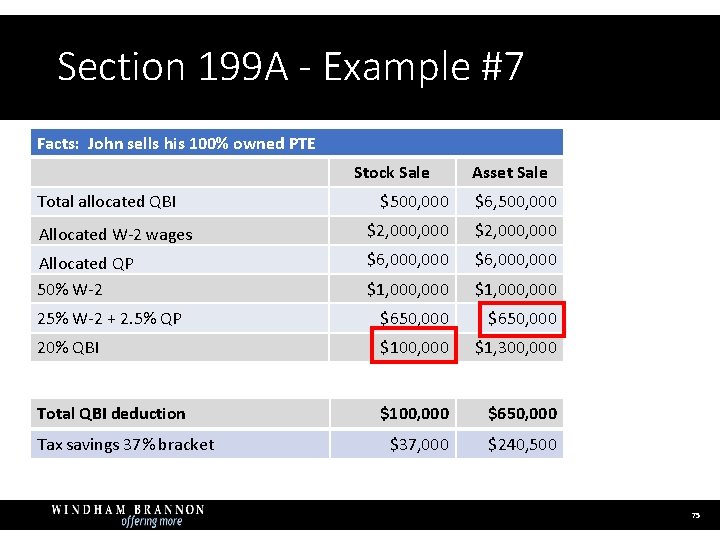
Section 199 A - Example #7 Facts: John sells his 100% owned PTE Stock Sale Total allocated QBI Asset Sale $500, 000 $6, 500, 000 Allocated W-2 wages $2, 000, 000 Allocated QP 50% W-2 $6, 000, 000 $1, 000, 000 25% W-2 + 2. 5% QP $650, 000 20% QBI $100, 000 $1, 300, 000 Total QBI deduction $100, 000 $650, 000 $37, 000 $240, 500 Tax savings 37% bracket #WBInsights 18 75 75
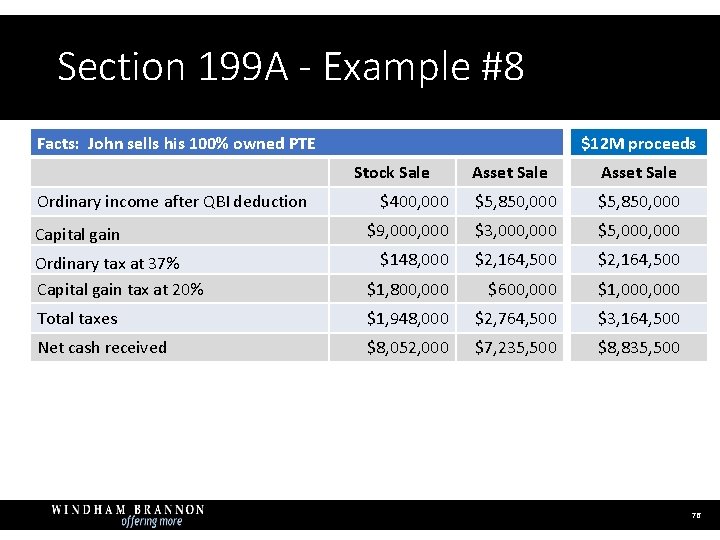
Section 199 A - Example #8 Facts: John sells his 100% owned PTE $12 M proceeds Stock Sale Asset Sale $400, 000 $5, 850, 000 $9, 000 $3, 000 $5, 000 $148, 000 $2, 164, 500 $1, 800, 000 $600, 000 $1, 000 Total taxes $1, 948, 000 $2, 764, 500 $3, 164, 500 Net cash received $8, 052, 000 $7, 235, 500 $8, 835, 500 Ordinary income after QBI deduction Capital gain Ordinary tax at 37% Capital gain tax at 20% #WBInsights 18 76 76
Section 199 A – Other Items • Straight 20% deduction allowed for qualified REIT dividends, qualified cooperative dividends and qualified publicly traded partnership income • Georgia does not allow QBI deduction #WBInsights 18 77 77
Section 199 A – Effect on Return • No reduction of AGI • Does not affect thresholds based on AGI • Deduction available to non-itemizers • No effect on adjusted basis of pass-through entity • Does not reduce SE tax • Does not reduce net investment tax • QBI deduction same for regular and AMT #WBInsights 18 78 78
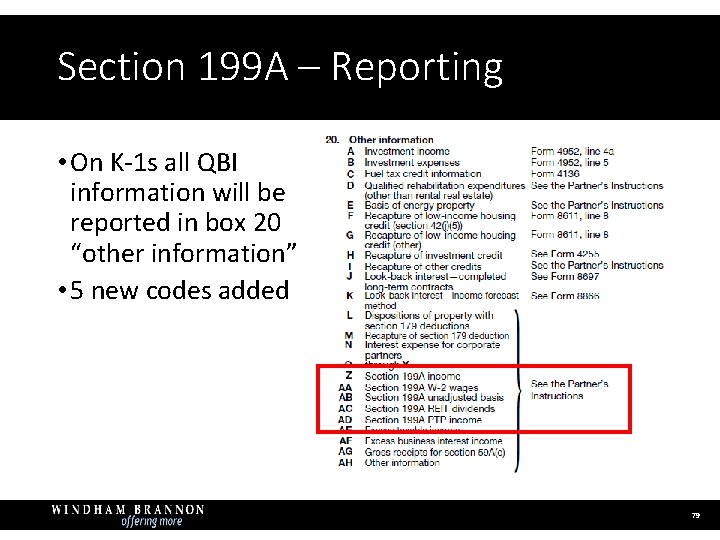
Section 199 A – Reporting • On K-1 s all QBI information will be reported in box 20 “other information” • 5 new codes added #WBInsights 18 79 79
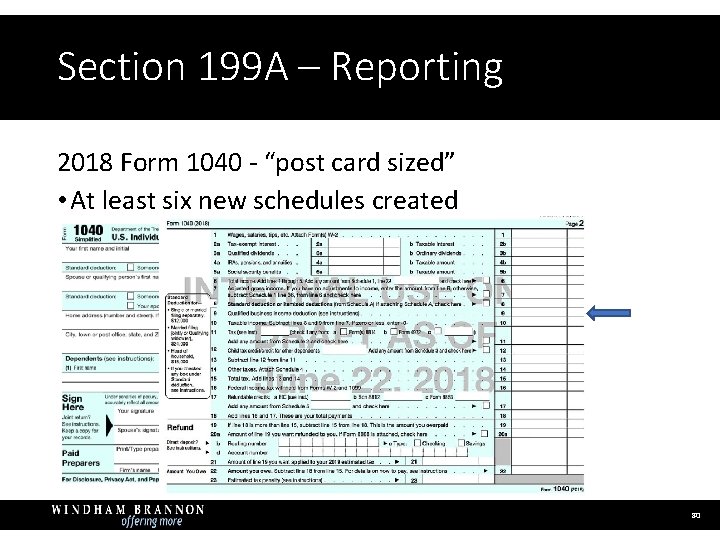
Section 199 A – Reporting 2018 Form 1040 - “post card sized” • At least six new schedules created #WBInsights 18 80 80
Section 199 A – Planning Opportunities • Appropriate shareholder compensation • Guaranteed payments versus income allocation • Aggregate businesses • “Share” a related management company • Bring taxable income down below thresholds #WBInsights 18 81 81
#WBInsights 18 82 82
Contact Information Questions? Nicole Suk, CPA Principal Windham Brannon 3630 Peachtree Road Suite 600 Atlanta, Georgia 30326 Main: 404. 898. 2000 Direct: 678. 510. 2785 Fax: 404. 898. 2010 Email: nsuk@windhambrannon. com #WBInsights 18 83 83
- Slides: 83