
Tax competition vs tax harmonization Where do we
- Slides: 11
Tax competition vs. tax harmonization: Where do we stand? CEPII-CERGE Conference on Tax competition in the EU 25 Prague, December 16 -17, 2004 Agnès Bénassy-Quéré Jean Pisani-Ferry Université Paris. Dauphine
Outline n n n The issues Costs and benefits of tax competition Ways forward 2
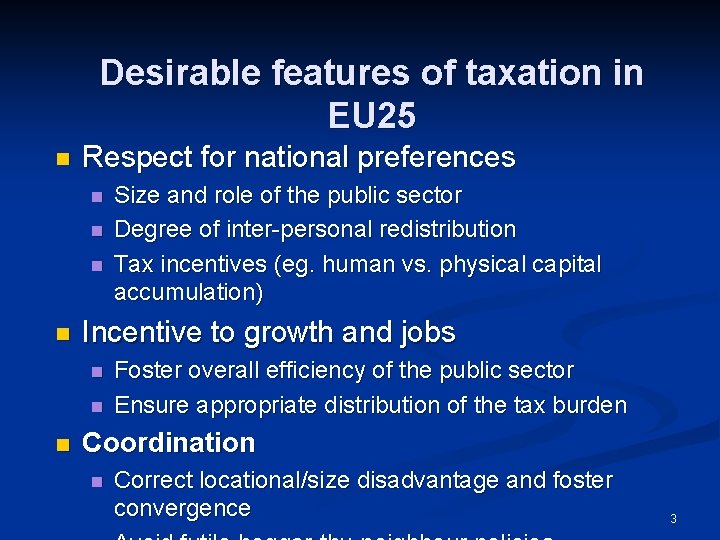
Desirable features of taxation in EU 25 n Respect for national preferences n n Incentive to growth and jobs n n n Size and role of the public sector Degree of inter-personal redistribution Tax incentives (eg. human vs. physical capital accumulation) Foster overall efficiency of the public sector Ensure appropriate distribution of the tax burden Coordination n Correct locational/size disadvantage and foster convergence 3
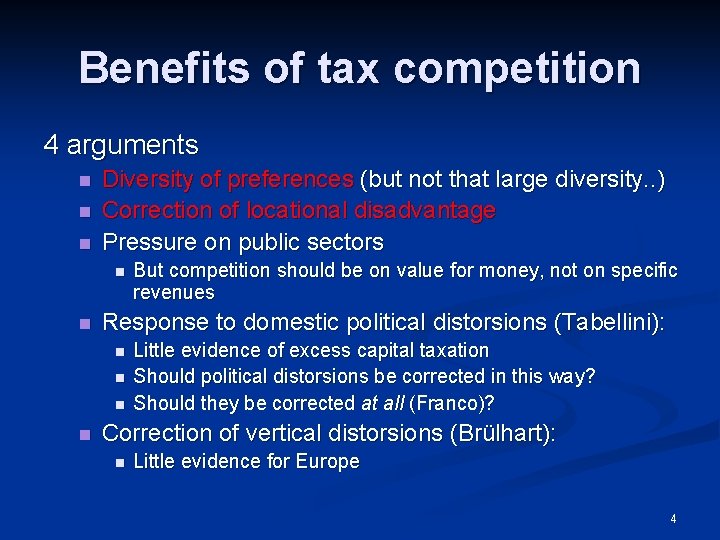
Benefits of tax competition 4 arguments n n n Diversity of preferences (but not that large diversity. . ) Correction of locational disadvantage Pressure on public sectors n n Response to domestic political distorsions (Tabellini): n n But competition should be on value for money, not on specific revenues Little evidence of excess capital taxation Should political distorsions be corrected in this way? Should they be corrected at all (Franco)? Correction of vertical distorsions (Brülhart): n Little evidence for Europe 4
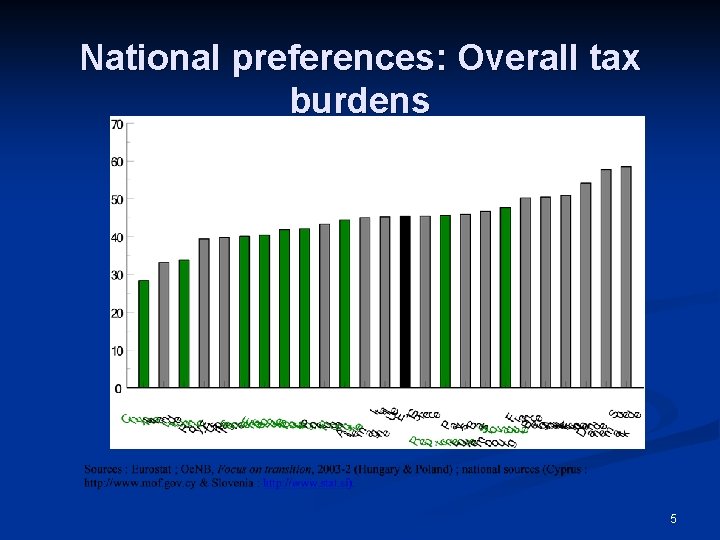
National preferences: Overall tax burdens 5
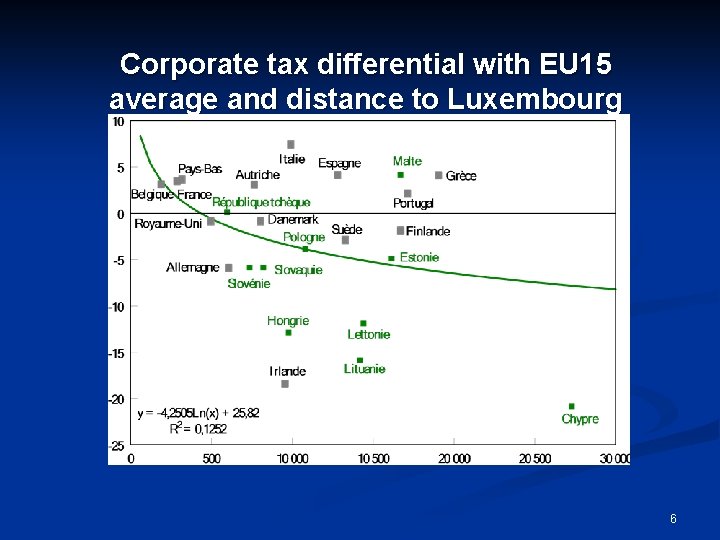
Corporate tax differential with EU 15 average and distance to Luxembourg 6
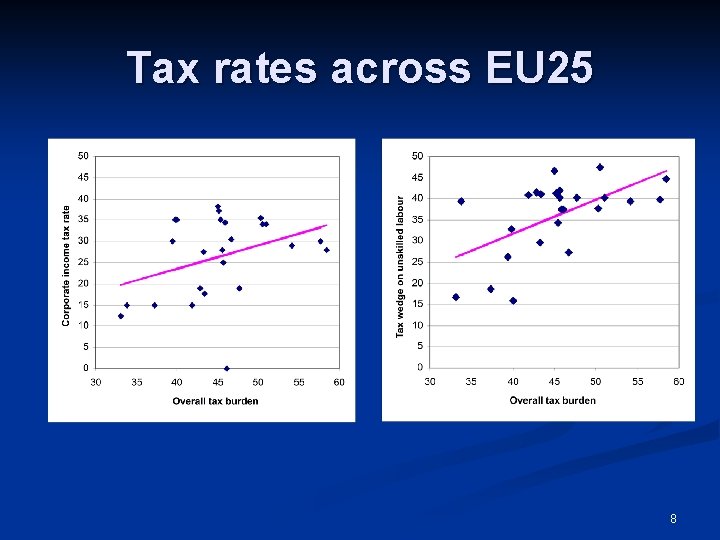
Costs of tax competition 3 arguments n Distorsions in investment location (Sarkozy): weak n n Inappropriate distribution of the tax burden (excess taxation of immobile labour): medium n n n With low elasticities (CPB, CEPII), lower tax rates may not go much beyond correcting locational disadvantage Aggregate evidence seems to confirm shifting of burden Some cross-country evidence also, but not very strong Opportunities for profit-shifting for tax avoidance: 7 strong
Tax rates across EU 25 8
Some disturbing trade-offs Measures that reduce opportunities for profit shifting may increase locational competition (Gérard) n Tax coordination does not necessarily lead to higher taxes (Häufler) n Thus: do not attempt at hitting three birds with one stone n Priority should be to limit tax avoidance n 9
Options Overall harmonisation is a non-starter n Even harmonisation of tax bases + consolidation is unlikely n Thus, choice between n Watered-down solutions (mutual recognition, options, targeted solutions) – Maggiulli, or n Coalition of the willing (enhanced cooperation) n n Beware of second best: some progress towards harmonisation may be harmful 10
Ways forward n Enhanced cooperation n Interesting intellectual support for partial harmonisation – Bucovetsky n n n May lead to stable, large coalitions Benefits to the participants: less distorsions, less shifting Compatible with treaty Differentiate – lower floor for NMS? European corporate income tax (Büttner) n Additional benefit – less demand for juste retour 11