
Tavistock and Portman NHS Foundation Trust Infant Observation
Tavistock and Portman NHS Foundation Trust Infant Observation and beyond: a collection of resources to support the study of psychoanalytic Infant Observation. Compiled by Georgia Cowley This collection of visual, audio and literature resources has been compiled and thematically organized with a view to stimulating students’ engagement with psychoanalytic observation and make links with child development research. The pack is designed to augment student’s experience of traditional infant observation practice and seminar teaching, as well as encourage curiosity about the wide breadth of research and mainstream programming the study of children and infants has inspired. We hope it will contribute to student’s motivation to explore resources, encouraging them to look into contemporary perspectives on the subject. The thematic exploration of the Journal of Infant Observation found towards the end of this pack is designed to make it easy for students and teachers to source contemporary literature as well as review the scope, limitations and applications of the method which has accumulated over the last ten years. Contents: 1. Video resources Available in the library…………. 2 2. Box of Broadcasts…………………………… 3 3. Podcast Episodes and Radio Programmes…………………. 4 4. Youtube ……. ……………………………… 5 5. The Journal of Infant Observation………………. . 6 This is not a comprehensive list of papers and audiovisual resources but rather the result of a students thematic review. If anyone has knowledge of further resources that could be added to this pack please do not hesitate to contact me: g. cowley@hotmail. com
Video resources available in the Tavistock library • Attachment in practice, Siren Films • Our children, ourselves, Channel 5 • The Attachment Relationship, Alan Sroufe • Prisoners of Childhood, Alice Miller, Channel 4 • Autism-a world apart, Susan Rein • Saturday’s child. Part III 7 -12 months, A child is born in Western India: • Autism: challenging behaviour, BBC maternal style and infant development (including daily massage), Lynn • Child of Our Time, BBC Barnett • A Child’s World, Channel 4 • Saturday’s child. Part II: 3 -6 months. A child is • Children Behaving Badly, BBC • Saturday’s child. Part I: 0 -2 months • For the Sake of the Children, BBC • The Separation-individuation process. Psychological birth of the human infant, Margaret S. Mahler • Francis Tustin remembers: an interview with Alexander Newman • Silent twin- not without my shadow, BBC • Some consequences of separation and loss in Childhood, John Bowlby • Spoiling the child? The case against modern parenting, Lisa Miller, BBC • • Learning and Communication. Functional learning programmes for young developmentally delayed children, Katrin Stroh and Thelma Robinson Sunday’s child. The growth of individuality, 0 -2 years, Lynn Barnett • A two-year-old goes to Hospital, James and Joyce Robertson • Learning to Share, National Association of Toy and Leisure Libraries • Young children in brief separation: Jane, James and Joyce Robertson • Monday’s Child: A baby born in rural Nepal Directed by Lynn Barnett and Meg Leng • Young children in brief separation: John, James and Joyce Robertson • Young children in brief separation: Kate, James and Joyce Robertson • Observation Observed. Closely observed infants on film. Tavistock Clinic Foundation, Beth Miller, Margaret Rustin, Lisa Miller. • Young children in brief separation: Thomas, James and Joyce Robertson • The Importance of Substitute Mothering: scenes from two films: John and Jane aged 18 months, James and Joyce Robertson • The Invention of Childhood, presented by Michael Morpurgo, BBC • Keeping Children in Mind: A model of child observation practice. Research conducted by Georgia Cowley at the Tavistock and Portman NHS Foundation Trust
Box of Broadcasts https: //learningonscreen. ac. uk/ondemand Box of Broadcasts is an online platform which records television and radio content for use in academic studies. . You can access the site via the link above and use your shibboleth username and password to log in and begin exploring. Here is a short list of programs found on Box of Broadcasts which may compliment the study of psychoanalytic observation. • • • Babies: Special Delivery: Fly-on-the-wall documentary series focusing on high-risk pregnancies and deliveries. Babies behind bars: a two-part documentary following a group of pregnant inmates at Indiana Women’s Prison. Child of Our Time: In 2000, the BBC embarked on a project to follow the lives of 25 babies from across the UK. (Please note: while only the follow-up series about teenagers is available on Bo. B, many of the earlier series are available to loan in the library. ) Growing Babies: Laverne Antrobus investigates foetal and infant neuropsychology as she tries to explain the curiosities of baby cognition. Kids on the Edge: Channel 4 documentary series following the work of Tavistock and Portman’s Gender Identity Development Service, Gloucester House Children’s Day Unit and the Camden Adolescent Intensive Support Service (CAISS) One Born Every Minute: Fly-on-the-wall documentary series filmed in a busy maternity ward. • • • Romanian Orphanage Babies: 21 years on: Radio 4 documentary exploring whether babies exposed to severe neglect and mal- treatment in Romanian orphanages, have recovered 21 years after from their adoption. The Big Personality Test: A Child of Our Time Special: Ten years on, the Child of Our Time children and their families explore their personalities, while Robert Winston and Sophie Raworth reveal the results of the BBC’s online personality survey The Secret Life of 4/5/6 -Year Olds: Observational documentary series which follows three groups of children aged four, five and six years - as they meet for the first time. Research conducted by Georgia Cowley at the Tavistock and Portman NHS Foundation Trust
Podcast Episodes and Radio Programs Podcasts are audio programs which can be found online, on spotify and via the podcast apps of smart phones. Here is a selection of episodes which may be of relevance to the study of infant observation (although students and teachers may wish to contribute their own additions to this list). • Hidden Brain: A podcast unpicking a multitude of psychological topics using contemporary research. • Kinder Gardening • Baby Talk • The Edge of Gender • Play Therapy Community Podcast: Jackie Flynn speaks to experts to help parents and professional understand child psychology. • Understanding Infant Toddler Mental Health • Nurturing the Relationship • The Psychonaut Show: Dr John K. Burton dissects key psychoanalytic concepts and applies them to everyday life and culture. • The Positions of Melanie Klein • The Oedipus Complex- Of Forbidden Fruits and Triangles • Transitional Space: The Magic of the “In-Between” Research conducted by Georgia Cowley at the Tavistock and Portman NHS Foundation Trust
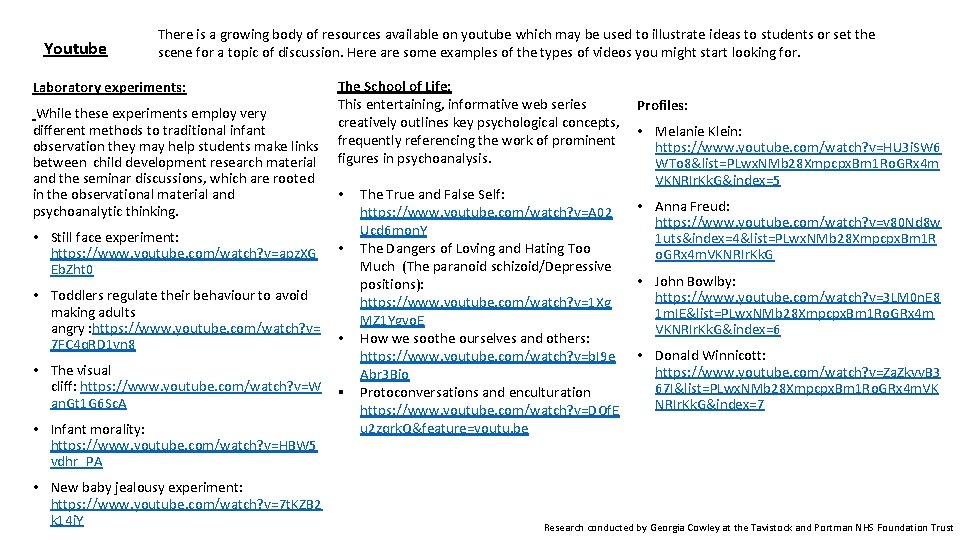
Youtube There is a growing body of resources available on youtube which may be used to illustrate ideas to students or set the scene for a topic of discussion. Here are some examples of the types of videos you might start looking for. Laboratory experiments: While these experiments employ very different methods to traditional infant observation they may help students make links between child development research material and the seminar discussions, which are rooted in the observational material and psychoanalytic thinking. • Still face experiment: https: //www. youtube. com/watch? v=apz. XG Eb. Zht 0 • Toddlers regulate their behaviour to avoid making adults angry : https: //www. youtube. com/watch? v= 7 FC 4 q. RD 1 vn 8 • The visual cliff: https: //www. youtube. com/watch? v=W an. Gt 1 G 6 Sc. A • Infant morality: https: //www. youtube. com/watch? v=HBW 5 vdhr_PA • New baby jealousy experiment: https: //www. youtube. com/watch? v=7 t. KZB 2 k 14 i. Y The School of Life: This entertaining, informative web series creatively outlines key psychological concepts, frequently referencing the work of prominent figures in psychoanalysis. • • • § The True and False Self: https: //www. youtube. com/watch? v=A 02 Ucd 6 mon. Y The Dangers of Loving and Hating Too Much (The paranoid schizoid/Depressive positions): https: //www. youtube. com/watch? v=1 Xg MZ 1 Ygyo. E How we soothe ourselves and others: https: //www. youtube. com/watch? v=b. I 9 e Abr 3 Bjo Protoconversations and enculturation https: //www. youtube. com/watch? v=DOf. E u 2 zqrk. Q&feature=youtu. be Profiles: • Melanie Klein: https: //www. youtube. com/watch? v=HU 3 i. SW 6 WTo 8&list=PLwx. NMb 28 Xmpcpx. Bm 1 Ro. GRx 4 m VKNRIr. Kk. G&index=5 • Anna Freud: https: //www. youtube. com/watch? v=v 80 Nd 8 w 1 uts&index=4&list=PLwx. NMb 28 Xmpcpx. Bm 1 R o. GRx 4 m. VKNRIr. Kk. G • John Bowlby: https: //www. youtube. com/watch? v=3 LM 0 n. E 8 1 m. IE&list=PLwx. NMb 28 Xmpcpx. Bm 1 Ro. GRx 4 m VKNRIr. Kk. G&index=6 • Donald Winnicott: https: //www. youtube. com/watch? v=Za. Zkvv. B 3 67 I&list=PLwx. NMb 28 Xmpcpx. Bm 1 Ro. GRx 4 m. VK NRIr. Kk. G&index=7 Research conducted by Georgia Cowley at the Tavistock and Portman NHS Foundation Trust
More Youtube videos of laboratory experiements • Aggression towards outgroup in babies- Yale baby lab. https: //www. youtube. com/watch? v=851_21 Euh 6 c •

The Journal of Infant Observation While comprehensive readings lists are available course handbooks, students may feel there areas in which they would like to deepen their understanding by exploring contemporary contributions to the literature. This may especially be the case as they come to the end of their observational journey and they start to think about the possible applications of their newfound knowledge. The Journal of Infant Observation is a great place to start to do this. In the following pages the last ten volumes of the journal have been organized into themes and presented as reading lists. On the following page you will find a spider diagram of the topics arranged thematically into groups and subgroups. To skip to your desired slide simply view the show and click on the bubbles. To return to the diagram press the blue arrow in the bottom left. You can access the papers via the library catalogue or on the journal page using your shibboleth log in. I hope this resource will give students an idea of the immense scope of infant observation both as a tool of research and as a therapeutic intervention. It may also stimulate students to think about what they could contribute to this growing body of work. What is missing from this picture of infant development? 1. 2. 3. 4. 5. 6. 7. 8. 9. 10. 11. 12. 13. 14. 15. 16. 17. 18. 19. 20. 21. 22. 23. 24. 25. 26. 27. 28. 29. 30. 31. 32. Adolescence…………………………………………. . 8 Application to Work Contexts……………………………. . . 9 As an intervention……………………………………. . . . 9 Psychotherapeutic applications……………. . ……………… 11 Schools……………………………………………. . 13 Social Work and Adoption. ……………………………… 13 Young Child Observation. ………………………………. . 14 Nurseries and Play groups………………………………. . 15 Group Dynamics……………………………………… 16 Ordinary Infant Development……………………………. . 17 Language Development and Communication…. . ……………… 18 Play and Creativity………. . …………………………………. 18 Triangulation and Oedipal Dynamics………………………. . 18 Separation and Loss…. . …………………………………. 19 Breastfeeding and Weaning……………. . ……………………. ……. . 19 Gender…………………………………. . . 20 Fathers…………………………………………. . 20 Societal/Cultural Commentary……………………. … 21 Arts and Literature……………………………. … 22 Teaching Infant Observation……………………………. . . 23 The experience of the Observer…………………………. … 25 Seminar Groups……………………………………. . 26 Methodology and the psychoanalytic observation model………. 27 Technology…………………………………………. . . 28 Observing in Specific Circumstances………………. . 29 Learning Difficulties and Disability…………. . ……………… 29 Illness………………. . ……………………………. … 29 Within Institutions……………………………………. . 29 Prematural Babies and Neonatal Units…. ……………………. . . 30 Sibling Dynamics………………. . ……………………………. . . 30 Maternal mental health/ postnatal depression/ perinatal trauma …… 31 Pregnancy and Birth……………………………………. . 32 Research conducted by Georgia Cowley at the Tavistock and Portman NHS Foundation Trust
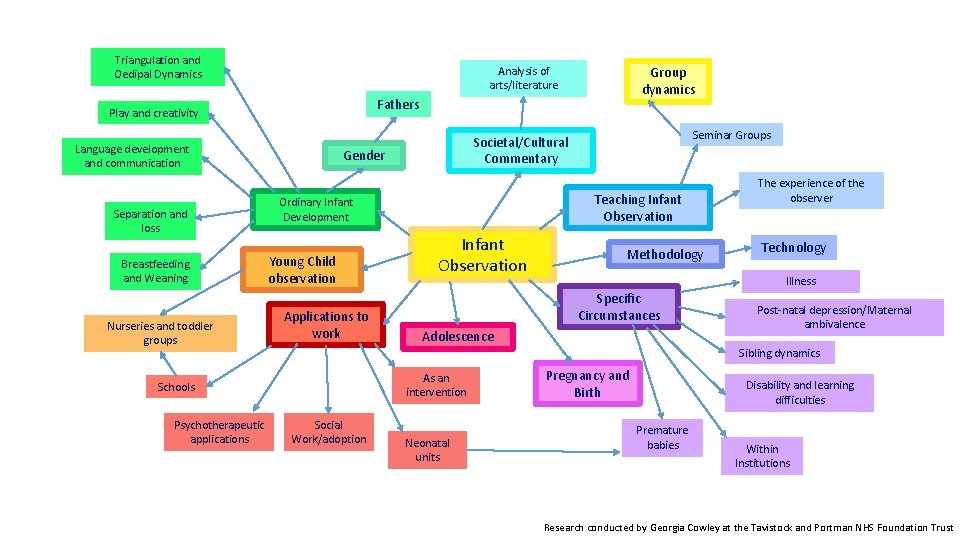
Triangulation and Oedipal Dynamics Analysis of arts/literature Fathers Play and creativity Language development and communication Separation and loss Breastfeeding and Weaning Nurseries and toddler groups Teaching Infant Observation Ordinary Infant Development Young Child observation Applications to work Seminar Groups Societal/Cultural Commentary Gender Infant Observation Methodology The experience of the observer Technology Illness Specific Circumstances Adolescence Post-natal depression/Maternal ambivalence Sibling dynamics As an intervention Schools Psychotherapeutic applications Group dynamics Social Work/adoption Neonatal units Pregnancy and Birth Disability and learning difficulties Premature babies Within Institutions Research conducted by Georgia Cowley at the Tavistock and Portman NHS Foundation Trust
Adolescence • Cudmore, L. (2012) 'Finding a place for the baby: complexity and congestion in the transition to parenthood', Infant Observation, 15(1), pp. 7790. • Hingley-Jones, H. (2011) 'An exploration of the use of infant observation methods to research the identities of severely learning-disabled adolescents and to enhance relationship-based practice for professional social work', Infant Observation, 14(3), pp. 317 -333. • Liddell, L. (2011) 'Troubles to the light: an exploration of the night in an adolescent inpatient unit', Infant Observation, 14(3), pp. 301 -316. • Roper, F. (2009) 'Riding the rollercoaster: an infant observation of a teenage couple and their baby', Infant Observation, 12(3), pp. 283 -294. • Thomas, L. (2009) 'Jack – an observation of a baby with adolescent parents', Infant Observation, 12(3), pp. 295 -303. • Waddell, M. (2009) 'Why teenagers have babies', Infant Observation, 12(3), pp. 271 -281. Research conducted by Georgia Cowley at the Tavistock and Portman NHS Foundation Trust
Applications to Work Contexts As an Intervention • • • Calvocoressi, F. (2010) 'Touching the void: observations of a very depressed mother in an inpatient unit', Infant Observation, 13(1), pp. 37 -44. Delion, P. (2000) 'The application of Esther Bick's method to the observation of babies at risk of autism', Infant Observation, 3(3), pp. 84 -90. Edmondson Alter, D. (2010) 'Playing matchmaker for mother and baby: a home-visiting intervention', Infant Observation, 13(3), pp. 351 -362. Franchi, V. (2014) 'The role of infant observation in developing the capacity of workers with refugee and asylum-seeking families in France', Infant Observation, 17(1), pp. 62 -80. Gavériaux, O. , Brizard, Y. and Roumegoux, F. (2015) 'Making use of psychoanalytic young child observation as a response to referrals of young children in a multidisciplinary medical, mental health and education Centre in Brittany', Infant Observation, 18(1), pp. 67 -82. Hall, J. (2009) 'Work in progress – developing a flexible model of therapeutic observation of young mothers and their infants in care proceedings', Infant Observation, 12(3), pp. 358 -364. Hasbun, E. J. and Castro Pinochet, E. (2016) 'A model of psychotherapeutical work with institutionalized infants', Infant Observation, 19(3), pp. 238 -248. Hollman, L. (2010) 'The impact of observation on the evolution of a relationship between an at-risk mother and infant', Infant Observation, 13(3), pp. 325 -338. Kanazawa, A. , Hirai, S. , Ukai, N. and Hubert, M. (2009) 'The application of infant observation technique as a means of assessment and therapeutic intervention for ‘classroom breakdown’ at a school for Japanese-Koreans', Infant Observation, 12(3), pp. 335 -348. Lena, F. E. (2013) 'Parents in the observer-position: a psychoanalytically informed use of video in the context of a brief parent-child intervention', Infant Observation, 16(1), pp. 76 -94. Loose, J. and Foster, C. (2002) 'The use of film observation in clinical work with parents and infants in a neonatal unit', Infant Observation, 5(3), pp. 4146. Mc. Laughlin, K. (2009) 'Marrying together music therapy and participant observation: helping four mothers and their children come together', Infant Observation, 12(2), pp. 187 -205. Research conducted by Georgia Cowley at the Tavistock and Portman NHS Foundation Trust
• Mendelsohn, A. (2005) 'Recovering reverie: Using infant observation in interventions with traumatised mothers and their premature babies', Infant Observation, 8(3), pp. 195 -208. • • Moskowitz, S. (2010) 'Representations of mother in the daughter of a single, gay father', Infant Observation, 13(3), pp. 309 -324. • Shulman, G. (2016) 'Looking in the right way: the use of infant observation as a clinical tool in parent−infant psychotherapy with parents with severe mental health difficulties', Infant Observation, 19(2), pp. 97 -119. • • Wakelyn, J. (2012) 'Observation as a therapeutic intervention for infants and young children in care', Infant Observation, 15(1), pp. 49 -66. Muir, E. , Lojkasek, M. and Cohen, N. (1999) 'Observant parents: Intervening through observation', Infant Observation, 3(1), pp. 11 -23. Parr, M. (1999) 'Integrating infant observation skills into parent facilitator training', Infant Observation, 3(1), pp. 33 -46. Rustin, M. (2014) 'The relevance of infant observation for early intervention: containment in theory and practice', Infant Observation, 17(2), pp. 97 -114. Widdershoven, M. -A. (2017) 'Clinical interventions via Skype with parents and their young children', Infant Observation, 20(1), pp. 72 -88. Research conducted by Georgia Cowley at the Tavistock and Portman NHS Foundation Trust
Psychotherapeutic applications • Athanassiou-Popesco, C. (2012) 'The emergence of depressive pain (French: souffrance): psychoanalytic infant observation applied to babies in institutions', Infant Observation, 15(2), pp. 151 -163. • Calvocoressi, F. (2010) 'Touching the void: observations of a very depressed mother in an inpatient unit', Infant Observation, 13(1), pp. 37 -44. • Cantle, A. (2013) 'Alleviating the impact of stress and trauma in the neonatal unit and beyond', Infant Observation, 16(3), pp. 257 -269. • Caron, N. A. and Lopes, R. S. (2015) 'When the internal setting becomes more important than therapist/analyst's interpretative capacity: extending the infant observation method to the prenatal and perinatal period', Infant Observation, 18(1), pp. 83 -95. • Demby, G. (2010) 'Observation as an adjunct to psychotherapy—when a patient delivers prematurely', Infant Observation, 13(3), pp. 269 -281. • Diaz Bonino, S. and Ball, K. (2013) 'From torment to hope: countertransference in parent-infant psychoanalytic psychotherapy', Infant Observation, 16(1), pp. 59 -75. • Hall, J. (2009) 'Work in progress – developing a flexible model of therapeutic observation of young mothers and their infants in care proceedings', Infant Observation, 12(3), pp. 358 -364. • Hasbun, E. J. and Castro Pinochet, E. (2016) 'A model of psychotherapeutical work with institutionalized infants', Infant Observation, 19(3), pp. 238 -248. • Liddell, L. (2011) 'Troubles to the light: an exploration of the night in an adolescent inpatient unit', Infant Observation, 14(3), pp. 301 -316. • Lubbe, T. and Joffe, A. (2009) 'The truth of the transference Reliving infantile experience in the transference: comparing data from an observed infant and the later psychotherapy of the same infant as a young child', Infant Observation, 12(2), pp. 215 -237. • Maliphant, J. and Horner, T. (2016) 'Feeling at sea: the anchor of therapeutic space', Infant Observation, 19(1), pp. 24 -41. • Mc. Laughlin, K. (2009) 'Marrying together music therapy and participant observation: helping four mothers and their children come together', Infant Observation, 12(2), pp. 187 -205. • Pozzi Monzo, M. (2011) 'The use of observation in parent-infant work when both parents have a diagnosis of mental illness', Infant Observation, 14(1), pp. 43 -60. • Prat, R. (2010) 'A time to see and a time to think: therapy and observation with mothers and their infants', Infant Observation, 13(2), pp. 135 -149. Research conducted by Georgia Cowley at the Tavistock and Portman NHS Foundation Trust
• Pretorius, I. -M. and Karni-Sharon, T. (2012) 'An audit and evaluation of the Hammersmith & Fulham CAMHS Child Psychotherapy Outreach Service at the Randolph Beresford Early Years Centre', Infant Observation, 15(2), pp. 165 -184. • Remez, A. (2010) 'Parent-infant therapy and the use of the third', Infant Observation, 13(3), pp. 293 -307. • Sandri, R. (2012) 'The usefulness of baby observation (Esther Bick model) as part of analytic training', Infant Observation, 15(2), pp. 133 -142. • Shopsin, S. F. (2011) 'Three adult analytic cases understood through the lens of infant development', Infant Observation, 14(1), pp. 31 -42. • Shulman, G. (2016) 'Looking in the right way: the use of infant observation as a clinical tool in parent−infant psychotherapy with parents with severe mental health difficulties', Infant Observation, 19(2), pp. 97 -119. • Siegel, L. (2011) 'A mother learns to enjoy her baby: parent-infant psychotherapy and art therapy in the treatment of intergenerational separationindividuation struggles', Infant Observation, 14(1), pp. 61 -74. • Sigrell, K. B. , Boëthius, S. B. , Adolfsson, L. K. and Swaling, J. (2014) 'Infant observation as part of a training programme for psychoanalysts in Sweden: candidates' expectations and experiences', Infant Observation, 17(1), pp. 20 -34. • Watillon-Naveau, A. and Coulson, S. (2010) 'Parent-infant therapy as an application of the Esther Bick method of infant observation', Infant Observation, 13(1), pp. 29 -36. • Wolf, N. (2011) 'A response to Vivian Eskin's paper entitled ‘When a parent is serving in the armed forces: the impact of waiting, knowing and not knowing on maternal functioning’', Infant Observation, 14(1), pp. 89 -96. • Yeo, B. (2016) 'Spiderman; the developmental possibilities of a superhero for a young adopted boy', Infant Observation, 19(3), pp. 181 -193. • Youell, B. (2014) 'Separation difficulties or transition? The value of observation in work with very young children and their parents', Infant Observation, 17(2), pp. 115 -125. Research conducted by Georgia Cowley at the Tavistock and Portman NHS Foundation Trust
Schools • Diamant, E. (2009) 'Understanding Korina. How can psychoanalytic observation support the role of a class teacher teaching special needs children in a mainstream school? ', Infant Observation, 12(3), pp. 319 -333. • Diem-Wille, G. (2015) 'Applying a psychoanalytic approach acquired through infant observation towards working as a teacher: a case study', Infant Observation, 18(2), pp. 110 -125. • Franchi, V. E. and Molli, A. (2012) 'Teaching and implementing classroom observations in France and Italy: a preliminary review', Infant Observation, 15(3), pp. 281 -296. • Kanazawa, A. , Hirai, S. , Ukai, N. and Hubert, M. (2009) 'The application of infant observation technique as a means of assessment and therapeutic intervention for ‘classroom breakdown’ at a school for Japanese-Koreans', Infant Observation, 12(3), pp. 335 -348. • Klauber, T. (2009) 'Early experience, developmental tasks and the blossoming of the capacity to learn', Infant Observation, 12(3), pp. 305 -318. • Mooney, R. (2014) 'The preschool playground: a young child's experience of entering the emotional field', Infant Observation, 17(1), pp. 35 -49. • Mooney, R. (2015) 'The preschool playground: a longing for a mother to a need for friends', Infant Observation, 18(1), pp. 36 -51. Social Work and Adoption • Athanassiou-Popesco, C. (2012) 'The emergence of depressive pain (French: souffrance): psychoanalytic infant observation applied to babies in institutions', Infant Observation, 15(2), pp. 151 -163. • Hingley-Jones, H. (2011) 'An exploration of the use of infant observation methods to research the identities of severely learning-disabled adolescents and to enhance relationship-based practice for professional social work', Infant Observation, 14(3), pp. 317 -333. • Remez, A. (2010) 'Parent-infant therapy and the use of the third', Infant Observation, 13(3), pp. 293 -307. • Wakelyn, J. (2012) 'Observation as a therapeutic intervention for infants and young children in care', Infant Observation, 15(1), pp. 49 -66. • Wakelyn, J. (2020) ‘Therapeutic approaches with babies and young children in care’, Abingdon, Routledge. Research conducted by Georgia Cowley at the Tavistock and Portman NHS Foundation Trust
Young Child Observation • Adamo, S. M. G. (2012) 'Group learning in a young child observation seminar', Infant Observation, 15(2), pp. 115 -131. • Adamo, S. M. G. , Pantaleo, C. F. and Rustin, M. (2013) 'An outsider in the nursery', Infant Observation, 16(3), pp. 230 -243. • Datler, W. , Hover-Reisner, N. and Datler, M. (2015) 'Toddlers’ relationships to peers in the processes of separation: from the discussion of observational accounts to the development of theory', Infant Observation, 18(1), pp. 14 -35. • Fox, E. (2014) 'Observing in a toddler group: the impact on a little girl's development of attending a group led by her mother', Infant Observation, 17(2), pp. 140 -150. • Gavériaux, O. , Brizard, Y. and Roumegoux, F. (2015) 'Making use of psychoanalytic young child observation as a response to referrals of young children in a multidisciplinary medical, mental health and education Centre in Brittany', Infant Observation, 18(1), pp. 67 -82. • Hadary, M. (2015) '‘When Amy gets angry—Really really angry’. Difficulties negotiating separation-individuation in the rapprochement subphase; the role of children's literature', Infant Observation, 18(3), pp. 228 -241. • Mooney, R. (2014) 'The preschool playground: a young child's experience of entering the emotional field', Infant Observation, 17(1), pp. 35 -49. • Mooney, R. (2015) 'The preschool playground: a longing for a mother to a need for friends', Infant Observation, 18(1), pp. 36 -51. • Nakaoka, H. (2014) 'Coming to terms with daily separation: observation of two children's transition from home to nursery', Infant Observation, 17(3), pp. 248 -263. • Padula, A. (2015) 'In the other's skin: aspects of identification in a young child observation of a twin', Infant Observation, 18(2), pp. 143 -153. • Spedding, A. (2014) 'An account of how an only child uses her peers at nursery school as companions and quasi-siblings in an effort to understand siblinghood and other relationships', Infant Observation, 17(1), pp. 50 -61. • Sze, Y. -T. (2015) 'Regulation of anxiety behind quiet adaptation', Infant Observation, 18(3), pp. 205 -214. • Yeo, B. (2013) 'Building and collapsing towers: the experience of a young boy in an inner city nursery', Infant Observation, 16(1), pp. 47 -58. • Zuppardi, S. (2015) 'A band of brothers at nursery: an account of male group dynamics in a preschool setting', Infant Observation, 18(1), pp. 52 -66 Research conducted by Georgia Cowley at the Tavistock and Portman NHS Foundation Trust
Nurseries and Toddler groups • Bergman, A. , Reiswig, R. , Moskowitz, S. , Demby, G. and Falk Shopsin, S. (2010) 'History and description of the Anni Bergman Parent-Infant Program', Infant Observation, 13(3), pp. 261 -267. • Cardenal, M. (2011) 'Psychoanalytic thinking in the community through Bick's observational method: a Work Discussion Seminar experience with care workers in a nursery', Infant Observation, 14(3), pp. 245 -255. • Datler, W. , Datler, M. and Funder, A. (2010) 'Struggling against a feeling of becoming lost: a young boy's painful transition to day care', Infant Observation, 13(1), pp. 65 -87. • Deletant, R. (2016) '‘Where your mama at? ’ Observations from the fishbowl: thoughts and experiences on working at a community pre-school', Infant Observation, 19(2), pp. 120 -138. • Elfer, P. (2010) 'The power of psychoanalytic conceptions in understanding nurseries', Infant Observation, 13(1), pp. 59 -63. • Fox, E. (2014) 'Observing in a toddler group: the impact on a little girl's development of attending a group led by her mother', Infant Observation, 17(2), pp. 140 -150. • Mooney, R. (2014) 'The preschool playground: a young child's experience of entering the emotional field', Infant Observation, 17(1), pp. 35 -49. • Mooney, R. (2015) 'The preschool playground: a longing for a mother to a need for friends', Infant Observation, 18(1), pp. 36 -51. • Nakaoka, H. (2014) 'Coming to terms with daily separation: observation of two children's transition from home to nursery', Infant Observation, 17(3), pp. 248 -263. • Pretorius, I. -M. and Karni-Sharon, T. (2012) 'An audit and evaluation of the Hammersmith & Fulham CAMHS Child Psychotherapy Outreach Service at the Randolph Beresford Early Years Centre', Infant Observation, 15(2), pp. 165 -184. • Rothenberg, S. (2010) 'Infant mental health: provision of service by a lone practitioner in a non-clinical setting', Infant Observation, 13(3), pp. 339 -350. Research conducted by Georgia Cowley at the Tavistock and Portman NHS Foundation Trust
Group Dynamics • Adamo, S. M. G. (2012) 'Group learning in a young child observation seminar', Infant Observation, 15(2), pp. 115 -131. • Adamo, S. M. G. , Pantaleo, C. F. and Rustin, M. (2013) 'An outsider in the nursery', Infant Observation, 16(3), pp. 230 -243. • • Mooney, R. (2014) 'The preschool playground: a young child's experience of entering the emotional field', Infant Observation, 17(1), pp. 35 -49. Selby, J. M. and Benjamin, S. B. (2003) ‘Infants in groups: A paradigm for the study of early social experience’ Human Development, 46 (4) pp 197 -221 • Urwin, C. (2001) 'Getting to know the self and others: Babies' interactions with other babies', Infant Observation, 4(3), pp. 13 -28. • Wolf, N. (2011) 'A response to Vivian Eskin's paper entitled ‘When a parent is serving in the armed forces: the impact of waiting, knowing and not knowing on maternal functioning’', Infant Observation, 14(1), pp. 89 -96. • Zuppardi, S. (2015) 'A band of brothers at nursery: an account of male group dynamics in a preschool setting', Infant Observation, 18(1), pp. 52 -66. Research conducted by Georgia Cowley at the Tavistock and Portman NHS Foundation Trust
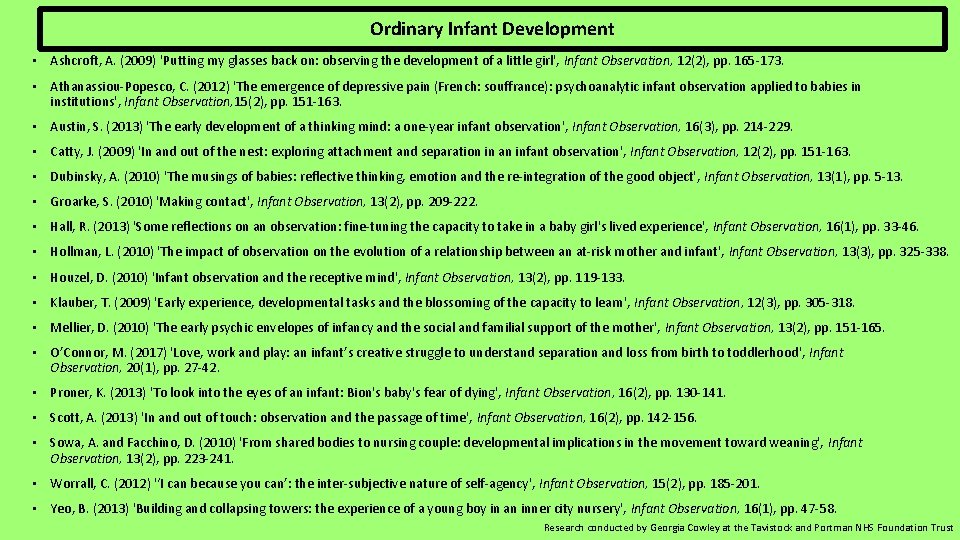
Ordinary Infant Development • Ashcroft, A. (2009) 'Putting my glasses back on: observing the development of a little girl', Infant Observation, 12(2), pp. 165 -173. • Athanassiou-Popesco, C. (2012) 'The emergence of depressive pain (French: souffrance): psychoanalytic infant observation applied to babies in institutions', Infant Observation, 15(2), pp. 151 -163. • Austin, S. (2013) 'The early development of a thinking mind: a one-year infant observation', Infant Observation, 16(3), pp. 214 -229. • Catty, J. (2009) 'In and out of the nest: exploring attachment and separation in an infant observation', Infant Observation, 12(2), pp. 151 -163. • Dubinsky, A. (2010) 'The musings of babies: reflective thinking, emotion and the re-integration of the good object', Infant Observation, 13(1), pp. 5 -13. • Groarke, S. (2010) 'Making contact', Infant Observation, 13(2), pp. 209 -222. • Hall, R. (2013) 'Some reflections on an observation: fine-tuning the capacity to take in a baby girl's lived experience', Infant Observation, 16(1), pp. 33 -46. • Hollman, L. (2010) 'The impact of observation on the evolution of a relationship between an at-risk mother and infant', Infant Observation, 13(3), pp. 325 -338. • Houzel, D. (2010) 'Infant observation and the receptive mind', Infant Observation, 13(2), pp. 119 -133. • Klauber, T. (2009) 'Early experience, developmental tasks and the blossoming of the capacity to learn', Infant Observation, 12(3), pp. 305 -318. • Mellier, D. (2010) 'The early psychic envelopes of infancy and the social and familial support of the mother', Infant Observation, 13(2), pp. 151 -165. • O’Connor, M. (2017) 'Love, work and play: an infant’s creative struggle to understand separation and loss from birth to toddlerhood', Infant Observation, 20(1), pp. 27 -42. • Proner, K. (2013) 'To look into the eyes of an infant: Bion's baby's fear of dying', Infant Observation, 16(2), pp. 130 -141. • Scott, A. (2013) 'In and out of touch: observation and the passage of time', Infant Observation, 16(2), pp. 142 -156. • Sowa, A. and Facchino, D. (2010) 'From shared bodies to nursing couple: developmental implications in the movement toward weaning', Infant Observation, 13(2), pp. 223 -241. • Worrall, C. (2012) '‘I can because you can’: the inter-subjective nature of self-agency', Infant Observation, 15(2), pp. 185 -201. • Yeo, B. (2013) 'Building and collapsing towers: the experience of a young boy in an inner city nursery', Infant Observation, 16(1), pp. 47 -58. Research conducted by Georgia Cowley at the Tavistock and Portman NHS Foundation Trust
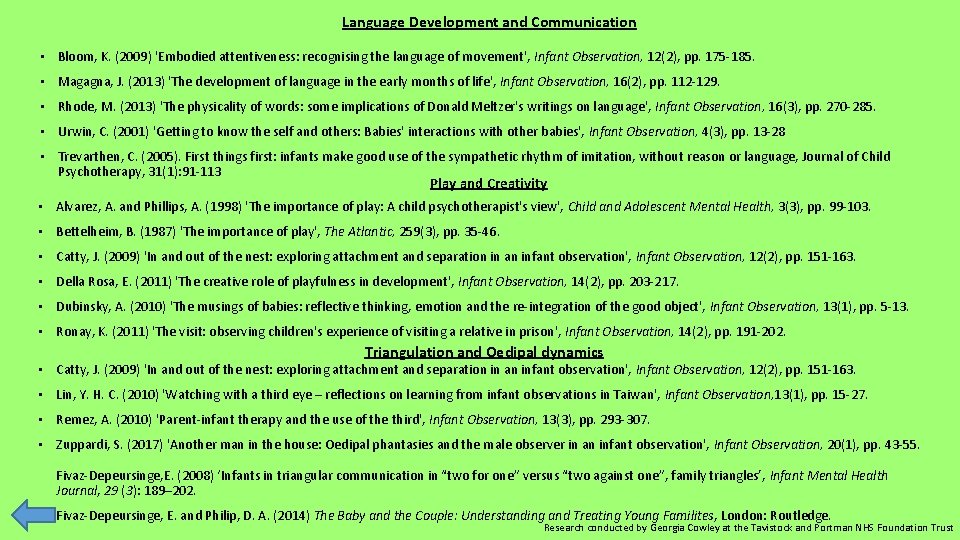
Language Development and Communication • Bloom, K. (2009) 'Embodied attentiveness: recognising the language of movement', Infant Observation, 12(2), pp. 175 -185. • Magagna, J. (2013) 'The development of language in the early months of life', Infant Observation, 16(2), pp. 112 -129. • Rhode, M. (2013) 'The physicality of words: some implications of Donald Meltzer's writings on language', Infant Observation, 16(3), pp. 270 -285. • Urwin, C. (2001) 'Getting to know the self and others: Babies' interactions with other babies', Infant Observation, 4(3), pp. 13 -28 • Trevarthen, C. (2005). First things first: infants make good use of the sympathetic rhythm of imitation, without reason or language, Journal of Child Psychotherapy, 31(1): 91 -113 Play and Creativity • Alvarez, A. and Phillips, A. (1998) 'The importance of play: A child psychotherapist's view', Child and Adolescent Mental Health, 3(3), pp. 99 -103. • Bettelheim, B. (1987) 'The importance of play', The Atlantic, 259(3), pp. 35 -46. • Catty, J. (2009) 'In and out of the nest: exploring attachment and separation in an infant observation', Infant Observation, 12(2), pp. 151 -163. • Della Rosa, E. (2011) 'The creative role of playfulness in development', Infant Observation, 14(2), pp. 203 -217. • Dubinsky, A. (2010) 'The musings of babies: reflective thinking, emotion and the re-integration of the good object', Infant Observation, 13(1), pp. 5 -13. • Ronay, K. (2011) 'The visit: observing children's experience of visiting a relative in prison', Infant Observation, 14(2), pp. 191 -202. Triangulation and Oedipal dynamics • Catty, J. (2009) 'In and out of the nest: exploring attachment and separation in an infant observation', Infant Observation, 12(2), pp. 151 -163. • Lin, Y. H. C. (2010) 'Watching with a third eye – reflections on learning from infant observations in Taiwan', Infant Observation, 13(1), pp. 15 -27. • Remez, A. (2010) 'Parent-infant therapy and the use of the third', Infant Observation, 13(3), pp. 293 -307. • Zuppardi, S. (2017) 'Another man in the house: Oedipal phantasies and the male observer in an infant observation', Infant Observation, 20(1), pp. 43 -55. Fivaz-Depeursinge, E. (2008) ‘Infants in triangular communication in “two for one” versus “two against one”, family triangles’, Infant Mental Health Journal, 29 (3): 189– 202. • Fivaz-Depeursinge, E. and Philip, D. A. (2014) The Baby and the Couple: Understanding and Treating Young Familites, London: Routledge. Research conducted by Georgia Cowley at the Tavistock and Portman NHS Foundation Trust
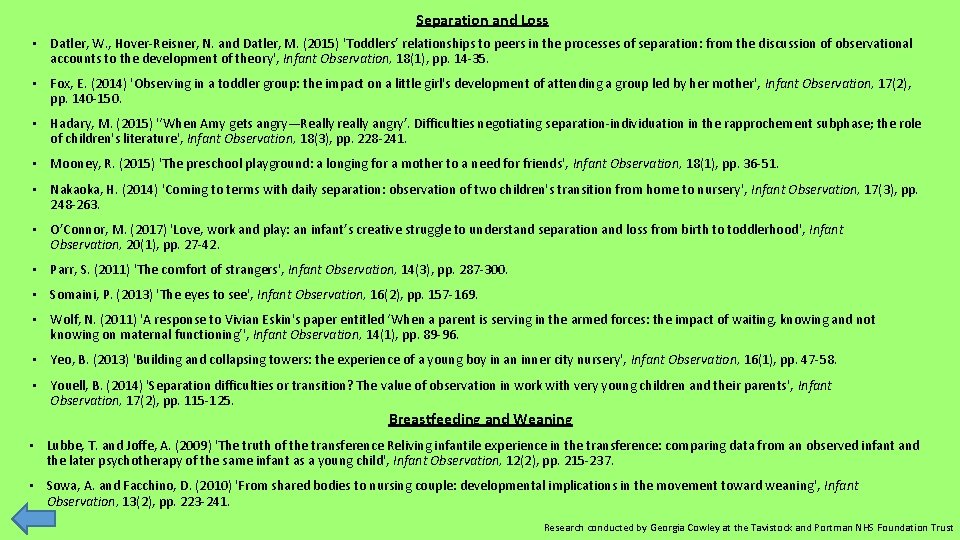
Separation and Loss • Datler, W. , Hover-Reisner, N. and Datler, M. (2015) 'Toddlers’ relationships to peers in the processes of separation: from the discussion of observational accounts to the development of theory', Infant Observation, 18(1), pp. 14 -35. • Fox, E. (2014) 'Observing in a toddler group: the impact on a little girl's development of attending a group led by her mother', Infant Observation, 17(2), pp. 140 -150. • Hadary, M. (2015) '‘When Amy gets angry—Really really angry’. Difficulties negotiating separation-individuation in the rapprochement subphase; the role of children's literature', Infant Observation, 18(3), pp. 228 -241. • Mooney, R. (2015) 'The preschool playground: a longing for a mother to a need for friends', Infant Observation, 18(1), pp. 36 -51. • Nakaoka, H. (2014) 'Coming to terms with daily separation: observation of two children's transition from home to nursery', Infant Observation, 17(3), pp. 248 -263. • O’Connor, M. (2017) 'Love, work and play: an infant’s creative struggle to understand separation and loss from birth to toddlerhood', Infant Observation, 20(1), pp. 27 -42. • Parr, S. (2011) 'The comfort of strangers', Infant Observation, 14(3), pp. 287 -300. • Somaini, P. (2013) 'The eyes to see', Infant Observation, 16(2), pp. 157 -169. • Wolf, N. (2011) 'A response to Vivian Eskin's paper entitled ‘When a parent is serving in the armed forces: the impact of waiting, knowing and not knowing on maternal functioning’', Infant Observation, 14(1), pp. 89 -96. • Yeo, B. (2013) 'Building and collapsing towers: the experience of a young boy in an inner city nursery', Infant Observation, 16(1), pp. 47 -58. • Youell, B. (2014) 'Separation difficulties or transition? The value of observation in work with very young children and their parents', Infant Observation, 17(2), pp. 115 -125. Breastfeeding and Weaning • Lubbe, T. and Joffe, A. (2009) 'The truth of the transference Reliving infantile experience in the transference: comparing data from an observed infant and the later psychotherapy of the same infant as a young child', Infant Observation, 12(2), pp. 215 -237. • Sowa, A. and Facchino, D. (2010) 'From shared bodies to nursing couple: developmental implications in the movement toward weaning', Infant Observation, 13(2), pp. 223 -241. Research conducted by Georgia Cowley at the Tavistock and Portman NHS Foundation Trust
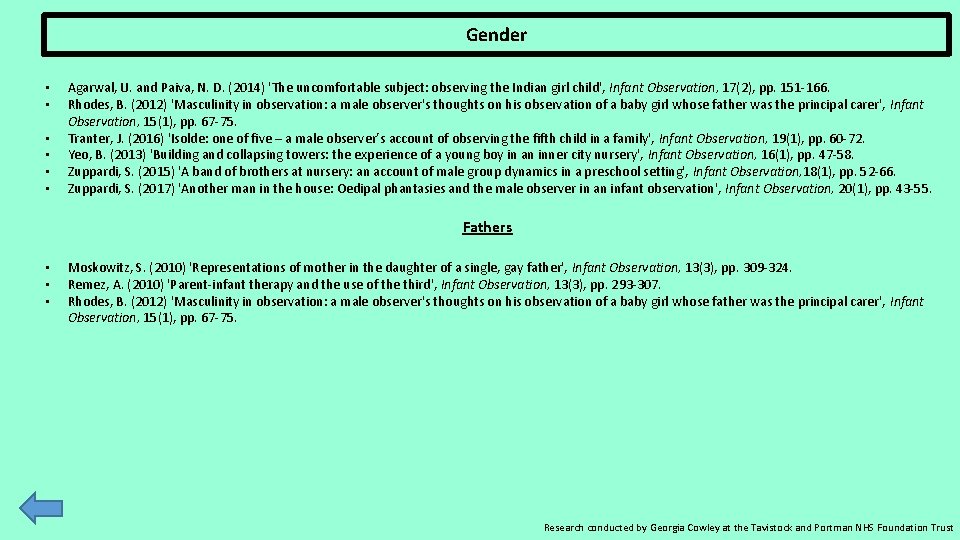
Gender • • • Agarwal, U. and Paiva, N. D. (2014) 'The uncomfortable subject: observing the Indian girl child', Infant Observation, 17(2), pp. 151 -166. Rhodes, B. (2012) 'Masculinity in observation: a male observer's thoughts on his observation of a baby girl whose father was the principal carer', Infant Observation, 15(1), pp. 67 -75. Tranter, J. (2016) 'Isolde: one of five – a male observer’s account of observing the fifth child in a family', Infant Observation, 19(1), pp. 60 -72. Yeo, B. (2013) 'Building and collapsing towers: the experience of a young boy in an inner city nursery', Infant Observation, 16(1), pp. 47 -58. Zuppardi, S. (2015) 'A band of brothers at nursery: an account of male group dynamics in a preschool setting', Infant Observation, 18(1), pp. 52 -66. Zuppardi, S. (2017) 'Another man in the house: Oedipal phantasies and the male observer in an infant observation', Infant Observation, 20(1), pp. 43 -55. Fathers • • • Moskowitz, S. (2010) 'Representations of mother in the daughter of a single, gay father', Infant Observation, 13(3), pp. 309 -324. Remez, A. (2010) 'Parent-infant therapy and the use of the third', Infant Observation, 13(3), pp. 293 -307. Rhodes, B. (2012) 'Masculinity in observation: a male observer's thoughts on his observation of a baby girl whose father was the principal carer', Infant Observation, 15(1), pp. 67 -75. Research conducted by Georgia Cowley at the Tavistock and Portman NHS Foundation Trust
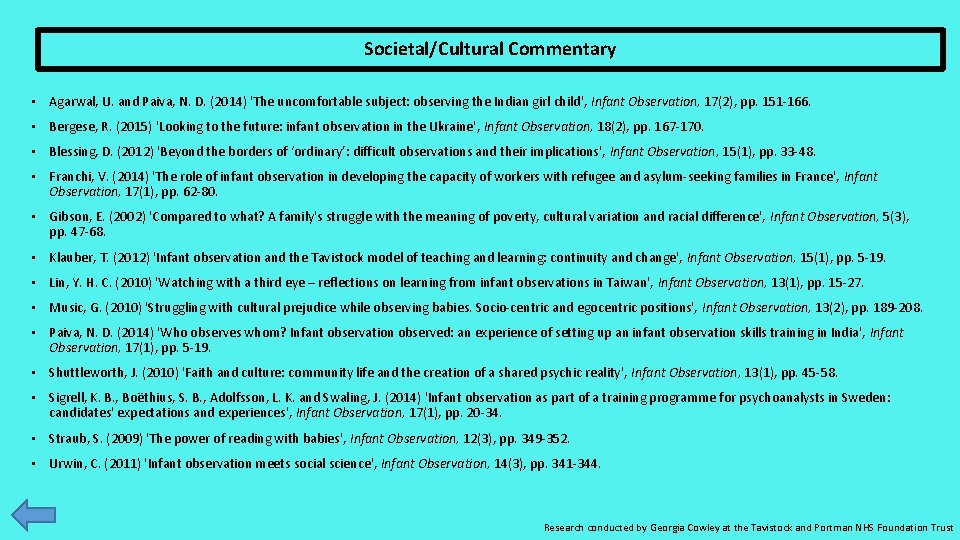
Societal/Cultural Commentary • Agarwal, U. and Paiva, N. D. (2014) 'The uncomfortable subject: observing the Indian girl child', Infant Observation, 17(2), pp. 151 -166. • Bergese, R. (2015) 'Looking to the future: infant observation in the Ukraine', Infant Observation, 18(2), pp. 167 -170. • Blessing, D. (2012) 'Beyond the borders of ‘ordinary’: difficult observations and their implications', Infant Observation, 15(1), pp. 33 -48. • Franchi, V. (2014) 'The role of infant observation in developing the capacity of workers with refugee and asylum-seeking families in France', Infant Observation, 17(1), pp. 62 -80. • Gibson, E. (2002) 'Compared to what? A family's struggle with the meaning of poverty, cultural variation and racial difference', Infant Observation, 5(3), pp. 47 -68. • Klauber, T. (2012) 'Infant observation and the Tavistock model of teaching and learning: continuity and change', Infant Observation, 15(1), pp. 5 -19. • Lin, Y. H. C. (2010) 'Watching with a third eye – reflections on learning from infant observations in Taiwan', Infant Observation, 13(1), pp. 15 -27. • Music, G. (2010) 'Struggling with cultural prejudice while observing babies. Socio-centric and egocentric positions', Infant Observation, 13(2), pp. 189 -208. • Paiva, N. D. (2014) 'Who observes whom? Infant observation observed: an experience of setting up an infant observation skills training in India', Infant Observation, 17(1), pp. 5 -19. • Shuttleworth, J. (2010) 'Faith and culture: community life and the creation of a shared psychic reality', Infant Observation, 13(1), pp. 45 -58. • Sigrell, K. B. , Boëthius, S. B. , Adolfsson, L. K. and Swaling, J. (2014) 'Infant observation as part of a training programme for psychoanalysts in Sweden: candidates' expectations and experiences', Infant Observation, 17(1), pp. 20 -34. • Straub, S. (2009) 'The power of reading with babies', Infant Observation, 12(3), pp. 349 -352. • Urwin, C. (2011) 'Infant observation meets social science', Infant Observation, 14(3), pp. 341 -344. Research conducted by Georgia Cowley at the Tavistock and Portman NHS Foundation Trust
• • Wolf, N. (2011) 'A response to Vivian Eskin's paper entitled ‘When a parent is serving in the armed forces: the impact of waiting, knowing and not knowing on maternal functioning’', Infant Observation, 14(1), pp. 89 -96. Youell, B. (2015) 'The impact of the global financial crisis on children and families as seen through infant observations in three European countries: the role of education professionals in containing anxiety and holding on to hope and hopefulness', Infant Observation, 18(2), pp. 154 -166. Arts and Literature • • Hindle, D. (2017) 'Sendak and Knussen’s Where the wild things are: a developmental journey', Infant Observation, 20(1), pp. 56 -71. Rustin, M. (2016) 'Young children and works of the imagination', Infant Observation, 19(2), pp. 139 -148. Simon, J. -A. (2010) 'The ogre and Little Thumb. Love, hate and survival in neonatology: an application of Esther Bick's method of infant observation', Infant Observation, 13(2), pp. 167 -178. Zuppardi, S. (2016) 'From Night kitchen to Wolves in the walls: a brief psychoanalytic look at children’s picture books', Infant Observation, 19(2), pp. 149 -164. Research conducted by Georgia Cowley at the Tavistock and Portman NHS Foundation Trust
Teaching Infant Observation • Adamo, S. M. G. (2012) 'Group learning in a young child observation seminar', Infant Observation, 15(2), pp. 115 -131. • Allnutt, L. (2011) 'A conversation with Isca Wittenberg', Infant Observation, 14(1), pp. 5 -13. • Allnutt, L. (2015) 'In conversation with Lisa Miller', Infant Observation, 18(1), pp. 4 -13. • Bergman, A. , Reiswig, R. , Moskowitz, S. , Demby, G. and Falk Shopsin, S. (2010) 'History and description of the Anni Bergman Parent-Infant Program', Infant Observation, 13(3), pp. 261 -267. • Blessing, D. (2012) 'Beyond the borders of ‘ordinary’: difficult observations and their implications', Infant Observation, 15(1), pp. 33 -48. • Caron, N. , Sobreira Lopes, R. , Steibel, D. and Schneider Donelli, T. (2012) 'Writing as a challenge in the observer's journey through the Bick method of infant observation', Infant Observation, 15(3), pp. 221 -230. • Datler, W. , Datler, M. , Hover-Reisner, N. and Trunkenpolz, K. (2014) 'Observation according to the Tavistock model as a research tool: remarks on methodology, education and the training of researchers', Infant Observation, 17(3), pp. 195 -214. • Davids, Z. , Miles, G. , Paton, A. and Trowell, J. (1999) 'Issues for seminar leaders in infant and young child observation: A comparative study', Infant Observation, 2(3), pp. 16 -29. • Edwards, J. (2009) 'Teaching observation to non-clinical students: continuing thoughts', Infant Observation, 12(2), pp. 207 -213. • Franchi, V. and Toth, A. (2014) 'Can you read the writing on the wall: what needs to happen for a researcher to see what she is observing? ', Infant Observation, 17(2), pp. 126 -139. • Franchi, V. E. and Molli, A. (2012) 'Teaching and implementing classroom observations in France and Italy: a preliminary review', Infant Observation, 15(3), pp. 281 -296. • Groarke, S. (2011) 'Understanding babies from the standpoint of experience', Infant Observation, 14(2), pp. 163 -177. • Hollway, W. (2012) 'Infant observation: opportunities, challenges, threats', Infant Observation, 15(1), pp. 21 -32. • Klauber, T. (2012) 'Infant observation and the Tavistock model of teaching and learning: continuity and change', Infant Observation, 15(1), pp. 5 -19. • Mendes de Almeida, M. , Finkelstein, L. and Caldas Campana, N. T. (2009) 'News from Brazil: psychoanalytic observation and its seminar group as a space for the integration of splitting aspects in the parent-infant relationship', Infant Observation, 12(3), pp. 352 -357. Research conducted by Georgia Cowley at the Tavistock and Portman NHS Foundation Trust
• Miller, B. (2011) 'The seminar leader as ‘a new baby’: teaching observation for the first time', Infant Observation, 14(3), pp. 335 -340. • Monticelli, M. (2014) 'The experience of infant observation in difficult situations: retaining the ability to observe', Infant Observation, 17(3), pp. 179 -194. • Paiva, N. D. (2014) 'Who observes whom? Infant observation observed: an experience of setting up an infant observation skills training in India', Infant Observation, 17(1), pp. 5 -19. • Prat, R. (2013) 'Shaping and misshaping (French: ‘Formation et deformation’) during clinical training: some reflections on the impact of infant observation on the clinical paradigm', Infant Observation, 16(3), pp. 244 -256. • Rustin, M. (2013) 'Sense and sensibility in infant observation: a response to Margot Waddell', Infant Observation, 16(1), pp. 23 -32. • Rustin, M. (2014) 'The relevance of infant observation for early intervention: containment in theory and practice', Infant Observation, 17(2), pp. 97 -114. • Sandri, R. (2012) 'The usefulness of baby observation (Esther Bick model) as part of analytic training', Infant Observation, 15(2), pp. 133 -142. • Segal, B. (2002) 'Anxieties, questions and technical issues in beginning observation', Infant Observation, 5(3), pp. 11 -23. • Tucker, J. (2002) 'Beginnings and endings workshop', Infant Observation, 5(3), pp. 101 -103. • Waddell, M. (2013) 'Infant observation in Britain: a Tavistock approach', Infant Observation, 16(1), pp. 4 -22. Research conducted by Georgia Cowley at the Tavistock and Portman NHS Foundation Trust
The experience of the Observer • • • • • Agarwal, U. and Paiva, N. D. (2014) 'The uncomfortable subject: observing the Indian girl child', Infant Observation, 17(2), pp. 151 -166. Allnutt, L. (2015) 'In conversation with Lisa Miller', Infant Observation, 18(1), pp. 4 -13. Ashcroft, A. (2009) 'Putting my glasses back on: observing the development of a little girl', Infant Observation, 12(2), pp. 165 -173. Caron, N. , Sobreira Lopes, R. , Steibel, D. and Schneider Donelli, T. (2012) 'Writing as a challenge in the observer's journey through the Bick method of infant observation', Infant Observation, 15(3), pp. 221 -230. Caron, N. A. and Lopes, R. S. (2015) 'When the internal setting becomes more important than therapist/analyst's interpretative capacity: extending the infant observation method to the prenatal and perinatal period', Infant Observation, 18(1), pp. 83 -95. de Rementeria, A. (2012) 'Managing intimacy and distance: an exploration of links between the experience of an observed mother and baby and that of her observer', Infant Observation, 15(3), pp. 231 -245. Franchi, V. and Toth, A. (2014) 'Can you read the writing on the wall: what needs to happen for a researcher to see what she is observing? ', Infant Observation, 17(2), pp. 126 -139. Groff Vivian, A. , Sobreira Lopes, R. and Caron, N. (2011) 'Making space for a fourth, unplanned child with the help of the observer's holding and receptive capacity', Infant Observation, 14(3), pp. 273 -286. Hall, R. (2013) 'Some reflections on an observation: fine-tuning the capacity to take in a baby girl's lived experience', Infant Observation, 16(1), pp. 33 -46. Hollway, W. (2012) 'Infant observation: opportunities, challenges, threats', Infant Observation, 15(1), pp. 21 -32. Houzel, D. (2010) 'Infant observation and the receptive mind', Infant Observation, 13(2), pp. 119 -133. Long, J. (2012) 'Bearing a beautiful daughter: conflicting identifications for a new mother and for the observer', Infant Observation, 15(3), pp. 247 -262. Milano, A. (2016) 'The sound of silence: evolution of the object in the relationship of parents of two twins', Infant Observation, 19(1), pp. 5 -23. Monticelli, M. (2014) 'The experience of infant observation in difficult situations: retaining the ability to observe', Infant Observation, 17(3), pp. 179 -194. Music, G. (2010) 'Struggling with cultural prejudice while observing babies. Socio-centric and egocentric positions', Infant Observation, 13(2), pp. 189 -208. Paglia, M. (2016) 'The ‘not knowing’ state of mind: intolerance of uncertainty in mother–infant bonding and ‘the position’ of the observer', Infant Observation, 19(1), pp. 73 -86. Scott, A. (2013) 'In and out of touch: observation and the passage of time', Infant Observation, 16(2), pp. 142 -156. Research conducted by Georgia Cowley at the Tavistock and Portman NHS Foundation Trust
• • Segal, B. (2002) 'Anxieties, questions and technical issues in beginning observation', Infant Observation, 5(3), pp. 11 -23. Somaini, P. (2013) 'The eyes to see', Infant Observation, 16(2), pp. 157 -169. Steibel, D. , Caron, N. A. and Lopes, R. S. (2014) 'An observer's intense and challenging journey observing the short life of an extremely premature baby in Neonatal Intensive Care', Infant Observation, 17(3), pp. 233 -247. Yeo, B. (2013) 'Building and collapsing towers: the experience of a young boy in an inner city nursery', Infant Observation, 16(1), pp. 47 -58. Seminar Groups • Adamo, S. M. G. (2012) 'Group learning in a young child observation seminar', Infant Observation, 15(2), pp. 115 -131. • Davids, Z. , Miles, G. , Paton, A. and Trowell, J. (1999) 'Issues for seminar leaders in infant and young child observation: A comparative study', Infant Observation, 2(3), pp. 16 -29. • Mendes de Almeida, M. , Finkelstein, L. and Caldas Campana, N. T. (2009) 'News from Brazil: psychoanalytic observation and its seminar group as a space for the integration of splitting aspects in the parent-infant relationship', Infant Observation, 12(3), pp. 352 -357. Research conducted by Georgia Cowley at the Tavistock and Portman NHS Foundation Trust
Methodology and the psychoanalytic observation model • Allnutt, L. (2011) 'A conversation with Isca Wittenberg', Infant Observation, 14(1), pp. 5 -13. • Athanassiou-Popesco, C. (2011) 'Reflection on the nature of attention in psycho-analytic observation', Infant Observation, 14(1), pp. 15 -29. • Blessing, D. (2012) 'Beyond the borders of ‘ordinary’: difficult observations and their implications', Infant Observation, 15(1), pp. 33 -48. • Caron, N. , Sobreira Lopes, R. , Steibel, D. and Schneider Donelli, T. (2012) 'Writing as a challenge in the observer's journey through the Bick method of infant observation', Infant Observation, 15(3), pp. 221 -230. • Datler, W. , Datler, M. , Hover-Reisner, N. and Trunkenpolz, K. (2014) 'Observation according to the Tavistock model as a research tool: remarks on methodology, education and the training of researchers', Infant Observation, 17(3), pp. 195 -214. • Datler, W. , Hover-Reisner, N. and Datler, M. (2015) 'Toddlers’ relationships to peers in the processes of separation: from the discussion of observational accounts to the development of theory', Infant Observation, 18(1), pp. 14 -35. • Franchi, V. and Toth, A. (2014) 'Can you read the writing on the wall: what needs to happen for a researcher to see what she is observing? ', Infant Observation, 17(2), pp. 126 -139. • Groarke, S. (2008) 'Psychoanalytical infant observation: a critical assessment', European Journal of Psychotherapy & Counselling, 10(4), pp. 299 -321. • Hollway, W. (2012) 'Infant observation: opportunities, challenges, threats', Infant Observation, 15(1), pp. 21 -32. • Klauber, T. (2012) 'Infant observation and the Tavistock model of teaching and learning: continuity and change', Infant Observation, 15(1), pp. 5 -19. • Lubbe, T. and Joffe, A. (2009) 'The truth of the transference Reliving infantile experience in the transference: comparing data from an observed infant and the later psychotherapy of the same infant as a young child', Infant Observation, 12(2), pp. 215 -237. • Mc. Fadyen, A. , Canham, H. and Youell, B. (1999) 'Rating infant observation - is it possible? ', Infant Observation, 2(3), pp. 66 -80. • Rustin, M. (2006) 'Infant observation research: What have we learned so far? ', Infant Observation, 9(1), pp. 35 -52. • Rustin, M. (2011) 'Infant observation and research: a reply to Steven Groarke', Infant Observation, 14(2), pp. 179 -190. Research conducted by Georgia Cowley at the Tavistock and Portman NHS Foundation Trust
• Rustin, M. (2013) 'Sense and sensibility in infant observation: a response to Margot Waddell', Infant Observation, 16(1), pp. 23 -32. • Rustin, M. (2014) 'The relevance of infant observation for early intervention: containment in theory and practice', Infant Observation, 17(2), pp. 97 -114. • Sandri, R. (2012) 'The usefulness of baby observation (Esther Bick model) as part of analytic training', Infant Observation, 15(2), pp. 133 -142. • Segal, B. (2002) 'Anxieties, questions and technical issues in beginning observation', Infant Observation, 5(3), pp. 11 -23. • Waddell, M. (2013) 'Infant observation in Britain: a Tavistock approach', Infant Observation, 16(1), pp. 4 -22. Technology • Lena, F. E. (2013) 'Parents in the observer-position: a psychoanalytically informed use of video in the context of a brief parent-child intervention', Infant Observation, 16(1), pp. 76 -94. • Loose, J. and Foster, C. (2002) 'The use of film observation in clinical work with parents and infants in a neonatal unit', Infant Observation, 5(3), pp. 41 -46. • Wang, X. (2015) 'Online psychoanalytic therapy – some insights from infant observation', Infant Observation, 18(3), pp. 215 -227 Research conducted by Georgia Cowley at the Tavistock and Portman NHS Foundation Trust
Observing in Specific Circumstances Learning Difficulties and Disability • • Delion, P. (2000) 'The application of Esther Bick's method to the observation of babies at risk of autism', Infant Observation, 3(3), pp. 84 -90. Diamant, E. (2009) 'Understanding Korina. How can psychoanalytic observation support the role of a class teacher teaching special needs children in a mainstream school? ', Infant Observation, 12(3), pp. 319 -333. Hingley-Jones, H. (2011) 'An exploration of the use of infant observation methods to research the identities of severely learning-disabled adolescents and to enhance relationship-based practice for professional social work', Infant Observation, 14(3), pp. 317 -333. Mc. Laughlin, K. (2009) 'Marrying together music therapy and participant observation: helping four mothers and their children come together', Infant Observation, 12(2), pp. 187 -205. Illness • • • Nemas, C. (2012) 'Traumatic situations in infant observation', Infant Observation, 15(2), pp. 143 -149. Parr, S. (2011) 'The comfort of strangers', Infant Observation, 14(3), pp. 287 -300. Pozzi Monzo, M. (2011) 'The use of observation in parent-infant work when both parents have a diagnosis of mental illness', Infant Observation, 14(1), pp. 43 -60. Within Institutions • • Calvocoressi, F. (2010) 'Touching the void: observations of a very depressed mother in an inpatient unit', Infant Observation, 13(1), pp. 37 -44. Ronay, K. (2011) 'The visit: observing children's experience of visiting a relative in prison', Infant Observation, 14(2), pp. 191 -202. Research conducted by Georgia Cowley at the Tavistock and Portman NHS Foundation Trust
Premature babies and Neonatal units • Cantle, A. (2013) 'Alleviating the impact of stress and trauma in the neonatal unit and beyond', Infant Observation, 16(3), pp. 257 -269. • Castro, E. (2011) 'Observing a premature baby: the case of Eliecer', Infant Observation, 14(3), pp. 257 -271. • Demby, G. (2010) 'Observation as an adjunct to psychotherapy—when a patient delivers prematurely', Infant Observation, 13(3), pp. 269 -281. • Ribeiro Batista Geraldini, S. A. (2016) 'Becoming a person? Learning from observing premature babies and their mothers', Infant Observation, 19(1), pp. 42 -59. • Simon, J. -A. (2010) 'The ogre and Little Thumb. Love, hate and survival in neonatology: an application of Esther Bick's method of infant observation', Infant Observation, 13(2), pp. 167 -178. • Steibel, D. , Caron, N. A. and Lopes, R. S. (2014) 'An observer's intense and challenging journey observing the short life of an extremely premature baby in Neonatal Intensive Care', Infant Observation, 17(3), pp. 233 -247. Sibling Dynamics • Groff Vivian, A. , Sobreira Lopes, R. and Caron, N. (2011) 'Making space for a fourth, unplanned child with the help of the observer's holding and receptive capacity', Infant Observation, 14(3), pp. 273 -286. • Humphrey, V. P. (2015) 'Two twinless twins seen through the direct and indirect lenses of infant observation', Infant Observation, 18(2), pp. 126 -142. • Marongiu, R. (2016) 'The vicissitudes of triangulation in the lives of twins: a Kleinian perspective on an infant observation', Infant Observation, 19(3), pp. 194 -209. • Moskowitz, S. (2010) 'Representations of mother in the daughter of a single, gay father', Infant Observation, 13(3), pp. 309 -324. • Padula, A. (2015) 'In the other's skin: aspects of identification in a young child observation of a twin', Infant Observation, 18(2), pp. 143 -153. • Spedding, A. (2014) 'An account of how an only child uses her peers at nursery school as companions and quasi-siblings in an effort to understand siblinghood and other relationships', Infant Observation, 17(1), pp. 50 -61. • Tranter, J. (2016) 'Isolde: one of five – a male observer’s account of observing the fifth child in a family', Infant Observation, 19(1), pp. 60 -72. Research conducted by Georgia Cowley at the Tavistock and Portman NHS Foundation Trust
Maternal mental health, postnatal depression and perinatal trauma • Calvocoressi, F. (2010) 'Touching the void: observations of a very depressed mother in an inpatient unit', Infant Observation, 13(1), pp. 37 -44. • Hollman, L. (2010) 'The impact of observation on the evolution of a relationship between an at-risk mother and infant', Infant Observation, 13(3), pp. 325338. • Long, J. (2012) 'Bearing a beautiful daughter: conflicting identifications for a new mother and for the observer', Infant Observation, 15(3), pp. 247 -262. • Nemas, C. (2012) 'Traumatic situations in infant observation', Infant Observation, 15(2), pp. 143 -149. • Parr, M. (1999) 'Integrating infant observation skills into parent facilitator training', Infant Observation, 3(1), pp. 33 -46. • Parr, S. (2011) 'The comfort of strangers', Infant Observation, 14(3), pp. 287 -300. • Reid, M. (2011) 'The impact of traumatic delivery on the mother–infant relationship', Infant Observation, 14(2), pp. 117 -128. • Reid, M. (2012) '‘For now we see through a glass, darkly’: the timelessness of emotional difficulties during the perinatal period', Infant Observation, 15(3), pp. 263 -279. • Rochette, J. , Mellier, D. , Grisi, S. and Marandet, A. (2010) '‘Hunting for butterflies’ in the immediate post-partum: reinforcing the framework of interagency care using observation according to Esther Bick's method', Infant Observation, 13(2), pp. 179 -187. • Shulman, G. (2016) 'Looking in the right way: the use of infant observation as a clinical tool in parent−infant psychotherapy with parents with severe mental health difficulties', Infant Observation, 19(2), pp. 97 -119. • Somaini, P. (2013) 'The eyes to see', Infant Observation, 16(2), pp. 157 -169. • Wolf, N. (2011) 'A response to Vivian Eskin's paper entitled ‘When a parent is serving in the armed forces: the impact of waiting, knowing and not knowing on maternal functioning’', Infant Observation, 14(1), pp. 89 -96. Research conducted by Georgia Cowley at the Tavistock and Portman NHS Foundation Trust
Pregnancy and Birth • Botero, H. and Sanders, C. (2014) 'Mother–baby relationship: a loving nest for mental health – observing ‘kangaroo’ infants', Infant Observation, 17(3), pp. 215 -232. • Caron, N. A. and Lopes, R. S. (2015) 'When the internal setting becomes more important than therapist/analyst's interpretative capacity: extending the infant observation method to the prenatal and perinatal period', Infant Observation, 18(1), pp. 83 -95. • Caron, N. A. , Sobreira Lopes, R. and Schneider Donelli, T. (2013) 'A place where verbalisation has no meaning', Infant Observation, 16(2), pp. 170 -182. • Cudmore, L. (2012) 'Finding a place for the baby: complexity and congestion in the transition to parenthood', Infant Observation, 15(1), pp. 77 -90. • Hall, M. (2011) '‘Containing the container’: an exploration of the mother–midwife relationship', Infant Observation, 14(2), pp. 145 -162. • Moskowitz, S. (2010) 'Representations of mother in the daughter of a single, gay father', Infant Observation, 13(3), pp. 309 -324. • O'Higgins, L. M. (2011) 'A psychoanalytic perspective on hospital midwifery and birth', Infant Observation, 14(2), pp. 129 -144. • Piontelli, A. (1987) 'Infant observation from before birth', The International Journal of Psychoanalysis. • Reid, M. (2011) 'The impact of traumatic delivery on the mother–infant relationship', Infant Observation, 14(2), pp. 117 -128. • Reid, M. (2012) '‘For now we see through a glass, darkly’: the timelessness of emotional difficulties during the perinatal period', Infant Observation, 15(3), pp. 263 -279. Research conducted by Georgia Cowley at the Tavistock and Portman NHS Foundation Trust
- Slides: 33