
Tau Lepton Reconstruction and Identification with the ATLAS
- Slides: 24
Tau Lepton Reconstruction and Identification with the ATLAS detector at the LHC Aldo F. Saavedra Sydney University, Sydney, Australia for the ATLAS Collaboration. Aldo F. Saavedra, Sydney University 1 Charged Higgs 2008 16 -19 th of Sept, 2008
Outline: � ATLAS features useful for hadronic tau reconstruction. Hadronic Tau Reconstruction. Identification and Jet Rejection Plans for first data. Aldo F. Saavedra, Sydney University 2 Charged Higgs 2008 16 -19 th of Sept, 2008
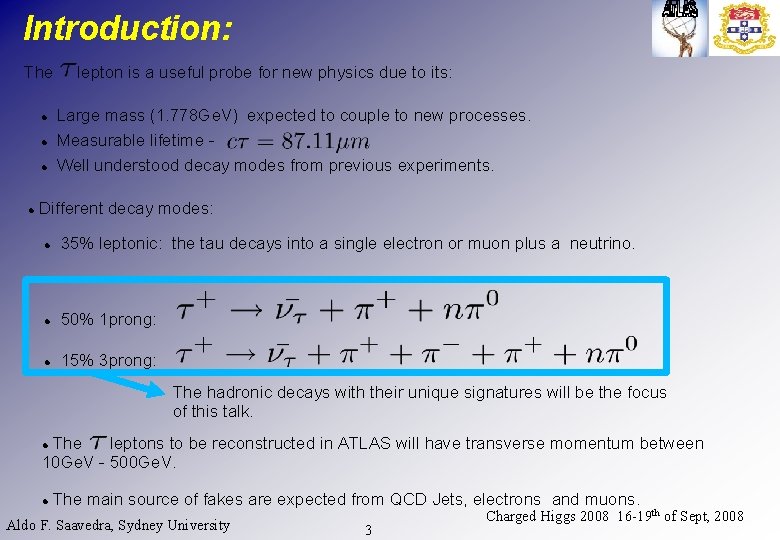
Introduction: The lepton is a useful probe for new physics due to its: Large mass (1. 778 Ge. V) expected to couple to new processes. Measurable lifetime. Well understood decay modes from previous experiments. Different decay modes: 35% leptonic: the tau decays into a single electron or muon plus a neutrino. 50% 1 prong: 15% 3 prong: The hadronic decays with their unique signatures will be the focus of this talk. The leptons to be reconstructed in ATLAS will have transverse momentum between 10 Ge. V - 500 Ge. V. The main source of fakes are expected from QCD Jets, electrons and muons. Aldo F. Saavedra, Sydney University 3 Charged Higgs 2008 16 -19 th of Sept, 2008
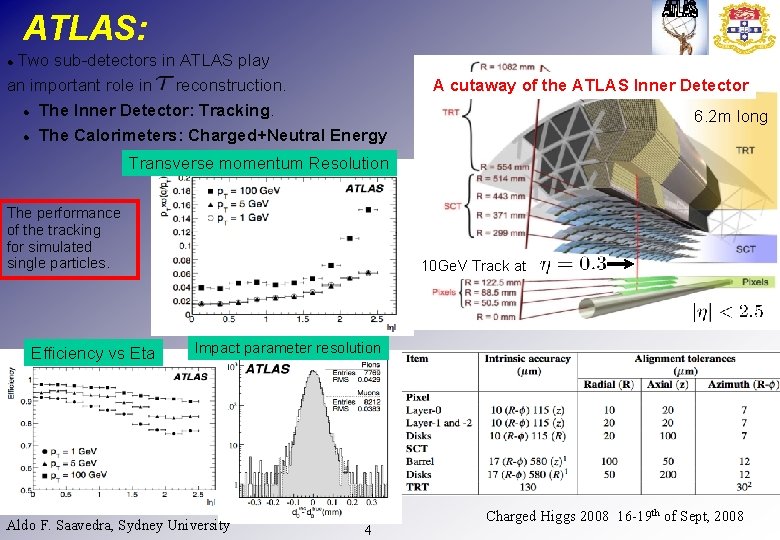
ATLAS: Two sub-detectors in ATLAS play an important role in reconstruction. The Inner Detector: Tracking. The Calorimeters: Charged+Neutral Energy A cutaway of the ATLAS Inner Detector 6. 2 m long Transverse momentum Resolution The performance of the tracking for simulated single particles. Efficiency vs Eta 10 Ge. V Track at Impact parameter resolution Aldo F. Saavedra, Sydney University 4 Charged Higgs 2008 16 -19 th of Sept, 2008
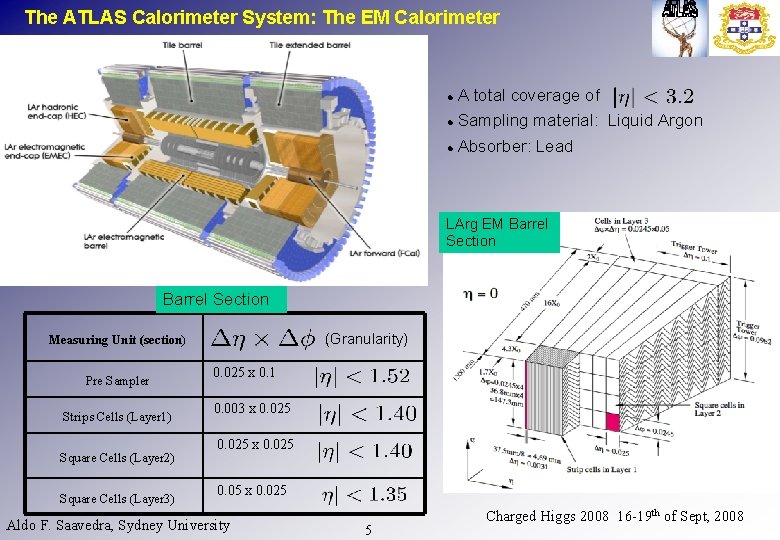
The ATLAS Calorimeter System: The EM Calorimeter A total coverage of. Sampling material: Liquid Argon Absorber: Lead LArg EM Barrel Section (Granularity) Measuring Unit (section) Pre Sampler Strips Cells (Layer 1) Square Cells (Layer 2) Square Cells (Layer 3) 0. 025 x 0. 1 0. 003 x 0. 025 0. 05 x 0. 025 Aldo F. Saavedra, Sydney University 5 Charged Higgs 2008 16 -19 th of Sept, 2008
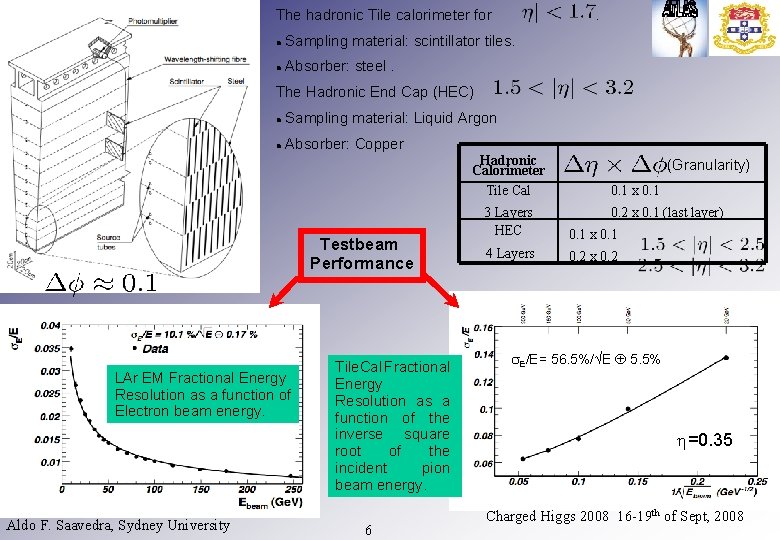
The hadronic Tile calorimeter for . Sampling material: scintillator tiles. Absorber: steel. The Hadronic End Cap (HEC) Sampling material: Liquid Argon Absorber: Copper Hadronic Calorimeter Tile Cal Testbeam Performance LAr EM Fractional Energy Resolution as a function of Electron beam energy. Aldo F. Saavedra, Sydney University Tile. Cal Fractional Energy Resolution as a function of the inverse square root of the incident pion beam energy. 6 (Granularity) 0. 1 x 0. 1 3 Layers HEC 0. 2 x 0. 1 (last layer) 0. 1 x 0. 1 4 Layers 0. 2 x 0. 2 E/E= 56. 5%/√E 5. 5% =0. 35 Charged Higgs 2008 16 -19 th of Sept, 2008
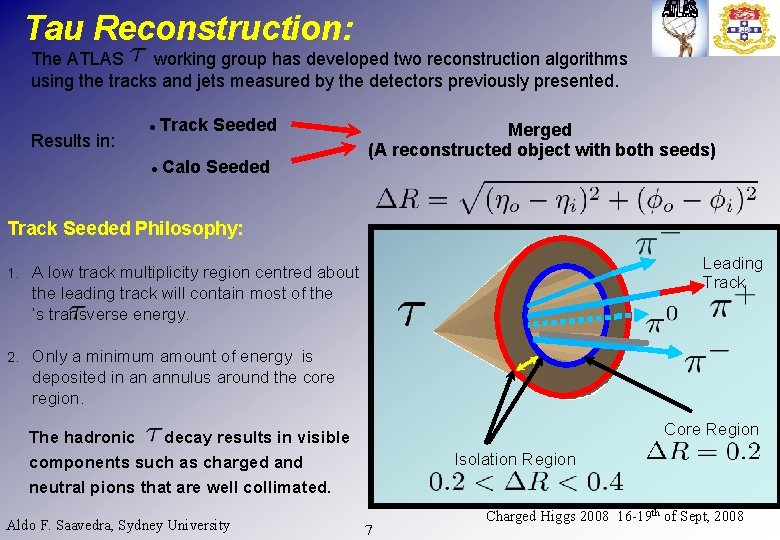
Tau Reconstruction: The ATLAS working group has developed two reconstruction algorithms using the tracks and jets measured by the detectors previously presented. Results in: Track Seeded Calo Seeded Merged (A reconstructed object with both seeds) Track Seeded Philosophy: 1. A low track multiplicity region centred about the leading track will contain most of the ‘s transverse energy. 2. Only a minimum amount of energy is deposited in an annulus around the core region. Leading Track Core Region The hadronic decay results in visible components such as charged and neutral pions that are well collimated. Aldo F. Saavedra, Sydney University Isolation Region 7 Charged Higgs 2008 16 -19 th of Sept, 2008
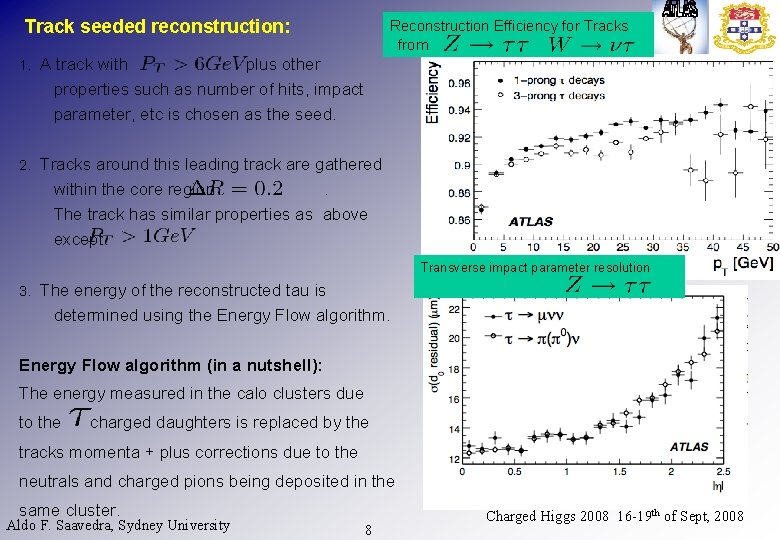
Track seeded reconstruction: Reconstruction Efficiency for Tracks from , 1. A track with plus other properties such as number of hits, impact parameter, etc is chosen as the seed. 2. Tracks around this leading track are gathered within the core region. The track has similar properties as above except. Transverse impact parameter resolution 3. The energy of the reconstructed tau is determined using the Energy Flow algorithm (in a nutshell): The energy measured in the calo clusters due to the charged daughters is replaced by the tracks momenta + plus corrections due to the neutrals and charged pions being deposited in the same cluster. Aldo F. Saavedra, Sydney University 8 Charged Higgs 2008 16 -19 th of Sept, 2008
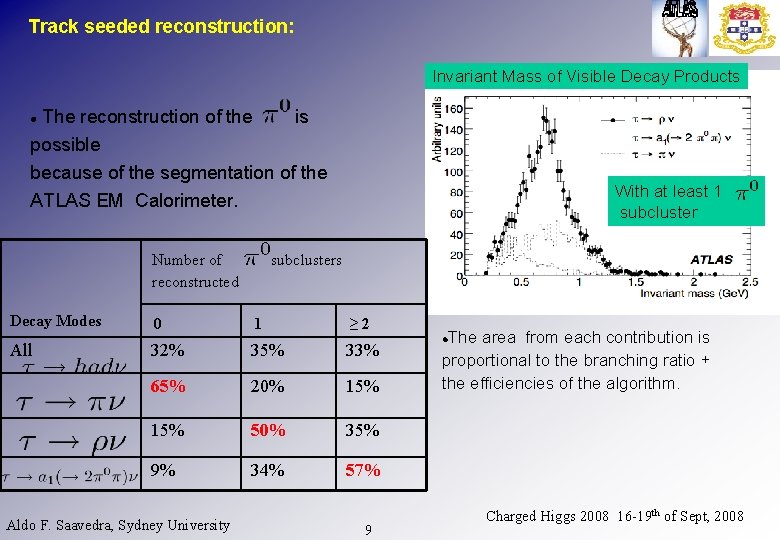
Track seeded reconstruction: Invariant Mass of Visible Decay Products The reconstruction of the is possible because of the segmentation of the ATLAS EM Calorimeter. Number of reconstructed With at least 1 subclusters Decay Modes 0 1 ≥ 2 All 32% 35% 33% 65% 20% 15% 50% 35% 9% 34% 57% Aldo F. Saavedra, Sydney University 9 The area from each contribution is proportional to the branching ratio + the efficiencies of the algorithm. Charged Higgs 2008 16 -19 th of Sept, 2008
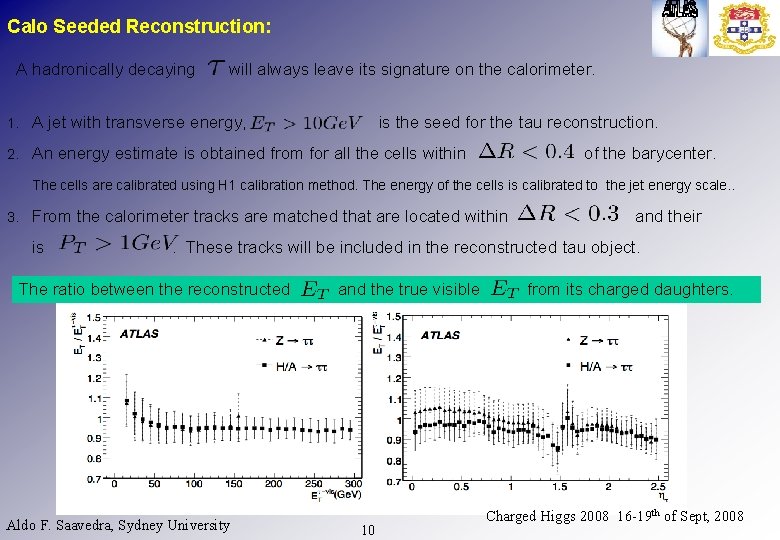
Calo Seeded Reconstruction: A hadronically decaying will always leave its signature on the calorimeter. 1. A jet with transverse energy, is the seed for the tau reconstruction. 2. An energy estimate is obtained from for all the cells within of the barycenter. The cells are calibrated using H 1 calibration method. The energy of the cells is calibrated to the jet energy scale. . 3. From the calorimeter tracks are matched that are located within is and their . These tracks will be included in the reconstructed tau object. The ratio between the reconstructed Aldo F. Saavedra, Sydney University and the true visible 10 from its charged daughters. Charged Higgs 2008 16 -19 th of Sept, 2008
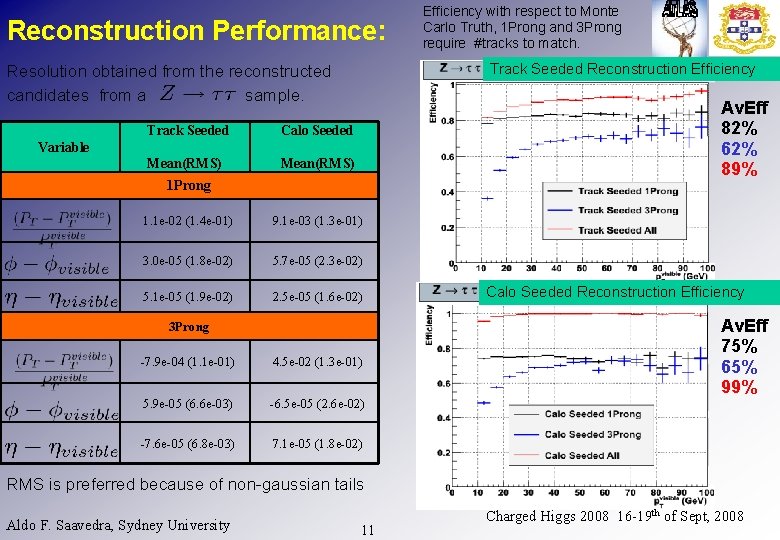
Reconstruction Performance: Track Seeded Reconstruction Efficiency Resolution obtained from the reconstructed candidates from a sample. Track Seeded Calo Seeded Mean(RMS) Efficiency with respect to Monte Carlo Truth, 1 Prong and 3 Prong require #tracks to match. Av. Eff 82% 62% 89% Variable 1 Prong 1. 1 e-02 (1. 4 e-01) 9. 1 e-03 (1. 3 e-01) 3. 0 e-05 (1. 8 e-02) 5. 7 e-05 (2. 3 e-02) 5. 1 e-05 (1. 9 e-02) 2. 5 e-05 (1. 6 e-02) 3 Prong -7. 9 e-04 (1. 1 e-01) 4. 5 e-02 (1. 3 e-01) 5. 9 e-05 (6. 6 e-03) -6. 5 e-05 (2. 6 e-02) -7. 6 e-05 (6. 8 e-03) 7. 1 e-05 (1. 8 e-02) Calo Seeded Reconstruction Efficiency Av. Eff 75% 65% 99% RMS is preferred because of non-gaussian tails Aldo F. Saavedra, Sydney University 11 Charged Higgs 2008 16 -19 th of Sept, 2008
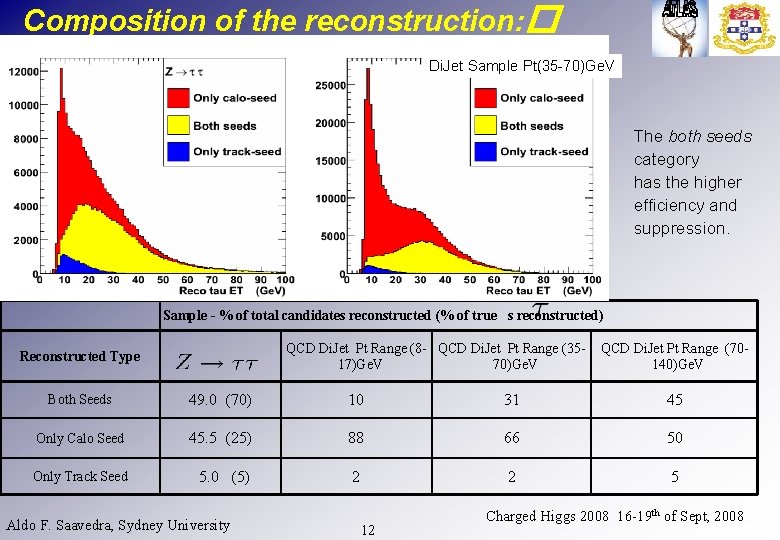
Composition of the reconstruction: � Di. Jet Sample Pt(35 -70)Ge. V The both seeds category has the higher efficiency and suppression. Sample - % of total candidates reconstructed (% of true s reconstructed) QCD Di. Jet Pt Range (8 - QCD Di. Jet Pt Range (3517)Ge. V 70)Ge. V Reconstructed Type QCD Di. Jet Pt Range (70140)Ge. V Both Seeds 49. 0 (70) 10 31 45 Only Calo Seed 45. 5 (25) 88 66 50 Only Track Seed 5. 0 (5) 2 2 5 Aldo F. Saavedra, Sydney University 12 Charged Higgs 2008 16 -19 th of Sept, 2008
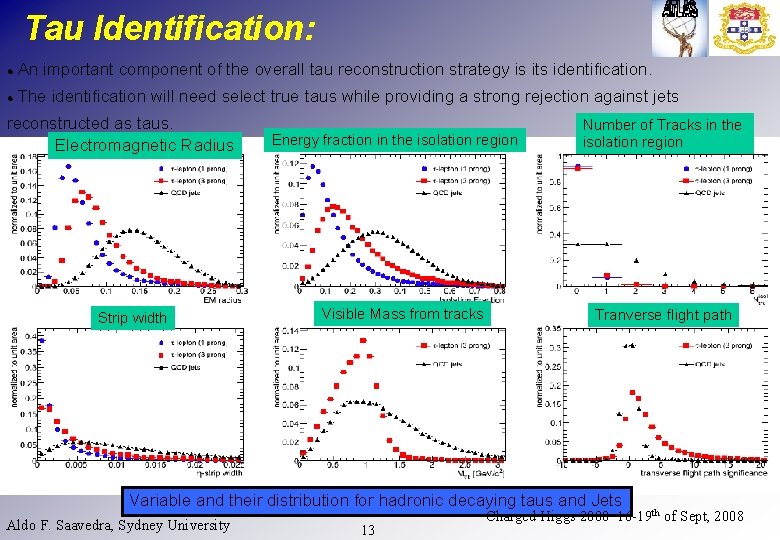
Tau Identification: An important component of the overall tau reconstruction strategy is its identification. The identification will need select true taus while providing a strong rejection against jets reconstructed as taus. Electromagnetic Radius Strip width Energy fraction in the isolation region Visible Mass from tracks Number of Tracks in the isolation region Tranverse flight path Variable and their distribution for hadronic decaying taus and Jets Aldo F. Saavedra, Sydney University 13 Charged Higgs 2008 16 -19 th of Sept, 2008
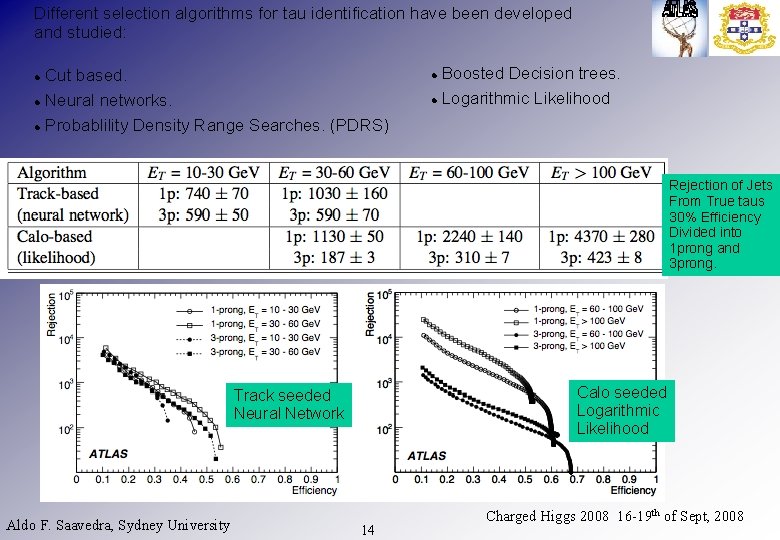
Different selection algorithms for tau identification have been developed and studied: Cut based. Neural networks. Probablility Density Range Searches. (PDRS) Boosted Decision trees. Logarithmic Likelihood Rejection of Jets From True taus 30% Efficiency Divided into 1 prong and 3 prong. Calo seeded Logarithmic Likelihood Track seeded Neural Network Aldo F. Saavedra, Sydney University 14 Charged Higgs 2008 16 -19 th of Sept, 2008
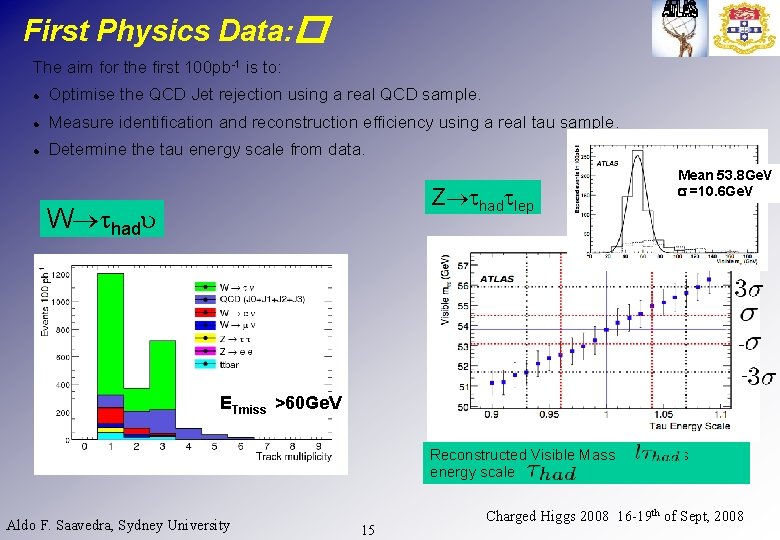
First Physics Data: � The aim for the first 100 pb-1 is to: Optimise the QCD Jet rejection using a real QCD sample. Measure identification and reconstruction efficiency using a real tau sample. Determine the tau energy scale from data. Z had lep W had Mean 53. 8 Ge. V =10. 6 Ge. V - ETmiss >60 Ge. V Reconstructed Visible Mass energy scale Aldo F. Saavedra, Sydney University 15 vs Charged Higgs 2008 16 -19 th of Sept, 2008
Conclusion: � The hadronic tau reconstruction in the ATLAS experiment has matured and is stable. Two algorithms that take advantage of different properties of the tau and the detector have been developed and their properties merged. A number of different discriminating algorithms have been developed that aim to increase the efficiency of selection and rejection power against QCD Jets. A program has been developed to take advantage of the first 100 pb-1 of data to determine and improve the performance of the reconstruction and identification. Aldo F. Saavedra, Sydney University 16 Charged Higgs 2008 16 -19 th of Sept, 2008
Back Up Slides� Aldo F. Saavedra, Sydney University 17 Charged Higgs 2008 16 -19 th of Sept, 2008
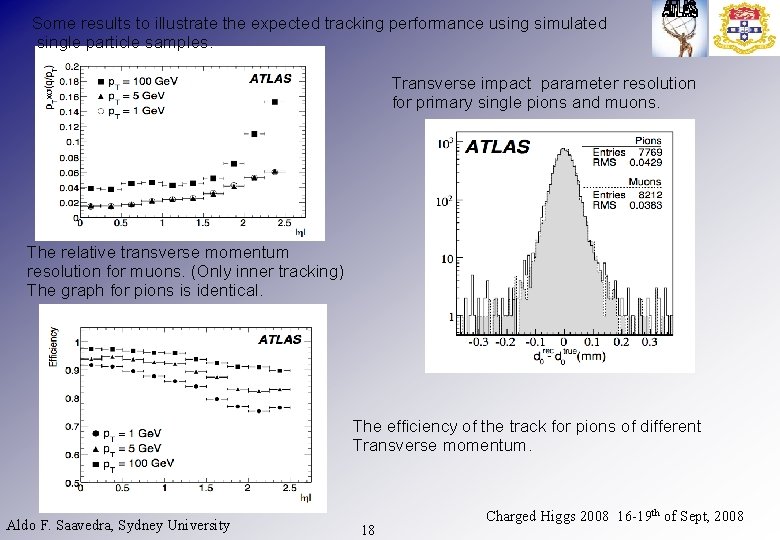
Some results to illustrate the expected tracking performance using simulated single particle samples. Transverse impact parameter resolution for primary single pions and muons. The relative transverse momentum resolution for muons. (Only inner tracking) The graph for pions is identical. The efficiency of the track for pions of different Transverse momentum. Aldo F. Saavedra, Sydney University 18 Charged Higgs 2008 16 -19 th of Sept, 2008
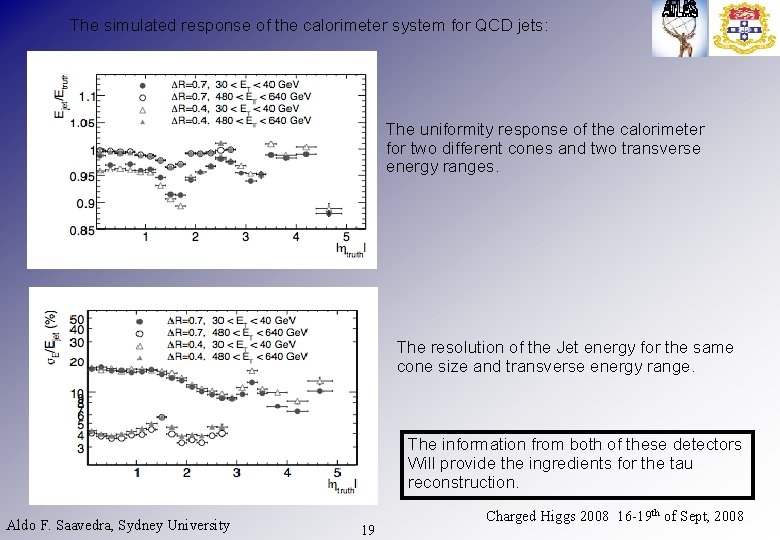
The simulated response of the calorimeter system for QCD jets: The uniformity response of the calorimeter for two different cones and two transverse energy ranges. The resolution of the Jet energy for the same cone size and transverse energy range. The information from both of these detectors Will provide the ingredients for the tau reconstruction. Aldo F. Saavedra, Sydney University 19 Charged Higgs 2008 16 -19 th of Sept, 2008
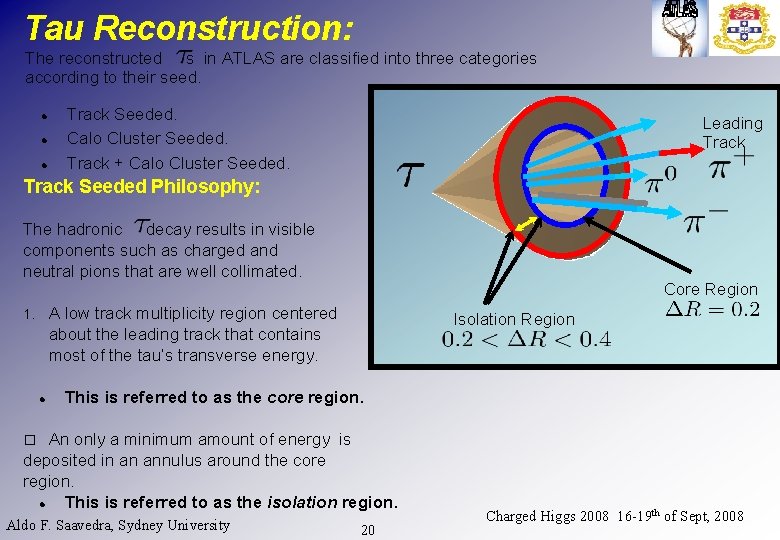
Tau Reconstruction: The reconstructed s in ATLAS are classified into three categories according to their seed. Track Seeded. Calo Cluster Seeded. Track + Calo Cluster Seeded. Leading Track Seeded Philosophy: The hadronic decay results in visible components such as charged and neutral pions that are well collimated. Core Region A low track multiplicity region centered about the leading track that contains most of the tau’s transverse energy. 1. Isolation Region This is referred to as the core region. An only a minimum amount of energy is deposited in an annulus around the core region. This is referred to as the isolation region. � Aldo F. Saavedra, Sydney University 20 Charged Higgs 2008 16 -19 th of Sept, 2008
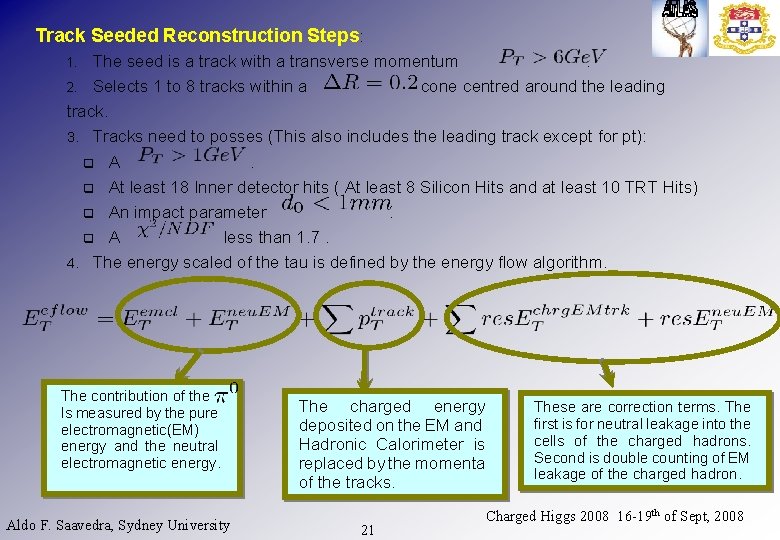
Track Seeded Reconstruction Steps: The seed is a track with a transverse momentum. 2. Selects 1 to 8 tracks within a cone centred around the leading track. 3. Tracks need to posses (This also includes the leading track except for pt): q At least 18 Inner detector hits ( At least 8 Silicon Hits and at least 10 TRT Hits) q An impact parameter. q A less than 1. 7. 4. The energy scaled of the tau is defined by the energy flow algorithm. 1. The contribution of the Is measured by the pure electromagnetic(EM) energy and the neutral electromagnetic energy. Aldo F. Saavedra, Sydney University The charged energy deposited on the EM and Hadronic Calorimeter is replaced by the momenta of the tracks. 21 These are correction terms. The first is for neutral leakage into the cells of the charged hadrons. Second is double counting of EM leakage of the charged hadron. Charged Higgs 2008 16 -19 th of Sept, 2008
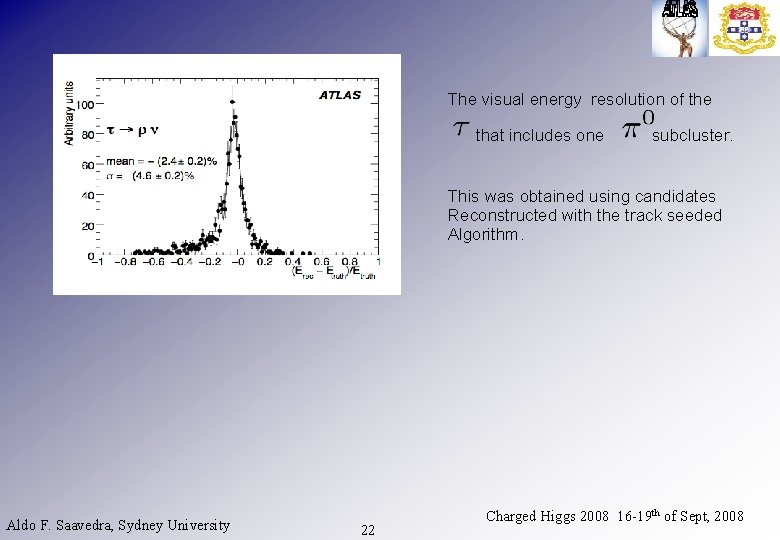
The visual energy resolution of the that includes one subcluster. This was obtained using candidates Reconstructed with the track seeded Algorithm. Aldo F. Saavedra, Sydney University 22 Charged Higgs 2008 16 -19 th of Sept, 2008
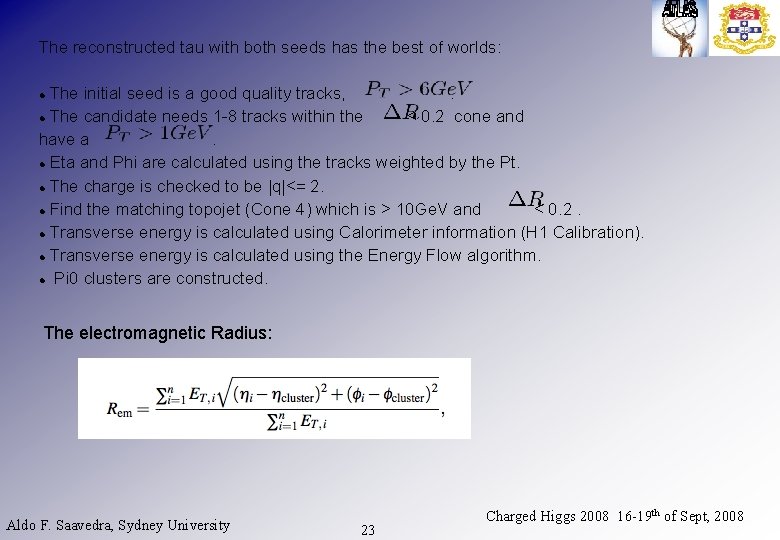
The reconstructed tau with both seeds has the best of worlds: The initial seed is a good quality tracks, . The candidate needs 1 -8 tracks within the < 0. 2 cone and have a. Eta and Phi are calculated using the tracks weighted by the Pt. The charge is checked to be |q|<= 2. Find the matching topojet (Cone 4) which is > 10 Ge. V and < 0. 2. Transverse energy is calculated using Calorimeter information (H 1 Calibration). Transverse energy is calculated using the Energy Flow algorithm. Pi 0 clusters are constructed. The electromagnetic Radius: Aldo F. Saavedra, Sydney University 23 Charged Higgs 2008 16 -19 th of Sept, 2008
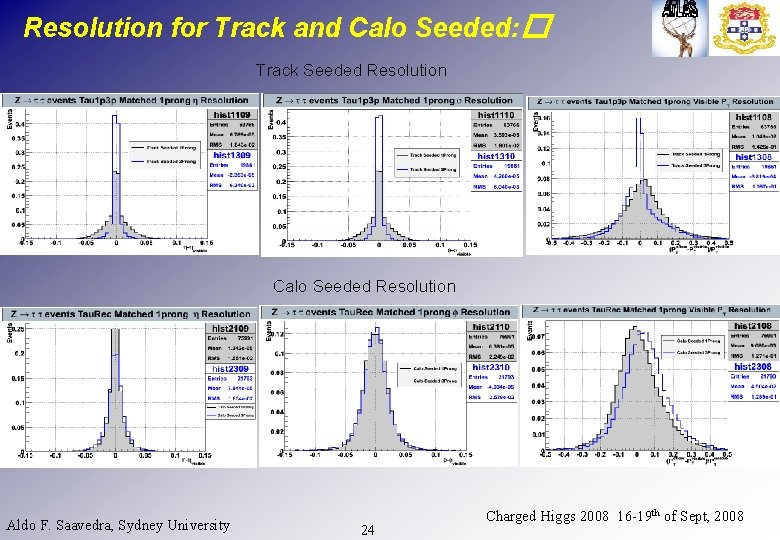
Resolution for Track and Calo Seeded: � Track Seeded Resolution Calo Seeded Resolution Aldo F. Saavedra, Sydney University 24 Charged Higgs 2008 16 -19 th of Sept, 2008