
Taste Transduction Input into the brain Transduction of
Taste Transduction Input into the brain
Transduction of tastants • Receptors on the apical surface of taste cells • Na+ enters the taste cell • H+ enters the taste cell • Cation selective channels --> inward current, receptor potential--> voltage gated Na channels, voltage gated Ca channels.

Sweet and amino acid (glutamate) receptors • Heteromeric G protein coupled receptors • Sweet: T 1 R 3 paired with. T 1 R 2 receptors (T 1 R 2/T 1 R 3). • Activates Phospholipase C • Increased IP 3 • Opening of TRP channels (transient receptor potential channel) TRPM, allow calcium entry.

Amino Acids: • T 1 R 1/T 1 R 3 receptor broadly tuned to 20 L amino acids • Activates Phospholipase C • Increased IP 3 • Opening of TRP channels (transient receptor potential channel) TRPM, allow calcium entry.
Bitter taste • • • G-protein couple receptors T 2 R receptors 30 T 2 R subtypes 30 genes Multiple T 2 R receptors in a single cell type. • Cells with T 2 R receptors do not express T 1 R receptors
Gustducin - the taste G protein • Found mostly on T 2 R cells.
• Taste, labeled line coding • Trigeminal nerve • Audition - the ear.
Neural Coding • Pattern of action potentials relayed to the brain.
Labeled Line Coding • Specifc pathways carry information quality to the brain. (Is there a “sweet” pathway? • Knock out T 1 R 2, T 1 R 1 – Loose behavioral response to sweet or amino acids – No action potential recorded in response to sweet or aa from VII, IX or X fibers – Consisten with Labeled Line hypothesis
Trigeminal chemoreception • Polymodal nociceptive neurons • Axons of trigeminal nerve (cranial nerve V) • Some axons of IX and X
Polymodal nociceptors • Free nerve endings • Polymodal, respond to thermal, mechanical and chemical stimuli • Associated with pain • C fibers conduct dull pain
Nociception Transduction • • • TRP channels (TRPV 1 binds casaicin) Transient receptor potential channels Channel closed under resting conditions Open - sodium and calcium flow Receptor opens in response to heat and capsaicin Endogenous endovanilloids bind to TRPV 1 channels
Irritants • • • High concentrations of tastants Ammonia Air pollutants (sulfur dioxide) Acetic acid Little known about signal transductio of irritants.
Auditory System • • Sound External ear Middle ear Inner ear
Sound • Pressure wave pass in three dimensional space • Amplitude - volume (loud) • Frequency - pitch • Inner ear is like a prism and decomposes sounds into tones
Audible spectrum • For humans, 20 Hz to 20 k. Hz. • Echolocation through high frequency vocal sounds • Low frequency hearing for sensing approaching predator
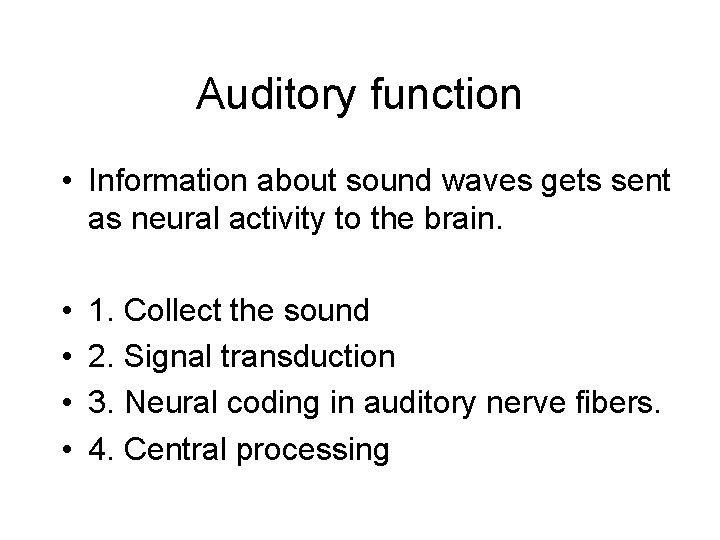
Auditory function • Information about sound waves gets sent as neural activity to the brain. • • 1. Collect the sound 2. Signal transduction 3. Neural coding in auditory nerve fibers. 4. Central processing


External Ear
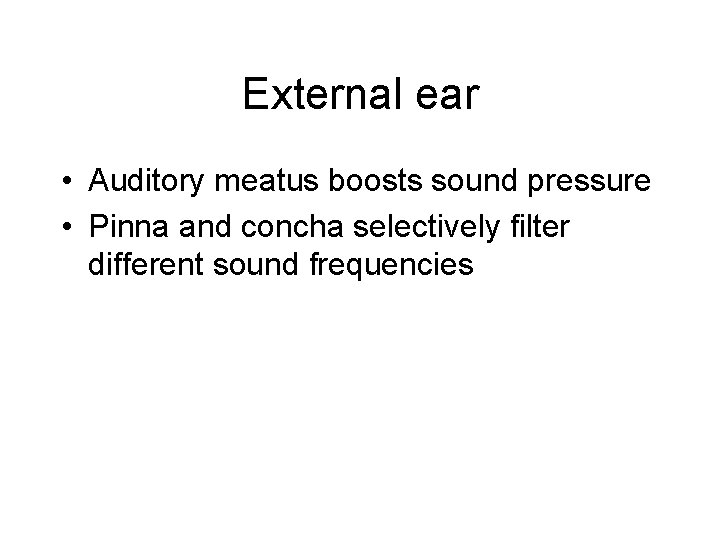
External ear • Auditory meatus boosts sound pressure • Pinna and concha selectively filter different sound frequencies
Middle Ear
Middle Ear
Middle Ear • Match airbourne sounds to fluid of inner ear. • Fluid is more resistant to movement (high impedance) than air
Middle ear • Sound is focused on the oval window, where the bones (ossicles) connect the tympanic membrane to the oval window.
Inner Ear • Cochlea • Pressure waves are transferred to neural impulses. • Physical properties of the cochlea are important.






- Slides: 33