
Tasks for the ECT team Dr Grace Fergusson



- Slides: 24
Tasks for the ECT team Dr Grace Fergusson Argyll and Bute Hospital Lochgilphead Royal College of Psychiatrists ECT training day, January 2002
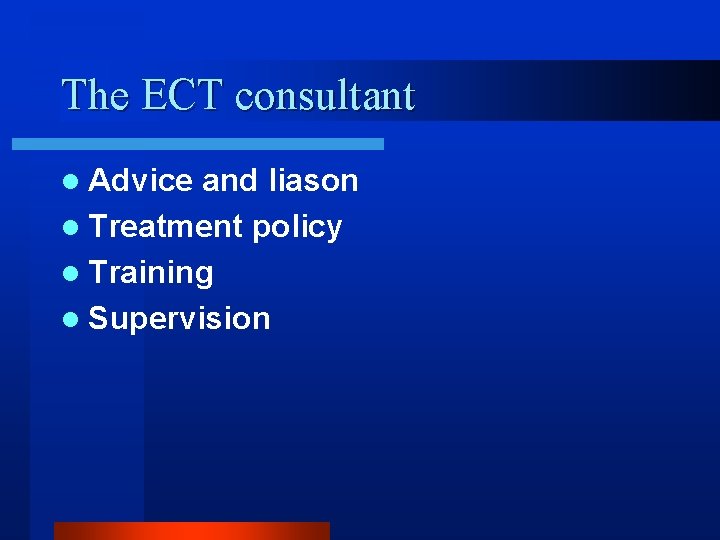
The ECT consultant l Advice and liason l Treatment policy l Training l Supervision
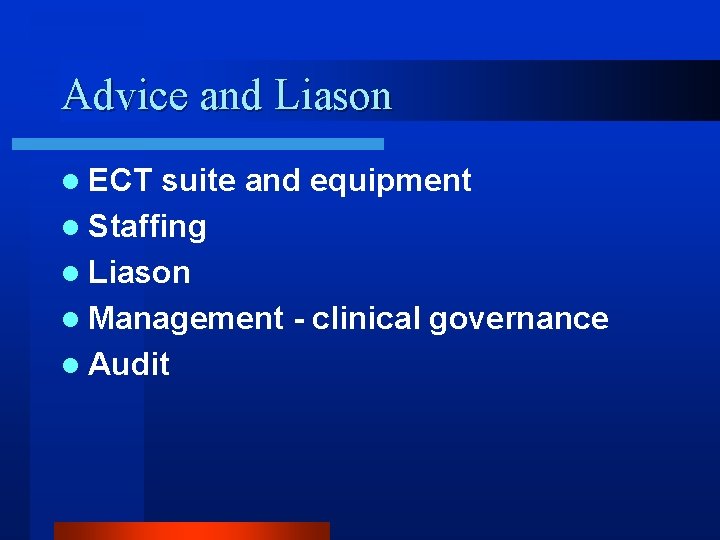
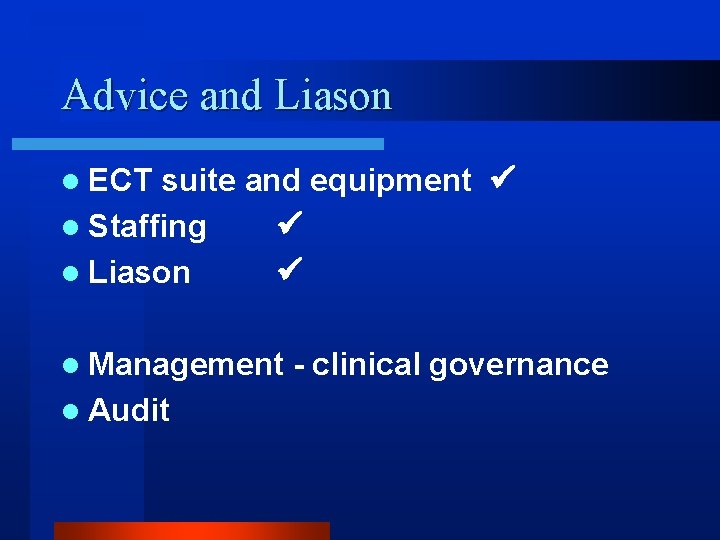
Advice and Liason l ECT suite and equipment l Staffing l Liason l Management - clinical governance l Audit
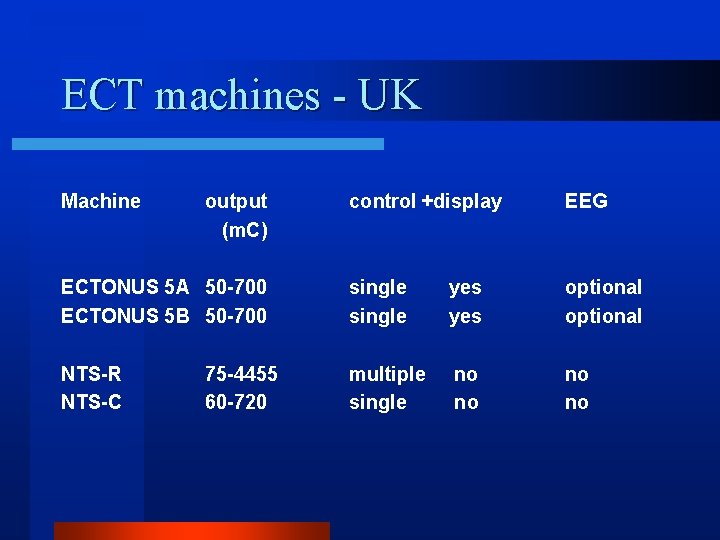
ECT machines - UK Machine output (m. C) control +display EEG ECTONUS 5 A 50 -700 ECTONUS 5 B 50 -700 single yes optional NTS-R NTS-C multiple single no no 75 -4455 60 -720
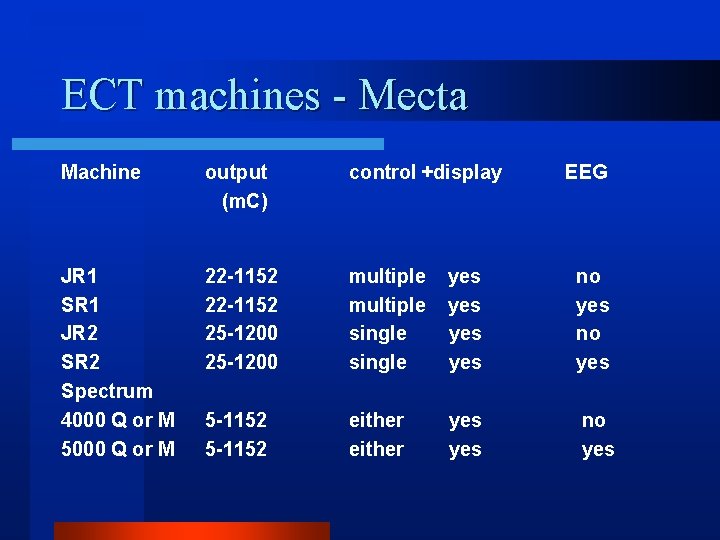
ECT machines - Mecta Machine output (m. C) control +display EEG JR 1 SR 1 JR 2 Spectrum 4000 Q or M 5000 Q or M 22 -1152 25 -1200 multiple single yes yes no yes 5 -1152 either yes no yes
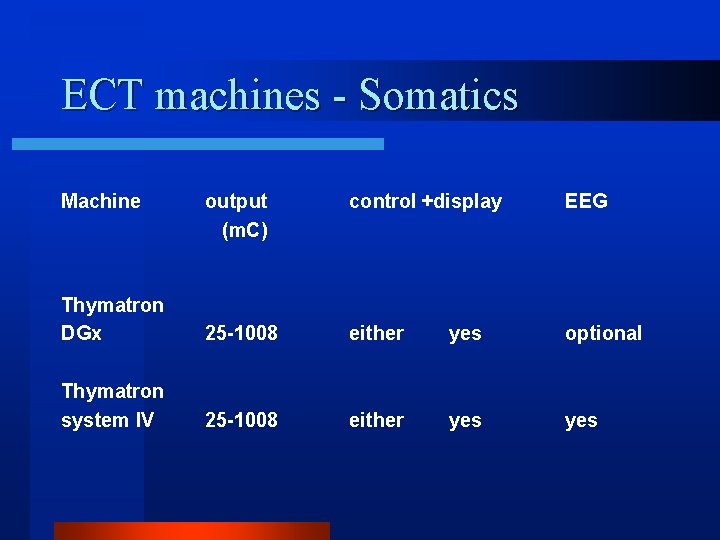
ECT machines - Somatics Machine output (m. C) control +display EEG Thymatron DGx 25 -1008 either yes optional Thymatron system IV 25 -1008 either yes
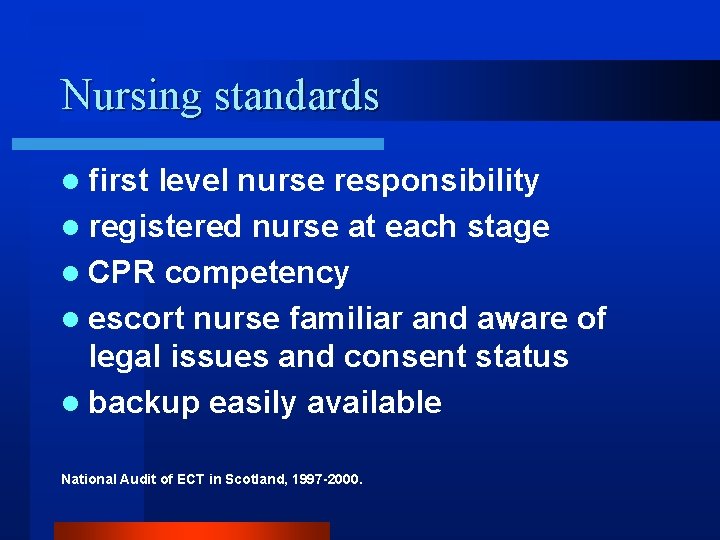
Nursing standards l first level nurse responsibility l registered nurse at each stage l CPR competency l escort nurse familiar and aware of legal issues and consent status l backup easily available National Audit of ECT in Scotland, 1997 -2000.
Guidelines for Anaesthesia l consultant responsibility l trained anaesthetists l trained assistant (ODP) l standard equipment l ECT workup l access to critical care for ASA grades 3 or above (medical condition affecting lifestyle)
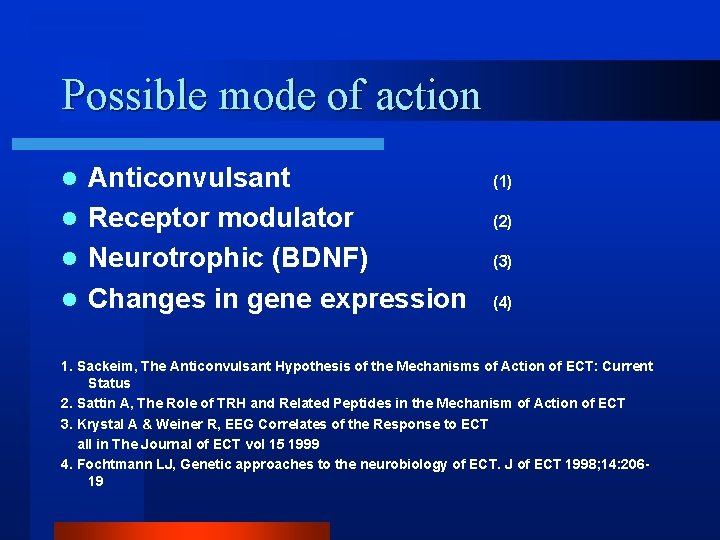
Possible mode of action Anticonvulsant l Receptor modulator l Neurotrophic (BDNF) l Changes in gene expression l (1) (2) (3) (4) 1. Sackeim, The Anticonvulsant Hypothesis of the Mechanisms of Action of ECT: Current Status 2. Sattin A, The Role of TRH and Related Peptides in the Mechanism of Action of ECT 3. Krystal A & Weiner R, EEG Correlates of the Response to ECT all in The Journal of ECT vol 15 1999 4. Fochtmann LJ, Genetic approaches to the neurobiology of ECT. J of ECT 1998; 14: 20619
Advice and Liason l ECT suite and equipment l Staffing l Liason l Management l Audit - clinical governance
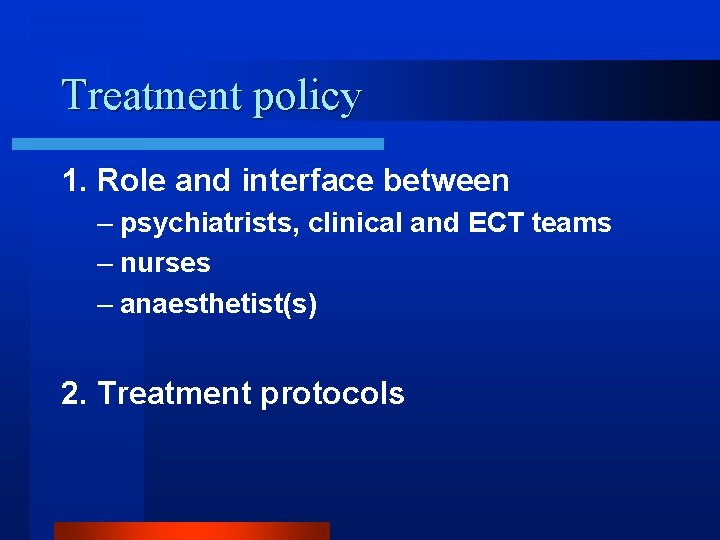
Treatment policy 1. Role and interface between – psychiatrists, clinical and ECT teams – nurses – anaesthetist(s) 2. Treatment protocols
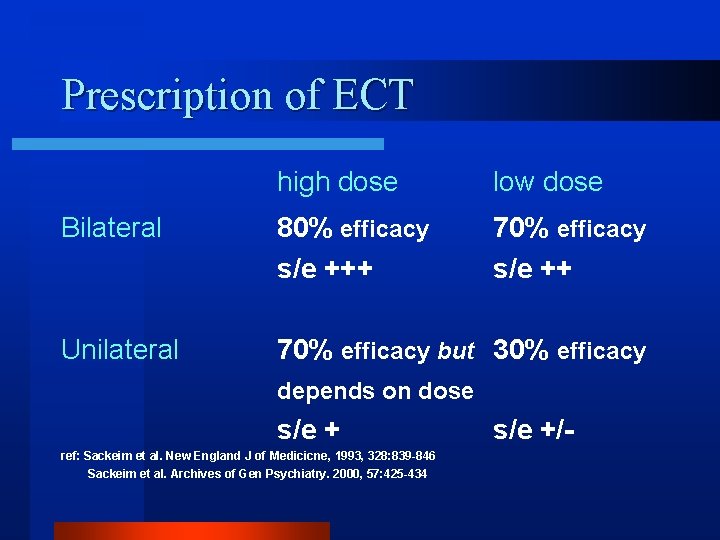
Prescription of ECT high dose low dose Bilateral 80% efficacy s/e +++ 70% efficacy s/e ++ Unilateral 70% efficacy but 30% efficacy depends on dose s/e + ref: Sackeim et al. New England J of Medicicne, 1993, 328: 839 -846 Sackeim et al. Archives of Gen Psychiatry. 2000, 57: 425 -434 s/e +/-
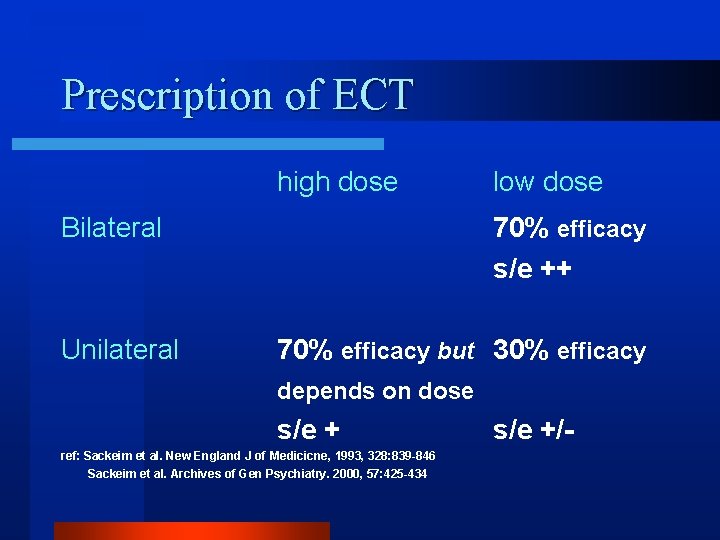
Prescription of ECT high dose Bilateral Unilateral low dose 70% efficacy s/e ++ 70% efficacy but 30% efficacy depends on dose s/e + ref: Sackeim et al. New England J of Medicicne, 1993, 328: 839 -846 Sackeim et al. Archives of Gen Psychiatry. 2000, 57: 425 -434 s/e +/-
Prescription of ECT high dose Bilateral Unilateral low dose 70% efficacy s/e ++ 70% efficacy but depends on dose s/e + ref: Sackeim et al. New England J of Medicicne, 1993, 328: 839 -846 Sackeim et al. Archives of Gen Psychiatry. 2000, 57: 425 -434
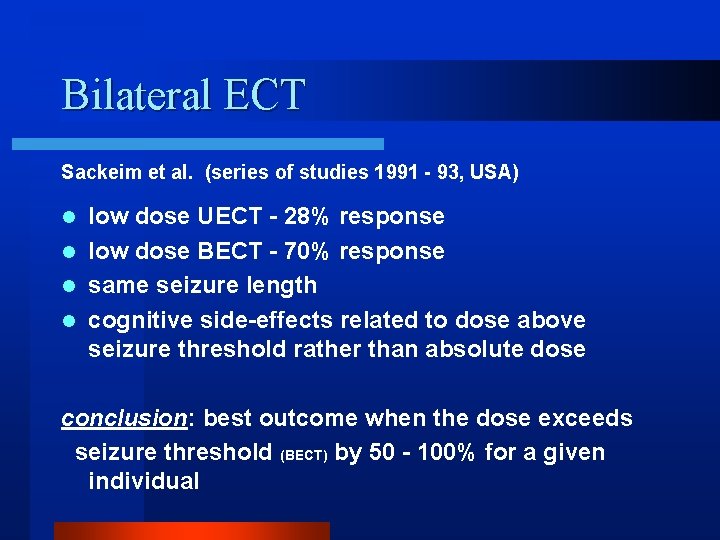
Bilateral ECT Sackeim et al. (series of studies 1991 - 93, USA) low dose UECT - 28% response l low dose BECT - 70% response l same seizure length l cognitive side-effects related to dose above seizure threshold rather than absolute dose l conclusion: best outcome when the dose exceeds seizure threshold (BECT) by 50 - 100% for a given individual
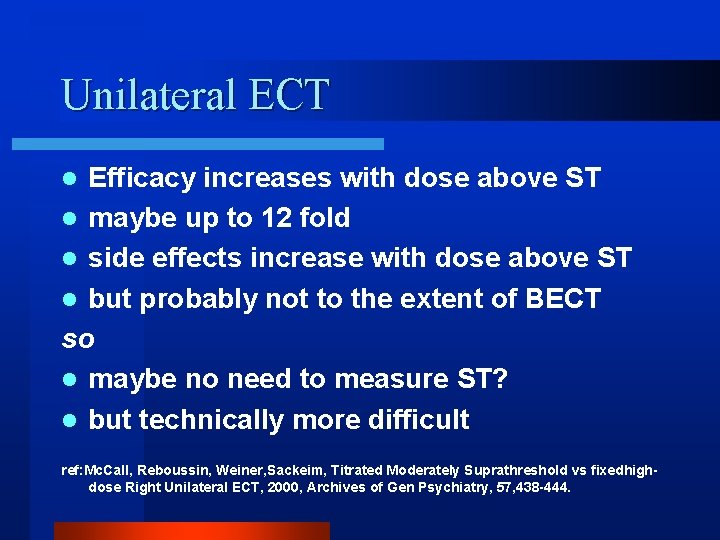
Unilateral ECT Efficacy increases with dose above ST l maybe up to 12 fold l side effects increase with dose above ST l but probably not to the extent of BECT so l maybe no need to measure ST? l but technically more difficult l ref: Mc. Call, Reboussin, Weiner, Sackeim, Titrated Moderately Suprathreshold vs fixedhighdose Right Unilateral ECT, 2000, Archives of Gen Psychiatry, 57, 438 -444.
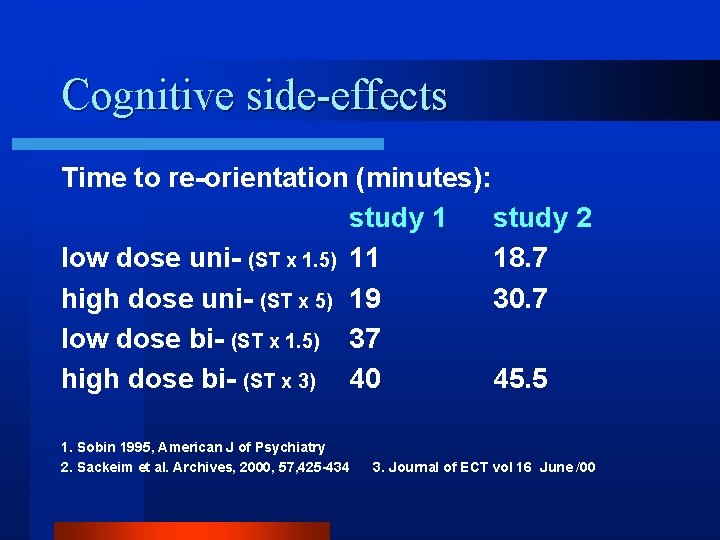
Cognitive side-effects Time to re-orientation (minutes): study 1 study 2 low dose uni- (ST x 1. 5) 11 18. 7 high dose uni- (ST x 5) 19 30. 7 low dose bi- (ST x 1. 5) 37 high dose bi- (ST x 3) 40 45. 5 1. Sobin 1995, American J of Psychiatry 2. Sackeim et al. Archives, 2000, 57, 425 -434 3. Journal of ECT vol 16 June /00
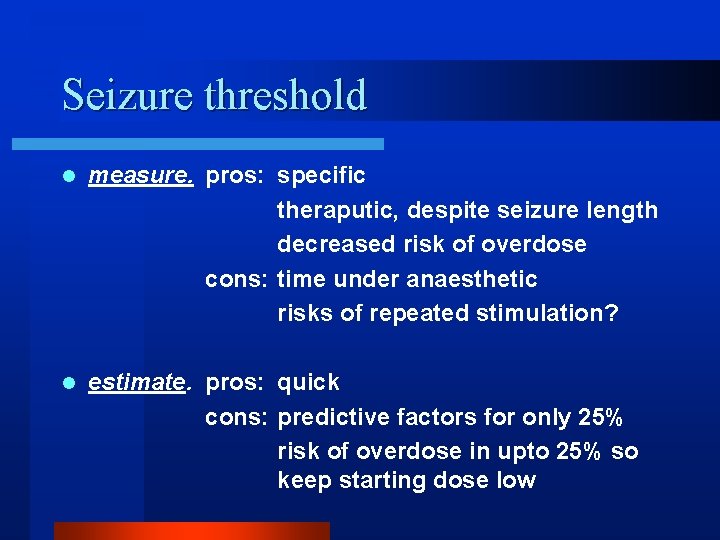
Seizure threshold l measure. pros: specific theraputic, despite seizure length decreased risk of overdose cons: time under anaesthetic risks of repeated stimulation? l estimate. pros: quick cons: predictive factors for only 25% risk of overdose in upto 25% so keep starting dose low
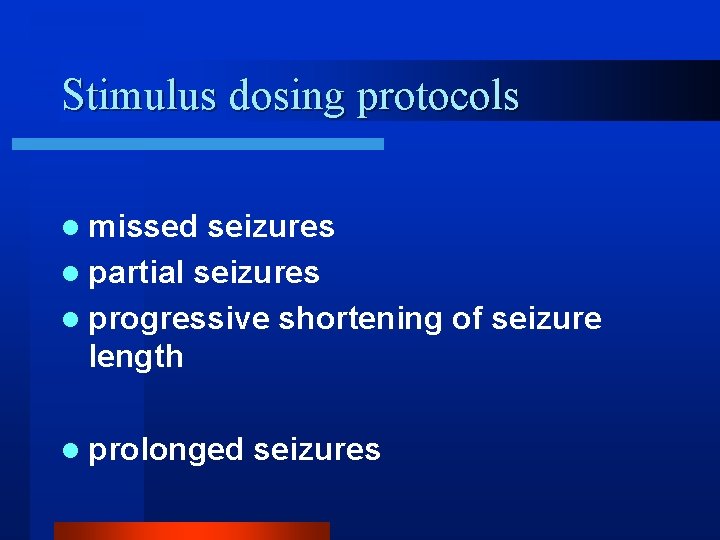
Stimulus dosing protocols l missed seizures l partial seizures l progressive shortening of seizure length l prolonged seizures
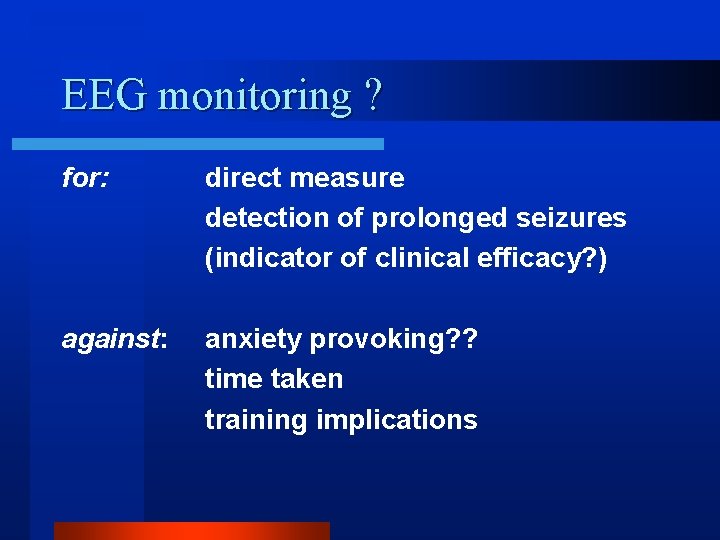
EEG monitoring ? for: direct measure detection of prolonged seizures (indicator of clinical efficacy? ) against: anxiety provoking? ? time taken training implications
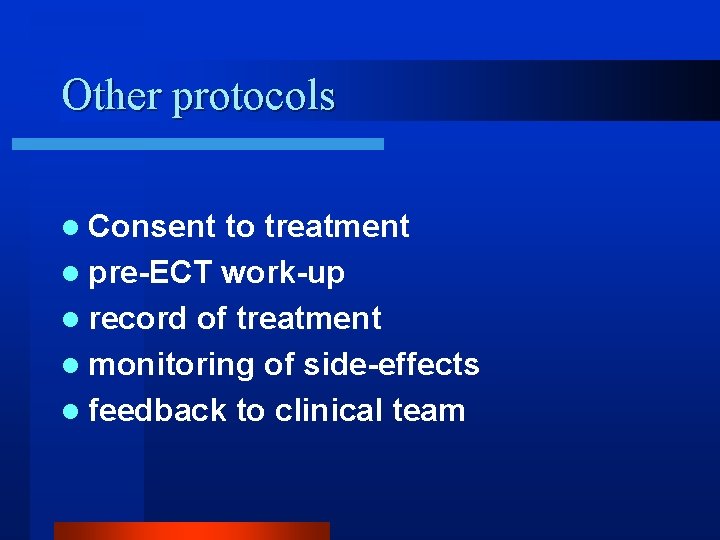
Other protocols l Consent to treatment l pre-ECT work-up l record of treatment l monitoring of side-effects l feedback to clinical team
Special populations l outpatients l young people l pregnancy l cognitively impaired see The ECT Handbook 1995.
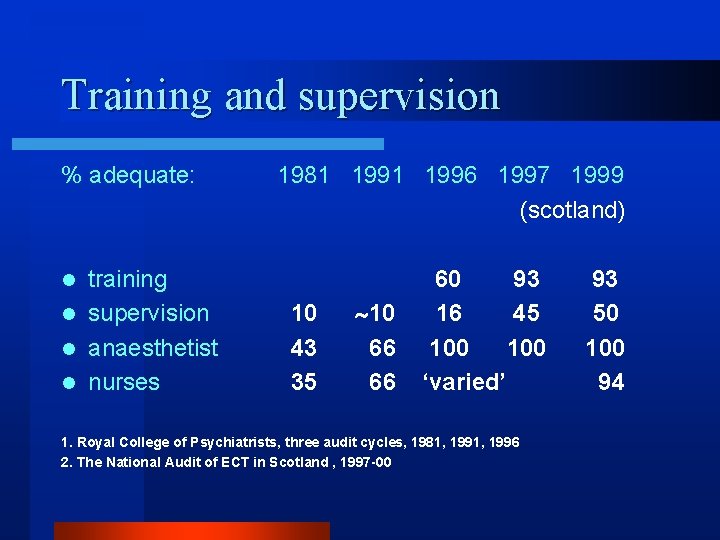
Training and supervision % adequate: training l supervision l anaesthetist l nurses 1981 1996 1997 1999 (scotland) l 10 43 35 10 66 66 60 93 16 45 100 ‘varied’ 1. Royal College of Psychiatrists, three audit cycles, 1981, 1996 2. The National Audit of ECT in Scotland , 1997 -00 93 50 100 94
Tasks for the ECT team Dr Grace Fergusson Argyll and Bute Hospital Lochgilphead Royal College of Psychiatrists ECT training day, Jan 2002