
TASK TRAINING WHY IS IT IMPORTANT TO DO



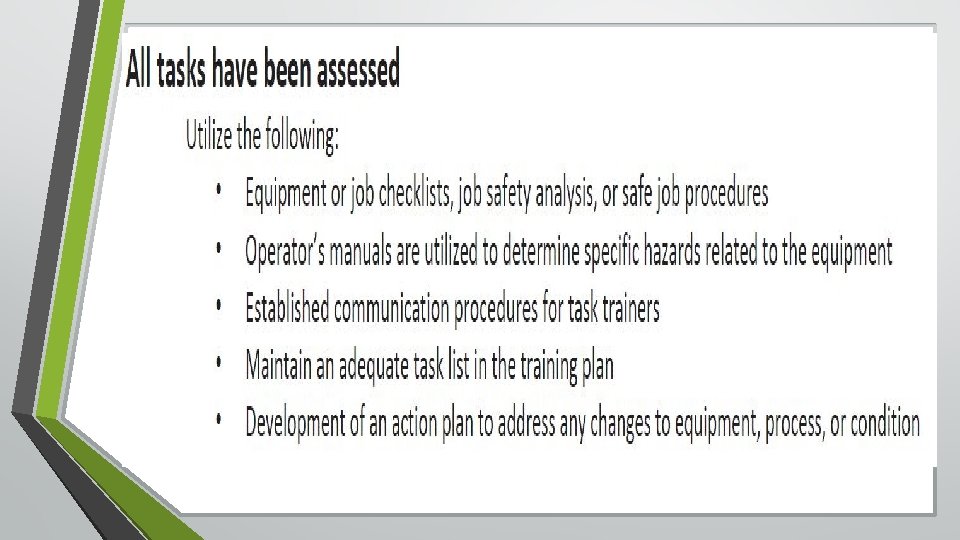
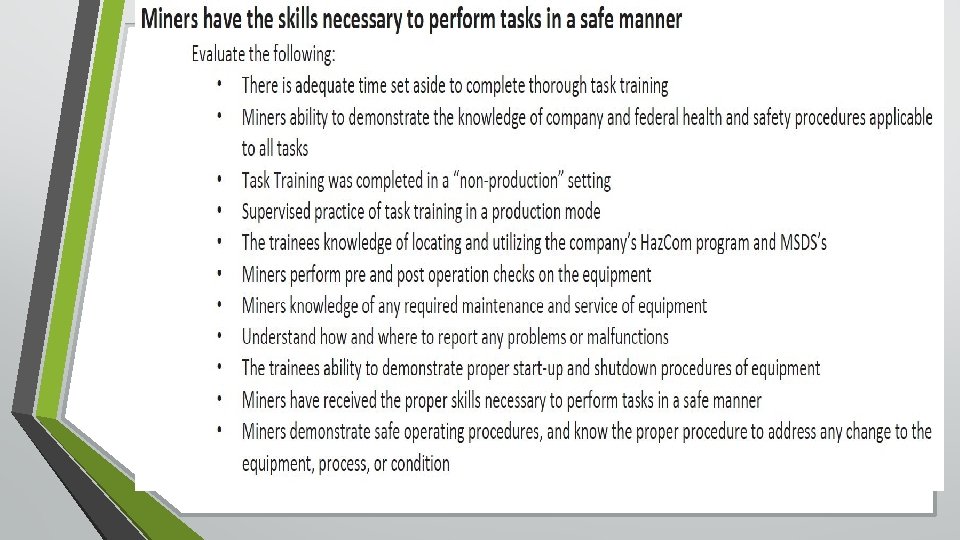
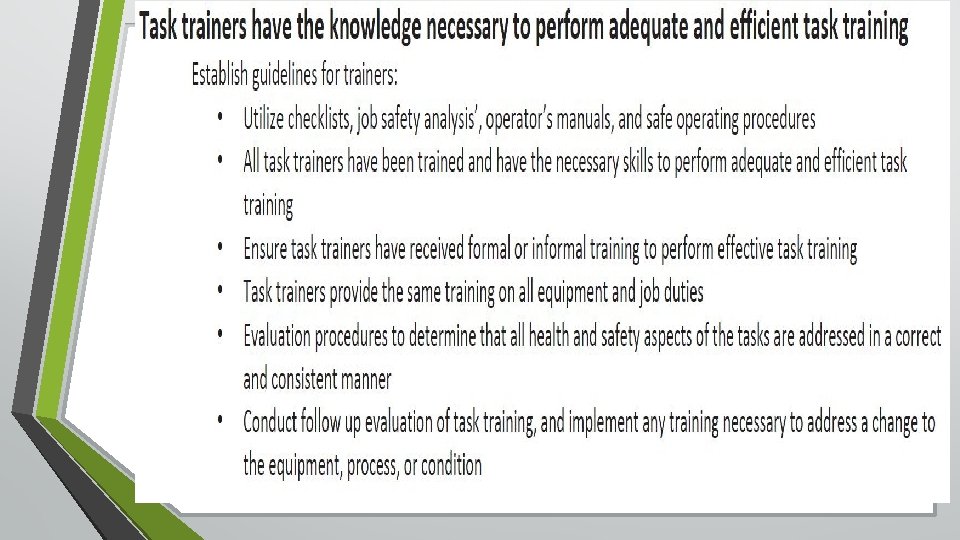




- Slides: 55
TASK TRAINING
WHY IS IT IMPORTANT TO DO PROPER TASK TRAINING !
STATE LAW One example of state law concerning task training is: 42. 10. 7 Equipment shall be operated only by persons trained in the use of and authorized to operate such equipment.
22 A-2 -12 b It is the duty of the mine foreman or the assistant mine foreman of every coal mine in this state to see that every person employed to work in the mine is, before beginning work therein, instructed in the particular danger incident to his or her work in the mine, and furnished a copy of the mining laws and rules of the mines. “Each miner in West Virginia has the right to work safely and to be properly trained on tasks to be performed in and around the mines. ”
FEDERAL LAW 30 CFR 48. 7 Training of Miners assigned to a Task in Which They Have Had No Previous Experience; Minimum Courses of Instruction.
“IF IT ISN’T DOCUMENTED IT ISN’T DONE”
The following Surface Fatals were directly connected to lack of training. Don’t forget that Lack of or Poor Training can contribute to injuries during the completion of All Tasks. Both on the Surface and Underground at Mining Operations.
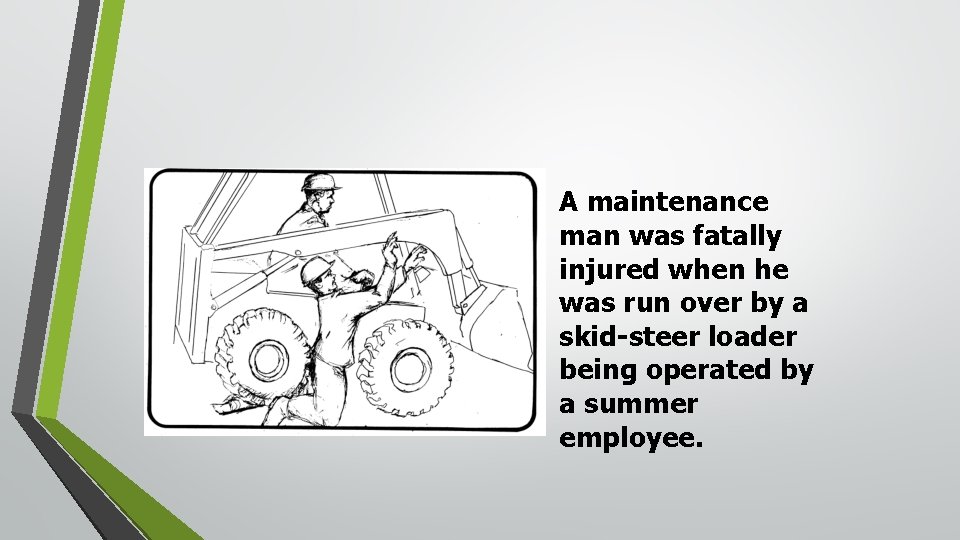
A maintenance man was fatally injured when he was run over by a skid-steer loader being operated by a summer employee.
• The maintenance man was directing the operator to cleanup spillage. • He turned to walk away from the loader, then turned and walked back toward the loader which was moving forward. • The victim stepped behind a column, causing the eye witness to momentarily lose sight of him.
• The witness then saw the victim being pulled down under the rear tire of the loader. • A 104(g)(1) order was issued because the mine operator failed to properly task train an employee on the safe operating procedures applicable to a new piece of equipment.
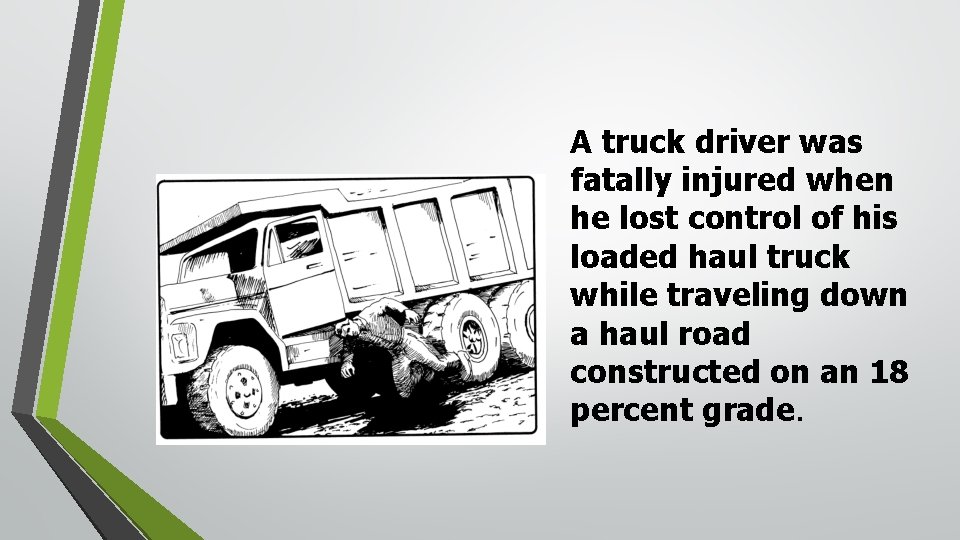
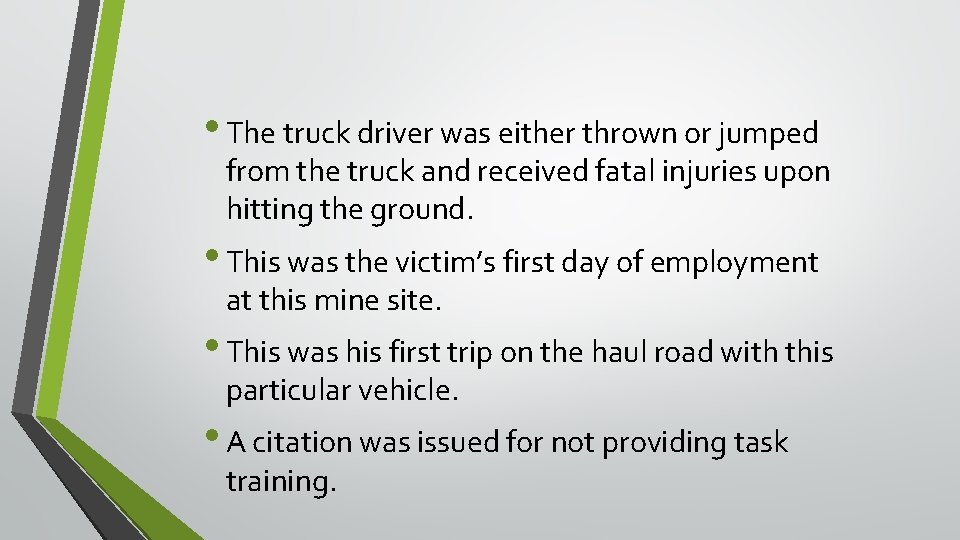
A truck driver was fatally injured when he lost control of his loaded haul truck while traveling down a haul road constructed on an 18 percent grade.
• The truck driver was either thrown or jumped from the truck and received fatal injuries upon hitting the ground. • This was the victim’s first day of employment at this mine site. • This was his first trip on the haul road with this particular vehicle. • A citation was issued for not providing task training.
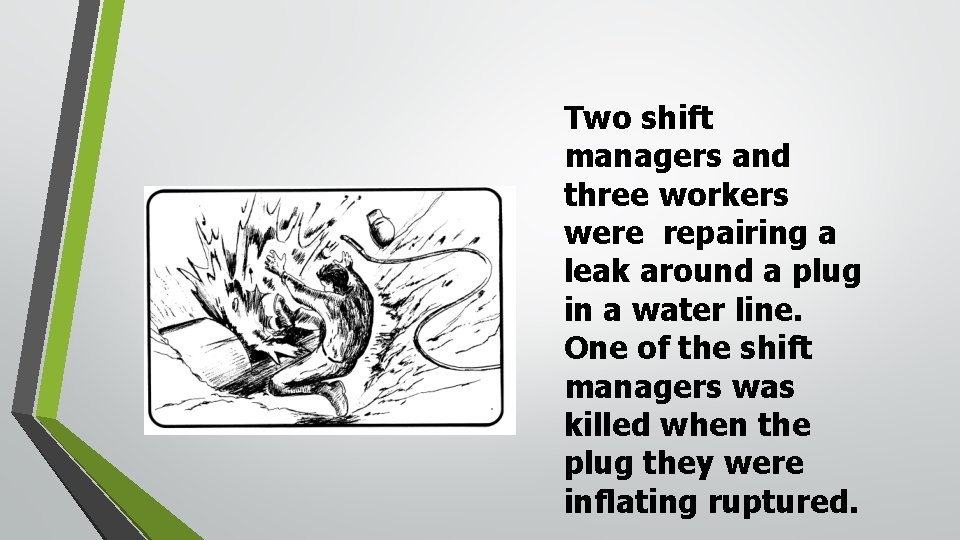
Two shift managers and three workers were repairing a leak around a plug in a water line. One of the shift managers was killed when the plug they were inflating ruptured.
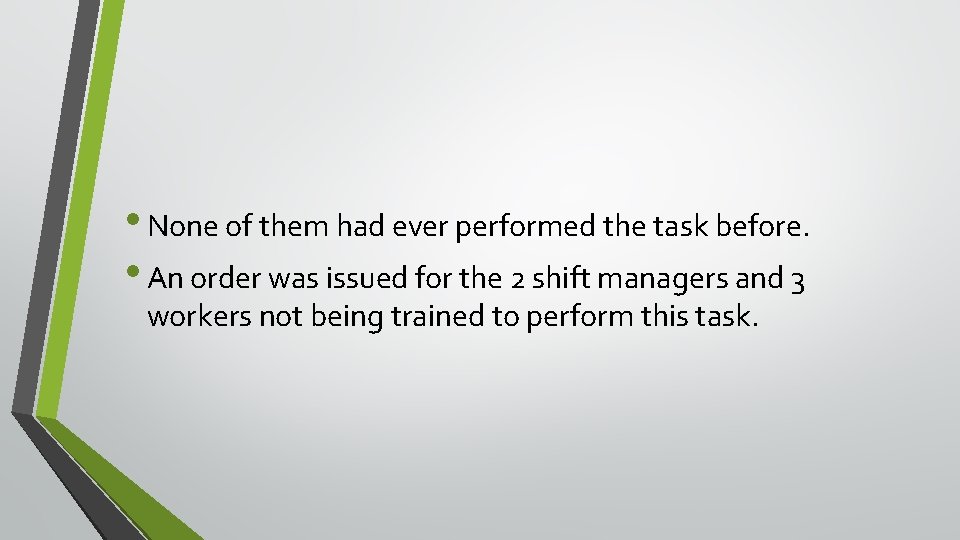
• None of them had ever performed the task before. • An order was issued for the 2 shift managers and 3 workers not being trained to perform this task.
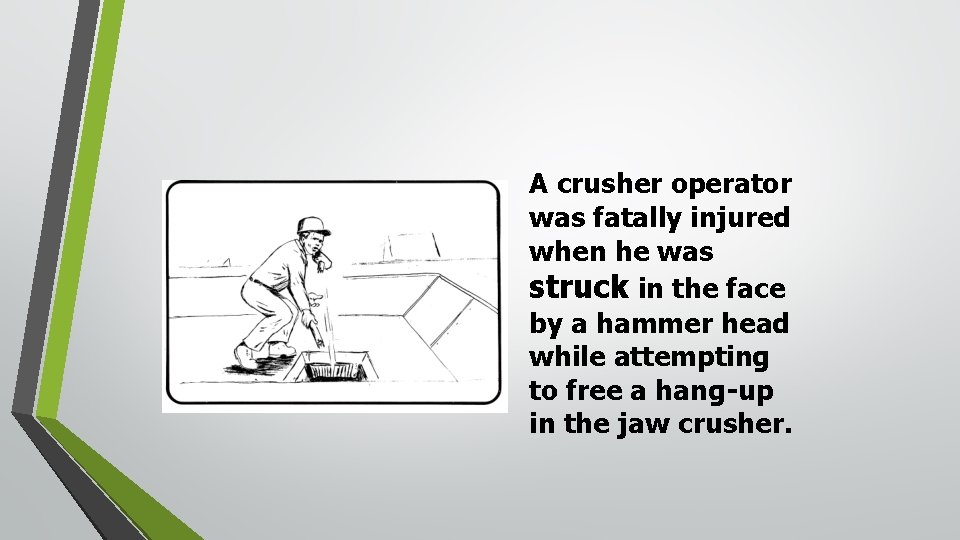
A crusher operator was fatally injured when he was struck in the face by a hammer head while attempting to free a hang-up in the jaw crusher.
• This was the victim’s first day on the job. • The investigation concluded that the company failed to indoctrinate the victim in safety rules and safe work procedures.
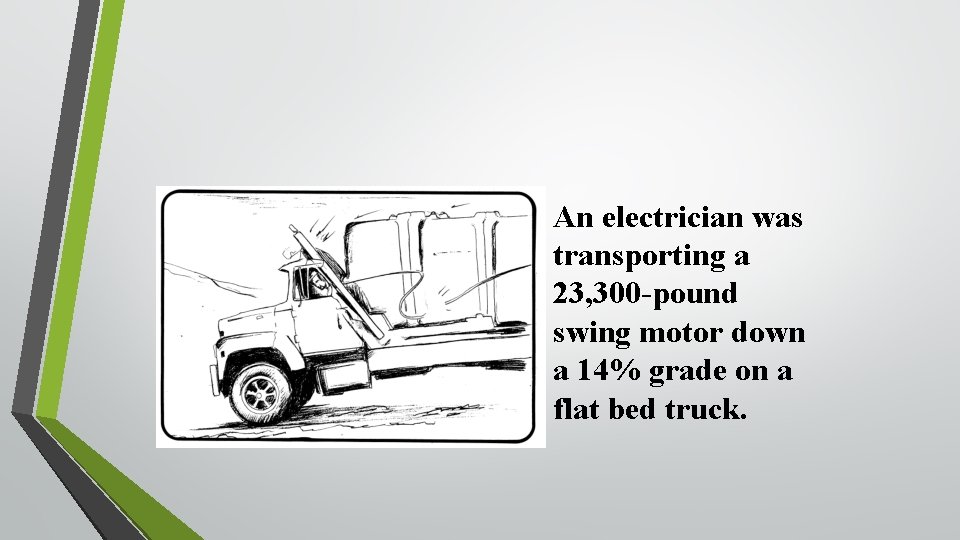
An electrician was transporting a 23, 300 -pound swing motor down a 14% grade on a flat bed truck.
• The 3/8 -inch chain securing the motor broke and forced a guard into the truck cab. • The driver was crushed against the steering wheel.
• The two electricians who loaded the motor had requested crane training, which included rigging instructions. • They did not receive the training. • A 104(d)(1) citation was issued for task training.
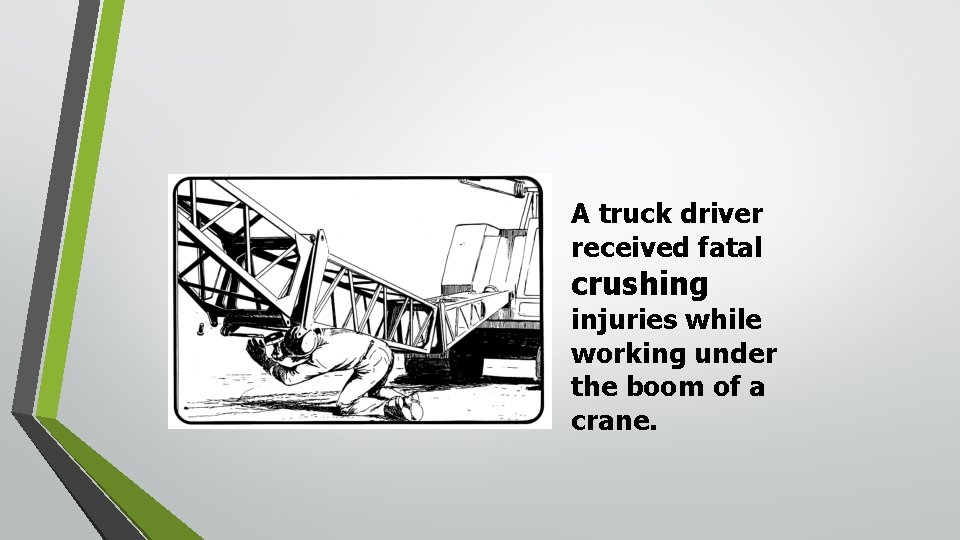
A truck driver received fatal crushing injuries while working under the boom of a crane.
• The victim and the crane operator were dismantling the boom before moving the crane to the shop. • The victim positioned himself under the boom to remove the bottom connecting pins from the first section of the boom mast.
• The boom was slightly elevated with only one crib block under the first section of the boom. • The victim was crushed between the first section of the boom and the ground when the boom buckled downward after the second bottom pin was removed.
• A 104(d)(1) citation was issued stating that the victim was not instructed in the safety and health aspects and safe work procedures of the task of dismantling the boom.
Environmental/Working Location Show trainees the dangers of the areas they are working in. • How steep is the grade? • What are the traffic patterns? • What are the haulage road conditions? • How bad are the roof/ground conditions? • How does the working height of the mine affect the performance of the job?
Environmental/Working Location • How do weather conditions affect the work place? • What health hazards are found in the environment/working location? • What are some other environmental /working location traps?
Equipment Train miners on new or modified equipment. • How do habits affect the actions of operators? • How does the size or type of equipment affect the operators ability to see? • How should an operator position equipment when performing a task
Equipment • What is the procedure for reporting and repairing defects? • What are some other equipment traps?
Procedural Show trainees the safe way of performing the task. • What hazards are associated with each step of the task? • When doing maintenance work, what safety precautions should be taken?
Procedural Show trainees the proper way to position themselves when performing a task. • Which direction should miners face when shoveling the belt? • Where should operators of remote-controlled equipment position themselves? • Where should miners avoid being when working around mobile equipment?
AVOID TASK TRAPS! Task train on: z. Environment/Working Location z. Equipment z. Procedures
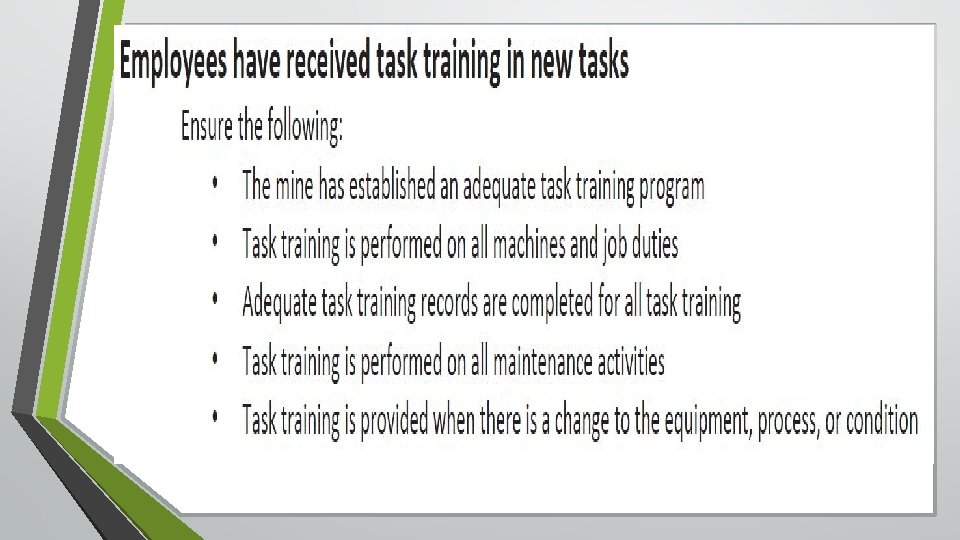
How do you prepare for task training? • Select someone to do the training who is qualified or experienced in the task. • Provide written instructions as supporting material for the training.
How do you prepare for task training? • A job safety analysis (JSA) provides a very strong foundation for task training. • The JSA concept is simple: • Select a task to be analyzed • Separate the task into its basic steps • Identify hazards associated with each step • Control each hazard
What does the law require? • 30 CFR 48. 7 requires task training for all miners in underground mines. • 30 CFR 48. 27 requires task training for all miners at surface mines and surface areas of underground mines.
Who is required to be task trained? (48. 7 and 48. 27) • Miners assigned to new work tasks as: • mobile equipment operators, • drilling machine operators, • haulage and conveyor system operators, • roof and ground control machine operators, and • those involved in blasting operations
Who is required to be task trained? (48. 7 and 48. 27) • Miners assigned to new work tasks not described in the previous paragraph must be instructed in the health and safety aspects and safe work procedures of the task. • Miners who have not performed a job or task for more than 12 months must be task trained.
Who is required to be task trained? (48. 7 and 48. 27) • Miners assigned to operate new or modified equipment or machines must be trained in safe operating procedures • Any miner who directs or controls haulage operations must receive training • safe haulage procedures related to the haulage system, ventilation system, firefighting procedures, and evacuation procedures
What is required in task training? (48. 7 and 48. 27) • Health and safety aspects and safe operating procedures for work tasks, equipment and machinery • Supervised practice during nonproduction • Supervised operation during production • Safe operating procedures for new or modified machines and equipment • Any other training required by the MSHA
What qualifications are required of the person conducting the training? • Under 48. 7 and 48. 27, the person must be a qualified trainer, a supervisor experienced in the assigned task, or other person experienced in the assigned task
What records are required for task training? (48. 9 & 48. 29) • Each time a person is task trained, it must be recorded on the certificate of training form, MSHA 5000 -23. • A copy of the training certificates must be given to the miner.
What records are required for task training? (48. 9 & 48. 29) • A copy of the training certificates of currently employed miners must be kept on file at the mine office for two years. • A copy of the training certificates of terminated miners must be kept on file at the mine office for 60 days after the termination.
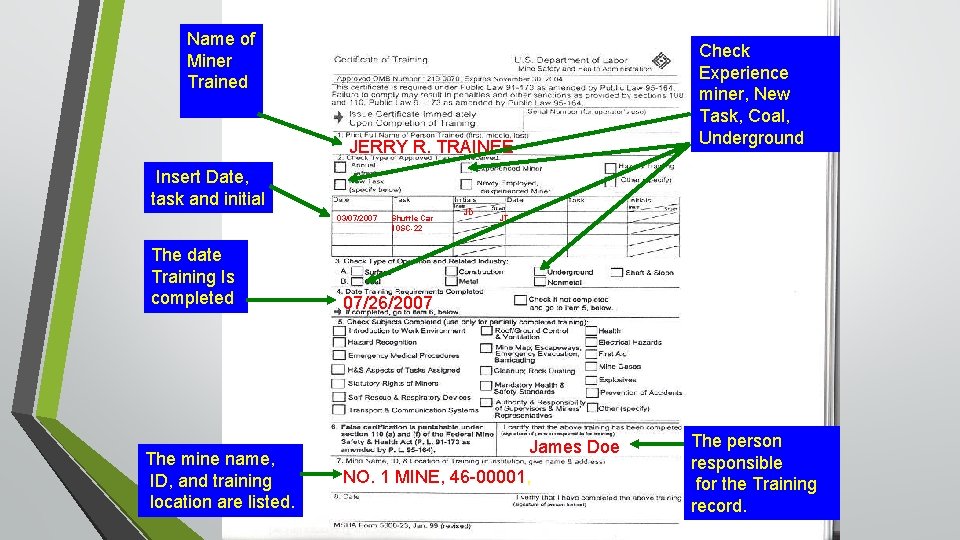
COMPLETING 5000 -23 FORM -- SCENARIO • An experience miner is hired at your underground No. 1 mine, I. D. 46 -00001 as a shuttle car operator. You have several models of Shuttle Cars at your operation, He will be operating a 10 SC-22. His last employment at a coal mine was October 2, 2005. His occupation was a continuous mining machine operator. You have conducted all the required training including task.
Name of Miner Trained Check Experience miner, New Task, Coal, Underground JERRY R. TRAINEE Insert Date, task and initial 03/07/2007 The date Training Is completed The mine name, ID, and training location are listed. Shuttle Car 10 SC-22 JD JT 07/26/2007 James Doe NO. 1 MINE, 46 -00001, The person responsible for the Training record.
Training for different Tasks. The miner needs to be trained in ALL Tasks performed. It has not been completed until the documentation has been completed. You can use this form for different tasks. The Trainer can write the date, task and both must initial the form. This will show that the training has been started. The TRAINER will only sign the form when the training has been completed. The Trainer must be competent and trained in the task training. Remember it may take a day, week or month to complete training for each task. The trainer must observe all aspects of the task being trained, to verify completion of training. Time will vary depending upon the experience of the trainee.
SURFACE HAZARD TRAINING The Training must be site specific for the location working at. The Trainer must be competent and trained in the task HE IS training. Don’t forget to cover the location of Safety Data Sheets and how to obtain information pertaining to Haz. Comm. You will need to check the other box and write reviewed Haz Comm Program.
Training for different Tasks. The miner needs to be trained in ALL Tasks performed. It has not been completed until the documentation has been completed. You can use this form for different tasks. The Trainer can write the date, task and both must initial the form. This will show that the training has been started. The TRAINER will only sign the form when the training has been completed. The Trainer must be competent and trained in the task training. Remember it may take a day, week or month to complete training for each task. The trainer must observe all aspects of the task being trained, to verify completion of training. Time will vary depending upon the experience of the trainee.
UNDERGROUND HAZARD TRAINING The Training must be site specific for the location working at. The Trainer must be competent and trained in the task HE IS training. Don’t forget to cover the location of Safety Data Sheets and how to obtain information pertaining to Haz. Comm. You will need to check the other box and write reviewed Haz Comm
How Good Are You At Training? 1. Divide Class into Four Groups. 2. Each Group Reduce to writing a Safe Work Procedure for making a pot of coffee. 3. Once you have a procedure, take turns training each group. 4. OPTIONAL – YOU CAN TRAIN ON ONE PIECE OF SPECIFIC MINE EQUIPMENT
Does Your Procedure Look Like The Following?