
Task The Divine Wind Consider the specific narrative
- Slides: 33
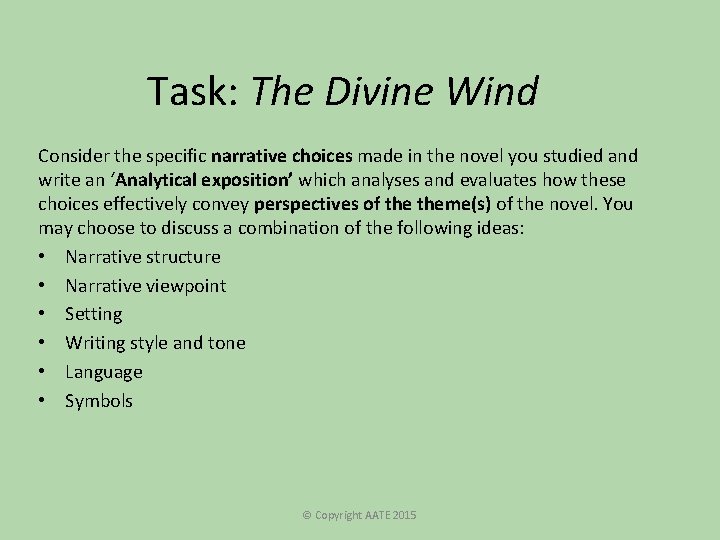
Task: The Divine Wind Consider the specific narrative choices made in the novel you studied and write an ‘Analytical exposition’ which analyses and evaluates how these choices effectively convey perspectives of theme(s) of the novel. You may choose to discuss a combination of the following ideas: • Narrative structure • Narrative viewpoint • Setting • Writing style and tone • Language • Symbols © Copyright AATE 2015
Planning your essay Underline or highlight the key phrases in the wording of the task to identify what topics you are being asked to consider and what tasks you have been set. The topics will be literary concepts that you need to understand the tasks will be signalled by the use of command verbs asking you to do something. © Copyright AATE 2015
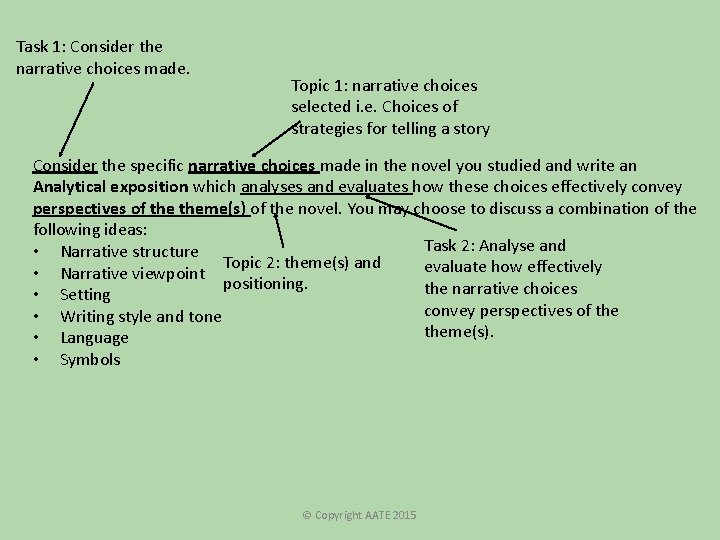
Task 1: Consider the narrative choices made. Topic 1: narrative choices selected i. e. Choices of strategies for telling a story Consider the specific narrative choices made in the novel you studied and write an Analytical exposition which analyses and evaluates how these choices effectively convey perspectives of theme(s) of the novel. You may choose to discuss a combination of the following ideas: Task 2: Analyse and • Narrative structure Topic 2: theme(s) and evaluate how effectively • Narrative viewpoint positioning. the narrative choices • Setting convey perspectives of the • Writing style and tone theme(s). • Language • Symbols © Copyright AATE 2015
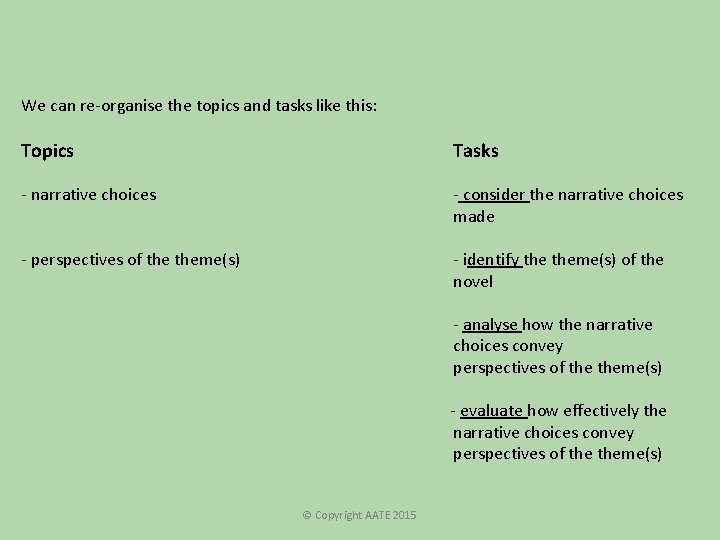
We can re-organise the topics and tasks like this: Topics Tasks - narrative choices - consider the narrative choices made - perspectives of theme(s) - identify theme(s) of the novel - analyse how the narrative choices convey perspectives of theme(s) - evaluate how effectively the narrative choices convey perspectives of theme(s) © Copyright AATE 2015
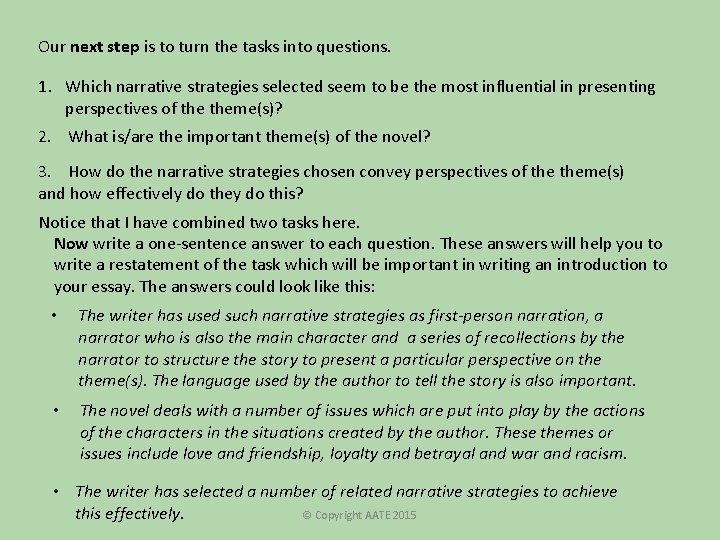
Our next step is to turn the tasks into questions. 1. Which narrative strategies selected seem to be the most influential in presenting perspectives of theme(s)? 2. What is/are the important theme(s) of the novel? 3. How do the narrative strategies chosen convey perspectives of theme(s) and how effectively do they do this? Notice that I have combined two tasks here. Now write a one-sentence answer to each question. These answers will help you to write a restatement of the task which will be important in writing an introduction to your essay. The answers could look like this: • The writer has used such narrative strategies as first-person narration, a narrator who is also the main character and a series of recollections by the narrator to structure the story to present a particular perspective on theme(s). The language used by the author to tell the story is also important. • The novel deals with a number of issues which are put into play by the actions of the characters in the situations created by the author. These themes or issues include love and friendship, loyalty and betrayal and war and racism. • The writer has selected a number of related narrative strategies to achieve this effectively. © Copyright AATE 2015
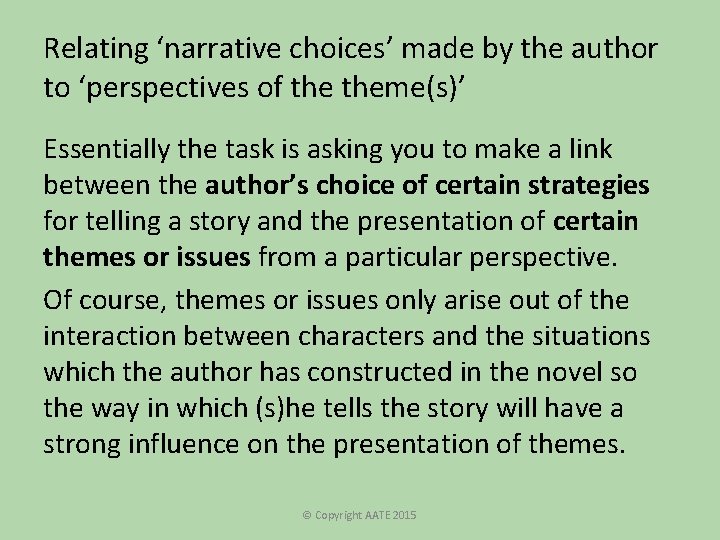
Relating ‘narrative choices’ made by the author to ‘perspectives of theme(s)’ Essentially the task is asking you to make a link between the author’s choice of certain strategies for telling a story and the presentation of certain themes or issues from a particular perspective. Of course, themes or issues only arise out of the interaction between characters and the situations which the author has constructed in the novel so the way in which (s)he tells the story will have a strong influence on the presentation of themes. © Copyright AATE 2015
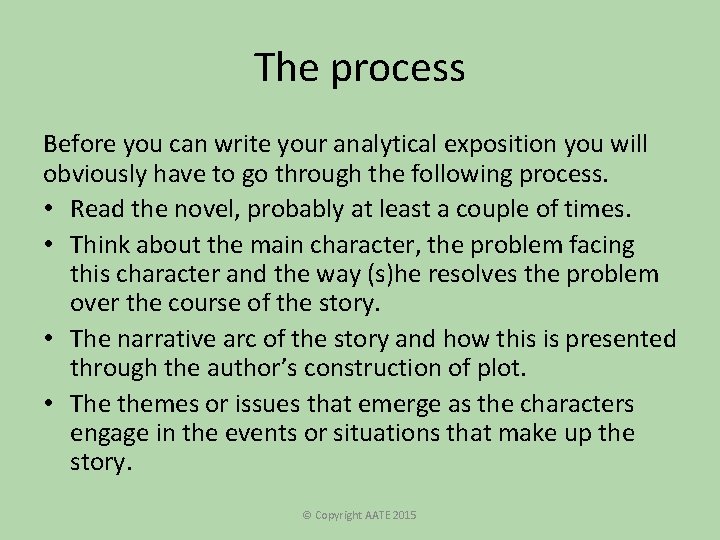
The process Before you can write your analytical exposition you will obviously have to go through the following process. • Read the novel, probably at least a couple of times. • Think about the main character, the problem facing this character and the way (s)he resolves the problem over the course of the story. • The narrative arc of the story and how this is presented through the author’s construction of plot. • The themes or issues that emerge as the characters engage in the events or situations that make up the story. © Copyright AATE 2015
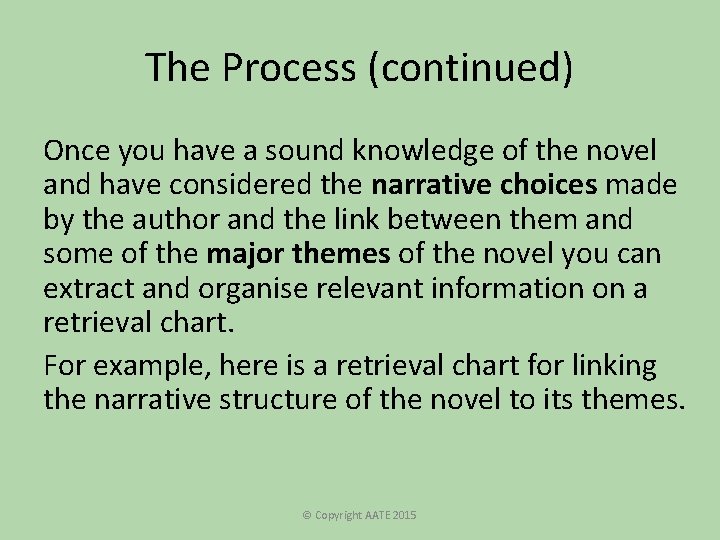
The Process (continued) Once you have a sound knowledge of the novel and have considered the narrative choices made by the author and the link between them and some of the major themes of the novel you can extract and organise relevant information on a retrieval chart. For example, here is a retrieval chart for linking the narrative structure of the novel to its themes. © Copyright AATE 2015
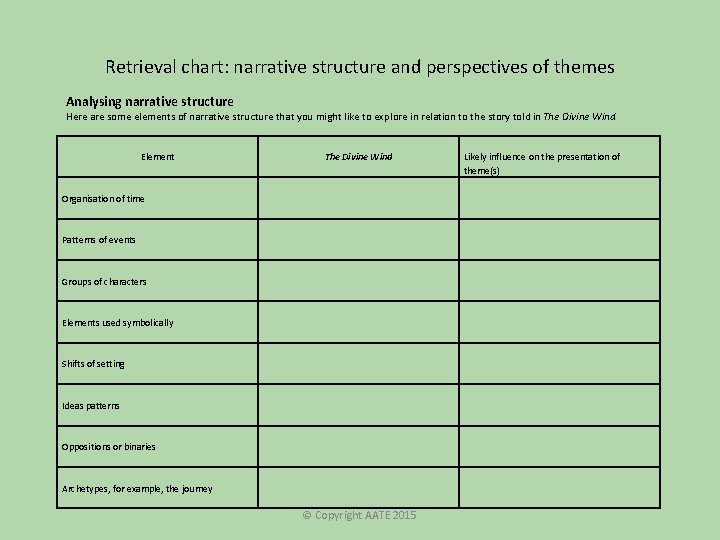
Retrieval chart: narrative structure and perspectives of themes Analysing narrative structure Here are some elements of narrative structure that you might like to explore in relation to the story told in The Divine Wind Likely influence on the presentation of theme(s) Element Organisation of time Patterns of events Groups of characters Elements used symbolically Shifts of setting Ideas patterns Oppositions or binaries Archetypes, for example, the journey The Divine Wind © Copyright AATE 2015
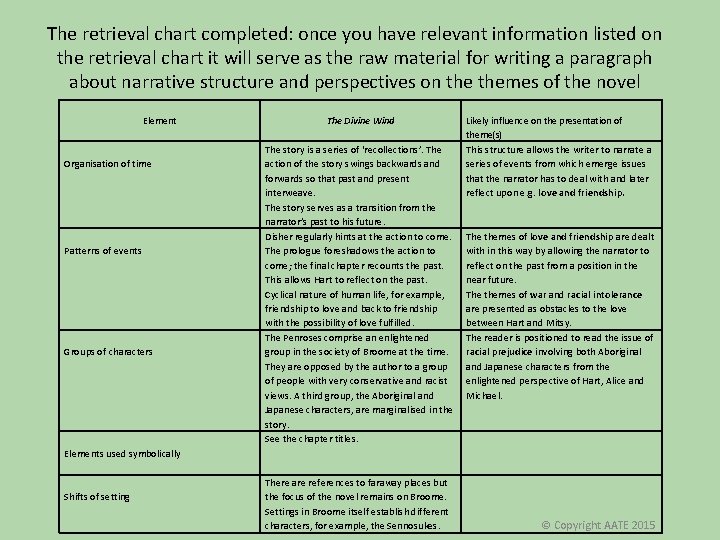
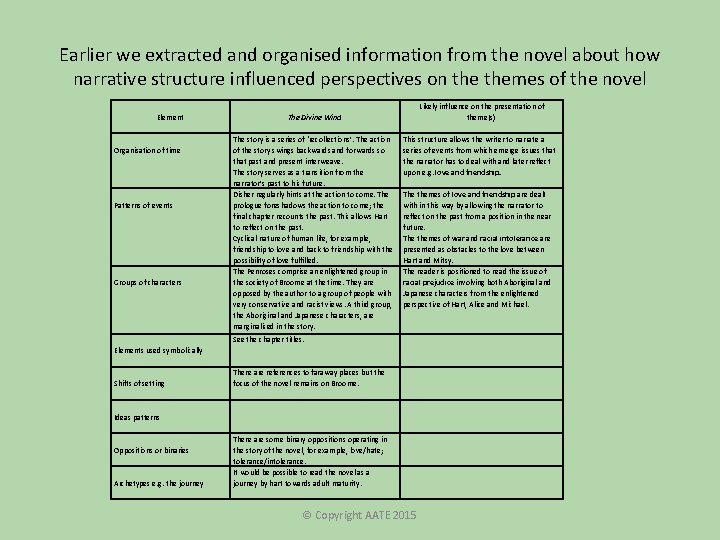
The retrieval chart completed: once you have relevant information listed on the retrieval chart it will serve as the raw material for writing a paragraph about narrative structure and perspectives on themes of the novel Element Organisation of time Patterns of events Groups of characters Elements used symbolically Shifts of setting The Divine Wind Likely influence on the presentation of theme(s) The story is a series of ‘recollections’. The action of the story swings backwards and forwards so that past and present interweave. The story serves as a transition from the narrator’s past to his future. Disher regularly hints at the action to come. The prologue foreshadows the action to come; the final chapter recounts the past. This allows Hart to reflect on the past. Cyclical nature of human life, for example, friendship to love and back to friendship with the possibility of love fulfilled. The Penroses comprise an enlightened group in the society of Broome at the time. They are opposed by the author to a group of people with very conservative and racist views. A third group, the Aboriginal and Japanese characters, are marginalised in the story. See the chapter titles. This structure allows the writer to narrate a series of events from which emerge issues that the narrator has to deal with and later reflect upon e. g. love and friendship. There are references to faraway places but the focus of the novel remains on Broome. Settings in Broome itself establish different characters, for example, the Sennosukes. The themes of love and friendship are dealt with in this way by allowing the narrator to reflect on the past from a position in the near future. The themes of war and racial intolerance are presented as obstacles to the love between Hart and Mitsy. The reader is positioned to read the issue of racial prejudice involving both Aboriginal and Japanese characters from the enlightened perspective of Hart, Alice and Michael. © Copyright AATE 2015
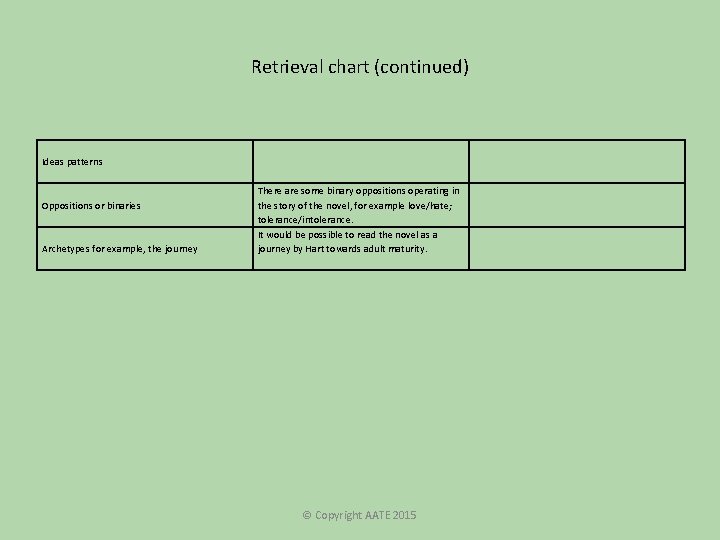
Retrieval chart (continued) Ideas patterns Oppositions or binaries Archetypes for example, the journey There are some binary oppositions operating in the story of the novel, for example love/hate; tolerance/intolerance. It would be possible to read the novel as a journey by Hart towards adult maturity. © Copyright AATE 2015
Planning and writing the analytical exposition Now that you have completed the process of reading and thinking about the novel and extracted and organised relevant information about the novel according to the requirements of the task you can start to think about writing a first draft of your analytical exposition. © Copyright AATE 2015
Planning an analytical exposition: the introduction • • • Introduction: Restatement: Explanation: Argument: Comment/opinion: (optional) © Copyright AATE 2015
Where to begin A good place to begin with this analytical exposition is to think about the central problem or difficulty of the main character who is also the narrator. This can help us in formulating a thesis for our writing. Here is a possible way of doing this. © Copyright AATE 2015
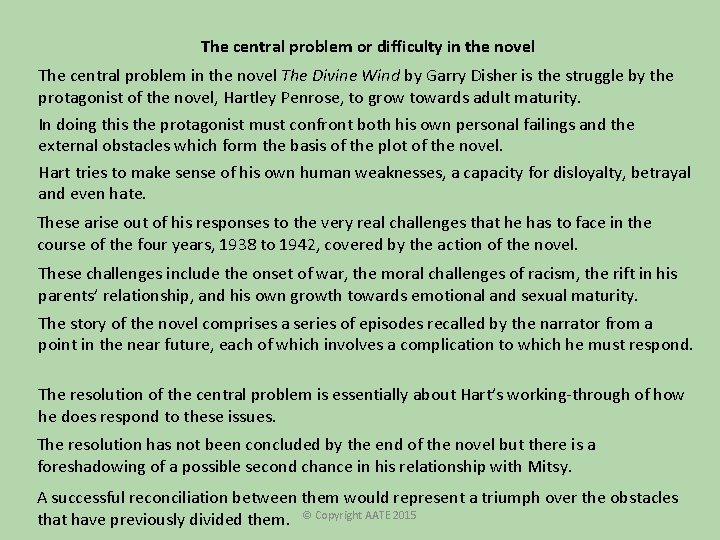
The central problem or difficulty in the novel The central problem in the novel The Divine Wind by Garry Disher is the struggle by the protagonist of the novel, Hartley Penrose, to grow towards adult maturity. In doing this the protagonist must confront both his own personal failings and the external obstacles which form the basis of the plot of the novel. Hart tries to make sense of his own human weaknesses, a capacity for disloyalty, betrayal and even hate. These arise out of his responses to the very real challenges that he has to face in the course of the four years, 1938 to 1942, covered by the action of the novel. These challenges include the onset of war, the moral challenges of racism, the rift in his parents’ relationship, and his own growth towards emotional and sexual maturity. The story of the novel comprises a series of episodes recalled by the narrator from a point in the near future, each of which involves a complication to which he must respond. The resolution of the central problem is essentially about Hart’s working-through of how he does respond to these issues. The resolution has not been concluded by the end of the novel but there is a foreshadowing of a possible second chance in his relationship with Mitsy. A successful reconciliation between them would represent a triumph over the obstacles that have previously divided them. © Copyright AATE 2015
From central problem to essay thesis Now that we have defined the central problem of the novel we can use this to write a thesis for our analytical exposition. © Copyright AATE 2015
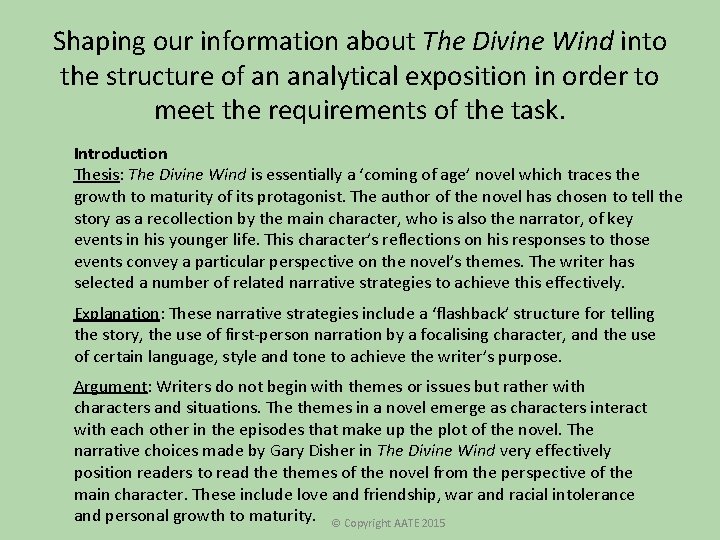
Shaping our information about The Divine Wind into the structure of an analytical exposition in order to meet the requirements of the task. Introduction Thesis: The Divine Wind is essentially a ‘coming of age’ novel which traces the growth to maturity of its protagonist. The author of the novel has chosen to tell the story as a recollection by the main character, who is also the narrator, of key events in his younger life. This character’s reflections on his responses to those events convey a particular perspective on the novel’s themes. The writer has selected a number of related narrative strategies to achieve this effectively. Explanation: These narrative strategies include a ‘flashback’ structure for telling the story, the use of first-person narration by a focalising character, and the use of certain language, style and tone to achieve the writer’s purpose. Argument: Writers do not begin with themes or issues but rather with characters and situations. The themes in a novel emerge as characters interact with each other in the episodes that make up the plot of the novel. The narrative choices made by Gary Disher in The Divine Wind very effectively position readers to read themes of the novel from the perspective of the main character. These include love and friendship, war and racial intolerance and personal growth to maturity. © Copyright AATE 2015
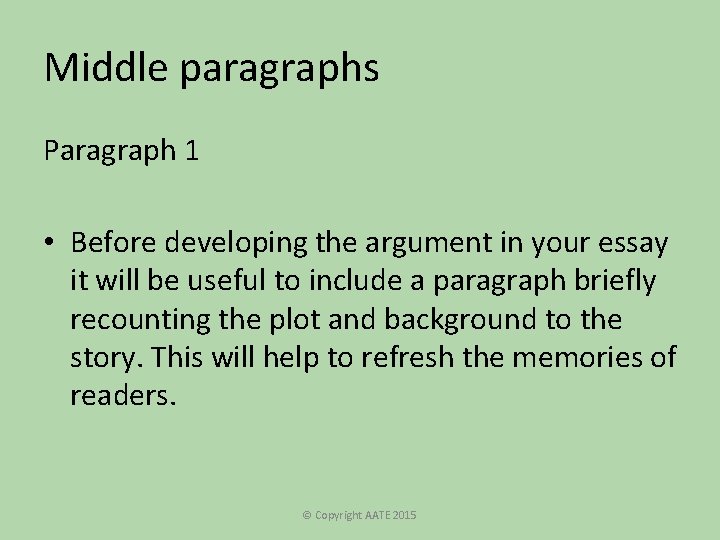
Middle paragraphs Paragraph 1 • Before developing the argument in your essay it will be useful to include a paragraph briefly recounting the plot and background to the story. This will help to refresh the memories of readers. © Copyright AATE 2015
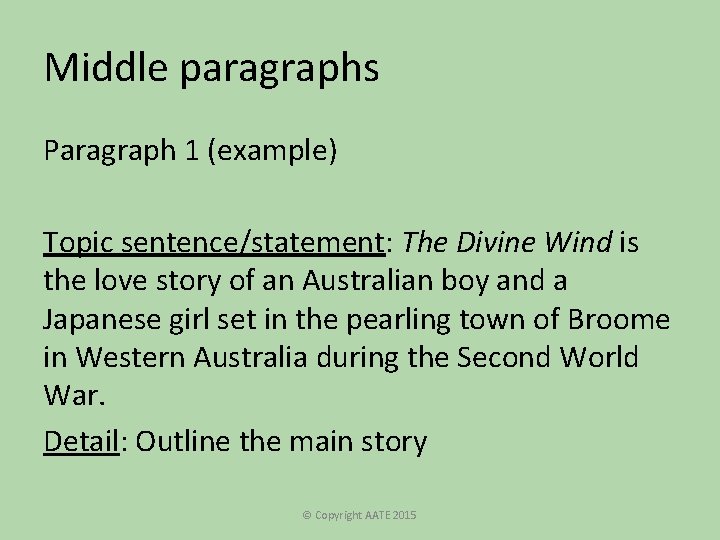
Middle paragraphs Paragraph 1 (example) Topic sentence/statement: The Divine Wind is the love story of an Australian boy and a Japanese girl set in the pearling town of Broome in Western Australia during the Second World War. Detail: Outline the main story © Copyright AATE 2015
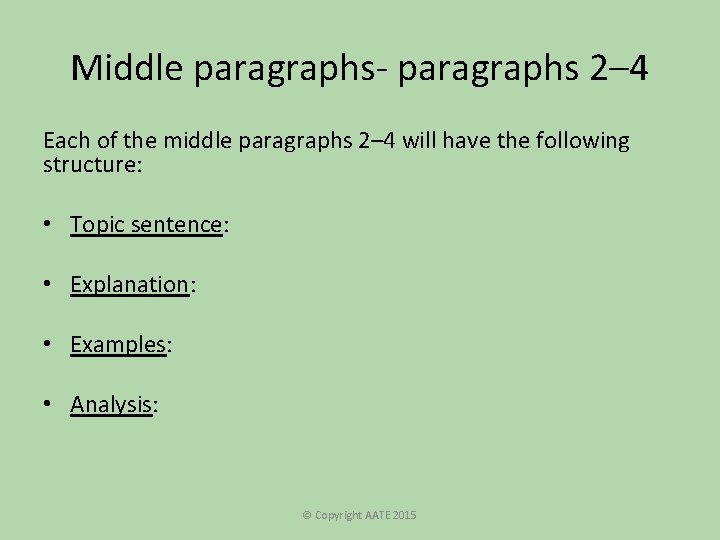
Middle paragraphs- paragraphs 2– 4 Each of the middle paragraphs 2– 4 will have the following structure: • Topic sentence: • Explanation: • Examples: • Analysis: © Copyright AATE 2015
Earlier we extracted and organised information from the novel about how narrative structure influenced perspectives on themes of the novel Element Organisation of time Patterns of events Groups of characters Elements used symbolically Shifts of setting Ideas patterns Oppositions or binaries Archetypes e. g. the journey Likely influence on the presentation of theme(s) The Divine Wind The story is a series of ‘recollections’. The action of the story swings backwards and forwards so that past and present interweave. The story serves as a transition from the narrator’s past to his future. Disher regularly hints at the action to come. The prologue foreshadows the action to come; the final chapter recounts the past. This allows Hart to reflect on the past. Cyclical nature of human life, for example, friendship to love and back to friendship with the possibility of love fulfilled. The Penroses comprise an enlightened group in the society of Broome at the time. They are opposed by the author to a group of people with very conservative and racist views. A third group, the Aboriginal and Japanese characters, are marginalised in the story. This structure allows the writer to narrate a series of events from which emerge issues that the narrator has to deal with and later reflect upon e. g. love and friendship. See the chapter titles. There are references to faraway places but the focus of the novel remains on Broome. There are some binary oppositions operating in the story of the novel, for example, love/hate; tolerance/intolerance. It would be possible to read the novel as a journey by hart towards adult maturity. The themes of love and friendship are dealt with in this way by allowing the narrator to reflect on the past from a position in the near future. The themes of war and racial intolerance are presented as obstacles to the love between Hart and Mitsy. The reader is positioned to read the issue of racial prejudice involving both Aboriginal and Japanese characters from the enlightened perspective of Hart, Alice and Michael. © Copyright AATE 2015
Turning your information into a paragraph The second paragraph in the body of your exposition should deal with how the narrative structure of the novel has positioned readers to read themes of the novel from certain perspectives. © Copyright AATE 2015
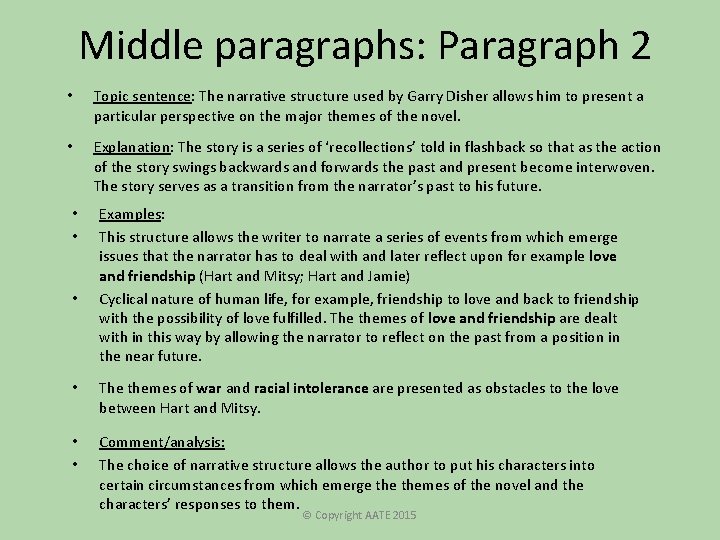
Middle paragraphs: Paragraph 2 • Topic sentence: The narrative structure used by Garry Disher allows him to present a particular perspective on the major themes of the novel. • Explanation: The story is a series of ‘recollections’ told in flashback so that as the action of the story swings backwards and forwards the past and present become interwoven. The story serves as a transition from the narrator’s past to his future. • • • Examples: This structure allows the writer to narrate a series of events from which emerge issues that the narrator has to deal with and later reflect upon for example love and friendship (Hart and Mitsy; Hart and Jamie) Cyclical nature of human life, for example, friendship to love and back to friendship with the possibility of love fulfilled. The themes of love and friendship are dealt with in this way by allowing the narrator to reflect on the past from a position in the near future. • The themes of war and racial intolerance are presented as obstacles to the love between Hart and Mitsy. • • Comment/analysis: The choice of narrative structure allows the author to put his characters into certain circumstances from which emerge themes of the novel and the characters’ responses to them. © Copyright AATE 2015
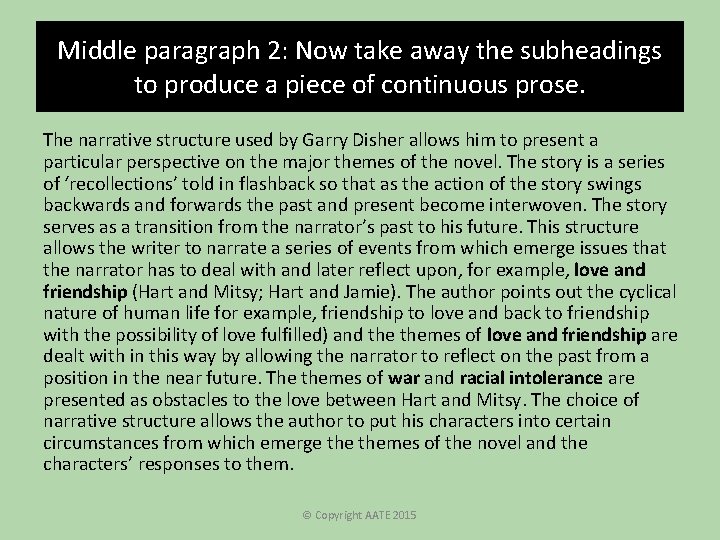
Middle paragraph 2: Now take away the subheadings to produce a piece of continuous prose. The narrative structure used by Garry Disher allows him to present a particular perspective on the major themes of the novel. The story is a series of ‘recollections’ told in flashback so that as the action of the story swings backwards and forwards the past and present become interwoven. The story serves as a transition from the narrator’s past to his future. This structure allows the writer to narrate a series of events from which emerge issues that the narrator has to deal with and later reflect upon, for example, love and friendship (Hart and Mitsy; Hart and Jamie). The author points out the cyclical nature of human life for example, friendship to love and back to friendship with the possibility of love fulfilled) and themes of love and friendship are dealt with in this way by allowing the narrator to reflect on the past from a position in the near future. The themes of war and racial intolerance are presented as obstacles to the love between Hart and Mitsy. The choice of narrative structure allows the author to put his characters into certain circumstances from which emerge themes of the novel and the characters’ responses to them. © Copyright AATE 2015
Information to middle paragraph 3 Next you can use the information about how narrative viewpoint influences perspectives on themes to write the next paragraph in the body of your exposition. Here is the retrieval chart for narrative point of view: © Copyright AATE 2015
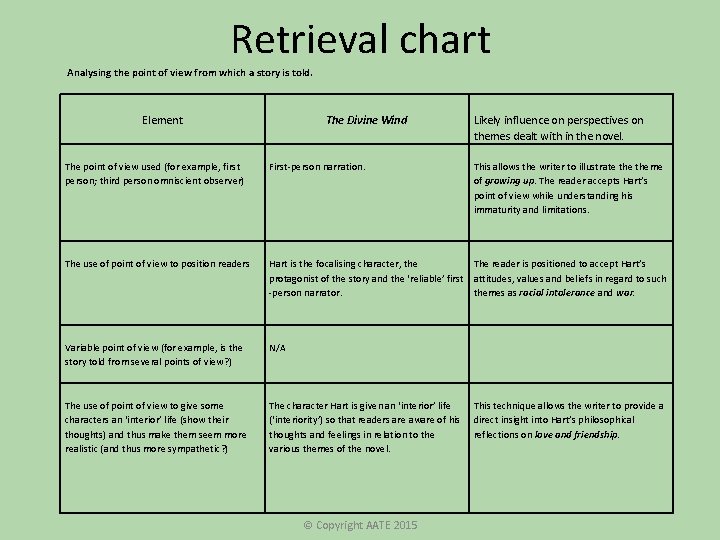
Retrieval chart Analysing the point of view from which a story is told. Element The Divine Wind Likely influence on perspectives on themes dealt with in the novel. The point of view used (for example, first person; third person omniscient observer) First-person narration. This allows the writer to illustrate theme of growing up. The reader accepts Hart’s point of view while understanding his immaturity and limitations. The use of point of view to position readers Hart is the focalising character, the protagonist of the story and the ‘reliable’ first -person narrator. The reader is positioned to accept Hart’s attitudes, values and beliefs in regard to such themes as racial intolerance and war. Variable point of view (for example, is the story told from several points of view? ) The use of point of view to give some characters an ‘interior’ life (show their thoughts) and thus make them seem more realistic (and thus more sympathetic? ) N/A The character Hart is given an ‘interior’ life (‘interiority’) so that readers are aware of his thoughts and feelings in relation to the various themes of the novel. This technique allows the writer to provide a direct insight into Hart’s philosophical reflections on love and friendship. © Copyright AATE 2015
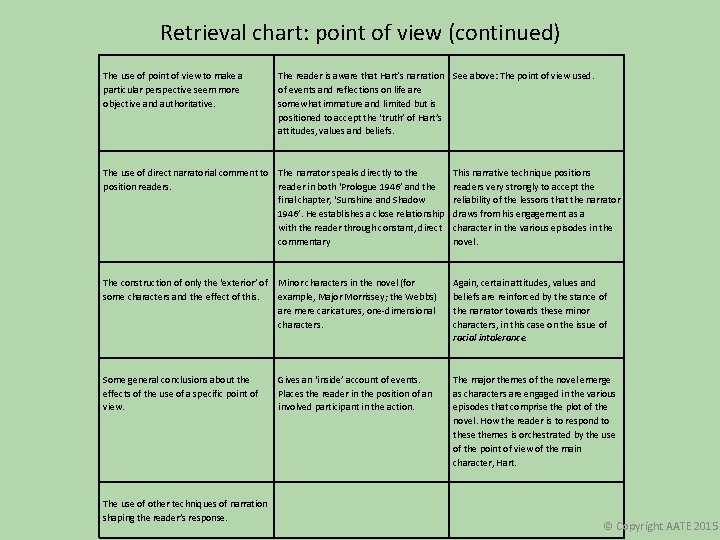
Retrieval chart: point of view (continued) The use of point of view to make a particular perspective seem more objective and authoritative. The reader is aware that Hart’s narration of events and reflections on life are somewhat immature and limited but is positioned to accept the ‘truth’ of Hart’s attitudes, values and beliefs. The use of direct narratorial comment to The narrator speaks directly to the position readers. reader in both ‘Prologue 1946’ and the final chapter, ‘Sunshine and Shadow 1946’. He establishes a close relationship with the reader through constant, direct commentary The construction of only the ‘exterior’ of Minor characters in the novel (for some characters and the effect of this. example, Major Morrissey; the Webbs) are mere caricatures, one-dimensional characters. Some general conclusions about the effects of the use of a specific point of view. Gives an ‘inside’ account of events. Places the reader in the position of an involved participant in the action. The use of other techniques of narration shaping the reader’s response. See above: The point of view used. This narrative technique positions readers very strongly to accept the reliability of the lessons that the narrator draws from his engagement as a character in the various episodes in the novel. Again, certain attitudes, values and beliefs are reinforced by the stance of the narrator towards these minor characters, in this case on the issue of racial intolerance. The major themes of the novel emerge as characters are engaged in the various episodes that comprise the plot of the novel. How the reader is to respond to these themes is orchestrated by the use of the point of view of the main character, Hart. © Copyright AATE 2015
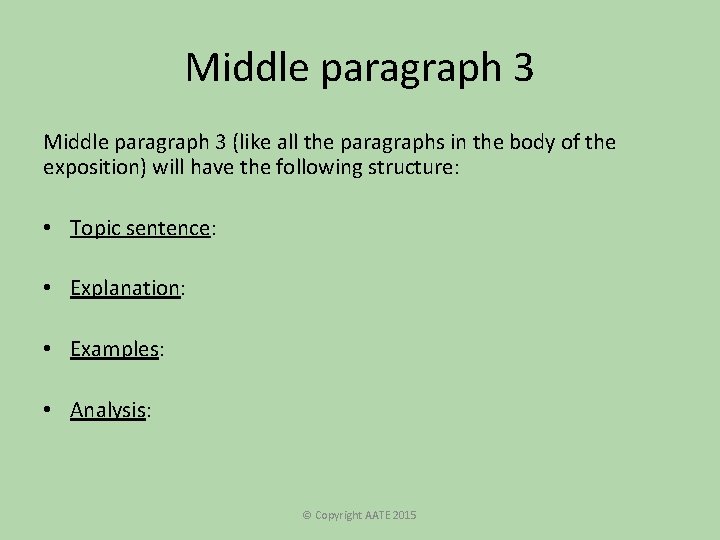
Middle paragraph 3 (like all the paragraphs in the body of the exposition) will have the following structure: • Topic sentence: • Explanation: • Examples: • Analysis: © Copyright AATE 2015
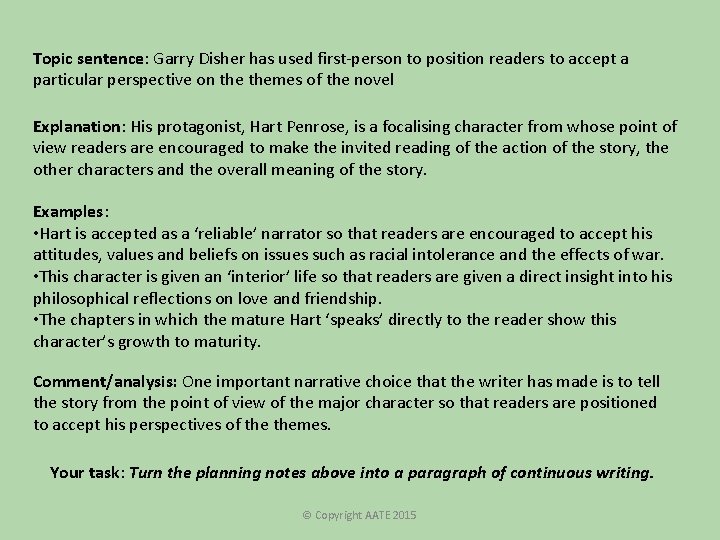
Topic sentence: Garry Disher has used first-person to position readers to accept a particular perspective on themes of the novel Explanation: His protagonist, Hart Penrose, is a focalising character from whose point of view readers are encouraged to make the invited reading of the action of the story, the other characters and the overall meaning of the story. Examples: • Hart is accepted as a ‘reliable’ narrator so that readers are encouraged to accept his attitudes, values and beliefs on issues such as racial intolerance and the effects of war. • This character is given an ‘interior’ life so that readers are given a direct insight into his philosophical reflections on love and friendship. • The chapters in which the mature Hart ‘speaks’ directly to the reader show this character’s growth to maturity. Comment/analysis: One important narrative choice that the writer has made is to tell the story from the point of view of the major character so that readers are positioned to accept his perspectives of themes. Your task: Turn the planning notes above into a paragraph of continuous writing. © Copyright AATE 2015
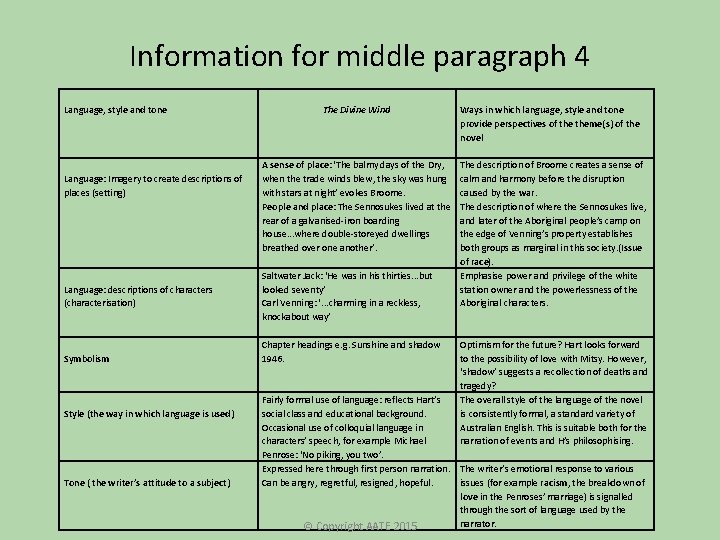
Information for middle paragraph 4 Language, style and tone Language: Imagery to create descriptions of places (setting) Language: descriptions of characters (characterisation) Symbolism Style (the way in which language is used) Tone ( the writer’s attitude to a subject) The Divine Wind Ways in which language, style and tone provide perspectives of theme(s) of the novel A sense of place: ‘The balmy days of the Dry, The description of Broome creates a sense of when the trade winds blew, the sky was hung calm and harmony before the disruption with stars at night’ evokes Broome. caused by the war. People and place: The Sennosukes lived at the The description of where the Sennosukes live, rear of a galvanised-iron boarding and later of the Aboriginal people’s camp on house. . . where double-storeyed dwellings the edge of Venning’s property establishes breathed over one another’. both groups as marginal in this society. (Issue of race). Saltwater Jack: ‘He was in his thirties. . . but Emphasise power and privilege of the white looked seventy’ station owner and the powerlessness of the Carl Venning: ‘. . . charming in a reckless, Aboriginal characters. knockabout way’ Chapter headings e. g. Sunshine and shadow 1946. Optimism for the future? Hart looks forward to the possibility of love with Mitsy. However, ‘shadow’ suggests a recollection of deaths and tragedy? The overall style of the language of the novel is consistently formal, a standard variety of Australian English. This is suitable both for the narration of events and H’s philosophising. Fairly formal use of language: reflects Hart’s social class and educational background. Occasional use of colloquial language in characters’ speech, for example Michael Penrose: ‘No piking, you two’. Expressed here through first person narration. The writer’s emotional response to various Can be angry, regretful, resigned, hopeful. issues (for example racism, the breakdown of love in the Penroses’ marriage) is signalled through the sort of language used by the narrator. © Copyright AATE 2015
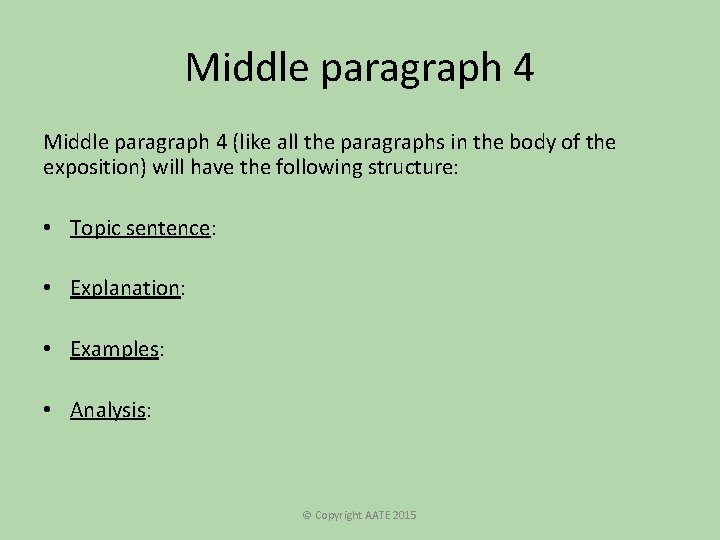
Middle paragraph 4 (like all the paragraphs in the body of the exposition) will have the following structure: • Topic sentence: • Explanation: • Examples: • Analysis: © Copyright AATE 2015
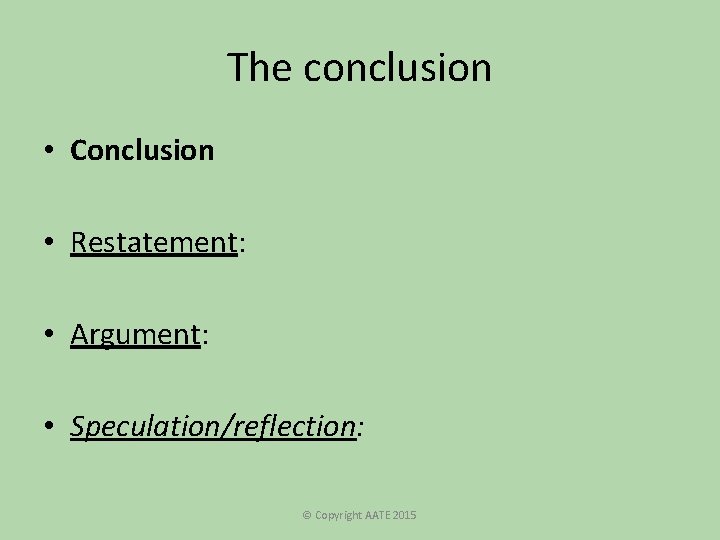
The conclusion • Conclusion • Restatement: • Argument: • Speculation/reflection: © Copyright AATE 2015
The conclusion Conclusion: Restatement of thesis: The author has chosen some related narrative strategies to present a particular perspective on themes of the novel, especially the major theme, the protagonist’s growth towards mature self-knowledge and wisdom. Argument: Such strategies as first-person story-telling, structuring the story as a series of recollections and giving readers access to the thoughts and feelings of the narrator position them effectively to accept the particular perspective offered on the novel’s themes. © Copyright AATE 2015