
Task Level Parallelism in MPI PIPE TSP PIPE

![PIPE: Sequential Program for( i=0; i<num_pic, read(in_pic); i++ ) { int_pic_1[i] = trans 1(](https://slidetodoc.com/presentation_image_h2/92f4a3043c9ff14b3a2e40f877509794/image-2.jpg "PIPE: Sequential Program for( i=0; i<num_pic, read(in_pic); i++ ) { int_pic_1[i] = trans 1(")
![PIPE: MPI Parallel Program P 0: for( i=0; i<num_pics, read(in_pic); i++ ) { int_pic_1[i]](https://slidetodoc.com/presentation_image_h2/92f4a3043c9ff14b3a2e40f877509794/image-4.jpg "PIPE: MPI Parallel Program P 0: for( i=0; i<num_pics, read(in_pic); i++ ) { int_pic_1[i]")






- Slides: 31
Task Level Parallelism in MPI • PIPE • TSP
PIPE: Sequential Program for( i=0; i<num_pic, read(in_pic); i++ ) { int_pic_1[i] = trans 1( in_pic ); int_pic_2[i] = trans 2( int_pic_1[i] ); int_pic_3[i] = trans 3( int_pic_2[i] ); out_pic[i] = trans 4( int_pic_3[i] ); }
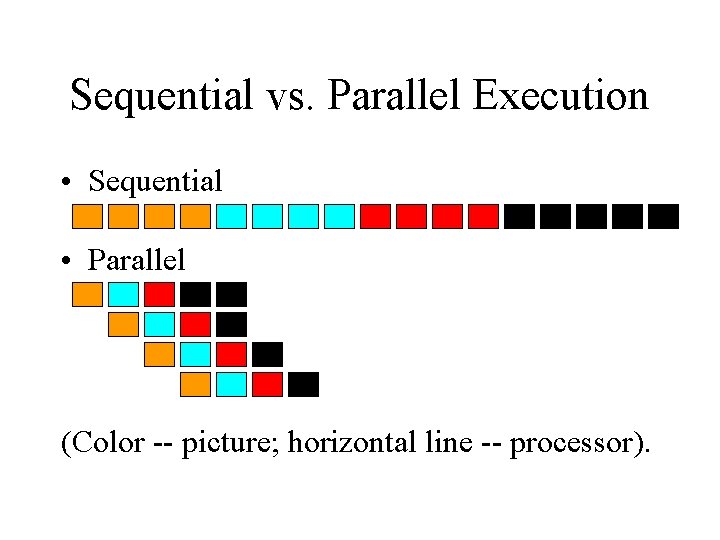
Sequential vs. Parallel Execution • Sequential • Parallel (Color -- picture; horizontal line -- processor).
PIPE: MPI Parallel Program P 0: for( i=0; i<num_pics, read(in_pic); i++ ) { int_pic_1[i] = trans 1( in_pic ); MPI_Send( int_pic_1[i], n, MPI_INT, 1, tag, comm ); } P 1: for( i=0; i<num_pics; i++ ) { MPI_Recv(int_pic_1[i], n, MPI_INT, tag, comm, &stat); int_pic_2[i] = trans 2( int_pic_1[i] ); MPI_Send( int_pic_2[i], n, MPI_INT, 1, tag, comm ); }
Another Sequential Program for( i=0; i<num_pic, read(in_pic); i++ ) { int_pic_1 = trans 1( in_pic ); int_pic_2 = trans 2( int_pic_1); int_pic_3 = trans 3( int_pic_2); out_pic[i] = trans 4( int_pic_3); }
Why This Change? • Anti-dependences on int_pic_1 between P 0 and P 1, etc. , prevent parallelization. • Remember: anti-dependences do not matter in message passing programs. • Reason: the processes do not share memory, thus no worry that P 0 overwrites what P 1 still has to read.
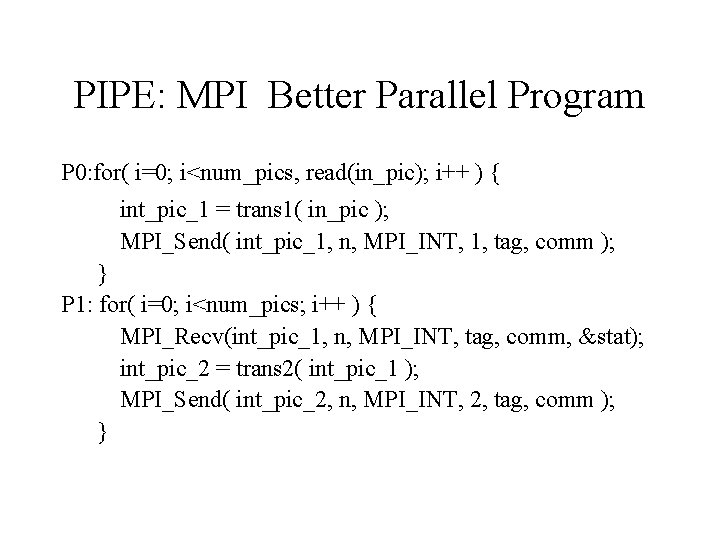
PIPE: MPI Better Parallel Program P 0: for( i=0; i<num_pics, read(in_pic); i++ ) { int_pic_1 = trans 1( in_pic ); MPI_Send( int_pic_1, n, MPI_INT, 1, tag, comm ); } P 1: for( i=0; i<num_pics; i++ ) { MPI_Recv(int_pic_1, n, MPI_INT, tag, comm, &stat); int_pic_2 = trans 2( int_pic_1 ); MPI_Send( int_pic_2, n, MPI_INT, 2, tag, comm ); }
A Look Underneath • The memory usage is not necessarily decreased in the program. • The buffers now appear inside the message passing library, rather than in the program.
TSP: Sequential Program init_q(); init_best(); while( (p=de_queue()) != NULL ) { for each expansion by one city { q = add_city(p); if( complete(q) ) { update_best(q) }; else { en_queue(q) }; } }
Parallel TSP: Possibilities • Have each process do one expansion. • Have each process do expansion of one partial path. • Have each process do expansion of multiple partial paths. • Issue of granularity/performance, not an issue of correctness.
TSP: MPI Program Structure • Have a coordinator/worker scheme: – Coordinator maintains shared data structures (priority queue and current best path). – Workers expand one partial path at a time. • Sometimes also called client/server: – Workers/clients issue requests. – Coordinator/server responds to requests.
TSP: MPI Main Program main() { MPI_Init(); MPI_Comm_rank( comm, &myrank ); MPI_Comm_size ( comm, &p); /* Read input and distribute */ if( myrank == 0 ) Coordinator(); else Worker(); MPI_Finalize(); }
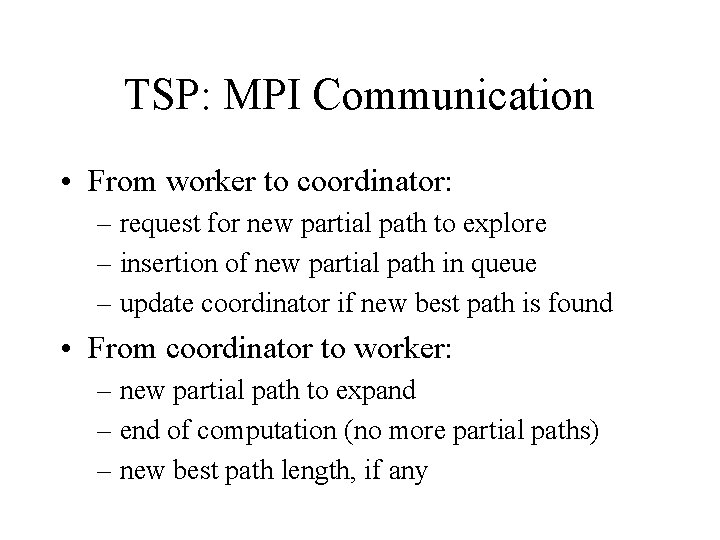
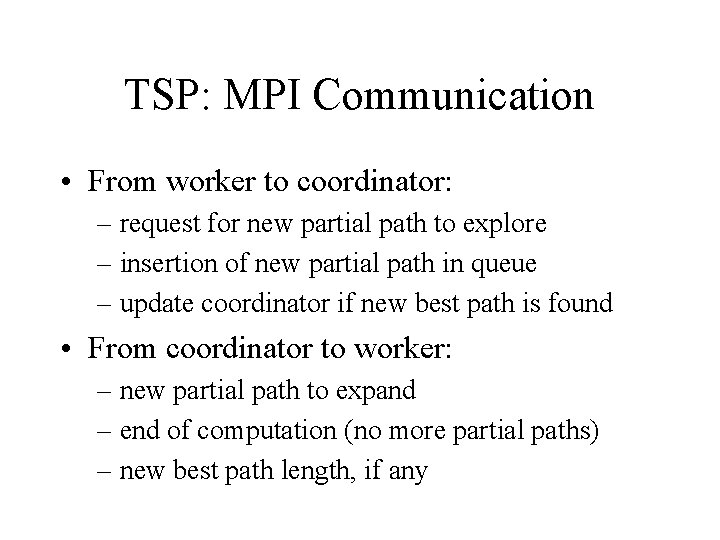
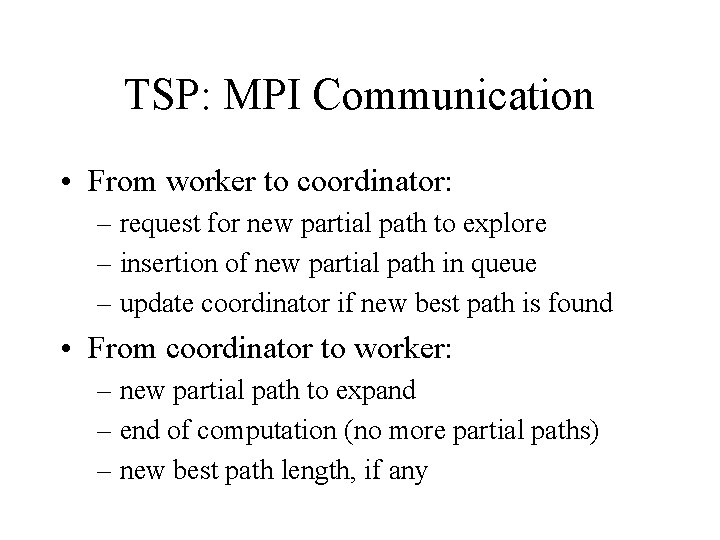
TSP: MPI Communication • From worker to coordinator: – request for new partial path to explore – insertion of new partial path in queue – update coordinator if new best path is found • From coordinator to worker: – new partial path to expand – end of computation (no more partial paths) – new best path length, if any
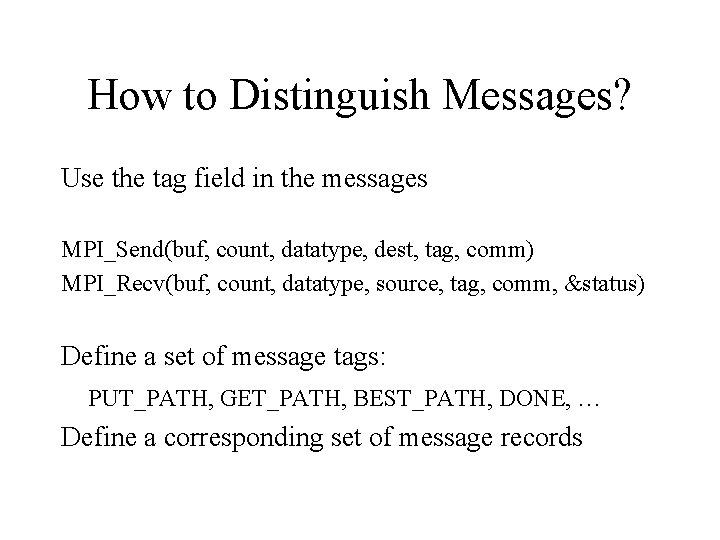
How to Distinguish Messages? Use the tag field in the messages MPI_Send(buf, count, datatype, dest, tag, comm) MPI_Recv(buf, count, datatype, source, tag, comm, &status) Define a set of message tags: PUT_PATH, GET_PATH, BEST_PATH, DONE, … Define a corresponding set of message records
More on status in MPI_Recv() • Status is a record with fields – MPI_SOURCE – MPI_TAG • Thus, on a MPI_Recv(), when you specify MPI_ANY_TAG, MPI_ANY_SOURCE, you can find out the tag and the source from the status field.
TSP: MPI Communication • From worker to coordinator: – request for new partial path to explore – insertion of new partial path in queue – update coordinator if new best path is found • From coordinator to worker: – new partial path to expand – end of computation (no more partial paths) – new best path length, if any
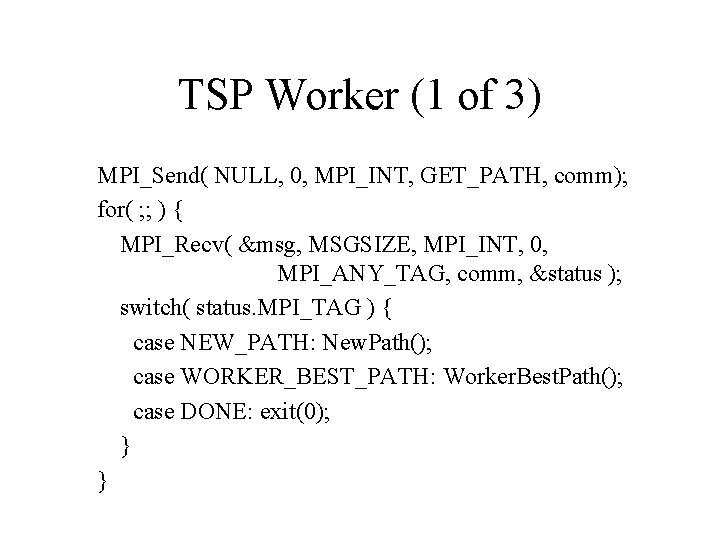
TSP Worker (1 of 3) MPI_Send( NULL, 0, MPI_INT, GET_PATH, comm); for( ; ; ) { MPI_Recv( &msg, MSGSIZE, MPI_INT, 0, MPI_ANY_TAG, comm, &status ); switch( status. MPI_TAG ) { case NEW_PATH: New. Path(); case WORKER_BEST_PATH: Worker. Best. Path(); case DONE: exit(0); } }
TSP Worker (2 of 3) Worker. Best. Path() { update bestlength; }
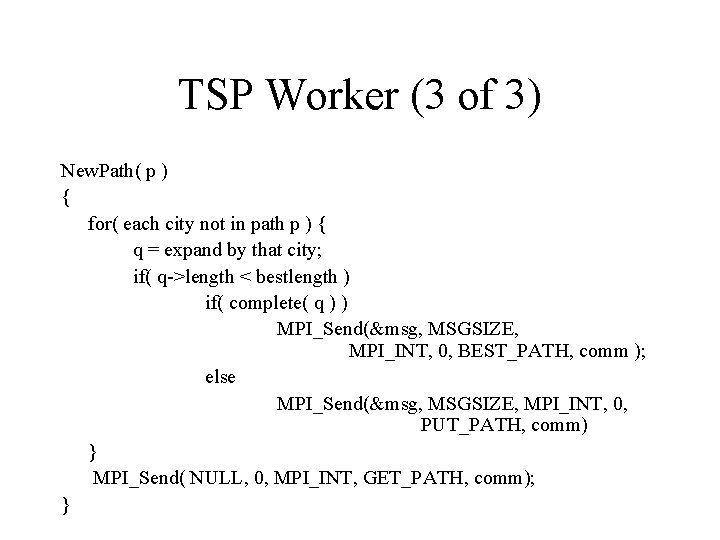
TSP Worker (3 of 3) New. Path( p ) { for( each city not in path p ) { q = expand by that city; if( q->length < bestlength ) if( complete( q ) ) MPI_Send(&msg, MSGSIZE, MPI_INT, 0, BEST_PATH, comm ); else MPI_Send(&msg, MSGSIZE, MPI_INT, 0, PUT_PATH, comm) } MPI_Send( NULL, 0, MPI_INT, GET_PATH, comm); }
TSP: MPI Communication • From worker to coordinator: – request for new partial path to explore – insertion of new partial path in queue – update coordinator if new best path is found • From coordinator to worker: – new partial path to expand – end of computation (no more partial paths) – new best path length, if any
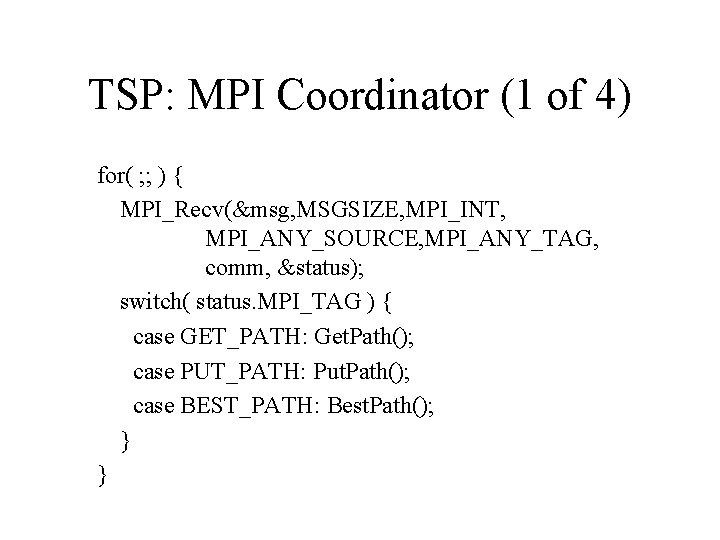
TSP: MPI Coordinator (1 of 4) for( ; ; ) { MPI_Recv(&msg, MSGSIZE, MPI_INT, MPI_ANY_SOURCE, MPI_ANY_TAG, comm, &status); switch( status. MPI_TAG ) { case GET_PATH: Get. Path(); case PUT_PATH: Put. Path(); case BEST_PATH: Best. Path(); } }
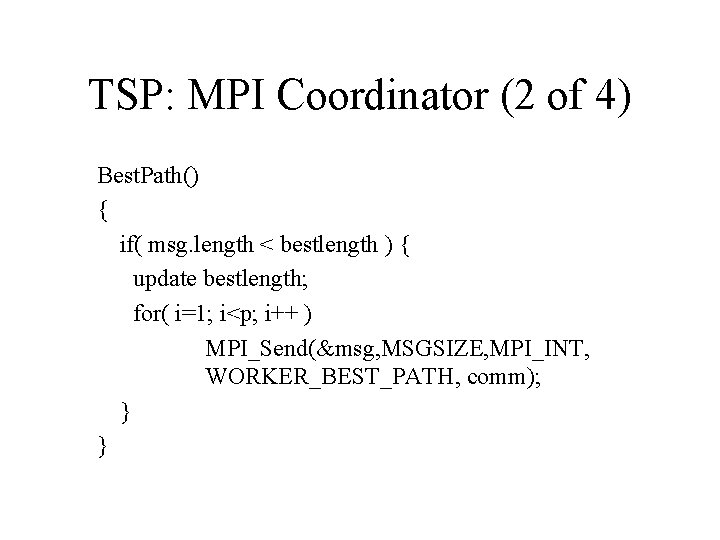
TSP: MPI Coordinator (2 of 4) Best. Path() { if( msg. length < bestlength ) { update bestlength; for( i=1; i<p; i++ ) MPI_Send(&msg, MSGSIZE, MPI_INT, WORKER_BEST_PATH, comm); } }
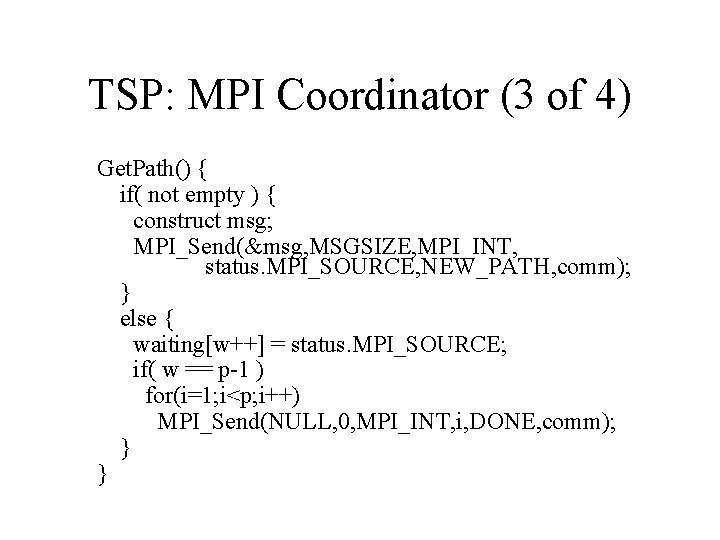
TSP: MPI Coordinator (3 of 4) Get. Path() { if( not empty ) { construct msg; MPI_Send(&msg, MSGSIZE, MPI_INT, status. MPI_SOURCE, NEW_PATH, comm); } else { waiting[w++] = status. MPI_SOURCE; if( w == p-1 ) for(i=1; i<p; i++) MPI_Send(NULL, 0, MPI_INT, i, DONE, comm); } }
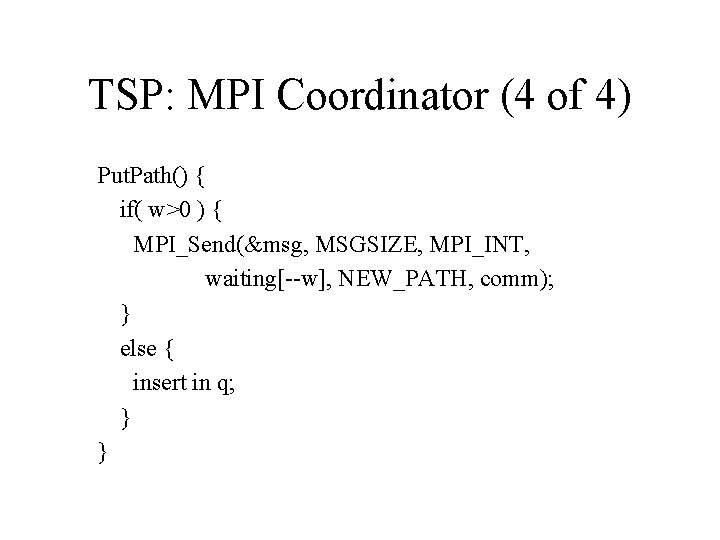
TSP: MPI Coordinator (4 of 4) Put. Path() { if( w>0 ) { MPI_Send(&msg, MSGSIZE, MPI_INT, waiting[--w], NEW_PATH, comm); } else { insert in q; } }
A Problem with This Solution • The coordinator does nothing else than maintaining shared state (updating it, and responding to queries about it). • It is possible to have the coordinator perform computation through the MPI asynchronous communication facility.
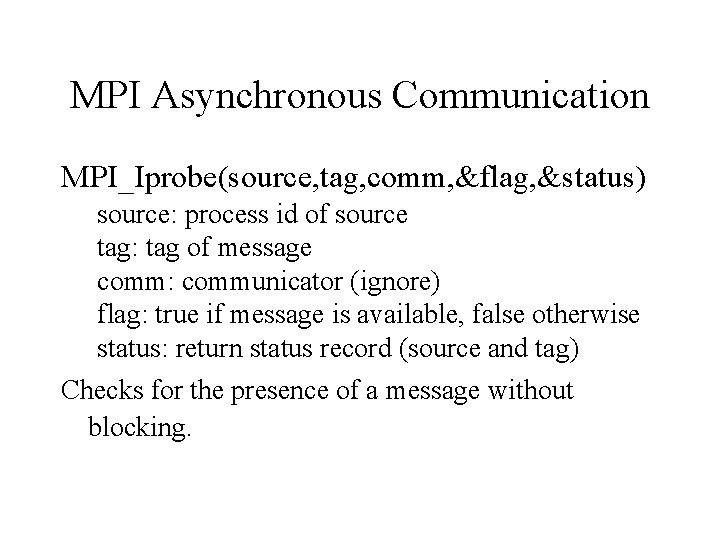
MPI Asynchronous Communication MPI_Iprobe(source, tag, comm, &flag, &status) source: process id of source tag: tag of message comm: communicator (ignore) flag: true if message is available, false otherwise status: return status record (source and tag) Checks for the presence of a message without blocking.
TSP: Revised Coordinator for( ; ; ) { flag = true; for( ; flag; ) { MPI_Iprobe(MPI_ANY_SOURCE, MPI_ANY_TAG, comm, &flag, &status); if( flag ) { MPI_Recv(&msg, MSGSIZE, MPI_INT, MPI_ANY_SOURCE, MPI_ANY_TAG, comm, &status); switch( status. MPI_TAG ) { … } } } remove next partial path from queue as in worker }
Remarks about This Solution • Not guaranteed to be an improvement. • If coordinator was mostly idle, this structure will improve performance. • If coordinator was the bottleneck, this structure will make performance worse. • Asynchronous communication tends to make programs complicated.
More Comments on Solution • Solution requires lots of messages. • Number of messages is often primary overhead factor. • Message aggregation: combining multiple messages in one.
A Bit of Perspective • Which one is easier, shared memory or message passing? • This has been the subject of a raging feud for the last ten years or so.
Views on the Issue • Shared memory: often easier to write and easier to get correct – data structures can be left unchanged – can parallelize the program incrementally • Message passing: sometimes easier to get good performance – Communication is explicit (you can count the number of messages, the amount of data, etc. )