
Task Dependence in Scheduling and Load Balancing Prof
Task Dependence in Scheduling and Load Balancing Prof. Adam Meyerson UCLA
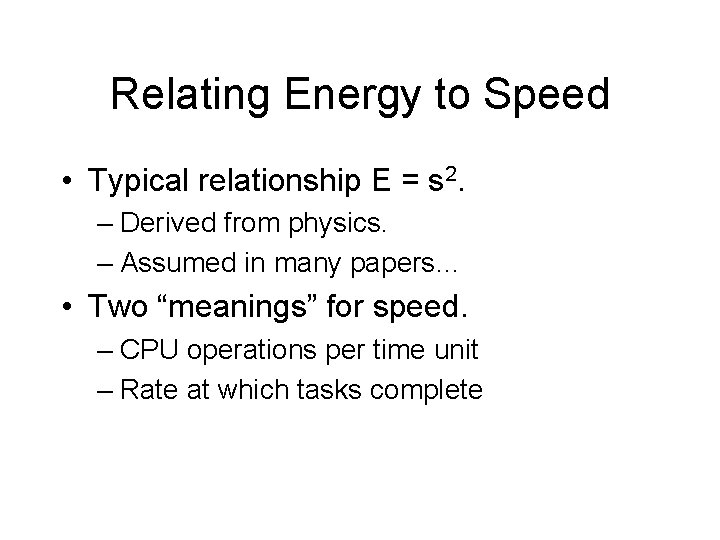
Relating Energy to Speed • Typical relationship E = s 2. – Derived from physics. – Assumed in many papers… • Two “meanings” for speed. – CPU operations per time unit – Rate at which tasks complete
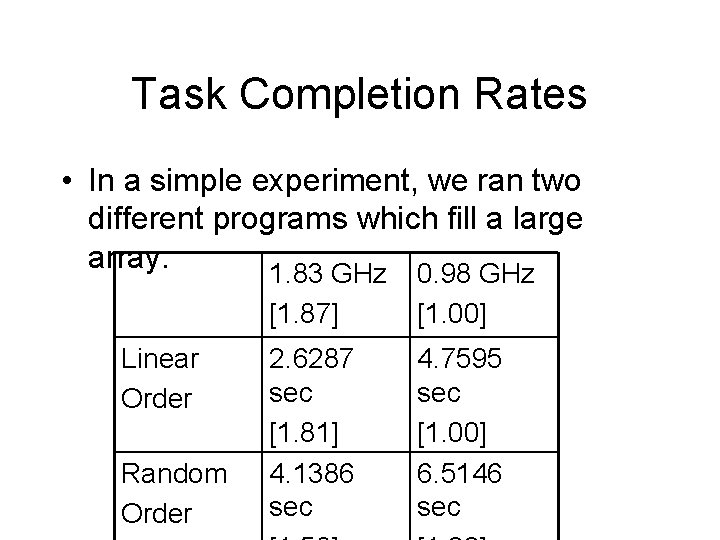
Task Completion Rates • In a simple experiment, we ran two different programs which fill a large array. 1. 83 GHz 0. 98 GHz Linear Order Random Order [1. 87] [1. 00] 2. 6287 sec [1. 81] 4. 1386 sec 4. 7595 sec [1. 00] 6. 5146 sec
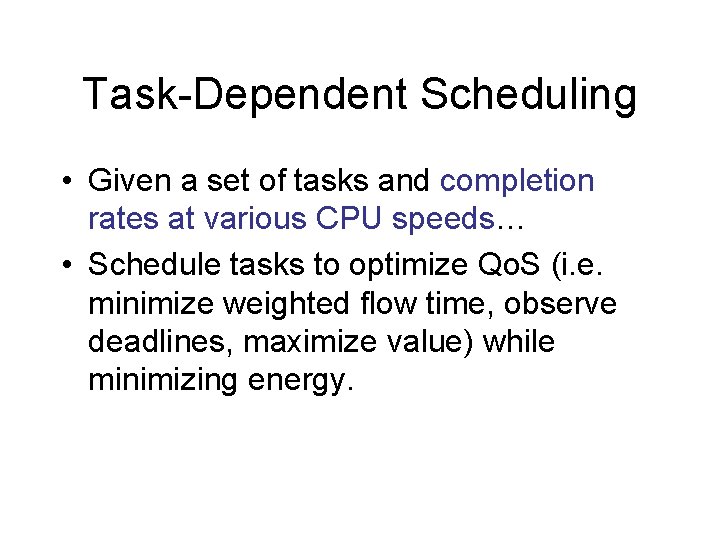
Task-Dependent Scheduling • Given a set of tasks and completion rates at various CPU speeds… • Schedule tasks to optimize Qo. S (i. e. minimize weighted flow time, observe deadlines, maximize value) while minimizing energy.
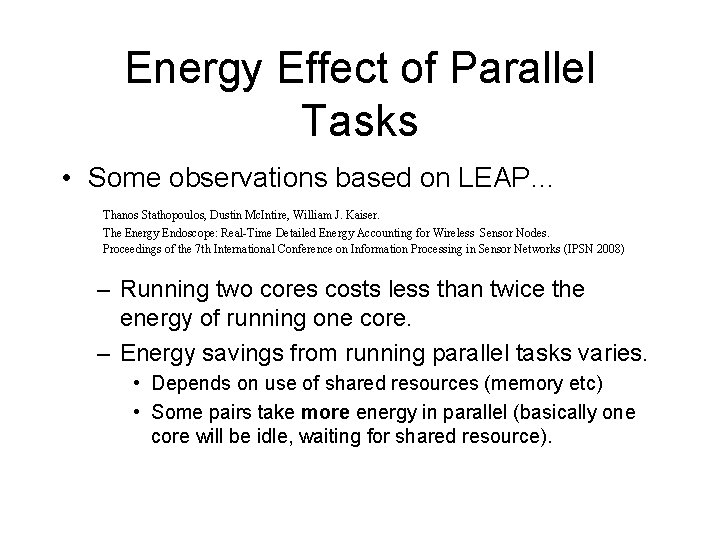
Energy Effect of Parallel Tasks • Some observations based on LEAP… Thanos Stathopoulos, Dustin Mc. Intire, William J. Kaiser. The Energy Endoscope: Real-Time Detailed Energy Accounting for Wireless Sensor Nodes. Proceedings of the 7 th International Conference on Information Processing in Sensor Networks (IPSN 2008) – Running two cores costs less than twice the energy of running one core. – Energy savings from running parallel tasks varies. • Depends on use of shared resources (memory etc) • Some pairs take more energy in parallel (basically one core will be idle, waiting for shared resource).

Task-Dependent Load Balancing Task 1 Task 3 Task 2 Core 1 Core 2 In prior work, energy determined by total time of activity, plus activation costs. Perhaps better to consider instantaneous energy consumption which depends on the set of active tasks in a non-trivial way.
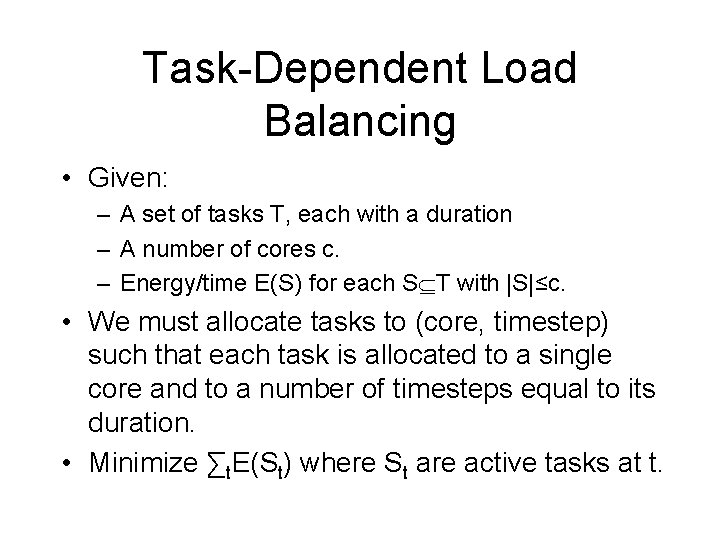
Task-Dependent Load Balancing • Given: – A set of tasks T, each with a duration – A number of cores c. – Energy/time E(S) for each S T with |S|≤c. • We must allocate tasks to (core, timestep) such that each task is allocated to a single core and to a number of timesteps equal to its duration. • Minimize ∑t. E(St) where St are active tasks at t.
- Slides: 7