
Task Centred Practice and Crisis Intervention An exploration
- Slides: 38
Task Centred Practice and Crisis Intervention An exploration of theory, method and practice Nigel Horner (University of Lincoln)
Session Overview ¨ What do we mean by Task Centred Practice? ¨ The core elements of TCP ¨ Applications and evaluations ¨ What do we mean by Crisis Intervention? ¨ The core elements of CI ¨ Applications and evaluations
But firstly……. . why are these lumped together? ¨ Malcolm Payne’s book sees common ground between TCP and CI ¨ Both are rooted in a reaction to psychodynamic casework relationships ¨ Both focus on short term, brief interventions ¨ Both are based upon problem solving ideas, and are connected to learning theory
What do we mean by Task Centred Practice? ¨ It emerged from a research movement that was critical of the protracted, unproven, fuzzy casework relationship ¨ It can be seen as atheoretical - a method more than a theory – although its theoretical roots are essentially behavioural ¨ It is central to Evidence- Based Practice – the What Works? agenda ¨ It can connect to other approaches, such as counselling or cognitive - behavioural work
TCP: A Definition ¨ “…a method of social work in which clients are helped to carry out problem - alleviating tasks within agreed periods of time” (Goldberg, Gibbons and Sinclair, 1985: 5) ¨ Social Work students identify Task – Centred practice as one of the most influential theories (Marsh and Triseliotis, 1996). ¨ In other words, it makes sense to student practitioners
Its behavioural roots………. ¨ According to Howe (1987: 82) task centred social work is linked with behavioural social work insofar as: ¨ “…problems are defined into identifiable pieces of behaviour. They are dealt with discretely. Goals are set and mutually agreed with service users. Involvement proceeds by way of small, sequential, manageable steps”.
Task Centred Practice Key Concepts ¨ The Mandate for ¨ Partnership Practice ¨ Establishing User Agreement ¨ “Clarifying what right a practitioner has to undertake the work at all” (Marsh, 1997: 197) ¨ User Involvement ¨ Building Upon User Strengths ¨ Written Agreements / Contracts ¨ Change comes through TASKS
The sequence of intervention ¨ According to Doel (2002) Task Centred Practice is based around four stages and processes: ¨ Phase 1: Developing a focus on the problem ¨ Phase 2: Reaching Agreement: Goals and Contracts ¨ Phase 3: Developing Goals into manageable tasks ¨ Phase 4: Ending and reviewing the work
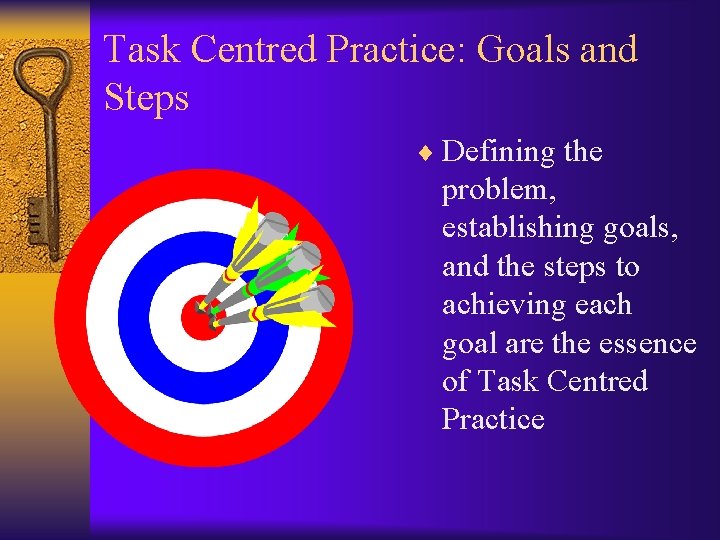
Task Centred Practice: Goals and Steps ¨ Defining the problem, establishing goals, and the steps to achieving each goal are the essence of Task Centred Practice
Stage One – in more detail: ¨ Problem scanning , or exploration requires the following questions to be explored: ¨ What is the problem? ¨ Who is involved? ¨ Where does in occur? ¨ When does it occur? ¨ Why does it occur? ¨ How does it occur? (known as the 5 Ws and 1 H)
Critical Commentary ¨ Payne (1991) delineates the limitations of task - centred work by pointing out that it is based upon the assumed rationality of the service user. ¨ The service user needs to able to make connections between actions and consequences, and with the help of the worker, to move from stating “What is wrong” to “What is wanted”. ¨ What is wanted has to be discussed in terms of Motivation, Feasibility, and Desirability. ¨ Objectives are ordered in terms of “Who is Doing What? ” based upon specific time - limits and often formulated around written agreements.
Evaluation and research ¨ Sainsbury (1989) undertook research to find out what ¨ ¨ ¨ service users value about interactions with social workers. They value: understanding the intentions and purposes of the service contributing to the work of the service the worker’s ability to respond to feelings which are not always expressed the worker’s concern even if change is not possible the worker’s ability to exercise care even when exercising control THESE ARE ALL CORE ELEMENTS IN TCP
Research continued…………. . ¨ Marsh and Fisher (1992: 10) asserted that “task centred practice is the most congruent model for clear, open and negotiated processes of partnership practice”, and that “effectiveness studies, user views, partnership orientation, practical use and a developmental stance which suits the changes now under way in social services come together in the task centred approach”
In summary…………. . ¨ Task Centred Practice has links to Behavioural Social Work, in its focus upon the Here -and Now, and the breaking down of problems into achievable bite sized chunks. ¨ It assumes that the successful achievement of tasks will increase self - esteem and confidence. ¨ It links with the ideas that inform Self Esteem and Resilience, Assertiveness, and acknowledges the structural impediments to previous task completion - poverty, deprivation, discrimination and oppression.
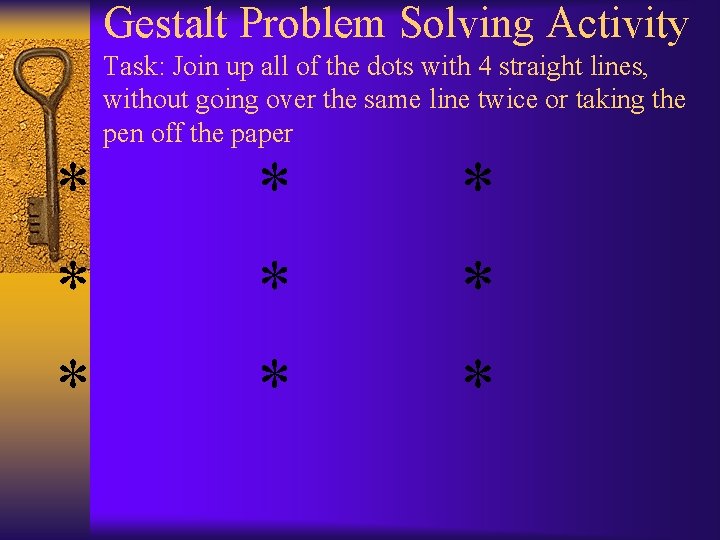
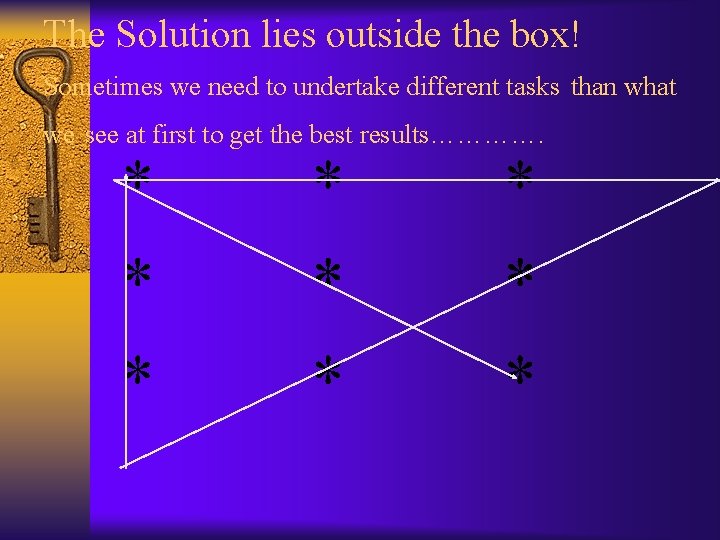
Gestalt Problem Solving Activity Task: Join up all of the dots with 4 straight lines, without going over the same line twice or taking the pen off the paper
The Solution lies outside the box! Sometimes we need to undertake different tasks than what we see at first to get the best results………….
Why Study Crisis Intervention? ¨ Anybody is vulnerable to crisis and its potential risks - in all areas of practice ¨ It is important to be aware of the potential risks and positive growth opportunities -particular links to mental health ¨ As a central idea in mental health interventions, Crisis Teams now part of the new National Service Framework for Mental Health ¨ International exposure to crisis situations
As a practitioner you need to …. ¨ Know what crisis and crisis intervention mean and require ¨ Recognise the indications that a person is experiencing a ‘crisis’ and is showing characteristic ‘signs’ ¨ Possess the skills in working with people and other agencies within this framework ¨ Develop an awareness of the ‘risks’ and the potentials for positive growth and change
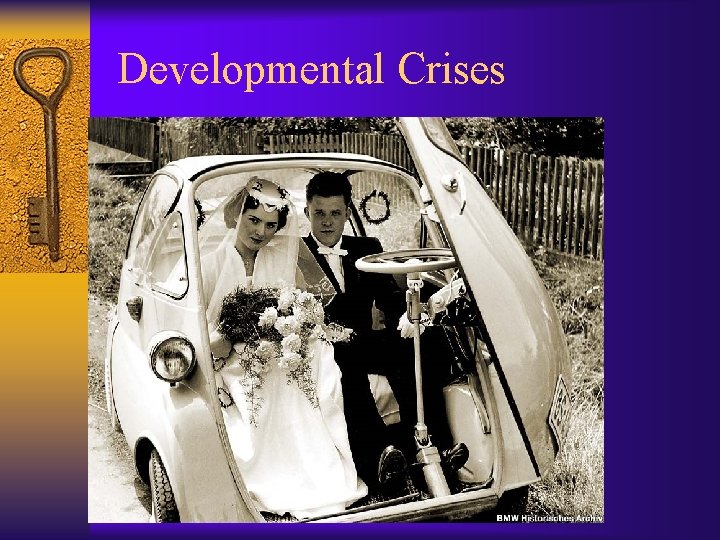
The Meaning of Crisis ¨ From the Greek word Krises, meaning decision (or opportunity or turning point) ¨ Developmental Crises: Leaving home, entering into a partnership, having a baby, going to university …. . these are all crises in that they all upset your steady state, the homeostasis, and things will never be the same again
Definitions ¨ People are in crisis when they face an obstacle to life goals - an obstacle that is, for a time, insurmountable by the use of customary methods (Caplan, 1961) ¨ Crises are crises because the individual knows no response to deal with a situation (Belkin, 1984) ¨ So, it’s facing new challenging situations and the usual coping / response mechanisms are not working …………. so the crisis situation becomes an active crisis
A summary Definition……. “A crisis is a perception or experiencing of an event or situation as an intolerable difficulty that exceeds the person’s current resources and coping mechanisms. Unless the person obtains relief, the crisis has the potential to cause severe affective, behavioral and cognitive malfunctioning” (James & Gilliland 2001)
Crisis Domains Each person and each crisis situation is different, crisis may be in the following areas of someone’s life: ¨ Developmental crises ¨ Situational crises ¨ Existential crises ¨ Environmental crises
Developmental Crises
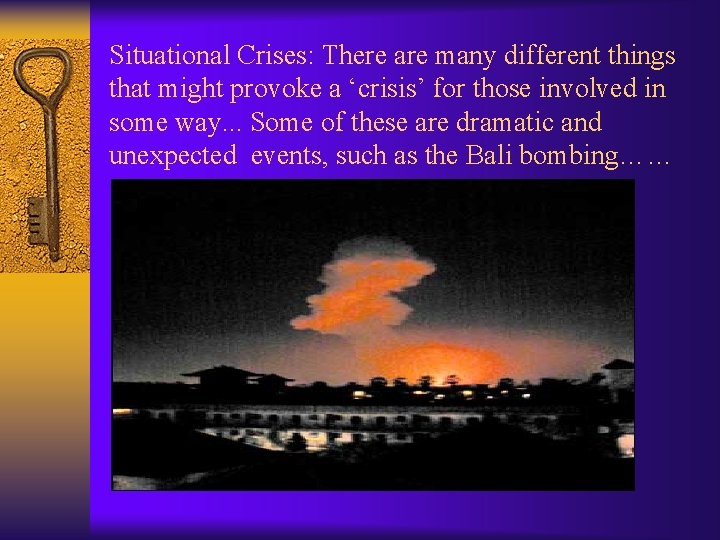
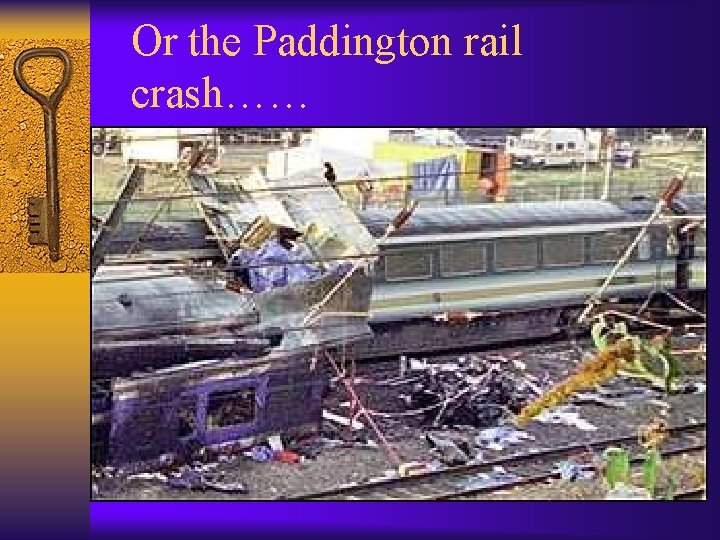
Situational Crises: There are many different things that might provoke a ‘crisis’ for those involved in some way. . . Some of these are dramatic and unexpected events, such as the Bali bombing……
Or the Paddington rail crash……
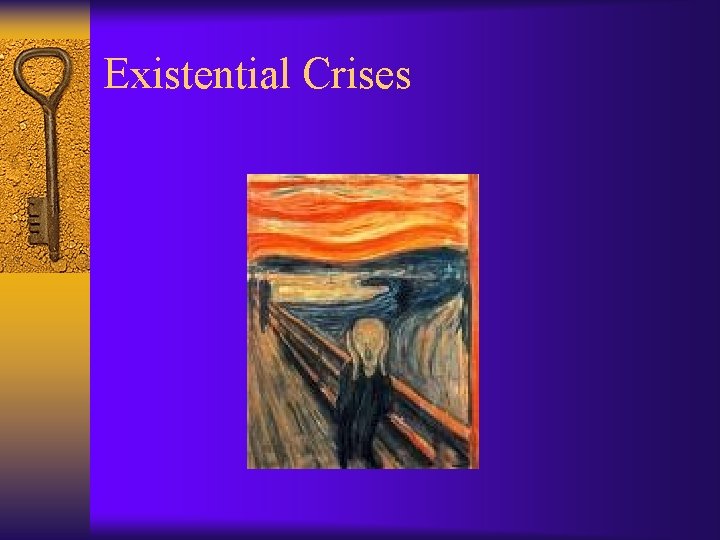
Existential Crises
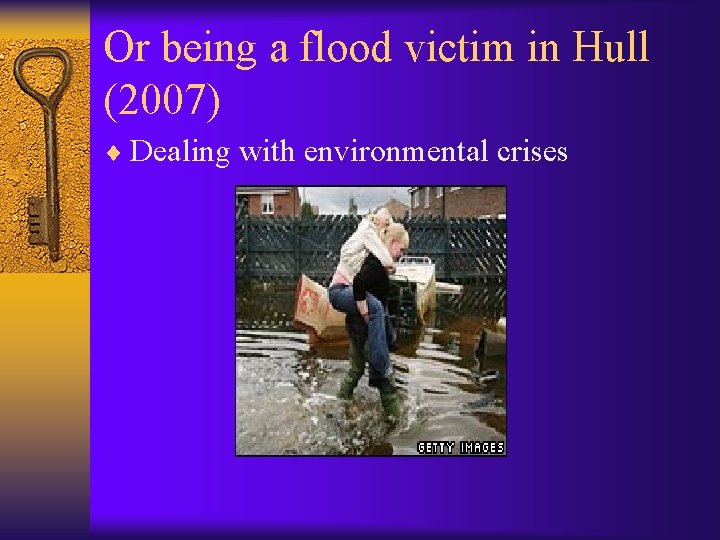
Or being a flood victim in Hull (2007) ¨ Dealing with environmental crises
Characteristics of a Crisis………… ¨ Stressful events experienced as threats, loss and fundamental challenges ¨ Characteristic responses include indication of that level of disturbance: anxiety, depression, guilt, confusion, tension, shame, anger, hostility ¨ May also be another set of psychological ‘coping’ mechanisms: denial, avoidance, withdrawal, delusion or fantasy
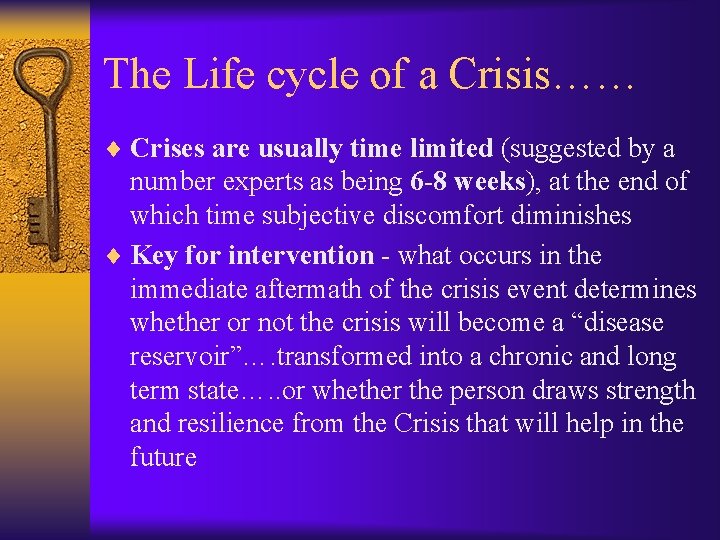
The Life cycle of a Crisis…… ¨ Crises are usually time limited (suggested by a number experts as being 6 -8 weeks), at the end of which time subjective discomfort diminishes ¨ Key for intervention - what occurs in the immediate aftermath of the crisis event determines whether or not the crisis will become a “disease reservoir”…. transformed into a chronic and long term state…. . or whether the person draws strength and resilience from the Crisis that will help in the future
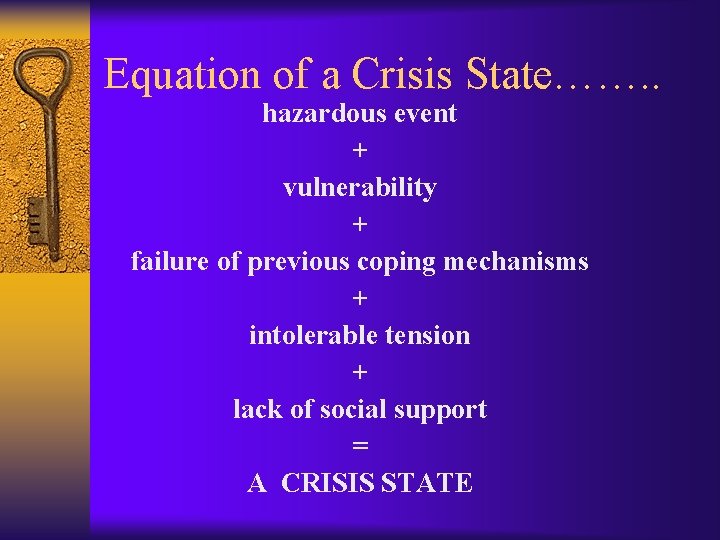
Equation of a Crisis State……. . hazardous event + vulnerability + failure of previous coping mechanisms + intolerable tension + lack of social support = A CRISIS STATE
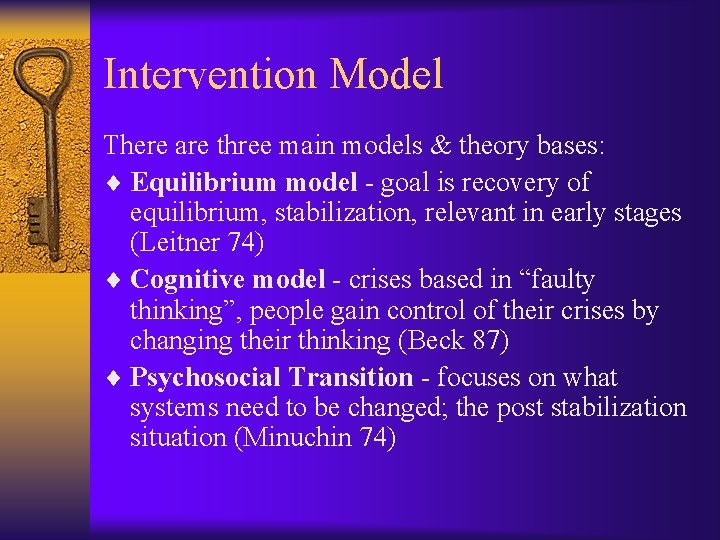
Intervention Model There are three main models & theory bases: ¨ Equilibrium model - goal is recovery of equilibrium, stabilization, relevant in early stages (Leitner 74) ¨ Cognitive model - crises based in “faulty thinking”, people gain control of their crises by changing their thinking (Beck 87) ¨ Psychosocial Transition - focuses on what systems need to be changed; the post stabilization situation (Minuchin 74)
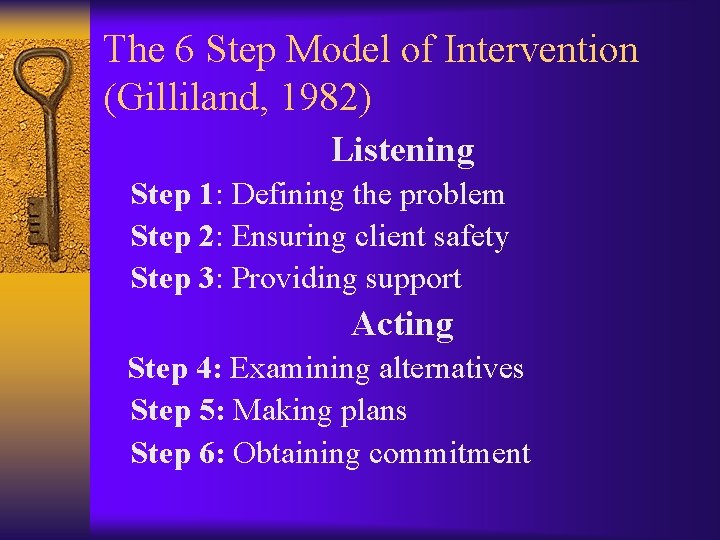
The 6 Step Model of Intervention (Gilliland, 1982) Listening Step 1: Defining the problem Step 2: Ensuring client safety Step 3: Providing support Acting Step 4: Examining alternatives Step 5: Making plans Step 6: Obtaining commitment
Steps in Practice ¨ Establish a supportive anxiety- reducing rapport: listen & help the person to gain perspective and to work collaboratively for potential solutions ¨ Information is gathered to identify the crisis, events & process - focus on reformulation ¨ Explore explanations to expand the person’s understanding of what has happened to them ¨ The person modifies assumptions and arrives at their own solution
The Goals of Crisis Intervention ¨ Reduction in disequilibrium / relief of symptoms of crisis ¨ Restoration of pre - crisis levels of functioning ¨ Identification of other support systems ¨ Initiating new modes of thinking, developing new coping responses beyond immediate crisis situation
So, Crisis Work can take place in many situations… ¨ Hospitals are common settings; suicide attempts, crime or accident victims, traumatic surgery ¨ many settings now include crisis counselling, e. g. Rape Crisis Centre ¨ Major incidents important response is crisis counseling e. g 9/11, Paddington, Hillsborough, Kings Cross, Lockerbie ¨ Positive effects of such intervention is acknowledged in the literature
Characteristics of effective crisis workers & working ¨ Attentiveness, accurate listening & responding ¨ Congruence between thinking, feeling and acting therapeutically ¨ Reassuring and supporting skills ¨ Ability to analyze, synthesize & diagnose ¨ Assessment & referral skills ¨ Ability to explore alternatives & solve problems “ the ideal crisis worker is someone who has experienced life, learnt and grown from their experiences” James & Gilliland, 2001, p 19)
Post Traumatic Stress Disorder (PTSD) ¨ We are now much more aware of the extent of this condition with people who have experienced or witnessed an event ¨ Signs are considerable deterioration in functioning, psychological symptoms ‘flashbacks’- traumatic situation is relived, may last for many years ¨ Interventions: cognitive therapies, ‘debriefing’
Summary thoughts………. ¨ Beware the indiscriminate use of the term crisis……many families appear to have crises, but they are not…. it is our perception / our values ¨ Workers refer to themselves as being in crisis…. . they are describing pressure and stress……which energises some and MAY lead to crises for others ¨ Crises are an opportunity for change …they may provide the chance to change destructive patterns of thoughts / behaviours