
Tariff Structure Statements Energex and Ergon Energy AER
- Slides: 18
Tariff Structure Statements – Energex and Ergon Energy AER public forum
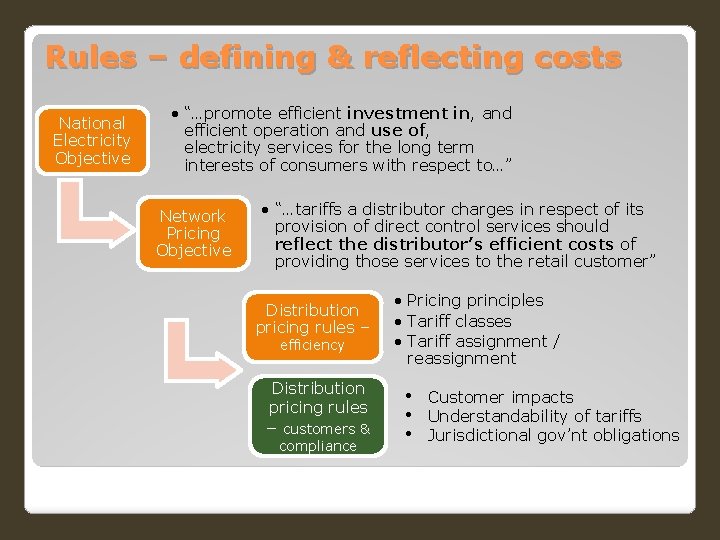
Rules – defining & reflecting costs National Electricity Objective • “…promote efficient investment in, and efficient operation and use of, electricity services for the long term interests of consumers with respect to…” Network Pricing Objective • “…tariffs a distributor charges in respect of its provision of direct control services should reflect the distributor’s efficient costs of providing those services to the retail customer” Distribution pricing rules – efficiency Distribution pricing rules – customers & compliance • Pricing principles • Tariff classes • Tariff assignment / reassignment • Customer impacts • Understandability of tariffs • Jurisdictional gov’nt obligations
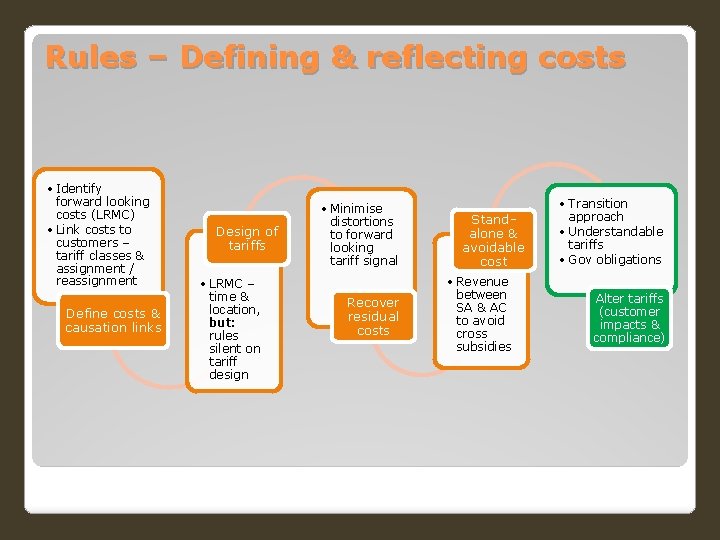
Rules – Defining & reflecting costs • Identify forward looking costs (LRMC) • Link costs to customers – tariff classes & assignment / reassignment Define costs & causation links Design of tariffs • LRMC – time & location, but: rules silent on tariff design • Minimise distortions to forward looking tariff signal Recover residual costs Standalone & avoidable cost • Revenue between SA & AC to avoid cross subsidies • Transition approach • Understandable tariffs • Gov obligations Alter tariffs (customer impacts & compliance)
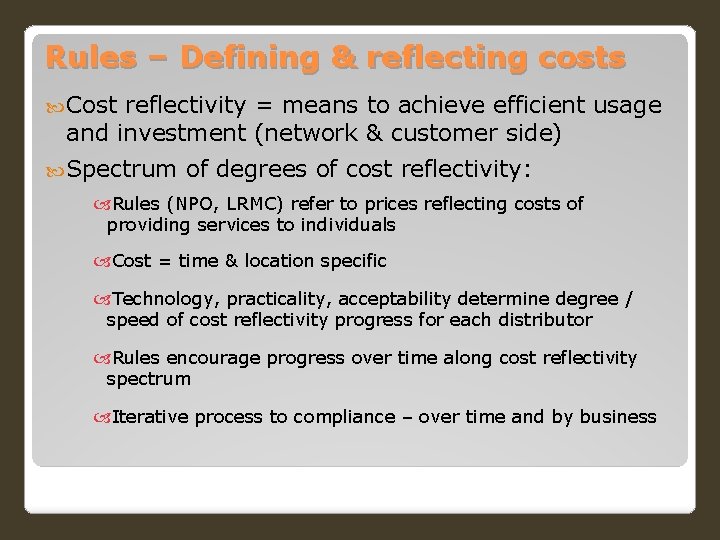
Rules – Defining & reflecting costs Cost reflectivity = means to achieve efficient usage and investment (network & customer side) Spectrum of degrees of cost reflectivity: Rules (NPO, LRMC) refer to prices reflecting costs of providing services to individuals Cost = time & location specific Technology, practicality, acceptability determine degree / speed of cost reflectivity progress for each distributor Rules encourage progress over time along cost reflectivity spectrum Iterative process to compliance – over time and by business
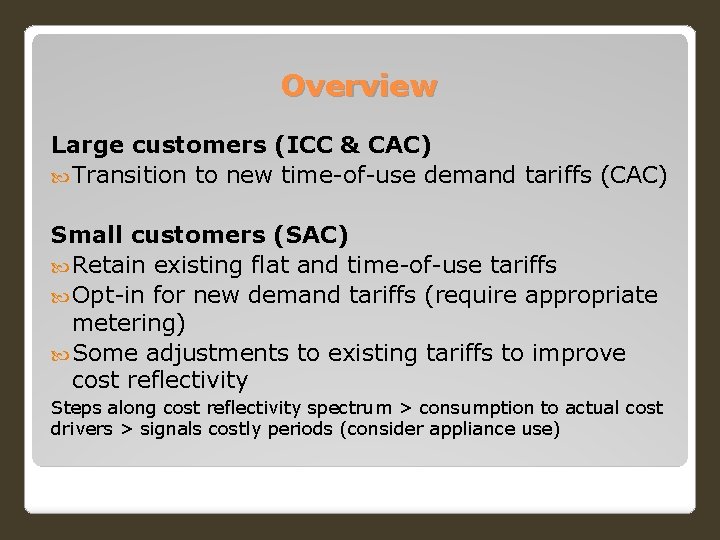
Overview Large customers (ICC & CAC) Transition to new time-of-use demand tariffs (CAC) Small customers (SAC) Retain existing flat and time-of-use tariffs Opt-in for new demand tariffs (require appropriate metering) Some adjustments to existing tariffs to improve cost reflectivity Steps along cost reflectivity spectrum > consumption to actual cost drivers > signals costly periods (consider appliance use)
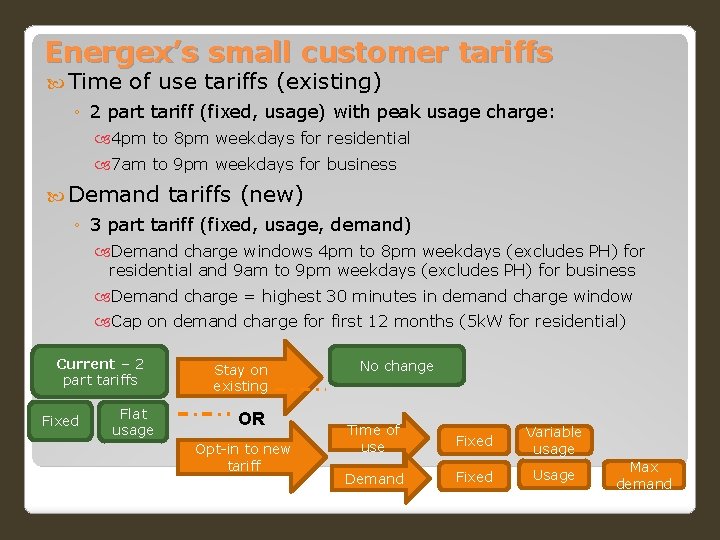
Energex’s small customer tariffs Time of use tariffs (existing) ◦ 2 part tariff (fixed, usage) with peak usage charge: 4 pm to 8 pm weekdays for residential 7 am to 9 pm weekdays for business Demand tariffs (new) ◦ 3 part tariff (fixed, usage, demand) Demand charge windows 4 pm to 8 pm weekdays (excludes PH) for residential and 9 am to 9 pm weekdays (excludes PH) for business Demand charge = highest 30 minutes in demand charge window Cap on demand charge for first 12 months (5 k. W for residential) Current – 2 part tariffs Fixed Flat usage Stay on existing OR Opt-in to new tariff No change Time of use Fixed Variable usage Demand Fixed Usage Max demand
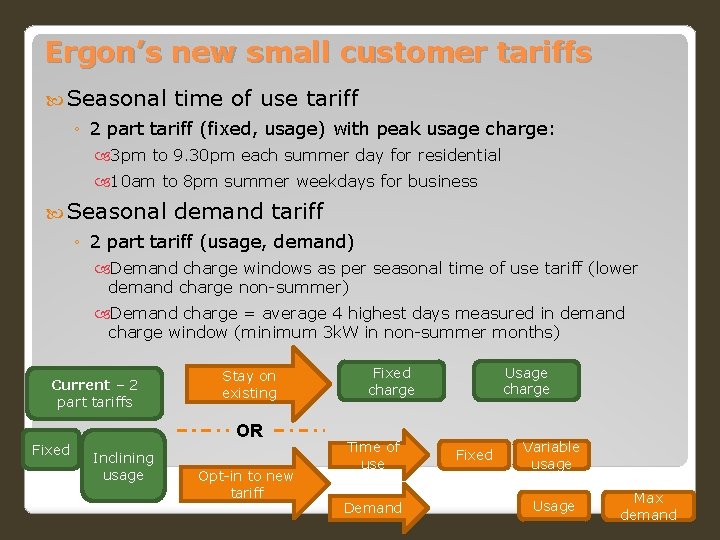
Ergon’s new small customer tariffs Seasonal time of use tariff ◦ 2 part tariff (fixed, usage) with peak usage charge: 3 pm to 9. 30 pm each summer day for residential 10 am to 8 pm summer weekdays for business Seasonal demand tariff ◦ 2 part tariff (usage, demand) Demand charge windows as per seasonal time of use tariff (lower demand charge non-summer) Demand charge = average 4 highest days measured in demand charge window (minimum 3 k. W in non-summer months) Current – 2 part tariffs Fixed Stay on existing OR Inclining usage Opt-in to new tariff Usage charge Fixed charge Time of use Demand Fixed Variable usage Usage Max demand
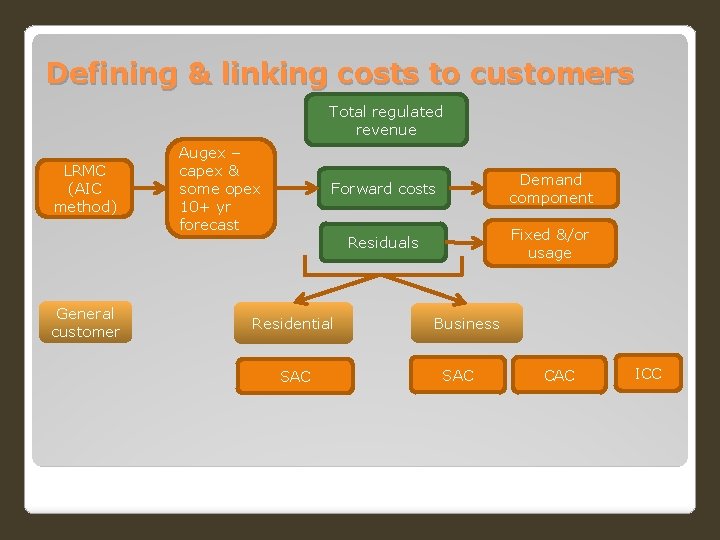
Defining & linking costs to customers Total regulated revenue LRMC (AIC method) General customer Augex – capex & some opex 10+ yr forecast Forward costs Demand component Residuals Fixed &/or usage Residential SAC Business SAC CAC ICC
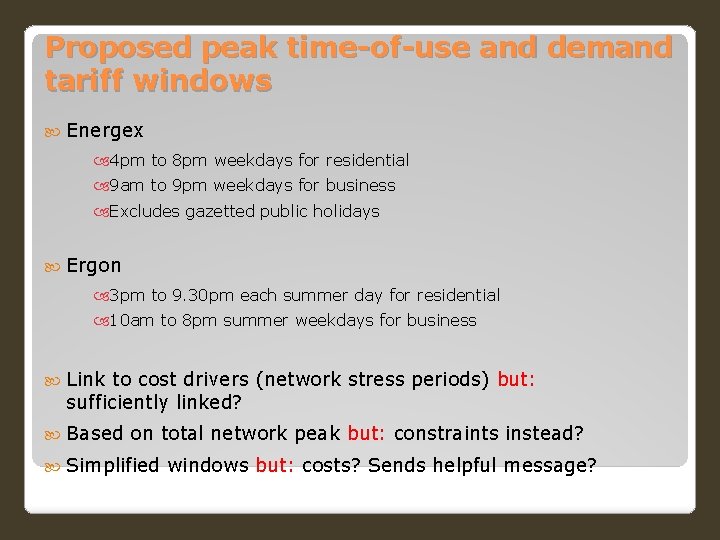
Proposed peak time-of-use and demand tariff windows Energex 4 pm to 8 pm weekdays for residential 9 am to 9 pm weekdays for business Excludes gazetted public holidays Ergon 3 pm to 9. 30 pm each summer day for residential 10 am to 8 pm summer weekdays for business Link to cost drivers (network stress periods) but: sufficiently linked? Based on total network peak but: constraints instead? Simplified windows but: costs? Sends helpful message?
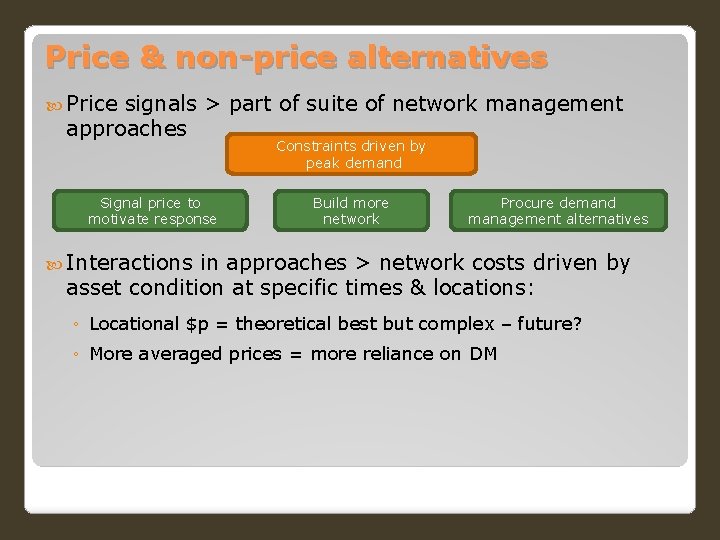
Price & non-price alternatives Price signals > part of suite of network management approaches Constraints driven by peak demand Signal price to motivate response Build more network Procure demand management alternatives Interactions in approaches > network costs driven by asset condition at specific times & locations: ◦ Locational $p = theoretical best but complex – future? ◦ More averaged prices = more reliance on DM
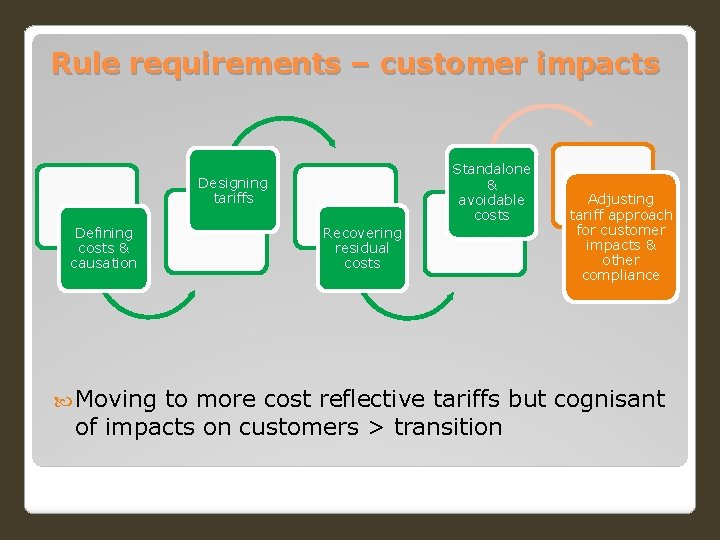
Rule requirements – customer impacts Standalone & avoidable costs Designing tariffs Defining costs & causation Moving Recovering residual costs Adjusting tariff approach for customer impacts & other compliance to more cost reflective tariffs but cognisant of impacts on customers > transition
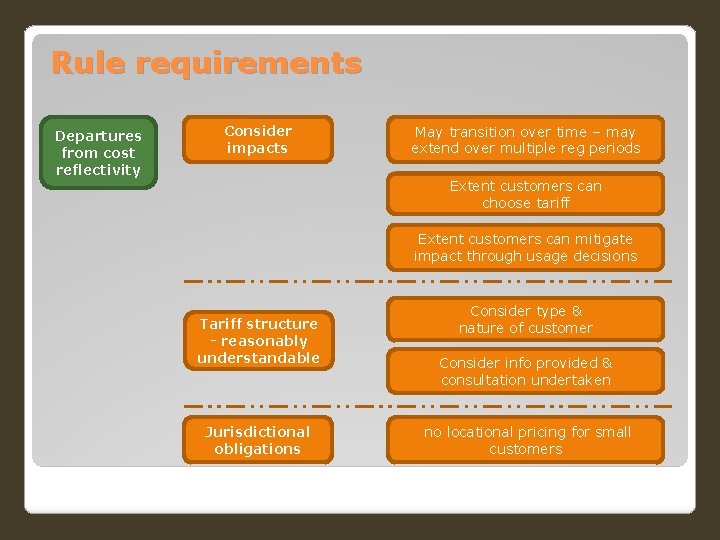
Rule requirements Departures from cost reflectivity Consider impacts May transition over time – may extend over multiple reg periods Extent customers can choose tariff Extent customers can mitigate impact through usage decisions Tariff structure - reasonably understandable Jurisdictional obligations Consider type & nature of customer Consider info provided & consultation undertaken no locational pricing for small customers
Impacts & understandability Rules require impact consideration but difficult: ◦ Retailer has direct contract with customers: Retailer(s) be able to offer varied options (flat tariffs, peaky tariffs, critical peaks, mobile phone style cap plans? ) Varied retailer options in effect could manage impacts? What constraints will retailer(s) face in offering various options? ◦ If constraints likely – impacts of network tariffs more identifiable ◦ Retailer incentive to make tariff info easy to understand?
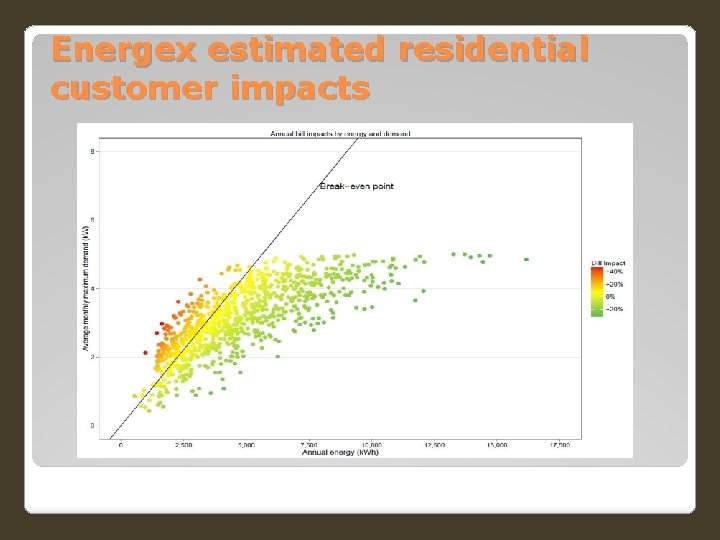
Energex estimated residential customer impacts
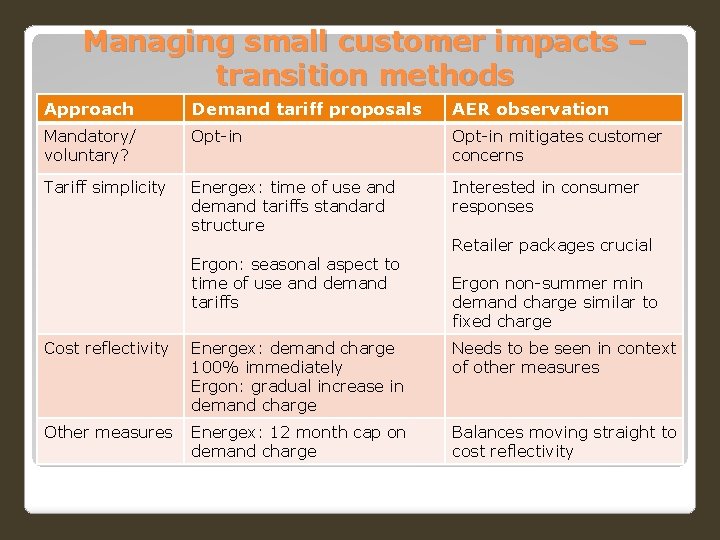
Managing small customer impacts – transition methods Approach Demand tariff proposals AER observation Mandatory/ voluntary? Opt-in mitigates customer concerns Tariff simplicity Energex: time of use and demand tariffs standard structure Interested in consumer responses Ergon: seasonal aspect to time of use and demand tariffs Retailer packages crucial Ergon non-summer min demand charge similar to fixed charge Cost reflectivity Energex: demand charge 100% immediately Ergon: gradual increase in demand charge Needs to be seen in context of other measures Other measures Energex: 12 month cap on demand charge Balances moving straight to cost reflectivity
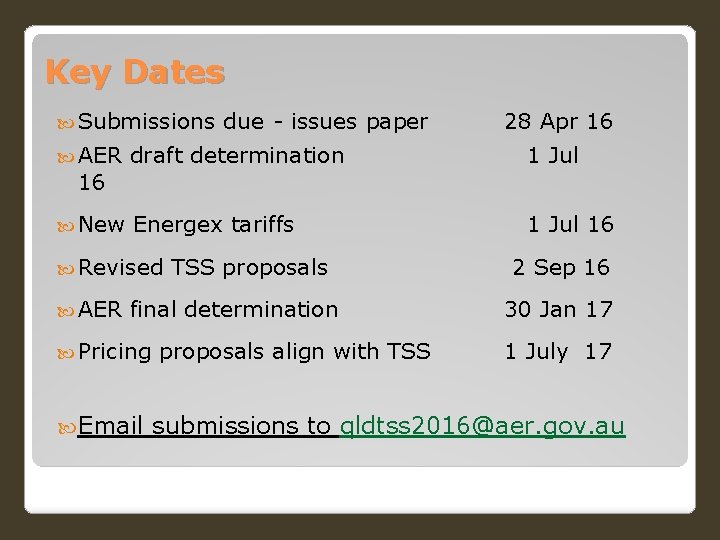
Key Dates Submissions due - issues paper 28 Apr 16 AER draft determination 1 Jul New Energex tariffs 1 Jul 16 16 Revised AER TSS proposals final determination Pricing Email proposals align with TSS 2 Sep 16 30 Jan 17 1 July 17 submissions to qldtss 2016@aer. gov. au
End
Potential discussion topics Pros and cons of choosing a new tariff Retailer Demand response tariff: ◦ Opt in for all or more important for existing customers? What about new customers with appropriate metering? ◦ Choice of charging windows > appropriate or could be better targeted? ◦ Benefits of switching are clear? Who better or worse off? Other issues?