
Targets Describe Law of Segregation Identify Phenotype Genotype
Targets ● Describe Law of Segregation ● Identify Phenotype & Genotype ● Probability ● Monohybrid Cross Section ● P 1 generation and F 1 generation
● Law of Segregation is when allele pairs separate during formation and unite at fertilization ● https: //www. youtube. com/watch? v=Mehz 7 t. Cxj SE
● Allele - different forms of genes. ● Most genes have two alleles ○ Dominant - trait we see ■ Example - Tall (T) - will be represented by a capital letter ○ Recessive - trait that will not be seen ■ Example - Short (t) - will be represented by a lowercase letter
● Homozygous - same alleles for a trait (pure) ○ Examples - TT, tt, BB, bb, AA, aa ● Heterozygous - different alleles for a trait ○ Example - Tt, Bb, Aa ● Hybrids - offspring of parents that have different forms of a trait
Genotype (the letters we use) - the set of genes in our DNA which is responsible for a particular trait Example: TT, Tt, tt Responsible for determining eye color, hair color, height, how your voice sounds, certain diseases, certain behaviors, the size of a bird’s beak, the length of a fox’s tail, the color of stripes on a cat, the spots on a dog’s back, a person’s shoe size
Phenotype (the words we use) - the physical expression, or characteristics, of that trait. Example: Green pea or Tall plant Responsible for the actual visible characteristics of eye color, hair color, height, how your voice sounds, certain diseases, certain behaviors, the size of a bird’s beak, the length of a fox’s tail, the color of stripes on a cat, the spots on a dog’s back, a person’s shoe size
● Probability is used in genetics to determine the possibilities of offspring having a particular trait. ●¼ = 25% ● 2/4 = 50% ●¾ = 75% ● 4/4 = 100%

● P 1 Parental generation – is the first set of parents crossed ● F 1 filial generation - is the first filial generation of offspring different from their parental generation
●Example 1 ○Round Pea Plant ○Dominant ○Heterozygous – Rr ○Wrinkled Pea Plant ○Recessive ○Heterozygous - Rr
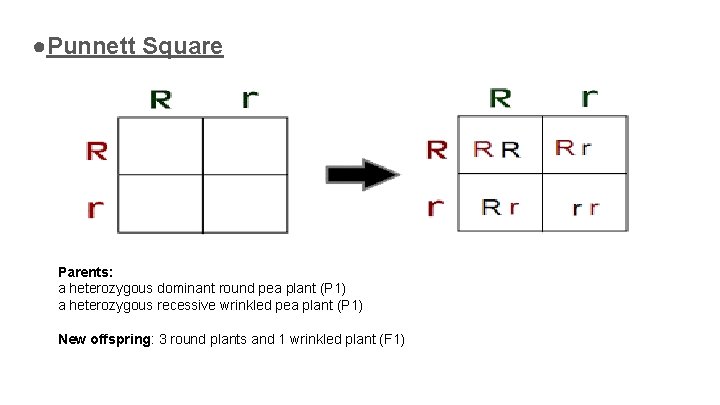
●Punnett Square Parents: a heterozygous dominant round pea plant (P 1) a heterozygous recessive wrinkled pea plant (P 1) New offspring: 3 round plants and 1 wrinkled plant (F 1)
●Example 2 ○Tall Pea Plant ○Dominant ○ Homozygous– TT ○Short Pea Plant ○Recessive ○Homozygous - tt
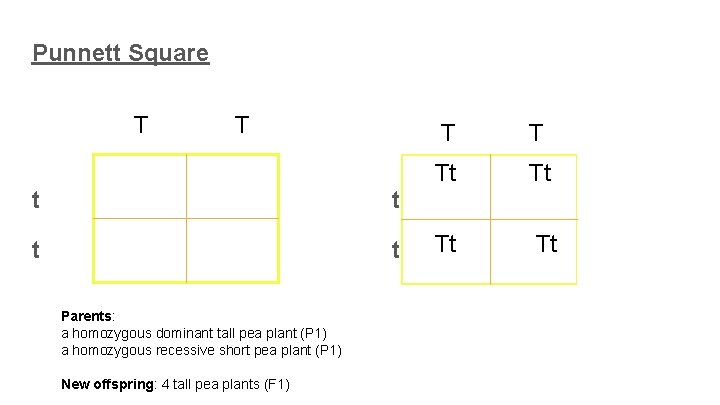
Punnett Square T T T t Tt t Tt Parents: a homozygous dominant tall pea plant (P 1) a homozygous recessive short pea plant (P 1) New offspring: 4 tall pea plants (F 1)
●Example 3 ○Tall Pea Plant ○Dominant ○Homozygous– TT ○Short Pea Plant ○Recessive ○Heterozygous - Tt
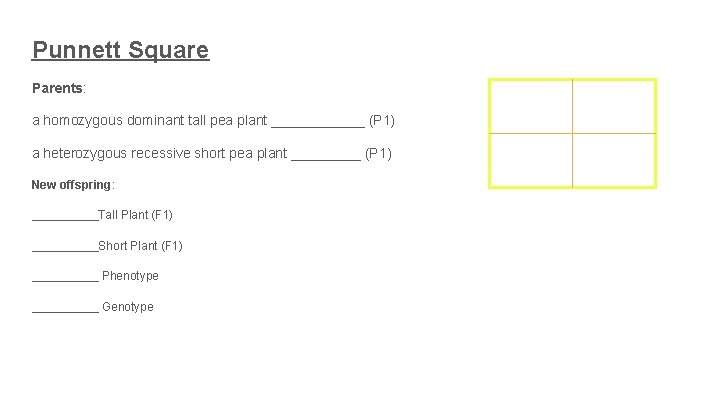
Punnett Square Parents: a homozygous dominant tall pea plant ______ (P 1) a heterozygous recessive short pea plant _____ (P 1) New offspring: _____Tall Plant (F 1) _____Short Plant (F 1) _____ Phenotype _____ Genotype
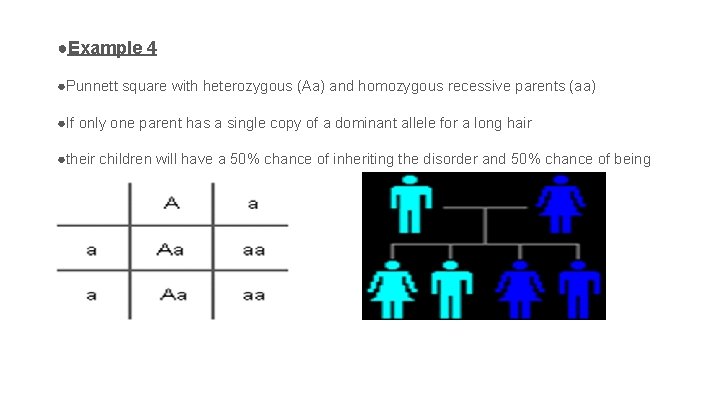
●Example 4 ●Punnett square with heterozygous (Aa) and homozygous recessive parents (aa) ●If only one parent has a single copy of a dominant allele for a long hair ●their children will have a 50% chance of inheriting the disorder and 50% chance of being entirely normal.
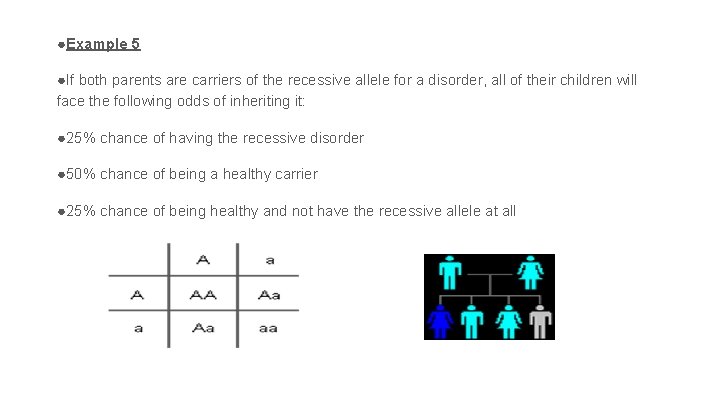
●Example 5 ●If both parents are carriers of the recessive allele for a disorder, all of their children will face the following odds of inheriting it: ● 25% chance of having the recessive disorder ● 50% chance of being a healthy carrier ● 25% chance of being healthy and not have the recessive allele at all
●Genotype (the letters we use) - the set of genes in our DNA which is responsible for a particular trait Example: TT, Tt, tt ●Phenotype (the words we use) - the physical expression, or characteristics, of that trait. Example: Green pea or Tall plant ●Homozygous - same alleles for a trait Examples - TT, tt, BB, bb, AA, aa ●Heterozygous - different alleles for a trait Example - Tt, Bb, Aa ●P 1 Parental generation – is the first set of parents crossed ●F 1 filial generation - is the first filial generation of offspring different from their parental generation ●Probability is used in genetics to determine the possibilities of offspring having a particular trait. ¼ = 25% 2/4 = 50% ¾ = 75% 4/4 = 100%
- Slides: 17