
Targeting Dispositions by Risk Need Responsivity Douglas B
Targeting Dispositions by Risk, Need, Responsivity Douglas B. Marlowe, J. D. , Ph. D. National Association of Drug Court Professionals Modeling If / Then Decisions
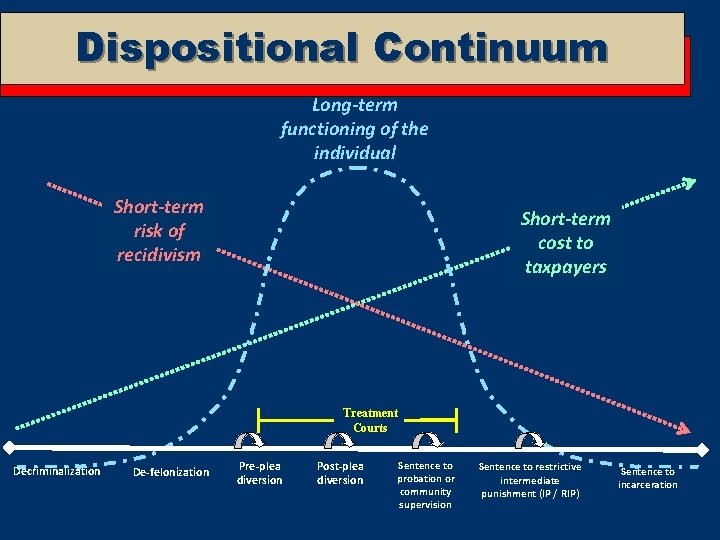
Dispositional Continuum Long-term functioning of the individual Short-term risk of recidivism Short-term cost to taxpayers Treatment Courts Decriminalization De-felonization Pre-plea diversion Post-plea diversion Sentence to probation or community supervision Sentence to restrictive intermediate punishment (IP / RIP) Sentence to incarceration
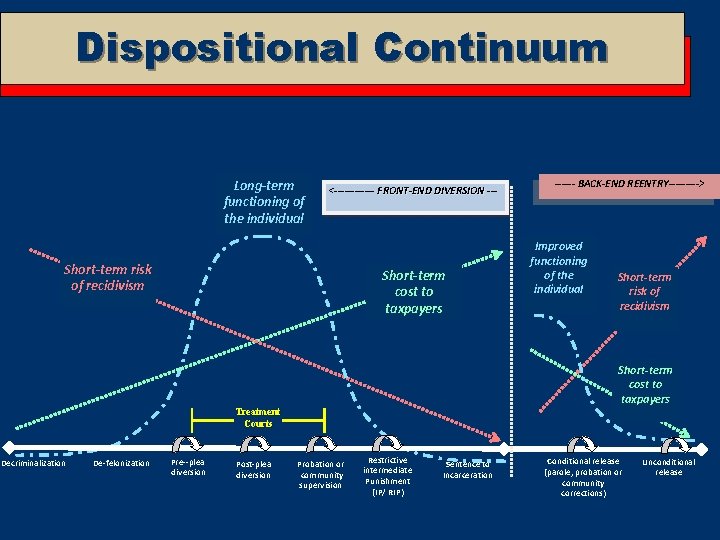
Dispositional Continuum Long-term functioning of the individual <------ FRONT-END DIVERSION --- Short-term risk of recidivism Short-term cost to taxpayers ------ BACK-END REENTRY-----> Improved functioning of the individual Short-term risk of recidivism Short-term cost to taxpayers Treatment Courts Decriminalization De-felonization Pre--plea diversion Post-plea diversion Probation or community supervision Restrictive intermediate Punishment (IP/ RIP) Sentence to Incarceration Conditional release (parole, probation or community corrections) Unconditional release
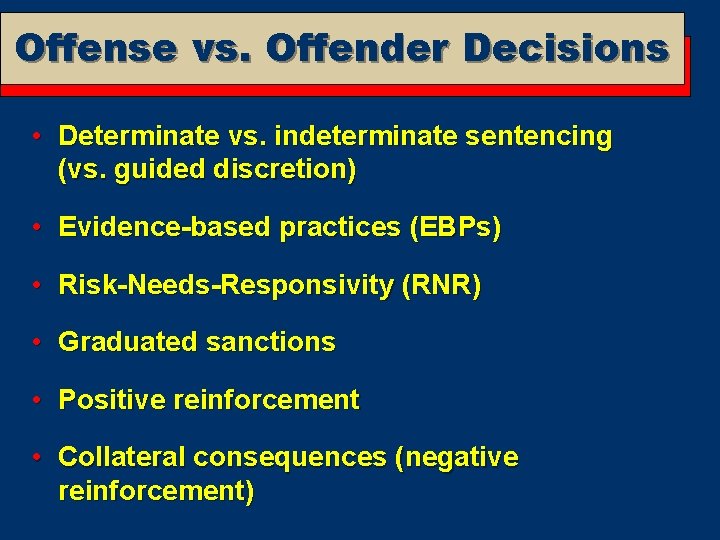
Offense vs. Offender Decisions • Determinate vs. indeterminate sentencing (vs. guided discretion) • Evidence-based practices (EBPs) • Risk-Needs-Responsivity (RNR) • Graduated sanctions • Positive reinforcement • Collateral consequences (negative reinforcement)

Risk Principle • Not necessarily a risk for violence or dangerousness • Serious prognosis or lesser amenability to treatment • The higher the risk level, the more intensive the supervision and accountability should be; and vice versa • Mixing risk levels is contraindicated!
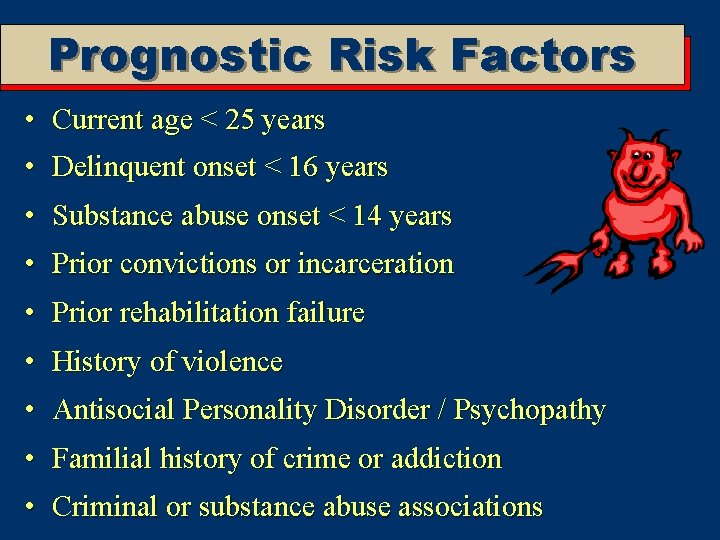
Prognostic Risk Factors • Current age < 25 years • Delinquent onset < 16 years • Substance abuse onset < 14 years • Prior convictions or incarceration • Prior rehabilitation failure • History of violence • Antisocial Personality Disorder / Psychopathy • Familial history of crime or addiction • Criminal or substance abuse associations

Need Principle • Clinical syndromes or impairments (diagnosis) • The higher the need level, the more intensive the treatment or rehabilitation services should be; and vice versa • Mixing need levels is contraindicated!

Specific Responsivity Order and timing of intervention is critical: 1. Responsivity needs: interfere with rehabilitation (e. g. , deficient housing, mental illness, withdrawal, anhedonia) 2. Criminogenic needs: cause or exacerbate crime (e. g. , addiction, criminal thinking) 3. Maintenance needs: degrade rehabilitation gains (e. g. , poor education or employment skills) 4. Humanitarian needs: cause distress (e. g. , medical or dental illness)
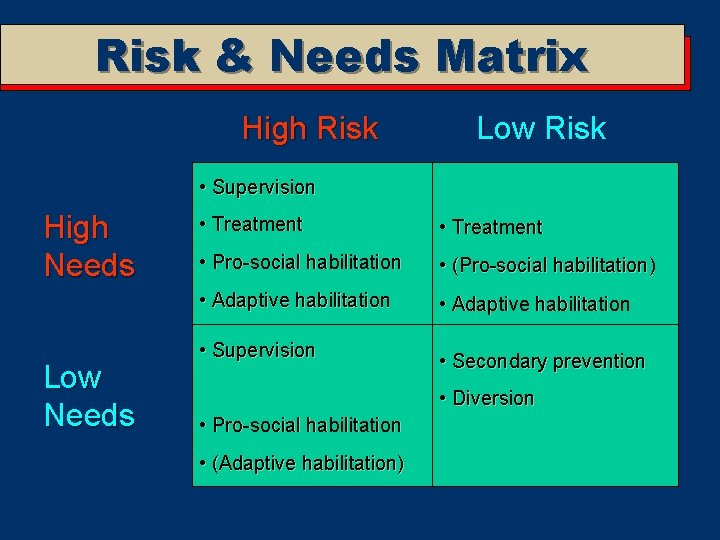
Risk & Needs Matrix High Risk Low Risk • Supervision High Needs Low Needs • Treatment • Pro-social habilitation • (Pro-social habilitation) • Adaptive habilitation • Supervision • Secondary prevention • Diversion • Pro-social habilitation • (Adaptive habilitation)
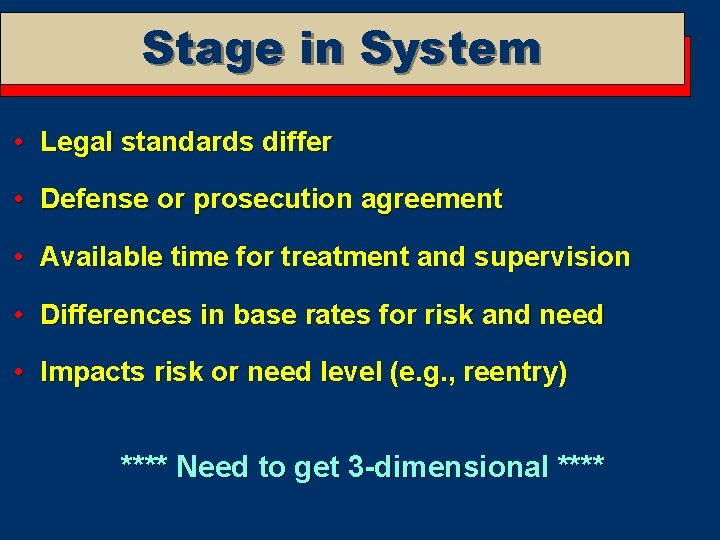
Stage in System • Legal standards differ • Defense or prosecution agreement • Available time for treatment and supervision • Differences in base rates for risk and need • Impacts risk or need level (e. g. , reentry) **** Need to get 3 -dimensional ****
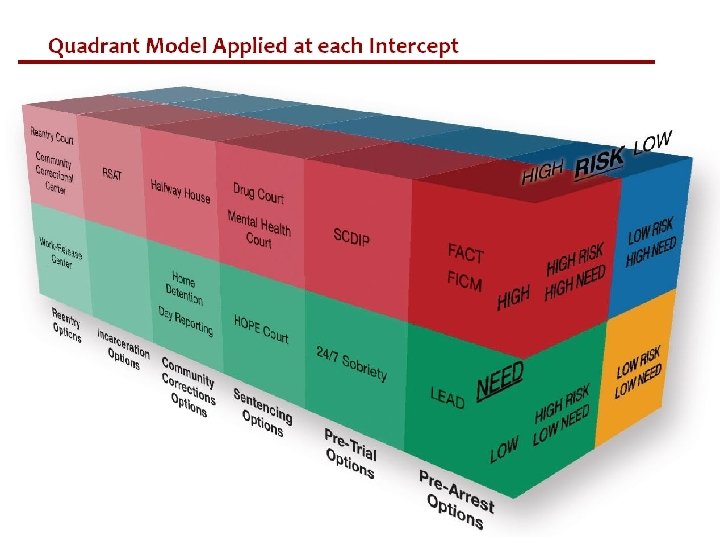
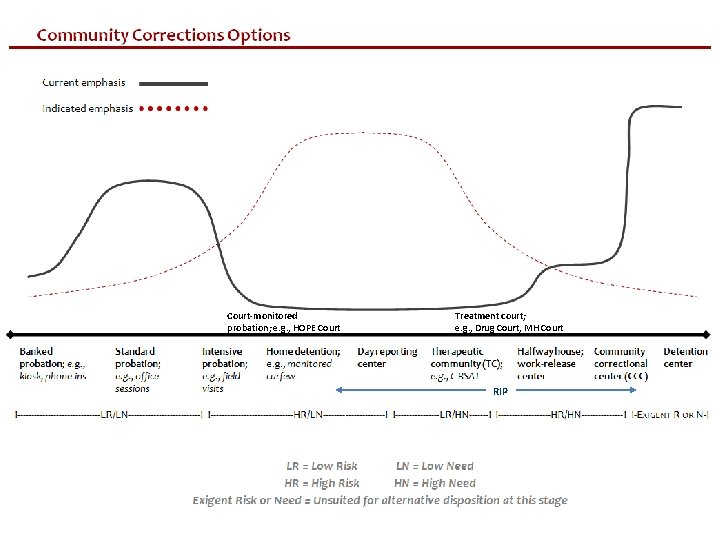
Court-monitored probation; e. g. , HOPE Court Treatment court; e. g. , Drug Court, MH Court RIP
Pre-Disposition Assessment • Use immunity, especially at pre-adjudication stage • Require assessment of risk and need after adjudication but prior to disposition (e. g. , as part of a PSI) • Valid, reliable & culturally unbiased instruments • Substance abuse vs. dependence diagnosis guides treatment conditions and response to technical violations involving new drug use
Guided Discretion • Require professionals to consider risk and need (excluding certain offenses) • Require professionals to consider effectiveness and cost -effectiveness (excluding certain offenses) • Publish data on recidivism and costs of alternative dispositions • Include dispositional rationale on the record • Restrictive basis for appeal (abuse of discretion) • Publish data on dispositional decisions
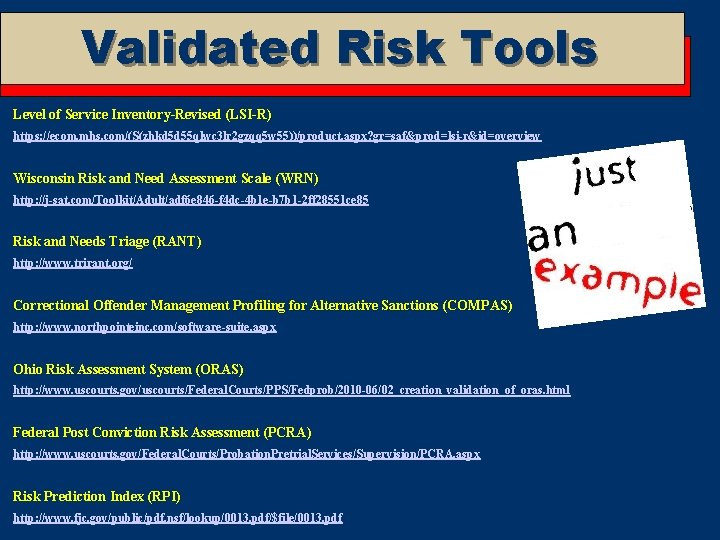
Validated Risk Tools Level of Service Inventory-Revised (LSI-R) https: //ecom. mhs. com/(S(zhkd 5 d 55 qlwc 3 lr 2 gzqq 5 w 55))/product. aspx? gr=saf&prod=lsi-r&id=overview Wisconsin Risk and Need Assessment Scale (WRN) http: //j-sat. com/Toolkit/Adult/adf 6 e 846 -f 4 dc-4 b 1 e-b 7 b 1 -2 ff 28551 ce 85 Risk and Needs Triage (RANT) http: //www. trirant. org/ Correctional Offender Management Profiling for Alternative Sanctions (COMPAS) http: //www. northpointeinc. com/software-suite. aspx Ohio Risk Assessment System (ORAS) http: //www. uscourts. gov/uscourts/Federal. Courts/PPS/Fedprob/2010 -06/02_creation_validation_of_oras. html Federal Post Conviction Risk Assessment (PCRA) http: //www. uscourts. gov/Federal. Courts/Probation. Pretrial. Services/Supervision/PCRA. aspx Risk Prediction Index (RPI) http: //www. fjc. gov/public/pdf. nsf/lookup/0013. pdf/$file/0013. pdf
Validated Needs Tools Addiction Severity Index (ASI) http: //www. tresearch. org/wp-content/uploads/2012/09/ASI_5 th_Ed. pdf Global Appraisal of Individual Needs (GAIN) http: //www. gaincc. org/products-services/instruments-reports/ Offender Profile Index (OPI) https: //www. ncjrs. gov/pdffiles 1/Digitization/148829 NCJRS. pdf Level of Service/Case Management Inventory (LS/CMI) https: //ecom. mhs. com/(S(0 aqkan 55 ovozwq 55 w 2 oxt 445))/saf_om. aspx? id=Training Correctional Offender Management Profiling for Alternative Sanctions (COMPAS) http: //www. northpointeinc. com/software-suite. aspx Offender Screening Tool (OST) http: //www. azcourts. gov/apsd/Evidence. Based. Practice/Risk. Needs. Assessment/Offender. Screening. Tool%28 O ST%29. aspx Inventory of Offender Risk, Needs, and Strengths (IORNS) http: //www 4. parinc. com/Products/Product. aspx? Product. ID=IORNS
Validated Diagnostic Tools Global Appraisal of Individual Needs (GAIN) http: //www. chestnut. org/LI/gain/index. html#Instruments Structured Clinical Interview for the DSM-IV (SCID) http: //www. scid 4. org/ Psychiatric Research Interview for Substance and Mental Disorders (PRISM) http: //www. columbia. edu/~dsh 2/prism/ Diagnostic Interview Schedule (DIS) http: //www. enotes. com/drugs-alcohol-encyclopedia/diagnostic-interview-schedule-dis Texas Christian University (TCU) Drug Dependence Screen-II http: //www. ibr. tcu. edu/pubs/datacoll/Forms/ddscreen-95. pdf
- Slides: 17