
Targeted Case Management Onboarding 1 Introduction This presentation
Targeted Case Management Onboarding 1
Introduction This presentation is a reference guide for Local Governmental Agencies (LGAs) that are interested in participating in the Targeted Case Management (TCM) program. This guide outlines the requirements that LGAs must comply with in order to participate in the TCM program. LGAs can also reference the information located in the TCM Provider Manual and the TCM website at: http: //www. dhcs. ca. gov/provgovpart/Pages/TCMProvider. Manual. aspx http: //www. dhcs. ca. gov/provgovpart/Pages/TCM. aspx 2

The TCM Program Background What is TCM: • TCM became a covered Medi-Cal benefit effective January 1, 1995. • The TCM Program provides specialized case management services to Medi-Cal eligible individuals in a defined target population to gain access to needed medical, social, educational, and other services. • The TCM Program is an optional Medi-Cal Program funded by federal and local funds. 3
The TCM Program Background Cont. What is not TCM: • Administrative activities necessary for the operation of the agency providing case management services rather than the overhead costs directly attributable to TCM, • Diagnostic and/or treatment services, • Restricting or limiting access to services, such as through prior authorization, • Activities that are an essential part of Medi-Cal administration, such as outreach, intake processing, eligibility determination, or claims processing, • Services that are an integral part of another service already reimbursed by Medi-Cal. 4
The TCM Program Background Cont. • TCM is a federal reimbursement program and not a federal matching or grant program. • LGAs that meet Medi-Cal program requirements may be eligible to receive partial reimbursement for providing Medi-Cal services. • LGAs may not submit claims for reimbursement prior to incurring TCM expenditures. 5
TCM Unit Organization The Department of Health Care Services (DHCS) TCM Unit consists of: • Three Program Analysts • Information Technology Associate • One Unit Chief • One Student Assistant To see the Analyst assigned for your LGA, visit the TCM website: http: //www. dhcs. ca. gov/provgovpart/Pages/TCMContact. I nformation. aspx 6
TCM Service Components and Target Populations 7
Target Populations “Target population” means those Medi-Cal beneficiaries described in Supplements 1 a, 1 b, 1 d, 1 e, 1 f, and 1 h of Attachment 3. 1 -A of the TCM State Plan Amendment. TCM services are provided to five defined TCM target populations listed below: (14) Children Under the Age of 21 (15) Medically Fragile Individuals (16) Individuals at Risk of Institutionalization (17) Individuals in Jeopardy of Negative Health or Psycho-Social Outcomes (18) Individuals with a Communicable Disease Note: Within the TCM Online System, the target populations are always referred by the above numbers, 14 -18. 8
TCM Service Components According to the State Plan, one of the four approved TCM service components must be performed by the case manager during an encounter. These services are subject to change by State Plan Amendments (SPAs), and currently include: 1. Comprehensive Assessment and Periodic Reassessment 2. Development and Periodic Revision of Specific Care Plan 3. Referral and Related Activities 4. Monitoring and Follow-up Activities 9
TCM Program Requirements Qualifications of providers (LGA): § Must be an agency employing staff with agency approved case management qualifications § Establish referral systems and demonstrated linkages and referral ability with essential social and health service agencies § Have a minimum of five years providing comprehensive case management services to the target group § Administrative capacity to ensure quality of services in accordance with state and federal requirements 10
TCM Program Requirements Qualifications of providers (LGA): § Financial management capacity and system that provides documentation of services and costs in accordance with 2 CFR Part 200 et seq. principles; and § Capacity to document and maintain individual case records in accordance with state and federal requirements. § Demonstrated ability to meet state and federal requirements for documentation, billing, and audits. § Ability to evaluate the effectiveness, accessibility, and quality of TCM services on a community-wide basis. 11
Qualifications of Case Managers cont. 3. An individual with at least an Associate of Arts degree from an accredited college, who has completed an agencyapproved case management training course and has two years of experience performing case management duties in the health or human services field, or 4. An individual who has completed an agency-approved case management training course and has four years of experience performing case management duties in a health or human services field. In such cases, the term agency refers to the LGA, who must ensure that this training requirement has been met with an approved training course. 12
Evergreen Provider Participation Agreement (PPA) • The Evergreen PPA is an agreement between the LGA and the DHCS for any LGA seeking reimbursement for providing TCM services. • LGAs are required to enter into a PPA with DHCS, in order to participate within the TCM Program and gain reimbursement. • The PPA will be evergreen and therefore, will not expire unless amended. 13
Providing TCM Services 14
Encounter TCM services are provided in a form of an encounter. An “encounter” is defined as a face-to-face contact or a telephone contact in lieu of a face-to-face contact when environmental considerations preclude a face-toface encounter for the purpose of rendering one or more targeted case management service components by a case manager. – Encounter notes/case notes describe what service components were performed. 15
Client Case Record Documentation • Providers must maintain client case records indicating all TCM encounters being claimed. • Case record documentation provides the primary support for billable TCM encounters. • The LGA must be able to provide both the client case records and backup documentation when asked by the Department of Health Care Services (DHCS) either for financial audits or program reviews. 16
Client Case Record Documentation (Cont’d) Case records must indicate the client characteristics that put the client in the defined target population and must prove that a client was eligible for TCM services on the date of service delivery. For billable TCM encounters, the case records must document the following information: • The name of the recipient and his/her Medi-Cal ID number. • The date of service. • The name of the provider agency and the person providing the service. • The nature and extent of the TCM service provided. • The place of service delivery (e. g. , home, office or other) • A billable TCM encounter must include one or more of the four components of TCM 17
Freedom of Choice LGAs shall comply with the freedom of choice requirement during the provision of case management services by not restricting an individual's free choice of providers pursuant to: • Eligible individuals will have free choice of any qualified Medicaid provider within the specified geographic area as identified in the SPA. • Eligible individuals will have free choice of any qualified Medicaid providers for other medical care. 18
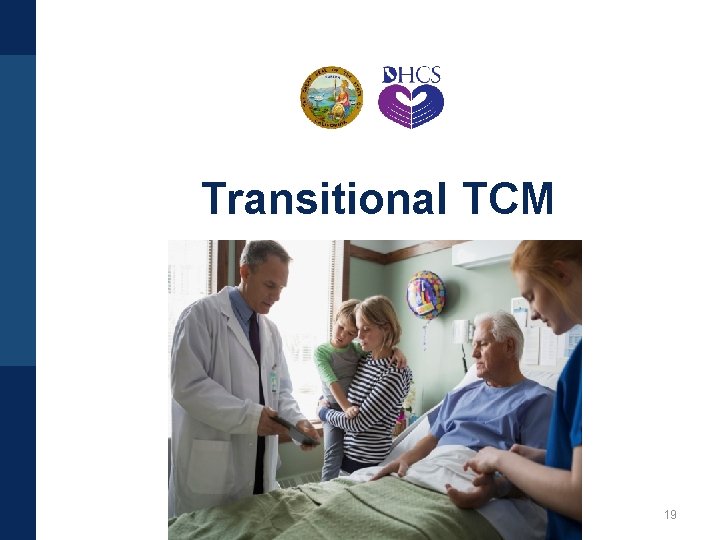
Transitional TCM 19
Transitional TCM Requirements for LGAs that claim for TCM encounters when beneficiaries transition from institutions to a community setting include: • Beneficiaries must be transitioning from institutions to a community setting for 180 consecutive days before the discharge date. • When beneficiaries reside in nursing facilities, hospitals, convalescent homes, or another facility that is not their private residence, TCM case managers cannot claim for services that have already been provided by another provider in the facility. Each LGA’s Performance Monitoring Plan (PMP) shall ensure care coordination and prevent duplication of services between the institution and the TCM provider. • TCM services cannot be provided when the client is transitioning from one institution to another. 20
Transitional TCM Documenting Transitional TCM • Documenting the beneficiary’s date of discharge from the institution. • Documenting (in the encounter log and the client case file) the beneficiary’s location where TCM services were provided (for example, nursing facilities, intermediate care facilities, hospitals, psychiatric facilities. 21
Affordable Care Act (ACA) 22
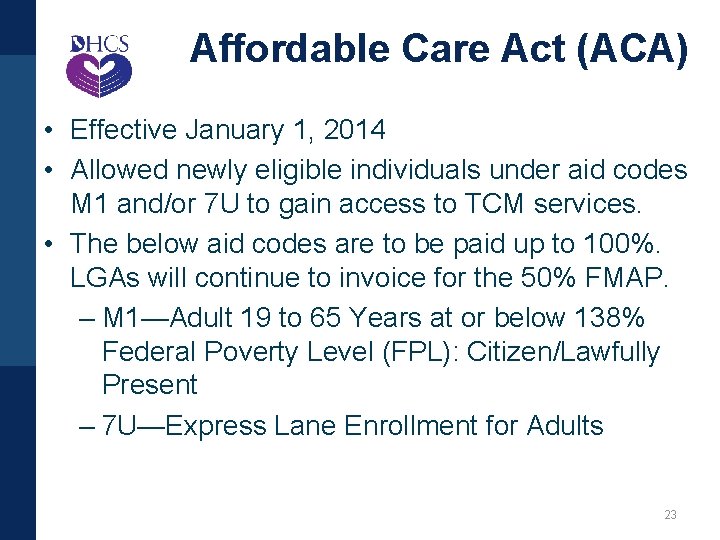
Affordable Care Act (ACA) • Effective January 1, 2014 • Allowed newly eligible individuals under aid codes M 1 and/or 7 U to gain access to TCM services. • The below aid codes are to be paid up to 100%. LGAs will continue to invoice for the 50% FMAP. – M 1—Adult 19 to 65 Years at or below 138% Federal Poverty Level (FPL): Citizen/Lawfully Present – 7 U—Express Lane Enrollment for Adults 23
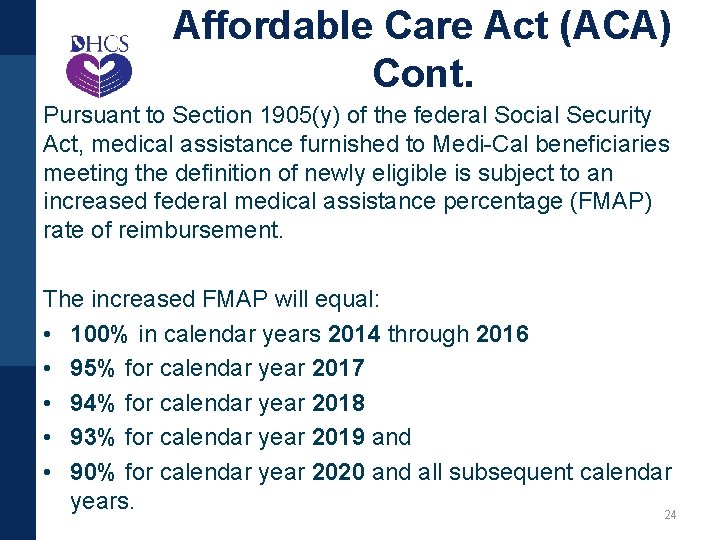
Affordable Care Act (ACA) Cont. Pursuant to Section 1905(y) of the federal Social Security Act, medical assistance furnished to Medi-Cal beneficiaries meeting the definition of newly eligible is subject to an increased federal medical assistance percentage (FMAP) rate of reimbursement. The increased FMAP will equal: • 100% in calendar years 2014 through 2016 • 95% for calendar year 2017 • 94% for calendar year 2018 • 93% for calendar year 2019 and • 90% for calendar year 2020 and all subsequent calendar years. 24
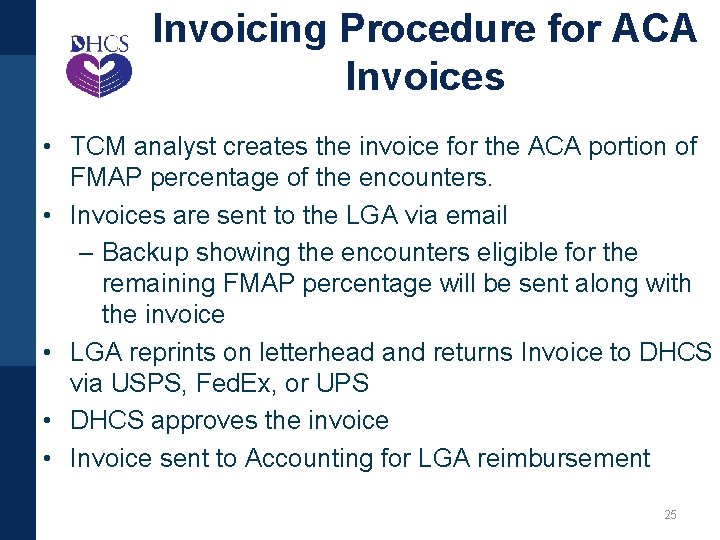
Invoicing Procedure for ACA Invoices • TCM analyst creates the invoice for the ACA portion of FMAP percentage of the encounters. • Invoices are sent to the LGA via email – Backup showing the encounters eligible for the remaining FMAP percentage will be sent along with the invoice • LGA reprints on letterhead and returns Invoice to DHCS via USPS, Fed. Ex, or UPS • DHCS approves the invoice • Invoice sent to Accounting for LGA reimbursement 25
MEDSLITE • DHCS granted LGAs MEDSLITE access to verify aid codes for ACA encounters. • LGA TCM staff will be able to access MEDSLITE online • MEDSLITE search can be completed by searching for unique identifiers. • For MEDSLITE account creation/deletion email the request to the DHCS-TCM Inbox. 26
Annual Participation Prerequisite (APP) 27
Annual Participation Prerequisite (APP) • The APP provides DHCS with participation and compliance information for the upcoming fiscal year. • The information within the APP assists DHCS with oversight of the TCM Program. • Annually, DHCS releases the APP template for LGAs to complete and submit. • LGAs opting to participate in the TCM Program are required to submit their APP and provide the supporting documents listed below to DHCS by the last business day in March annually. – Performance Monitoring Plan (PMP) – Fee Mechanism (FM) – Signature Authority – Profile Request – Proof (screenshots) displaying verification of case 28 managers not on the OIG LEIE exclusion list
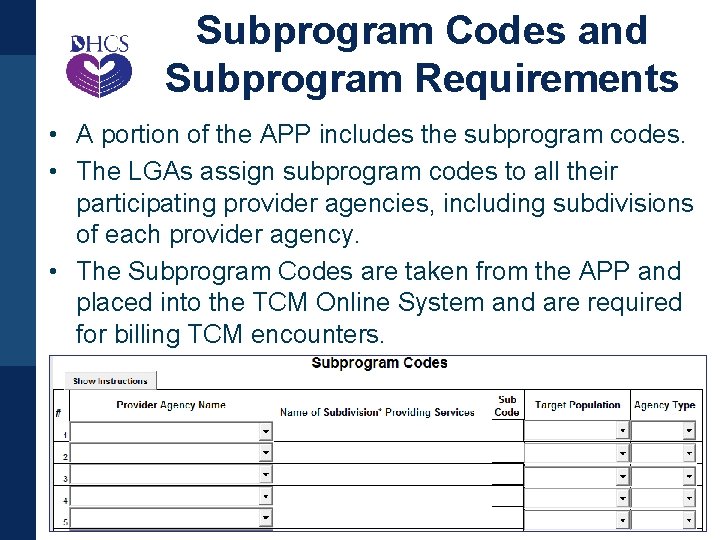
Subprogram Codes and Subprogram Requirements • A portion of the APP includes the subprogram codes. • The LGAs assign subprogram codes to all their participating provider agencies, including subdivisions of each provider agency. • The Subprogram Codes are taken from the APP and placed into the TCM Online System and are required for billing TCM encounters. 29
Performance Monitoring Plan (PMP) • The PMP helps ensure statewide non-duplication of payments, non-duplication of services, and a more efficient use of agency resources in meeting needs. • The PMP must include protocols and procedures for coordination and continuity of care among providers for Medi-Cal beneficiaries who are eligible to receive TCM services from two or more providers. • Accompanying the APP, LGAs are required to submit their PMP Annually to DHCS. 30
Fee Mechanism Accompanying the APP, a fee mechanism shall be submitted annually to DHCS by the last business day in March annually. • Medi-Cal is the payer of last resort, a fee mechanism must be in place to ensure that all other possible payment sources have been considered prior to using Medi-Cal as a payment source for TCM services. 31
OIG List of Excluded Individuals and Entities • The OIG requires that no individual included on the List of Excluded Individuals/Entities (LEIE) receives federal funds. • To verify that each case manager is not on the OIG’s LEIE, the LGAs will search each case manager name against the LEIE online database. • The data base can be found at the website: https: //exclusions. oig. hhs. gov. 32
TCM Cost Report 33
TCM Cost Report • Participating LGAs must complete and submit to DHCS on an annual basis • Must be prepared in a format specified by DHCS and submitted by November 1 of each year. • The information provided in the TCM cost report is based on actual public expenditure of providing TCM services. • The information provided within the TCM cost report will be used to establish an interim TCM encounter rate that will be used as a basis to claim for federal funds. Note: DHCS Audits and Investigations (A&I) Division will conduct an audit to perform a settlement reconciliation as appropriate. 34
TCM Time Survey 35
Time Survey • The TCM time survey is used to document all TCM time related to the services the LGAs • TCM time used to calculate costs is then incorporated into the TCM cost report. • It is important to code all time and other activities as applicable. • Participating LGAs must time survey throughout the year. • DHCS provides a mandated annual Time Survey “Train the Trainer” Training. • All LGA TCM staff must be trained by the LGA Coordinator and/or Authorized Alternate by July 1 of 36 each year.
TCM and Duplication of Services 37
Memorandum of Understanding (MOU) • A TCM provider of services shall be an LGA that has an established procedure for performance monitoring that assures that participating units are complying with state and federal requirements. • In compliance with this requirement, LGAs are required to enter into a MOU with their managed care health plans to ensure non-duplication of services. – For more details regarding the MOU protocols, refer to PPL 15 -002 and its attachment 38
Payment and/or Reimbursement for TCM Services • Payment for case management or TCM services under the State Plan does not duplicate payments made to public agencies or private entities under other program authorities for this same purpose. • If, during an audit, duplication is found to occur, any reimbursements may be owed back to DHCS. 39
DHCS Oversight 40
TCM Oversight TCM Program Site Visits and Desk Reviews • LGAs are required to keep all documentation for three years. • The TCM Program conducts site visits/desk reviews every four years on a rotating basis. • The LGA will be notified six weeks in advance of any site visit/desk review. • A site visit is onsite at the LGAs office • A desk review is performed at DHCS office • The LGA will be sent an entrance packet that will explain the documentation needed. – For desk review, your TCM Analyst will ask for the case record documentation be sent securely to DHCS two weeks in advance. – For a site visit, the LGA will be instructed to have the case record documentation ready for review during the scheduled visit. 41
TCM Oversight Cont. • Following the site review, DHCS will provide the LGA with a summary of findings. • The LGA will have 60 days to submit a Corrective Action Plan (CAP) and any payment of disallowances (if applicable). 42
TCM Reference Information and Forms 43
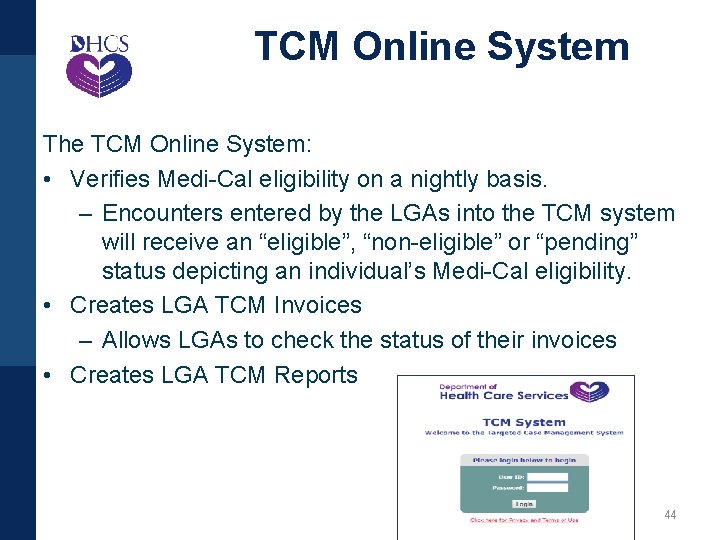
TCM Online System The TCM Online System: • Verifies Medi-Cal eligibility on a nightly basis. – Encounters entered by the LGAs into the TCM system will receive an “eligible”, “non-eligible” or “pending” status depicting an individual’s Medi-Cal eligibility. • Creates LGA TCM Invoices – Allows LGAs to check the status of their invoices • Creates LGA TCM Reports 44
TCM Website On the TCM website, an LGA is able to find: • Policy and Procedure Letters (PPLs) • State Plan Amendments (SPAs) • Program Overview/Fact Sheet • Cost Report/Time Survey Information • Time Survey Methodology Training • TCM Online System Training • Forms The TCM website can be found at: http: //www. dhcs. ca. gov/provgovpart/Pages/TCM. aspx 45
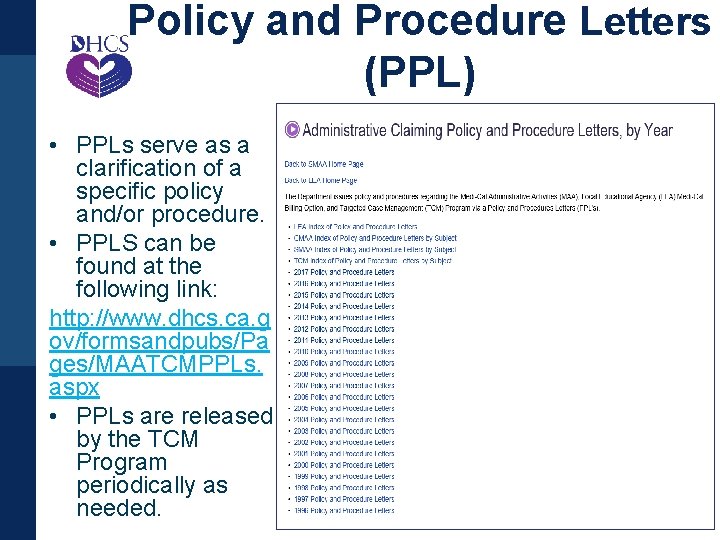
Policy and Procedure Letters (PPL) • PPLs serve as a clarification of a specific policy and/or procedure. • PPLS can be found at the following link: http: //www. dhcs. ca. g ov/formsandpubs/Pa ges/MAATCMPPLs. aspx • PPLs are released by the TCM Program periodically as needed. 46
State Plan Amendments (SPAs) The TCM SPAs are comprehensive documents describing the nature and scope of TCM services. The SPAs can be found on the following DHCS TCM website: http: //www. dhcs. ca. gov/provgovpart/Pages/TCMAppro ved. State. Plan. Amendments. aspx The service SPAs indicate in which target populations an LGA will participate, these are updated each year based on the information collected from the APPs. 47
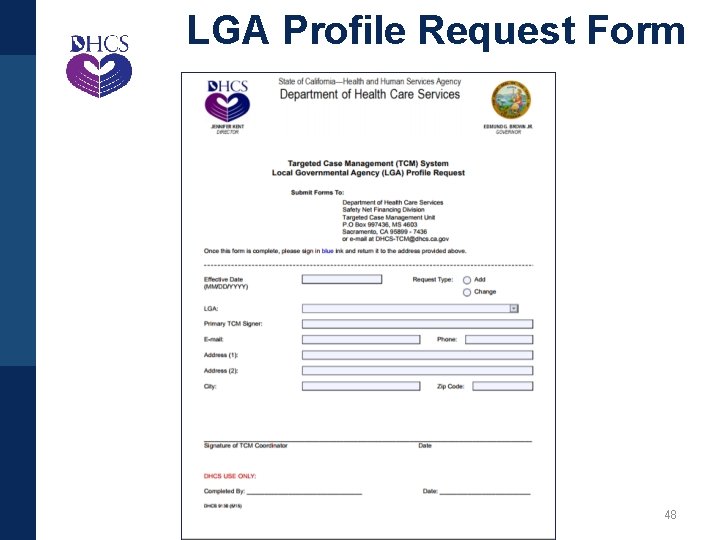
LGA Profile Request Form 48
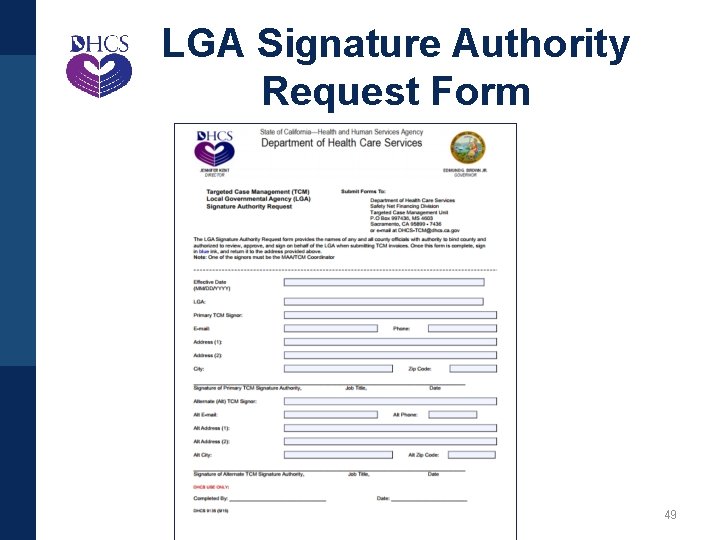
LGA Signature Authority Request Form 49
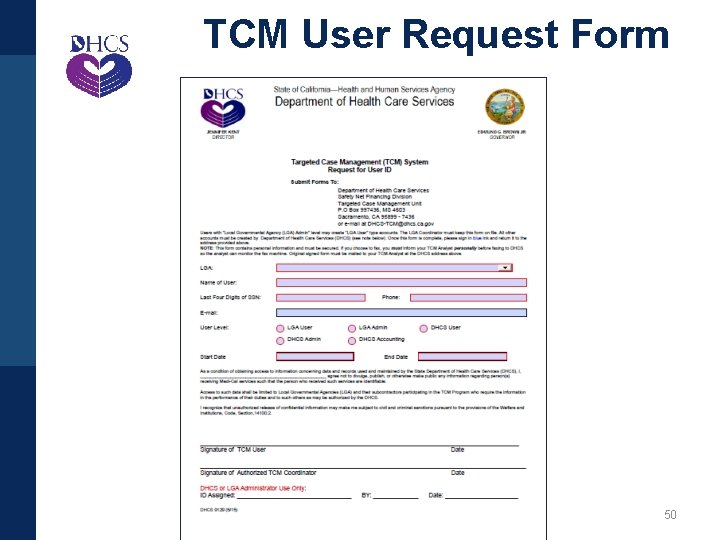
TCM User Request Form 50
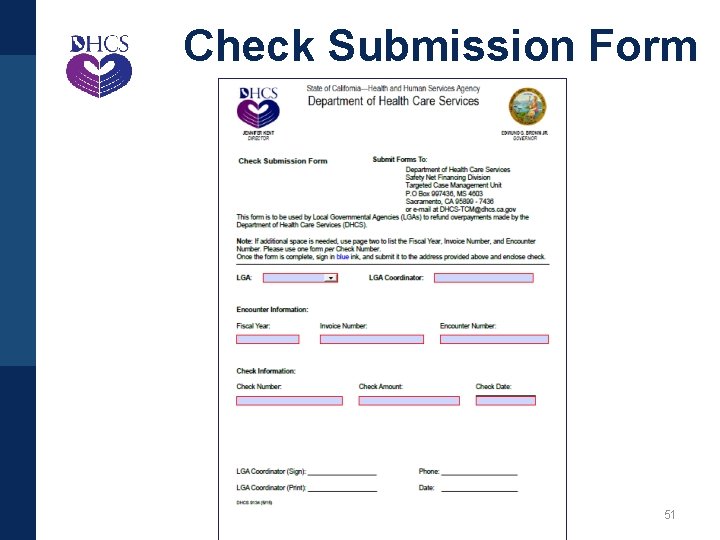
Check Submission Form 51
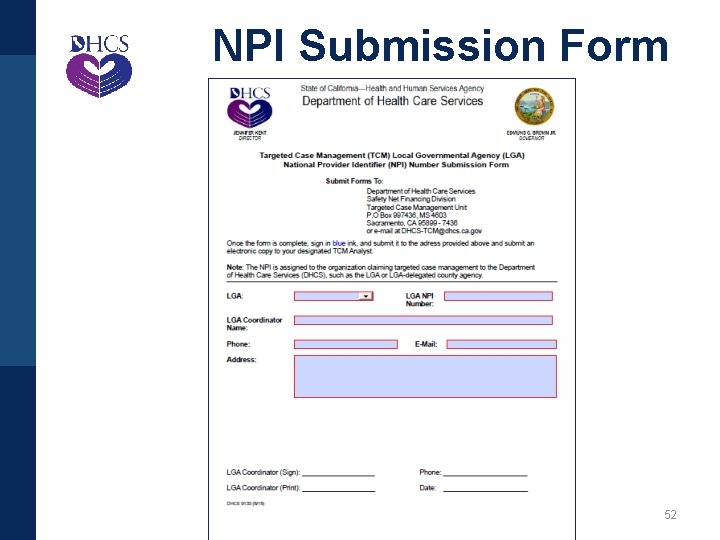
NPI Submission Form 52
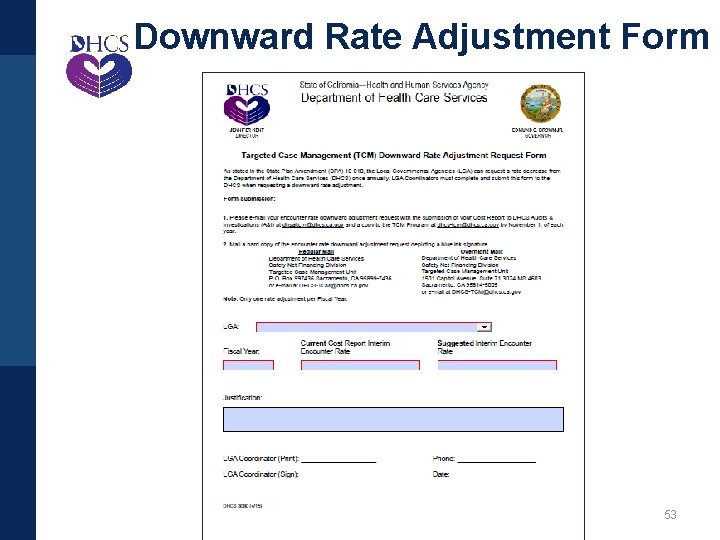
Downward Rate Adjustment Form 53
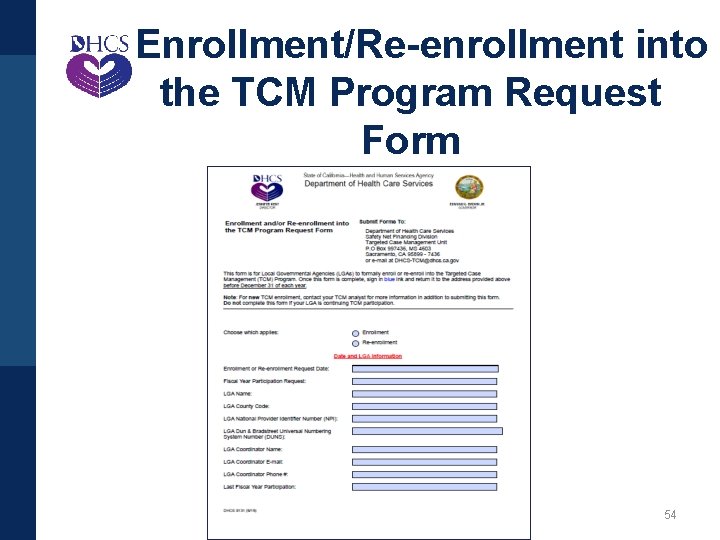
Enrollment/Re-enrollment into the TCM Program Request Form 54
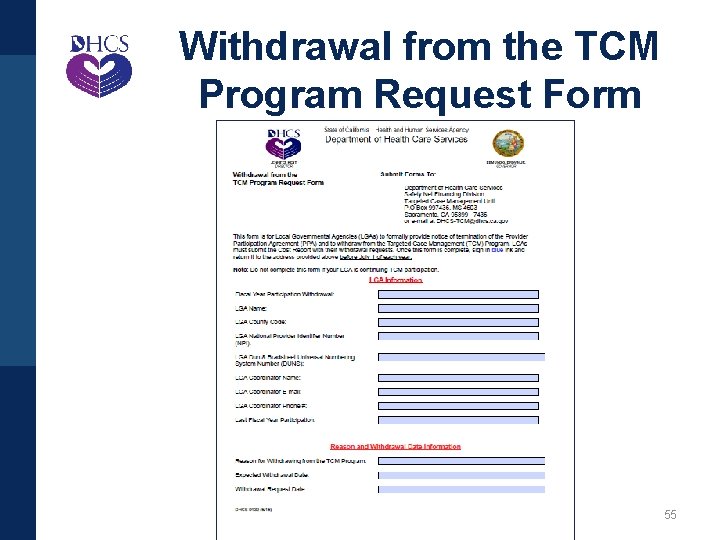
Withdrawal from the TCM Program Request Form 55
Requirements Checklist, Resources, and Authorities 56
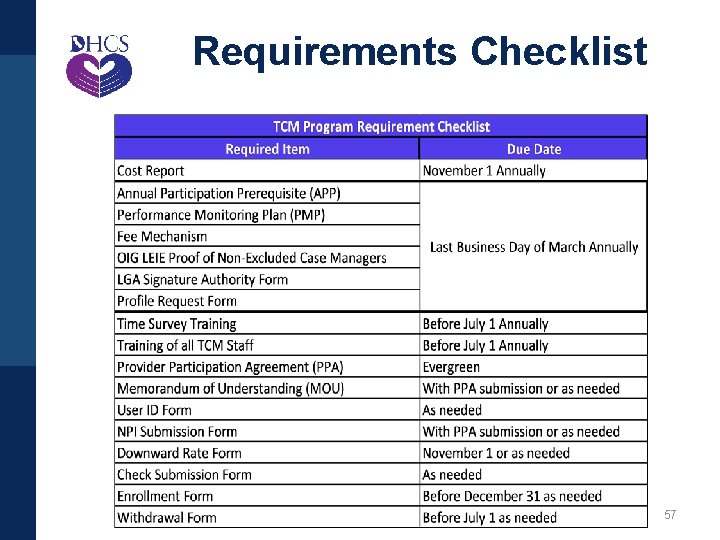
Requirements Checklist 57
Helpful Resources Contact your DHCS Analyst: Anthony. Garcia@DHCS. CA. GOV Candace. Banks@DHCS. CA. GOV Sara. Schmid@DHCS. CA. GOV Ranjini. Janardhanan@DHCS. CA. GOV Shafi. Rahimi@DHCS. CA. GOV DHCS TCM Inbox: DHCS-TCM@DHCS. CA. GOV EC Consortium: http: //www. maa-tcm. com/index 58
References and Authorities • TCM Program Requirements and Qualifications: – Title 42 of the Code of Federal Regulations (42 CFR), sections 441. 18(a)(2), 441. 18(a)(3), and 441. 18(a)(6) • Target Populations: – Defined in State Plan Supplement 1 a-1 f to Attachment 3. 1 -A and can be found on the TCM website • Provider Participation Agreement (PPA): – Pursuant to 22 CCR, section 51271 • Freedom of Choice: – Section 1902(a)(23) of the Act • Care Plans: – Per 42 CFR, section 440. 169 • Annual Participation Pre-requisite (APP): – Per PPL No. 18 -005 59
References and Authorities Cont. • Performance Monitoring Plan (PMP): – 22 CCR, section 51271(a). • Cost Report: – WIC Section 14132. 44(f). • Certified Public Expenditures (CPE): – 42, CFR, section 433. 51 • Time survey: – PPL 15 -008 • Limitations on CPEs and claims resulting from duplication of services: – 42 CFR, section 440. 169 • Duplication of services: – 42 CFR, section 441. 18(a)(4) • Encounter log: – PPL 16 -014 60

Questions? 61
- Slides: 61