
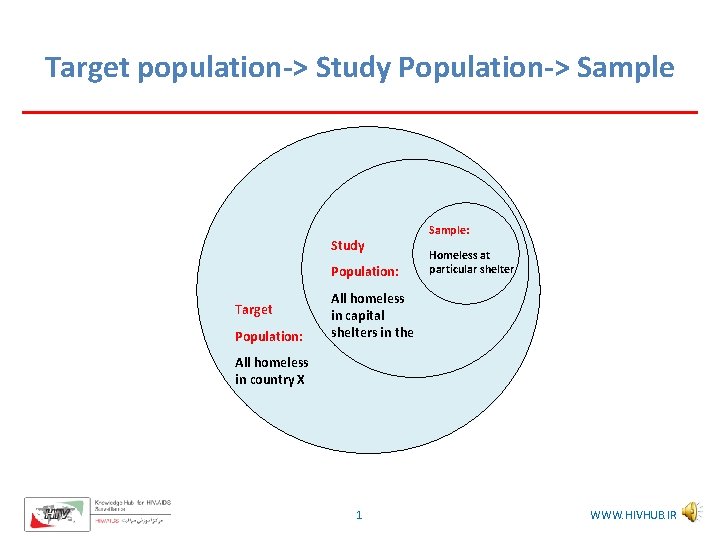
Target population Study Population Sample Study Population Target

- Slides: 7
Target population-> Study Population-> Sample Study Population: Target Population: Sample: Homeless at particular shelter All homeless in capital shelters in the All homeless in country X 1 WWW. HIVHUB. IR
What do we want from our sample? • Unbiased estimates of our indicators = Low Systematic Error • Precise estimates of our indicators = Low Random Error 2 WWW. HIVHUB. IR
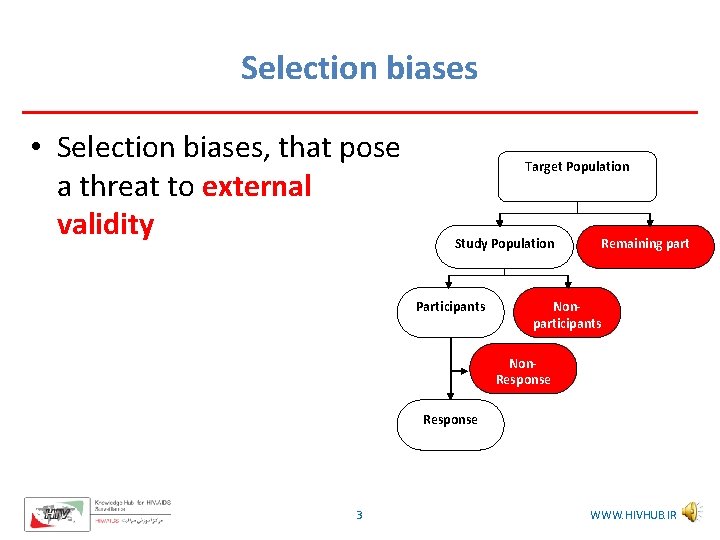
Selection biases • Selection biases, that pose a threat to external validity Target Population Study Population Participants Remaining part Nonparticipants Non. Response 3 WWW. HIVHUB. IR
How to avoid selection biases • Avoiding selection bias requires a random/probability sample. • Monitoring the sampling process from the beginning to the end of the survey. 4 WWW. HIVHUB. IR
Precise estimates • Parameter: the value of our variable in the whole population • Statistics: the value of a variable in the sample • Standard error: is a measure which shows how much our statistics is close to the parameter 5 WWW. HIVHUB. IR
How to improve the precision • Standard error (or precision) depends upon: – Size of the sample ( Total / Efficient sample size) – Distribution of character of interest in the population 6 WWW. HIVHUB. IR
General Conclusion • In HIV surveillance surreys, we have to estimate relevant indicators in the whole population, and/or in the most at risk groups. • Since, census is impossible, we have to measure these indicators in a sample and extrapolate the findings to the whole target population • To increase the accuracy, we have to have an unbiased sample with reasonable sample size 7 WWW. HIVHUB. IR