
Target Outcomes Sheet example Research project title Wild
- Slides: 2
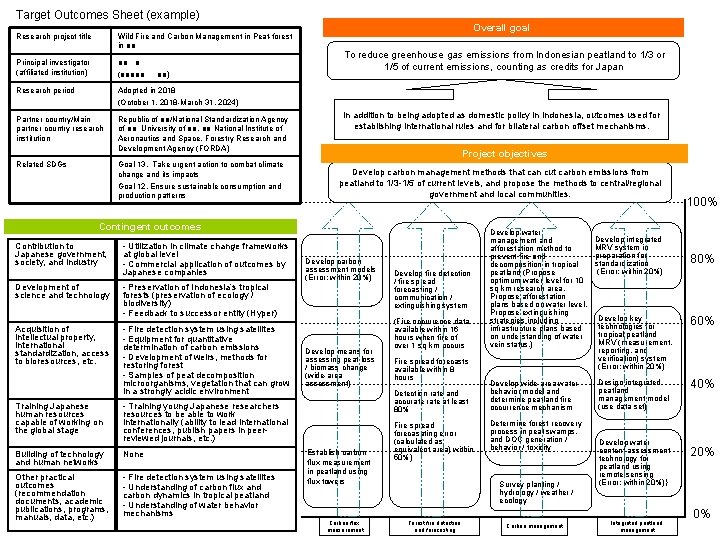
Target Outcomes Sheet (example) Research project title Wild Fire and Carbon Management in Peat-forest in ■■ Principal investigator (affiliated institution) ■■ ■ (■■■■■ Research period Adopted in 2018 (October 1, 2018 -March 31, 2024) Partner country/Main partner country research institution Republic of ■■/National Standardization Agency of ■■ University of ■■, ■■ National Institute of Aeronautics and Space, Forestry Research and Development Agency (FORDA) Related SDGs Goal 13. Take urgent action to combat climate change and its impacts Goal 12. Ensure sustainable consumption and production patterns ■■) Overall goal To reduce greenhouse gas emissions from Indonesian peatland to 1/3 or 1/5 of current emissions, counting as credits for Japan In addition to being adopted as domestic policy in Indonesia, outcomes used for establishing international rules and for bilateral carbon offset mechanisms. Project objectives Develop carbon management methods that can cut carbon emissions from peatland to 1/3 -1/5 of current levels, and propose the methods to central/regional government and local communities. Contingent outcomes Contribution to Japanese government, society, and industry - Utilization in climate change frameworks at global level - Commercial application of outcomes by Japanese companies Development of science and technology - Preservation of Indonesia’s tropical forests (preservation of ecology / biodiversity) - Feedback to successor entity (Hyper) Acquisition of intellectual property, international standardization, access to bioresources, etc. - Fire detection system using satellites - Equipment for quantitative determination of carbon emissions - Development of weirs, methods for restoring forest - Samples of peat decomposition microorganisms, vegetation that can grow in a strongly acidic environment Training Japanese human resources capable of working on the global stage - Training young Japanese researchers resources to be able to work internationally (ability to lead international conferences, publish papers in peerreviewed journals, etc. ) Building of technology and human networks None Other practical outcomes (recommendation documents, academic publications, programs, manuals, data, etc. ) - Fire detection system using satellites - Understanding of carbon flux and carbon dynamics in tropical peatland - Understanding of water behavior mechanisms Develop carbon assessment models (Error: within 20%) Develop means for assessing peat loss / biomass change (wide-area assessment) Develop fire detection / fire spread forecasting / communication / extinguishing system (Fire occurrence data available within 16 hours when fire of over 1 sq km occurs Fire spread forecasts available within 8 hours Detection rate and accurate at least 80% Establish carbon flux measurement in peatland using flux towers Carbon flux measurement Fire spread forecasating error (calculated as equivalent area) within 50%) Develop water management and afforestation method to prevent fire and decomposition in tropical peatland (Propose optimum water level for 10 sq km research area. Propose afforestation plans based on water level. Propose extinguishing strategies including infrastructure plans based on understanding of water vein status. ) Develop wide-area water behavior model and determine peatland fire occurrence mechanism Determine forest recovery process in peat swamps, and DOC generation / behavior / toxicity Survey planting / hydrology / weather / ecology Forest fire detection and forecasting Carbon management Develop integrated MRV system in preparation for standardization (Error: within 20%) 100% 80% Develop key technologies for tropical peatland MRV (measurement, reporting, and verification) system (Error: within 20%) 60% Design integrated peatland management model (use data set) 40% Develop water content assessment technology for peatland using remote sensing (Error: within 20%)) Integrated peatland management 20% 0%
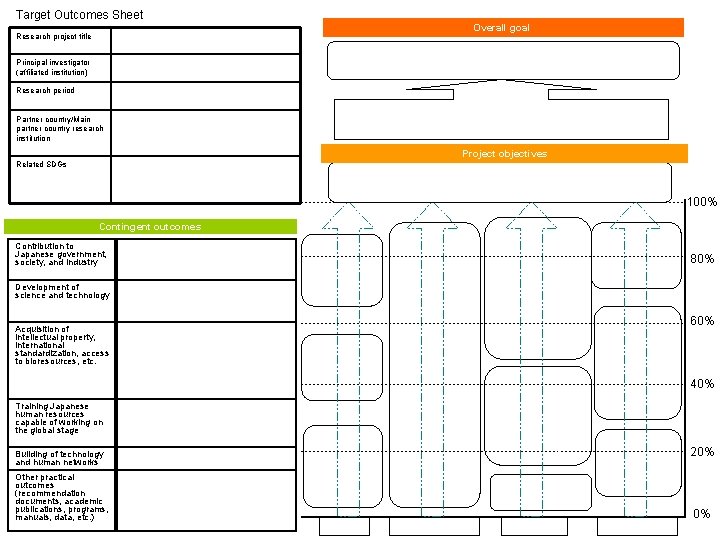
Target Outcomes Sheet Research project title Overall goal Principal investigator (affiliated institution) Research period Partner country/Main partner country research institution Project objectives Related SDGs 100% Contingent outcomes Contribution to Japanese government, society, and industry 80% Development of science and technology Acquisition of intellectual property, international standardization, access to bioresources, etc. 60% 40% Training Japanese human resources capable of working on the global stage Building of technology and human networks Other practical outcomes (recommendation documents, academic publications, programs, manuals, data, etc. ) 20% 0%