
Target identification using the inverse scattering series data





- Slides: 44
Target identification using the inverse scattering series: data requirements for the direct inversion of large-contrast, inhomogeneous elastic media Haiyan Zhang and Arthur B. Weglein M-OSRP Annual Meeting, University of Houston March 31 – April 1, 2004 1
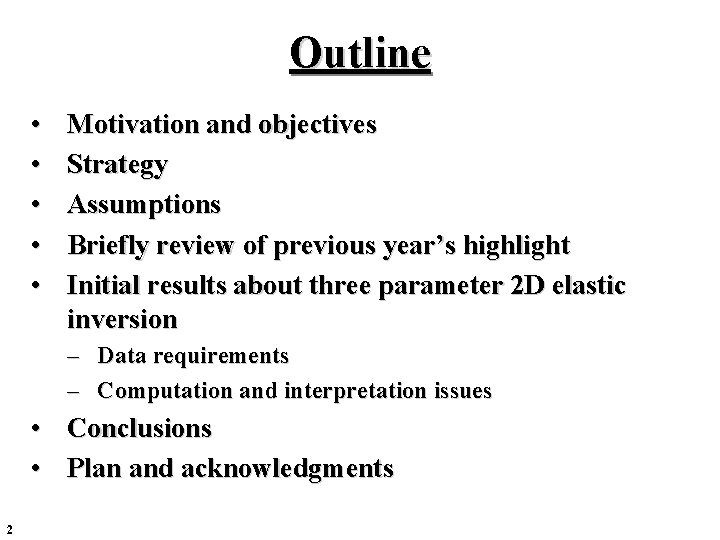
Outline • • • Motivation and objectives Strategy Assumptions Briefly review of previous year’s highlight Initial results about three parameter 2 D elastic inversion – Data requirements – Computation and interpretation issues • Conclusions • Plan and acknowledgments 2
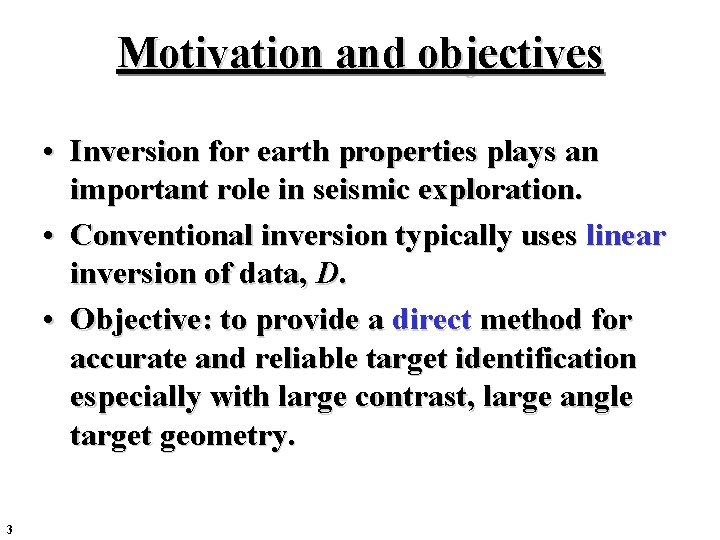
Motivation and objectives • Inversion for earth properties plays an important role in seismic exploration. • Conventional inversion typically uses linear inversion of data, D. • Objective: to provide a direct method for accurate and reliable target identification especially with large contrast, large angle target geometry. 3
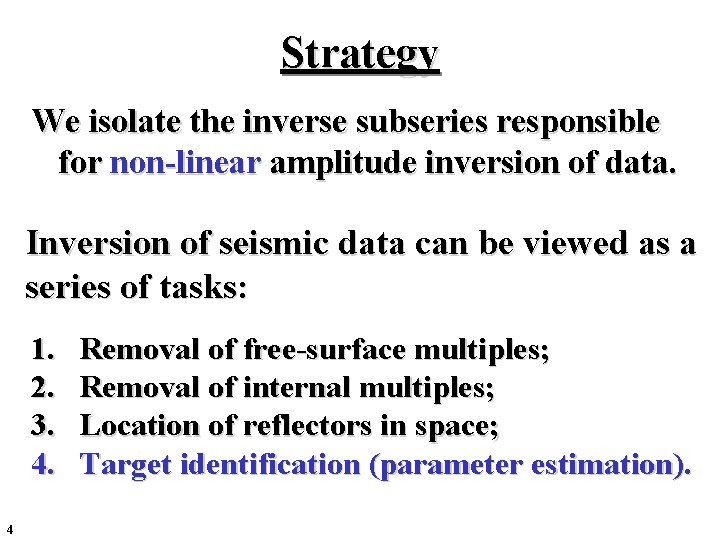
Strategy We isolate the inverse subseries responsible for non-linear amplitude inversion of data. Inversion of seismic data can be viewed as a series of tasks: 1. 2. 3. 4. 4 Removal of free-surface multiples; Removal of internal multiples; Location of reflectors in space; Target identification (parameter estimation).
Assumptions • All multiples have been removed from the input data (only primary reflections). • The targets have already been located in correct position. • The information of the reference medium is given. 5
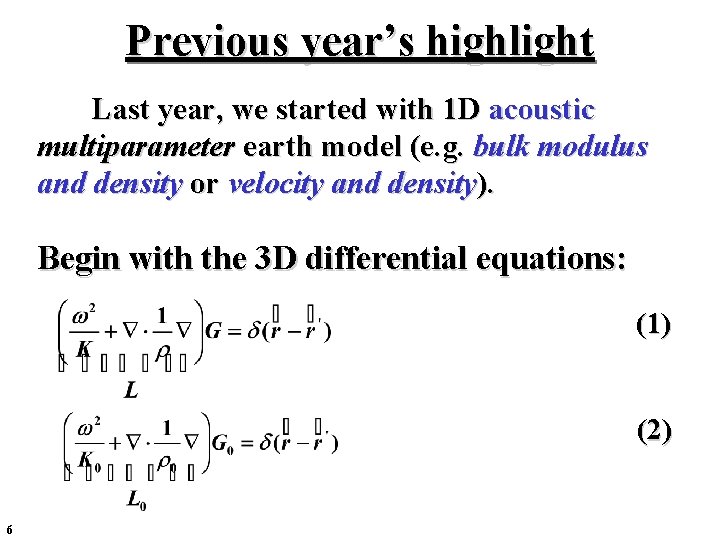
Previous year’s highlight Last year, we started with 1 D acoustic multiparameter earth model (e. g. bulk modulus and density or velocity and density). Begin with the 3 D differential equations: (1) (2) 6
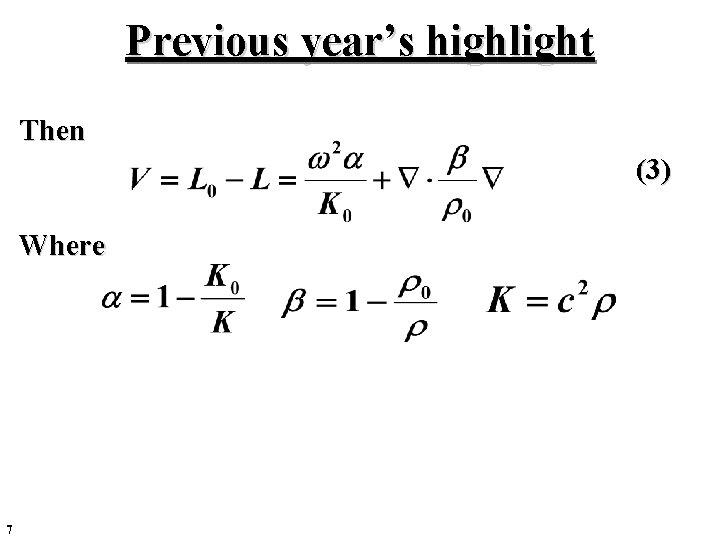
Previous year’s highlight Then (3) Where 7
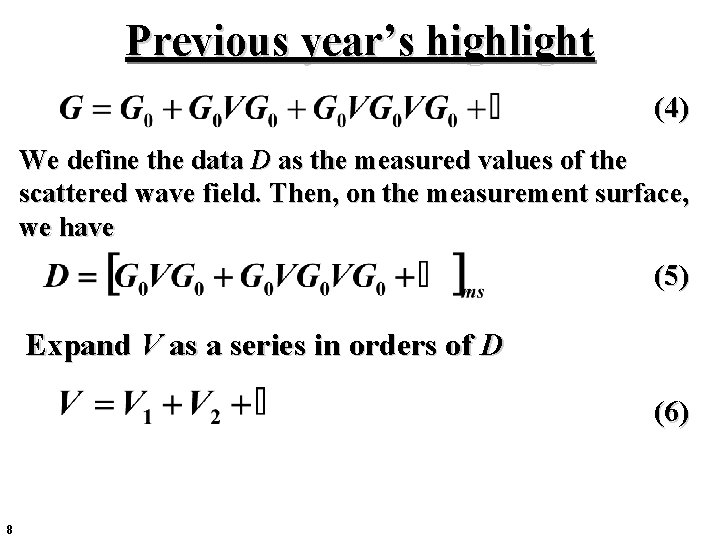
Previous year’s highlight (4) We define the data D as the measured values of the scattered wave field. Then, on the measurement surface, we have (5) Expand V as a series in orders of D (6) 8
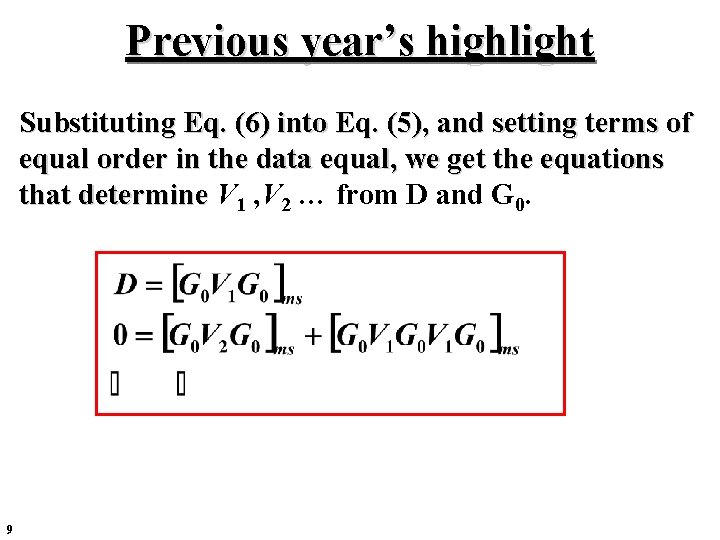
Previous year’s highlight Substituting Eq. (6) into Eq. (5), and setting terms of equal order in the data equal, we get the equations that determine V 1 , V 2 … from D and G 0. 9
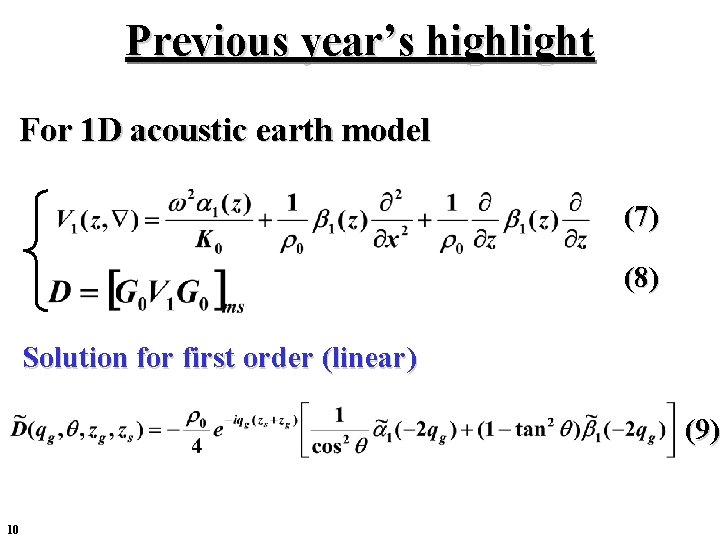
Previous year’s highlight For 1 D acoustic earth model (7) (8) Solution for first order (linear) (9) 10
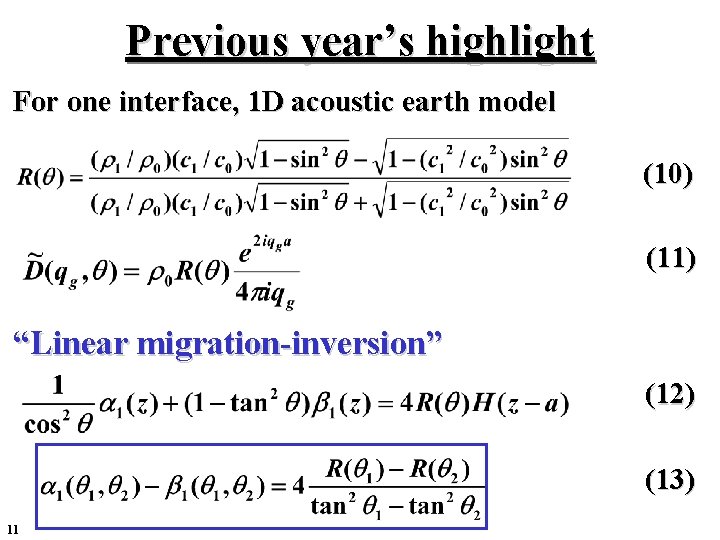
Previous year’s highlight For one interface, 1 D acoustic earth model (10) (11) “Linear migration-inversion” (12) (13) 11
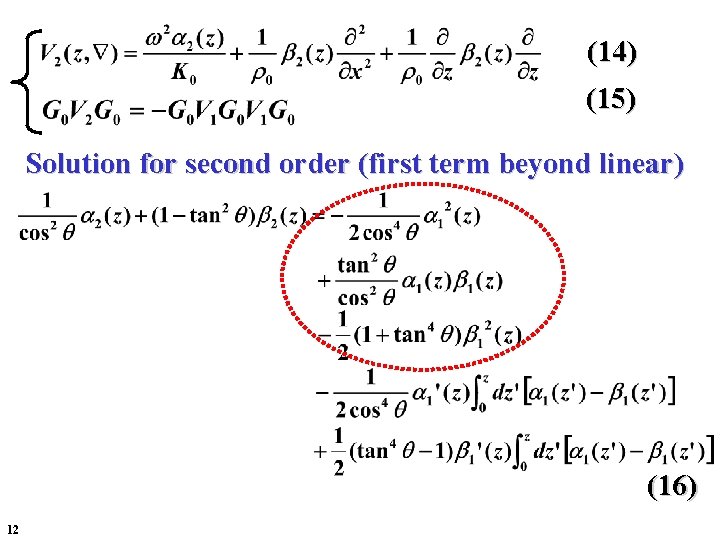
(14) (15) Solution for second order (first term beyond linear) (16) 12
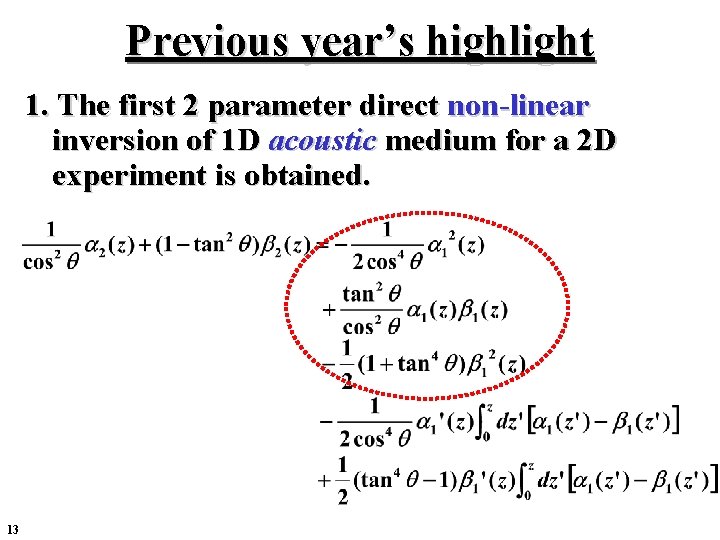
Previous year’s highlight 1. The first 2 parameter direct non-linear inversion of 1 D acoustic medium for a 2 D experiment is obtained. 13
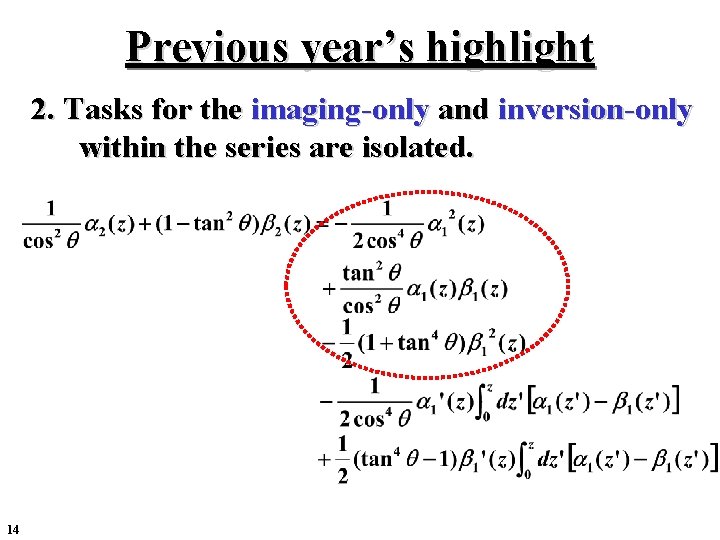
Previous year’s highlight 2. Tasks for the imaging-only and inversion-only within the series are isolated. 14
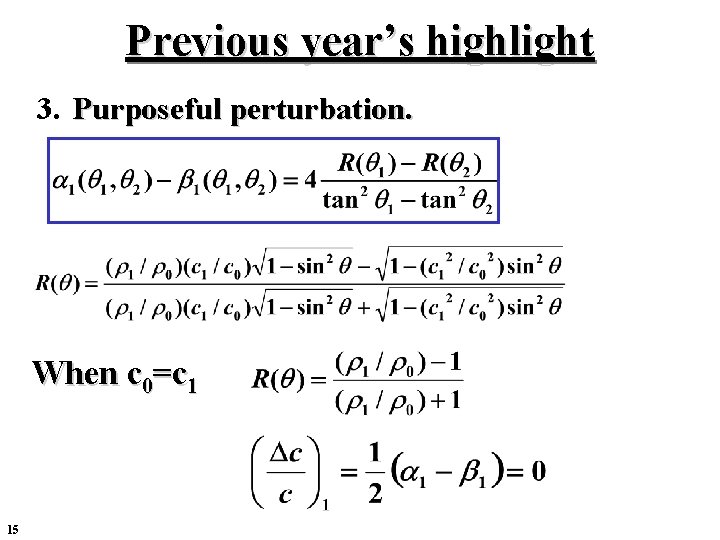
Previous year’s highlight 3. Purposeful perturbation. When c 0=c 1 15
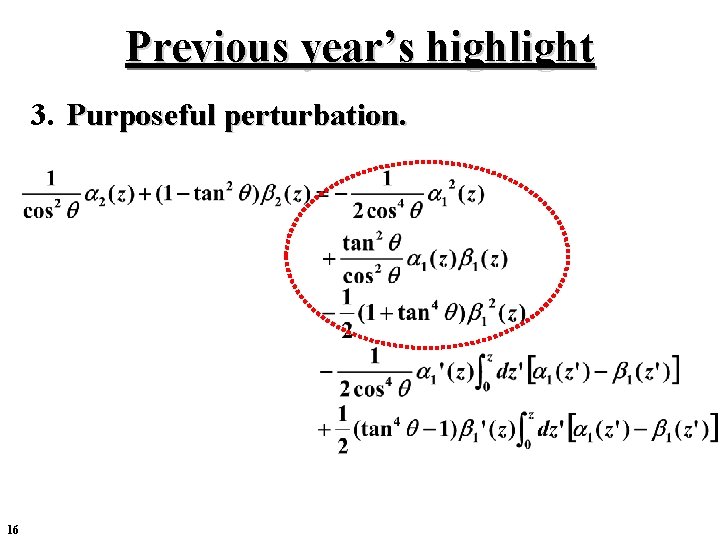
Previous year’s highlight 3. Purposeful perturbation. 16
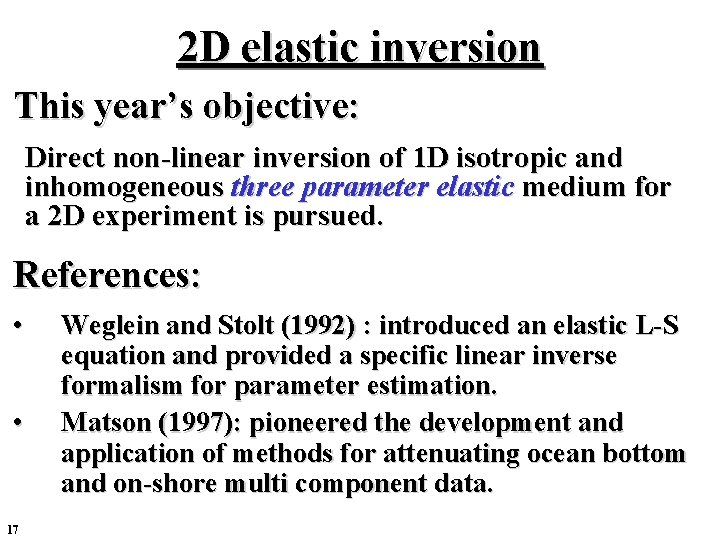
2 D elastic inversion This year’s objective: Direct non-linear inversion of 1 D isotropic and inhomogeneous three parameter elastic medium for a 2 D experiment is pursued. References: • • 17 Weglein and Stolt (1992) : introduced an elastic L-S equation and provided a specific linear inverse formalism for parameter estimation. Matson (1997): pioneered the development and application of methods for attenuating ocean bottom and on-shore multi component data.
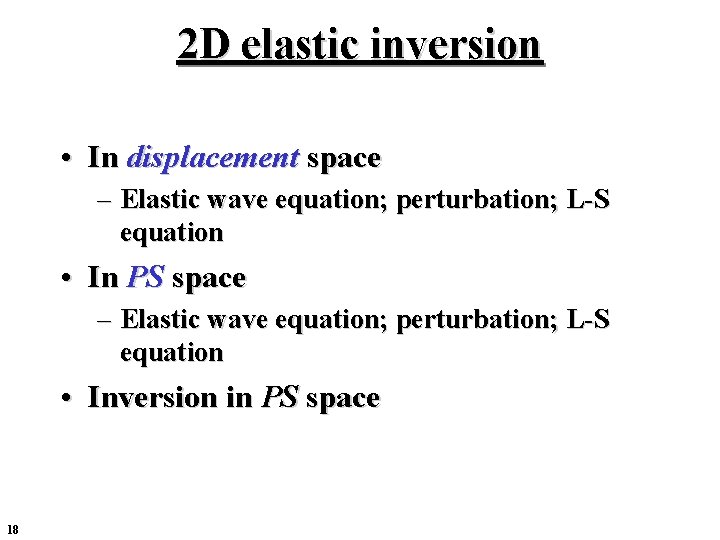
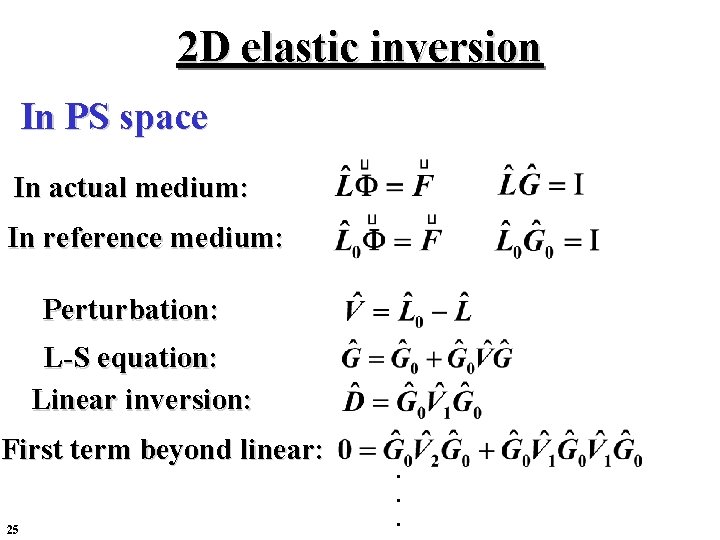
2 D elastic inversion • In displacement space – Elastic wave equation; perturbation; L-S equation • In PS space – Elastic wave equation; perturbation; L-S equation • Inversion in PS space 18
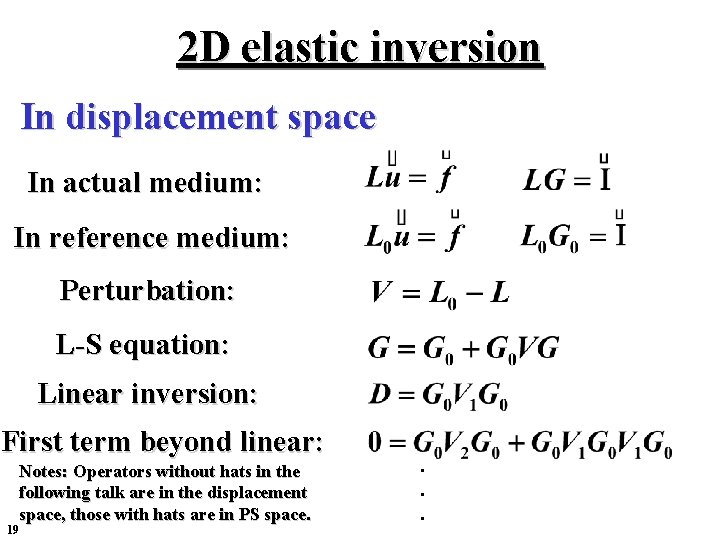
2 D elastic inversion In displacement space In actual medium: In reference medium: Perturbation: L-S equation: Linear inversion: First term beyond linear: Notes: Operators without hats in the following talk are in the displacement space, those with hats are in PS space. 19 . . .
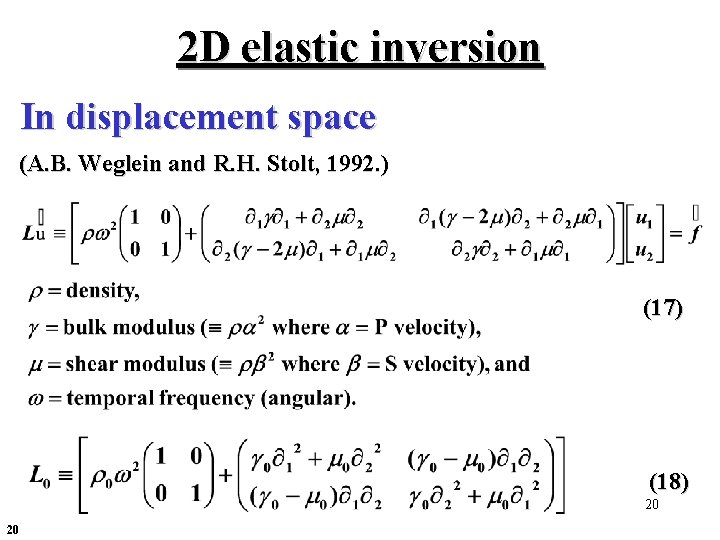
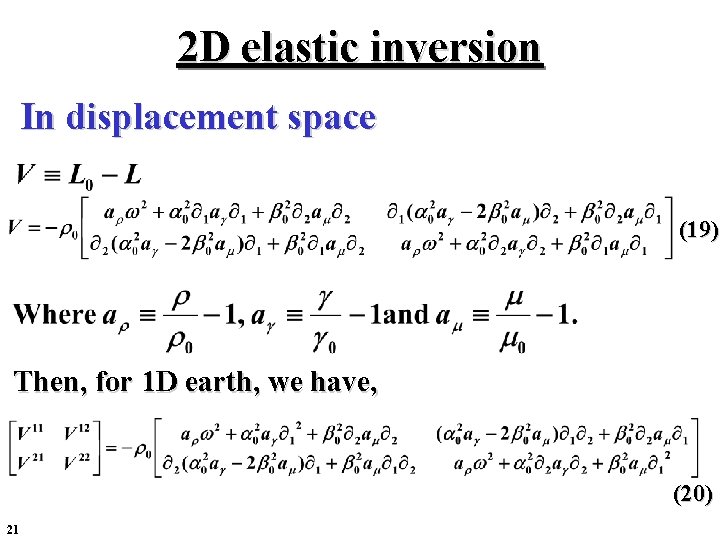
2 D elastic inversion In displacement space (A. B. Weglein and R. H. Stolt, 1992. ) (17) (18) 20 20
2 D elastic inversion In displacement space (19) Then, for 1 D earth, we have, (20) 21
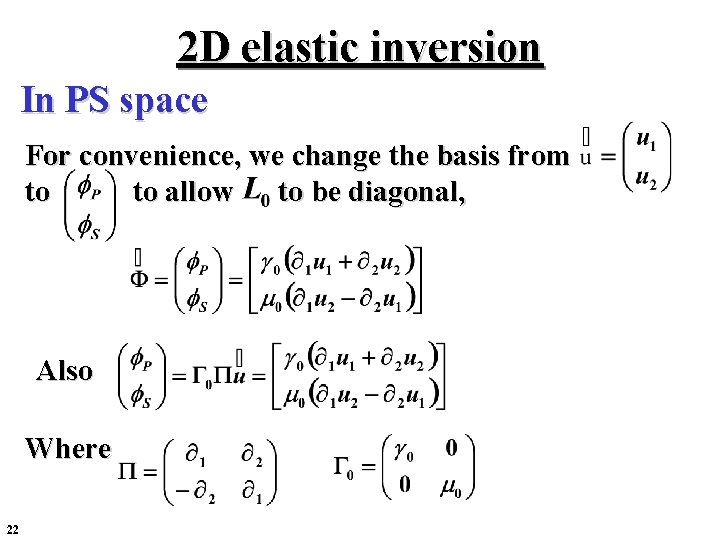
2 D elastic inversion In PS space For convenience, we change the basis from to to allow to be diagonal, Also Where 22
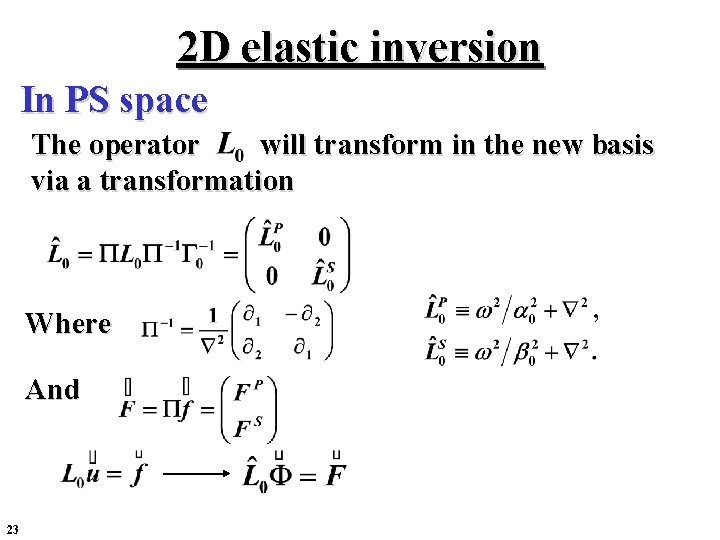
2 D elastic inversion In PS space The operator will transform in the new basis via a transformation Where And 23
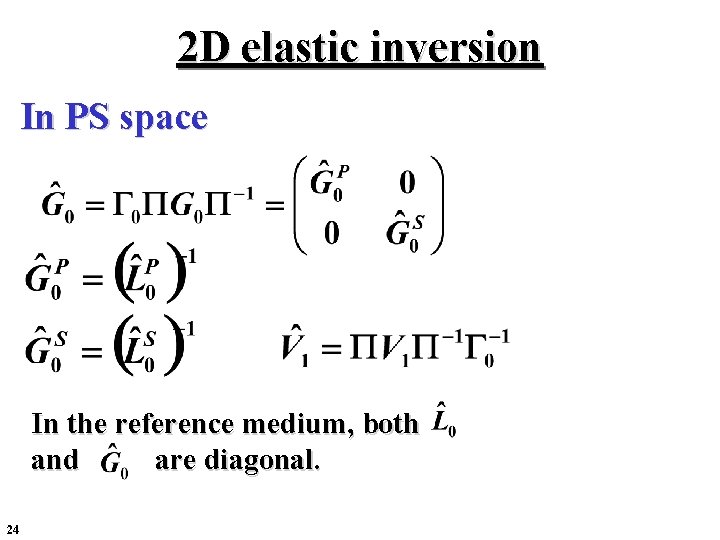
2 D elastic inversion In PS space In the reference medium, both and are diagonal. 24
2 D elastic inversion In PS space In actual medium: In reference medium: Perturbation: L-S equation: Linear inversion: First term beyond linear: 25 . . .
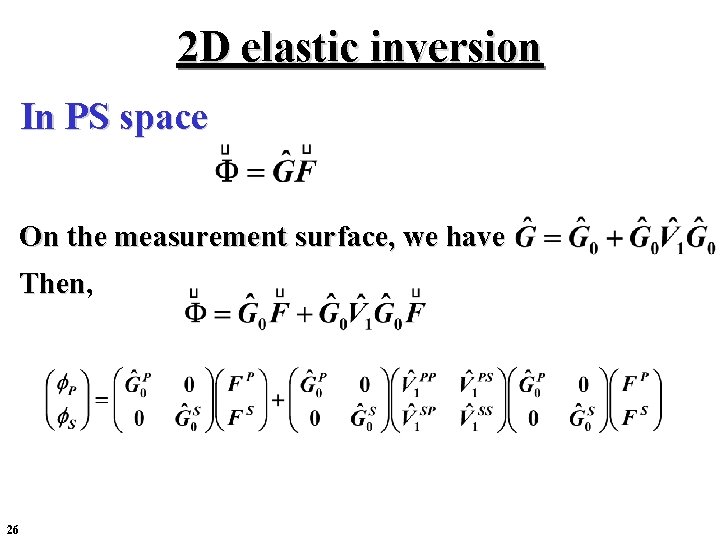
2 D elastic inversion In PS space On the measurement surface, we have Then, Then 26
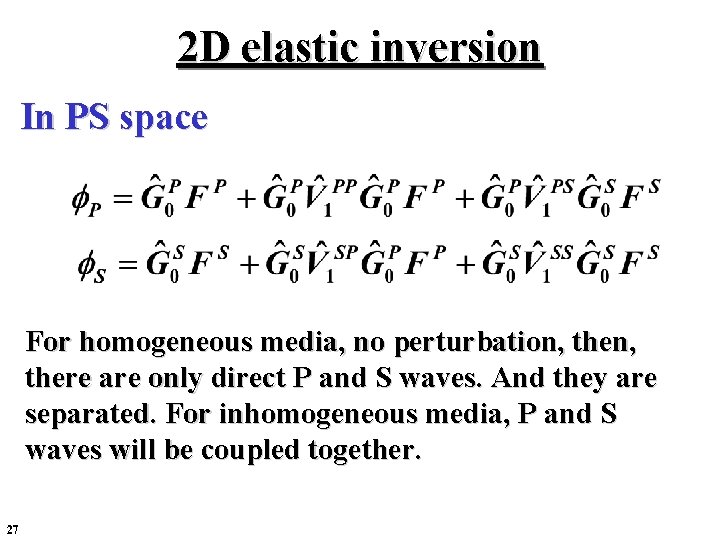
2 D elastic inversion In PS space For homogeneous media, no perturbation, there are only direct P and S waves. And they are separated. For inhomogeneous media, P and S waves will be coupled together. 27
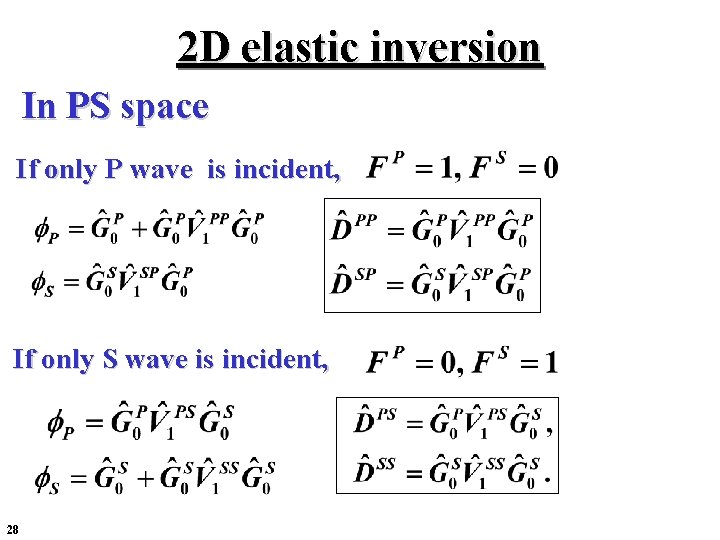
2 D elastic inversion In PS space If only P wave is incident, If only S wave is incident, 28
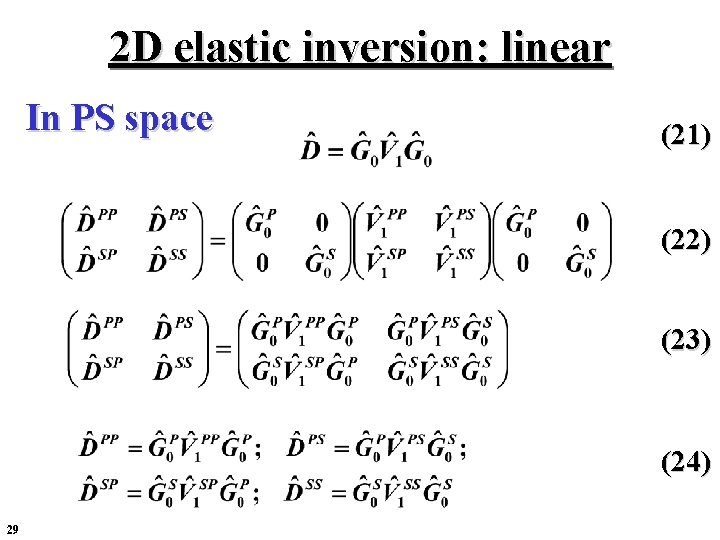
2 D elastic inversion: linear In PS space (21) (22) (23) (24) 29
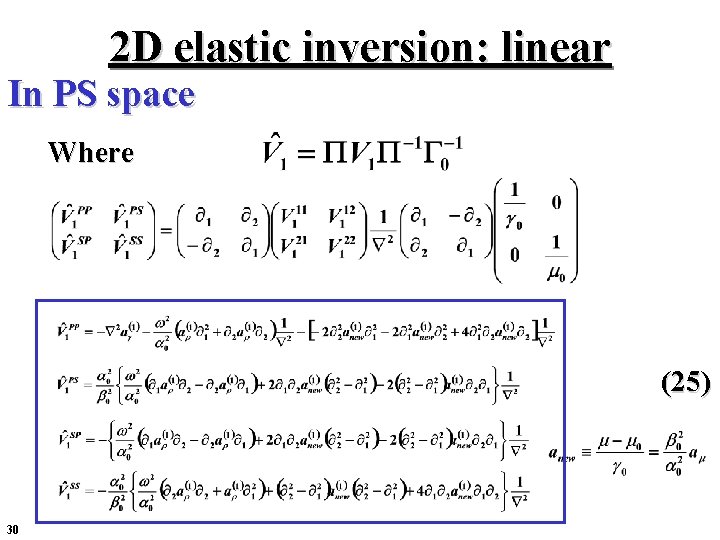
2 D elastic inversion: linear In PS space Where (25) 30
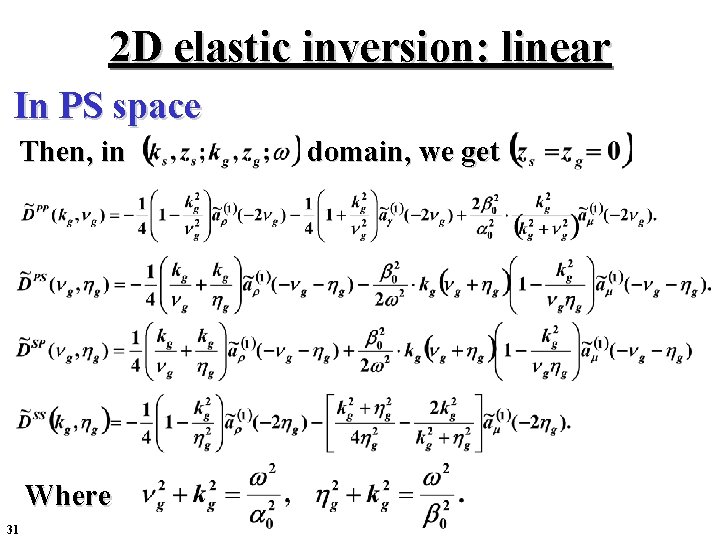
2 D elastic inversion: linear In PS space Then, in Where 31 domain, we get
2 D elastic inversion: non-linear In PS space (26) 32
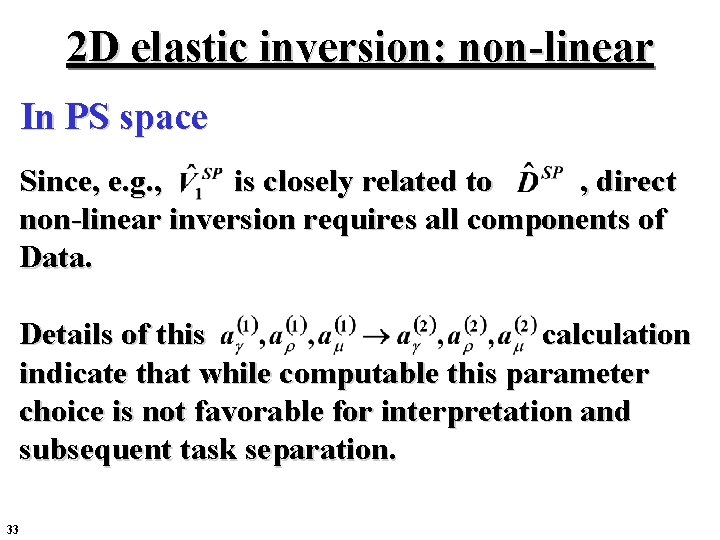
2 D elastic inversion: non-linear In PS space Since, e. g. , is closely related to , direct non-linear inversion requires all components of Data. Details of this calculation indicate that while computable this parameter choice is not favorable for interpretation and subsequent task separation. 33
2 D elastic inversion: non-linear In PS space The issue of how inverse series can be interpreted in terms of tasks is not new, not confined to tasks associated with primaries, and not an issue that begins with the elastic equation. We illustrate this by taking another look at the acoustic problem. 34
Interpretation in inversion • What parameters to use? – Material parameters – Free parameters 35
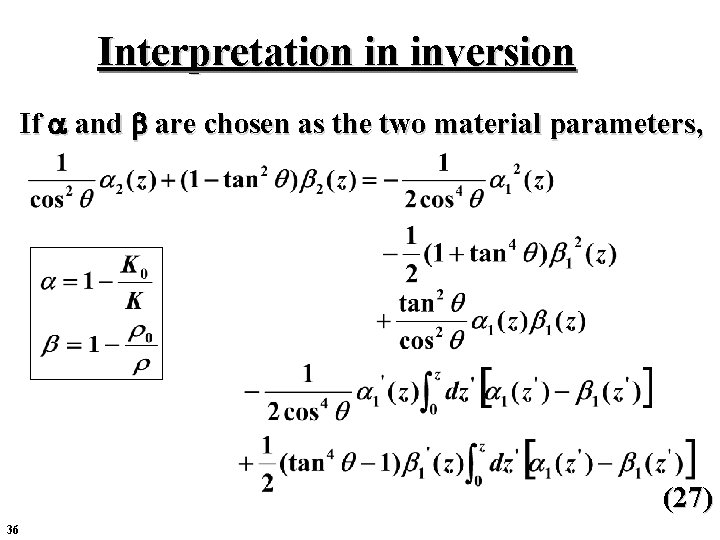
Interpretation in inversion If a and b are chosen as the two material parameters, (27) 36
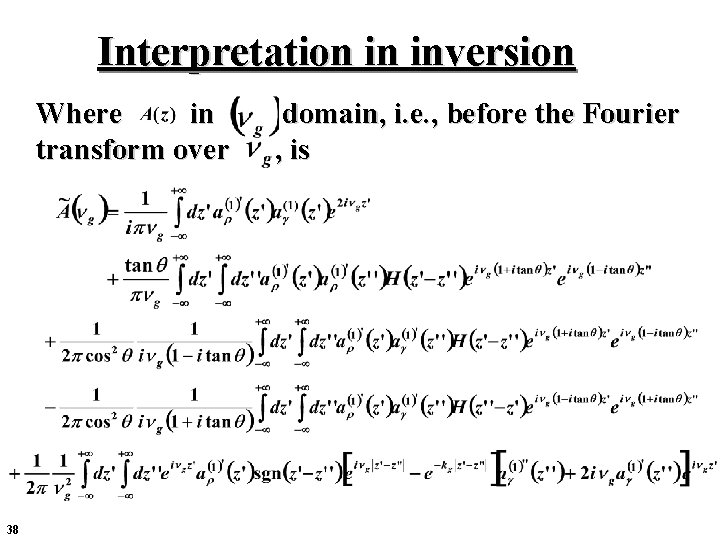
Interpretation in inversion If and are chosen as the two material parameters, (28) 37
Interpretation in inversion Where in transform over 38 domain, i. e. , before the Fourier , is
Interpretation in inversion • The parameters that we have chosen for the elastic non-linear inversion are the generalizations of the for the acoustic case, computable but not amenable to easy interpretation and subsequent task separation. We are examining the framework to allow an interpretable elastic generalization. 39
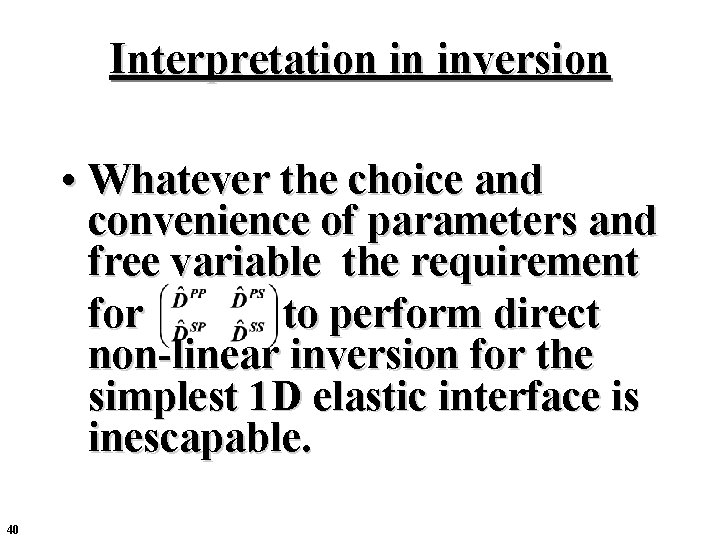
Interpretation in inversion • Whatever the choice and convenience of parameters and free variable the requirement for to perform direct non-linear inversion for the simplest 1 D elastic interface is inescapable. 40
Interpretation in inversion • Provides a framework for that level of ambition and allows time to strategize to allow the inverse series to provide the R’s free of T’s required for this non-linear direct inversion at depth. 41
Conclusion • This talk provides a conceptual platform and analysis of issues involved in data requirements, computation and interpretation of the non-linear direct elastic inverse problem. • A detailed examination of how different choices of acoustic parameters and free parameters have a marked difference on the ability of task separated interpretation. • This analysis provides a guide and lesson for ongoing efforts at parameter inversion and structural location specific sub series for the elastic world. 42
Plan • To choose parameters for the elastic nonlinear inversion problem, that are most agreeable to physical interpretation in terms of imaging and inversion tasks. 43
Acknowledgments • The M-OSRP sponsors are thanked for supporting this research. • We are grateful to Robert Keys and Douglas Foster for useful comments and suggestions. 44