
Target Architecture Development Learning Purpose Learn how to

- Slides: 38
Target Architecture Development
Learning Purpose Learn how to develop a target architecture Understand the procedure of defining architectural directions which will lead development of a desired future state (target architecture) Understand the procedure of developing a target architecture, and how to apply business and IT requirements according to the architecture. 1
Contents 1. Target Architecture Development Overview 2. Target Architecture Directions Definition 3. Target Architecture Development
1. Target Architecture Development Overview 2. Target Architecture Directions Definition 3. Target Architecture Development
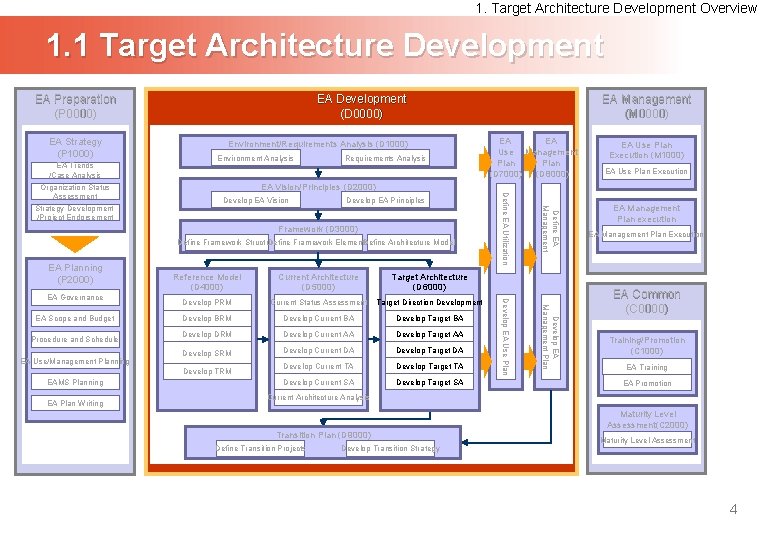
1. Target Architecture Development Overview 1. 1 Target Architecture Development EA Preparation (P 0000) EA Strategy (P 1000) Environment/Requirements Analysis (D 1000) Environment Analysis Requirements Analysis Develop EA Principles EA Use/Management Planning Target Architecture (D 6000) Develop PRM Current Status Assessment Target Direction Development Develop BRM Develop Current BA Develop Target BA Develop DRM Develop Current AA Develop Target AA Develop SRM Develop Current DA Develop Target DA Develop Current TA Develop Target TA Develop Current SA Develop Target SA Develop TRM EAMS Planning EA Plan Writing Develop EA Management Plan Procedure and Schedule Current Architecture (D 5000) Develop EA Use Plan EA Scope and Budget Reference Model (D 4000) Define EA Management Framework (D 3000) EA Governance EA Use Plan Execution (M 1000) EA Use Plan Execution EA Vision/Principles (D 2000) Develop EA Vision Define Framework Structure Define Architecture Model Define Framework Elements EA Planning (P 2000) EA EA Use Management Plan (D 7000) (D 8000) Define EA Utilization EA Trends /Case Analysis Organization Status Assessment Strategy Development /Project Endorsement EA Management (M 0000) EA Development (D 0000) EA Management Plan execution (M 2000) EA Management Plan Execution EA Common (C 0000) Training/Promotion (C 1000) EA Training EA Promotion Current Architecture Analysis Maturity Level Assessment(C 2000) Transition Plan (D 9000) Define Transition Projects Develop Transition Strategy Maturity Level Assessment 4
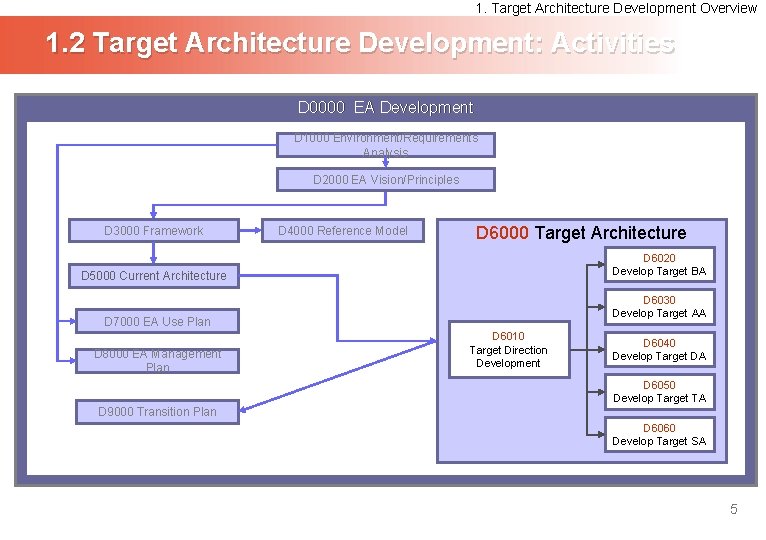
1. Target Architecture Development Overview 1. 2 Target Architecture Development: Activities D 0000 EA Development D 1000 Environment/Requirements Analysis D 2000 EA Vision/Principles D 3000 Framework D 4000 Reference Model D 6000 Target Architecture D 6020 Develop Target BA D 5000 Current Architecture D 6030 Develop Target AA D 7000 EA Use Plan D 8000 EA Management Plan D 6010 Target Direction Development D 6040 Develop Target DA D 6050 Develop Target TA D 9000 Transition Plan D 6060 Develop Target SA 5
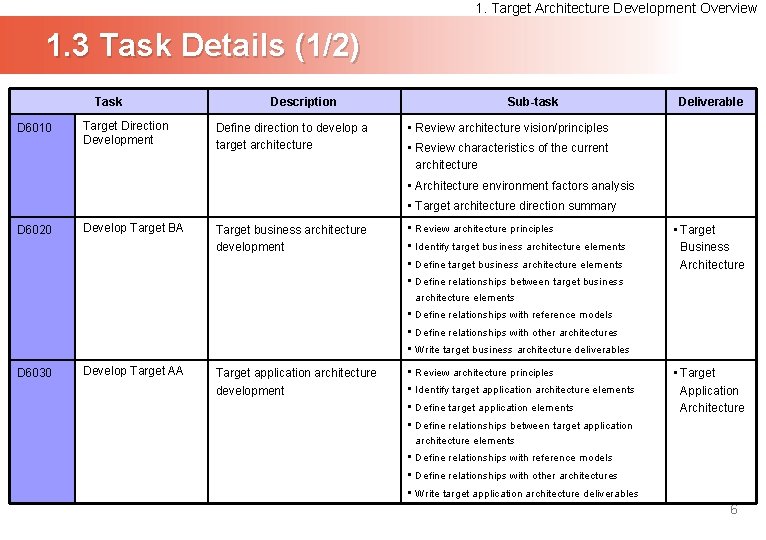
1. Target Architecture Development Overview 1. 3 Task Details (1/2) Task D 6010 Target Direction Development Description Define direction to develop a target architecture Sub-task Deliverable • Review architecture vision/principles • Review characteristics of the current architecture • Architecture environment factors analysis • Target architecture direction summary D 6020 Develop Target BA Target business architecture development • Review architecture principles • Identify target business architecture elements • Define target business architecture elements • Target Business Architecture • Define relationships between target business architecture elements • Define relationships with reference models • Define relationships with other architectures • Write target business architecture deliverables D 6030 Develop Target AA Target application architecture development • Review architecture principles • Identify target application architecture elements • Define target application elements • Target Application Architecture • Define relationships between target application architecture elements • Define relationships with reference models • Define relationships with other architectures • Write target application architecture deliverables 6
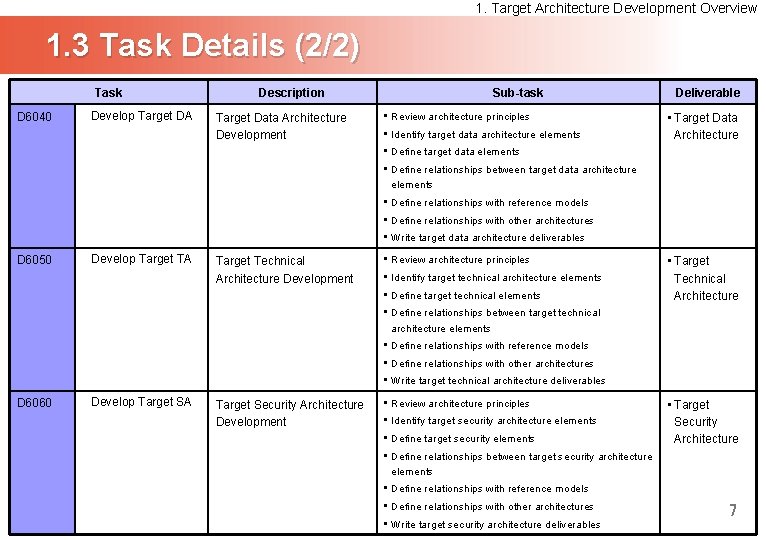
1. Target Architecture Development Overview 1. 3 Task Details (2/2) Task D 6040 Develop Target DA Description Target Data Architecture Development Sub-task • Review architecture principles • Identify target data architecture elements Deliverable • Target Data Architecture • Define target data elements • Define relationships between target data architecture elements • Define relationships with reference models • Define relationships with other architectures • Write target data architecture deliverables D 6050 Develop Target TA Target Technical Architecture Development • Review architecture principles • Identify target technical architecture elements • Define target technical elements • Target Technical Architecture • Define relationships between target technical architecture elements • Define relationships with reference models • Define relationships with other architectures • Write target technical architecture deliverables D 6060 Develop Target SA Target Security Architecture Development • Review architecture principles • Identify target security architecture elements • Define target security elements • Target Security Architecture • Define relationships between target security architecture elements • Define relationships with reference models • Define relationships with other architectures • Write target security architecture deliverables 7
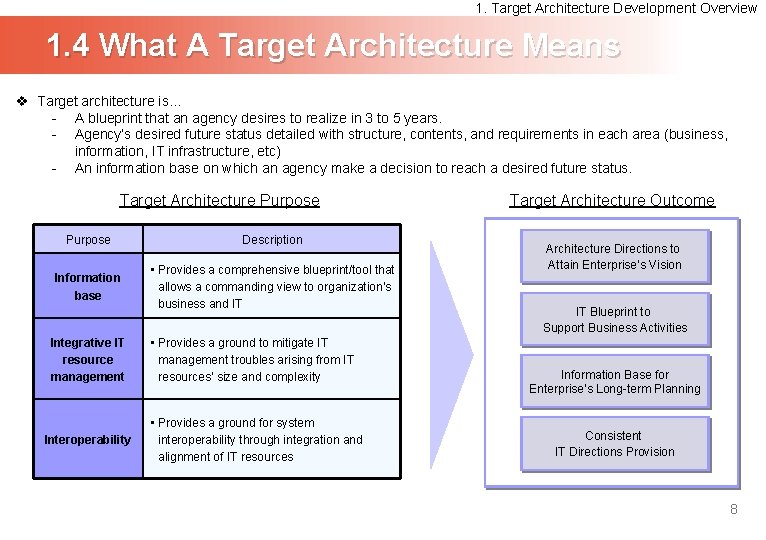
1. Target Architecture Development Overview 1. 4 What A Target Architecture Means v Target architecture is… - A blueprint that an agency desires to realize in 3 to 5 years. - Agency’s desired future status detailed with structure, contents, and requirements in each area (business, information, IT infrastructure, etc) - An information base on which an agency make a decision to reach a desired future status. Target Architecture Purpose Description Information base • Provides a comprehensive blueprint/tool that allows a commanding view to organization’s business and IT Integrative IT resource management Interoperability • Provides a ground to mitigate IT management troubles arising from IT resources’ size and complexity • Provides a ground for system interoperability through integration and alignment of IT resources Target Architecture Outcome Architecture Directions to Attain Enterprise’s Vision IT Blueprint to Support Business Activities Information Base for Enterprise’s Long-term Planning Consistent IT Directions Provision 8
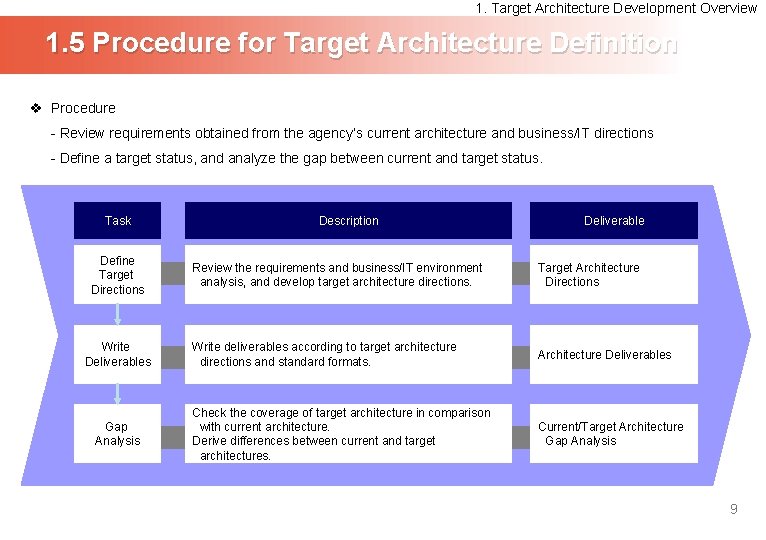
1. Target Architecture Development Overview 1. 5 Procedure for Target Architecture Definition v Procedure - Review requirements obtained from the agency’s current architecture and business/IT directions - Define a target status, and analyze the gap between current and target status. Task Define Target Directions Write Deliverables Gap Analysis Description Deliverable Review the requirements and business/IT environment analysis, and develop target architecture directions. Target Architecture Directions Write deliverables according to target architecture directions and standard formats. Architecture Deliverables Check the coverage of target architecture in comparison with current architecture. Derive differences between current and target architectures. Current/Target Architecture Gap Analysis 9
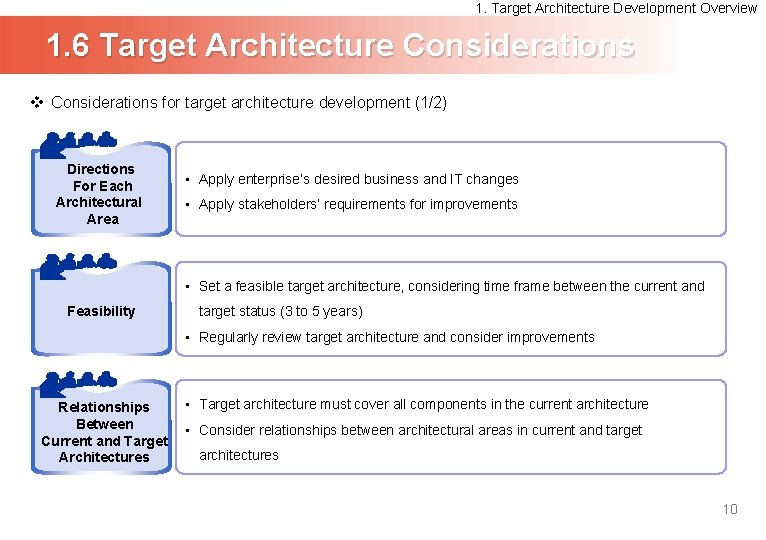
1. Target Architecture Development Overview 1. 6 Target Architecture Considerations v Considerations for target architecture development (1/2) Directions For Each Architectural Area • Apply enterprise’s desired business and IT changes • Apply stakeholders’ requirements for improvements • Set a feasible target architecture, considering time frame between the current and Feasibility target status (3 to 5 years) • Regularly review target architecture and consider improvements Relationships Between Current and Target Architectures • Target architecture must cover all components in the current architecture • Consider relationships between architectural areas in current and target architectures 10
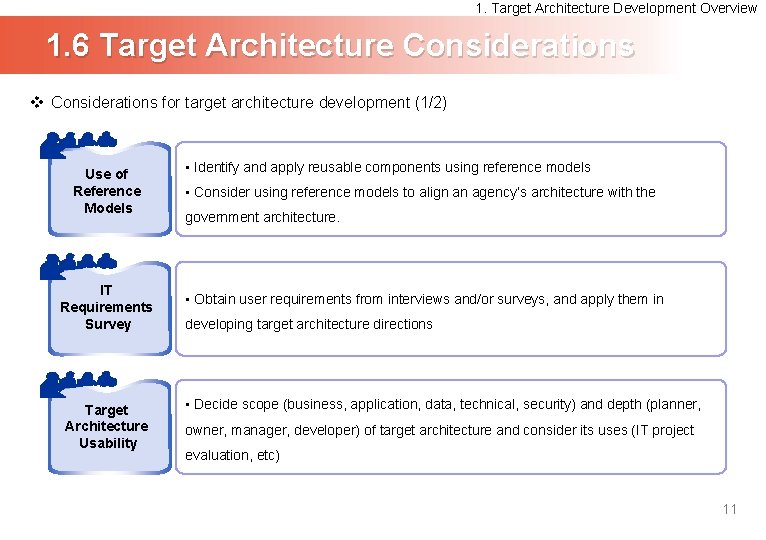
1. Target Architecture Development Overview 1. 6 Target Architecture Considerations v Considerations for target architecture development (1/2) Use of Reference Models IT Requirements Survey Target Architecture Usability • Identify and apply reusable components using reference models • Consider using reference models to align an agency’s architecture with the government architecture. • Obtain user requirements from interviews and/or surveys, and apply them in developing target architecture directions • Decide scope (business, application, data, technical, security) and depth (planner, owner, manager, developer) of target architecture and consider its uses (IT project evaluation, etc) 11
1. Target Architecture Development Overview 2. Target Architecture Directions Definition 3. Target Architecture Development
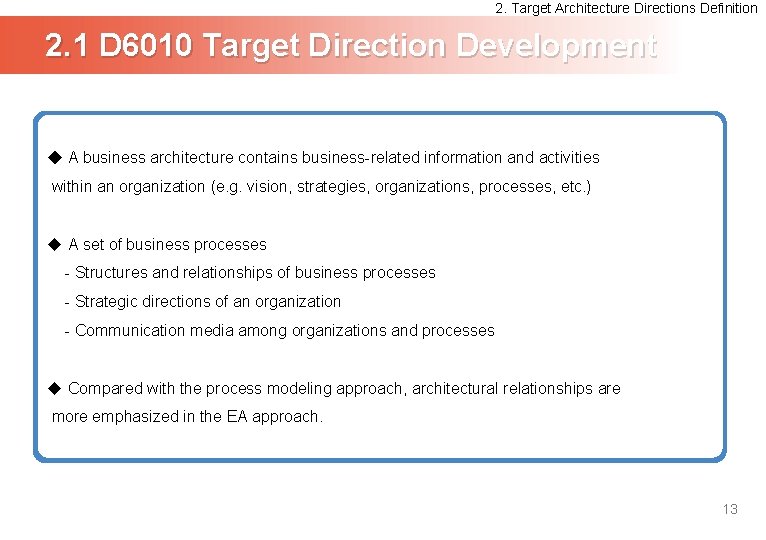
2. Target Architecture Directions Definition 2. 1 D 6010 Target Direction Development ◆ A business architecture contains business-related information and activities within an organization (e. g. vision, strategies, organizations, processes, etc. ) u A set of business processes - Structures and relationships of business processes - Strategic directions of an organization - Communication media among organizations and processes u Compared with the process modeling approach, architectural relationships are more emphasized in the EA approach. 13
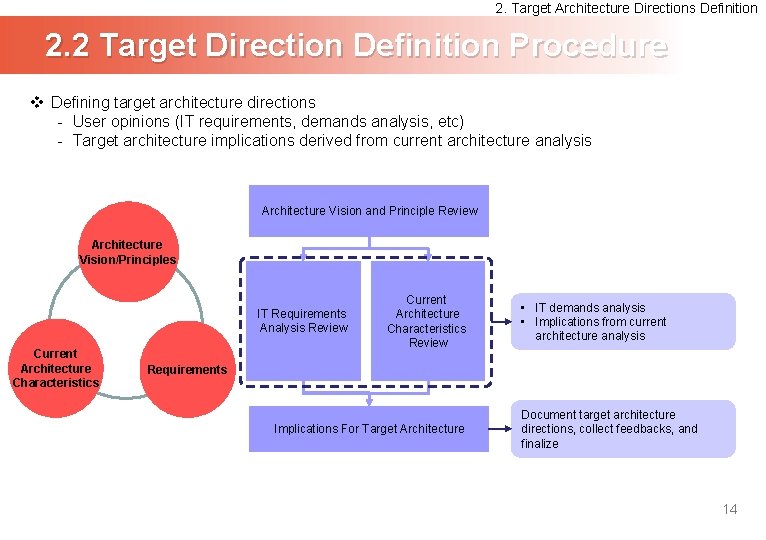
2. Target Architecture Directions Definition 2. 2 Target Direction Definition Procedure v Defining target architecture directions - User opinions (IT requirements, demands analysis, etc) - Target architecture implications derived from current architecture analysis Architecture Vision and Principle Review Architecture Vision/Principles IT Requirements Analysis Review Current Architecture Characteristics Review • IT demands analysis • Implications from current architecture analysis Requirements Implications For Target Architecture Document target architecture directions, collect feedbacks, and finalize 14
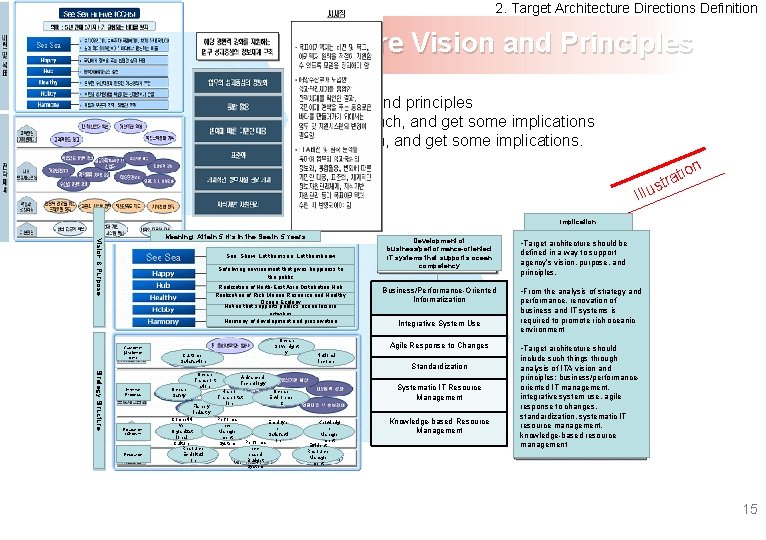
2. Target Architecture Directions Definition 2. 2 Review on Architecture Vision and Principles v Review previously defined architecture vision and principles - Review EA vision that agency desires to reach, and get some implications - Review principles to build an architecture on, and get some implications. ion at r t s Illu Implication Vision & Purpose Meaning: Attain 5 H’s in the Sea in 5 Years See, Show, Let them see, Let them know Safe living environment that gives happiness to the public Realization of North-East Asia Distribution Hub Realization of Rich Marine Resource and Healthy Ocean Ecology Nation that supports public’s ocean leisure activities Harmony of development and preservation Customer (Stakehol der) Strategy Structure Internal Process Customer Satisfaction Ocean Safety Ocean Transport ation Fishery Industry Education / Growth Resource Ocean Sovereignt y Competiti ve Organizat ional Culture Resource Exploitati on Performa nce Manage ment System Integrative System Use Standardization Systematic IT Resource Management Ocean Environme nt Employe e Satisfacti on Performa ncebased Budget System Business/Performance-Oriented Informatization Agile Response to Changes National Income Advanced Technology Harbor Transportat ion Development of business/performance-oriented IT systems that supports ocean competency Knowledg e Manage ment Efficient Resource Manage ment Knowledge-based Resource Management • Target architecture should be defined in a way to support agency’s vision, purpose, and principles. • From the analysis of strategy and performance, renovation of business and IT systems is required to promote rich oceanic environment • Target architecture should include such things through analysis of ITA vision and principles; business/performanceoriented IT management, integrative system use, agile response to changes, standardization, systematic IT resource management, knowledge-based resource management 15
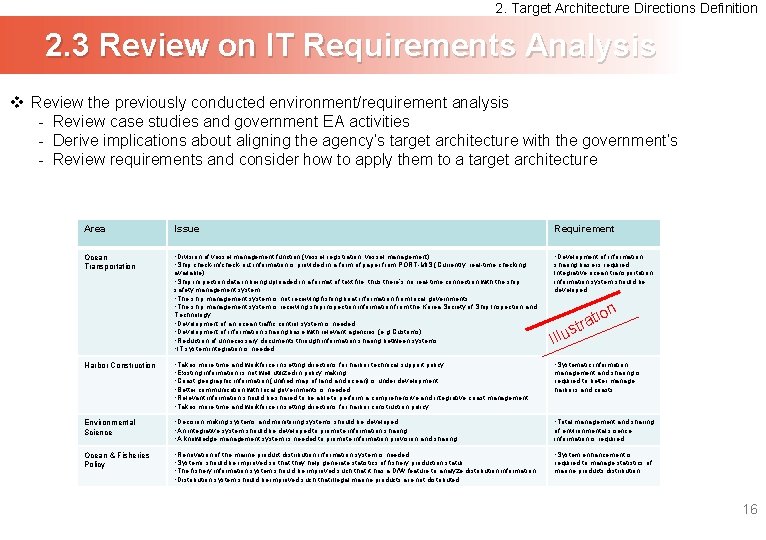
2. Target Architecture Directions Definition 2. 3 Review on IT Requirements Analysis v Review the previously conducted environment/requirement analysis - Review case studies and government EA activities - Derive implications about aligning the agency’s target architecture with the government’s - Review requirements and consider how to apply them to a target architecture Area Issue Requirement Ocean Transportation • Division of vessel management function (vessel registration, vessel management) • Ship check-in/check-out information is provided in a form of paper from PORT-MIS (Currently, real-time checking • Development of information available) • Ship inspection data in being uploaded in a format of text file, thus there’s no real-time connection with the ship safety management system • The ship management system is not receiving fishing boat information from local governments • The ship management system is receiving ship inspection information from the Korea Society of Ship Inspection and Technology • Development of an ocean traffic control system is needed • Development of information sharing base with relevant agencies (e. g Customs) • Reduction of unnecessary documents through information sharing between systems • IT system integration is needed sharing base is required. Integrative ocean transportation information system should be developed. n atio r t llus I Harbor Construction • Takes more time and workforce in setting directions for harbor technical support policy • Existing information is not well utilized in policy making • Coast geographic information (unified map of land ocean) is under development • Better communication with local governments is needed • Relevant information should be shared to be able to perform a comprehensive and integrative coast management • Takes more time and workforce in setting directions for harbor construction policy • Systematic information Environmental Science • Decision making systems and monitoring systems should be developed • An integrative system should be developed to promote information sharing • A knowledge management system is needed to promote information provision and sharing • Total management and sharing Ocean & Fisheries Policy • Renovation of the marine product distribution information system is needed • Systems should be improved so that they help generate statistics of fishery production status • The fishery information system should be improved such that it has a D/W feature to analyze distribution information • Distribution system should be improved such that illegal marine products are not distributed. • System enhancement is management and sharing is required to better manage harbors and coasts. of environmental science information is required to manage statistics of marine products distribution 16
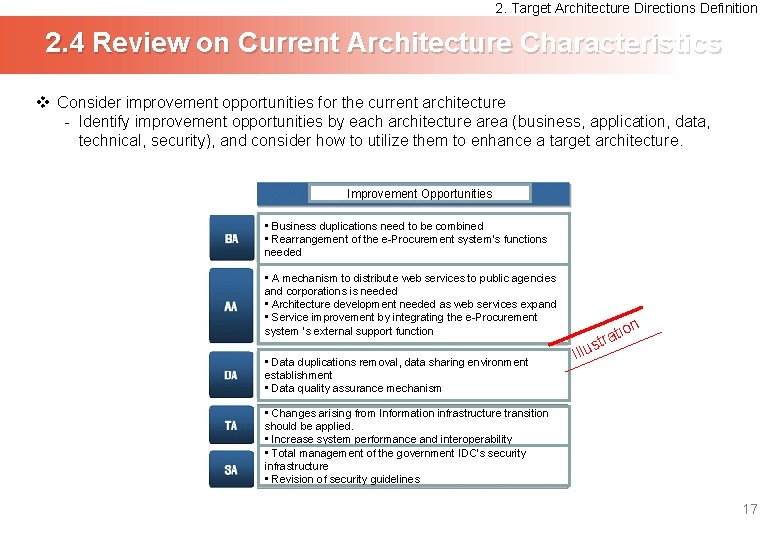
2. Target Architecture Directions Definition 2. 4 Review on Current Architecture Characteristics v Consider improvement opportunities for the current architecture - Identify improvement opportunities by each architecture area (business, application, data, technical, security), and consider how to utilize them to enhance a target architecture. Improvement Opportunities • Business duplications need to be combined • Rearrangement of the e-Procurement system’s functions needed • A mechanism to distribute web services to public agencies and corporations is needed • Architecture development needed as web services expand • Service improvement by integrating the e-Procurement system ‘s external support function • Data duplications removal, data sharing environment establishment • Data quality assurance mechanism n tio tra s Illu • Changes arising from Information infrastructure transition should be applied. • Increase system performance and interoperability • Total management of the government IDC’s security infrastructure • Revision of security guidelines 17
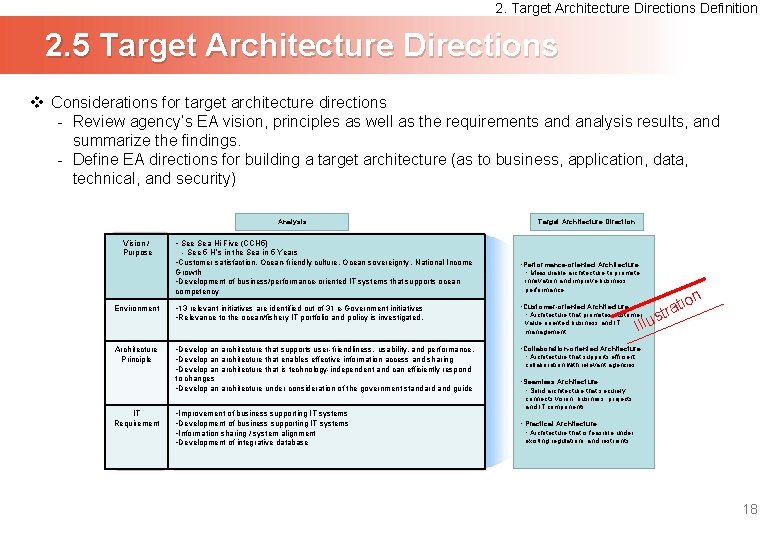
2. Target Architecture Directions Definition 2. 5 Target Architecture Directions v Considerations for target architecture directions - Review agency’s EA vision, principles as well as the requirements and analysis results, and summarize the findings. - Define EA directions for building a target architecture (as to business, application, data, technical, and security) Analysis Vision / Purpose • See Sea Hi Five (CCH 5) - See 5 H’s in the Sea in 5 Years • Customer satisfaction, Ocean-friendly culture, Ocean sovereignty , National Income Growth • Development of business/performance-oriented IT systems that supports ocean competency Environment Architecture Principle IT Requirement Target Architecture Direction • Performance-oriented Architecture • Measurable architecture to promote innovation and improve business performance • 13 relevant initiatives are identified out of 31 e-Government initiatives • Relevance to the ocean/fishery IT portfolio and policy is investigated. • Customer-oriented Architecture • Architecture that promotes customer • Develop an architecture that supports user-friendliness, usability, and performance. • Develop an architecture that enables effective information access and sharing • Develop an architecture that is technology-independent and can efficiently respond • Collaboration-oriented Architecture • Architecture that supports efficient to changes • Develop an architecture under consideration of the government standard and guide • Seamless Architecture • Solid architecture that securely • Improvement of business supporting IT systems • Development of business supporting IT systems • Information sharing / system alignment • Development of integrative database value oriented business and IT management n tio tra s Illu collaboration with relevant agencies. connects vision, business, projects, and IT components. • Practical Architecture • Architecture that is feasible under existing regulations and restraints. 18
1. Target Architecture Overview 2. Target Architecture Directions Definition 3. Target Architecture Development
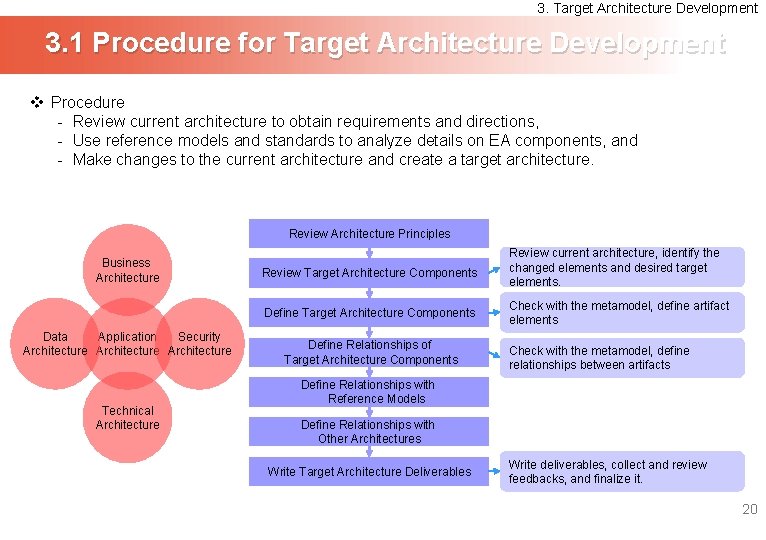
3. Target Architecture Development 3. 1 Procedure for Target Architecture Development v Procedure - Review current architecture to obtain requirements and directions, - Use reference models and standards to analyze details on EA components, and - Make changes to the current architecture and create a target architecture. Review Architecture Principles Business Architecture Data Application Security Architecture Technical Architecture Review Target Architecture Components Review current architecture, identify the changed elements and desired target elements. Define Target Architecture Components Check with the metamodel, define artifact elements Define Relationships of Target Architecture Components Check with the metamodel, define relationships between artifacts Define Relationships with Reference Models Define Relationships with Other Architectures Write Target Architecture Deliverables Write deliverables, collect and review feedbacks, and finalize it. 20
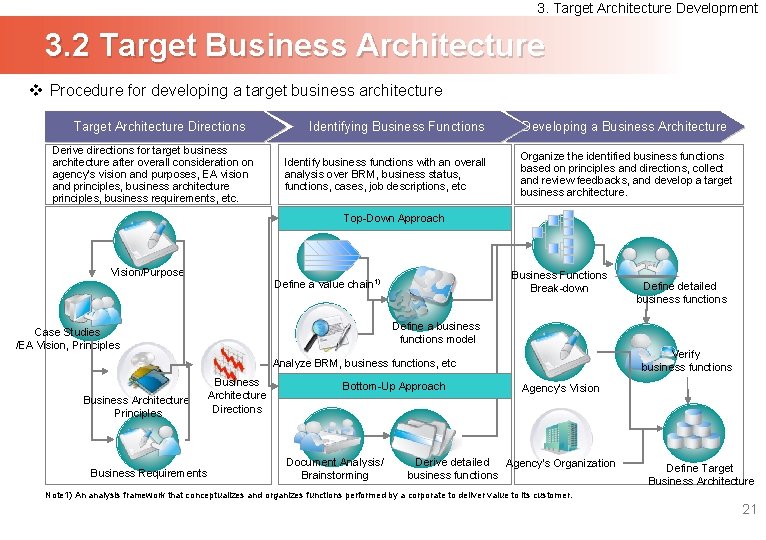
3. Target Architecture Development 3. 2 Target Business Architecture v Procedure for developing a target business architecture Target Architecture Directions Derive directions for target business architecture after overall consideration on agency’s vision and purposes, EA vision and principles, business architecture principles, business requirements, etc. Identifying Business Functions Identify business functions with an overall analysis over BRM, business status, functions, cases, job descriptions, etc Developing a Business Architecture Organize the identified business functions based on principles and directions, collect and review feedbacks, and develop a target business architecture. Top-Down Approach Vision/Purpose Business Functions Break-down Define a value chain 1) Define a business functions model Case Studies /EA Vision, Principles Verify business functions Analyze BRM, business functions, etc Business Architecture Principles Business Requirements Define detailed business functions Business Architecture Directions Bottom-Up Approach Document Analysis/ Brainstorming Agency’s Vision Derive detailed Agency’s Organization business functions Define Target Business Architecture Note 1) An analysis framework that conceptualizes and organizes functions performed by a corporate to deliver value to its customer. 21
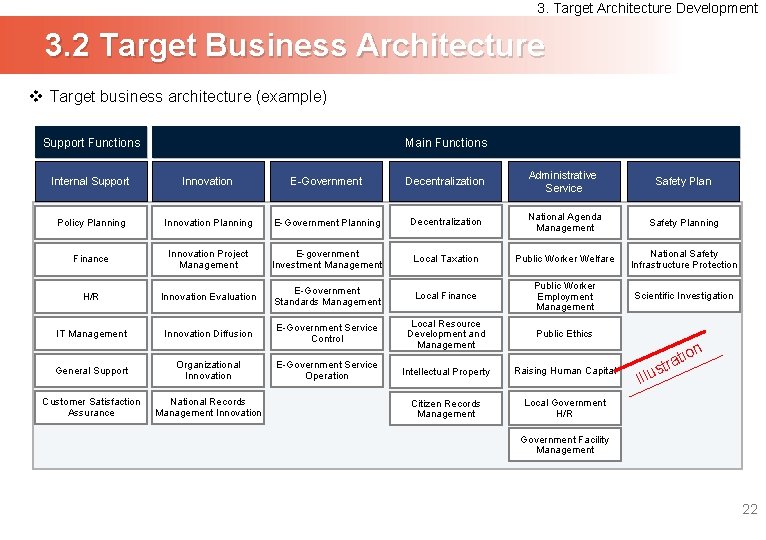
3. Target Architecture Development 3. 2 Target Business Architecture v Target business architecture (example) Support Functions Main Functions Internal Support Innovation E-Government Decentralization Administrative Service Safety Plan Policy Planning Innovation Planning E-Government Planning Decentralization National Agenda Management Safety Planning Finance Innovation Project Management E-government Investment Management Local Taxation Public Worker Welfare National Safety Infrastructure Protection H/R Innovation Evaluation E-Government Standards Management Local Finance Public Worker Employment Management Scientific Investigation IT Management Innovation Diffusion E-Government Service Control Local Resource Development and Management Public Ethics Intellectual Property Raising Human Capital Citizen Records Management Local Government H/R General Support Organizational Innovation Customer Satisfaction Assurance National Records Management Innovation E-Government Service Operation n tio tra s Illu Government Facility Management 22
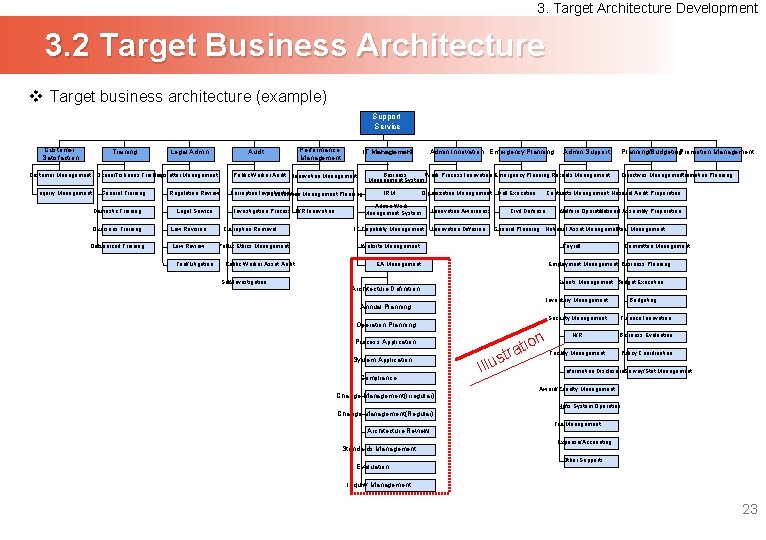
3. Target Architecture Development 3. 2 Target Business Architecture v Target business architecture (example) Support Service Customer Satisfaction Training Legal Admin Customer Management Ocean/Fisheries Training Newsletter Management Inquiry Management General Training Domestic Training Public Worker Audit Regulation Review Legal Service Overseas Training Law Revision Outsourced Training Law Review Trial/Litigation Performance Management Audit IT Management Corruption Investigation Performance Management Planning Corruption Removal Public Ethics Management Public Worker Asset Audit Self-Investigation Admin Support Planning/Budgeting. Promotion Management Business Work Process Innovation Emergency Planning Records Management System Innovation Management Investigation Process H/R Innovation Admin Innovation Emergency Planning IRM Organization Management Admin Work Management System IT Capability Management Drill Execution Innovation Awareness Innovation Diffusion Contracts Management National Audit Preparation Civil Defense Payroll EA Management Events Management Budget Execution Inventory Management Annual Planning Operation Planning ion t a tr Process Application Change Management(Irregular) Change Management(Regular) Architecture Review Standards Management Evaluation Committee Management Employment Management Business Planning Architecture Definition Compliance Welfare Operation National Assembly Preparation General Planning National Asset Management Goal Management Website Management System Application Directives Management Promotion Planning s Illu Budgeting Security Management Finance Innovation H/R Business Evaluation Facility Management Policy Coordination Information Disclosure Survey/Stat Management Award/Penalty Management Nafis System Operation File Management Expense/Accounting Other Supports Inquiry Management 23
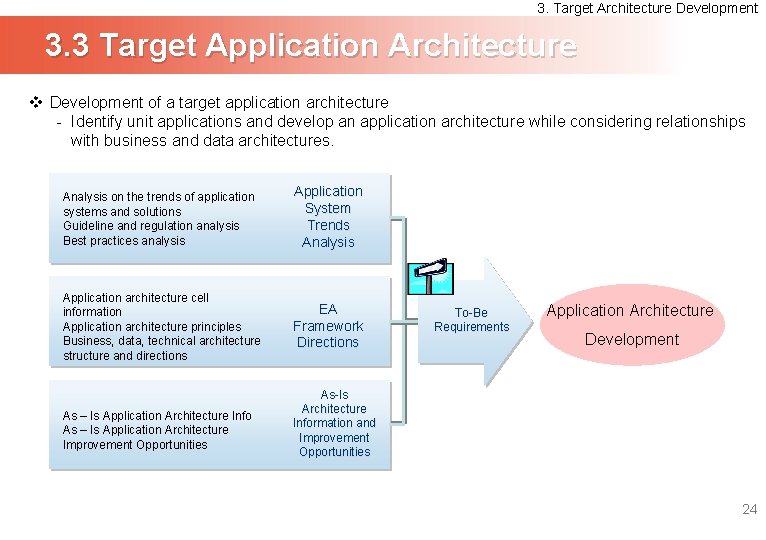
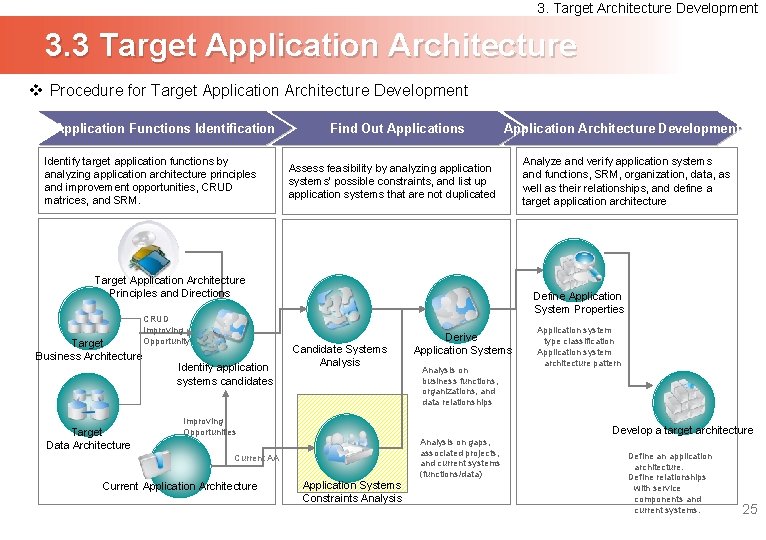
3. Target Architecture Development 3. 3 Target Application Architecture v Development of a target application architecture - Identify unit applications and develop an application architecture while considering relationships with business and data architectures. Analysis on the trends of application systems and solutions Guideline and regulation analysis Best practices analysis Application System Trends Analysis Application architecture cell information Application architecture principles Business, data, technical architecture structure and directions EA Framework Directions As – Is Application Architecture Info As – Is Application Architecture Improvement Opportunities To-Be Requirements Application Architecture Development As-Is Architecture Information and Improvement Opportunities 24
3. Target Architecture Development 3. 3 Target Application Architecture v Procedure for Target Application Architecture Development Application Functions Identification Identify target application functions by analyzing application architecture principles and improvement opportunities, CRUD matrices, and SRM. Find Out Applications Application Architecture Development Assess feasibility by analyzing application systems’ possible constraints, and list up application systems that are not duplicated Target Application Architecture Principles and Directions Target Business Architecture Target Data Architecture CRUD Improving Opportunity Identify application systems candidates Define Application System Properties Candidate Systems Analysis Derive Application Systems Analysis on business functions, organizations, and data relationships Improving Opportunities Current AA Current Application Architecture Analyze and verify application systems and functions, SRM, organization, data, as well as their relationships, and define a target application architecture Application Systems Constraints Analysis on gaps, associated projects, and current systems (functions/data) Application system type classification Application system architecture pattern Develop a target architecture Define an application architecture. Define relationships with service components and current systems. 25
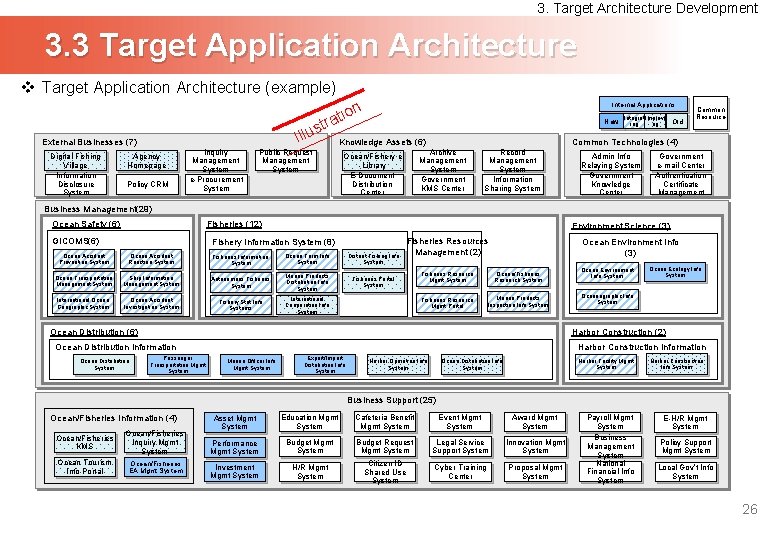
3. Target Architecture Development 3. 3 Target Application Architecture v Target Application Architecture (example) ion t a r ust Ill External Businesses (7) Digital Fishing Village Information Disclosure System Agency Homepage Policy CRM Inquiry Management System e-Procurement System Public Request Management System Internal Applications New Knowledge Assets (6) Old Common Resource Common Technologies (4) Archive Management System Government KMS Center Ocean/Fishery e -Library E-Document Distribution Center Integrat Improvi ing ng Record Management System Information Sharing System Admin Info Relaying System Government Knowledge Center Government e-mail Center Authentication Certificate Management Business Management(29) Ocean Safety (6) Fisheries (12) GICOMS(6) Environment Science (3) Fishery Information System (8) Ocean Accident Prevention System Ocean Accident Reaction System Fisheries Information System Ocean Farm Info System Distant Fishing Info System Ocean Transportation Management System Ship Information Management System Autonomous Fisheries System Marine Products Distribution Info System Fisheries Portal System International Ocean Geographic System Ocean Accident Investigation System Fishery Stat Info Systems International Cooperation Info System Fisheries Resources Management (2) Ocean Environment Info (3) Fisheries Resource Mgmt System Ocean/Fisheries Research System Fisheries Resource Mgmt Portal Marine Products Inspection Info System Ocean Ecology Info System Oceanographic Info System Harbor Construction (2) Ocean Distribution (6) Ocean Distribution Information Ocean Distribution System Ocean Environment Info System Passenger Transportation Mgmt System Harbor Construction Information Marine Officer Info Mgmt System Export/Import Distribution Info System Harbor Operation Info System Harbor Facility Mgmt System Ocean Distribution Info System Harbor Construction Info System Business Support (25) Ocean/Fisheries Information (4) Ocean/Fisheries KMS Ocean/Fisheries Inquiry Mgmt System Ocean Tourism Info Portal Ocean/Fisheries EA Mgmt System Asset Mgmt System Education Mgmt System Cafeteria Benefit Mgmt System Event Mgmt System Award Mgmt System Performance Mgmt System Budget Request Mgmt System Legal Service Support System Innovation Mgmt System Investment Mgmt System H/R Mgmt System Citizen ID Shared Use System Cyber Training Center Proposal Mgmt System Payroll Mgmt System Business Management System National Financial Info System E-H/R Mgmt System Policy Support Mgmt System Local Gov’t Info System 26
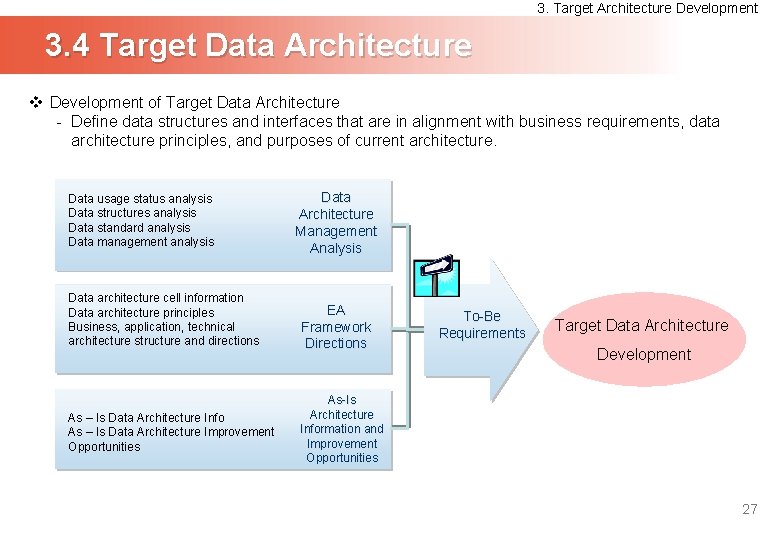
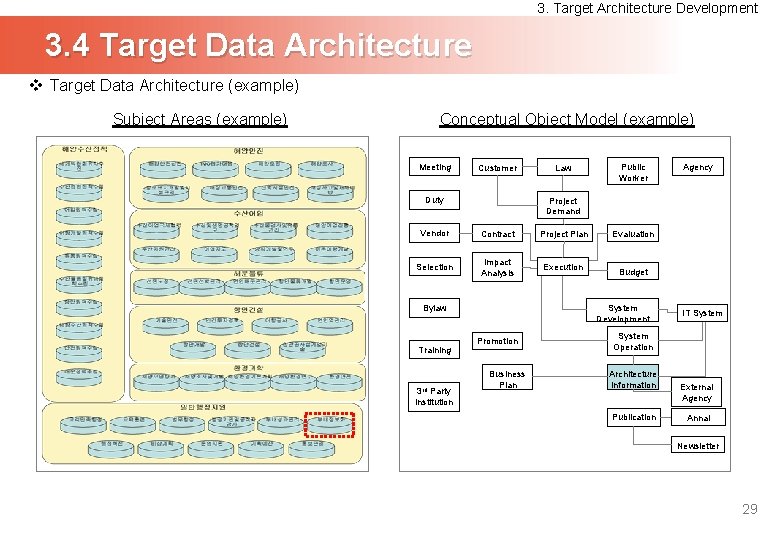
3. Target Architecture Development 3. 4 Target Data Architecture v Development of Target Data Architecture - Define data structures and interfaces that are in alignment with business requirements, data architecture principles, and purposes of current architecture. Data usage status analysis Data structures analysis Data standard analysis Data management analysis Data architecture cell information Data architecture principles Business, application, technical architecture structure and directions As – Is Data Architecture Info As – Is Data Architecture Improvement Opportunities Data Architecture Management Analysis EA Framework Directions To-Be Requirements Target Data Architecture Development As-Is Architecture Information and Improvement Opportunities 27
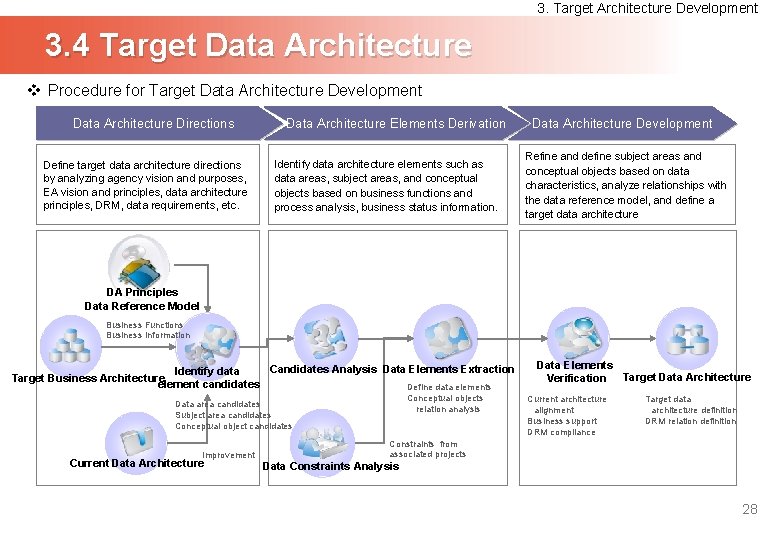
3. Target Architecture Development 3. 4 Target Data Architecture v Procedure for Target Data Architecture Development Data Architecture Directions Define target data architecture directions by analyzing agency vision and purposes, EA vision and principles, data architecture principles, DRM, data requirements, etc. Data Architecture Elements Derivation Identify data architecture elements such as data areas, subject areas, and conceptual objects based on business functions and process analysis, business status information. Data Architecture Development Refine and define subject areas and conceptual objects based on data characteristics, analyze relationships with the data reference model, and define a target data architecture DA Principles Data Reference Model Business Functions Business Information Candidates Analysis Data Elements Extraction Identify data Target Business Architecture element candidates Define data elements Conceptual objects relation analysis Data area candidates Subject area candidates Conceptual object candidates Improvement Current Data Architecture Data Elements Verification Target Data Architecture Current architecture alignment Business support DRM compliance Target data architecture definition DRM relation definition Constraints from associated projects Data Constraints Analysis 28
3. Target Architecture Development 3. 4 Target Data Architecture v Target Data Architecture (example) Subject Areas (example) Conceptual Object Model (example) Meeting Customer Duty Law Public Worker Project Demand Vendor Contract Project Plan Evaluation Selection Impact Analysis Execution Budget Bylaw Training 3 rd Party Institution Agency System Development Promotion Business Plan IT System Operation Architecture Information Publication External Agency Annal Newsletter 29
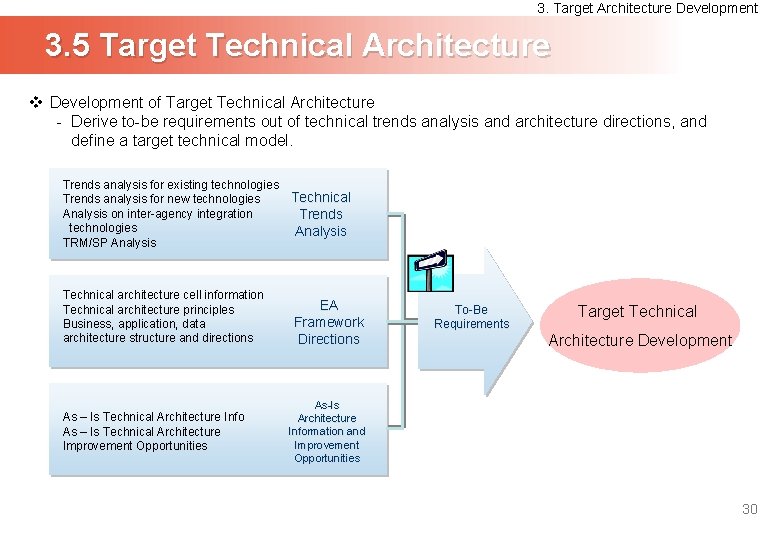
3. Target Architecture Development 3. 5 Target Technical Architecture v Development of Target Technical Architecture - Derive to-be requirements out of technical trends analysis and architecture directions, and define a target technical model. Trends analysis for existing technologies Trends analysis for new technologies Analysis on inter-agency integration technologies TRM/SP Analysis Technical Trends Analysis Technical architecture cell information Technical architecture principles Business, application, data architecture structure and directions EA Framework Directions As – Is Technical Architecture Info As – Is Technical Architecture Improvement Opportunities To-Be Requirements Target Technical Architecture Development As-Is Architecture Information and Improvement Opportunities 30
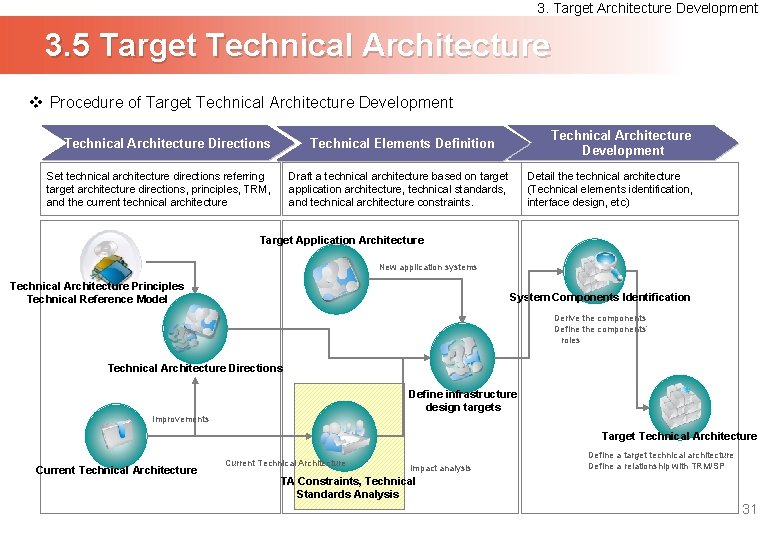
3. Target Architecture Development 3. 5 Target Technical Architecture v Procedure of Target Technical Architecture Development Technical Architecture Directions Technical Architecture Development Technical Elements Definition Set technical architecture directions referring target architecture directions, principles, TRM, and the current technical architecture Draft a technical architecture based on target application architecture, technical standards, and technical architecture constraints. Detail the technical architecture (Technical elements identification, interface design, etc) Target Application Architecture New application systems Technical Architecture Principles Technical Reference Model System Components Identification Derive the components Define the components’ roles Technical Architecture Directions Define infrastructure design targets Improvements Target Technical Architecture Current Technical Architecture Impact analysis Define a target technical architecture Define a relationship with TRM/SP TA Constraints, Technical Standards Analysis 31
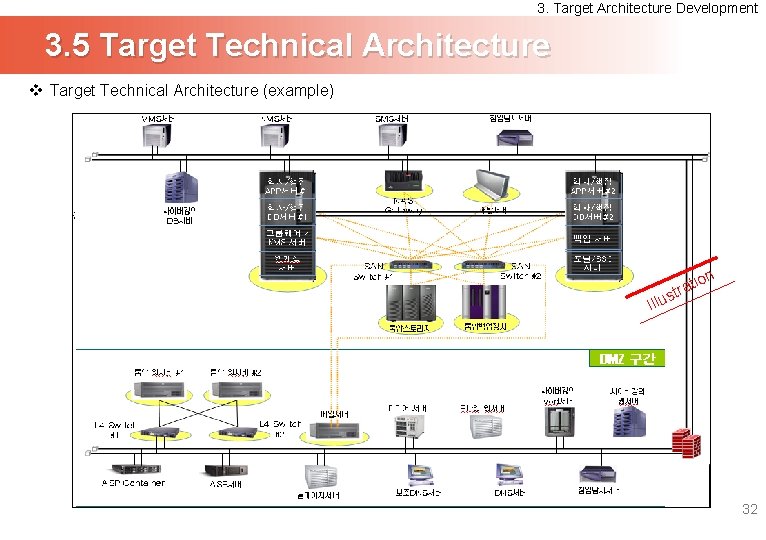
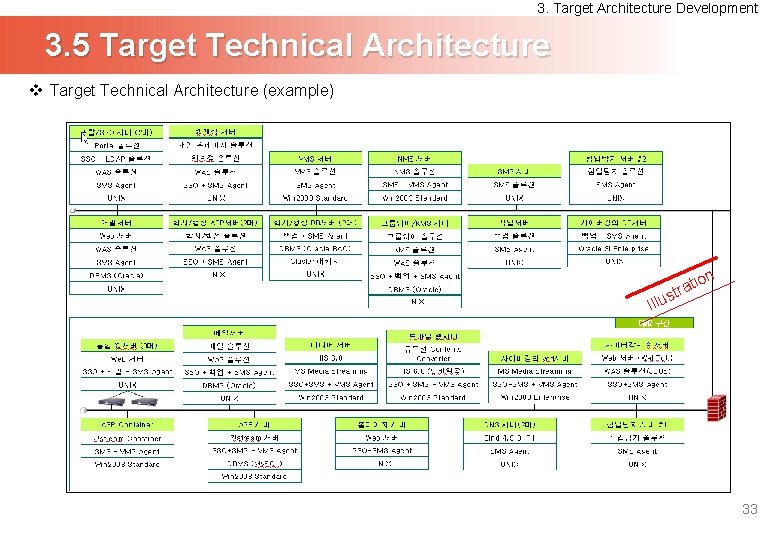
3. Target Architecture Development 3. 5 Target Technical Architecture v Target Technical Architecture (example) tion a r st Illu 32
3. Target Architecture Development 3. 5 Target Technical Architecture v Target Technical Architecture (example) tion a r st Illu 33
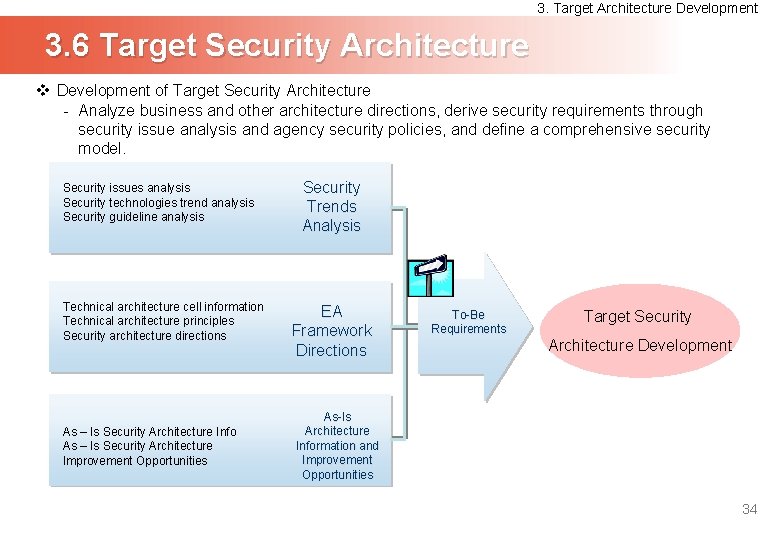
3. Target Architecture Development 3. 6 Target Security Architecture v Development of Target Security Architecture - Analyze business and other architecture directions, derive security requirements through security issue analysis and agency security policies, and define a comprehensive security model. Security issues analysis Security technologies trend analysis Security guideline analysis Technical architecture cell information Technical architecture principles Security architecture directions As – Is Security Architecture Info As – Is Security Architecture Improvement Opportunities Security Trends Analysis EA Framework Directions To-Be Requirements Target Security Architecture Development As-Is Architecture Information and Improvement Opportunities 34
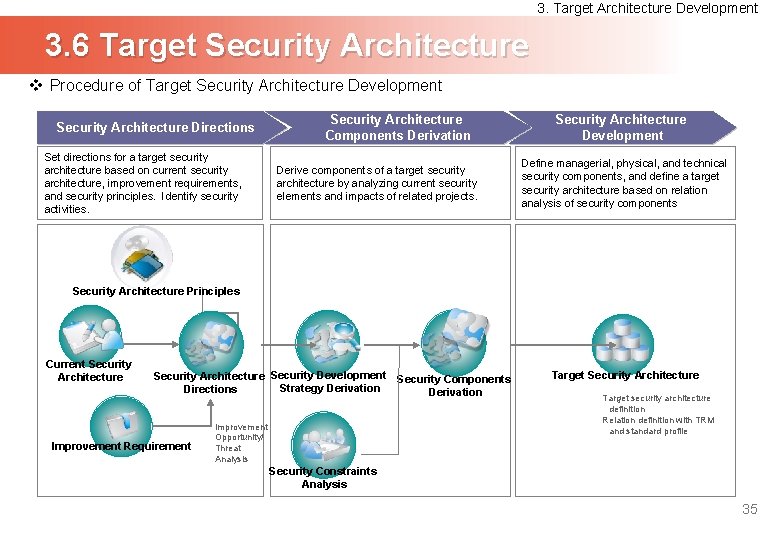
3. Target Architecture Development 3. 6 Target Security Architecture v Procedure of Target Security Architecture Development Security Architecture Directions Set directions for a target security architecture based on current security architecture, improvement requirements, and security principles. Identify security activities. Security Architecture Components Derivation Derive components of a target security architecture by analyzing current security elements and impacts of related projects. Security Architecture Development Define managerial, physical, and technical security components, and define a target security architecture based on relation analysis of security components Security Architecture Principles Current Security Architecture Security Development Strategy Derivation Directions Improvement Requirement Improvement Opportunity/ Threat Analysis Security Components Derivation Target Security Architecture Target security architecture definition Relation definition with TRM and standard profile Security Constraints Analysis 35
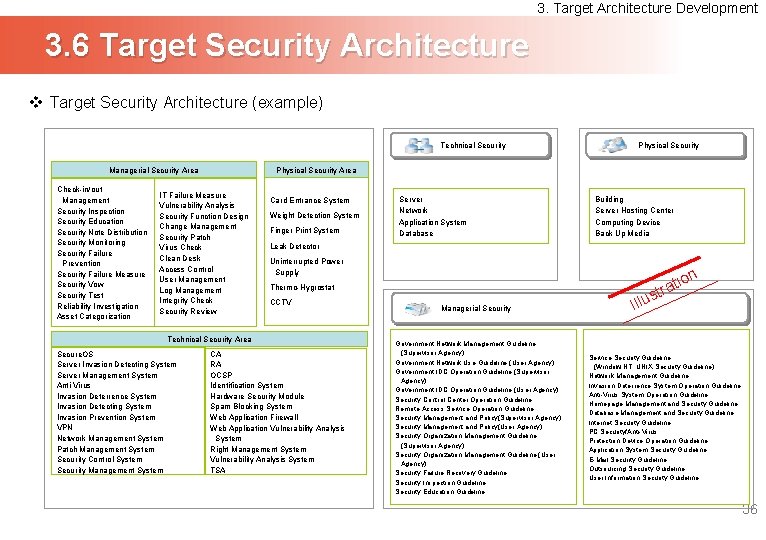
3. Target Architecture Development 3. 6 Target Security Architecture v Target Security Architecture (example) Technical Security Physical Security Area Managerial Security Area Check-in/out Management Security Inspection Security Education Security Note Distribution Security Monitoring Security Failure Prevention Security Failure Measure Security Vow Security Test Reliability Investigation Asset Categorization IT Failure Measure Vulnerability Analysis Security Function Design Change Management Security Patch Virus Check Clean Desk Access Control User Management Log Management Integrity Check Security Review Card Entrance System Weight Detection System Finger Print System Server Network Application System Database Building Server Hosting Center Computing Device Back Up Media Leak Detector Uninterrupted Power Supply Thermo-Hygrostat CCTV Technical Security Area Secure. OS Server Invasion Detecting System Server Management System Anti-Virus Invasion Deterrence System Invasion Detecting System Invasion Prevention System VPN Network Management System Patch Management System Security Control System Security Management System Physical Security CA RA OCSP Identification System Hardware Security Module Spam Blocking System Web Application Firewall Web Application Vulnerability Analysis System Right Management System Vulnerability Analysis System TSA Managerial Security Government Network Management Guideline (Supervisor Agency) Government Network Use Guideline (User Agency) Government IDC Operation Guideline (Supervisor Agency) Government IDC Operation Guideline (User Agency) Security Control Center Operation Guideline Remote Access Service Operation Guideline Security Management and Policy(Supervisor Agency) Security Management and Policy(User Agency) Security Organization Management Guideline (Supervisor Agency) Security Organization Management Guideline (User Agency) Security Failure Recovery Guideline Security Inspection Guideline Security Education Guideline tion a r st Illu Service Security Guideline (Window NT, UNIX Security Guideline) Network Management Guideline Invasion Deterrence System Operation Guideline Anti-Virus System Operation Guideline Homepage Management and Security Guideline Database Management and Security Guideline Internet Security Guideline PC Security/Anti-Virus Protection Device Operation Guideline Application System Security Guideline E-Mail Security Guideline Outsourcing Security Guideline User Information Security Guideline 36
Q&A Thank You! 37