
Taping Mohammad Saleki MD Sport medicine specialist IUMS

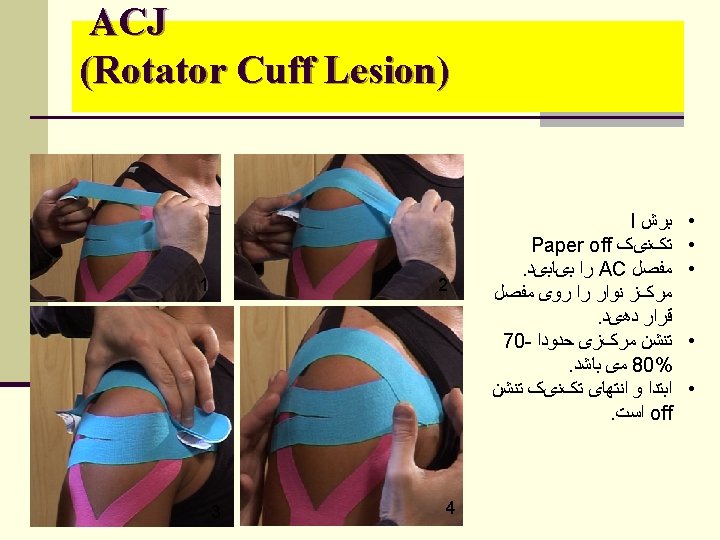
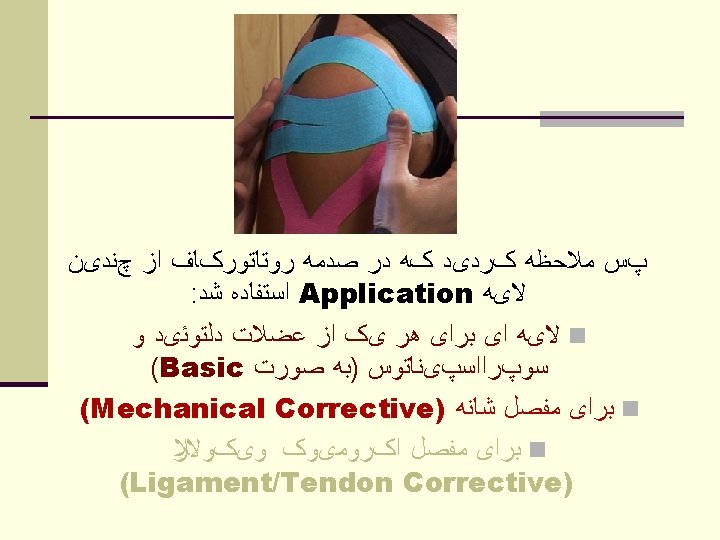
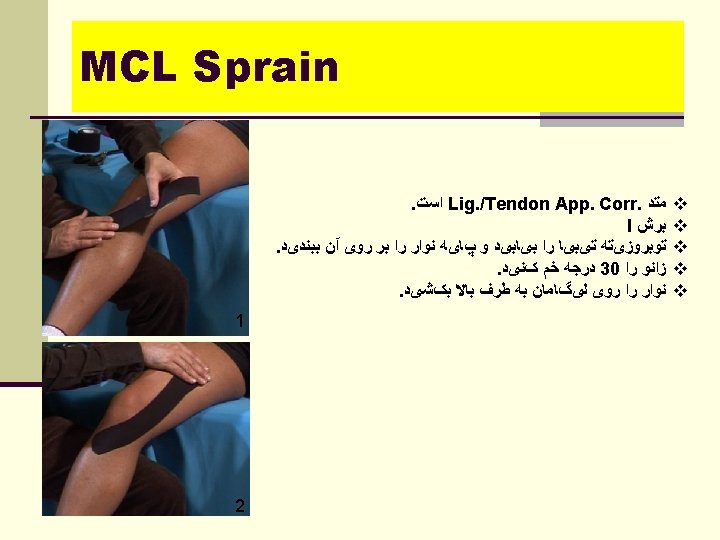
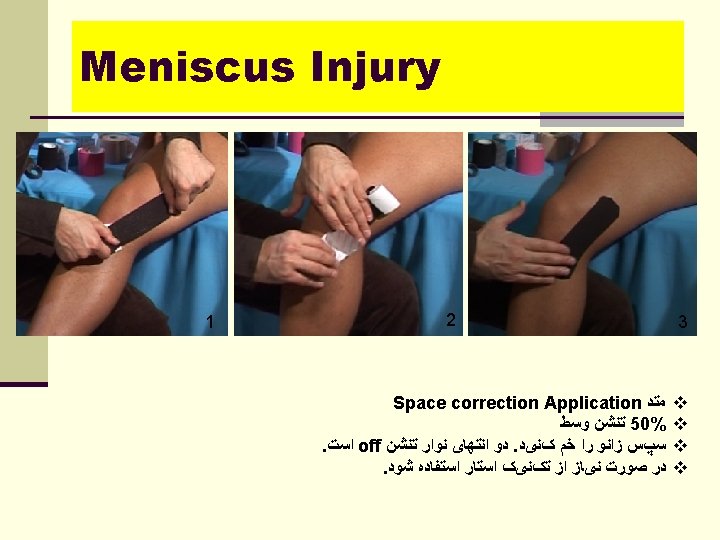

- Slides: 82
Taping ØMohammad Saleki MD Ø Sport medicine specialist IUMS
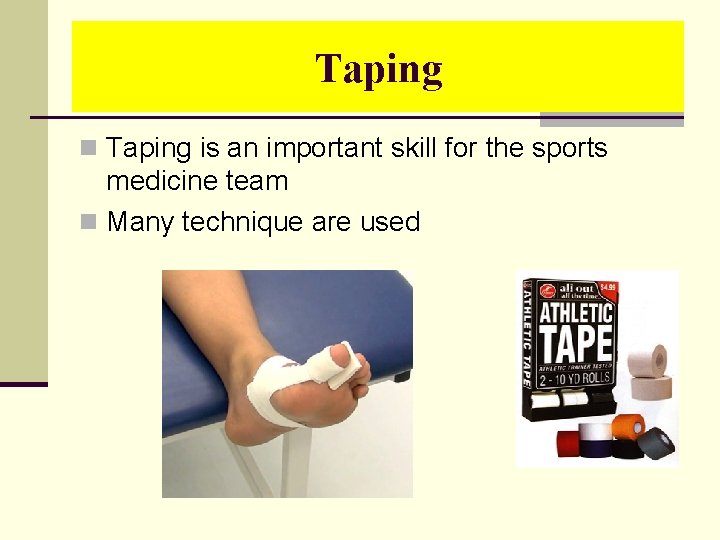
Taping n Taping is an important skill for the sports medicine team n Many technique are used
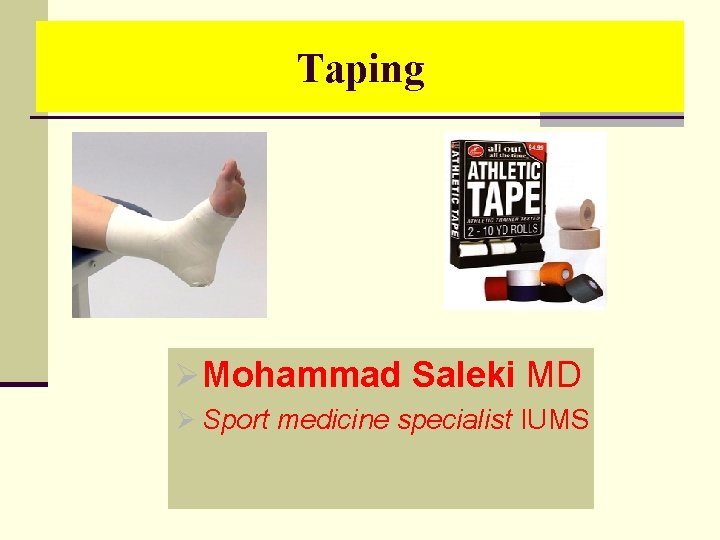
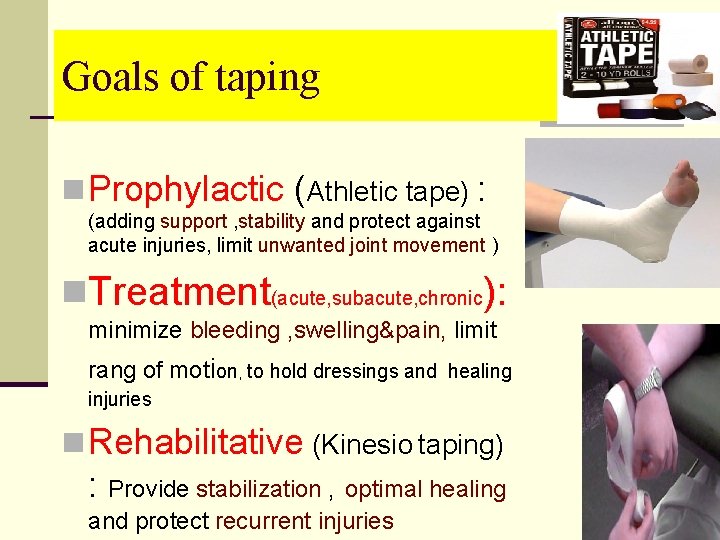
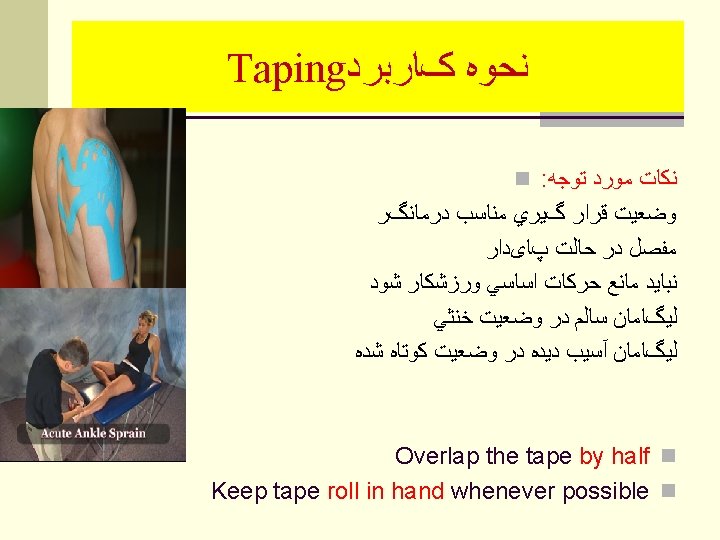
Goals of taping n Prophylactic (Athletic tape) : (adding support , stability and protect against acute injuries, limit unwanted joint movement ) n. Treatment(acute, subacute, chronic): minimize bleeding , swelling&pain, limit rang of motion, to hold dressings and healing injuries n Rehabilitative (Kinesio taping) : Provide stabilization , optimal healing and protect recurrent injuries
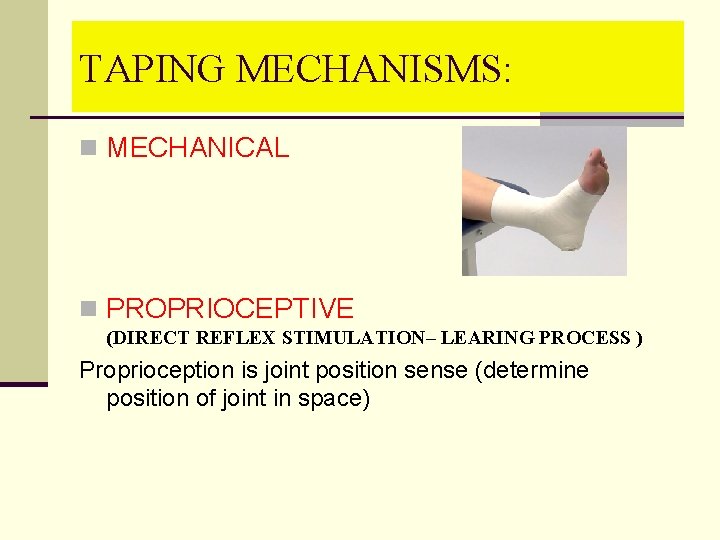
TAPING MECHANISMS: n MECHANICAL n PROPRIOCEPTIVE (DIRECT REFLEX STIMULATION– LEARING PROCESS ) Proprioception is joint position sense (determine position of joint in space)
n Joint Mechanoreceptors n Found in ligaments, capsules, menisci, labra, and fat pads n n n Ruffini’s endings Pacinian corpuscles Free nerve endings Sensitive to changes in shape of structure and rate/direction of movement n Most active at end of ranges of motion n n Muscle Mechanoreceptors n Muscle spindles - sensitive to changes in length of muscle n Golgi tendon organs - sensitive to changes in tissue tension
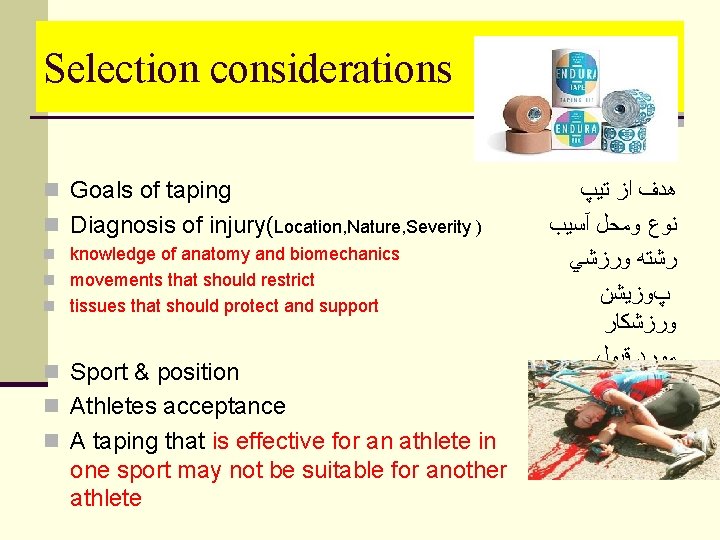
Selection considerations n Goals of taping n Diagnosis of injury(Location, Nature, Severity ) n knowledge of anatomy and biomechanics n movements that should restrict n tissues that should protect and support n Sport & position n Athletes acceptance n A taping that is effective for an athlete in one sport may not be suitable for another athlete ﻫﺪﻑ ﺍﺯ ﺗﻴپ ﻧﻮﻉ ﻭﻣﺤﻞ آﺴﻴﺐ ﺭﺷﺘﻪ ﻭﺭﺯﺷﻲ پﻮﺯﻳﺸﻦ ﻭﺭﺯﺷﻜﺎﺭ ﻣﻮﺭﺩ ﻗﺒﻮﻝ ﻭﺭﺯﺷﻜﺎﺭ
ﻣﻮﺭﺩ ﻗﺒﻮﻝ ﻭﺭﺯﺷﻜﺎﺭ n If the athlete feels that taping is uncomfortable or decreases performance the attempt to support will failed
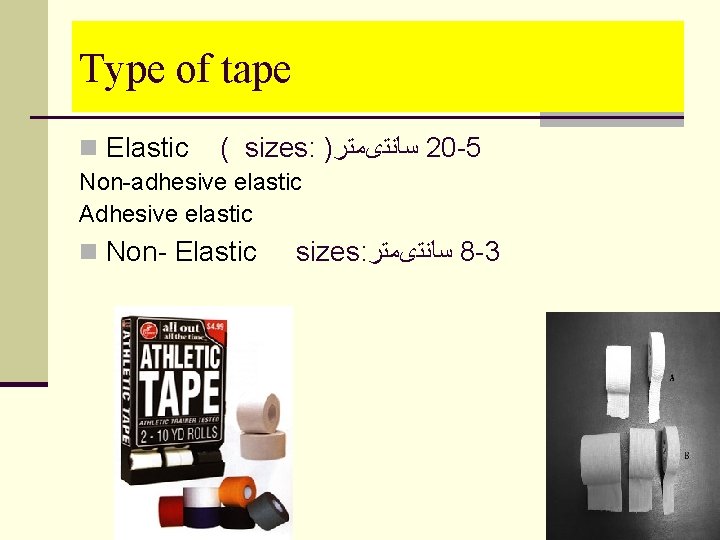
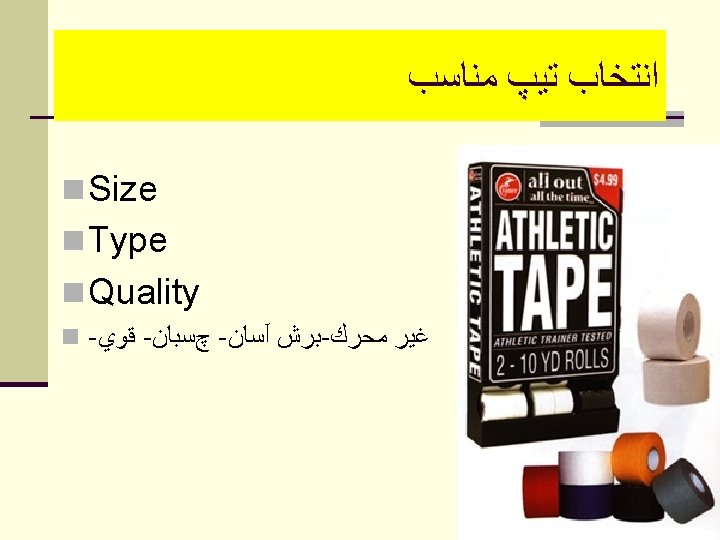
Type of tape n Elastic ( sizes: ) ﺳﺎﻧﺘیﻤﺘﺮ 20 -5 Non-adhesive elastic Adhesive elastic n Non- Elastic sizes: ﺳﺎﻧﺘیﻤﺘﺮ 8 -3
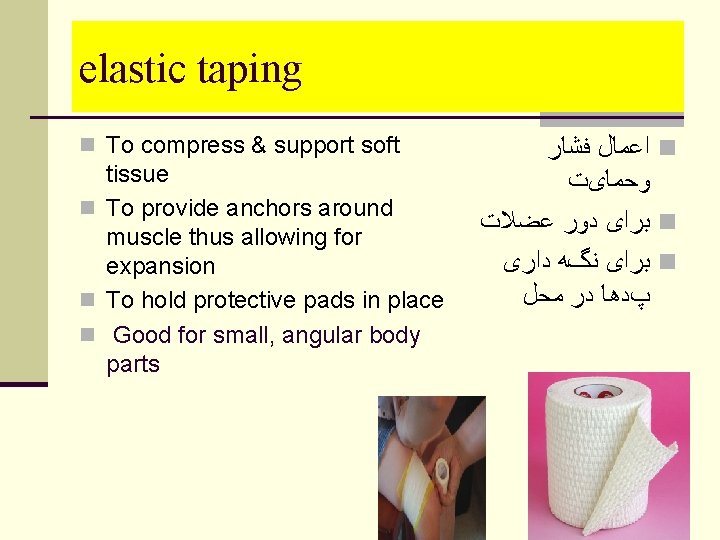
elastic taping n To compress & support soft tissue n To provide anchors around muscle thus allowing for expansion n To hold protective pads in place n Good for small, angular body parts ﺍﻋﻤﺎﻝ ﻓﺸﺎﺭ n ﻭﺣﻤﺎیﺖ ﺑﺮﺍی ﺩﻭﺭ ﻋﻀﻼﺕ n ﺑﺮﺍی ﻧگﻪ ﺩﺍﺭی n پﺪﻫﺎ ﺩﺭ ﻣﺤﻞ
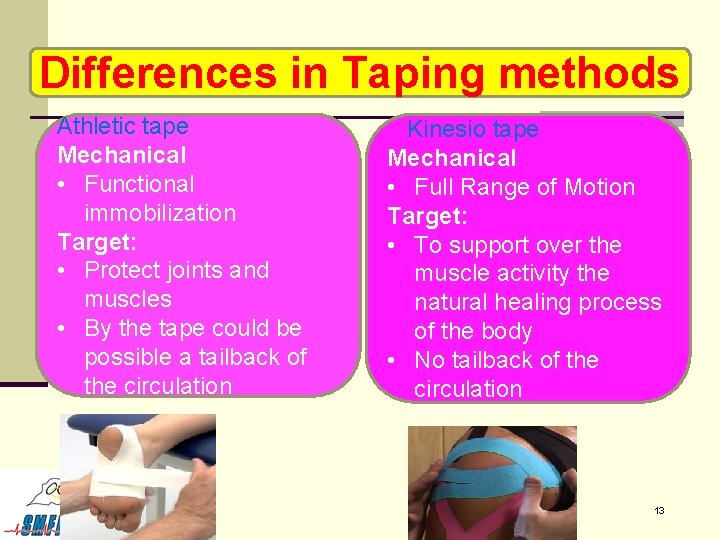
Differences in Taping methods Athletic tape Mechanical • Functional immobilization Target: • Protect joints and muscles • By the tape could be possible a tailback of the circulation Kinesio tape Mechanical • Full Range of Motion Target: • To support over the muscle activity the natural healing process of the body • No tailback of the circulation 13
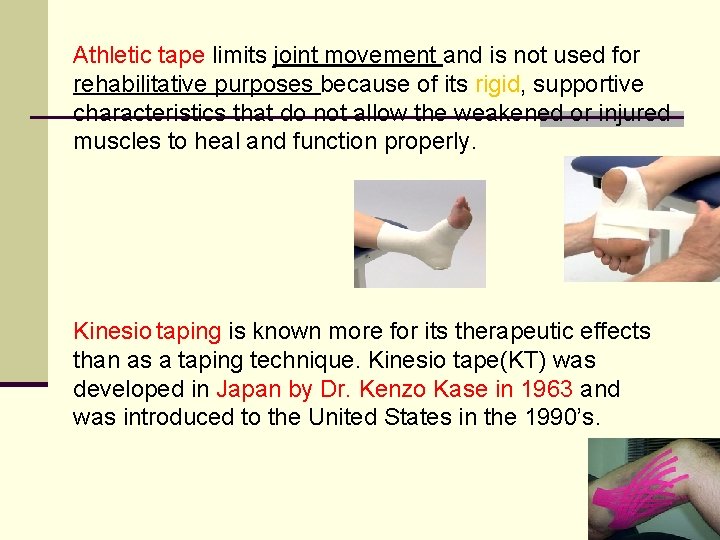
Athletic tape limits joint movement and is not used for rehabilitative purposes because of its rigid, supportive characteristics that do not allow the weakened or injured muscles to heal and function properly. Kinesio taping is known more for its therapeutic effects than as a taping technique. Kinesio tape(KT) was developed in Japan by Dr. Kenzo Kase in 1963 and was introduced to the United States in the 1990’s. 14
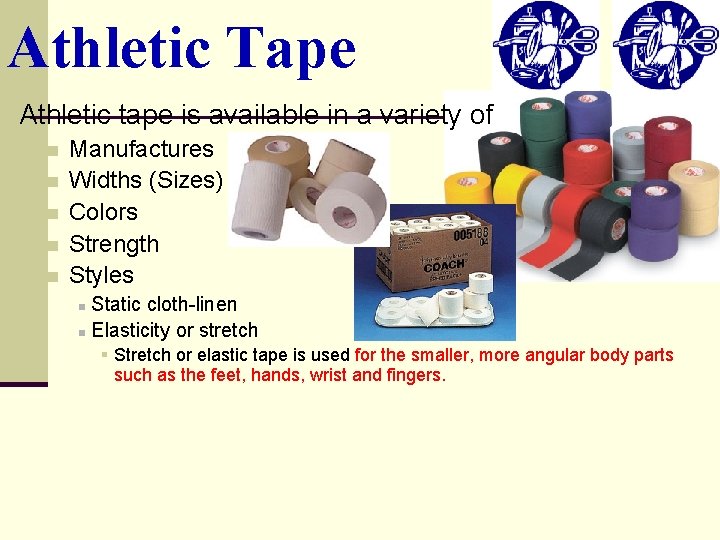
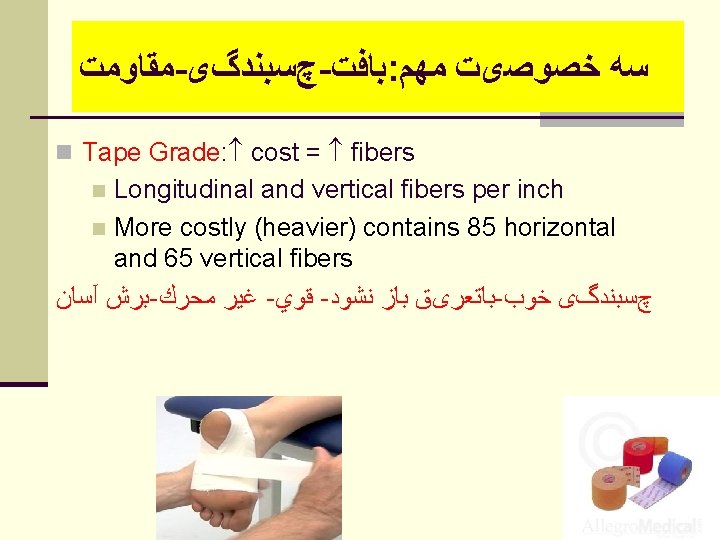
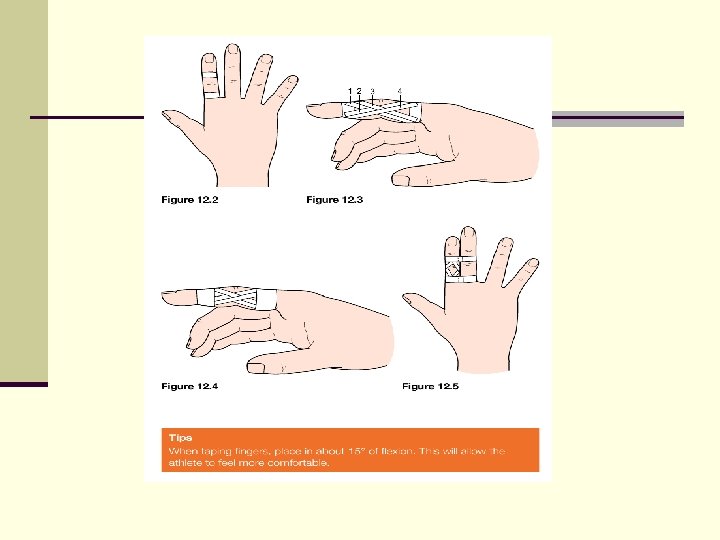
Athletic Tape Athletic tape is available in a variety of n n n Manufactures Widths (Sizes) Colors Strength Styles Static cloth-linen n Elasticity or stretch n § Stretch or elastic tape is used for the smaller, more angular body parts such as the feet, hands, wrist and fingers.
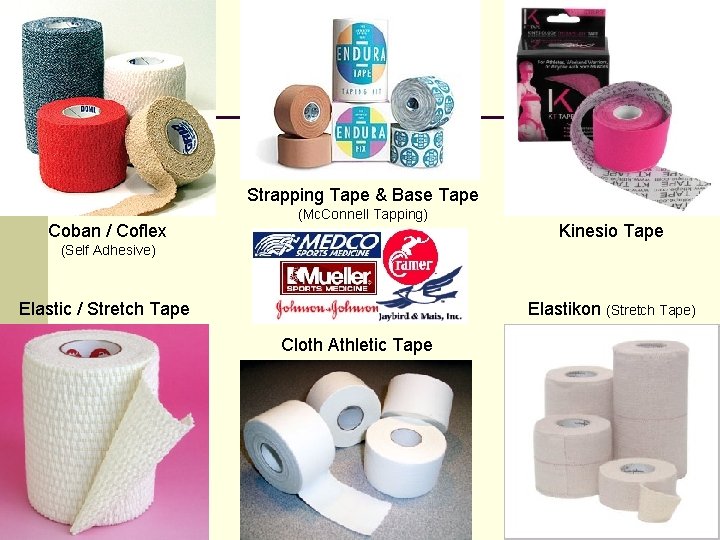
Strapping Tape & Base Tape Coban / Coflex (Mc. Connell Tapping) Kinesio Tape (Self Adhesive) Elastic / Stretch Tape Elastikon (Stretch Tape) Cloth Athletic Tape
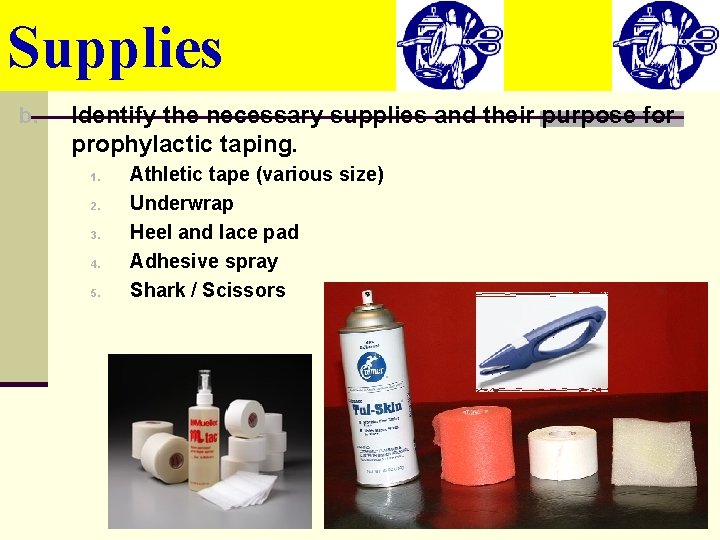
Supplies b. Identify the necessary supplies and their purpose for prophylactic taping. 1. 2. 3. 4. 5. Athletic tape (various size) Underwrap Heel and lace pad Adhesive spray Shark / Scissors
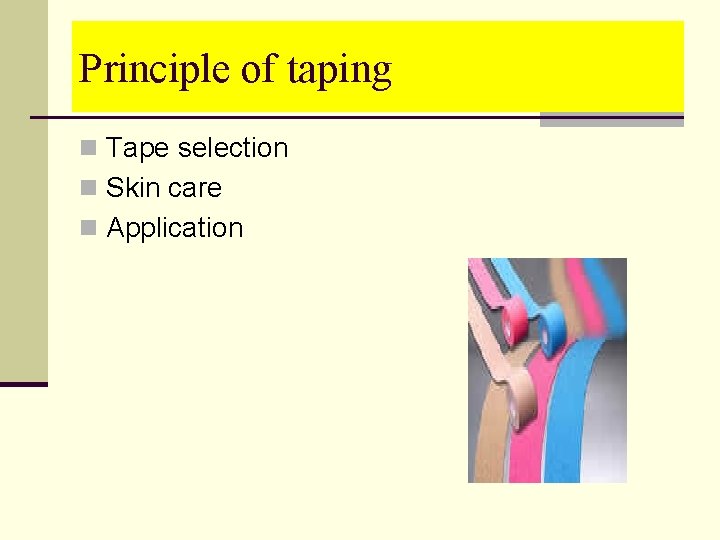
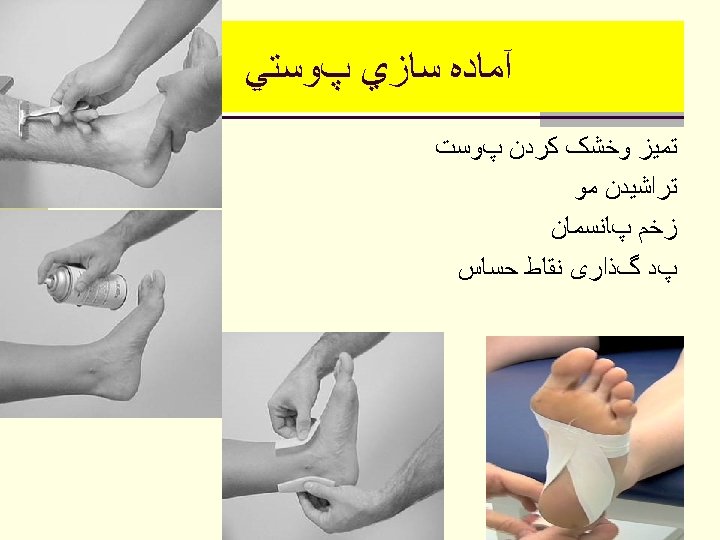
Principle of taping n Tape selection n Skin care n Application
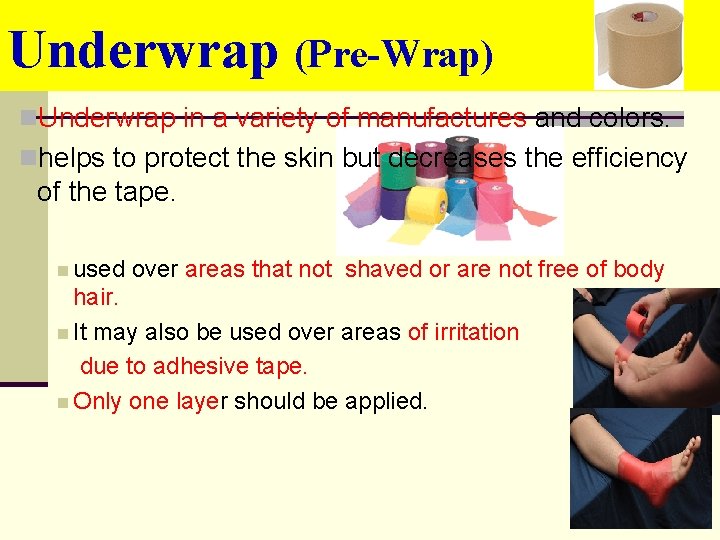
Underwrap (Pre-Wrap) n. Underwrap in a variety of manufactures and colors. nhelps to protect the skin but decreases the efficiency of the tape. n used over areas that not shaved or are not free of body hair. n It may also be used over areas of irritation due to adhesive tape. n Only one layer should be applied.
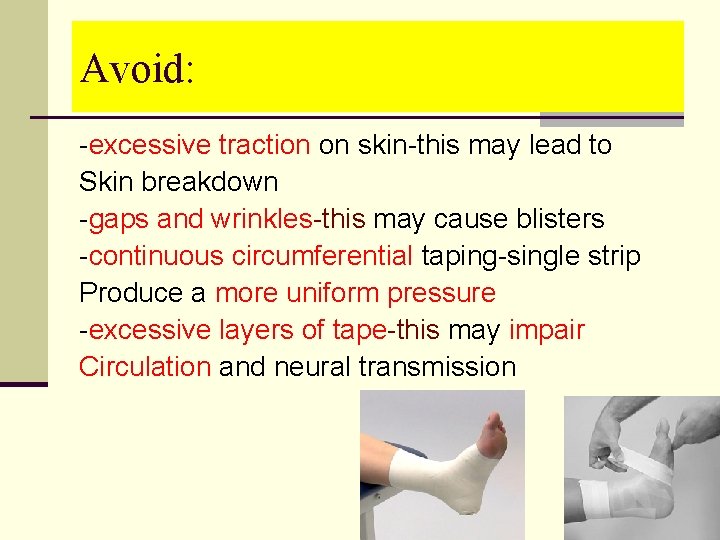
Avoid: -excessive traction on skin-this may lead to Skin breakdown -gaps and wrinkles-this may cause blisters -continuous circumferential taping-single strip Produce a more uniform pressure -excessive layers of tape-this may impair Circulation and neural transmission
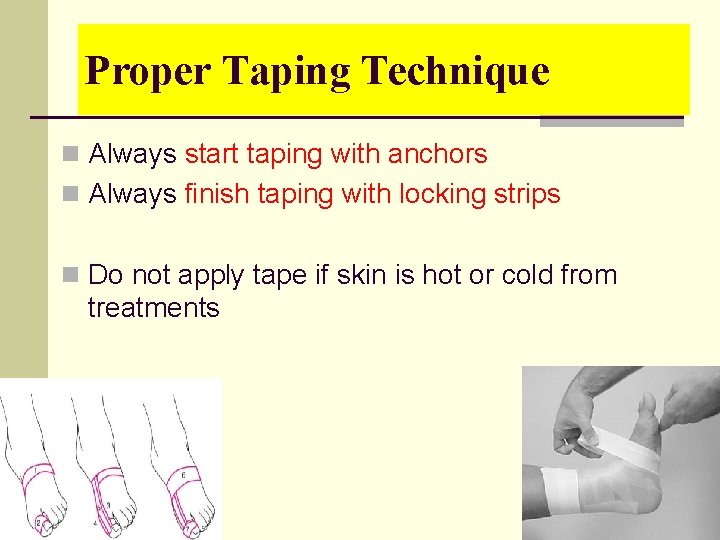
Proper Taping Technique n Always start taping with anchors n Always finish taping with locking strips n Do not apply tape if skin is hot or cold from treatments
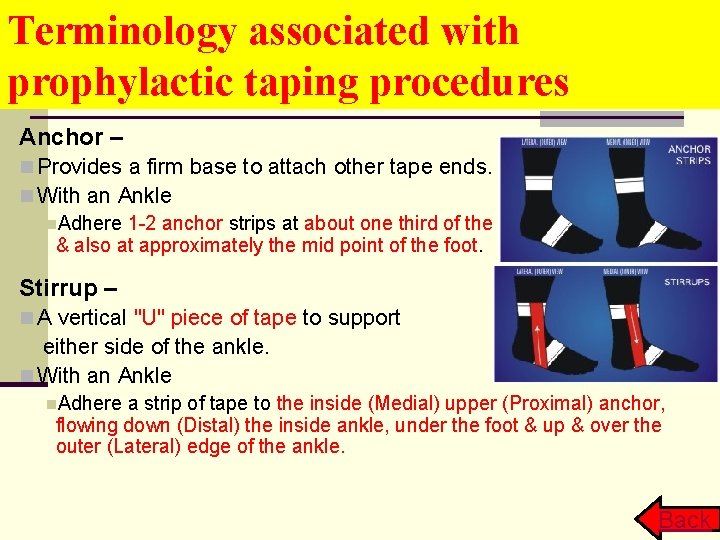
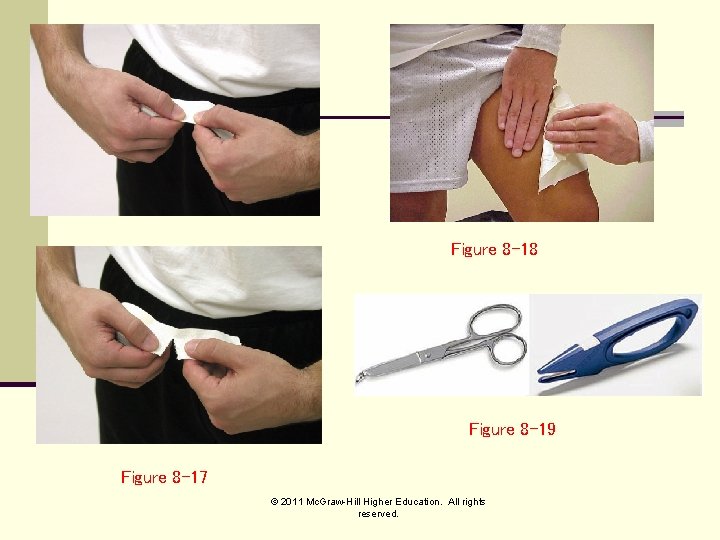
Terminology associated with prophylactic taping procedures Anchor – n Provides a firm base to attach other tape ends. n With an Ankle n. Adhere 1 -2 anchor strips at about one third of the way up the lower leg & also at approximately the mid point of the foot. Stirrup – n A vertical "U" piece of tape to support either side of the ankle. n With an Ankle n. Adhere a strip of tape to the inside (Medial) upper (Proximal) anchor, flowing down (Distal) the inside ankle, under the foot & up & over the outer (Lateral) edge of the ankle. Back
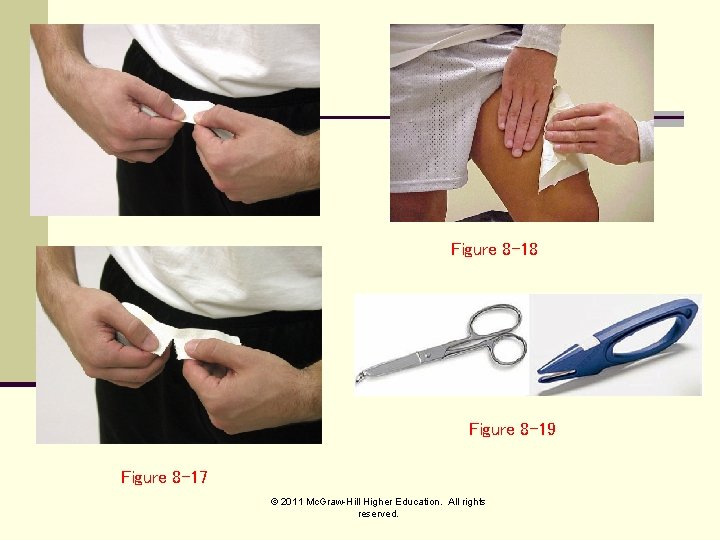
Figure 8 -18 Figure 8 -19 Figure 8 -17 © 2011 Mc. Graw-Hill Higher Education. All rights reserved.
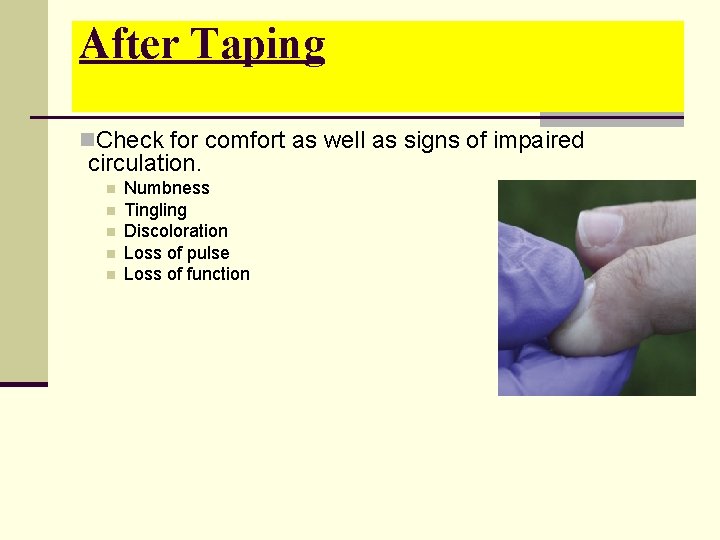
After Taping n. Check for comfort as well as signs of impaired circulation. n n n Numbness Tingling Discoloration Loss of pulse Loss of function
Foot Taping
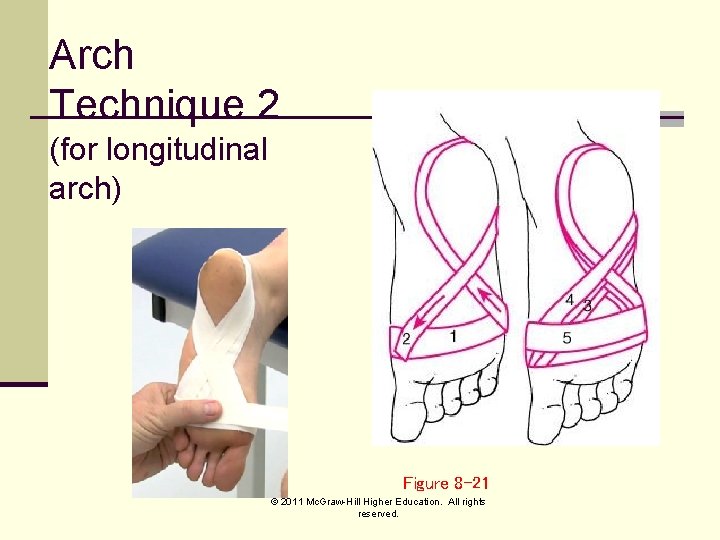
Arch Technique 2 (for longitudinal arch) Figure 8 -21 © 2011 Mc. Graw-Hill Higher Education. All rights reserved.
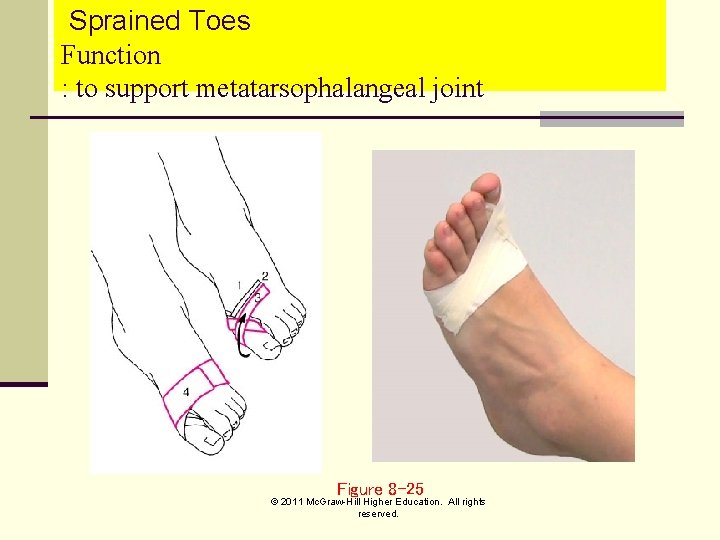
Sprained Toes Function : to support metatarsophalangeal joint Figure 8 -25 © 2011 Mc. Graw-Hill Higher Education. All rights reserved.
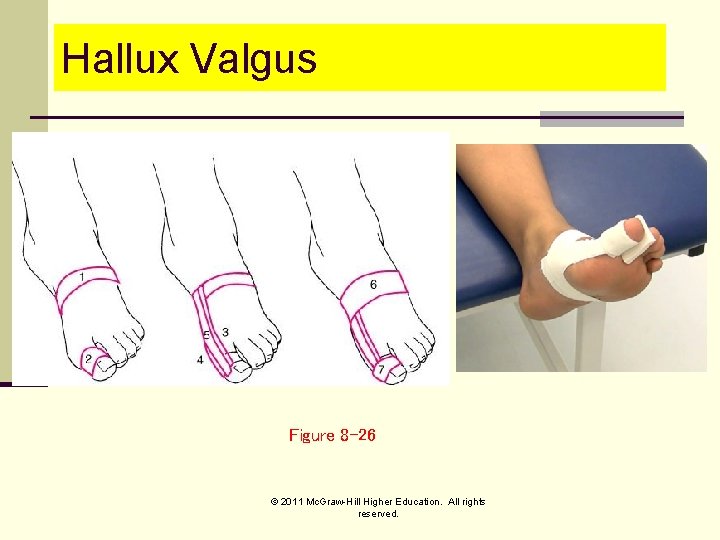
Hallux Valgus Figure 8 -26 © 2011 Mc. Graw-Hill Higher Education. All rights reserved.
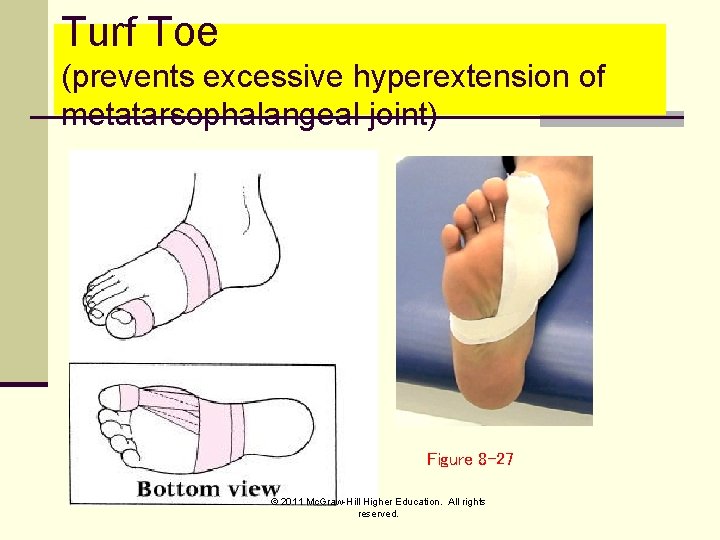
Turf Toe (prevents excessive hyperextension of metatarsophalangeal joint) Figure 8 -27 © 2011 Mc. Graw-Hill Higher Education. All rights reserved.
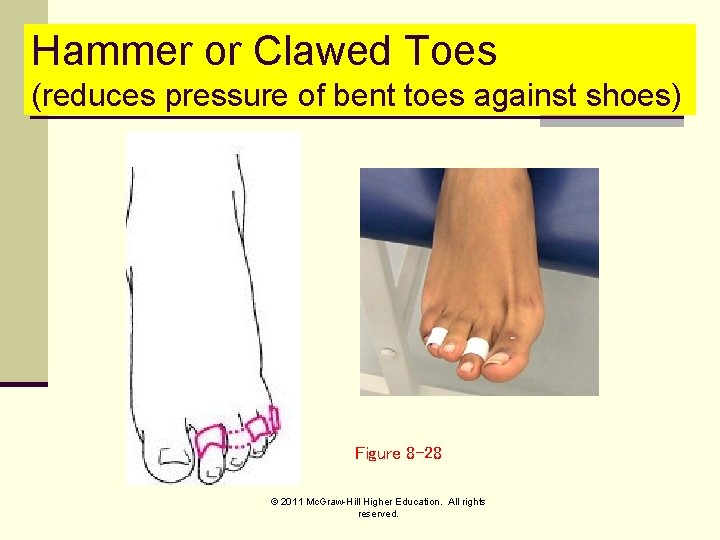
Hammer or Clawed Toes (reduces pressure of bent toes against shoes) Figure 8 -28 © 2011 Mc. Graw-Hill Higher Education. All rights reserved.
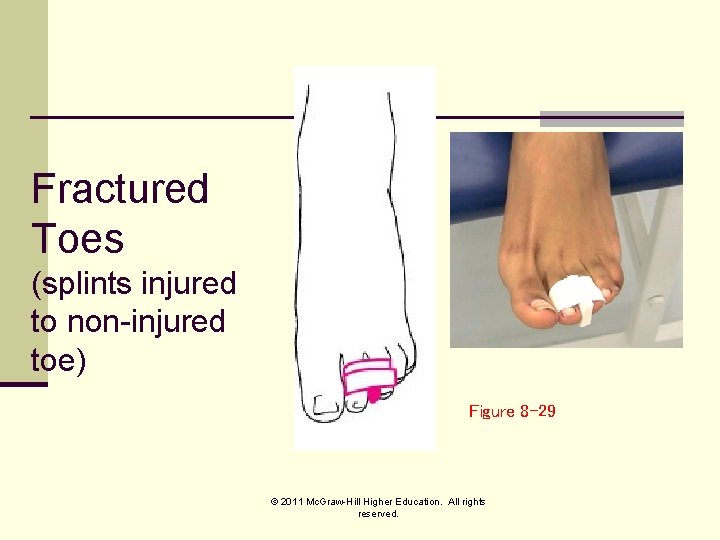
Fractured Toes (splints injured to non-injured toe) Figure 8 -29 © 2011 Mc. Graw-Hill Higher Education. All rights reserved.
Common Ankle Taping Procedures
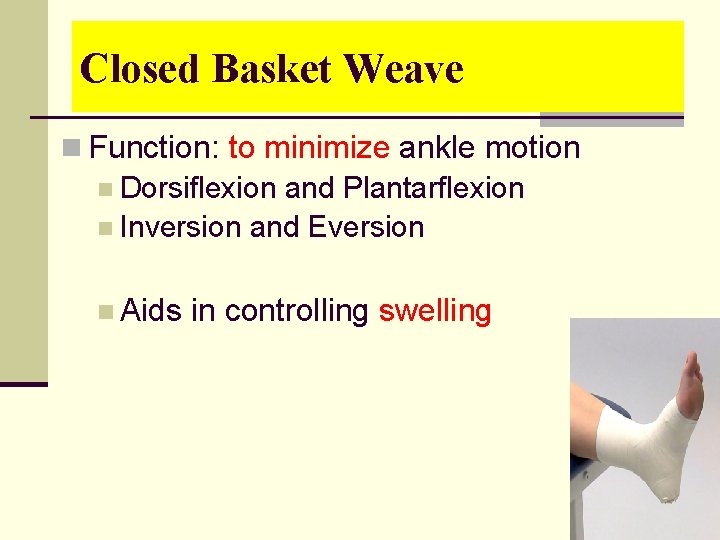
Closed Basket Weave n Function: to minimize ankle motion n Dorsiflexion and Plantarflexion n Inversion and Eversion n Aids in controlling swelling
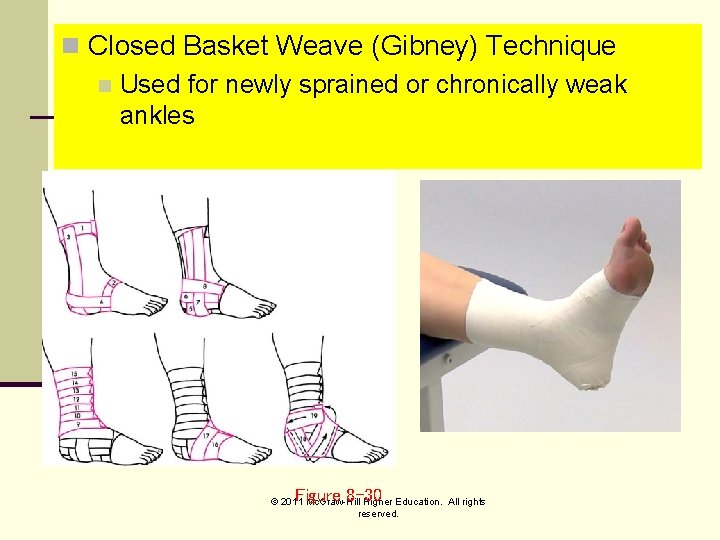
n Closed Basket Weave (Gibney) Technique n Used for newly sprained or chronically weak ankles Figure 8 -30 © 2011 Mc. Graw-Hill Higher Education. All rights reserved.
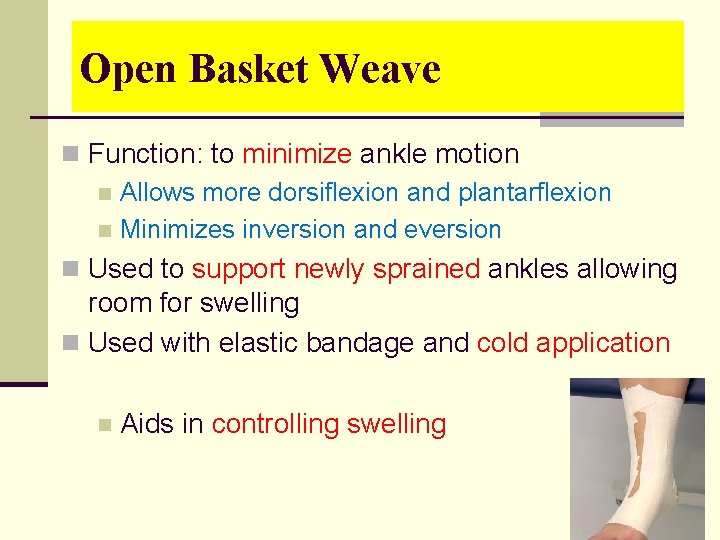
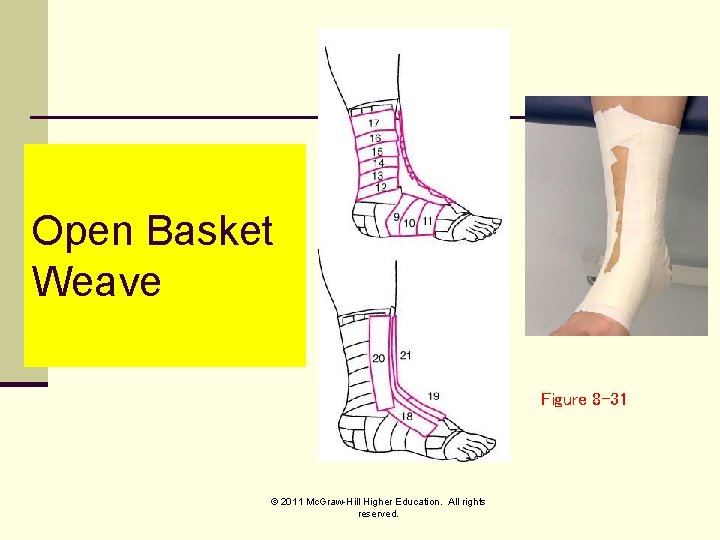
Open Basket Weave n Function: to minimize ankle motion n Allows more dorsiflexion and plantarflexion n Minimizes inversion and eversion n Used to support newly sprained ankles allowing room for swelling n Used with elastic bandage and cold application n Aids in controlling swelling
Open Basket Weave Figure 8 -31 © 2011 Mc. Graw-Hill Higher Education. All rights reserved.
Common Leg & Knee Taping Procedures
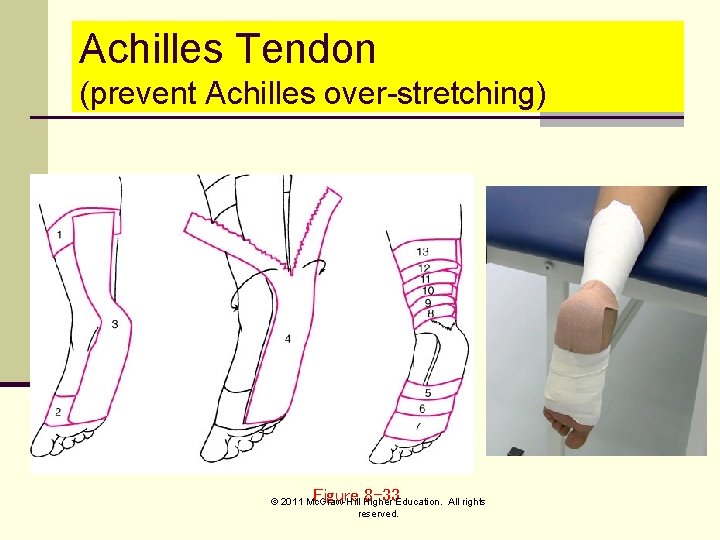
Achilles Tendon (prevent Achilles over-stretching) Figure 8 -33 © 2011 Mc. Graw-Hill Higher Education. All rights reserved.
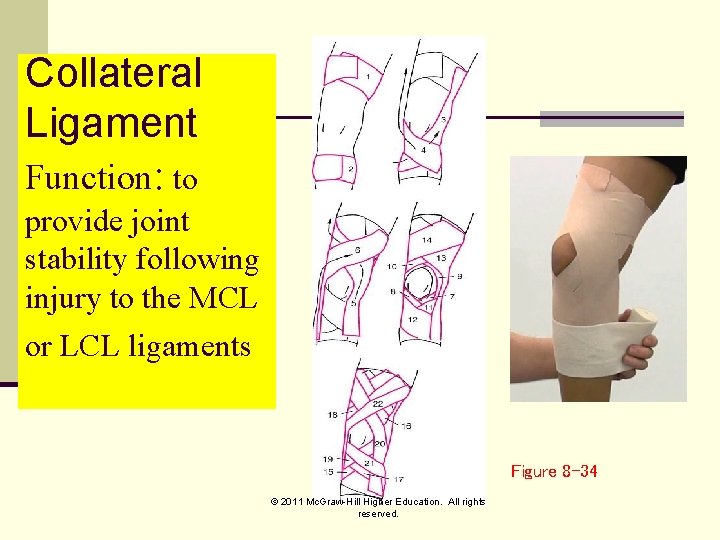
Collateral Ligament Function: to provide joint stability following injury to the MCL or LCL ligaments Figure 8 -34 © 2011 Mc. Graw-Hill Higher Education. All rights reserved.
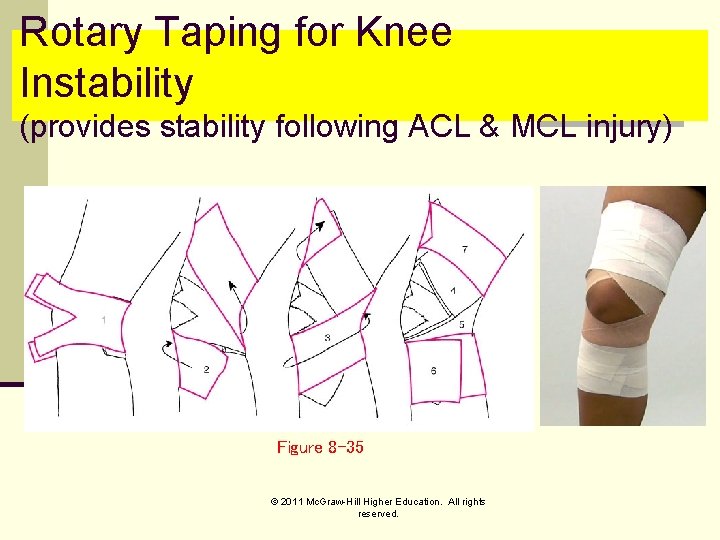
Rotary Taping for Knee Instability (provides stability following ACL & MCL injury) Figure 8 -35 © 2011 Mc. Graw-Hill Higher Education. All rights reserved.
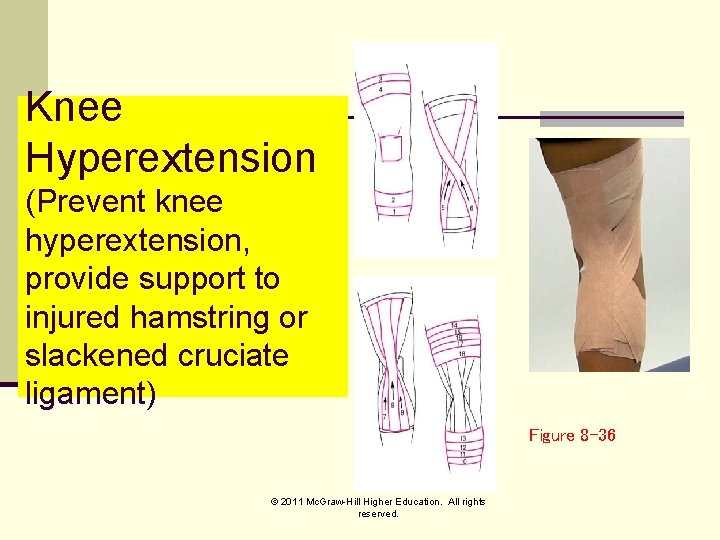
Knee Hyperextension (Prevent knee hyperextension, provide support to injured hamstring or slackened cruciate ligament) Figure 8 -36 © 2011 Mc. Graw-Hill Higher Education. All rights reserved.
Common Upper Extremity Taping Procedures
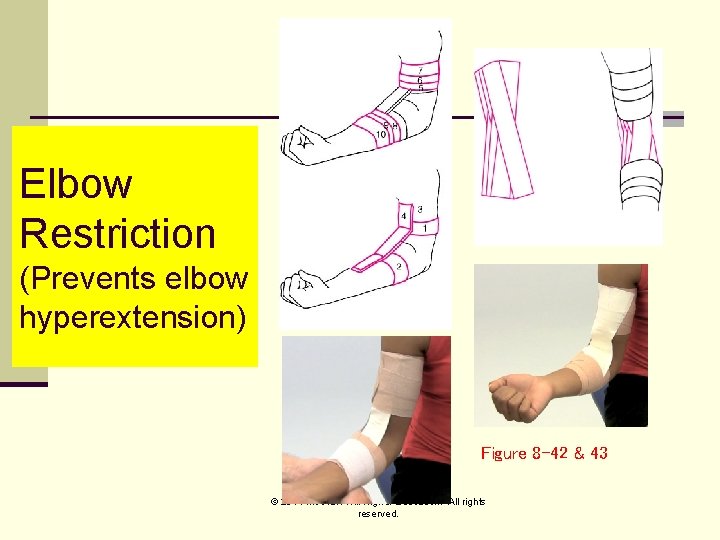
Elbow Restriction (Prevents elbow hyperextension) Figure 8 -42 & 43 © 2011 Mc. Graw-Hill Higher Education. All rights reserved.
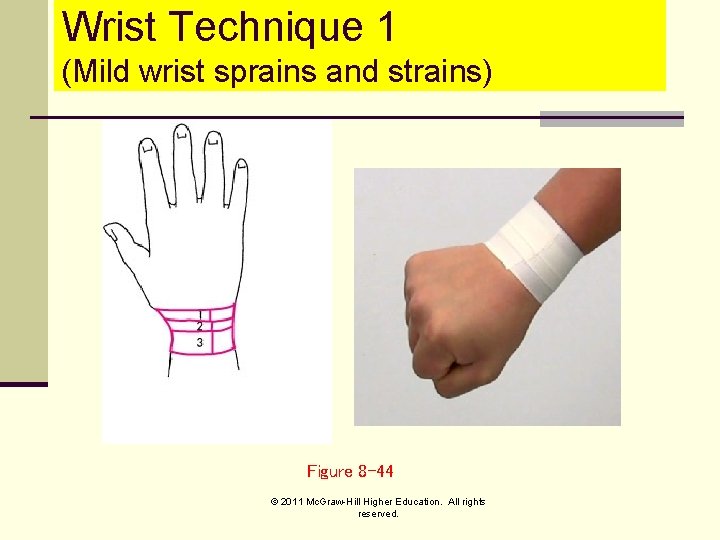
Wrist Technique 1 (Mild wrist sprains and strains) Figure 8 -44 © 2011 Mc. Graw-Hill Higher Education. All rights reserved.
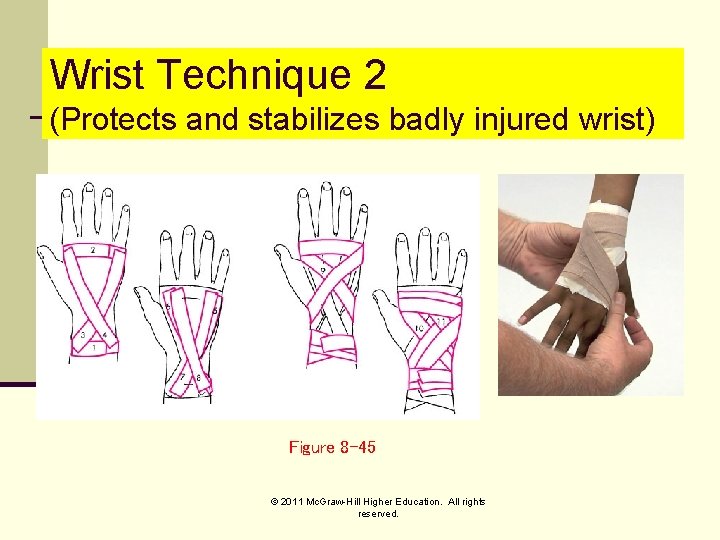
Wrist Technique 2 (Protects and stabilizes badly injured wrist) Figure 8 -45 © 2011 Mc. Graw-Hill Higher Education. All rights reserved.
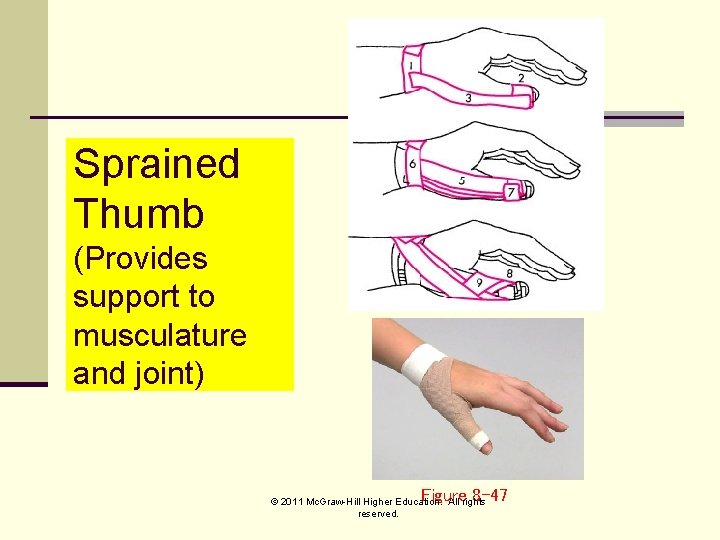
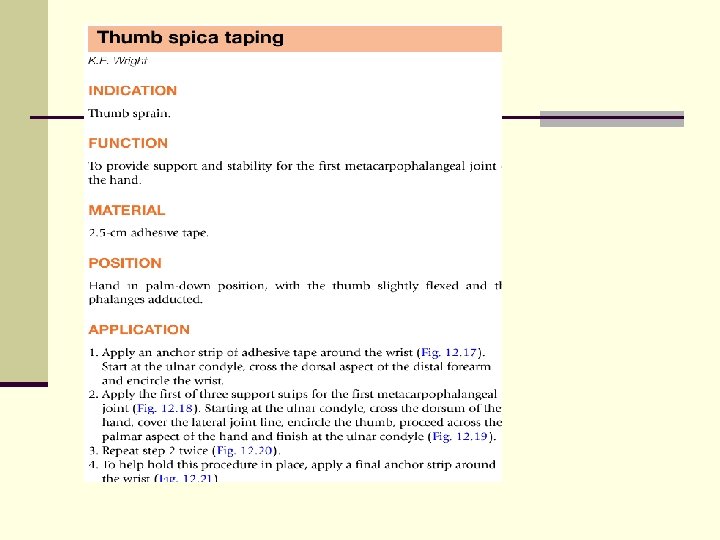
Sprained Thumb (Provides support to musculature and joint) Figure 8 -47 © 2011 Mc. Graw-Hill Higher Education. All rights reserved.
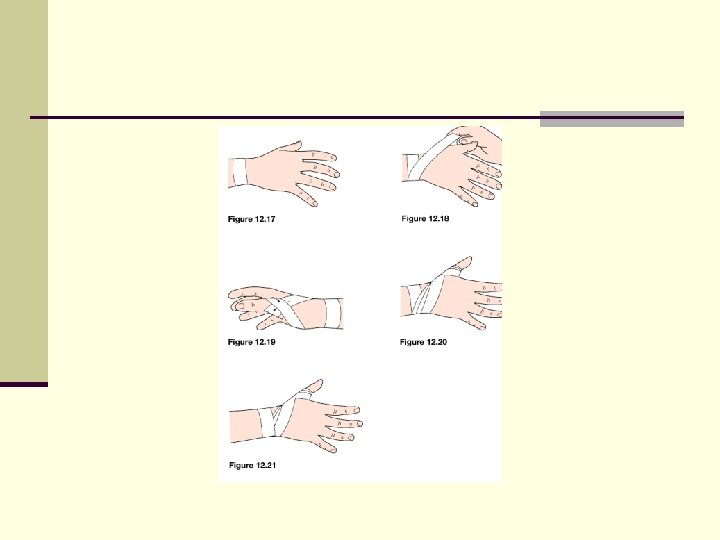
Figure 8 -18 Figure 8 -19 Figure 8 -17 © 2011 Mc. Graw-Hill Higher Education. All rights reserved.
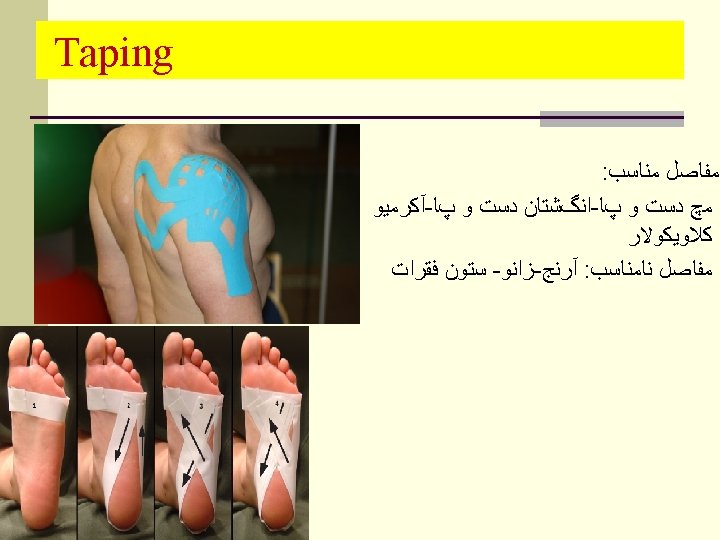
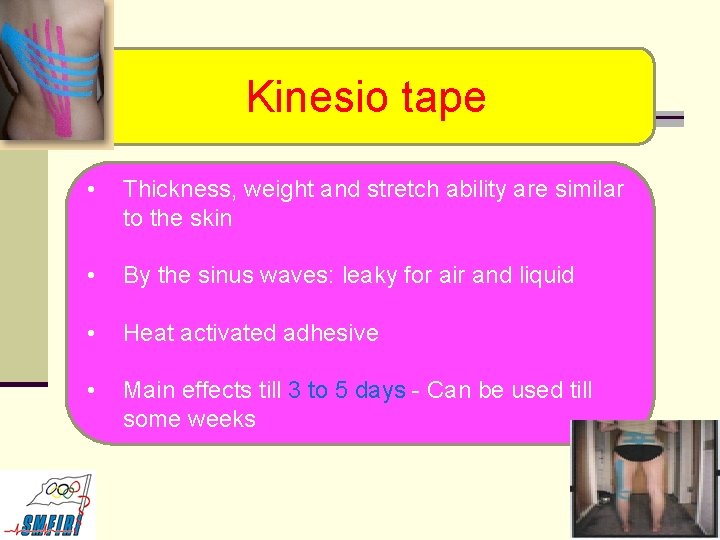
Kinesio tape • Thickness, weight and stretch ability are similar to the skin • By the sinus waves: leaky for air and liquid • Heat activated adhesive • Main effects till 3 to 5 days - Can be used till some weeks 59
Kinesio Taping n Technique developed in Japan and widely used throughout Europe and Asia n Can be stretched to 140% of original length n Used for edema reduction, pain management, and inhibition/facilitation of motor activity © 2011 Mc. Graw-Hill Higher Education. All rights reserved.
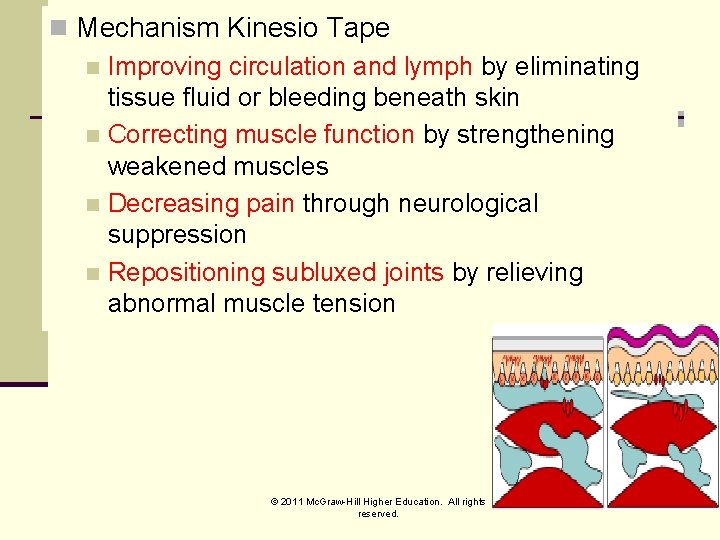
n Mechanism Kinesio Tape n Improving circulation and lymph by eliminating tissue fluid or bleeding beneath skin n Correcting muscle function by strengthening weakened muscles n Decreasing pain through neurological suppression n Repositioning subluxed joints by relieving abnormal muscle tension © 2011 Mc. Graw-Hill Higher Education. All rights reserved.
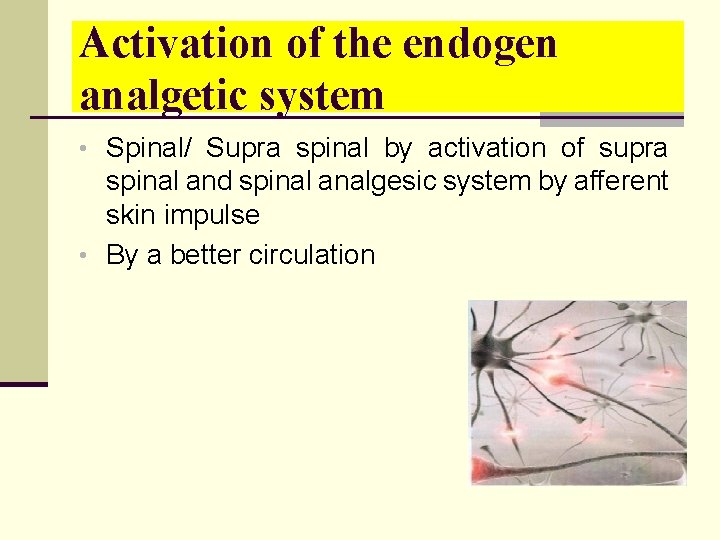
Activation of the endogen analgetic system • Spinal/ Supra spinal by activation of supra spinal and spinal analgesic system by afferent skin impulse • By a better circulation
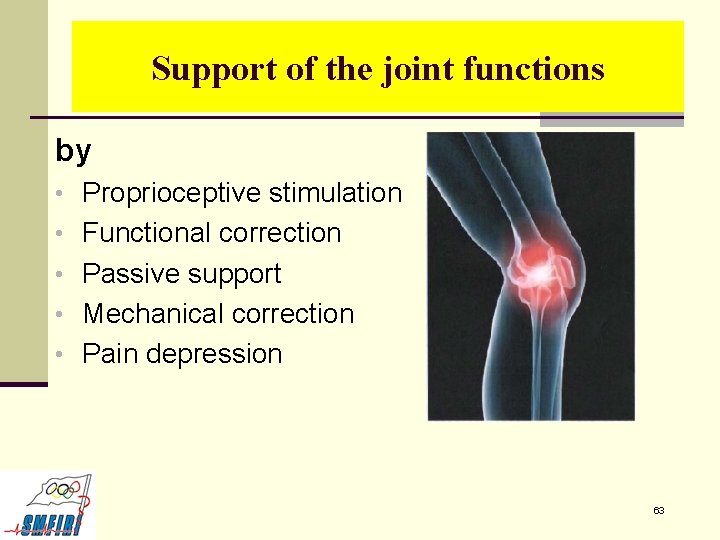
Support of the joint functions by • Proprioceptive stimulation • Functional correction • Passive support • Mechanical correction • Pain depression 63
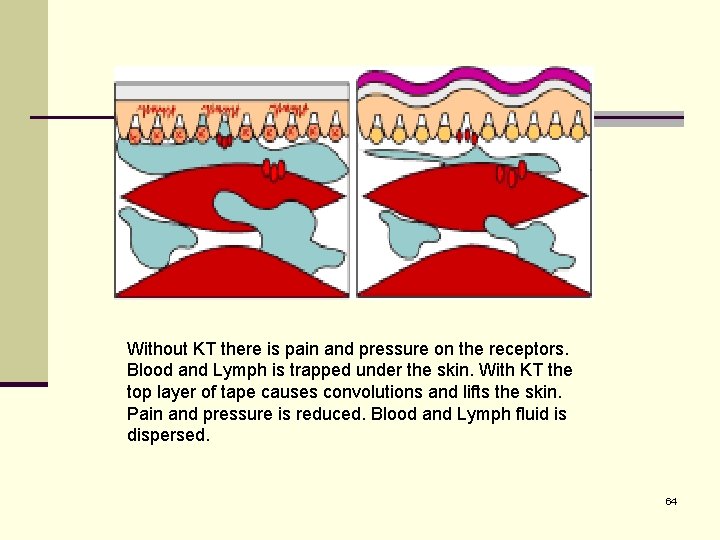
Without KT there is pain and pressure on the receptors. Blood and Lymph is trapped under the skin. With KT the top layer of tape causes convolutions and lifts the skin. Pain and pressure is reduced. Blood and Lymph fluid is dispersed. 64
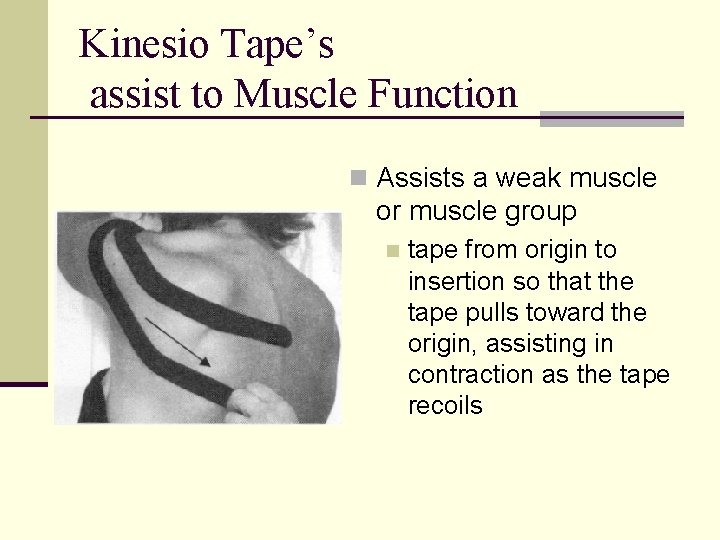
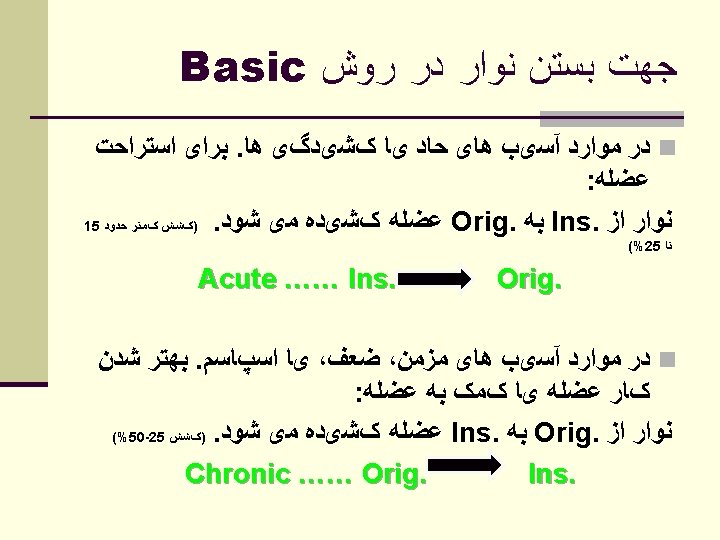
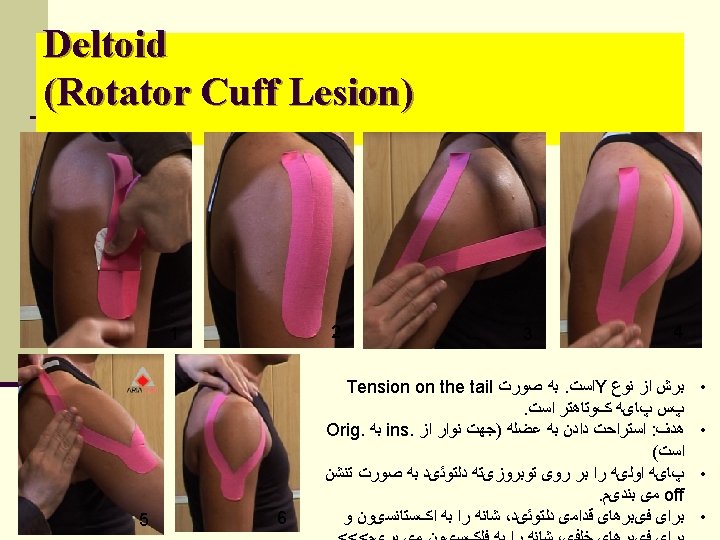
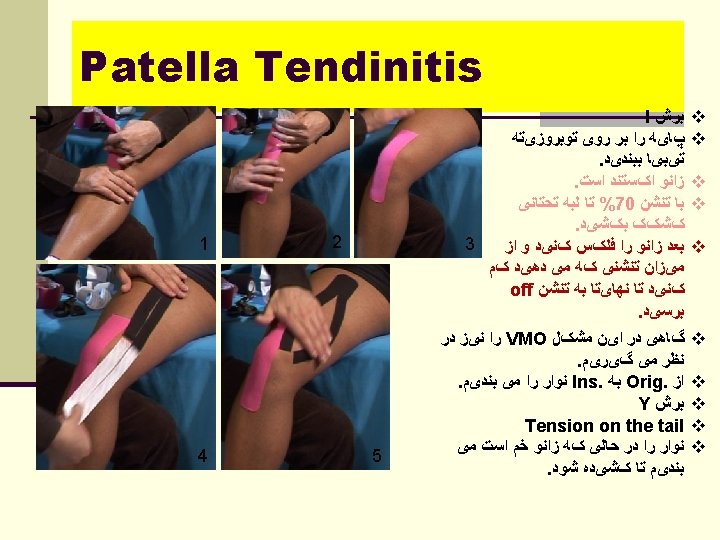
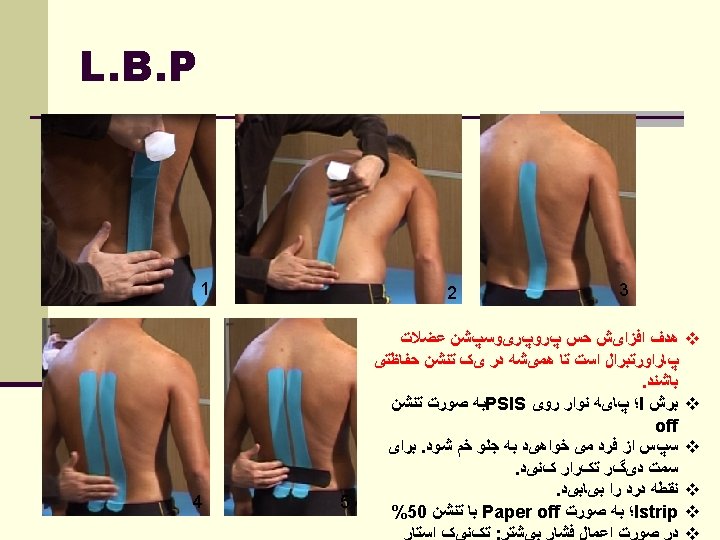
Kinesio Tape’s assist to Muscle Function n Assists a weak muscle or muscle group n tape from origin to insertion so that the tape pulls toward the origin, assisting in contraction as the tape recoils
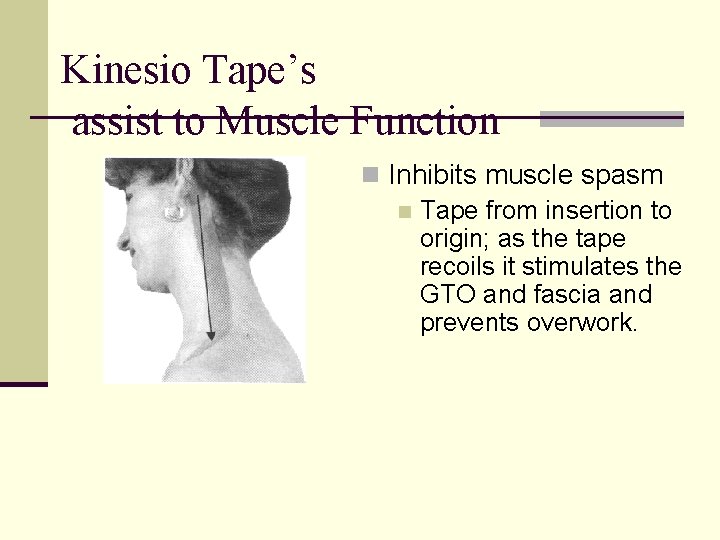
Kinesio Tape’s assist to Muscle Function n Inhibits muscle spasm n Tape from insertion to origin; as the tape recoils it stimulates the GTO and fascia and prevents overwork.
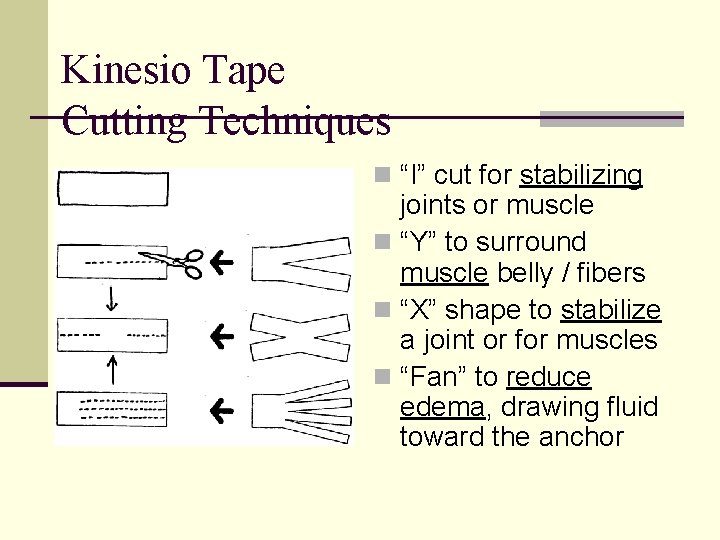
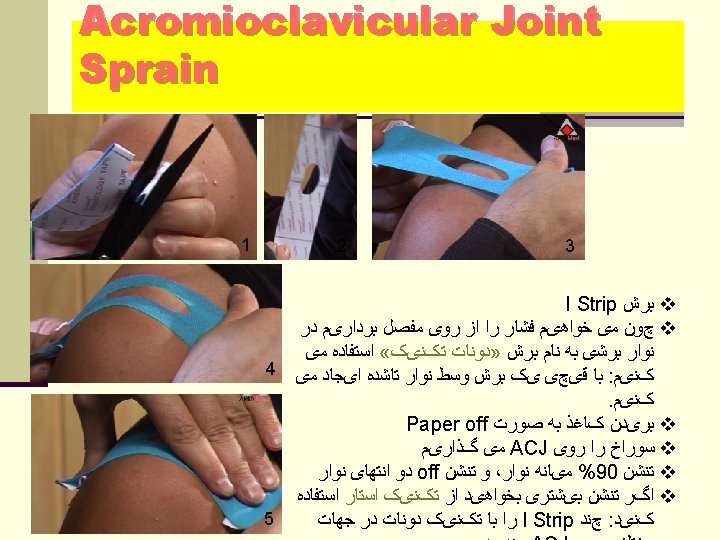
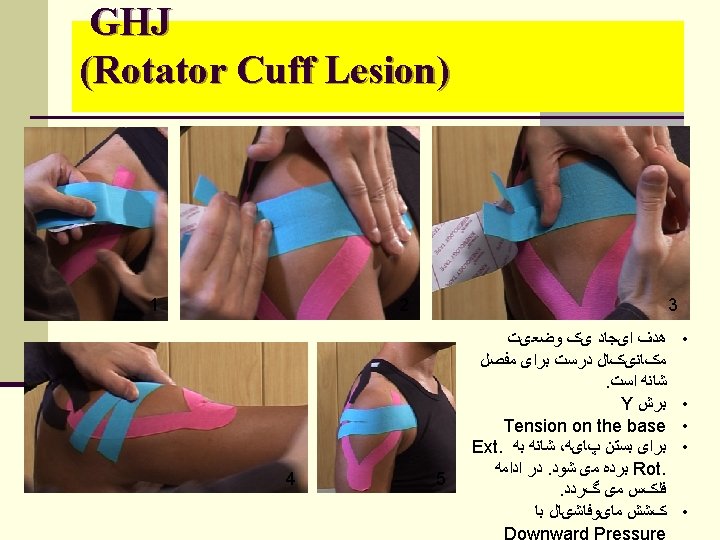
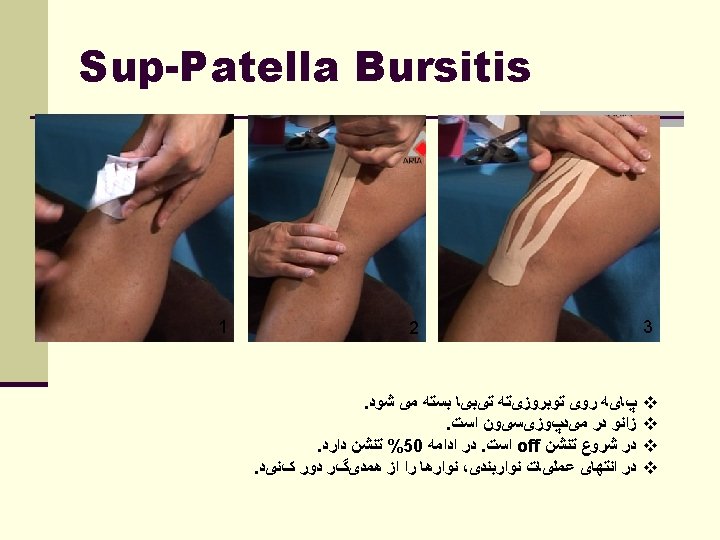
Kinesio Tape Cutting Techniques n “I” cut for stabilizing joints or muscle n “Y” to surround muscle belly / fibers n “X” shape to stabilize a joint or for muscles n “Fan” to reduce edema, drawing fluid toward the anchor
n Basic Application Principles n Apply tape from origin to insertion without minimal tension for muscle support n Should be applied from insertion to origin during rehabilitation n Can be worn for 3 -4 days n n Latex free, cotton fabric Heat activated adhesive © 2011 Mc. Graw-Hill Higher Education. All rights reserved.
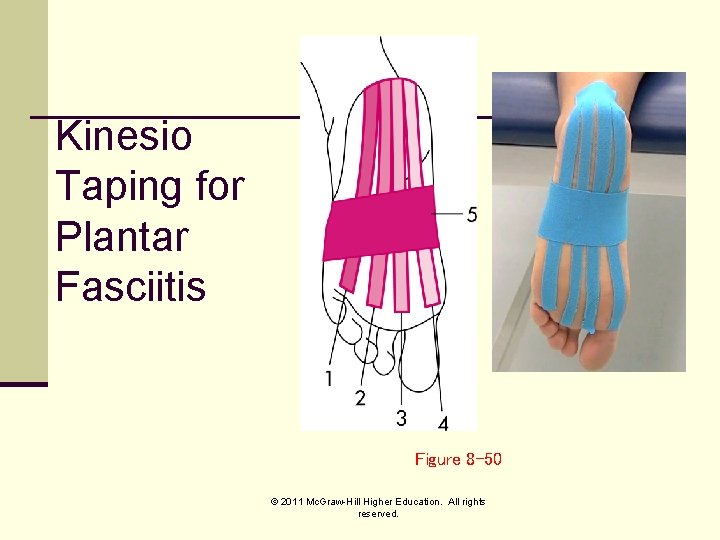
Kinesio Taping for Plantar Fasciitis Figure 8 -50 © 2011 Mc. Graw-Hill Higher Education. All rights reserved.