
TAP Channel Measurement Fundamentals Goals and Plans Outline

- Slides: 25
TAP Channel Measurement Fundamentals, Goals, and Plans
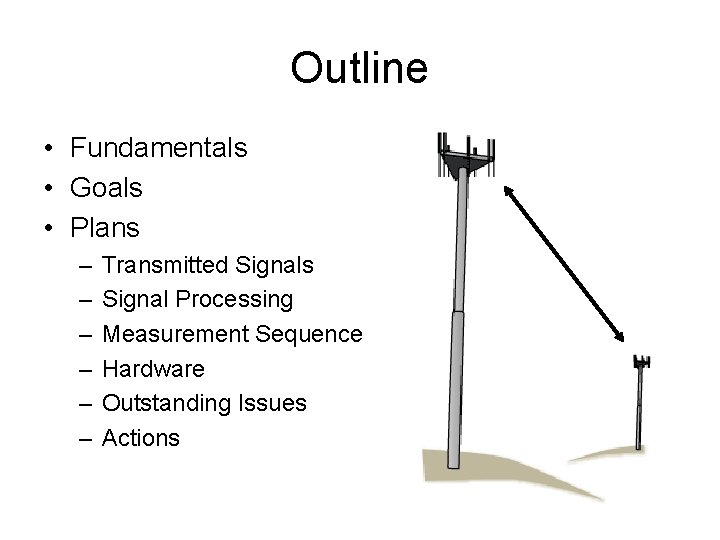
Outline • Fundamentals • Goals • Plans
Outline • Fundamentals – Channel • • • Delay Spread Coherence Bandwidth Coherence Time Ricean K-factor Pathloss Coherence Distance – System • Goals • Plans
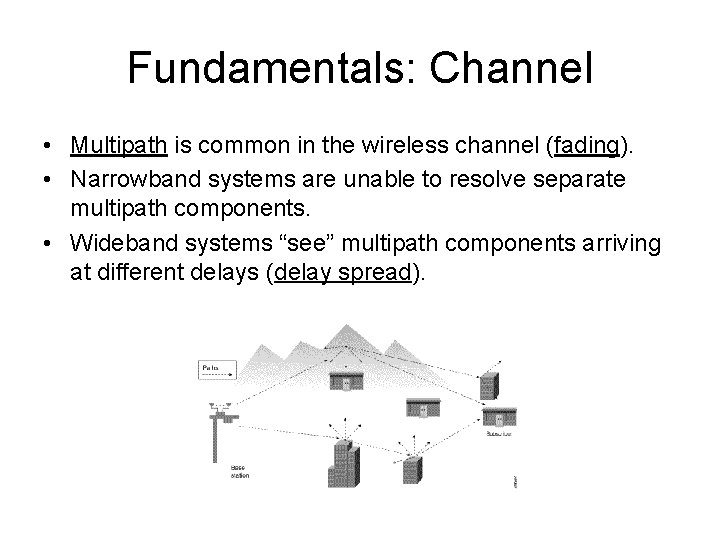
Fundamentals: Channel • Multipath is common in the wireless channel (fading). • Narrowband systems are unable to resolve separate multipath components. • Wideband systems “see” multipath components arriving at different delays (delay spread).
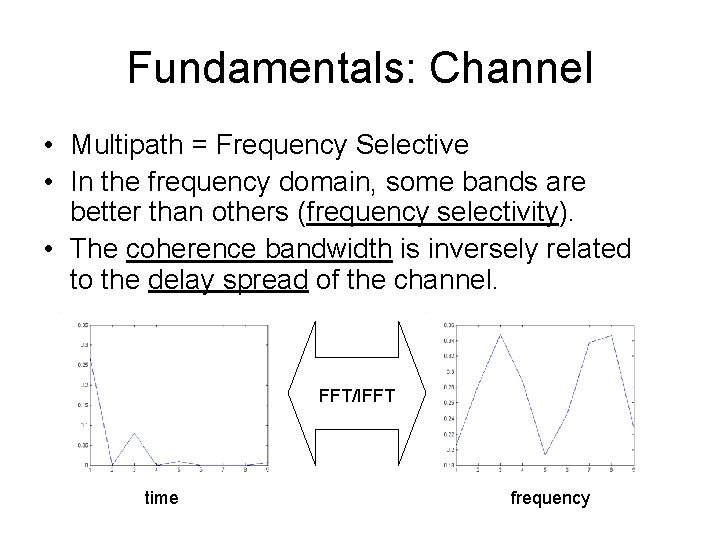
Fundamentals: Channel • Multipath = Frequency Selective • In the frequency domain, some bands are better than others (frequency selectivity). • The coherence bandwidth is inversely related to the delay spread of the channel. FFT/IFFT time frequency
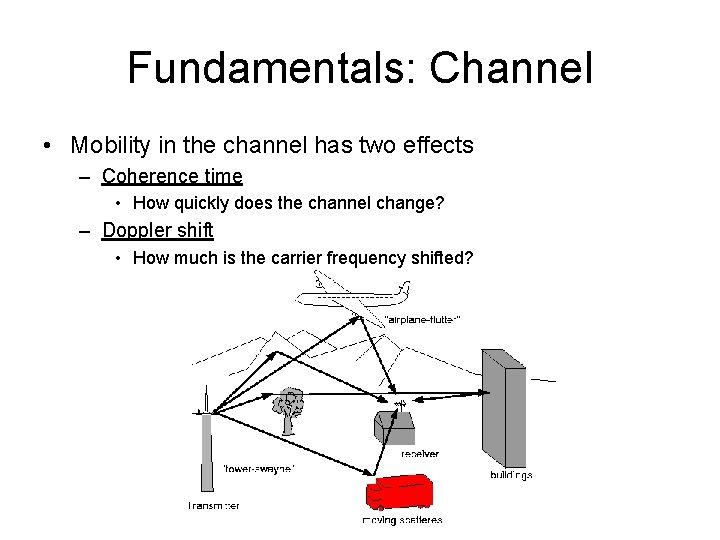
Fundamentals: Channel • Mobility in the channel has two effects – Coherence time • How quickly does the channel change? – Doppler shift • How much is the carrier frequency shifted?
Fundamentals: Channel • Each resolved multipath component has a certain ratio of direct to reflected signal power (Ricean KFactor). • Reflected and direct signals are attenuated to varying degrees depending on materials in the environment (pathloss).
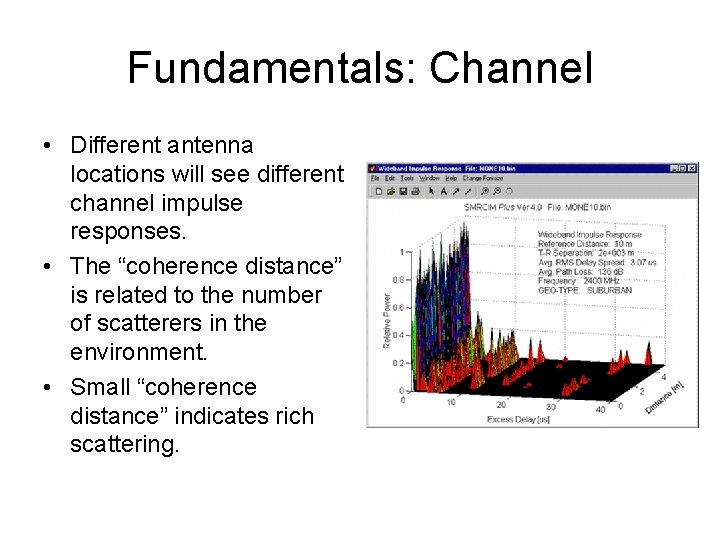
Fundamentals: Channel • Different antenna locations will see different channel impulse responses. • The “coherence distance” is related to the number of scatterers in the environment. • Small “coherence distance” indicates rich scattering.
Outline • Fundamentals – Channel – System • • • MIMO Directional antennas OFDM Cyclic prefix PAPR • Goals • Plans
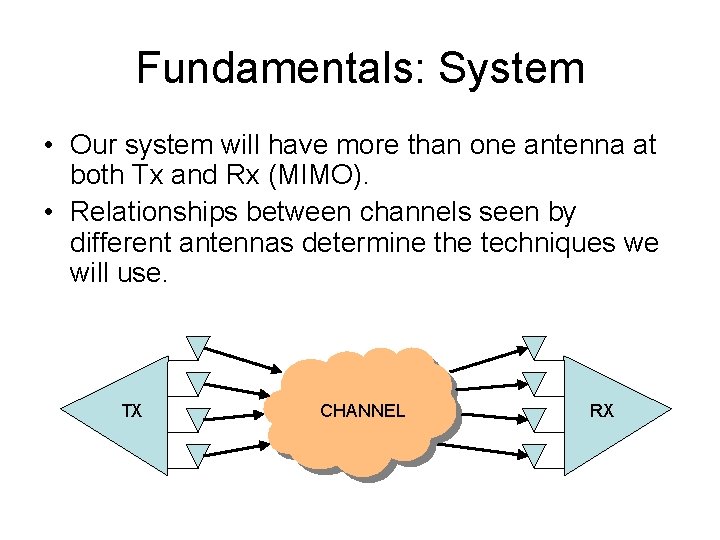
Fundamentals: System • Our system will have more than one antenna at both Tx and Rx (MIMO). • Relationships between channels seen by different antennas determine the techniques we will use. TX CHANNEL RX
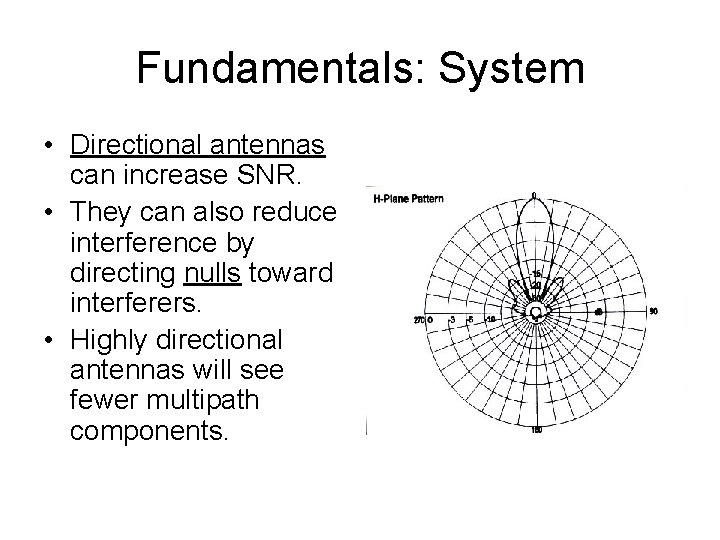
Fundamentals: System • Directional antennas can increase SNR. • They can also reduce interference by directing nulls toward interferers. • Highly directional antennas will see fewer multipath components.
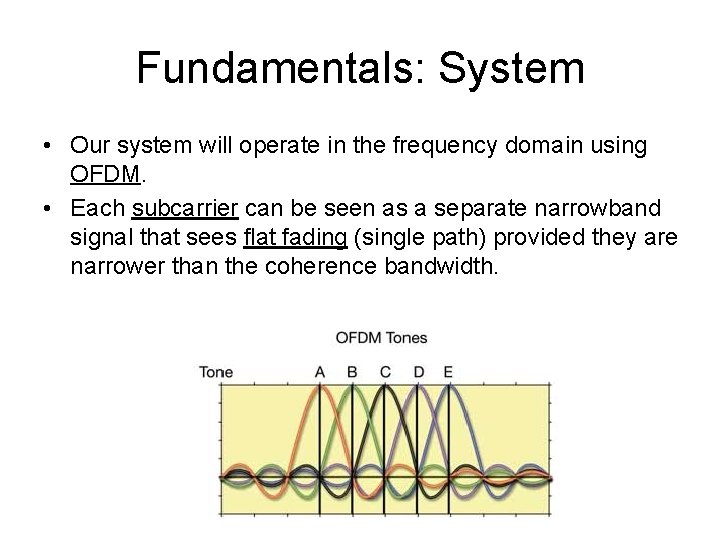
Fundamentals: System • Our system will operate in the frequency domain using OFDM. • Each subcarrier can be seen as a separate narrowband signal that sees flat fading (single path) provided they are narrower than the coherence bandwidth.
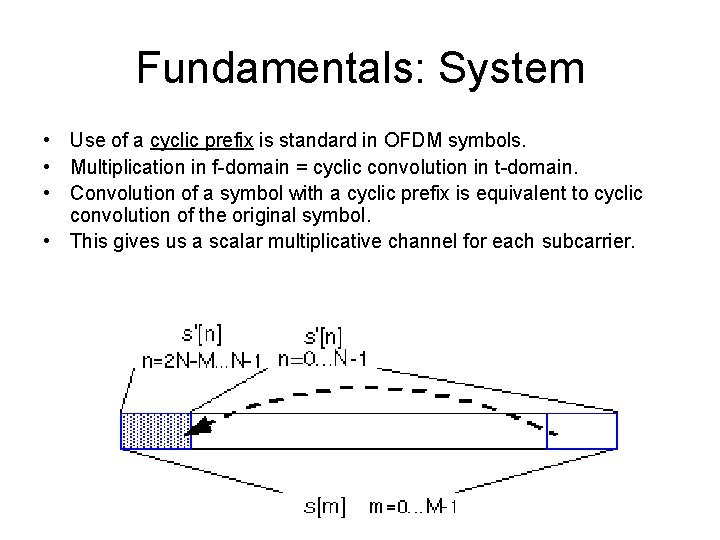
Fundamentals: System • Use of a cyclic prefix is standard in OFDM symbols. • Multiplication in f-domain = cyclic convolution in t-domain. • Convolution of a symbol with a cyclic prefix is equivalent to cyclic convolution of the original symbol. • This gives us a scalar multiplicative channel for each subcarrier.
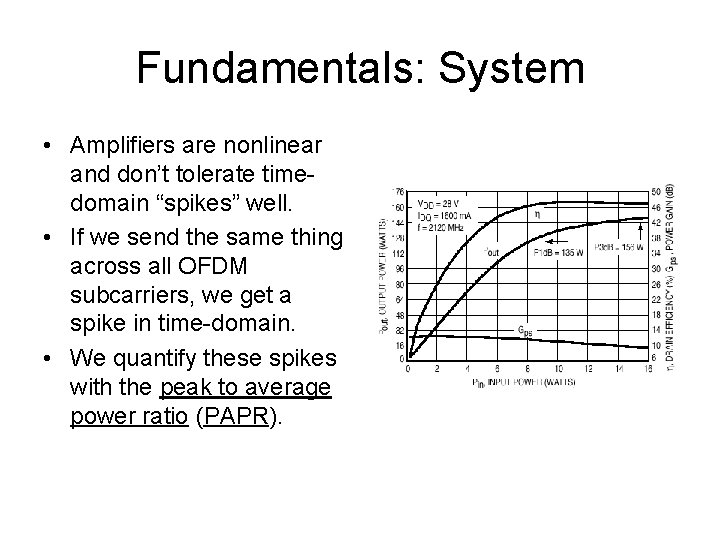
Fundamentals: System • Amplifiers are nonlinear and don’t tolerate timedomain “spikes” well. • If we send the same thing across all OFDM subcarriers, we get a spike in time-domain. • We quantify these spikes with the peak to average power ratio (PAPR).
Outline • Fundamentals • Goals – – Big picture Parameters Variables Timeline • Plans
Goals: Big Picture • Channel measurements are a means to an end, not a final goal. • System-specific parameters • How to design beamforming algorithms • How much multiplexing is possible • Realistic performance bounds
Goals: Parameters to Measure • • • Antenna correlation Pathloss exponents Coherence bandwidth Coherence time Delay spread Ricean K-factor
Goals: Experimental Variables • • • Antenna separation Antenna polarity Antenna directionality Tx-Rx separation Measurement location
Goals: Timeline • Begin assembling system May 04 • Fully operational measurement system by August 04 • Measurements completed by November 04 (earlier if at all possible)
Outline • Fundamentals • Goals • Plans – – – Transmitted Signals Signal Processing Measurement Sequence Hardware Outstanding Issues Actions
Plans: Transmitted Signals • Design pilot signals according to the following criteria – Minimize PAPR (adjust phases accordingly) – Make the two transmit antennas orthogonal (alternate subcarriers) – Make cyclic prefix longer than delay spread – Make OFDM symbols much shorter than coherence time – Keep subcarriers much narrower than coherence bandwidth
Plans: Signal Processing • Buffer several seconds of received samples from each radio • Download to a PC for offline processing • Find statistics using Matlab
Plans: Measurement Sequence • Use narrowband measurements to find coherence time. • Use extremely narrow subcarriers to find coherence bandwidth. • Use extra long cyclic prefixes to find approximate delay spread. • Find reasonable values for number of subcarriers and cyclic prefix length. • Vary antenna separation, polarity, type, etc.
Plans: Outstanding Issues • Carrier offset recovery (clock synchronization) • Location, azimuth and distance measurements (GPS? ) • Antenna mounting hardware • Antenna choices • PAPR problems • Other non-ideal hardware effects • Limited buffer size for data storage • Measurement locations
Plans: Actions • Start writing System Generator code to control our measurements. • Derive optimal pilot symbols. • Write Matlab code to analyze data. • Test with channel emulators. • Buy higher capacity FPGA boards. • Buy/make adjustable antenna mounting hardware. • Find and buy several types of antennas. • Begin field measurements.