
Taoism Symbols Images YingYang dyagram is the most
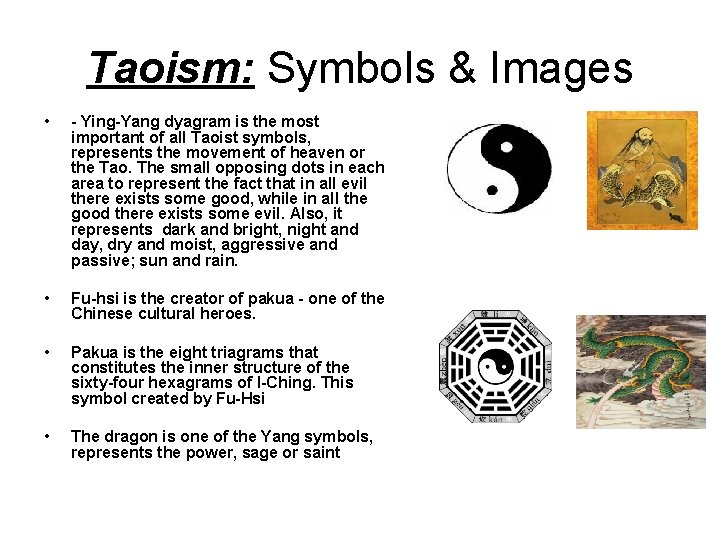
Taoism: Symbols & Images • - Ying-Yang dyagram is the most important of all Taoist symbols, represents the movement of heaven or the Tao. The small opposing dots in each area to represent the fact that in all evil there exists some good, while in all the good there exists some evil. Also, it represents dark and bright, night and day, dry and moist, aggressive and passive; sun and rain. • Fu-hsi is the creator of pakua - one of the Chinese cultural heroes. • Pakua is the eight triagrams that constitutes the inner structure of the sixty-four hexagrams of I-Ching. This symbol created by Fu-Hsi • The dragon is one of the Yang symbols, represents the power, sage or saint

Taoism: Symbols & Images • The three sages are Buddha, Confucius and Lao-Tzu. They represent money, power and talent. • The sacred tortoise with pukua on its back is the symbol of wisdom and divinatory power. • Kua is a hexagram formed of six continuous or discontinuous lines. • The I-ching coin is one of the symbol of Taoism, which three coins are used to consult the oracle
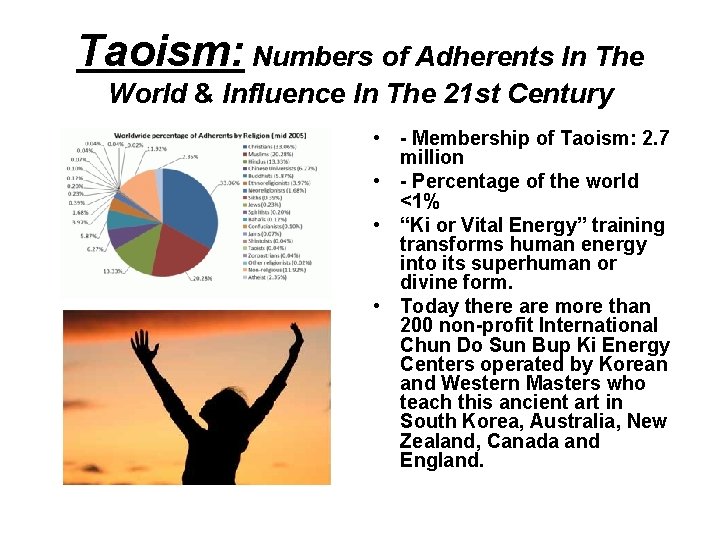
Taoism: Numbers of Adherents In The World & Influence In The 21 st Century • - Membership of Taoism: 2. 7 million • - Percentage of the world <1% • “Ki or Vital Energy” training transforms human energy into its superhuman or divine form. • Today there are more than 200 non-profit International Chun Do Sun Bup Ki Energy Centers operated by Korean and Western Masters who teach this ancient art in South Korea, Australia, New Zealand, Canada and England.
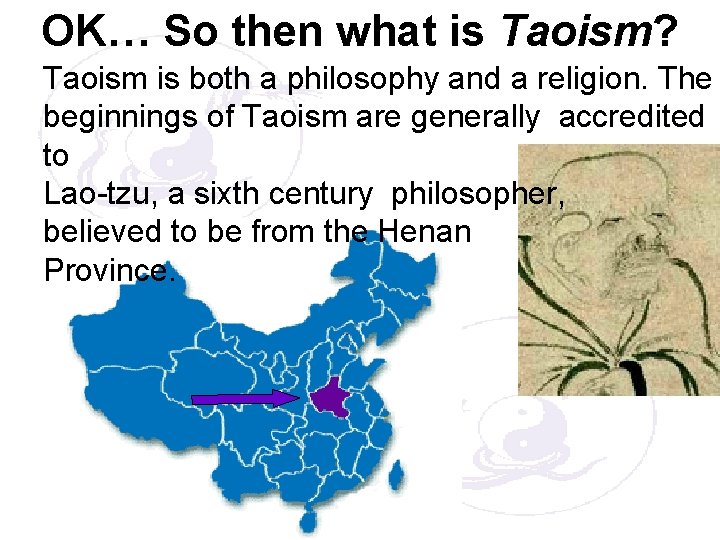
OK… So then what is Taoism? Taoism is both a philosophy and a religion. The beginnings of Taoism are generally accredited to Lao-tzu, a sixth century philosopher, believed to be from the Henan Province.
Oh… So then what do Taoists believe? Here are three of the major Taoist concepts: v TE means power. The power of a thing is its virtue, its identity, its integrity. So the te of a person is their authentic self, or genuineness. Te is expressed through humility and meekness. v WU-WEI is a concept involving relaxing the conscious mind. It seeks the denial of anything personal and the dissolution of the conscious, individual self. Wu-wei is best illustrated by water; it is supple yet strong, it flows over and fills what it encounters. It means to simply follow the way of nature. v P’U is a term which literally means “unpainted wood”. P’U stresses the importance of simplicity and the need to leave things in their natural state.
Say What? ? In plain English: v. Taoists advocate a simple honest life and noninterference with the course of natural events v Taoists don’t like politics, administration, or elaborate rituals. v So then how would you have government? v Do not emphasize status, intelligence, or possessions. v Govern with least visibility and with a serving attitude. v Reduce laws and govern lightly. v Take few actions that involve the people. v Treat other countries non-aggressively.
DEITIES When Taoism was first developing, there were no deities, only the Tao. As time went by, however, many gods became present in the religion. Two types of deities developed. Ø The first type consists of the natural gods, the highest gods who are believed to have emerged from primordial energy at the beginning of the world. These gods developed as part of Taoism between the second and sixth centuries C. E. We will be giving examples of this type of god. Ø The second type of Taoist deity consist of human beings who, through learning, self-discipline, alchemy, or some other means, have purified themselves of mortal imperfections and become gods.
- Slides: 7