
Tanzania Power Chain Blockchain enabled energy trading unlocking
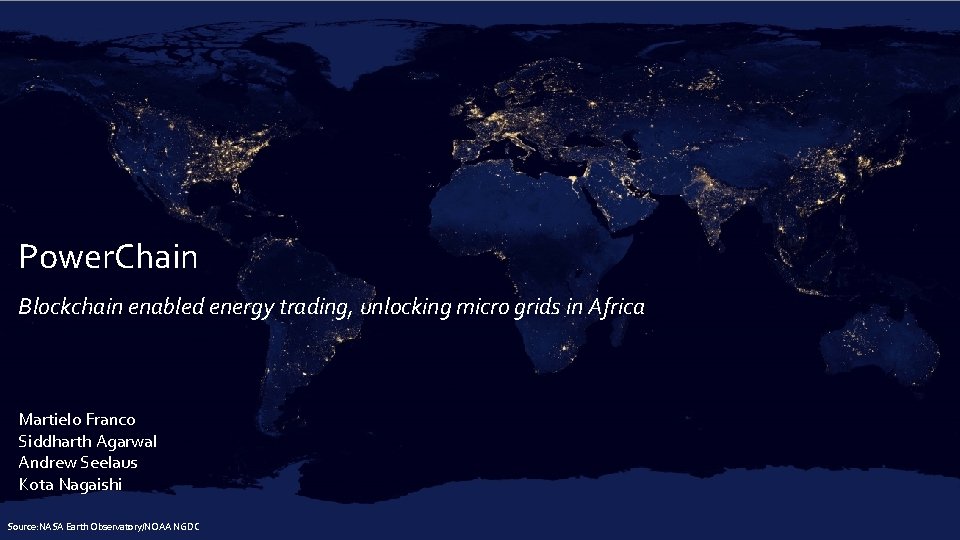
Tanzania Power. Chain Blockchain enabled energy trading, unlocking micro grids in Africa Martielo Franco Siddharth Agarwal Andrew Seelaus Kota Nagaishi Source: NASA Earth Observatory/NOAA NGDC
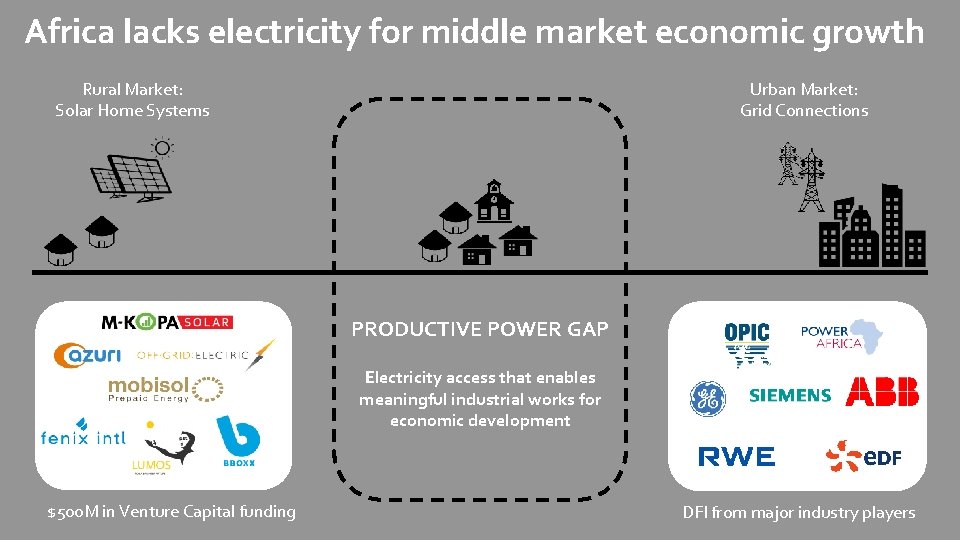
Africa lacks electricity for middle market economic growth Rural Market: Solar Home Systems Urban Market: Grid Connections PRODUCTIVE POWER GAP Electricity access that enables meaningful industrial works for economic development $500 M in Venture Capital funding DFI from major industry players
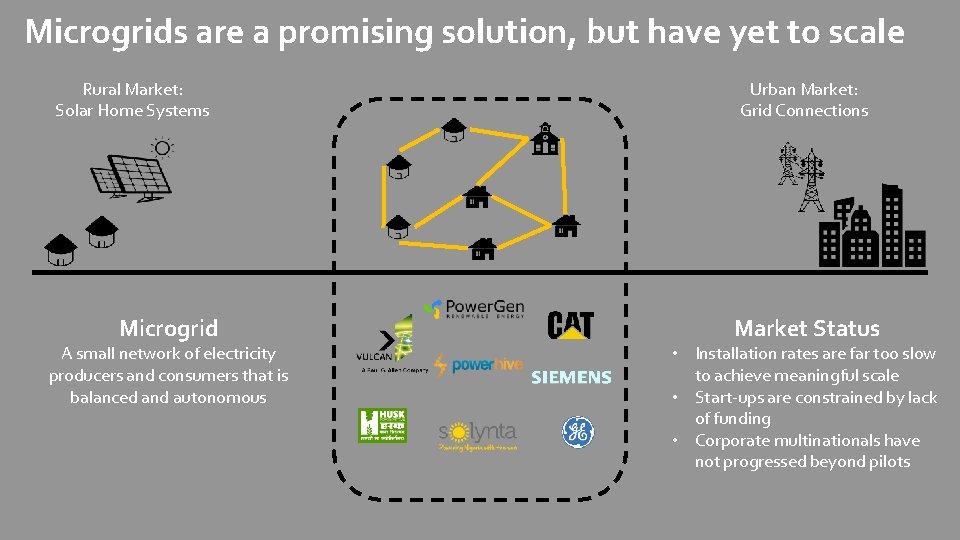
Microgrids are a promising solution, but have yet to scale Rural Market: Solar Home Systems Microgrid A small network of electricity producers and consumers that is balanced and autonomous Urban Market: Grid Connections Market Status • Installation rates are far too slow to achieve meaningful scale • Start-ups are constrained by lack of funding • Corporate multinationals have not progressed beyond pilots
Three stubborn challenges prevent scalable solutions Selling the System Microgrids require a minimum adoption rate to be economically feasible. Convincing an entire community to pay for a microgrid solution is much more difficult than getting buy-in from individual consumers. Standardization Current microgrid technologies require a unique plan for each system depending on the size and demand of a given community. The ability to offer a streamlined solution would dramatically reduce fixed costs of engineering and planning. The goal is selling a “microgrid in a box. ” Funding Microgrid pilots have not yet proved to be feasible on a unit economics basis. Therefore, significant business model risk makes capital prohibitively expensive or not available at all.
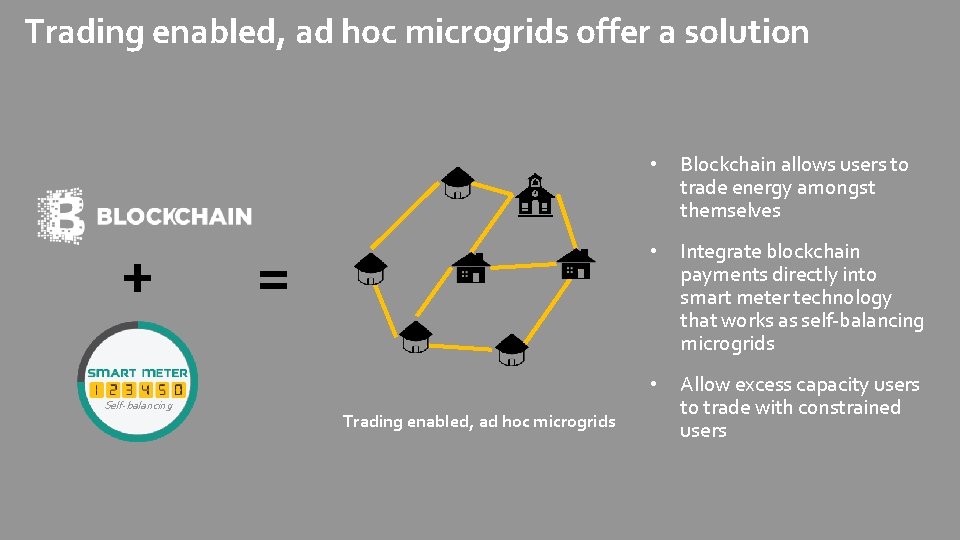
Trading enabled, ad hoc microgrids offer a solution + Self-balancing = Trading enabled, ad hoc microgrids • Blockchain allows users to trade energy amongst themselves • Integrate blockchain payments directly into smart meter technology that works as self-balancing microgrids • Allow excess capacity users to trade with constrained users
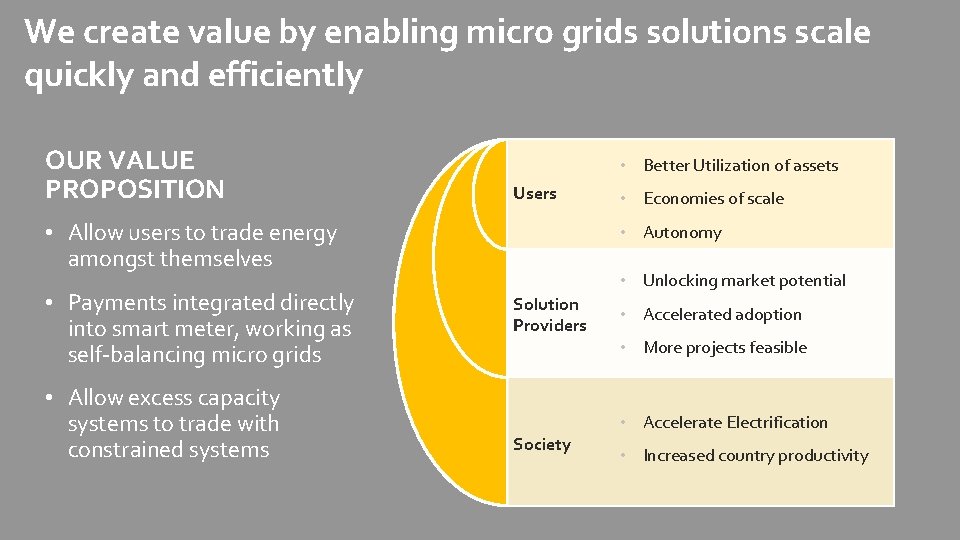
We create value by enabling micro grids solutions scale quickly and efficiently OUR VALUE PROPOSITION • Better Utilization of assets Users • Allow users to trade energy amongst themselves • Payments integrated directly into smart meter, working as self-balancing micro grids • Allow excess capacity systems to trade with constrained systems • Economies of scale • Autonomy • Unlocking market potential Solution Providers • Accelerated adoption • More projects feasible • Accelerate Electrification Society • Increased country productivity
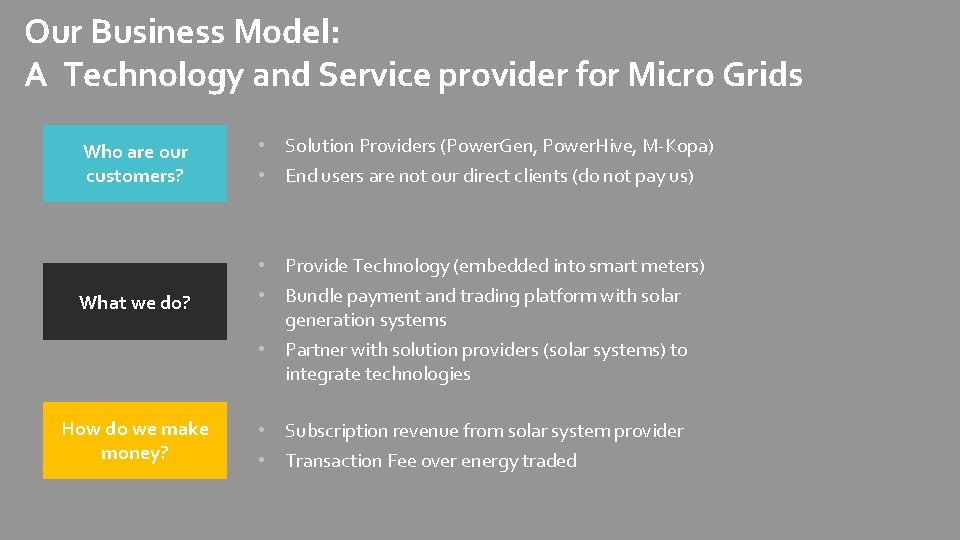
Our Business Model: A Technology and Service provider for Micro Grids Who are our customers? What we do? How do we make money? • Solution Providers (Power. Gen, Power. Hive, M-Kopa) • End users are not our direct clients (do not pay us) • Provide Technology (embedded into smart meters) • Bundle payment and trading platform with solar generation systems • Partner with solution providers (solar systems) to integrate technologies • Subscription revenue from solar system provider • Transaction Fee over energy traded
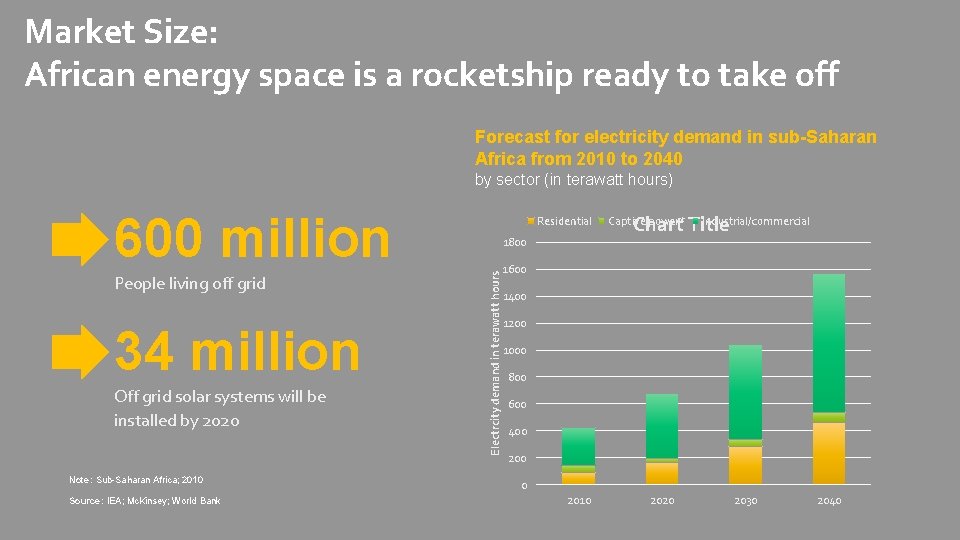
Market Size: African energy space is a rocketship ready to take off Forecast for electricity demand in sub-Saharan Africa from 2010 to 2040 by sector (in terawatt hours) 600 million 34 million Off grid solar systems will be installed by 2020 Note: Sub-Saharan Africa; 2010 Source: IEA; Mc. Kinsey; World Bank 1800 Electrcity demand in terawatt hours People living off grid Residential Industrial/commercial Chart Title Captive power* 1600 1400 1200 1000 800 600 400 200 0 2010 2020 2030 2040
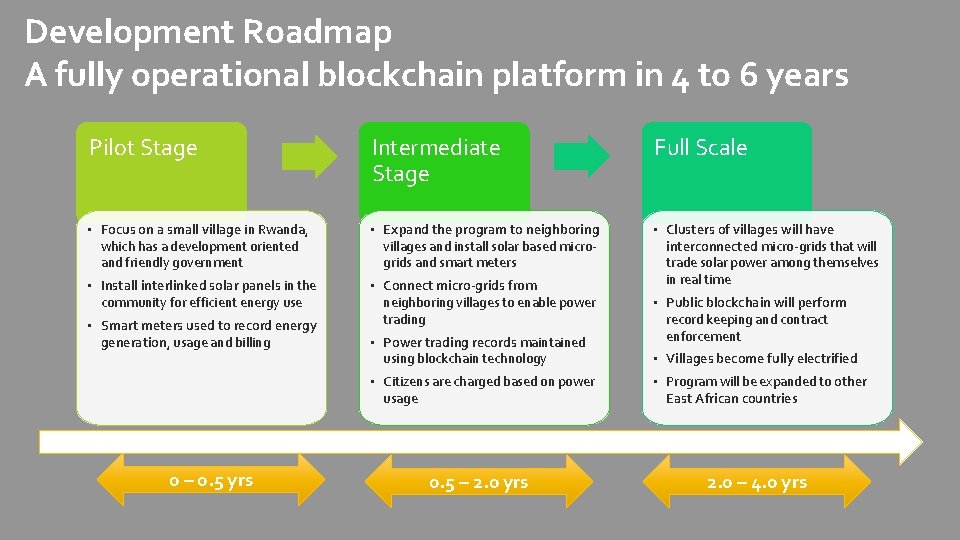
Development Roadmap A fully operational blockchain platform in 4 to 6 years Pilot Stage Intermediate Stage Full Scale • Focus on a small village in Rwanda, which has a development oriented and friendly government • Expand the program to neighboring villages and install solar based microgrids and smart meters • Install interlinked solar panels in the community for efficient energy use • Connect micro-grids from neighboring villages to enable power trading • Clusters of villages will have interconnected micro-grids that will trade solar power among themselves in real time • Smart meters used to record energy generation, usage and billing • Power trading records maintained using blockchain technology • Citizens are charged based on power usage 0 – 0. 5 yrs 0. 5 – 2. 0 yrs • Public blockchain will perform record keeping and contract enforcement • Villages become fully electrified • Program will be expanded to other East African countries 2. 0 – 4. 0 yrs
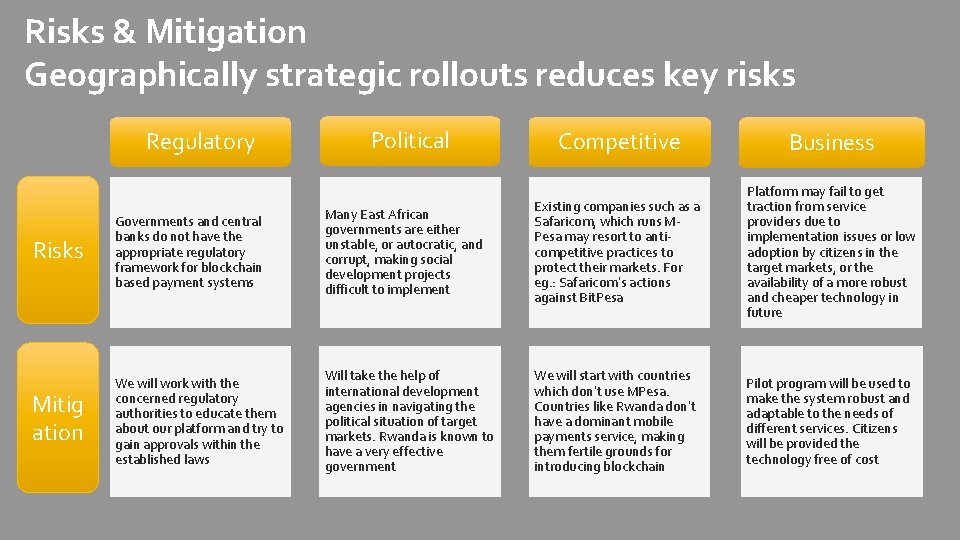
Risks & Mitigation Geographically strategic rollouts reduces key risks Regulatory Political Competitive Business Platform may fail to get traction from service providers due to implementation issues or low adoption by citizens in the target markets, or the availability of a more robust and cheaper technology in future Pilot program will be used to make the system robust and adaptable to the needs of different services. Citizens will be provided the technology free of cost Risks Governments and central banks do not have the appropriate regulatory framework for blockchain based payment systems Many East African governments are either unstable, or autocratic, and corrupt, making social development projects difficult to implement Existing companies such as a Safaricom, which runs MPesa may resort to anticompetitive practices to protect their markets. For eg. : Safaricom’s actions against Bit. Pesa Mitig ation We will work with the concerned regulatory authorities to educate them about our platform and try to gain approvals within the established laws Will take the help of international development agencies in navigating the political situation of target markets. Rwanda is known to have a very effective government We will start with countries which don’t use MPesa. Countries like Rwanda don’t have a dominant mobile payments service, making them fertile grounds for introducing blockchain
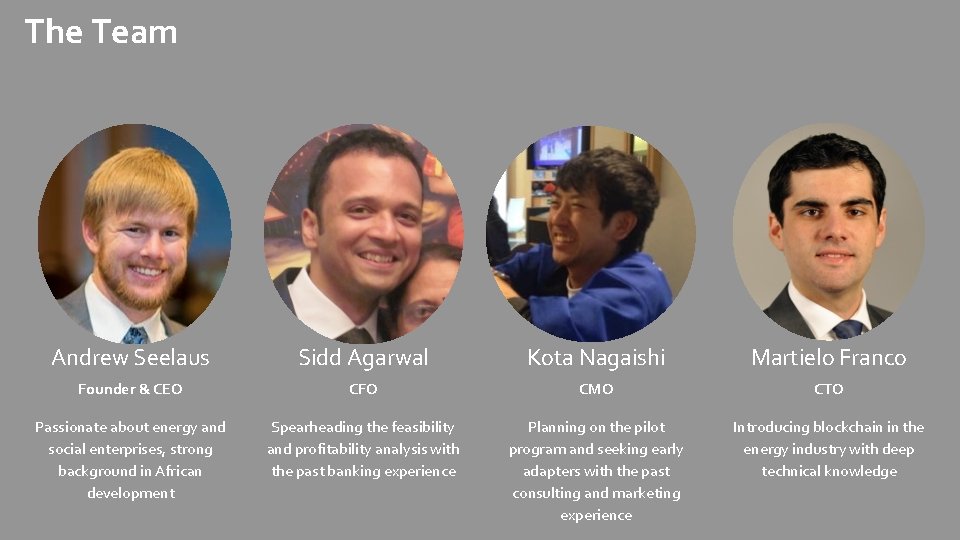
The Team Andrew Seelaus Sidd Agarwal Kota Nagaishi Martielo Franco Founder & CEO CFO CMO CTO Passionate about energy and social enterprises, strong background in African development Spearheading the feasibility and profitability analysis with the past banking experience Planning on the pilot program and seeking early adapters with the past consulting and marketing experience Introducing blockchain in the energy industry with deep technical knowledge
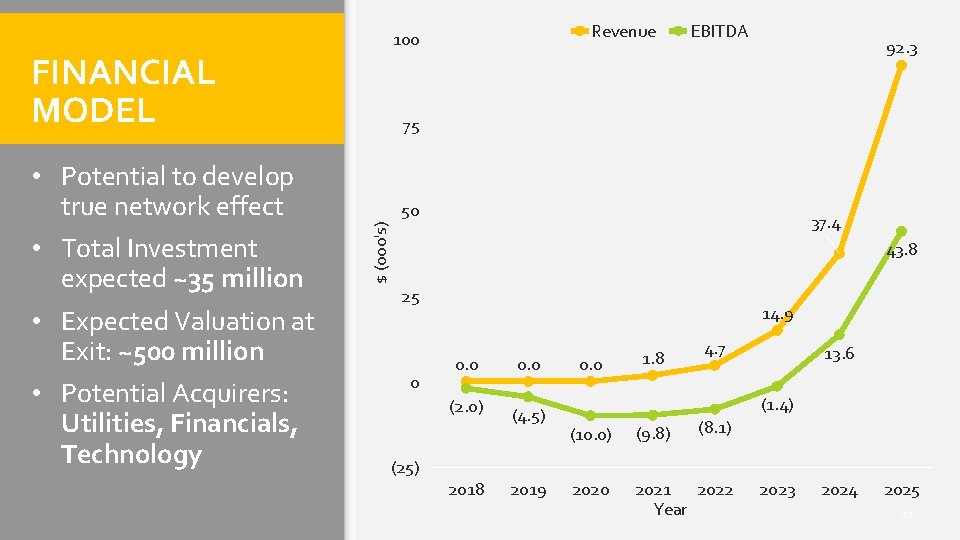
FINANCIAL MODEL EBITDA 92. 3 75 50 37. 4 $ (000's) • Potential to develop true network effect • Total Investment expected ~35 million • Expected Valuation at Exit: ~500 million • Potential Acquirers: Utilities, Financials, Technology Revenue 100 43. 8 25 0 (25) 14. 9 0. 0 (2. 0) (4. 5) 2018 2019 0. 0 1. 8 4. 7 13. 6 (1. 4) (8. 1) (10. 0) (9. 8) 2020 2021 2022 Year 2023 2024 2025 12
Our Ask Tanzania $2 M for 30% of company Enables: Rwandan pilot Platform development

SUPPLEMENTARY MATERIALS
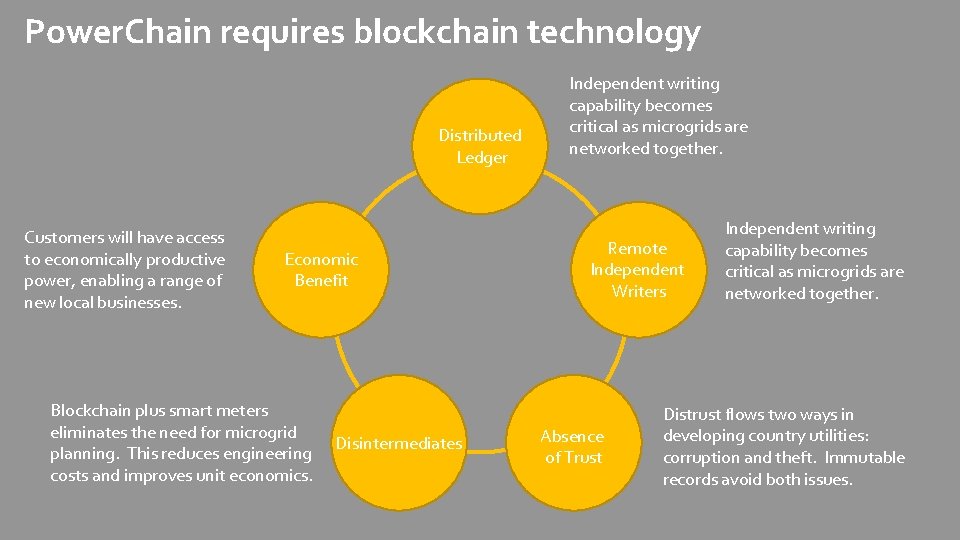
Power. Chain requires blockchain technology Distributed Ledger Customers will have access to economically productive power, enabling a range of new local businesses. Economic Benefit Blockchain plus smart meters eliminates the need for microgrid planning. This reduces engineering costs and improves unit economics. Disintermediates Independent writing capability becomes critical as microgrids are networked together. Remote Independent Writers Absence of Trust Independent writing capability becomes critical as microgrids are networked together. Distrust flows two ways in developing country utilities: corruption and theft. Immutable records avoid both issues.
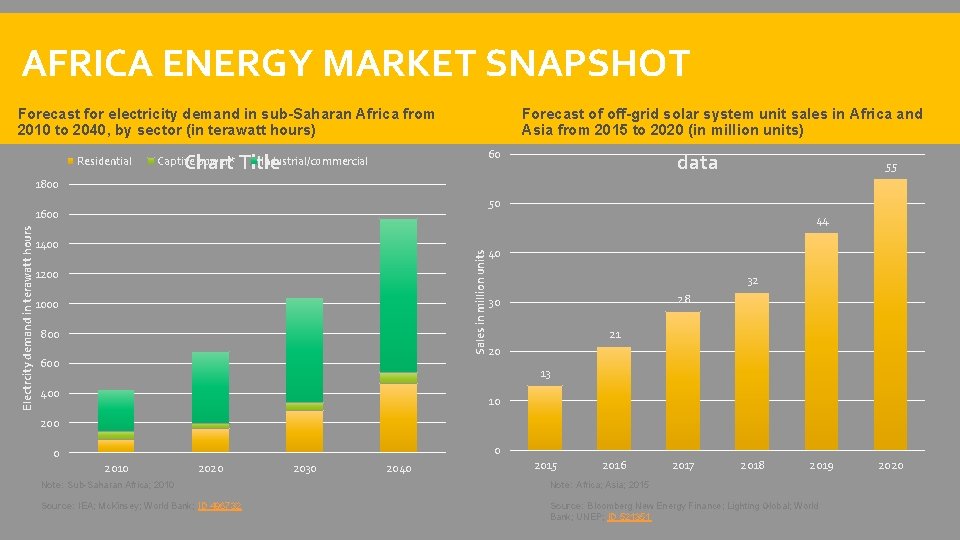
AFRICA ENERGY MARKET SNAPSHOT Forecast for electricity demand in sub-Saharan Africa from 2010 to 2040, by sector (in terawatt hours) Residential Forecast of off-grid solar system unit sales in Africa and Asia from 2015 to 2020 (in million units) 60 Industrial/commercial Chart Title Captive power* data 55 1800 50 44 1400 Sales in million units Electrcity demand in terawatt hours 1600 1200 1000 800 600 40 32 28 30 21 20 13 400 10 200 0 0 2010 2020 2030 2040 2015 2016 2017 2018 2019 Note: Sub-Saharan Africa; 2010 Note: Africa; Asia; 2015 Source: IEA; Mc. Kinsey; World Bank; ID 496732 Source: Bloomberg New Energy Finance; Lighting Global; World Bank; UNEP; ID 521351 2020
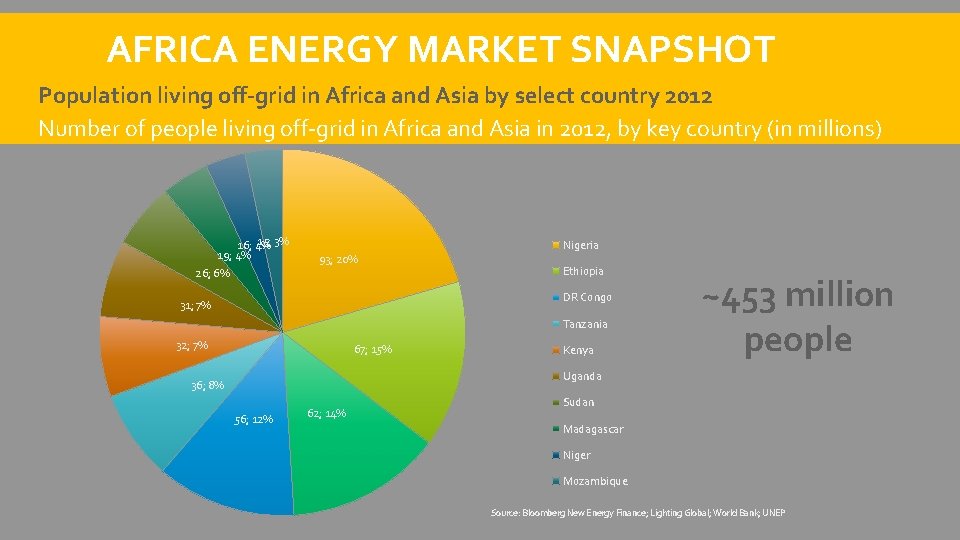
AFRICA ENERGY MARKET SNAPSHOT Population living off-grid in Africa and Asia by select country 2012 Number of people living off-grid in Africa and Asia in 2012, by key country (in millions) 15; 3% 16; 4% 19; 4% 26; 6% 93; 20% Nigeria Ethiopia DR Congo 31; 7% Tanzania 32; 7% 67; 15% Kenya ~453 million people Uganda 36; 8% 56; 12% 62; 14% Sudan Madagascar Niger Mozambique Source: Bloomberg New Energy Finance; Lighting Global; World Bank; UNEP
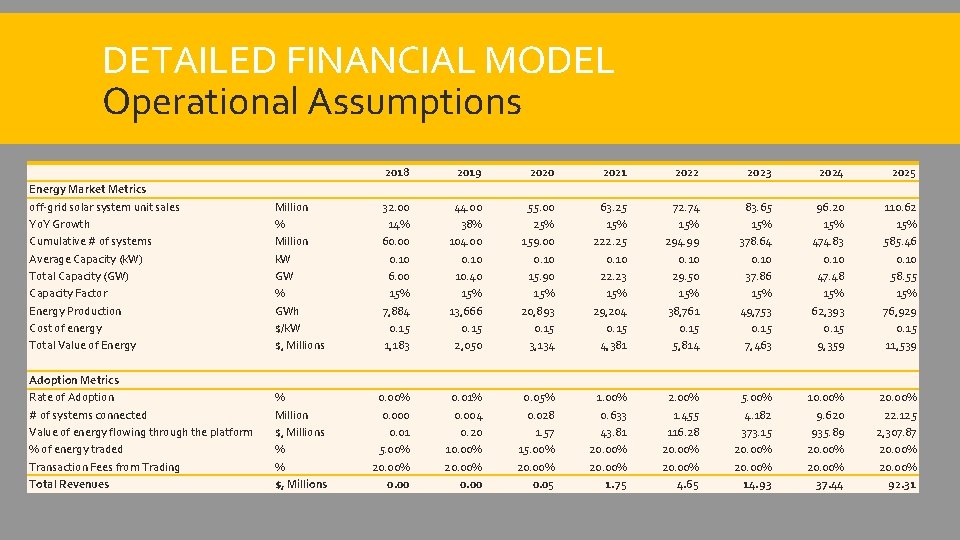
DETAILED FINANCIAL MODEL Operational Assumptions Energy Market Metrics off-grid solar system unit sales Yo. Y Growth Cumulative # of systems Average Capacity (k. W) Total Capacity (GW) Capacity Factor Energy Production Cost of energy Total Value of Energy Million % Million k. W GW % GWh $/k. W $, Millions Adoption Metrics Rate of Adoption # of systems connected Value of energy flowing through the platform % of energy traded Transaction Fees from Trading Total Revenues % Million $, Millions % % $, Millions 2018 2019 32. 00 14% 60. 00 0. 10 6. 00 15% 7, 884 0. 15 1, 183 44. 00 38% 104. 00 0. 10 10. 40 15% 13, 666 0. 15 2, 050 0. 00% 0. 000 0. 01 5. 00% 20. 00% 0. 00 2020 55. 00 25% 159. 00 0. 10 15. 90 15% 20, 893 0. 15 3, 134 0. 01% 0. 004 0. 20 10. 00% 20. 00% 0. 00 2021 63. 25 15% 222. 25 0. 10 22. 23 15% 29, 204 0. 15 4, 381 0. 05% 0. 028 1. 57 15. 00% 20. 00% 0. 05 2022 72. 74 15% 294. 99 0. 10 29. 50 15% 38, 761 0. 15 5, 814 1. 00% 0. 633 43. 81 20. 00% 1. 75 2023 83. 65 15% 378. 64 0. 10 37. 86 15% 49, 753 0. 15 7, 463 2. 00% 1. 455 116. 28 20. 00% 4. 65 2024 96. 20 15% 474. 83 0. 10 47. 48 15% 62, 393 0. 15 9, 359 5. 00% 4. 182 373. 15 20. 00% 14. 93 2025 110. 62 15% 585. 46 0. 10 58. 55 15% 76, 929 0. 15 11, 539 10. 00% 9. 620 935. 89 20. 00% 37. 44 20. 00% 22. 125 2, 307. 87 20. 00% 92. 31
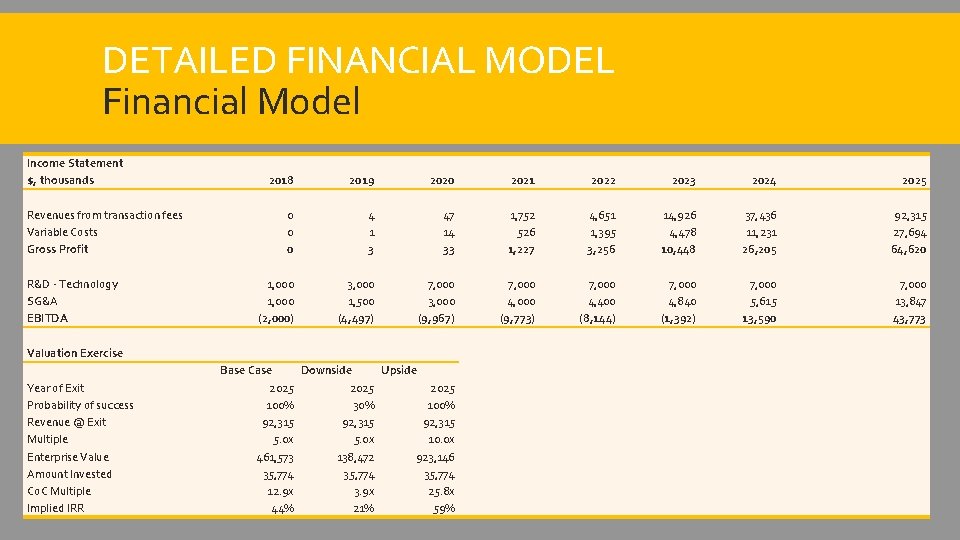
DETAILED FINANCIAL MODEL Financial Model Income Statement $, thousands Revenues from transaction fees Variable Costs Gross Profit R&D - Technology SG&A EBITDA Valuation Exercise Year of Exit Probability of success Revenue @ Exit Multiple Enterprise Value Amount Invested Co. C Multiple Implied IRR 2018 2019 2020 2021 2022 2023 2024 2025 0 0 0 4 1 3 47 14 33 1, 752 526 1, 227 4, 651 1, 395 3, 256 14, 926 4, 478 10, 448 37, 436 11, 231 26, 205 92, 315 27, 694 64, 620 1, 000 (2, 000) 3, 000 1, 500 (4, 497) 7, 000 3, 000 (9, 967) 7, 000 4, 000 (9, 773) 7, 000 4, 400 (8, 144) 7, 000 4, 840 (1, 392) 7, 000 5, 615 13, 590 7, 000 13, 847 43, 773 Base Case Downside Upside 2025 100% 30% 100% 92, 315 5. 0 x 10. 0 x 461, 573 138, 472 923, 146 35, 774 12. 9 x 3. 9 x 25. 8 x 44% 21% 59%
- Slides: 19