
Tank Irrigation Challenges Options By Praful Ranjan Rohit
Tank Irrigation- Challenges & Options By Praful Ranjan Rohit Arya Roll No. - 28 Roll No. - 40
Defining Tank Irrigation Technically, a tank can be described as a miniature version of a large dam. Water is impounded behind an earthen embankment to be released through sluices into canals to be further distributed to irrigated lands.
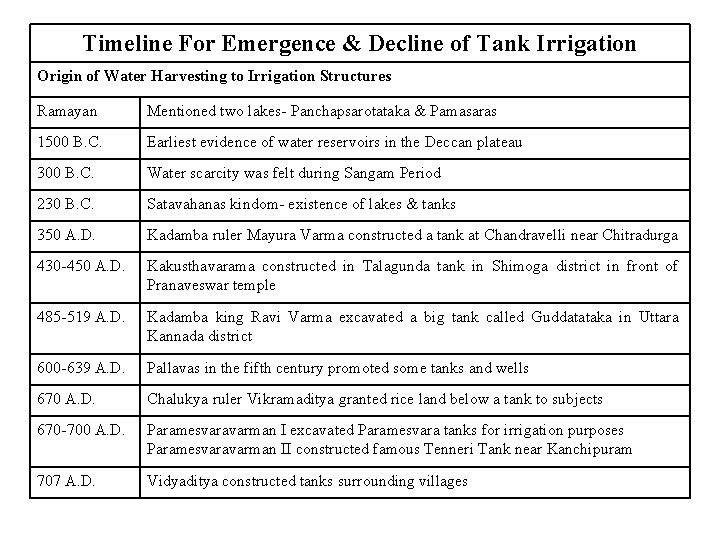
Timeline For Emergence & Decline of Tank Irrigation Origin of Water Harvesting to Irrigation Structures Ramayan Mentioned two lakes- Panchapsarotataka & Pamasaras 1500 B. C. Earliest evidence of water reservoirs in the Deccan plateau 300 B. C. Water scarcity was felt during Sangam Period 230 B. C. Satavahanas kindom- existence of lakes & tanks 350 A. D. Kadamba ruler Mayura Varma constructed a tank at Chandravelli near Chitradurga 430 -450 A. D. Kakusthavarama constructed in Talagunda tank in Shimoga district in front of Pranaveswar temple 485 -519 A. D. Kadamba king Ravi Varma excavated a big tank called Guddatataka in Uttara Kannada district 600 -639 A. D. Pallavas in the fifth century promoted some tanks and wells 670 A. D. Chalukya ruler Vikramaditya granted rice land below a tank to subjects 670 -700 A. D. Paramesvaravarman I excavated Paramesvara tanks for irrigation purposes Paramesvaravarman II constructed famous Tenneri Tank near Kanchipuram 707 A. D. Vidyaditya constructed tanks surrounding villages
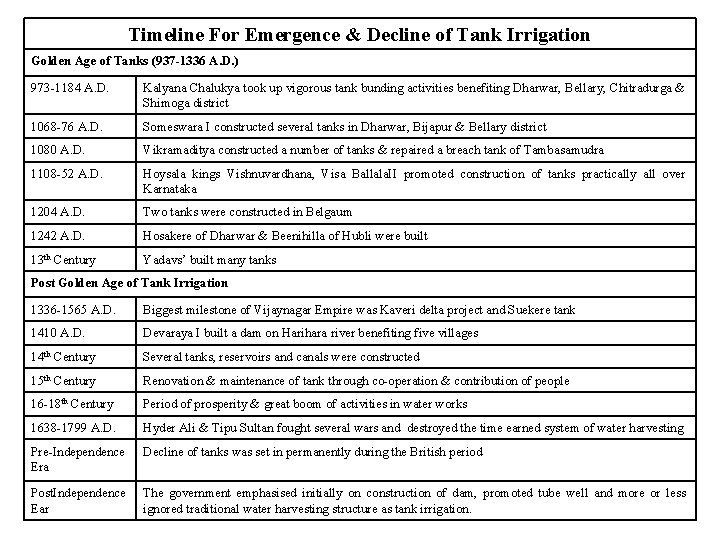
Timeline For Emergence & Decline of Tank Irrigation Golden Age of Tanks (937 -1336 A. D. ) 973 -1184 A. D. Kalyana Chalukya took up vigorous tank bunding activities benefiting Dharwar, Bellary, Chitradurga & Shimoga district 1068 -76 A. D. Someswara I constructed several tanks in Dharwar, Bijapur & Bellary district 1080 A. D. Vikramaditya constructed a number of tanks & repaired a breach tank of Tambasamudra 1108 -52 A. D. Hoysala kings Vishnuvardhana, Visa Ballala. II promoted construction of tanks practically all over Karnataka 1204 A. D. Two tanks were constructed in Belgaum 1242 A. D. Hosakere of Dharwar & Beenihilla of Hubli were built 13 th Century Yadavs’ built many tanks Post Golden Age of Tank Irrigation 1336 -1565 A. D. Biggest milestone of Vijaynagar Empire was Kaveri delta project and Suekere tank 1410 A. D. Devaraya I built a dam on Harihara river benefiting five villages 14 th Century Several tanks, reservoirs and canals were constructed 15 th Century Renovation & maintenance of tank through co-operation & contribution of people 16 -18 th Century Period of prosperity & great boom of activities in water works 1638 -1799 A. D. Hyder Ali & Tipu Sultan fought several wars and destroyed the time earned system of water harvesting Pre-Independence Era Decline of tanks was set in permanently during the British period Post. Independence Ear The government emphasised initially on construction of dam, promoted tube well and more or less ignored traditional water harvesting structure as tank irrigation.
Advantages of Tank Irrigation Appropriate irrigation devices in the cultivation of paddy Flood control device Insurance against low rainfall periods and also recharged groundwater A device to protect the ecosystem
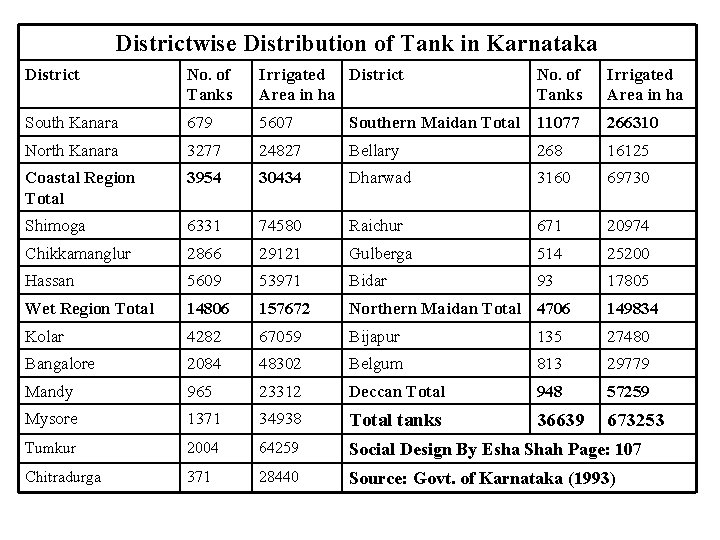
Districtwise Distribution of Tank in Karnataka District No. of Tanks Irrigated District Area in ha No. of Tanks Irrigated Area in ha South Kanara 679 5607 Southern Maidan Total 11077 266310 North Kanara 3277 24827 Bellary 268 16125 Coastal Region Total 3954 30434 Dharwad 3160 69730 Shimoga 6331 74580 Raichur 671 20974 Chikkamanglur 2866 29121 Gulberga 514 25200 Hassan 5609 53971 Bidar 93 17805 Wet Region Total 14806 157672 Northern Maidan Total 4706 149834 Kolar 4282 67059 Bijapur 135 27480 Bangalore 2084 48302 Belgum 813 29779 Mandy 965 23312 Deccan Total 948 57259 Mysore 1371 34938 Total tanks 36639 673253 Tumkur 2004 64259 Social Design By Esha Shah Page: 107 Chitradurga 371 28440 Source: Govt. of Karnataka (1993)
Tank Design • A reservoir with the least length for the maximum depth of the embankment would provide maximum storage per unit length would cause least submergence and most economical. • Generally tanks are prepared for paddy cultivation. • Shape and length of embankment determine the cost of construction of a tank.
Diversity of Tank Design • During British period also, some tanks were constructed but they were constructed for drinking purpose or leisure spot. • Tanks were also constructed based on the requirement of farmers. • Based on water availability and rainfall pattern

Decline of Tank Irrigation Conversion of Water Structures in Jodhpur City Old Water Structure Converted To Phoolalao Vyas Park Jagat Sagar Bakhat Sagar Kalyan Sagar Masuria Talab Fadusar Kaliberi Abhoy Sagar Public Park Nehru Park Raik Bag Masuria Colony Mining Belt Residential Colony
Personal Learning Those who can do, those who can’t report. Education does not tell you what to think but how to think. Learn to live with conflict and don’t look for immediate answers. There is a difference among information, knowledge and wisdom. Everyday is a learning process, the day you stop learning, you grow faster.
Learning from NRM Non-renewable resource can be a big source of business enterprise. I need to dovetail my understanding of management to make it an entrepreneurial venture. No mindless opposing everything coming on my ways. Understanding natural resources as a complex phenomenon as it trespasses boundary & goes beyond economic & political sphere.
Learning From Term Paper • Traditional technique in some cases are as good as modern technique • Reviewing books • How to read through cursory glances • Modify traditional technique to suit local situation • Need to preserve traditional technique
The Myth of Kalahandi A few decades ago the entire landscape was green. A web of some 30, 000 traditional water harvesting structures helped the Kalahandi region tide over some of its worst famines. It also made the region one of the richest in east India. Rain never failed Kalahandi. Mismanagement did. Like in the past, it still rains heavily, but the rainwater is not harvested. The tanks are still there, but silted up. A slight shortfall in rainfall now triggers a large-scale crop failure. So agriculture is a difficult prospect for survival for more than 50 per cent of the population. “Kalahandi’s poverty is amid plenty, ” says Shiv
The Myth of Kalahandi • Independence triggered the gradual death of the tanks. “After Independence, the government decided to wrest control of all the water harvesting structures including those that were privately owned. Fearing a takeover, the landlords converted most of these structures into agricultural fields. The process was followed by encroachment of public waterbodies by the influential people, ” observes a survey of done by international NGO Action Aid on Balangir’s traditional structures. • These tanks were later transferred to the Panchayats in 1955. As monetary allocation was primarily for roads and building and the community was kept away, tanks were silted up due to lack of maintenance. “The death of this tradition proved a death kneel for the agrarian society, ” says S K Patnaik of Vikalp, a Kantabanji-based NGO working on the revival of traditional water harvesting structures.
The Myth of Kalahandi • Deforestation and collapse of the traditional tank irrigation have caused desertification of this area. • Rainwater was earlier stored through an extensive network of tanks. In the KBK districts, every village has a network of tanks. • Villagers were directly managing these structures through their own institutions like Jal Sabha (water assembly). • “This part had a rich and highly sustainable tank culture that evolved with people’s participation, ” said Sohini Sengupta, who did a research paper on western Orissa’s tank irrigation for Oxfam’s India Disaster Report.
Irrigation Capacity of Tanks As per present calculation, the live storage capacity of a tank is 120 million cubic feet, but according to the tank registers of the British period, total storage capacity of tank was 659 units, where on unit 172 million cubic feet. Total irrigation capacity of tank is 659 acres in monsoon and irrigates one acre of paddy 534 acres in summer as per PWD manuals. Source: Social Designs By Esha Shah
Challenges For Tank Irrigation Tank irrigation becomes less significant if one traverses from south to north and from west to east in Karnatka. Tanks have been the most important source of irrigation in the wet region and the mixed region of south Karnataka where paddy is the main crop cultivated. Well irrigation replaces tanks in Deccan region of northern Karnataka where non-paddy crops dominate agriculture. Farmers resistance in sharing the common irrigation resources. “Jiski lathi usaki bhains” principle is applied in these cases. Sometime upstream farmers stop tank water to flow through the field channel passing through their land. Rich farmers or village head claim first right on water resources. Farmers also use other water sources for irrigation besides tank water. Farmers tap shallow ground water which slowly seeps through the previous geological formation through open shallow wells (Baori).
Options To Tank Irrigation According to experts the development of minor irrigation should receive greater attention because of the several advantages they posses like small investments, simpler components as also being labour intensive, quick maturing and mot of all farmer friendly. Reservoirs and tanks in are losing their storage capacity due to heavy siltation. This in turn causes inadequate supply of water and also recurrent floods in some areas. Floods not only causes economic loss but also results in inundation of fertile top soil and erosion. Siltation which results from soil erosion in the catchment areas is one of the major problems in tank irrigation systems. As a result there is loss of storage capacity and reduction in water spread area and water availability.
References 1. Title: Social Design Author: Shah Esha Publication: Wageningen University Water Resources Series 2. Title: Traditional Water Harvesting System Author: Bhuban C. Barah Publication: New Age International Publishers 3. Title: Water Resources Management Author: Nishi Sinha Publication: Har Anand Publication 4. www. indiatogether. com

Thank You! Any Questions?
- Slides: 20