
Tanggung Jawab dan Tujuan Audit serta SPAP PERTEMUAN
Tanggung Jawab dan Tujuan Audit serta SPAP PERTEMUAN II Dr Rilla Gantino, SE. , AK. , MM MM-FEB

KEMAMPUAN AKHIR YANG DIHARAPKAN Mampu menjelaskan tanggung jawab dan tujuan audit dan memahami tujuan penerapan SPAP
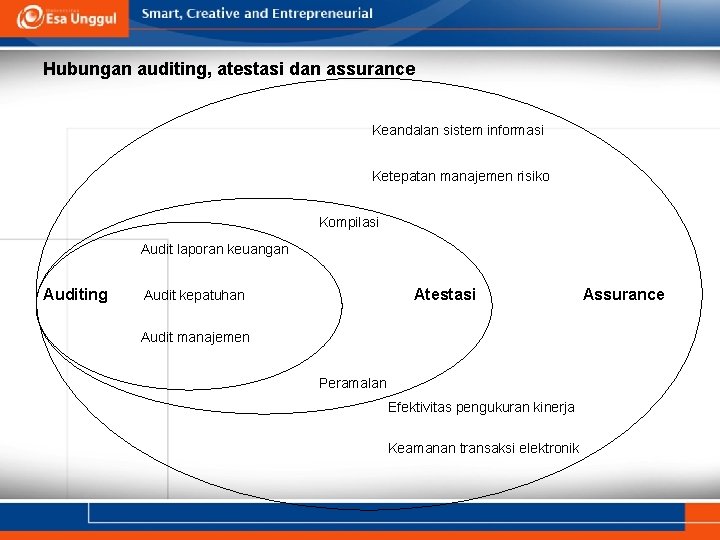
Hubungan auditing, atestasi dan assurance Keandalan sistem informasi Ketepatan manajemen risiko Kompilasi Audit laporan keuangan Auditing Atestasi Audit kepatuhan Audit manajemen Peramalan Efektivitas pengukuran kinerja Keamanan transaksi elektronik Assurance
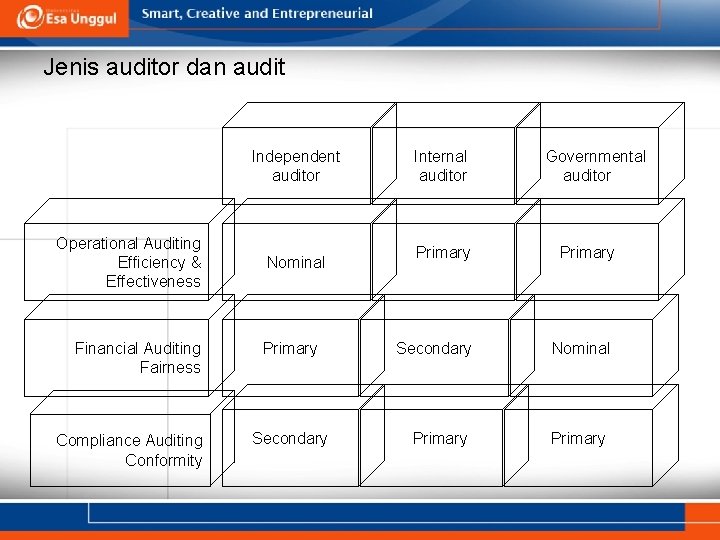
Jenis auditor dan audit Independent auditor Operational Auditing Efficiency & Effectiveness Financial Auditing Fairness Compliance Auditing Conformity Nominal Primary Secondary Internal auditor Governmental auditor Primary Secondary Nominal Primary
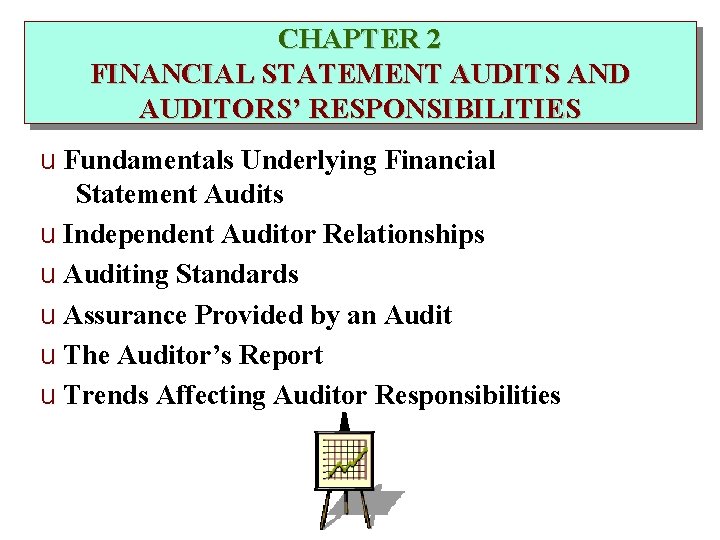
CHAPTER 2 FINANCIAL STATEMENT AUDITS AND AUDITORS’ RESPONSIBILITIES u Fundamentals Underlying Financial Statement Audits u Independent Auditor Relationships u Auditing Standards u Assurance Provided by an Audit u The Auditor’s Report u Trends Affecting Auditor Responsibilities
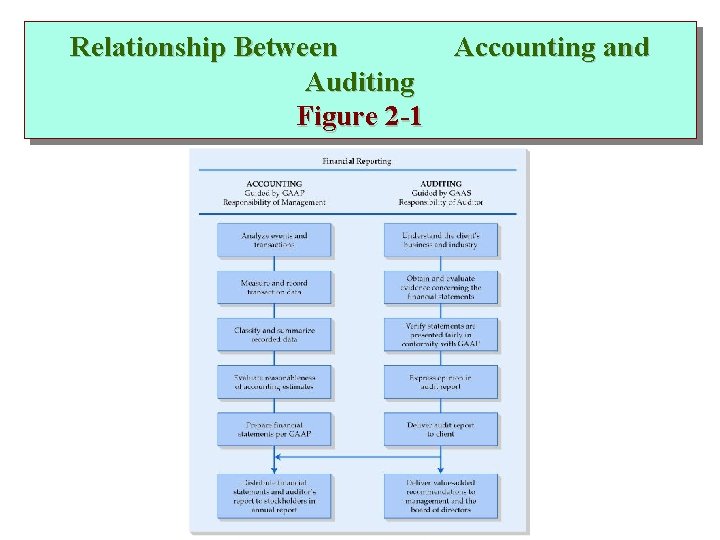
Relationship Between Accounting and Auditing Figure 2 -1
Need for Financial Statement Audits 1. Conflict of Interest 2. Consequence 3. Complexity 4. Remoteness
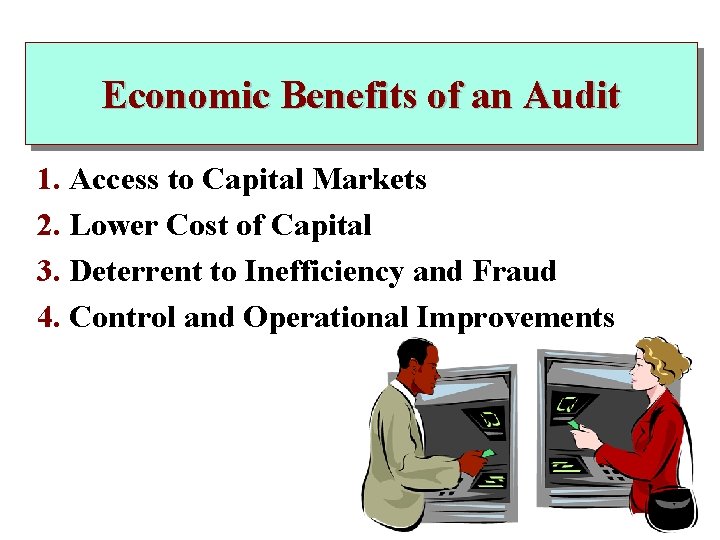
Economic Benefits of an Audit 1. Access to Capital Markets 2. Lower Cost of Capital 3. Deterrent to Inefficiency and Fraud 4. Control and Operational Improvements
Limitations of a Financial Statement Audit Following are 2 important economic limits: 1. Reasonable Cost 2. Reasonable Length of Time Following are 2 important limitations associated with the established accounting framework: 1. Alternative Accounting Principles 2. Accounting Estimates
Independent Auditor Relationships 1. Management 2. Board of Directors and Audit Committee 3. Internal Auditors 4. Stockholders
Generally Accepted Auditing Standards Figure 2 -2 General Standards 1. The audit is to be performed by a person or persons having adequate technical training and proficiency as an auditor. 2. In all matters relating to the assignment, an independence in mental attitude is to be maintained by the auditor or auditors. 3. Due professional care is to be exercised in the performance of the audit and the preparation of report. the
Generally Accepted Auditing Standards Figure 2 -2 Standards of Field Work 1. The work is to be adequately planned, and assistants, if any, are to be properly supervised. 2. A sufficient understanding of the internal control structure is to be obtained to plan the audit and to determine the nature, timing, and extent of tests to be performed. 3. Sufficient competent evidential matter is to be obtained through inspection, observation, inquiries, and confirmations to afford a reasonable basis for an opinion regarding the financial statements under audit.
Generally Accepted Auditing Standards Figure 2 -2 Standards of Reporting 1. The report shall state whether the financial statements are presented in accordance with generally accepted accounting principles. 2. The report shall identify those circumstances in which such principles have not been consistently observed in the current period in relation to the preceding period. 3. Informative disclosures in the financial statements are to be regarded as reasonably adequate unless otherwise stated in the report.
Generally Accepted Auditing Standards Figure 2 -2 Standards of Reporting 4. The report shall either contain an expression of opinion regarding the financial statements, taken as a whole, or an assertion to the effect that an opinion cannot be expressed. When an overall opinion cannot be expressed, the reasons therefore should be stated. In all cases where an auditor’s name is associated with financial statements, the report should contain a clear-cut indication of the character of the auditor’s work, if any, and the degree of responsibility the auditor is taking.
Assurance Provided Audit 1. Auditor Independence 2. Reasonable Assurance 3. Detection of Fraud 4. Responsibility to Detect Fraud 5. Responsibility to Report Fraud 6. Illegal Client Acts 7. Assurance About a Going Concern by an
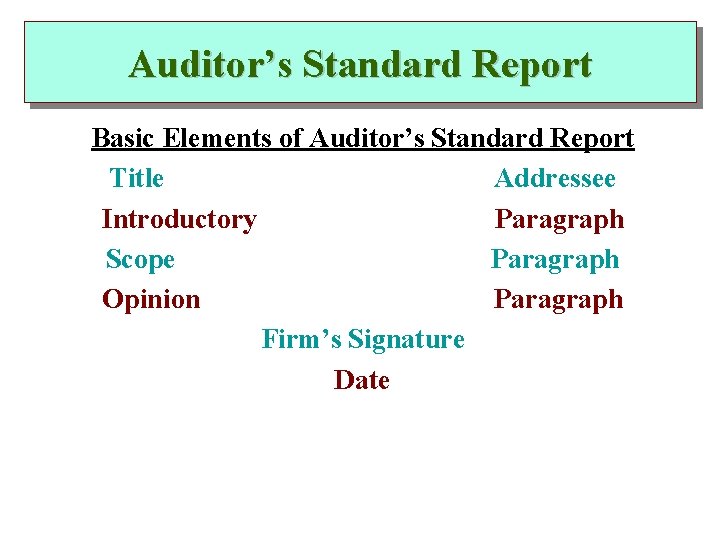
Auditor’s Standard Report Basic Elements of Auditor’s Standard Report Title Addressee Introductory Paragraph Scope Paragraph Opinion Paragraph Firm’s Signature Date
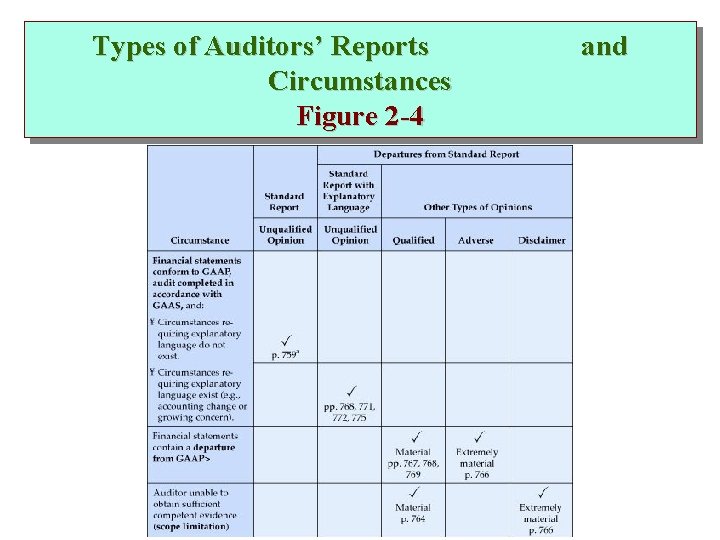
Types of Auditors’ Reports Circumstances Figure 2 -4 and
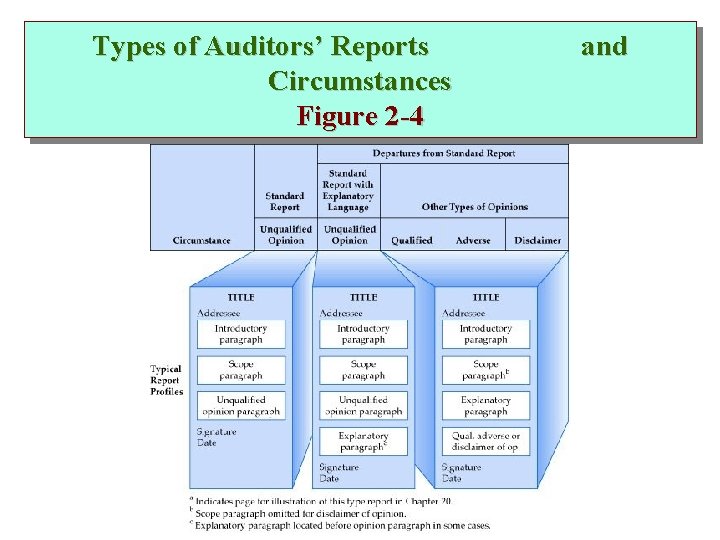
Types of Auditors’ Reports Circumstances Figure 2 -4 and
Certified Public Accounting Firms The legal right to perform audits is granted to CPA firms by regulation of each state. CPA firms also provide many other services to their clients, such as tax and consulting services. CPAs continue to develop new products and services- such as financial planning, business valuation and information technology. © 2010 Prentice Hall Business Publishing, Auditing 13/e, Arens/Elder/Beasley 2 - 19
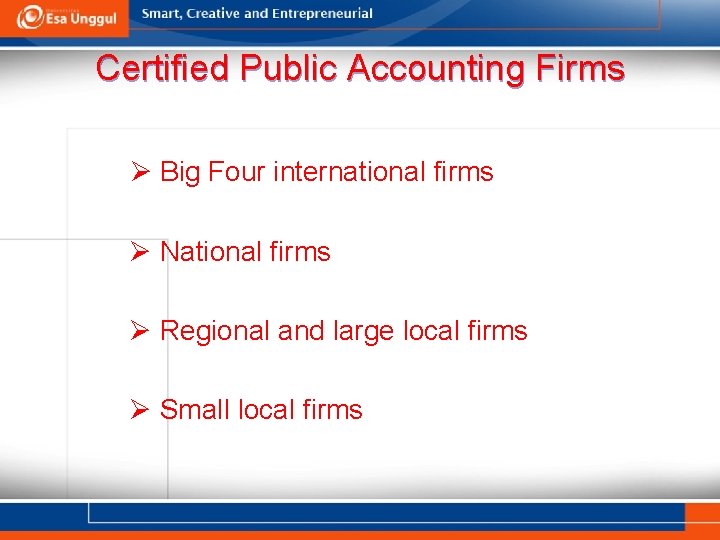
Certified Public Accounting Firms Ø Big Four international firms Ø National firms Ø Regional and large local firms Ø Small local firms © 2010 Prentice Hall Business Publishing, Auditing 13/e, Arens/Elder/Beasley 2 - 20
Certified Public Accounting Firms The four largest CPA firms in the United States are called the “Big Four” international CPA firms. These four firms have offices in most major cities in the United States and in many cities throughout the world. © 2010 Prentice Hall Business Publishing, Auditing 13/e, Arens/Elder/Beasley 2 - 21
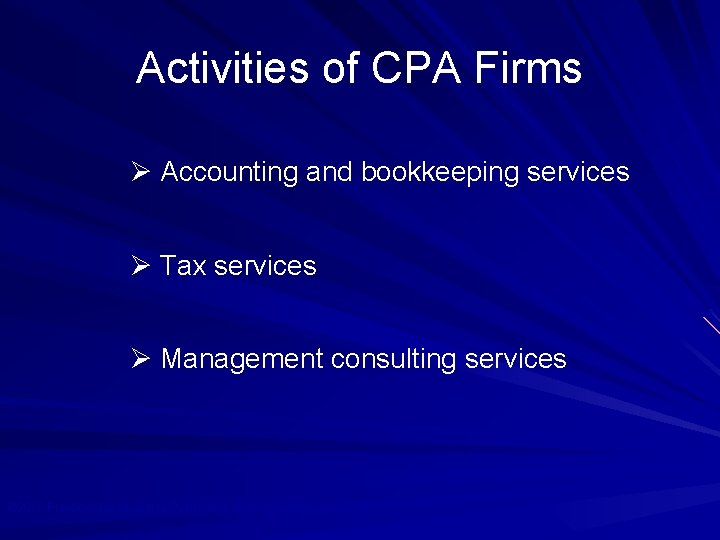
Activities of CPA Firms Ø Accounting and bookkeeping services Ø Tax services Ø Management consulting services © 2010 Prentice Hall Business Publishing, Auditing 13/e, Arens/Elder/Beasley 2 - 22
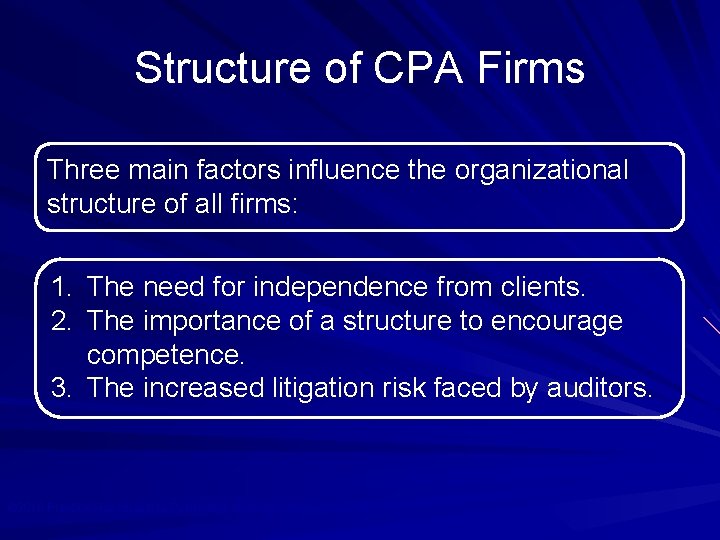
Structure of CPA Firms Three main factors influence the organizational structure of all firms: 1. The need for independence from clients. 2. The importance of a structure to encourage competence. 3. The increased litigation risk faced by auditors. © 2010 Prentice Hall Business Publishing, Auditing 13/e, Arens/Elder/Beasley 2 - 23
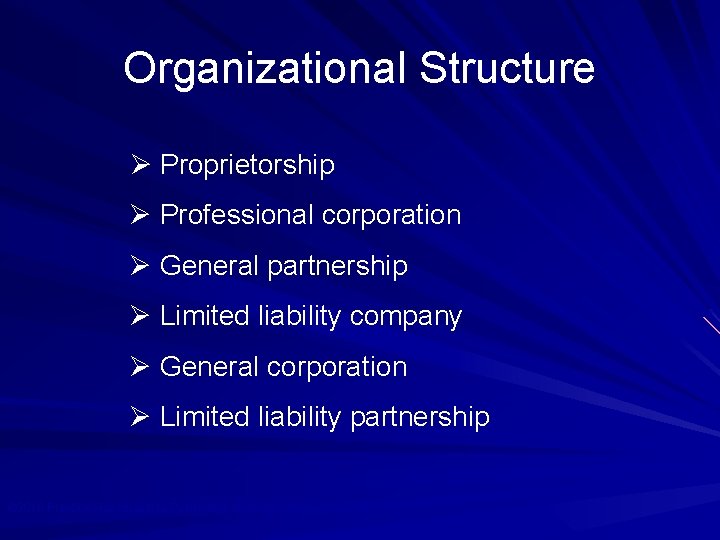
Organizational Structure Ø Proprietorship Ø Professional corporation Ø General partnership Ø Limited liability company Ø General corporation Ø Limited liability partnership © 2010 Prentice Hall Business Publishing, Auditing 13/e, Arens/Elder/Beasley 2 - 24
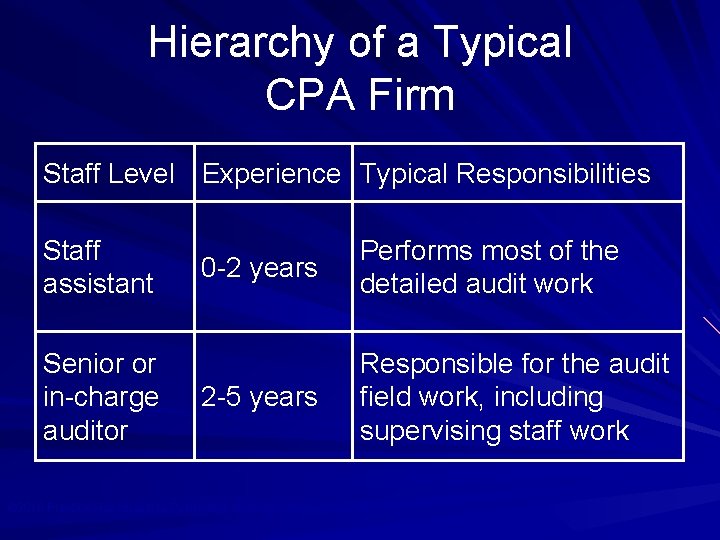
Hierarchy of a Typical CPA Firm Staff Level Experience Typical Responsibilities Staff assistant Senior or in-charge auditor 0 -2 years Performs most of the detailed audit work 2 -5 years Responsible for the audit field work, including supervising staff work © 2010 Prentice Hall Business Publishing, Auditing 13/e, Arens/Elder/Beasley 2 - 25
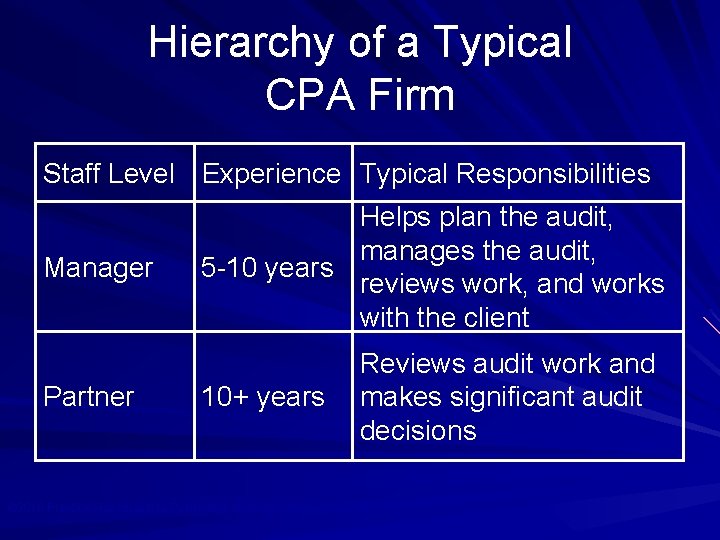
Hierarchy of a Typical CPA Firm Staff Level Experience Typical Responsibilities Manager Partner Helps plan the audit, manages the audit, 5 -10 years reviews work, and works with the client 10+ years Reviews audit work and makes significant audit decisions © 2010 Prentice Hall Business Publishing, Auditing 13/e, Arens/Elder/Beasley 2 - 26
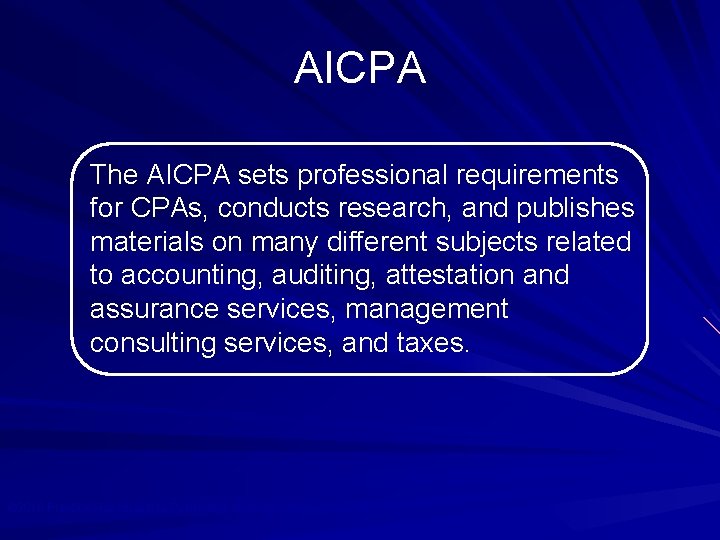
AICPA The AICPA sets professional requirements for CPAs, conducts research, and publishes materials on many different subjects related to accounting, auditing, attestation and assurance services, management consulting services, and taxes. © 2010 Prentice Hall Business Publishing, Auditing 13/e, Arens/Elder/Beasley 2 - 27
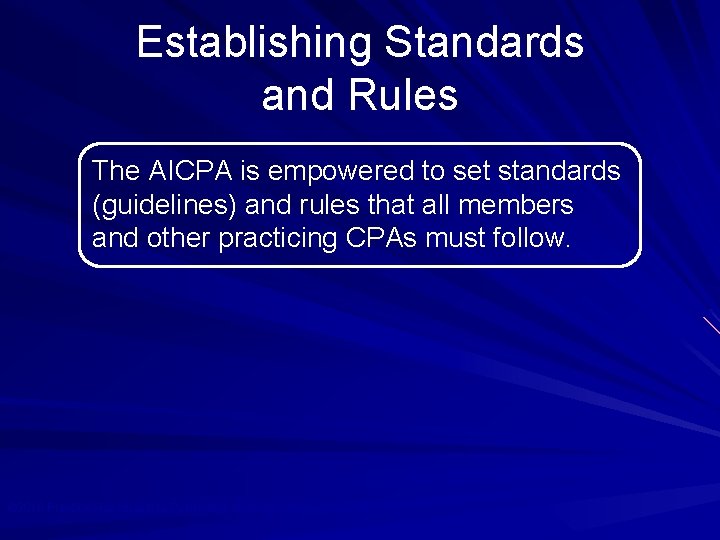
Establishing Standards and Rules The AICPA is empowered to set standards (guidelines) and rules that all members and other practicing CPAs must follow. © 2010 Prentice Hall Business Publishing, Auditing 13/e, Arens/Elder/Beasley 2 - 28
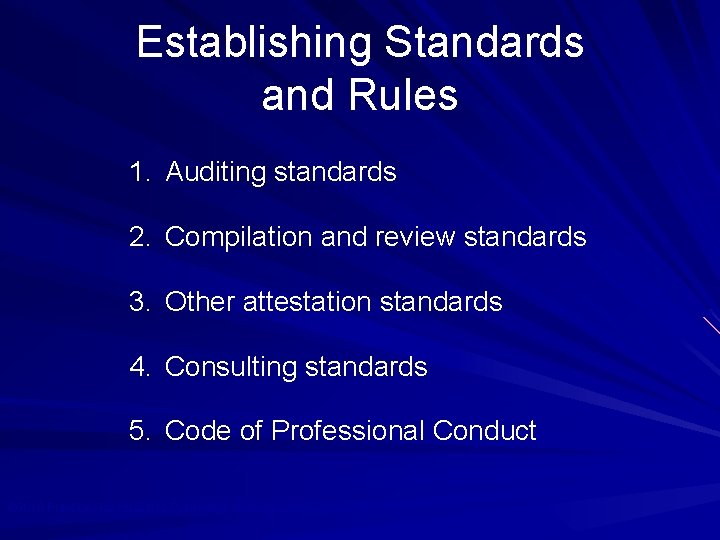
Establishing Standards and Rules 1. Auditing standards 2. Compilation and review standards 3. Other attestation standards 4. Consulting standards 5. Code of Professional Conduct © 2010 Prentice Hall Business Publishing, Auditing 13/e, Arens/Elder/Beasley 2 - 29
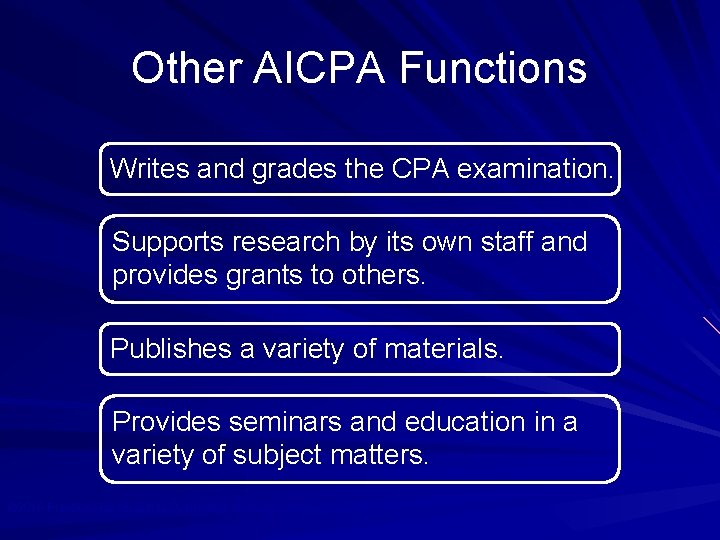
Other AICPA Functions Writes and grades the CPA examination. Supports research by its own staff and provides grants to others. Publishes a variety of materials. Provides seminars and education in a variety of subject matters. © 2010 Prentice Hall Business Publishing, Auditing 13/e, Arens/Elder/Beasley 2 - 30
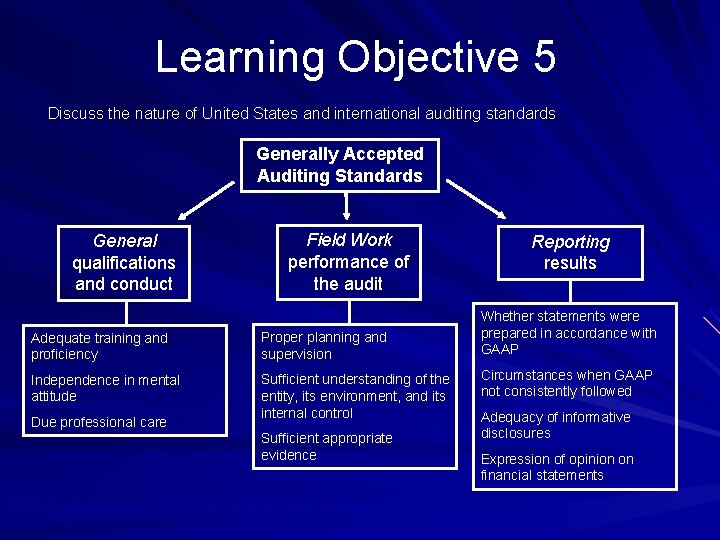
Learning Objective 5 Discuss the nature of United States and international auditing standards Generally Accepted Auditing Standards General qualifications and conduct Field Work performance of the audit Adequate training and proficiency Proper planning and supervision Independence in mental attitude Sufficient understanding of the entity, its environment, and its internal control Due professional care Sufficient appropriate evidence © 2010 Prentice Hall Business Publishing, Auditing 13/e, Arens/Elder/Beasley Reporting results Whether statements were prepared in accordance with GAAP Circumstances when GAAP not consistently followed Adequacy of informative disclosures Expression of opinion on financial statements 2 - 31
Statements on Auditing Standards Ø Classification of Statements on Auditing Standards Ø GAAS and Standards of Performance © 2010 Prentice Hall Business Publishing, Auditing 13/e, Arens/Elder/Beasley 2 - 32
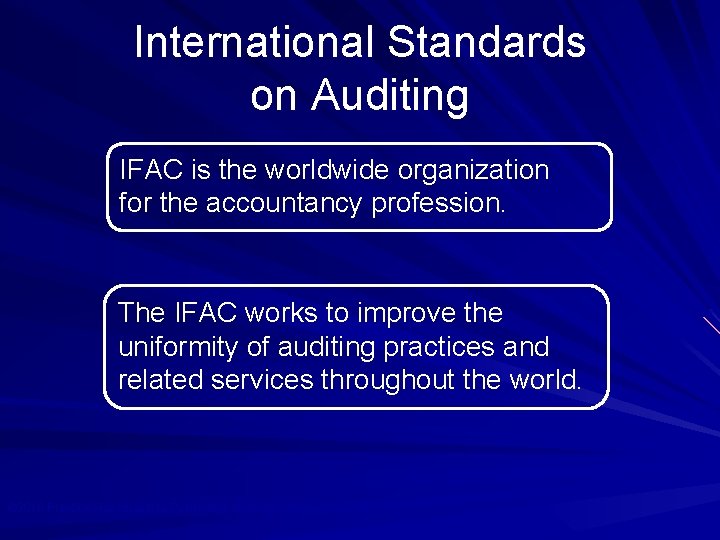
International Standards on Auditing IFAC is the worldwide organization for the accountancy profession. The IFAC works to improve the uniformity of auditing practices and related services throughout the world. © 2010 Prentice Hall Business Publishing, Auditing 13/e, Arens/Elder/Beasley 2 - 33
International Standards on Auditing (ISAs) are issued by the International Auditing and Assurance Standards Board (IAASB) of the International Federation of Accountants (IFAC). © 2010 Prentice Hall Business Publishing, Auditing 13/e, Arens/Elder/Beasley 2 - 34
What Are Ethics? Ethics can be defined broadly as a set of moral principles or values. Each of us has such a set of values. We may or may not have considered them explicitly. © 2012 Prentice Hall Business Publishing, Auditing 14/e, Arens/Elder/Beasley 4 - 35
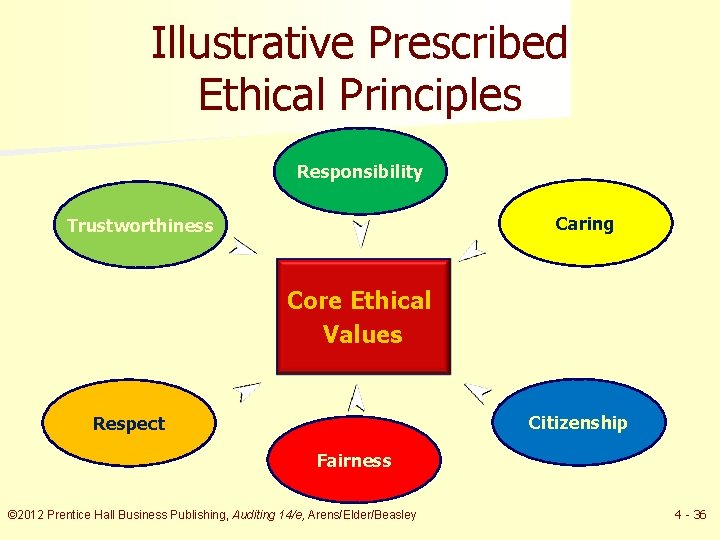
Illustrative Prescribed Ethical Principles Responsibility Caring Trustworthiness Core Ethical Values Citizenship Respect Fairness © 2012 Prentice Hall Business Publishing, Auditing 14/e, Arens/Elder/Beasley 4 - 36
Need for Ethics Ethical behavior is necessary for a society to function in an orderly manner. The need for ethics in society is sufficiently important that many commonly held ethical values are incorporated into laws. © 2012 Prentice Hall Business Publishing, Auditing 14/e, Arens/Elder/Beasley 4 - 37
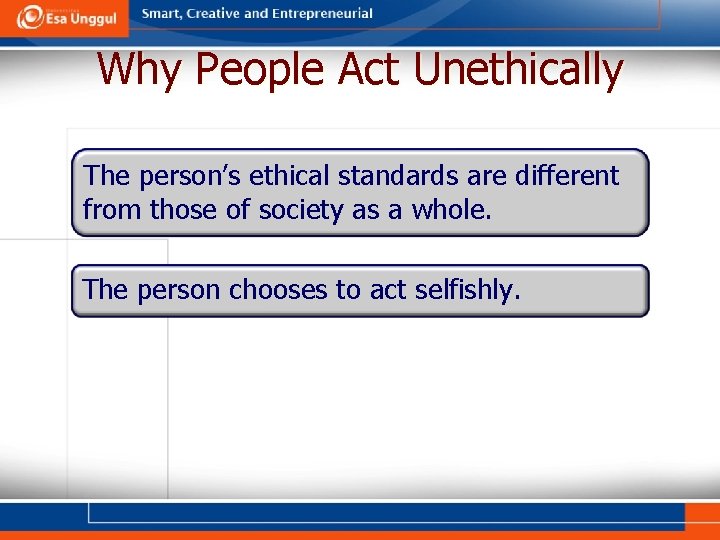
Why People Act Unethically The person’s ethical standards are different from those of society as a whole. The person chooses to act selfishly. © 2012 Prentice Hall Business Publishing, Auditing 14/e, Arens/Elder/Beasley 4 - 38
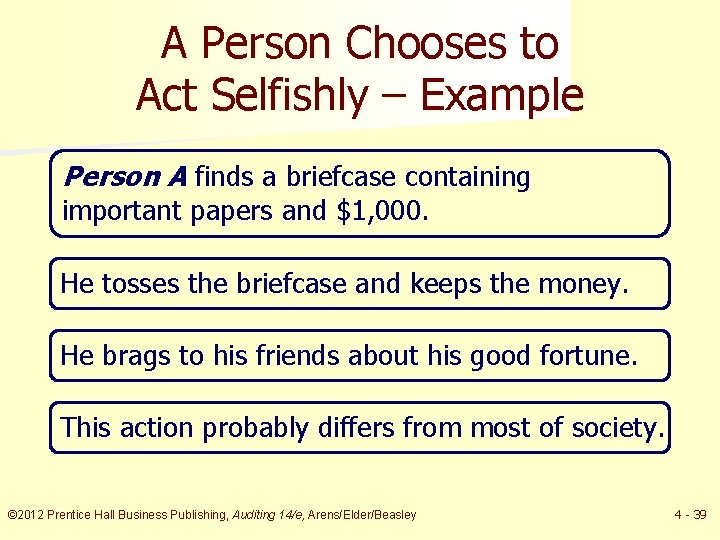
A Person Chooses to Act Selfishly – Example Person A finds a briefcase containing important papers and $1, 000. He tosses the briefcase and keeps the money. He brags to his friends about his good fortune. This action probably differs from most of society. © 2012 Prentice Hall Business Publishing, Auditing 14/e, Arens/Elder/Beasley 4 - 39
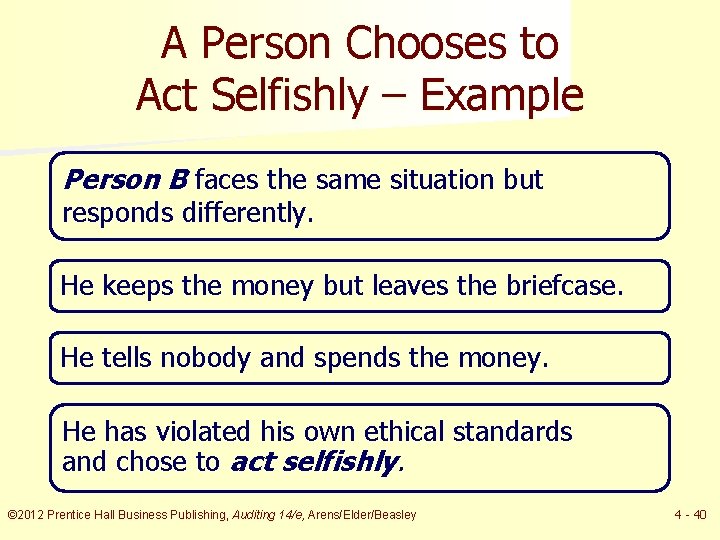
A Person Chooses to Act Selfishly – Example Person B faces the same situation but responds differently. He keeps the money but leaves the briefcase. He tells nobody and spends the money. He has violated his own ethical standards and chose to act selfishly. © 2012 Prentice Hall Business Publishing, Auditing 14/e, Arens/Elder/Beasley 4 - 40
Learning Objective 2 Resolve ethical dilemmas using an ethical framework. © 2012 Prentice Hall Business Publishing, Auditing 14/e, Arens/Elder/Beasley 4 - 41
Ethical Dilemmas An ethical dilemma is a situation a person faces in which a decision must be made about appropriate behavior. Auditors face many ethical dilemmas in their business careers. © 2012 Prentice Hall Business Publishing, Auditing 14/e, Arens/Elder/Beasley 4 - 42
Rationalizing Unethical Behavior Ø Everybody does it Ø If it’s legal, it’s ethical Ø Likelihood of discovery and consequences © 2012 Prentice Hall Business Publishing, Auditing 14/e, Arens/Elder/Beasley 4 - 43
Resolving Ethical Dilemmas 1. Obtain the relevant facts 2. Identify the ethical issues from the facts 3. Determine who is affected © 2012 Prentice Hall Business Publishing, Auditing 14/e, Arens/Elder/Beasley 4 - 44
Resolving Ethical Dilemmas 4. Identify the alternatives available to the person who must resolve the dilemma 5. Identify the likely consequence of each alternative 6. Decide the appropriate action © 2012 Prentice Hall Business Publishing, Auditing 14/e, Arens/Elder/Beasley 4 - 45
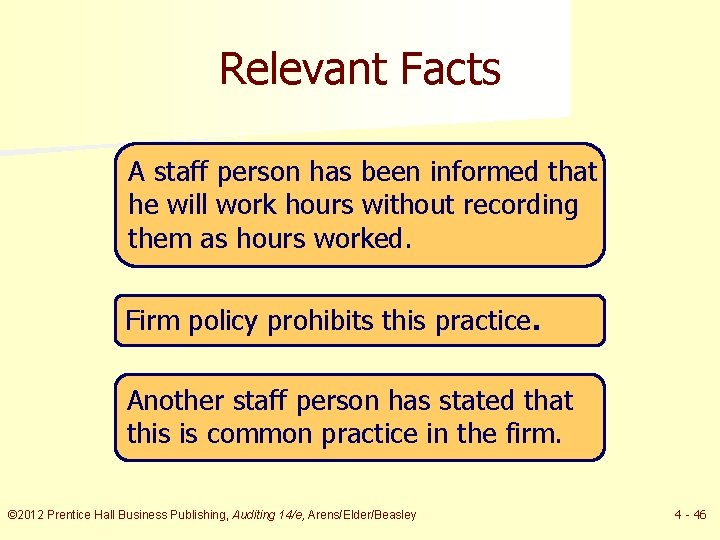
Relevant Facts A staff person has been informed that he will work hours without recording them as hours worked. Firm policy prohibits this practice. Another staff person has stated that this is common practice in the firm. © 2012 Prentice Hall Business Publishing, Auditing 14/e, Arens/Elder/Beasley 4 - 46
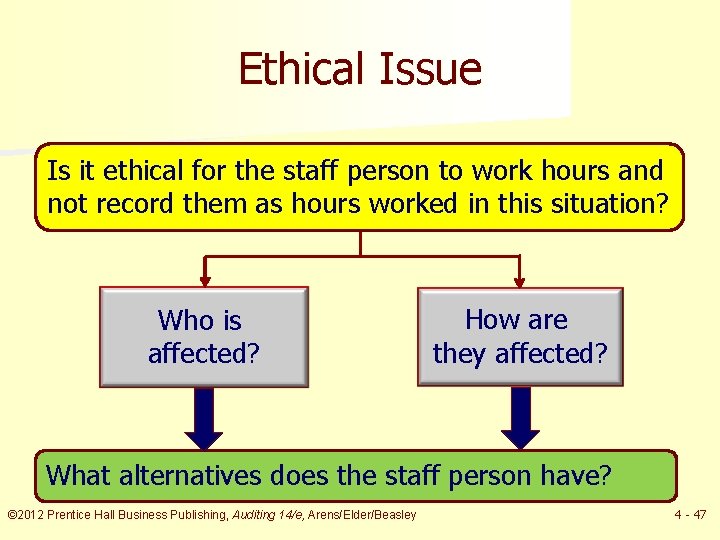
Ethical Issue Is it ethical for the staff person to work hours and not record them as hours worked in this situation? Who is affected? How are they affected? What alternatives does the staff person have? © 2012 Prentice Hall Business Publishing, Auditing 14/e, Arens/Elder/Beasley 4 - 47

Learning Objective 3 Explain the importance of ethical conduct for the accounting profession. © 2012 Prentice Hall Business Publishing, Auditing 14/e, Arens/Elder/Beasley 4 - 48

Special Need for Ethical Conduct in Professions © 2012 Prentice Hall Business Publishing, Auditing 14/e, Arens/Elder/Beasley 4 - 49

Difference Between CPA Firms and Other Professionals © 2012 Prentice Hall Business Publishing, Auditing 14/e, Arens/Elder/Beasley 4 - 50
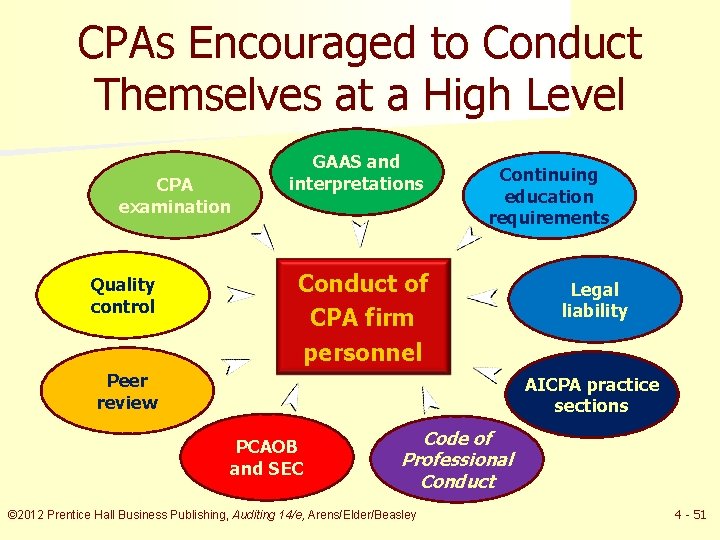
CPAs Encouraged to Conduct Themselves at a High Level CPA examination Quality control GAAS and interpretations Continuing education requirements Conduct of CPA firm personnel Peer review Legal liability AICPA practice sections PCAOB and SEC Code of Professional Conduct © 2012 Prentice Hall Business Publishing, Auditing 14/e, Arens/Elder/Beasley 4 - 51
Learning Objective 4 Describe the purpose and content of the AICPA Code of Professional Conduct. © 2012 Prentice Hall Business Publishing, Auditing 14/e, Arens/Elder/Beasley 4 - 52
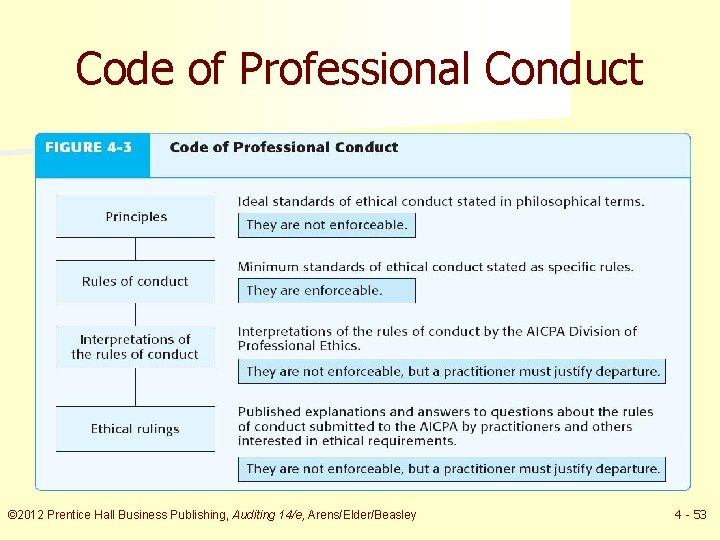
Code of Professional Conduct © 2012 Prentice Hall Business Publishing, Auditing 14/e, Arens/Elder/Beasley 4 - 53

Ethical Principles 1. Responsibilities: Professionals should exercise sensitive and moral judgments in all their activities. 2. The public interest: Members should accept the obligation to act in a way that will serve and honor the public. © 2012 Prentice Hall Business Publishing, Auditing 14/e, Arens/Elder/Beasley 4 - 54
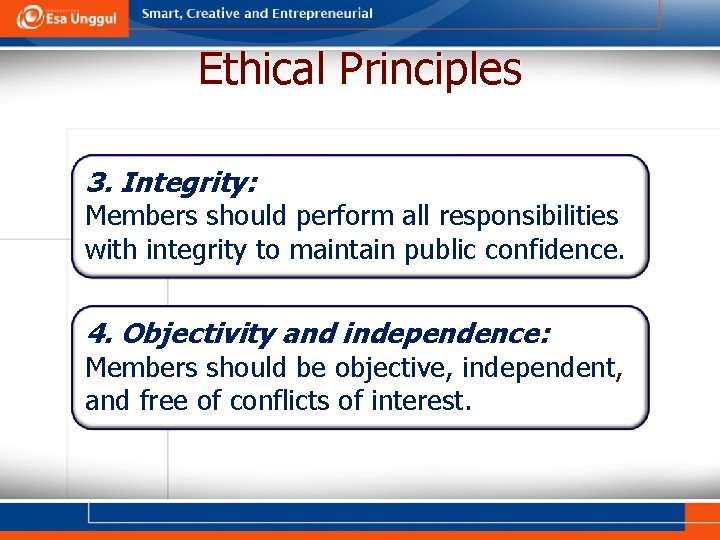
Ethical Principles 3. Integrity: Members should perform all responsibilities with integrity to maintain public confidence. 4. Objectivity and independence: Members should be objective, independent, and free of conflicts of interest. © 2012 Prentice Hall Business Publishing, Auditing 14/e, Arens/Elder/Beasley 4 - 55
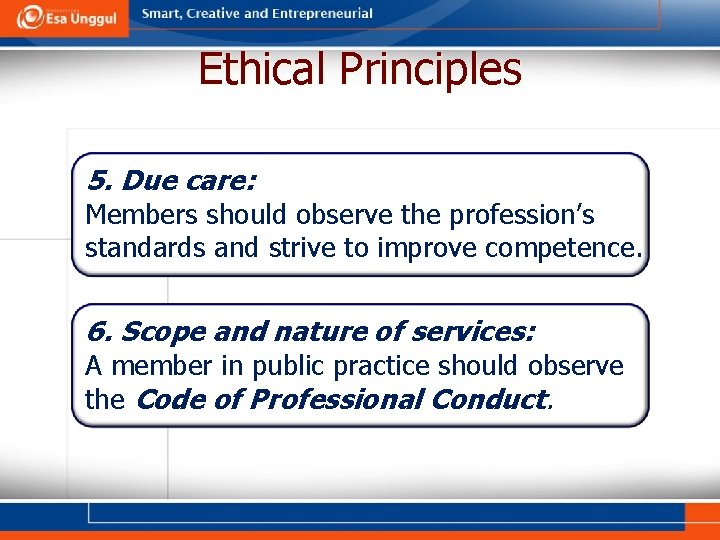
Ethical Principles 5. Due care: Members should observe the profession’s standards and strive to improve competence. 6. Scope and nature of services: A member in public practice should observe the Code of Professional Conduct. © 2012 Prentice Hall Business Publishing, Auditing 14/e, Arens/Elder/Beasley 4 - 56
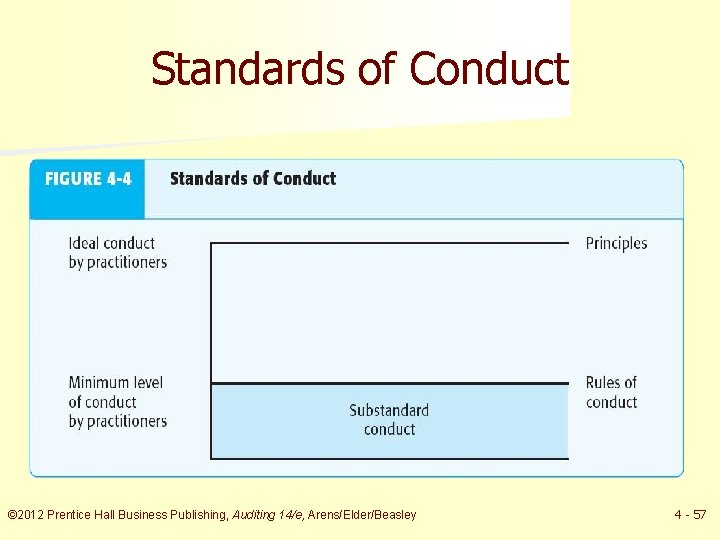
Standards of Conduct © 2012 Prentice Hall Business Publishing, Auditing 14/e, Arens/Elder/Beasley 4 - 57
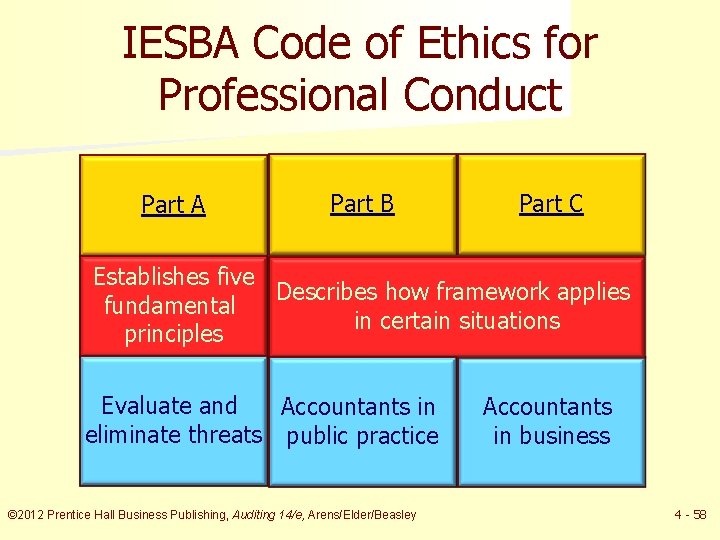
IESBA Code of Ethics for Professional Conduct Part A Part B Part C Establishes five Describes how framework applies fundamental in certain situations principles Evaluate and Accountants in eliminate threats public practice © 2012 Prentice Hall Business Publishing, Auditing 14/e, Arens/Elder/Beasley Accountants in business 4 - 58
Learning Objective 5 Understand Sarbanes-Oxley Act and other SEC and PCAOB independence requirements and additional factors that influence auditor independence. © 2012 Prentice Hall Business Publishing, Auditing 14/e, Arens/Elder/Beasley 4 - 59
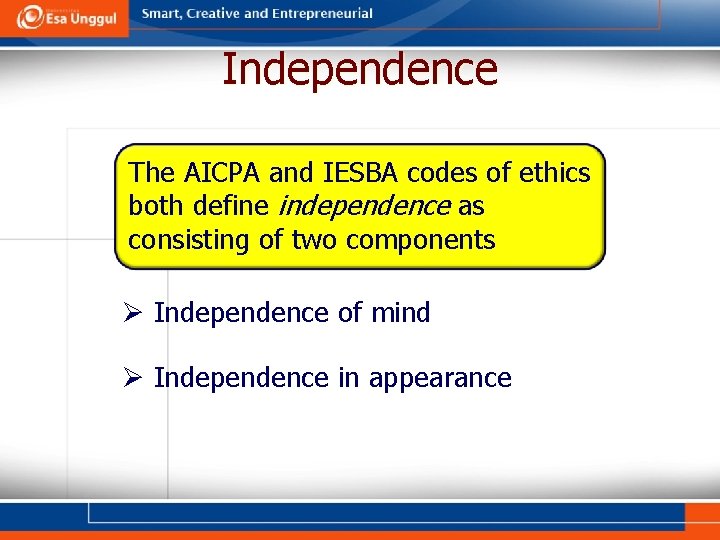
Independence The AICPA and IESBA codes of ethics both define independence as consisting of two components Ø Independence of mind Ø Independence in appearance © 2012 Prentice Hall Business Publishing, Auditing 14/e, Arens/Elder/Beasley 4 - 60
Sarbanes-Oxley Act and SEC Provisions Addressing Auditor Independence SEC auditor independence rules strengthened in 2003 consistent with the Sarbanes-Oxley Act. The Sarbanes-Oxley Act and revised SEC rules further restrict the type of nonaudit services that can be provided by auditors. © 2012 Prentice Hall Business Publishing, Auditing 14/e, Arens/Elder/Beasley 4 - 61
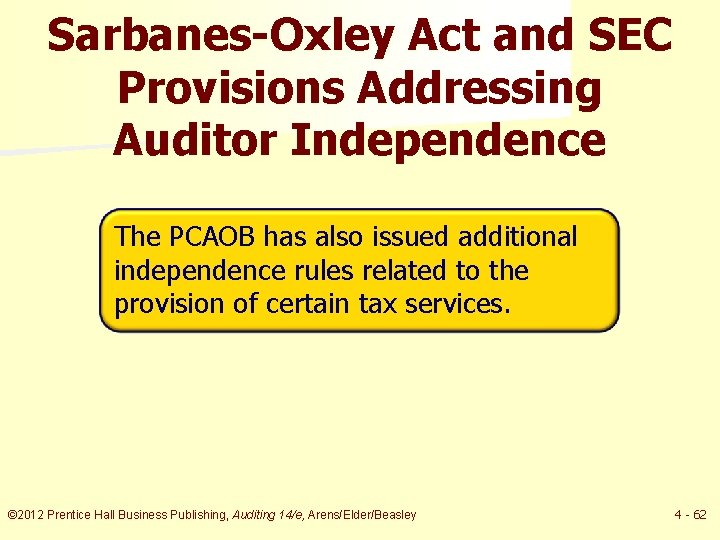
Sarbanes-Oxley Act and SEC Provisions Addressing Auditor Independence The PCAOB has also issued additional independence rules related to the provision of certain tax services. © 2012 Prentice Hall Business Publishing, Auditing 14/e, Arens/Elder/Beasley 4 - 62
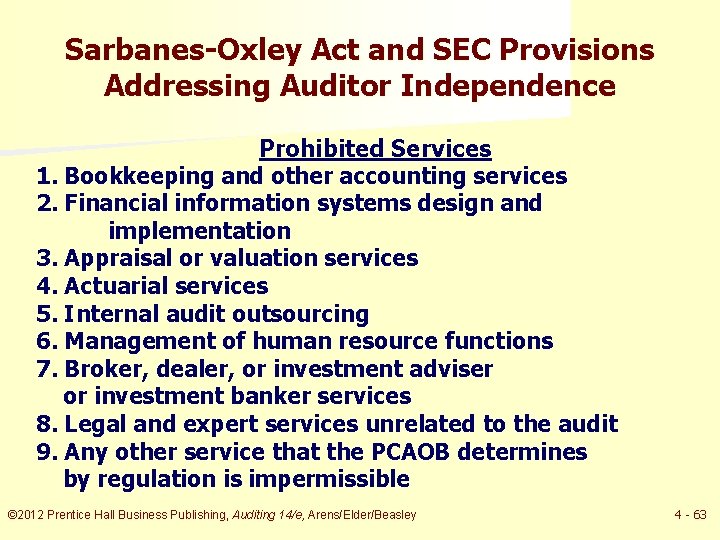
Sarbanes-Oxley Act and SEC Provisions Addressing Auditor Independence Prohibited Services 1. Bookkeeping and other accounting services 2. Financial information systems design and implementation 3. Appraisal or valuation services 4. Actuarial services 5. Internal audit outsourcing 6. Management of human resource functions 7. Broker, dealer, or investment adviser or investment banker services 8. Legal and expert services unrelated to the audit 9. Any other service that the PCAOB determines by regulation is impermissible © 2012 Prentice Hall Business Publishing, Auditing 14/e, Arens/Elder/Beasley 4 - 63
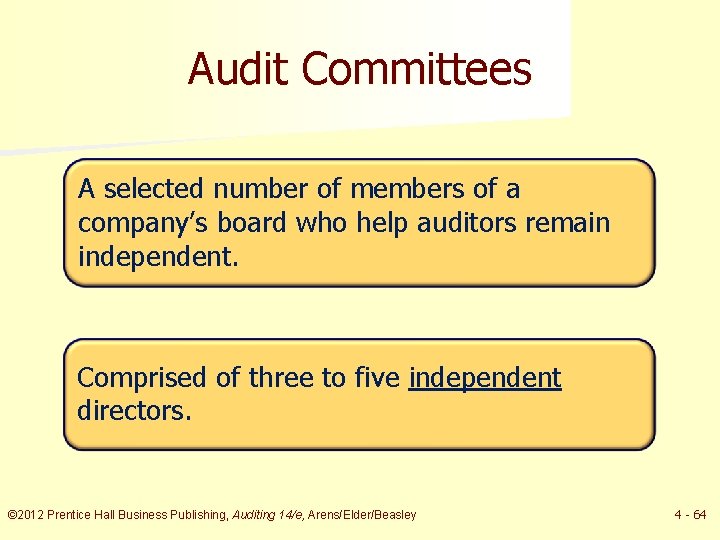
Audit Committees A selected number of members of a company’s board who help auditors remain independent. Comprised of three to five independent directors. © 2012 Prentice Hall Business Publishing, Auditing 14/e, Arens/Elder/Beasley 4 - 64
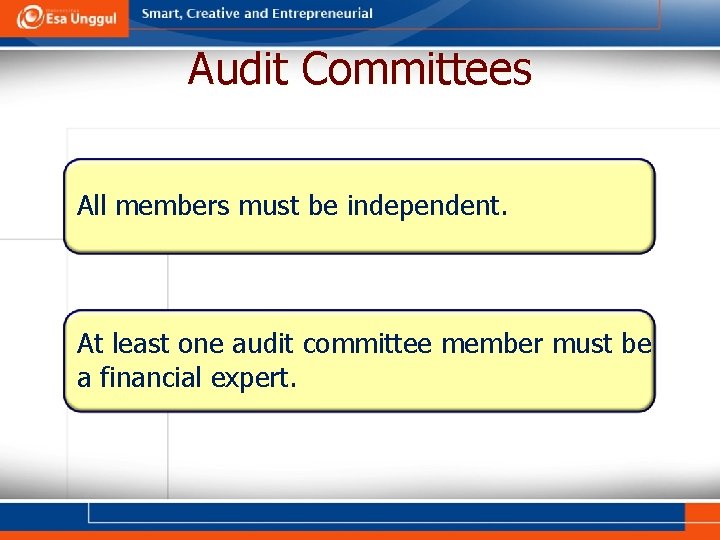
Audit Committees All members must be independent. At least one audit committee member must be a financial expert. © 2012 Prentice Hall Business Publishing, Auditing 14/e, Arens/Elder/Beasley 4 - 65
Conflicts Arising from Employment Relationships A one year “cooling off” period must occur before a member of the audit engagement team can accept a key management position at a client. © 2012 Prentice Hall Business Publishing, Auditing 14/e, Arens/Elder/Beasley 4 - 66
Partner Rotation The Sarbanes-Oxley Act requires that the lead and concurring audit partner rotate off the audit engagement after a period of five years. © 2012 Prentice Hall Business Publishing, Auditing 14/e, Arens/Elder/Beasley 4 - 67
Ownership Interests SEC rules on financial relationships take an engagement perspective. SEC rules prohibit ownership in audit clients by those persons who can influence the audit. © 2012 Prentice Hall Business Publishing, Auditing 14/e, Arens/Elder/Beasley 4 - 68
Other Issues Ø Shopping for accounting principles Ø Engagement and payment of audit fees by management Ø Can the auditor be truly independent if payment depends on company management? © 2012 Prentice Hall Business Publishing, Auditing 14/e, Arens/Elder/Beasley 4 - 69
Learning Objective 6 Apply the AICPA Code rules and interpretations on independence and explain their importance. © 2012 Prentice Hall Business Publishing, Auditing 14/e, Arens/Elder/Beasley 4 - 70
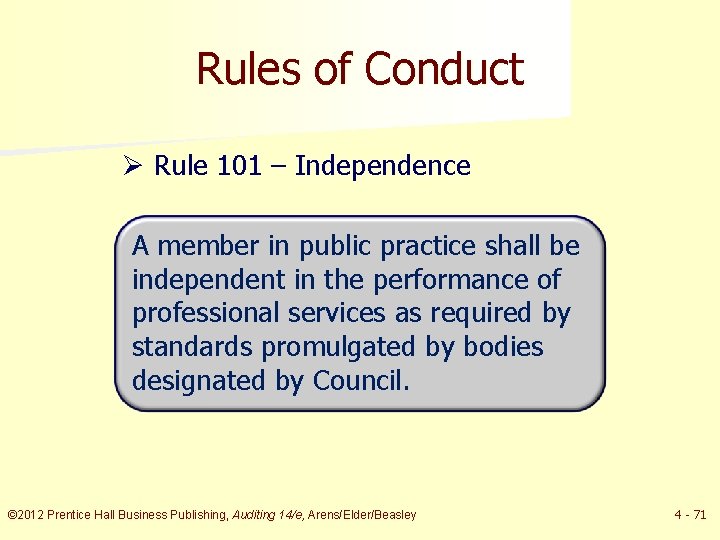
Rules of Conduct Ø Rule 101 – Independence A member in public practice shall be independent in the performance of professional services as required by standards promulgated by bodies designated by Council. © 2012 Prentice Hall Business Publishing, Auditing 14/e, Arens/Elder/Beasley 4 - 71
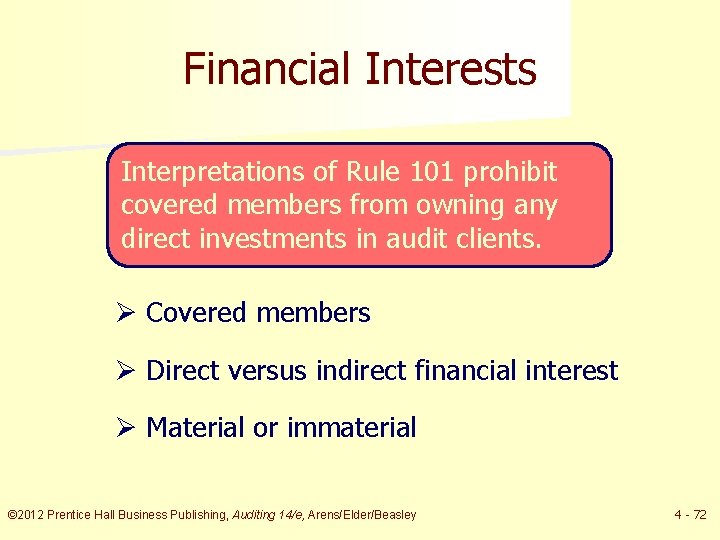
Financial Interests Interpretations of Rule 101 prohibit covered members from owning any direct investments in audit clients. Ø Covered members Ø Direct versus indirect financial interest Ø Material or immaterial © 2012 Prentice Hall Business Publishing, Auditing 14/e, Arens/Elder/Beasley 4 - 72
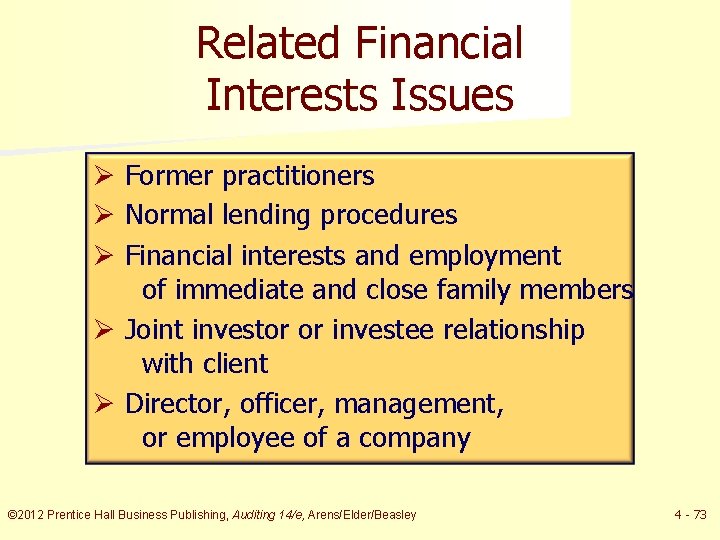
Related Financial Interests Issues Ø Former practitioners Ø Normal lending procedures Ø Financial interests and employment of immediate and close family members Ø Joint investor or investee relationship with client Ø Director, officer, management, or employee of a company © 2012 Prentice Hall Business Publishing, Auditing 14/e, Arens/Elder/Beasley 4 - 73
Litigation Between CPA Firm and Client A lawsuit or intent to start a lawsuit between a CPA firm and its client, the ability of the CPA firm and client to remain objective is questionable. The interpretations regard such litigation as a violation of Rule 101. © 2012 Prentice Hall Business Publishing, Auditing 14/e, Arens/Elder/Beasley 4 - 74
Bookkeeping and Other Services The AICPA Code permits a CPA firm to do both bookkeeping and auditing for a nonpublic client. © 2012 Prentice Hall Business Publishing, Auditing 14/e, Arens/Elder/Beasley 4 - 75
Bookkeeping and Other Services 1. Client must accept full responsibility for the financial statements. 2. The CPA must not assume the role of employee or of management. 3. The audit must conform to use of auditing standards. © 2012 Prentice Hall Business Publishing, Auditing 14/e, Arens/Elder/Beasley 4 - 76
Bookkeeping and Other Services The SEC and AICPA rules do not allow audit firms to provide bookkeeping services to public company audit clients. Ø Consulting and other nonaudit services Ø Unpaid fees © 2012 Prentice Hall Business Publishing, Auditing 14/e, Arens/Elder/Beasley 4 - 77
Learning Objective 7 Understand the requirements of other rules under the AICPA Code. © 2012 Prentice Hall Business Publishing, Auditing 14/e, Arens/Elder/Beasley 4 - 78
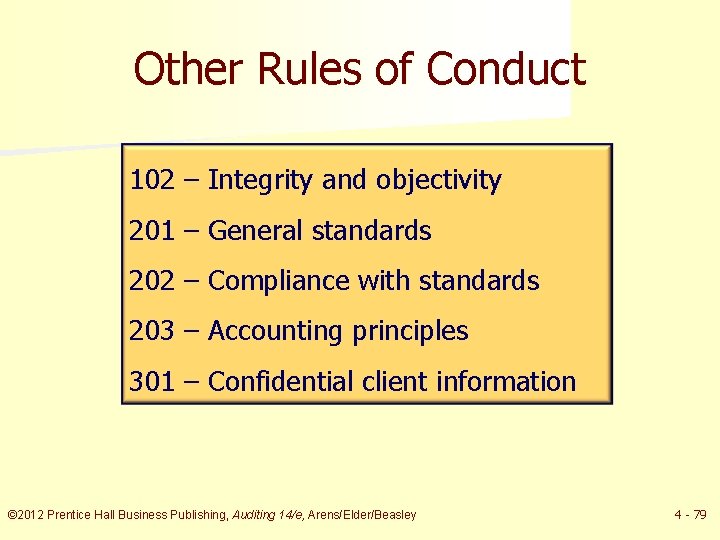
Other Rules of Conduct 102 – Integrity and objectivity 201 – General standards 202 – Compliance with standards 203 – Accounting principles 301 – Confidential client information © 2012 Prentice Hall Business Publishing, Auditing 14/e, Arens/Elder/Beasley 4 - 79
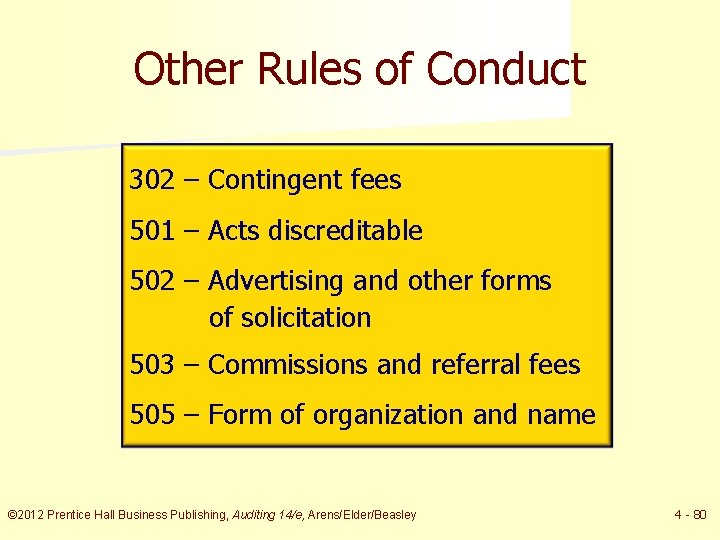
Other Rules of Conduct 302 – Contingent fees 501 – Acts discreditable 502 – Advertising and other forms of solicitation 503 – Commissions and referral fees 505 – Form of organization and name © 2012 Prentice Hall Business Publishing, Auditing 14/e, Arens/Elder/Beasley 4 - 80
Learning Objective 8 Describe the enforcement mechanisms for the rules of conduct. © 2012 Prentice Hall Business Publishing, Auditing 14/e, Arens/Elder/Beasley 4 - 81
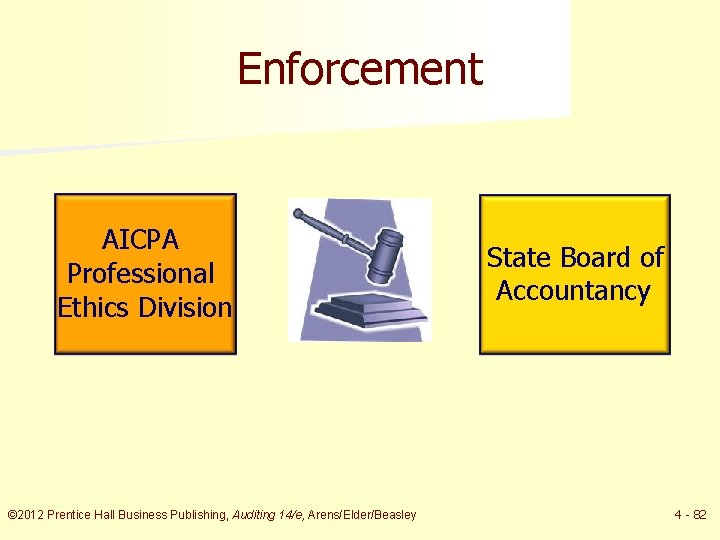
Enforcement AICPA Professional Ethics Division © 2012 Prentice Hall Business Publishing, Auditing 14/e, Arens/Elder/Beasley State Board of Accountancy 4 - 82
MODERN AUDITING 7 th Edition William C. Boynton California Polytechnic State University at San Luis Obispo Raymond N. Johnson Portland State University Walter G. Kell Developed by: Gregory K. Lowry, MBA, CPA Saint Paul’s College University of Michigan John Wiley & Sons, Inc.
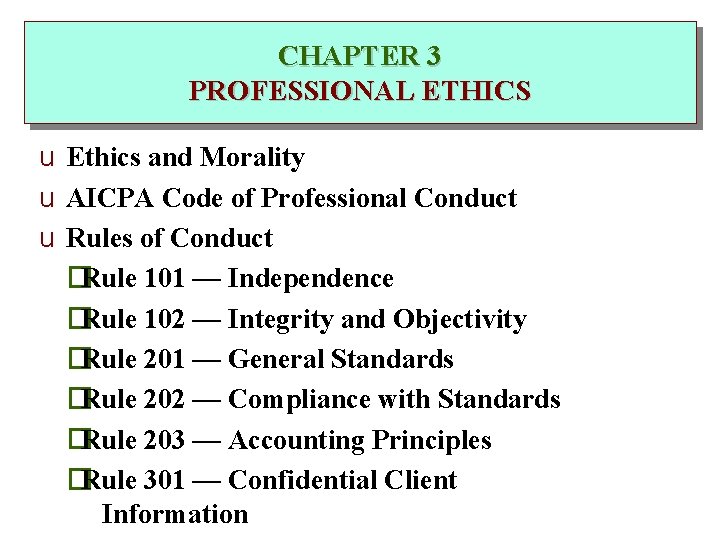
CHAPTER 3 PROFESSIONAL ETHICS u Ethics and Morality u AICPA Code of Professional Conduct u Rules of Conduct �Rule 101 — Independence �Rule 102 — Integrity and Objectivity �Rule 201 — General Standards �Rule 202 — Compliance with Standards �Rule 203 — Accounting Principles �Rule 301 — Confidential Client Information
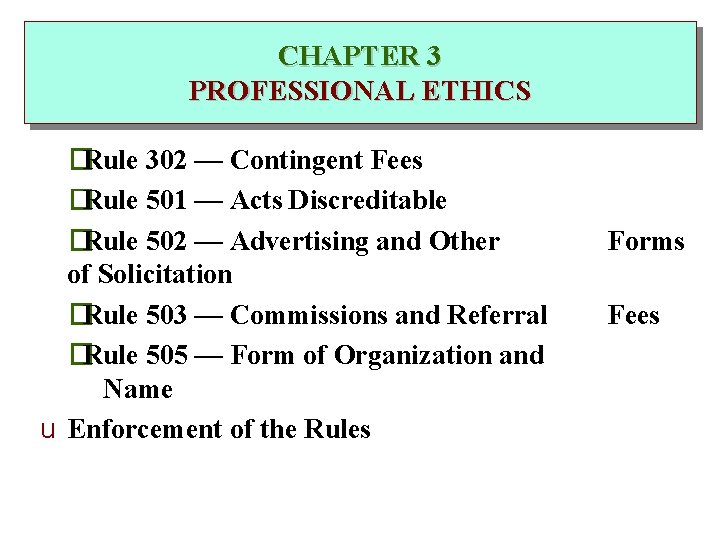
CHAPTER 3 PROFESSIONAL ETHICS �Rule 302 — Contingent Fees �Rule 501 — Acts Discreditable �Rule 502 — Advertising and Other of Solicitation �Rule 503 — Commissions and Referral �Rule 505 — Form of Organization and Name u Enforcement of the Rules Forms Fees
Ethics and Morality General Ethics attempts to deal with ethical questions by defining what is good for the individual and society, and by trying to establish the nature of obligations or duties that individuals owe themselves and each other. Professional Ethics must extend beyond moral principles. They include standards of behavior for a professional person that are designed for both practical and idealistic purposes.
AICPA Code of Professional Conduct AICPA Professional Ethics Team 1. Standard Setting 2. Ethics Enforcement 3. Technical Inquiry Services
Code Sections and Related Pronouncements Figure 3 -1
Code Definitions Client Any person or entity, other than the member’s employer, that engages a member or a member’s firm to perform professional services or a person or entity with respect to which professional services are performed. Council The Council of the AICPA. Enterprise Synonymous with the term “client. ”
Code Definitions Firm A form of organization permitted by state law or regulation whose characteristics conform to resolutions of Council that is engaged in the practice of public accounting, including the individual owners thereof. Holding out Any action initiated by a member that informs others of his or her status as a CPA or AICPA accredited specialist. Institute The AICPA.
Code Definitions Member A member, associate member, or international associate of the AICPA. Practice of public accounting Performance for a client, by a member or a member’s firm, while holding out as CPA(s), of the professional services of accounting, tax, personal financial planning, litigation support services, and those professional services for which standards are promulgated by bodies designated by Council. Professional Services All services performed by a CPA while holding out as a CPA.
Principles In the Code, the 6 principles are identified as follows: 1. Responsibilities 2. The Public Interest 3. Integrity 4. Objectivity and Independence 5. Due Care 6. Scope and Nature of Services
Rules of Conduct Figure 3 -2
Rules of Conduct Figure 3 -2
Enforcement of the Rules 1. Joint Ethics Enforcement Procedures 2. Joint Trial Board Procedures a. Admonish the member. b. Suspend the member for a period no more than 2 years. c. Expel the member. 3. Automatic Disciplinary Provisions of
- Slides: 95