
Tamkang University Social Computing and Big Data Analytics
Tamkang University Social Computing and Big Data Analytics 社群運算與大數據分析 Tamkang University Deep Learning with Google Tensor. Flow (Google Tensor. Flow 深度學習) 1042 SCBDA 10 MIS MBA (M 2226) (8628) Wed, 8, 9, (15: 10 -17: 00) (B 309) Min-Yuh Day 戴敏育 Assistant Professor 專任助理教授 Dept. of Information Management, Tamkang University 淡江大學 資訊管理學系 http: //mail. tku. edu. tw/myday/ 2016 -05 -04 1
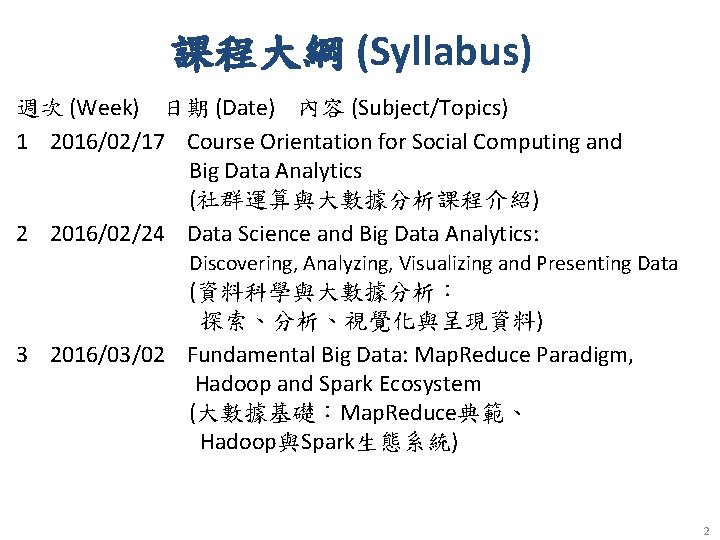
課程大綱 (Syllabus) 週次 (Week) 日期 (Date) 內容 (Subject/Topics) 1 2016/02/17 Course Orientation for Social Computing and Big Data Analytics (社群運算與大數據分析課程介紹) 2 2016/02/24 Data Science and Big Data Analytics: Discovering, Analyzing, Visualizing and Presenting Data (資料科學與大數據分析: 探索、分析、視覺化與呈現資料) 3 2016/03/02 Fundamental Big Data: Map. Reduce Paradigm, Hadoop and Spark Ecosystem (大數據基礎:Map. Reduce典範、 Hadoop與Spark生態系統) 2
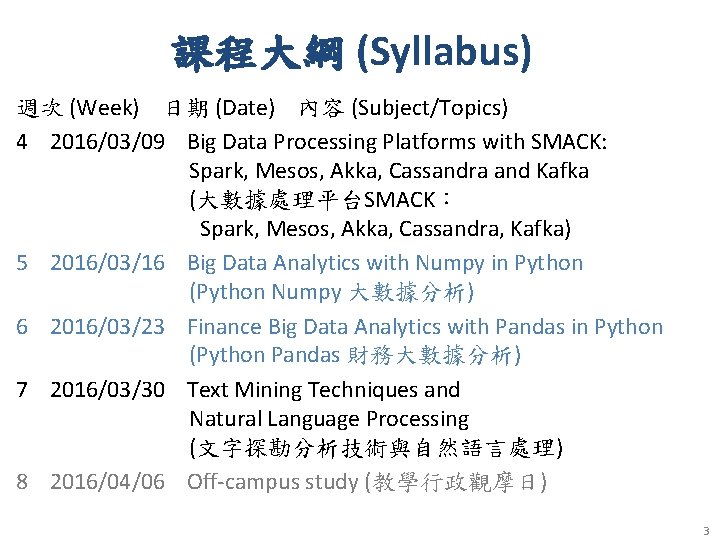
課程大綱 (Syllabus) 週次 (Week) 日期 (Date) 內容 (Subject/Topics) 4 2016/03/09 Big Data Processing Platforms with SMACK: Spark, Mesos, Akka, Cassandra and Kafka (大數據處理平台SMACK: Spark, Mesos, Akka, Cassandra, Kafka) 5 2016/03/16 Big Data Analytics with Numpy in Python (Python Numpy 大數據分析) 6 2016/03/23 Finance Big Data Analytics with Pandas in Python (Python Pandas 財務大數據分析) 7 2016/03/30 Text Mining Techniques and Natural Language Processing (文字探勘分析技術與自然語言處理) 8 2016/04/06 Off-campus study (教學行政觀摩日) 3
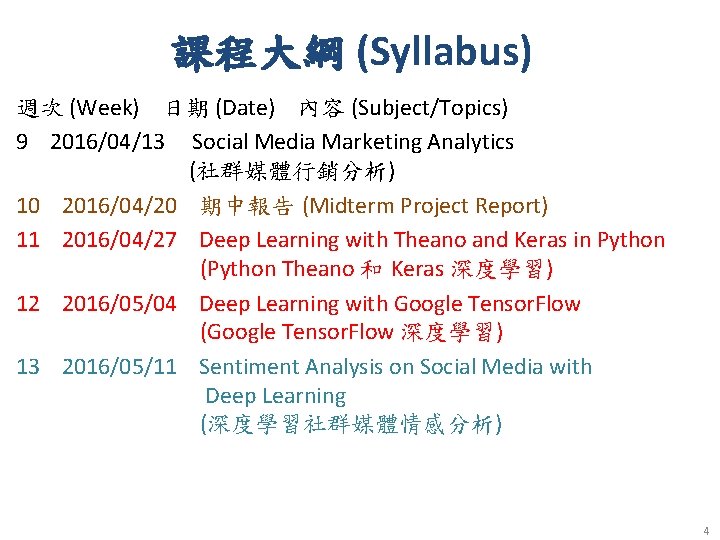
課程大綱 (Syllabus) 週次 (Week) 日期 (Date) 內容 (Subject/Topics) 9 2016/04/13 Social Media Marketing Analytics (社群媒體行銷分析) 10 2016/04/20 期中報告 (Midterm Project Report) 11 2016/04/27 Deep Learning with Theano and Keras in Python (Python Theano 和 Keras 深度學習) 12 2016/05/04 Deep Learning with Google Tensor. Flow (Google Tensor. Flow 深度學習) 13 2016/05/11 Sentiment Analysis on Social Media with Deep Learning (深度學習社群媒體情感分析) 4
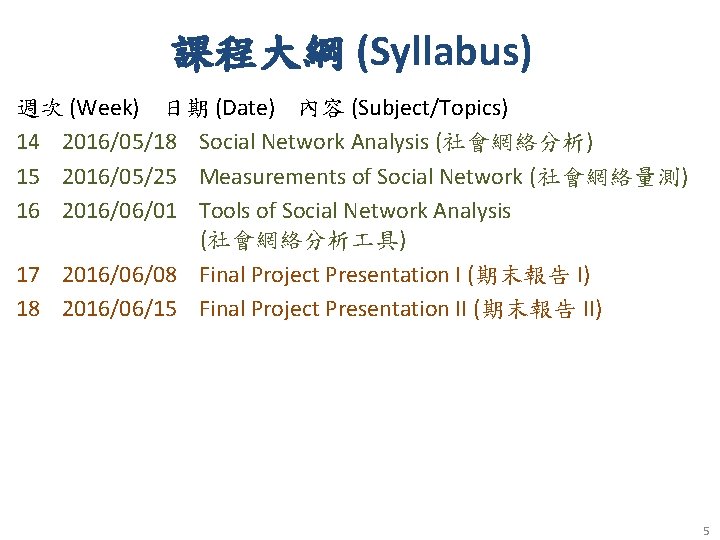
課程大綱 (Syllabus) 週次 (Week) 日期 (Date) 內容 (Subject/Topics) 14 2016/05/18 Social Network Analysis (社會網絡分析) 15 2016/05/25 Measurements of Social Network (社會網絡量測) 16 2016/06/01 Tools of Social Network Analysis (社會網絡分析 具) 17 2016/06/08 Final Project Presentation I (期末報告 I) 18 2016/06/15 Final Project Presentation II (期末報告 II) 5

Source: https: //github. com/tensorflow 6
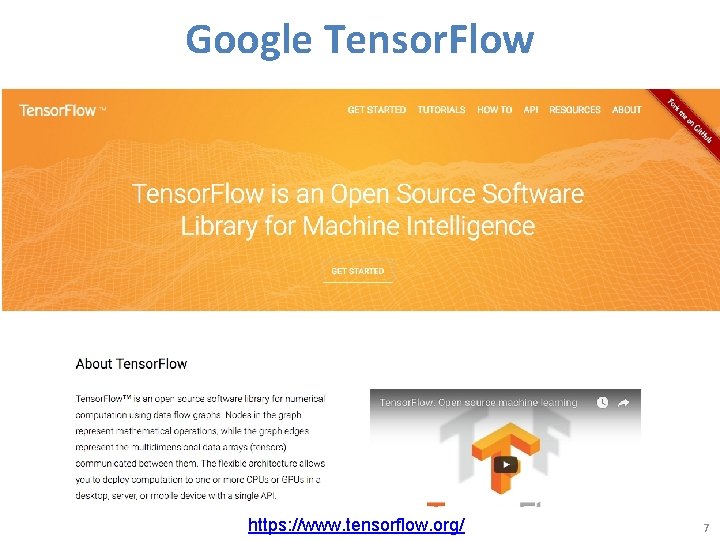
Google Tensor. Flow https: //www. tensorflow. org/ 7
Tensor. Flow is an Open Source Software Library for Machine Intelligence 8
numerical computation using data flow graphs 9
Nodes: mathematical operations edges: multidimensional data arrays (tensors) communicated between nodes 10
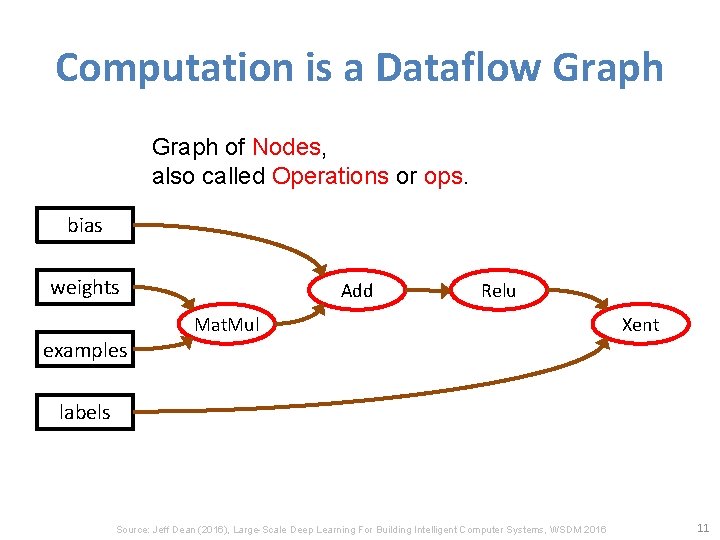
Computation is a Dataflow Graph of Nodes, also called Operations or ops. bias weights examples Add Relu Mat. Mul Xent labels Source: Jeff Dean (2016), Large-Scale Deep Learning For Building Intelligent Computer Systems, WSDM 2016 11
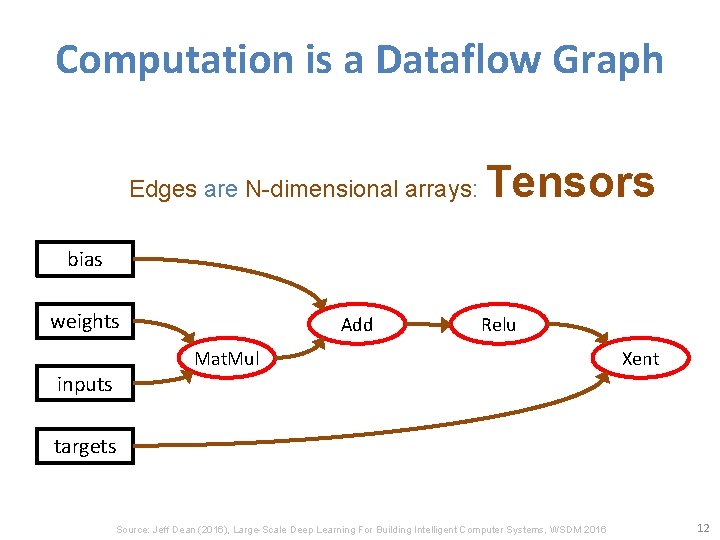
Computation is a Dataflow Graph Edges are N-dimensional arrays: Tensors bias weights Add Relu Mat. Mul inputs Xent targets Source: Jeff Dean (2016), Large-Scale Deep Learning For Building Intelligent Computer Systems, WSDM 2016 12
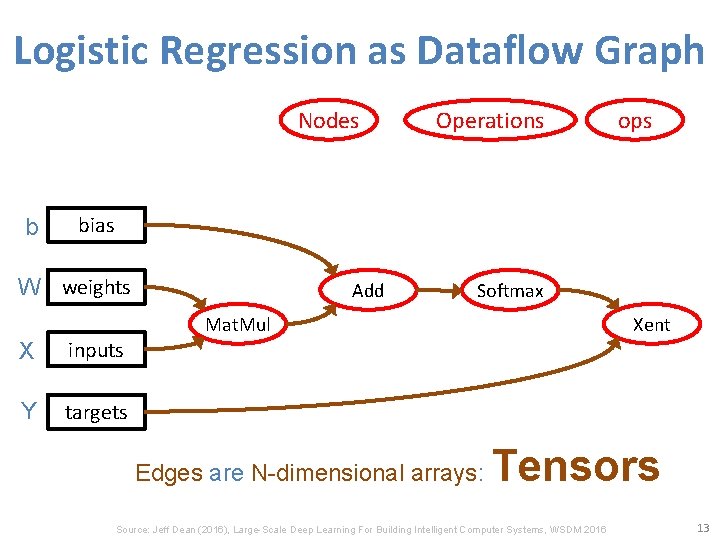
Logistic Regression as Dataflow Graph Nodes b Operations ops bias W weights X inputs Y targets Add Softmax Mat. Mul Edges are N-dimensional arrays: Xent Tensors Source: Jeff Dean (2016), Large-Scale Deep Learning For Building Intelligent Computer Systems, WSDM 2016 13
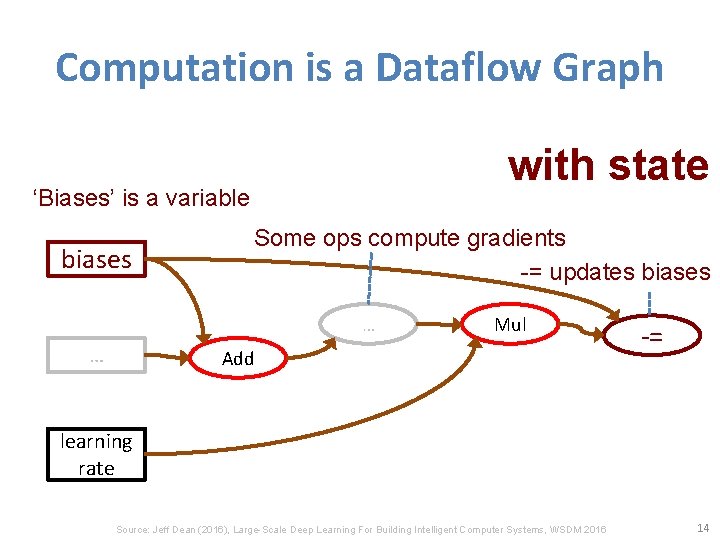
Computation is a Dataflow Graph with state ‘Biases’ is a variable biases Some ops compute gradients -= updates biases … … Mul Add -= learning rate Source: Jeff Dean (2016), Large-Scale Deep Learning For Building Intelligent Computer Systems, WSDM 2016 14
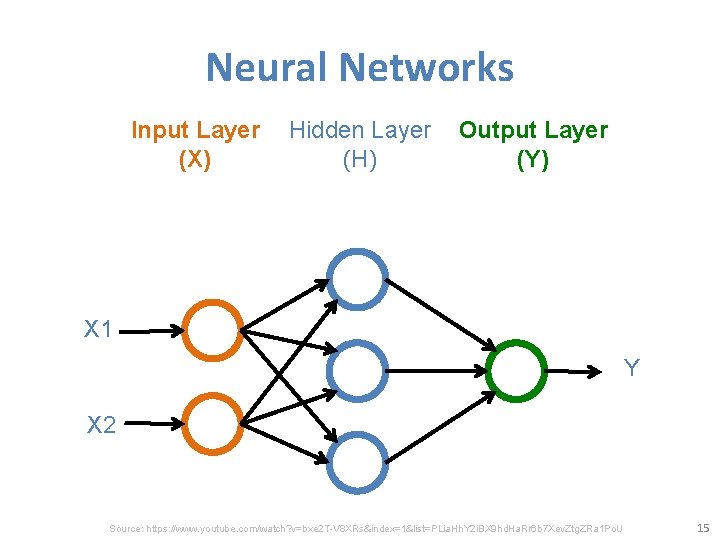
Neural Networks Input Layer (X) Hidden Layer (H) Output Layer (Y) X 1 Y X 2 Source: https: //www. youtube. com/watch? v=bxe 2 T-V 8 XRs&index=1&list=PLia. Hh. Y 2 i. BX 9 hd. Ha. Rr 6 b 7 Xev. Ztg. ZRa 1 Po. U 15
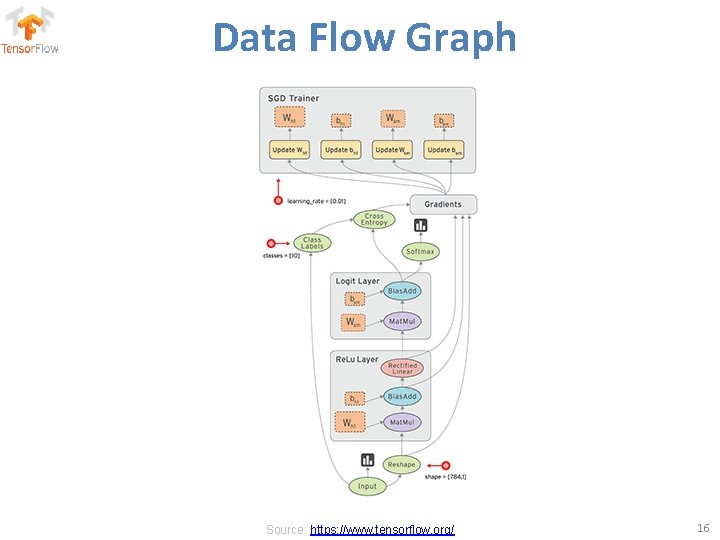
Data Flow Graph Source: https: //www. tensorflow. org/ 16
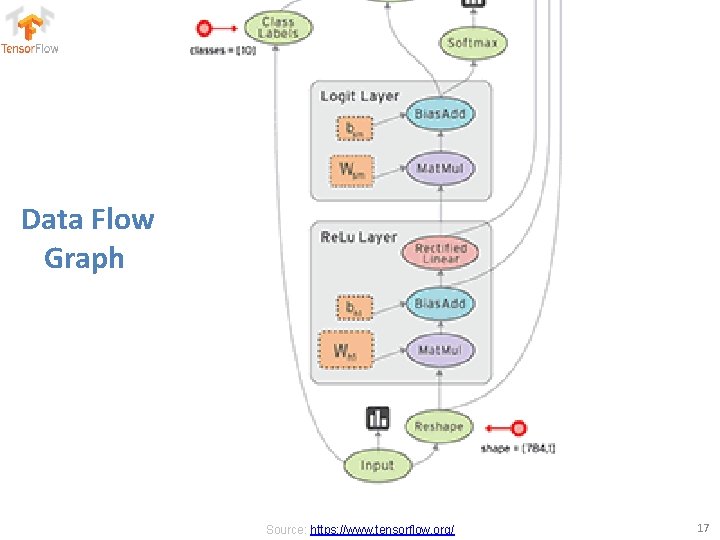
Data Flow Graph Source: https: //www. tensorflow. org/ 17
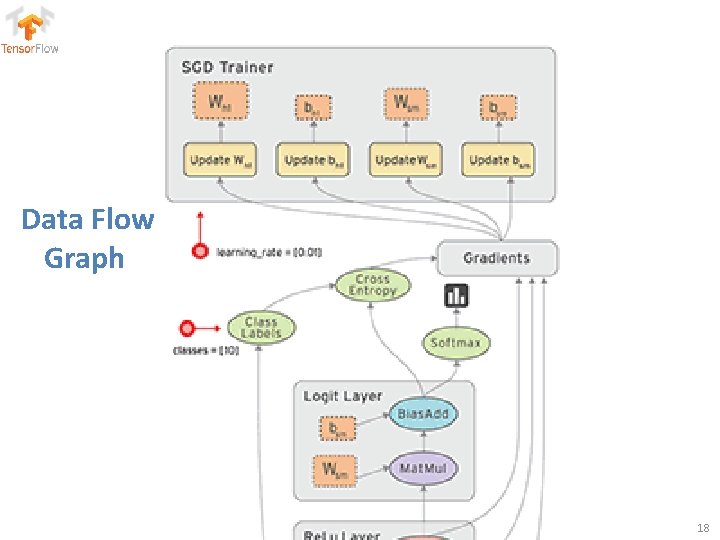
Data Flow Graph Source: https: //www. tensorflow. org/ 18
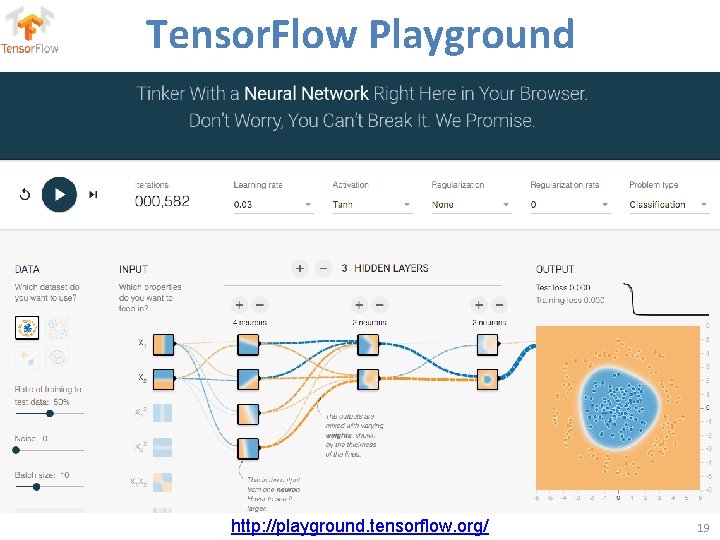
Tensor. Flow Playground http: //playground. tensorflow. org/ 19
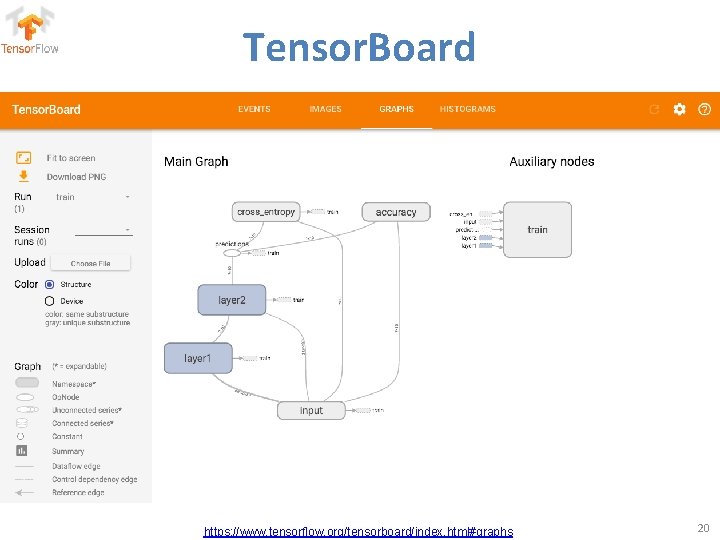
Tensor. Board https: //www. tensorflow. org/tensorboard/index. html#graphs 20
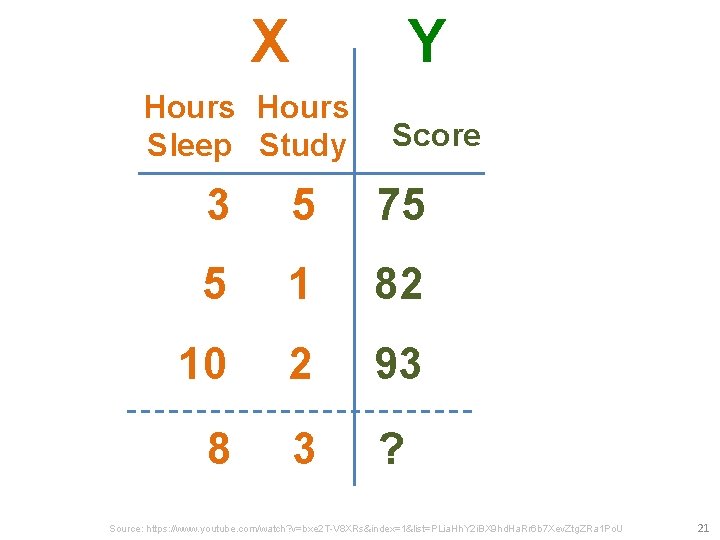
X Y Hours Sleep Study Score 3 5 75 5 1 82 10 2 93 8 3 ? Source: https: //www. youtube. com/watch? v=bxe 2 T-V 8 XRs&index=1&list=PLia. Hh. Y 2 i. BX 9 hd. Ha. Rr 6 b 7 Xev. Ztg. ZRa 1 Po. U 21
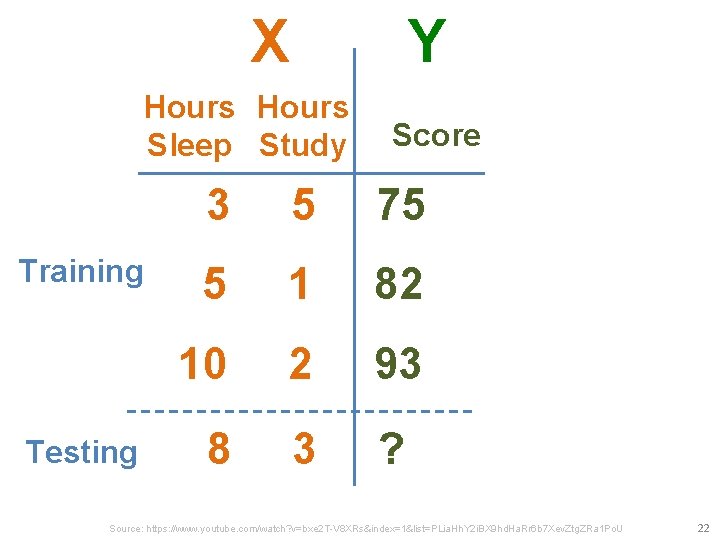
X Y Hours Sleep Study Training Testing Score 3 5 75 5 1 82 10 2 93 8 3 ? Source: https: //www. youtube. com/watch? v=bxe 2 T-V 8 XRs&index=1&list=PLia. Hh. Y 2 i. BX 9 hd. Ha. Rr 6 b 7 Xev. Ztg. ZRa 1 Po. U 22
Training a Network = Minimize the Cost Function Source: https: //www. youtube. com/watch? v=bxe 2 T-V 8 XRs&index=1&list=PLia. Hh. Y 2 i. BX 9 hd. Ha. Rr 6 b 7 Xev. Ztg. ZRa 1 Po. U 23
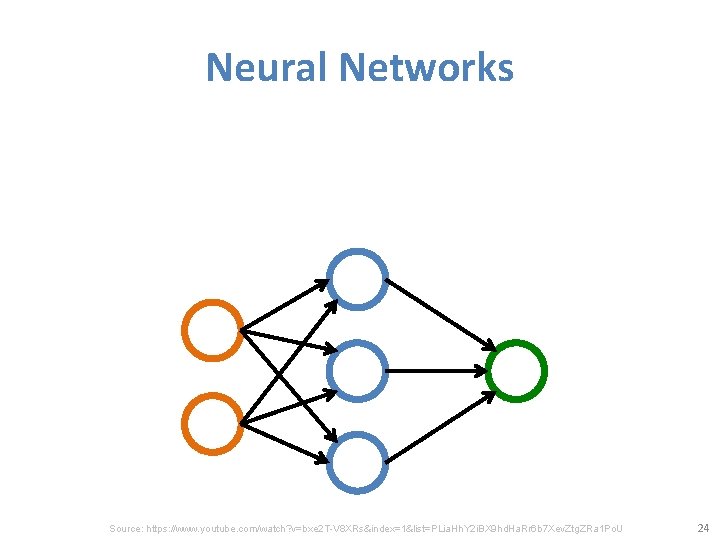
Neural Networks Source: https: //www. youtube. com/watch? v=bxe 2 T-V 8 XRs&index=1&list=PLia. Hh. Y 2 i. BX 9 hd. Ha. Rr 6 b 7 Xev. Ztg. ZRa 1 Po. U 24
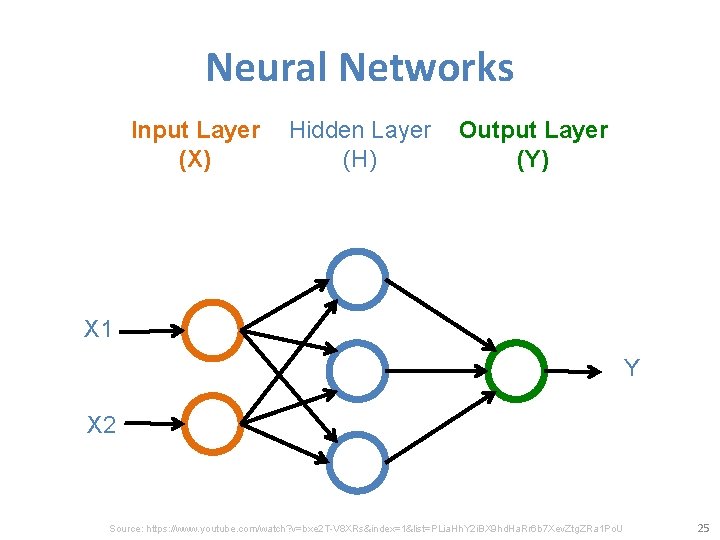
Neural Networks Input Layer (X) Hidden Layer (H) Output Layer (Y) X 1 Y X 2 Source: https: //www. youtube. com/watch? v=bxe 2 T-V 8 XRs&index=1&list=PLia. Hh. Y 2 i. BX 9 hd. Ha. Rr 6 b 7 Xev. Ztg. ZRa 1 Po. U 25
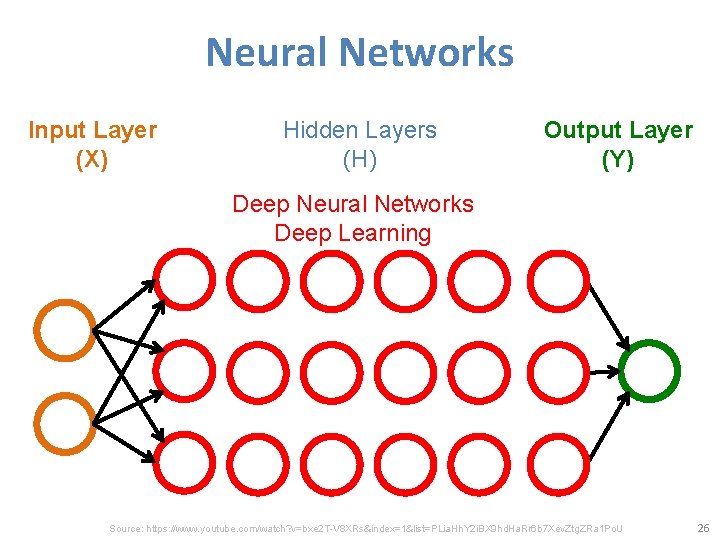
Neural Networks Input Layer (X) Hidden Layers (H) Output Layer (Y) Deep Neural Networks Deep Learning Source: https: //www. youtube. com/watch? v=bxe 2 T-V 8 XRs&index=1&list=PLia. Hh. Y 2 i. BX 9 hd. Ha. Rr 6 b 7 Xev. Ztg. ZRa 1 Po. U 26
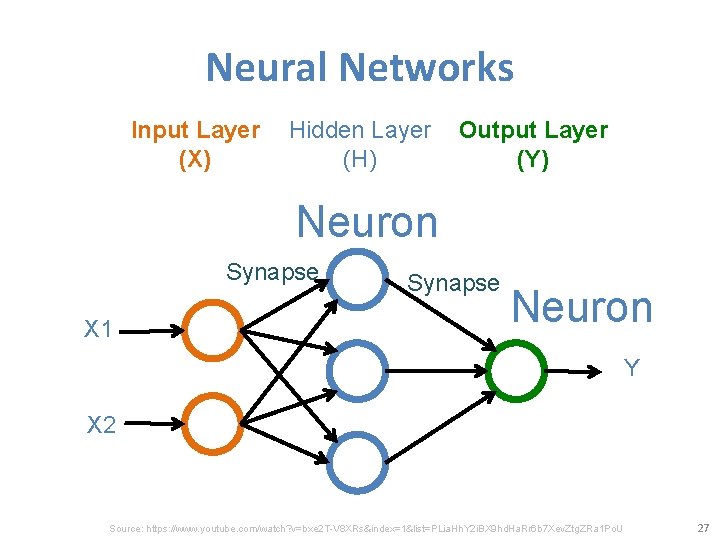
Neural Networks Input Layer (X) Hidden Layer (H) Output Layer (Y) Neuron Synapse X 1 Synapse Neuron Y X 2 Source: https: //www. youtube. com/watch? v=bxe 2 T-V 8 XRs&index=1&list=PLia. Hh. Y 2 i. BX 9 hd. Ha. Rr 6 b 7 Xev. Ztg. ZRa 1 Po. U 27
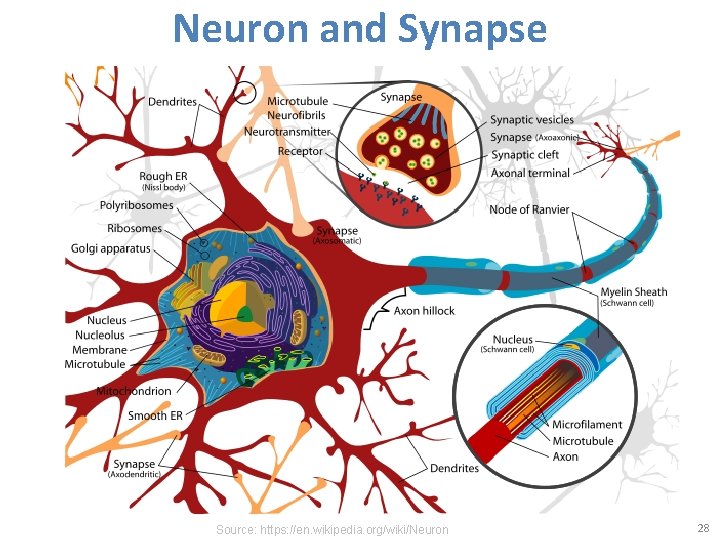
Neuron and Synapse Source: https: //en. wikipedia. org/wiki/Neuron 28
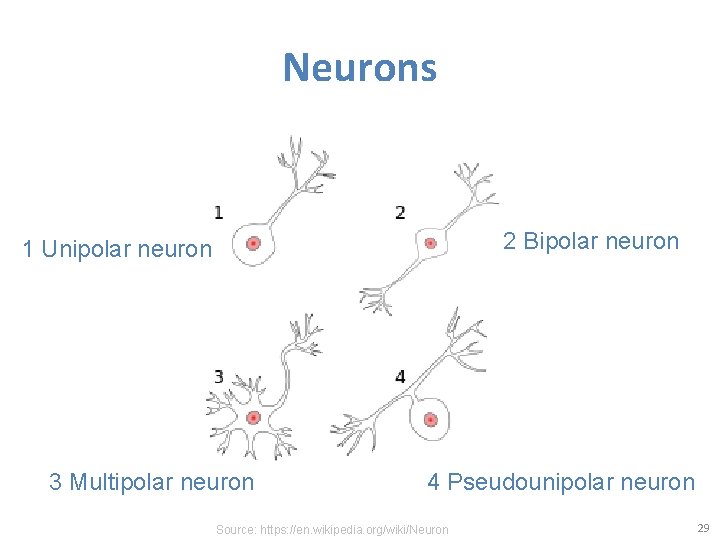
Neurons 2 Bipolar neuron 1 Unipolar neuron 3 Multipolar neuron 4 Pseudounipolar neuron Source: https: //en. wikipedia. org/wiki/Neuron 29
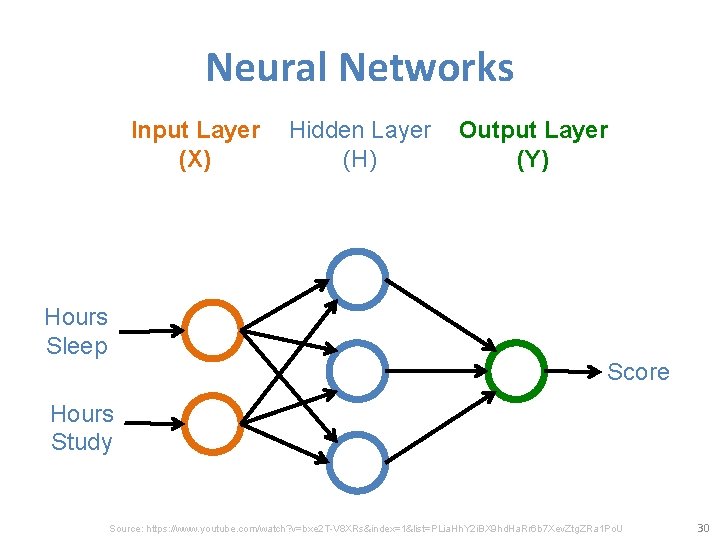
Neural Networks Input Layer (X) Hours Sleep Hidden Layer (H) Output Layer (Y) Score Hours Study Source: https: //www. youtube. com/watch? v=bxe 2 T-V 8 XRs&index=1&list=PLia. Hh. Y 2 i. BX 9 hd. Ha. Rr 6 b 7 Xev. Ztg. ZRa 1 Po. U 30
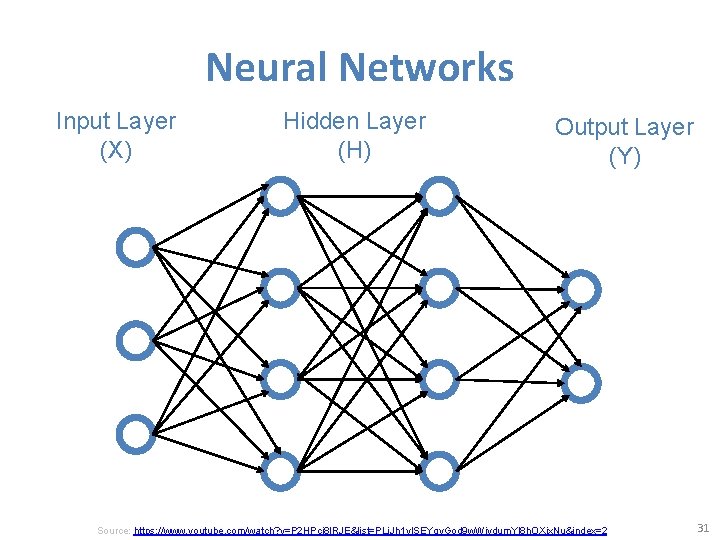
Neural Networks Input Layer (X) Hidden Layer (H) Output Layer (Y) Source: https: //www. youtube. com/watch? v=P 2 HPcj 8 l. RJE&list=PLj. Jh 1 vl. SEYgv. God 9 w. Wiydum. Yl 8 h. OXix. Nu&index=2 31
Convolutional Neural Networks (CNNs / Conv. Nets) http: //cs 231 n. github. io/convolutional-networks/ 32
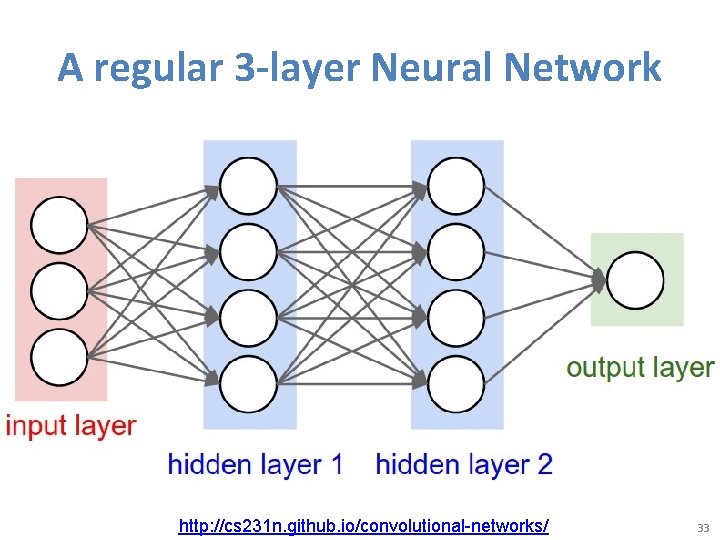
A regular 3 -layer Neural Network http: //cs 231 n. github. io/convolutional-networks/ 33
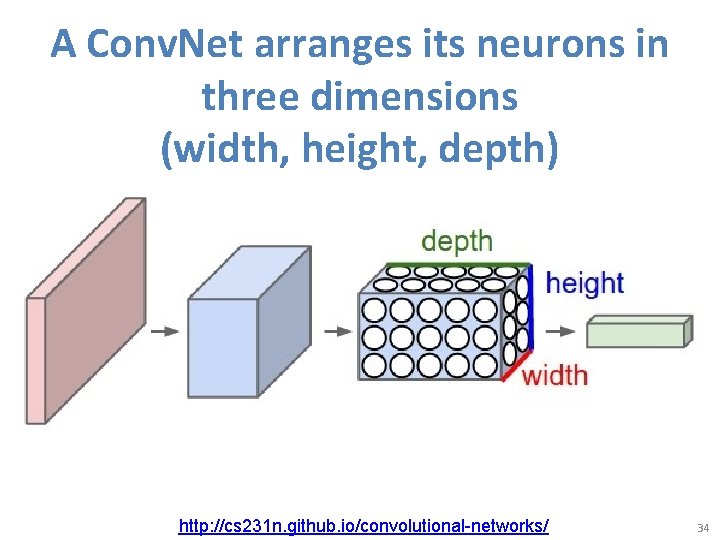
A Conv. Net arranges its neurons in three dimensions (width, height, depth) http: //cs 231 n. github. io/convolutional-networks/ 34
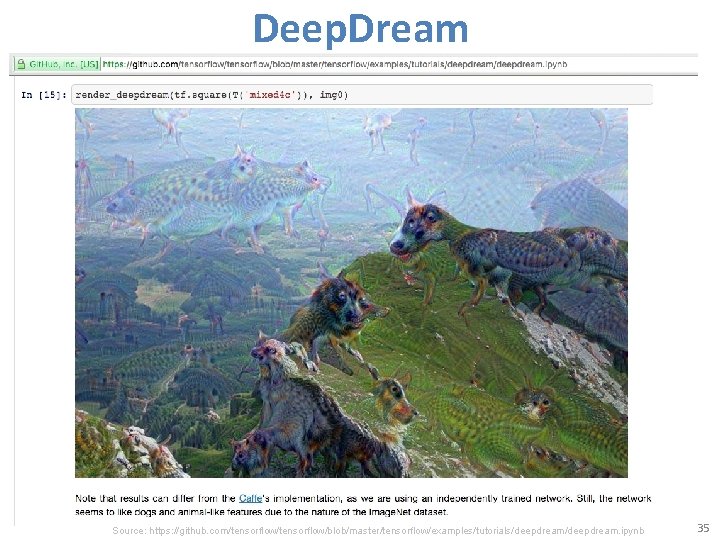
Deep. Dream Source: https: //github. com/tensorflow/blob/master/tensorflow/examples/tutorials/deepdream. ipynb 35
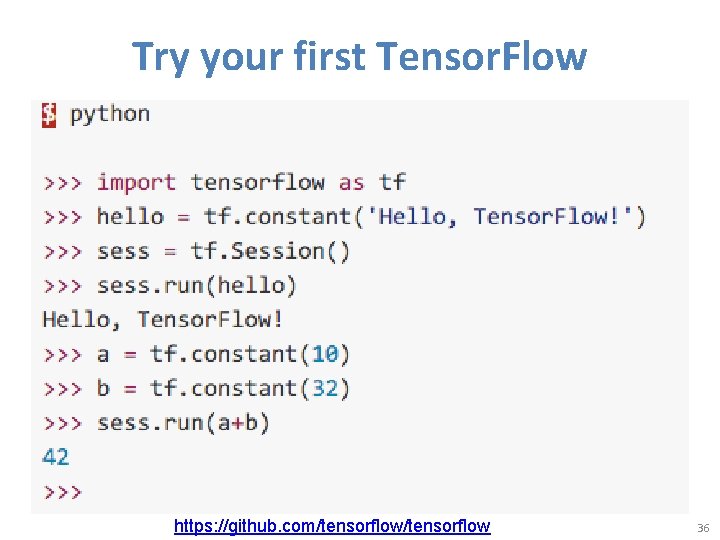
Try your first Tensor. Flow https: //github. com/tensorflow 36
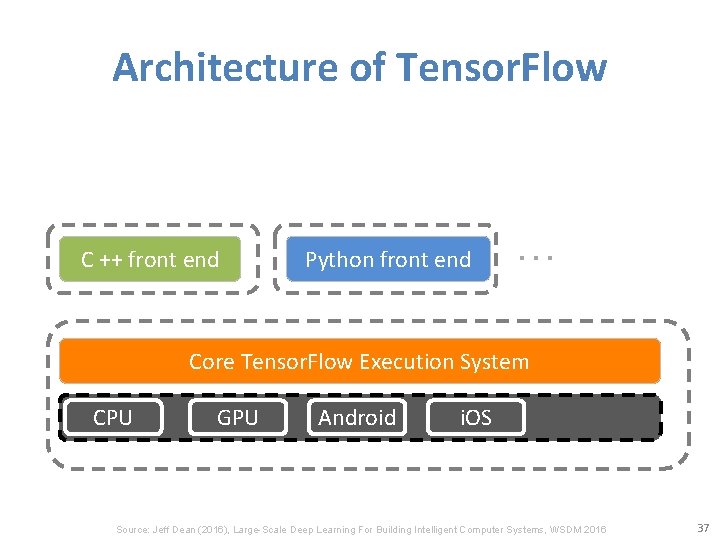
Architecture of Tensor. Flow C ++ front end Python front end … Core Tensor. Flow Execution System CPU GPU Android i. OS Source: Jeff Dean (2016), Large-Scale Deep Learning For Building Intelligent Computer Systems, WSDM 2016 37
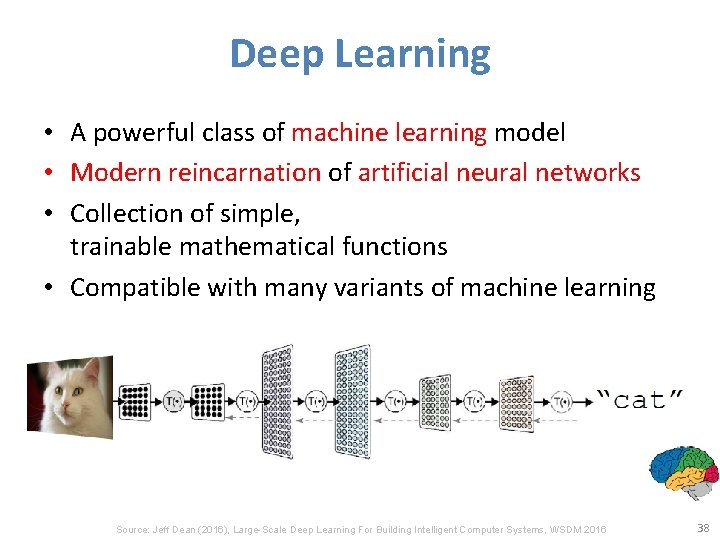
Deep Learning • A powerful class of machine learning model • Modern reincarnation of artificial neural networks • Collection of simple, trainable mathematical functions • Compatible with many variants of machine learning Source: Jeff Dean (2016), Large-Scale Deep Learning For Building Intelligent Computer Systems, WSDM 2016 38
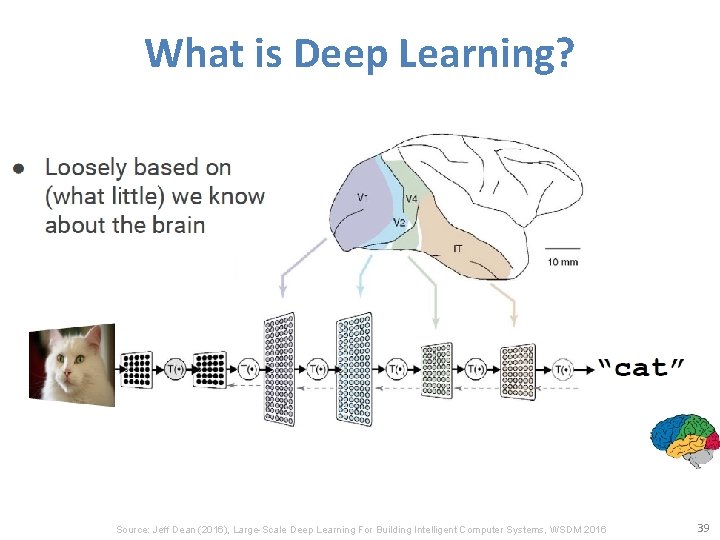
What is Deep Learning? Source: Jeff Dean (2016), Large-Scale Deep Learning For Building Intelligent Computer Systems, WSDM 2016 39
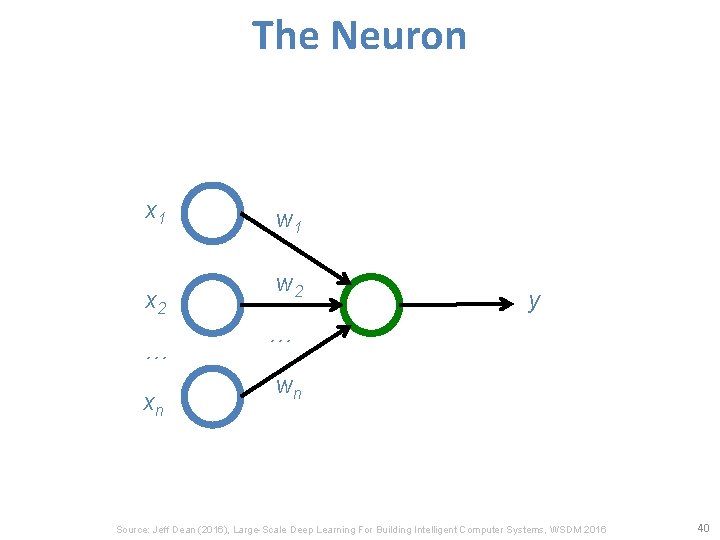
The Neuron x 1 x 2 … xn w 1 w 2 y … wn Source: Jeff Dean (2016), Large-Scale Deep Learning For Building Intelligent Computer Systems, WSDM 2016 40
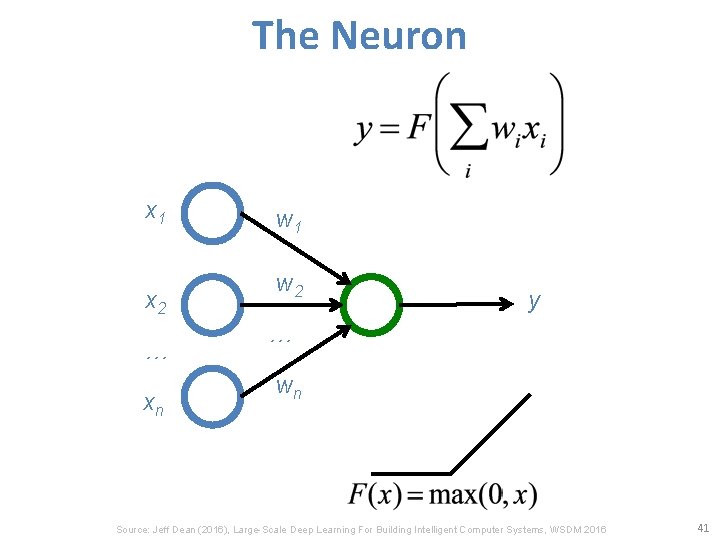
The Neuron x 1 x 2 … xn w 1 w 2 y … wn Source: Jeff Dean (2016), Large-Scale Deep Learning For Building Intelligent Computer Systems, WSDM 2016 41
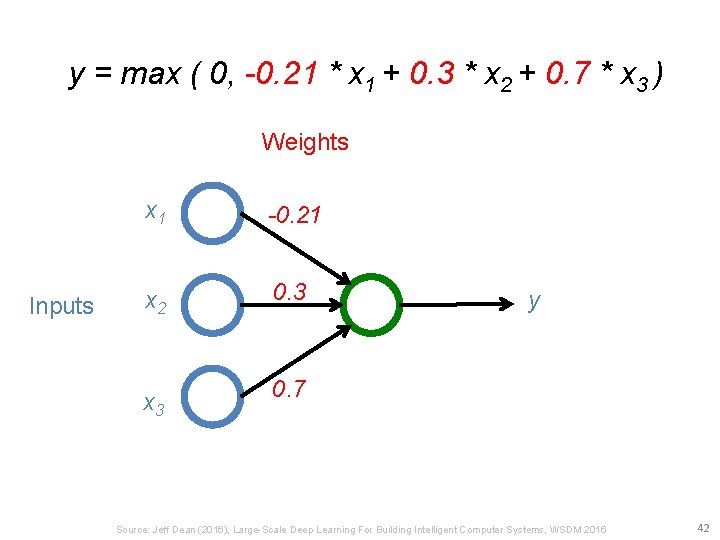
y = max ( 0, -0. 21 * x 1 + 0. 3 * x 2 + 0. 7 * x 3 ) Weights Inputs x 1 -0. 21 x 2 0. 3 x 3 y 0. 7 Source: Jeff Dean (2016), Large-Scale Deep Learning For Building Intelligent Computer Systems, WSDM 2016 42
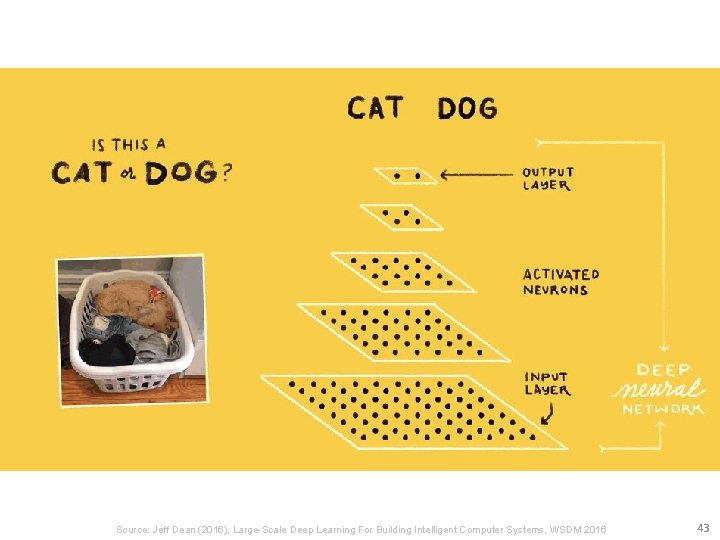
Source: Jeff Dean (2016), Large-Scale Deep Learning For Building Intelligent Computer Systems, WSDM 2016 43
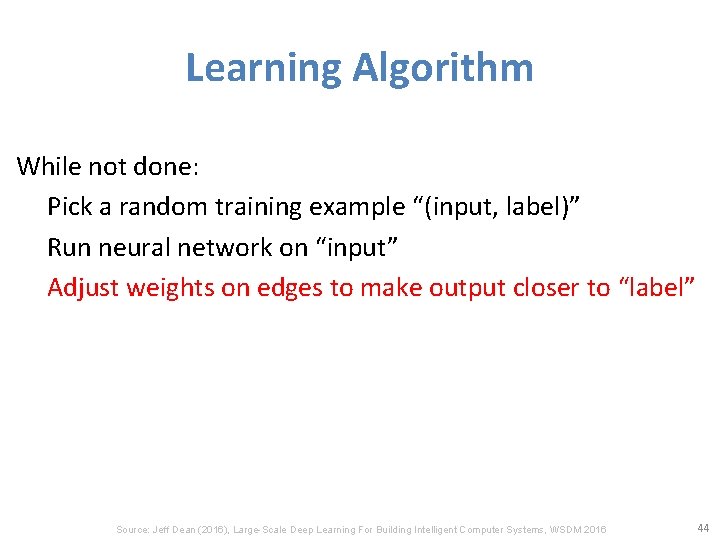
Learning Algorithm While not done: Pick a random training example “(input, label)” Run neural network on “input” Adjust weights on edges to make output closer to “label” Source: Jeff Dean (2016), Large-Scale Deep Learning For Building Intelligent Computer Systems, WSDM 2016 44
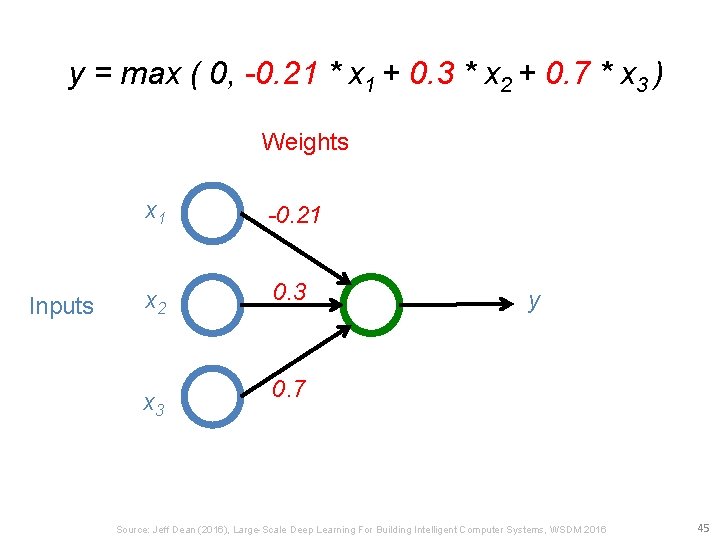
y = max ( 0, -0. 21 * x 1 + 0. 3 * x 2 + 0. 7 * x 3 ) Weights Inputs x 1 -0. 21 x 2 0. 3 x 3 y 0. 7 Source: Jeff Dean (2016), Large-Scale Deep Learning For Building Intelligent Computer Systems, WSDM 2016 45
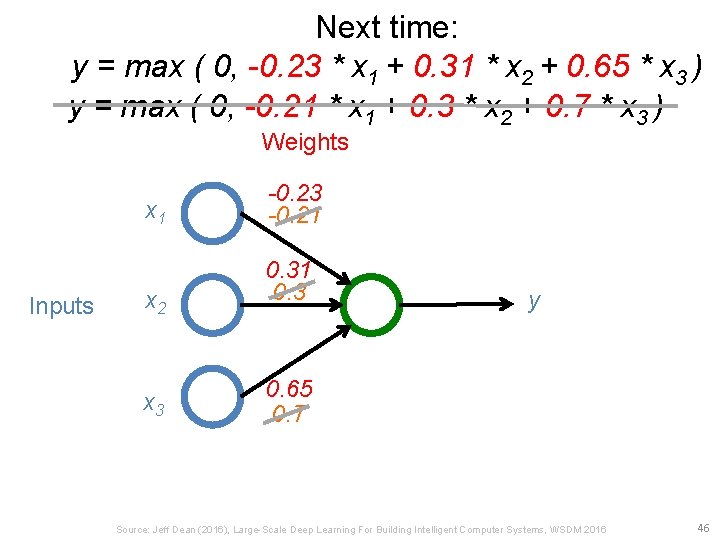
Next time: y = max ( 0, -0. 23 * x 1 + 0. 31 * x 2 + 0. 65 * x 3 ) y = max ( 0, -0. 21 * x 1 + 0. 3 * x 2 + 0. 7 * x 3 ) Weights x 1 Inputs x 2 x 3 -0. 21 0. 3 y 0. 65 0. 7 Source: Jeff Dean (2016), Large-Scale Deep Learning For Building Intelligent Computer Systems, WSDM 2016 46
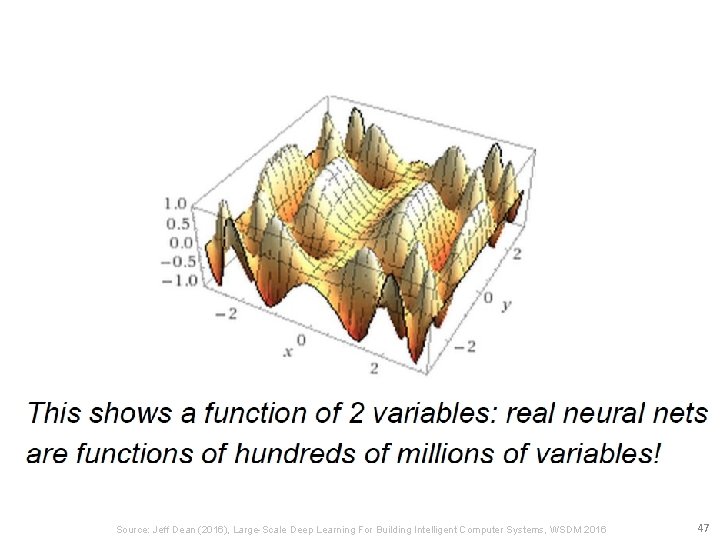
Source: Jeff Dean (2016), Large-Scale Deep Learning For Building Intelligent Computer Systems, WSDM 2016 47
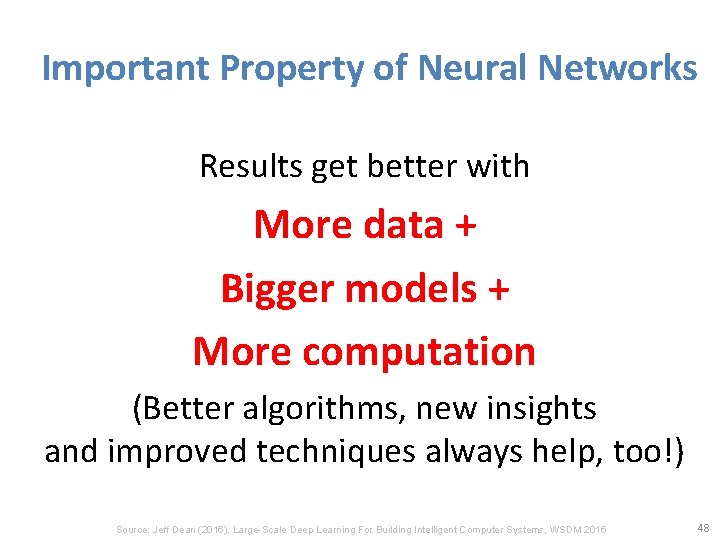
Important Property of Neural Networks Results get better with More data + Bigger models + More computation (Better algorithms, new insights and improved techniques always help, too!) Source: Jeff Dean (2016), Large-Scale Deep Learning For Building Intelligent Computer Systems, WSDM 2016 48
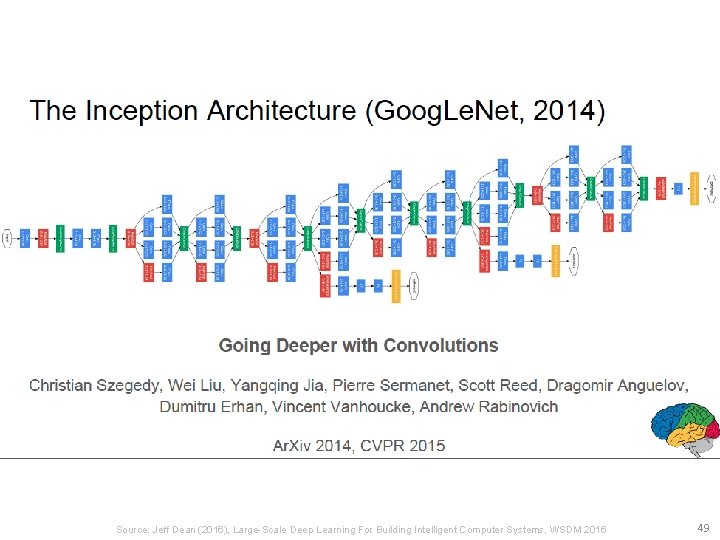
Source: Jeff Dean (2016), Large-Scale Deep Learning For Building Intelligent Computer Systems, WSDM 2016 49
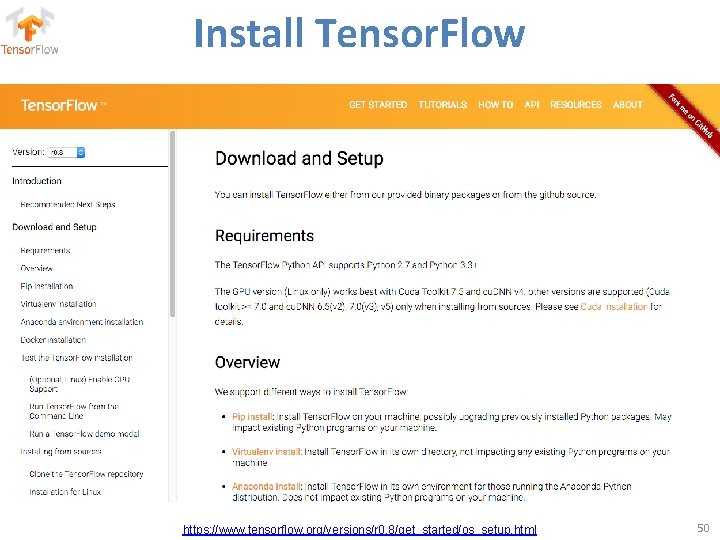
Install Tensor. Flow https: //www. tensorflow. org/versions/r 0. 8/get_started/os_setup. html 50
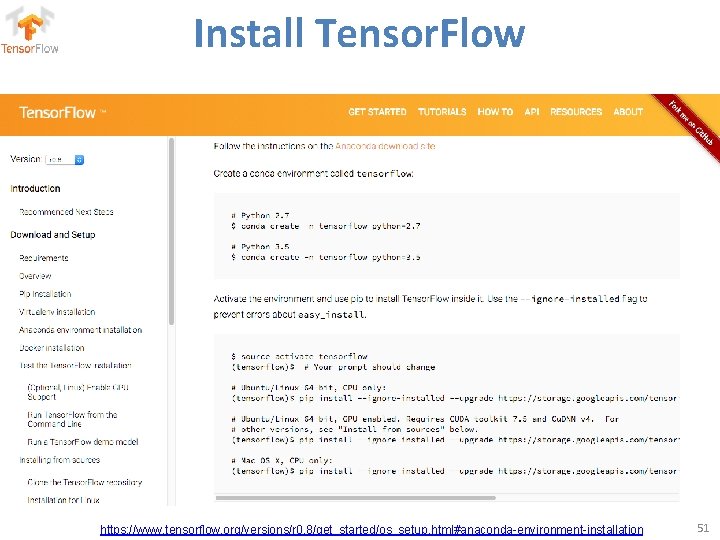
Install Tensor. Flow https: //www. tensorflow. org/versions/r 0. 8/get_started/os_setup. html#anaconda-environment-installation 51
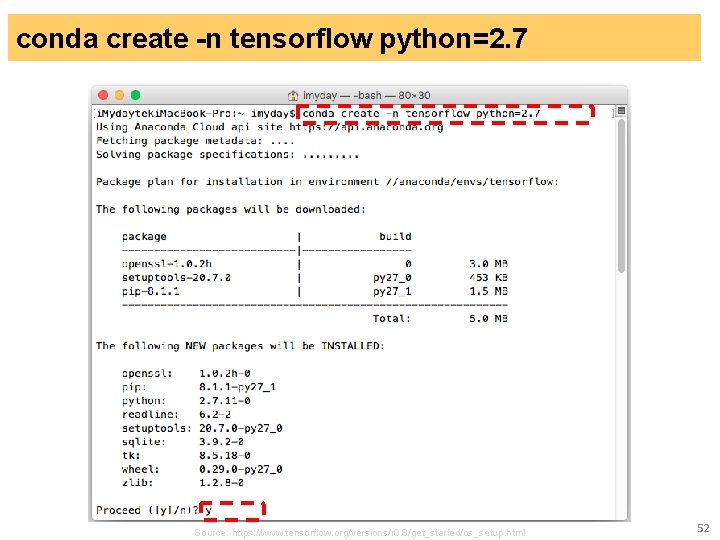
conda create -n tensorflow python=2. 7 Source: https: //www. tensorflow. org/versions/r 0. 8/get_started/os_setup. html 52
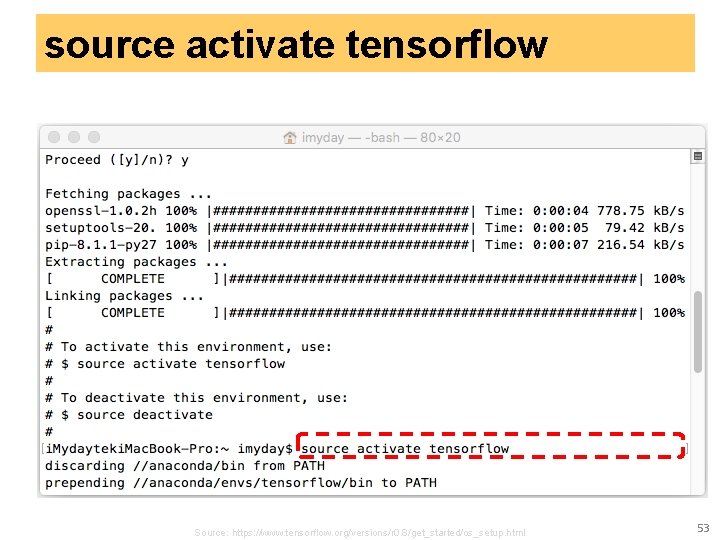
source activate tensorflow Source: https: //www. tensorflow. org/versions/r 0. 8/get_started/os_setup. html 53
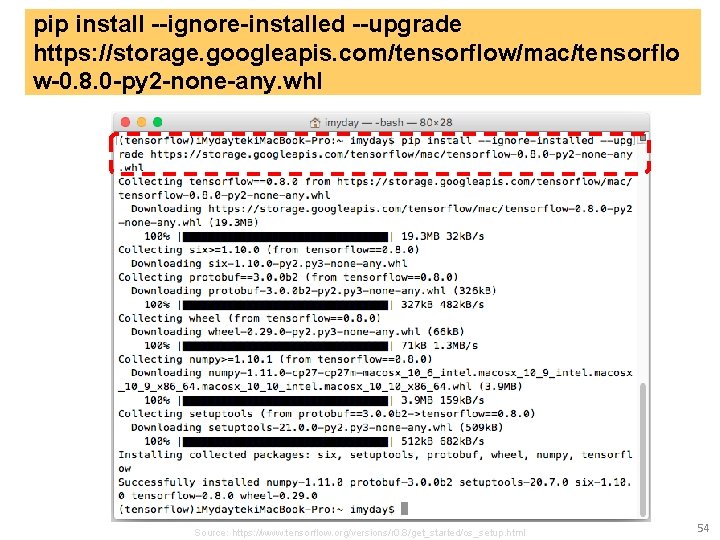
pip install --ignore-installed --upgrade https: //storage. googleapis. com/tensorflow/mac/tensorflo w-0. 8. 0 -py 2 -none-any. whl Source: https: //www. tensorflow. org/versions/r 0. 8/get_started/os_setup. html 54
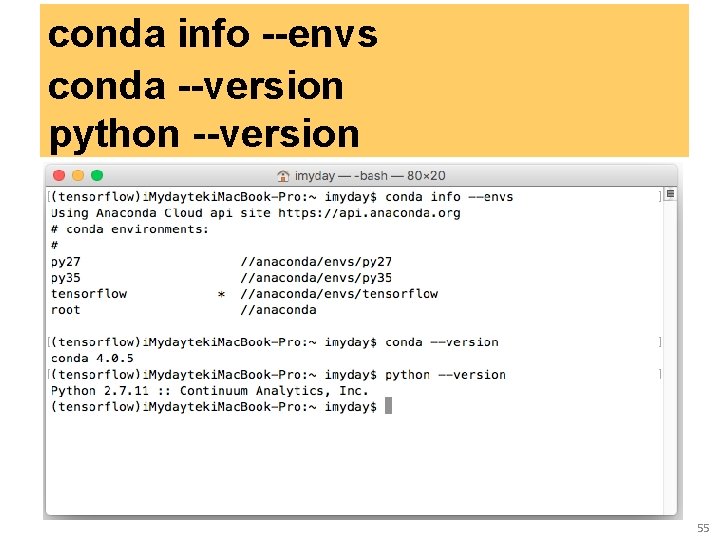
conda info --envs conda --version python --version 55
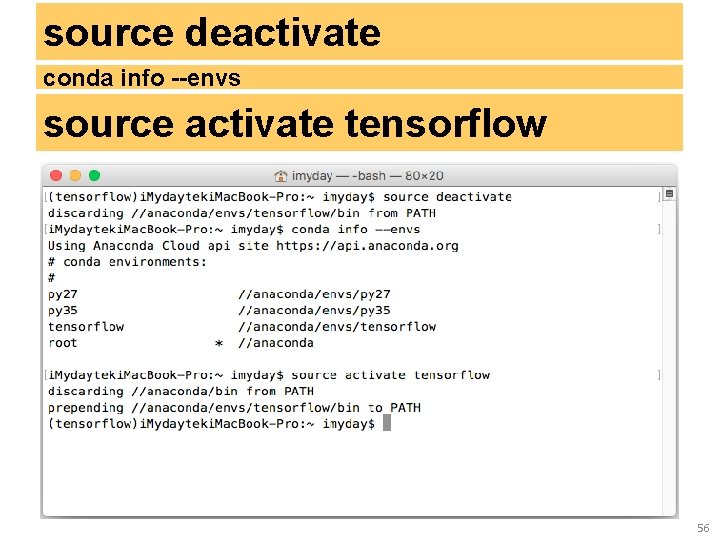
source deactivate conda info --envs source activate tensorflow 56
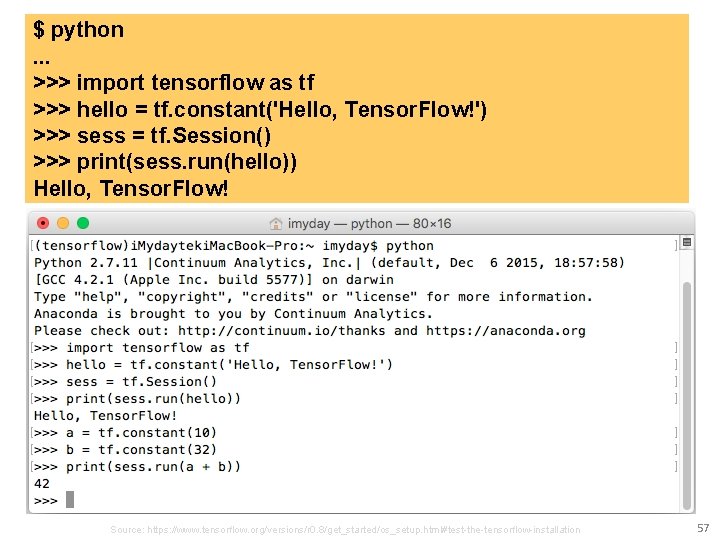
$ python. . . >>> import tensorflow as tf >>> hello = tf. constant('Hello, Tensor. Flow!') >>> sess = tf. Session() >>> print(sess. run(hello)) Hello, Tensor. Flow! Source: https: //www. tensorflow. org/versions/r 0. 8/get_started/os_setup. html#test-the-tensorflow-installation 57
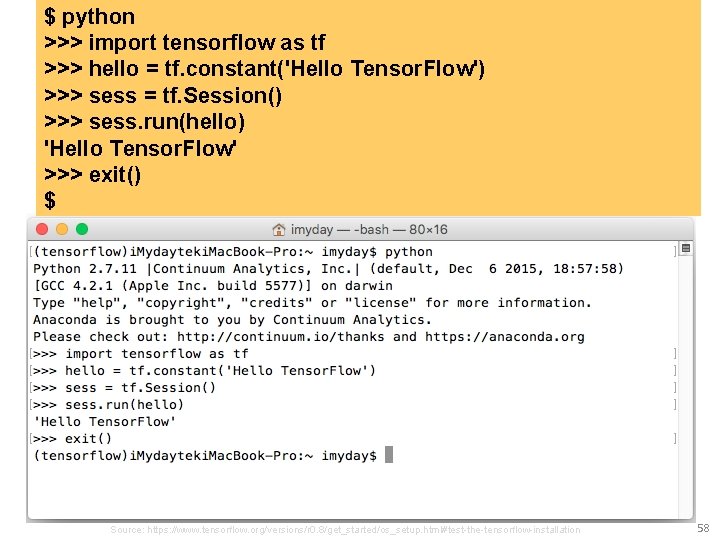
$ python >>> import tensorflow as tf >>> hello = tf. constant('Hello Tensor. Flow') >>> sess = tf. Session() >>> sess. run(hello) 'Hello Tensor. Flow' >>> exit() $ Source: https: //www. tensorflow. org/versions/r 0. 8/get_started/os_setup. html#test-the-tensorflow-installation 58
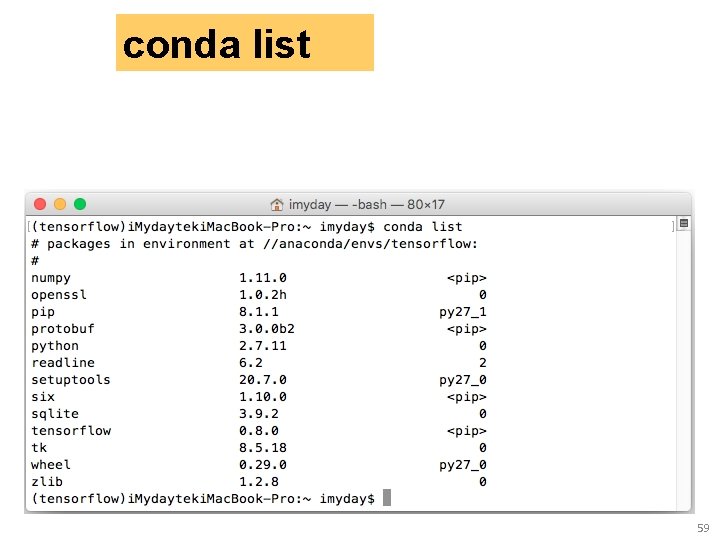
conda list 59
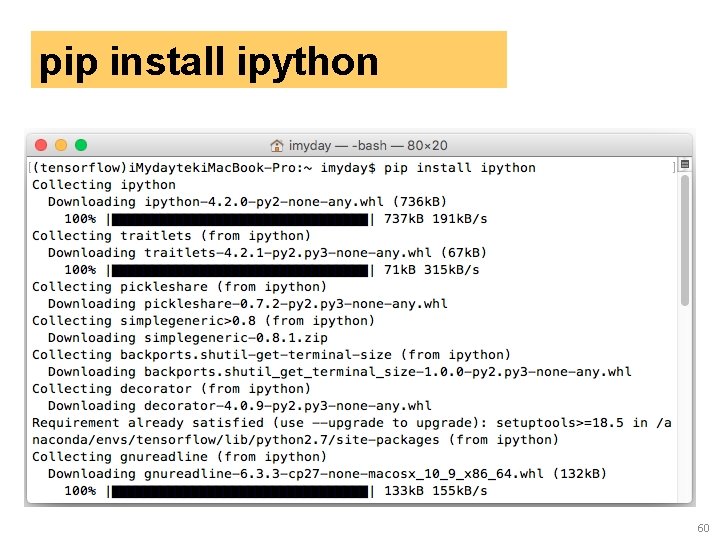
pip install ipython 60
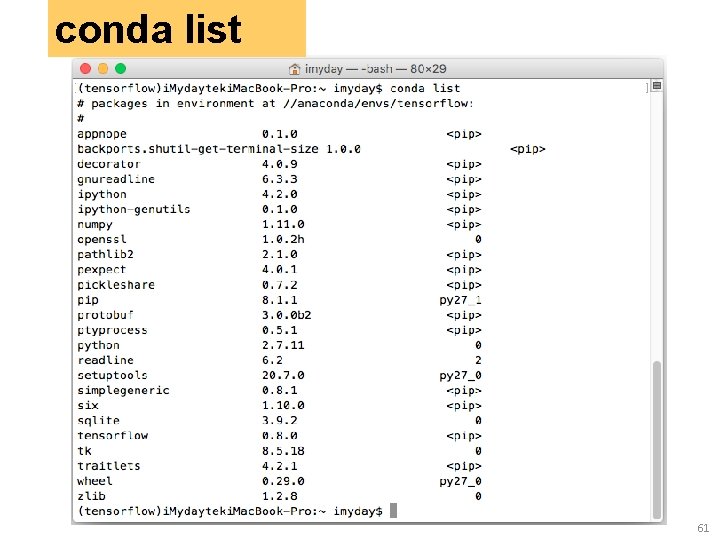
conda list 61
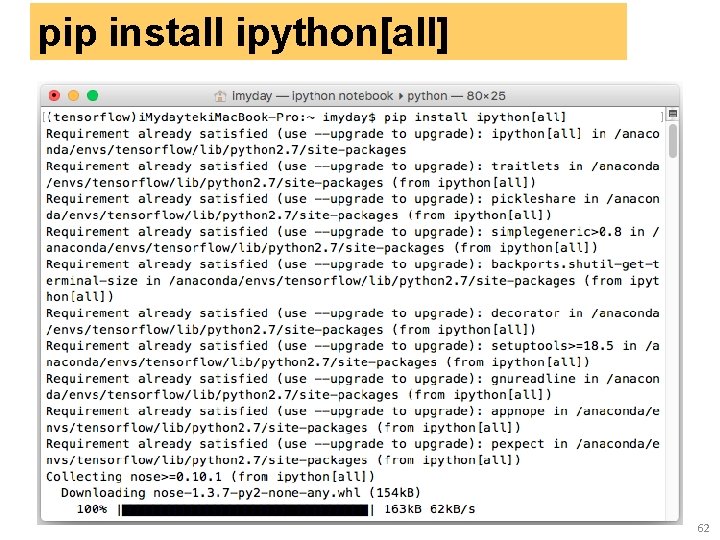
pip install ipython[all] 62
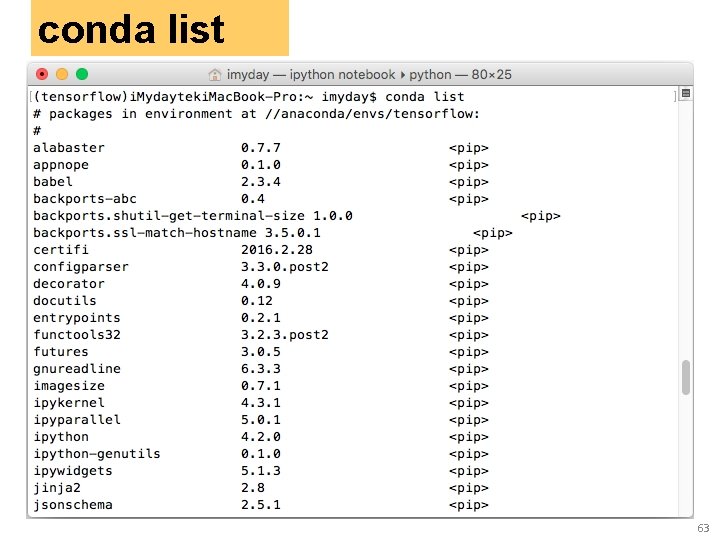
conda list 63
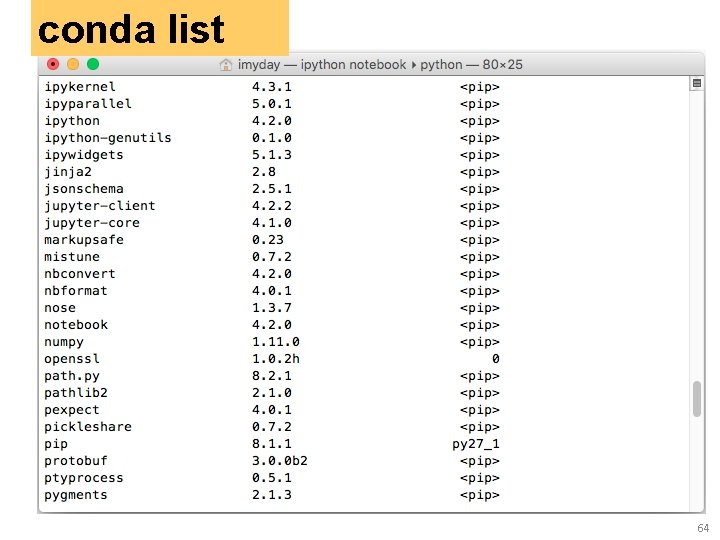
conda list 64
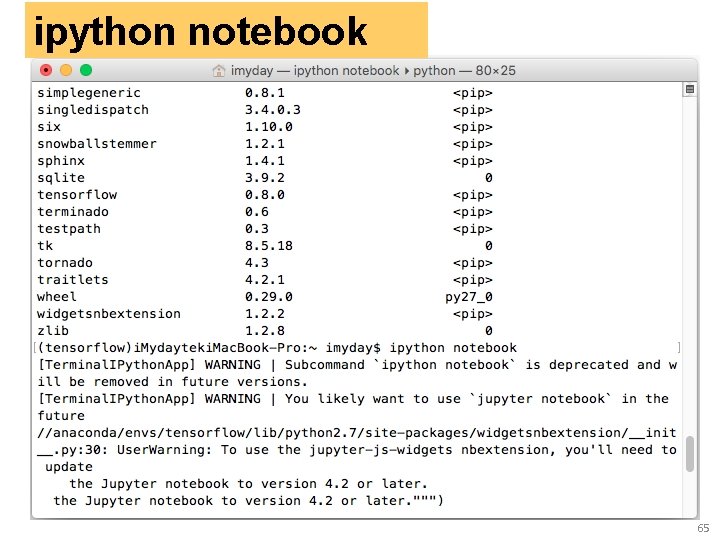
ipython notebook 65
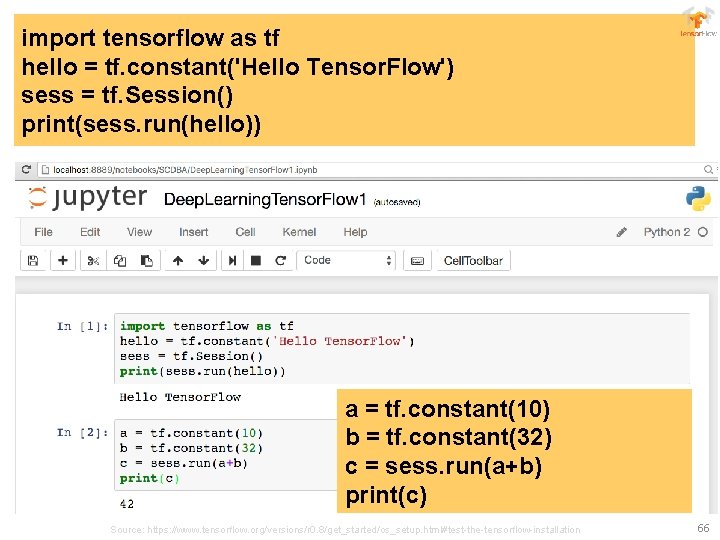
import tensorflow as tf hello = tf. constant('Hello Tensor. Flow') sess = tf. Session() print(sess. run(hello)) a = tf. constant(10) b = tf. constant(32) c = sess. run(a+b) print(c) Source: https: //www. tensorflow. org/versions/r 0. 8/get_started/os_setup. html#test-the-tensorflow-installation 66
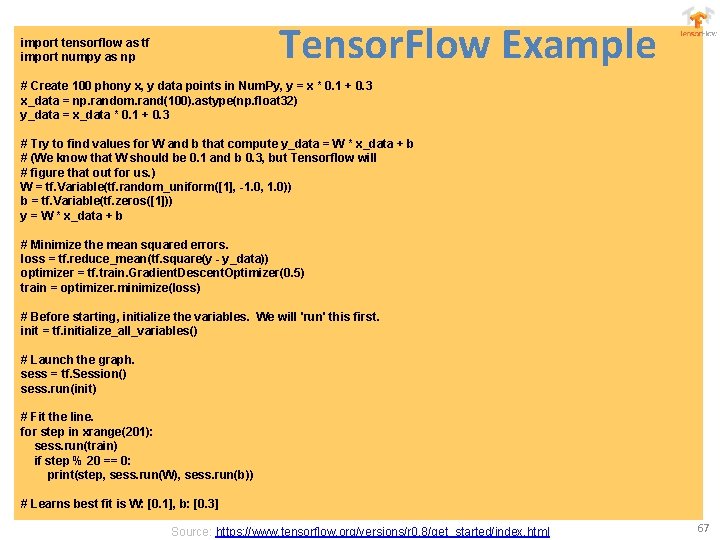
Tensor. Flow Example import tensorflow as tf import numpy as np # Create 100 phony x, y data points in Num. Py, y = x * 0. 1 + 0. 3 x_data = np. random. rand(100). astype(np. float 32) y_data = x_data * 0. 1 + 0. 3 # Try to find values for W and b that compute y_data = W * x_data + b # (We know that W should be 0. 1 and b 0. 3, but Tensorflow will # figure that out for us. ) W = tf. Variable(tf. random_uniform([1], -1. 0, 1. 0)) b = tf. Variable(tf. zeros([1])) y = W * x_data + b # Minimize the mean squared errors. loss = tf. reduce_mean(tf. square(y - y_data)) optimizer = tf. train. Gradient. Descent. Optimizer(0. 5) train = optimizer. minimize(loss) # Before starting, initialize the variables. We will 'run' this first. init = tf. initialize_all_variables() # Launch the graph. sess = tf. Session() sess. run(init) # Fit the line. for step in xrange(201): sess. run(train) if step % 20 == 0: print(step, sess. run(W), sess. run(b)) # Learns best fit is W: [0. 1], b: [0. 3] Source: https: //www. tensorflow. org/versions/r 0. 8/get_started/index. html 67
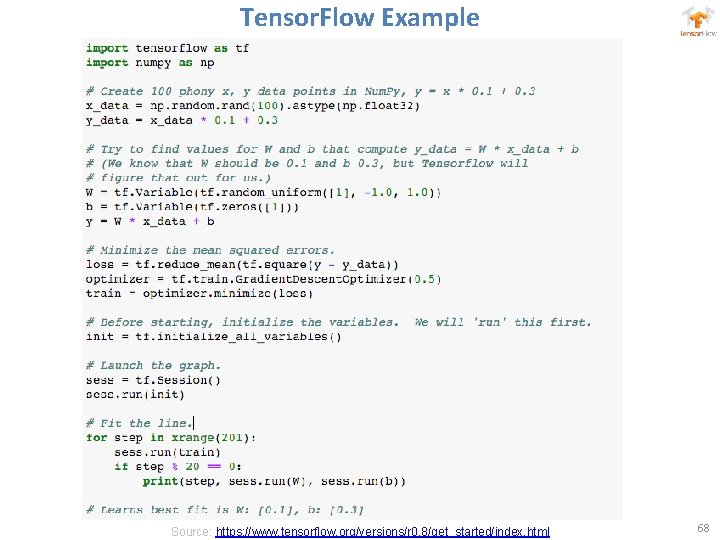
Tensor. Flow Example Source: https: //www. tensorflow. org/versions/r 0. 8/get_started/index. html 68
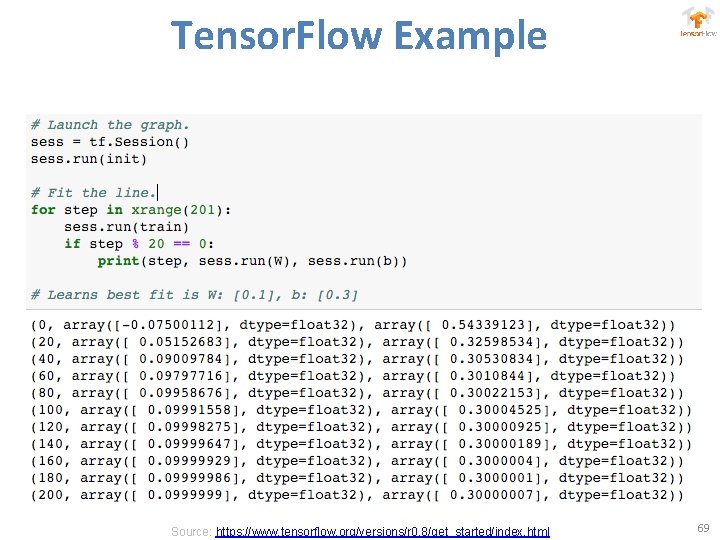
Tensor. Flow Example Source: https: //www. tensorflow. org/versions/r 0. 8/get_started/index. html 69
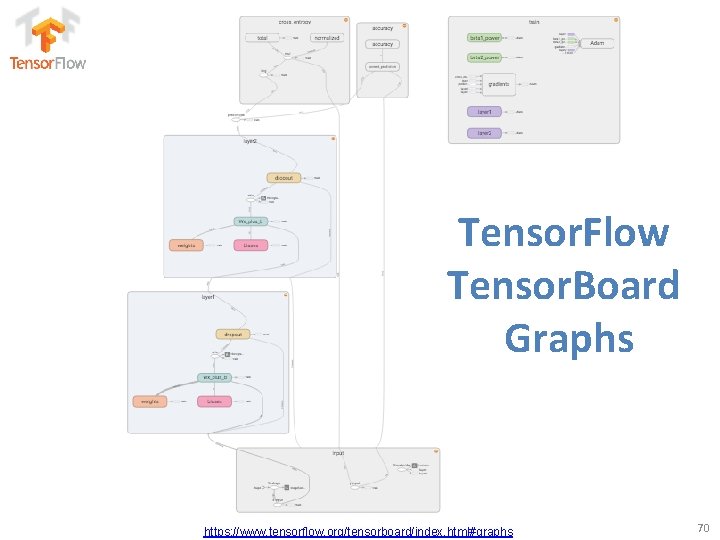
Tensor. Flow Tensor. Board Graphs https: //www. tensorflow. org/tensorboard/index. html#graphs 70
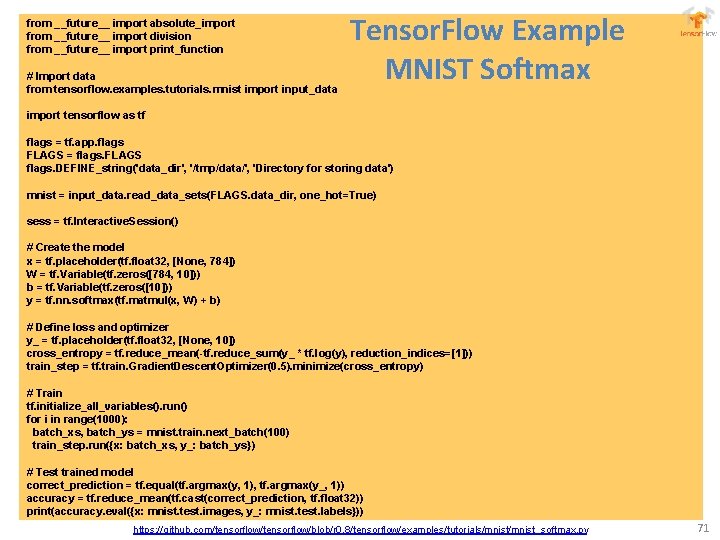
from __future__ import absolute_import from __future__ import division from __future__ import print_function # Import data from tensorflow. examples. tutorials. mnist import input_data Tensor. Flow Example MNIST Softmax import tensorflow as tf flags = tf. app. flags FLAGS = flags. FLAGS flags. DEFINE_string('data_dir', '/tmp/data/', 'Directory for storing data') mnist = input_data. read_data_sets(FLAGS. data_dir, one_hot=True) sess = tf. Interactive. Session() # Create the model x = tf. placeholder(tf. float 32, [None, 784]) W = tf. Variable(tf. zeros([784, 10])) b = tf. Variable(tf. zeros([10])) y = tf. nn. softmax(tf. matmul(x, W) + b) # Define loss and optimizer y_ = tf. placeholder(tf. float 32, [None, 10]) cross_entropy = tf. reduce_mean(-tf. reduce_sum(y_ * tf. log(y), reduction_indices=[1])) train_step = tf. train. Gradient. Descent. Optimizer(0. 5). minimize(cross_entropy) # Train tf. initialize_all_variables(). run() for i in range(1000): batch_xs, batch_ys = mnist. train. next_batch(100) train_step. run({x: batch_xs, y_: batch_ys}) # Test trained model correct_prediction = tf. equal(tf. argmax(y, 1), tf. argmax(y_, 1)) accuracy = tf. reduce_mean(tf. cast(correct_prediction, tf. float 32)) print(accuracy. eval({x: mnist. test. images, y_: mnist. test. labels})) https: //github. com/tensorflow/blob/r 0. 8/tensorflow/examples/tutorials/mnist_softmax. py 71
Tensor. Flow Example MNIST Softmax https: //github. com/tensorflow/blob/r 0. 8/tensorflow/examples/tutorials/mnist_softmax. py 72

Tensor. Flow Example MNIST Softmax https: //github. com/tensorflow/blob/r 0. 8/tensorflow/examples/tutorials/mnist_softmax. py 73
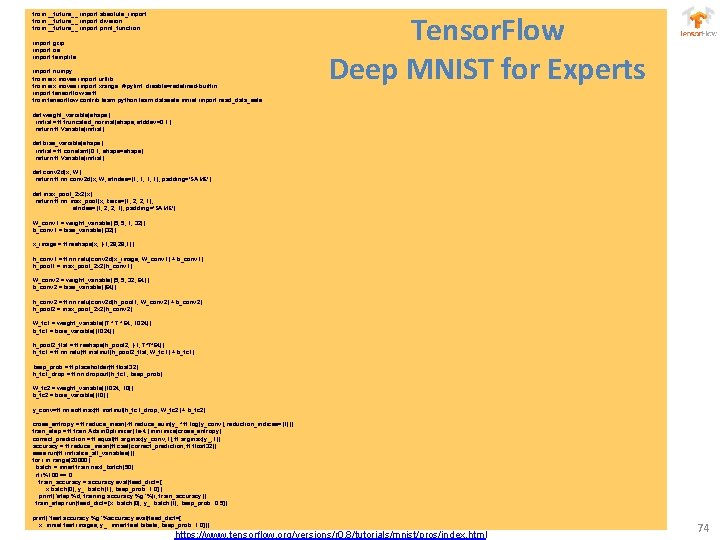
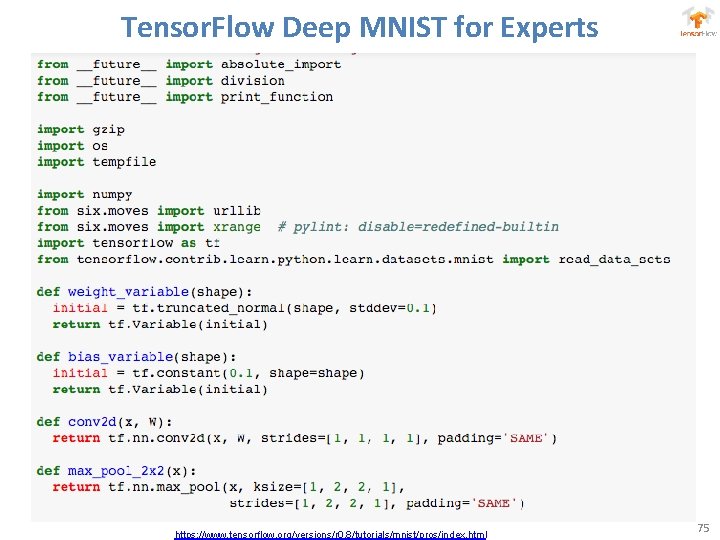
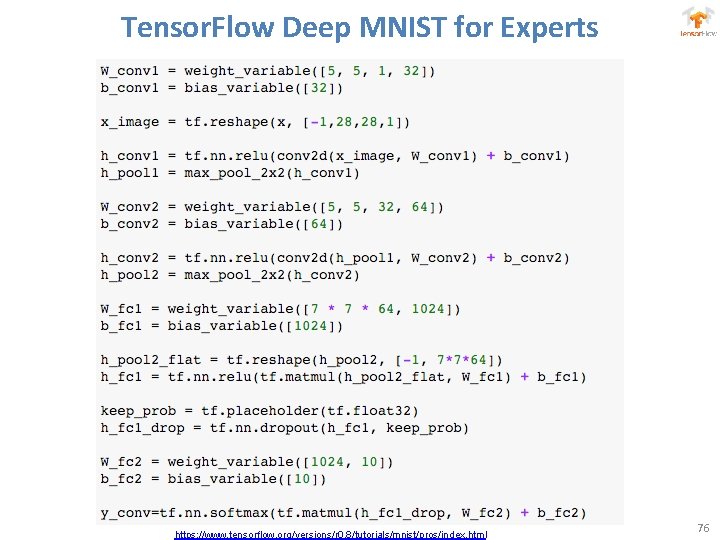
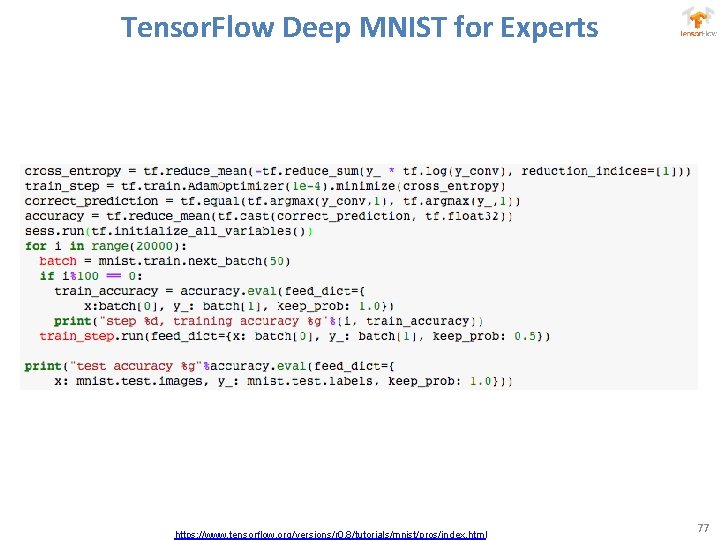
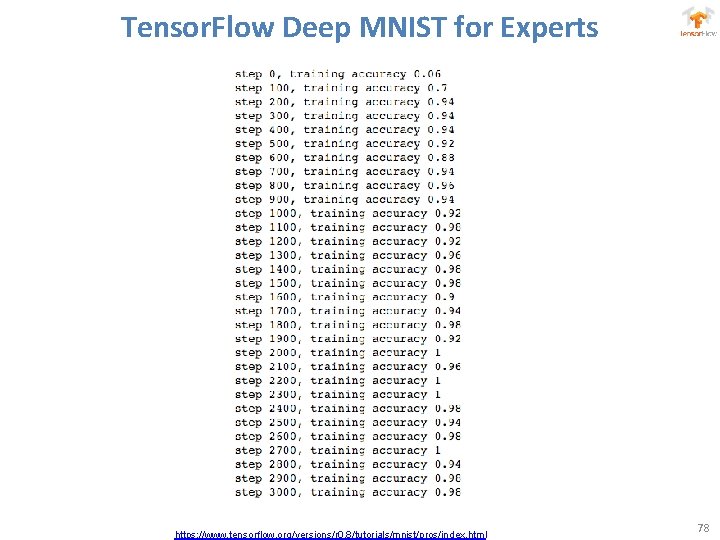
from __future__ import absolute_import from __future__ import division from __future__ import print_function import gzip import os import tempfile import numpy from six. moves import urllib from six. moves import xrange # pylint: disable=redefined-builtin import tensorflow as tf from tensorflow. contrib. learn. python. learn. datasets. mnist import read_data_sets Tensor. Flow Deep MNIST for Experts def weight_variable(shape): initial = tf. truncated_normal(shape, stddev=0. 1) return tf. Variable(initial) def bias_variable(shape): initial = tf. constant(0. 1, shape=shape) return tf. Variable(initial) def conv 2 d(x, W): return tf. nn. conv 2 d(x, W, strides=[1, 1, 1, 1], padding='SAME') def max_pool_2 x 2(x): return tf. nn. max_pool(x, ksize=[1, 2, 2, 1], strides=[1, 2, 2, 1], padding='SAME') W_conv 1 = weight_variable([5, 5, 1, 32]) b_conv 1 = bias_variable([32]) x_image = tf. reshape(x, [-1, 28, 1]) h_conv 1 = tf. nn. relu(conv 2 d(x_image, W_conv 1) + b_conv 1) h_pool 1 = max_pool_2 x 2(h_conv 1) W_conv 2 = weight_variable([5, 5, 32, 64]) b_conv 2 = bias_variable([64]) h_conv 2 = tf. nn. relu(conv 2 d(h_pool 1, W_conv 2) + b_conv 2) h_pool 2 = max_pool_2 x 2(h_conv 2) W_fc 1 = weight_variable([7 * 64, 1024]) b_fc 1 = bias_variable([1024]) h_pool 2_flat = tf. reshape(h_pool 2, [-1, 7*7*64]) h_fc 1 = tf. nn. relu(tf. matmul(h_pool 2_flat, W_fc 1) + b_fc 1) keep_prob = tf. placeholder(tf. float 32) h_fc 1_drop = tf. nn. dropout(h_fc 1, keep_prob) W_fc 2 = weight_variable([1024, 10]) b_fc 2 = bias_variable([10]) y_conv=tf. nn. softmax(tf. matmul(h_fc 1_drop, W_fc 2) + b_fc 2) cross_entropy = tf. reduce_mean(-tf. reduce_sum(y_ * tf. log(y_conv), reduction_indices=[1])) train_step = tf. train. Adam. Optimizer(1 e-4). minimize(cross_entropy) correct_prediction = tf. equal(tf. argmax(y_conv, 1), tf. argmax(y_, 1)) accuracy = tf. reduce_mean(tf. cast(correct_prediction, tf. float 32)) sess. run(tf. initialize_all_variables()) for i in range(20000): batch = mnist. train. next_batch(50) if i%100 == 0: train_accuracy = accuracy. eval(feed_dict={ x: batch[0], y_: batch[1], keep_prob: 1. 0}) print("step %d, training accuracy %g"%(i, train_accuracy)) train_step. run(feed_dict={x: batch[0], y_: batch[1], keep_prob: 0. 5}) print("test accuracy %g"%accuracy. eval(feed_dict={ x: mnist. test. images, y_: mnist. test. labels, keep_prob: 1. 0})) https: //www. tensorflow. org/versions/r 0. 8/tutorials/mnist/pros/index. html 74
Tensor. Flow Deep MNIST for Experts https: //www. tensorflow. org/versions/r 0. 8/tutorials/mnist/pros/index. html 75
Tensor. Flow Deep MNIST for Experts https: //www. tensorflow. org/versions/r 0. 8/tutorials/mnist/pros/index. html 76
Tensor. Flow Deep MNIST for Experts https: //www. tensorflow. org/versions/r 0. 8/tutorials/mnist/pros/index. html 77
Tensor. Flow Deep MNIST for Experts https: //www. tensorflow. org/versions/r 0. 8/tutorials/mnist/pros/index. html 78
Deep Learning Software • Theano – CPU/GPU symbolic expression compiler in python (from MILA lab at University of Montreal) • Keras – A theano based deep learning library. • Tensorflow – Tensor. Flow™ is an open source software library for numerical computation using data flow graphs. Source: http: //deeplearning. net/software_links/ 79
References • • • Sunila Gollapudi (2016), Practical Machine Learning, Packt Publishing Sebastian Raschka (2015), Python Machine Learning, Packt Publishing Tensor. Flow: https: //www. tensorflow. org/ Rajat Monga (2016), Tensor. Flow: Machine Learning for Everyone, https: //www. youtube. com/watch? v=wmw 8 Bbb_e. IE Jeff Dean (2016), Large-Scale Deep Learning For Building Intelligent Computer Systems, The 9 th ACM International Conference on Web Search and Data Mining (WSDM 2016), San Francisco, California, USA. , February 22 -25, 2016. http: //www. wsdm-conference. org/2016/slides/WSDM 2016 -Jeff-Dean. pdf Deep Learning Basics: Neural Networks Demystified, https: //www. youtube. com/playlist? list=PLia. Hh. Y 2 i. BX 9 hd. Ha. Rr 6 b 7 Xev. Ztg. ZRa 1 Po. U Deep Learning SIMPLIFIED, https: //www. youtube. com/playlist? list=PLj. Jh 1 vl. SEYgv. God 9 w. Wiydum. Yl 8 h. OXi x. Nu Theano: http: //deeplearning. net/software/theano/ Keras: http: //keras. io/ 80
- Slides: 80