
Tamara Petrosyan O D Importance of a Comprehensive
- Slides: 28
Tamara Petrosyan, O. D. Importance of a Comprehensive Pediatric Vision and Eye Evaluation
Why have a comprehensive vision exam? ● ● Vision disorders are the 4 th most common disability in the U. S. and the most prevalent handicapping condition during childhood 2006 analysis of 1, 051 infants (0 -12 mo) checked for 'visual risk factors' – ocular or visual complication requiring careful follow up or treatment ● ● 17% had a positive risk factor 25% if premature, minority, or family income below $41 K
Why have a comprehensive vision exam? ● ● ● Risk factors for many eye conditions have no signs or symptoms Estimated 1 in 10 children (age 6 and below) is at risk for an undiagnosed eye or vision problem Only 13% of parents make sure their child receives a comprehensive eye assessment
Why have a comprehensive vision exam? ● If left untreated, eye and vision problems can lead to difficulties in development, education, and potential permanent vision loss – Majority of learning in school is done through reading, especially after 3 rd grade ● Distance vision tests only catch myopes (nearsighted), high hyperopes (farsighted) and high astigmatism. – Vision screenings miss many potentially problematic issues
Why have a comprehensive vision exam?
Why have a comprehensive vision exam? ● For fluent reading, a person must – focus on the page to make it clear – comfortably keep that focus for a long period of time – coordinate eye teaming so both eyes point at the same place at the same time – accurately and quickly jump from one word to another or from the end of one line to the start of another – interpret and accurately process and decode what is read to give it meaning
Essential Health Benefit ● ● ● Starting January 1 st 2014, yearly comprehensive pediatric eye and vision evaluations are considered one of the ten essential health benefits under the ACA Pediatric eye health care is defined as an annual comprehensive eye exam and treatment, including medical eye care All new health plans - both inside and outside of state exchanges – are required to provide fully integrated coverage for pediatric eye health care and must recognize optometrists as providers of medical eye care
What we are trying to catch during a vision exam? ● Amblyopia (lazy eye) ● Strabismus (cross eye) ● Significant Refractive Error ● – farsighted, nearsighted, or astigmatism – accommodative problems Eye Disease
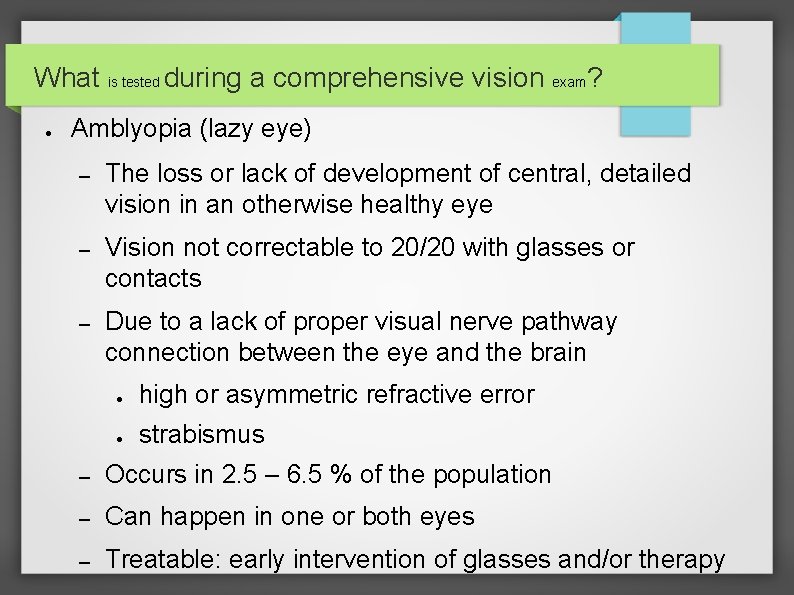
What is tested during a comprehensive vision exam? ● Amblyopia (lazy eye) – The loss or lack of development of central, detailed vision in an otherwise healthy eye – Vision not correctable to 20/20 with glasses or contacts – Due to a lack of proper visual nerve pathway connection between the eye and the brain ● high or asymmetric refractive error ● strabismus – Occurs in 2. 5 – 6. 5 % of the population – Can happen in one or both eyes – Treatable: early intervention of glasses and/or therapy
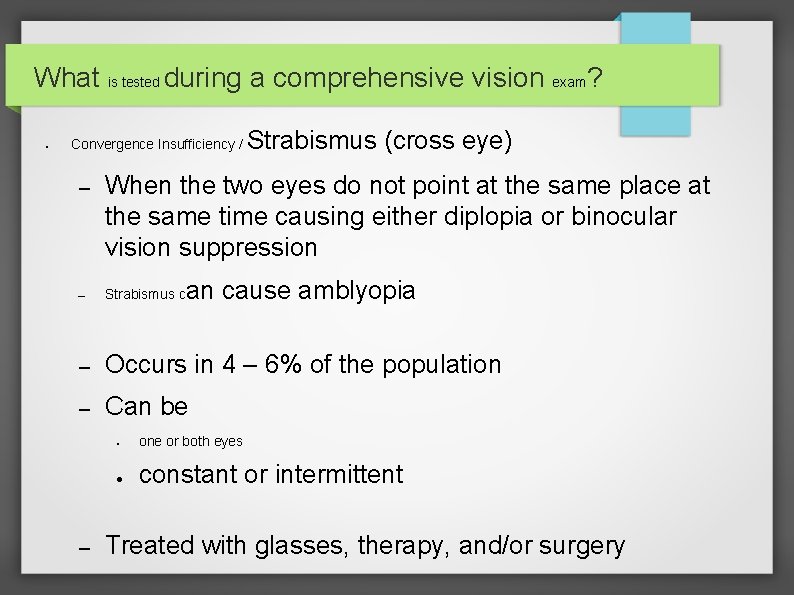
What is tested during a comprehensive vision exam? ● Convergence Insufficiency / Strabismus (cross eye) – When the two eyes do not point at the same place at the same time causing either diplopia or binocular vision suppression – Strabismus c – Occurs in 4 – 6% of the population – Can be – an cause amblyopia ● one or both eyes ● constant or intermittent Treated with glasses, therapy, and/or surgery
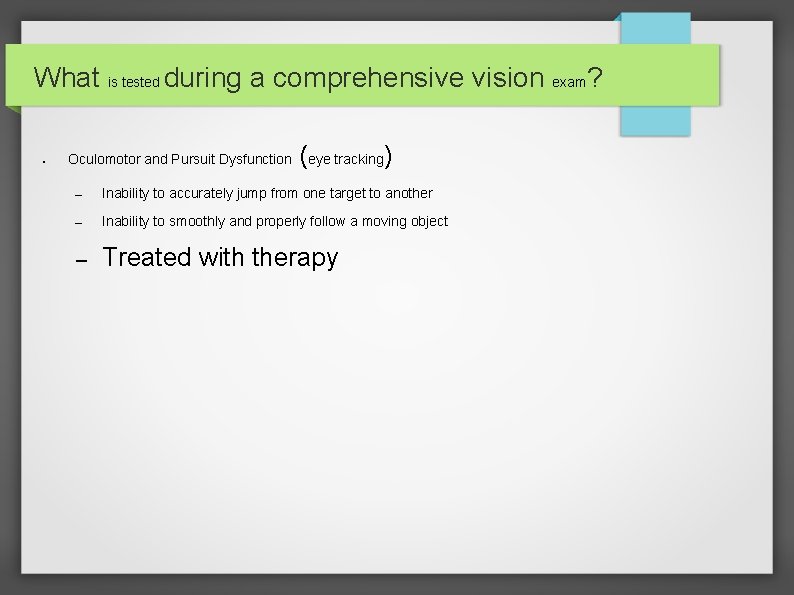
What is tested during a comprehensive vision exam? ● Oculomotor and Pursuit Dysfunction (eye tracking) – Inability to accurately jump from one target to another – Inability to smoothly and properly follow a moving object – Treated with therapy
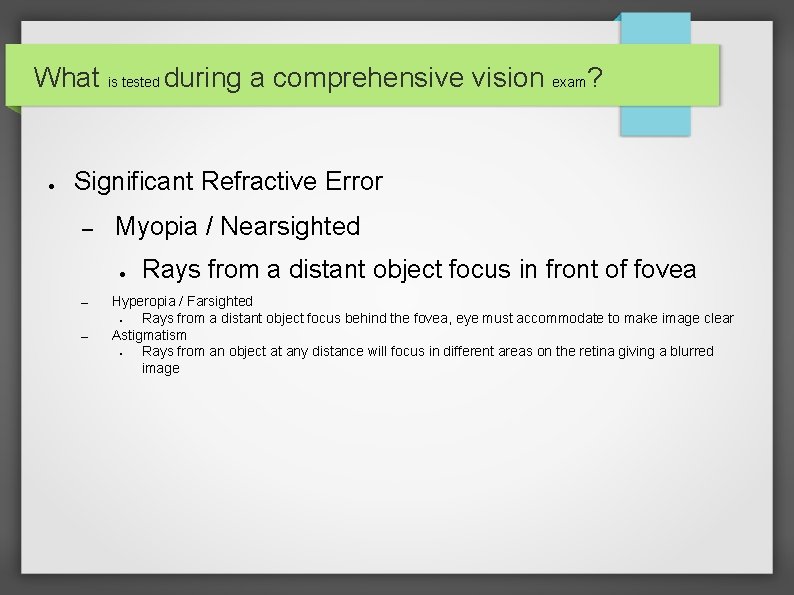
What is tested during a comprehensive vision exam? ● Significant Refractive Error – Myopia / Nearsighted ● – – Rays from a distant object focus in front of fovea Hyperopia / Farsighted ● Rays from a distant object focus behind the fovea, eye must accommodate to make image clear Astigmatism ● Rays from an object at any distance will focus in different areas on the retina giving a blurred image
What is tested during a comprehensive vision exam? ● Significant Refractive Error – Accommodative Insufficiency and In-facility ● ● Inability of the eyes focusing / accommodative system to properly focus images falling behind the fovea Inability to sustain the focus of the eye or inability to quickly and accurately change focus on objects at different distances
What is tested during a comprehensive vision exam? ● Ocular Disease (less than 2% in pedes) – Eyelid or eyeball infections – Entropion / Ectropion – Ptosis – Nasolacrimal Duct Obstruction – Nystagmus – Cataract – Glaucoma – Color Vision Deficiency – Retinopathy of prematurity – Retinoblastoma
What is tested during a comprehensive vision exam? ● If the above mentioned problems are not caught early, they can impede development ● A comprehensive eye and vision evaluation tests for all of these problems – The sooner the problem is caught, the easier and more successful the treatment will be
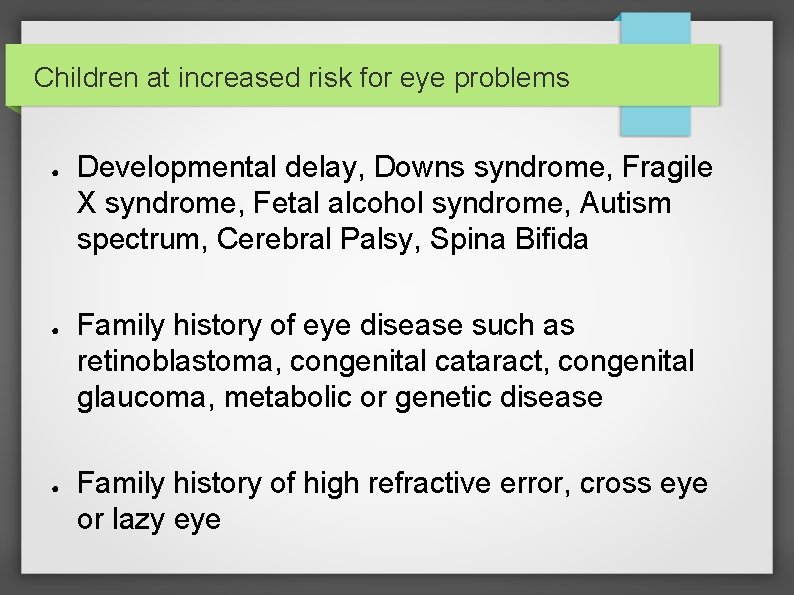
Children at increased risk for eye problems ● ● Difficult or assisted labor, associated with fetal distress or low APGAR scores Premature birth, low birth weight, or oxygen use following birth ● Drug or alcohol use during pregnancy ● Sexually transmitted disease, CMV, HIV
Children at increased risk for eye problems ● ● ● Developmental delay, Downs syndrome, Fragile X syndrome, Fetal alcohol syndrome, Autism spectrum, Cerebral Palsy, Spina Bifida Family history of eye disease such as retinoblastoma, congenital cataract, congenital glaucoma, metabolic or genetic disease Family history of high refractive error, cross eye or lazy eye
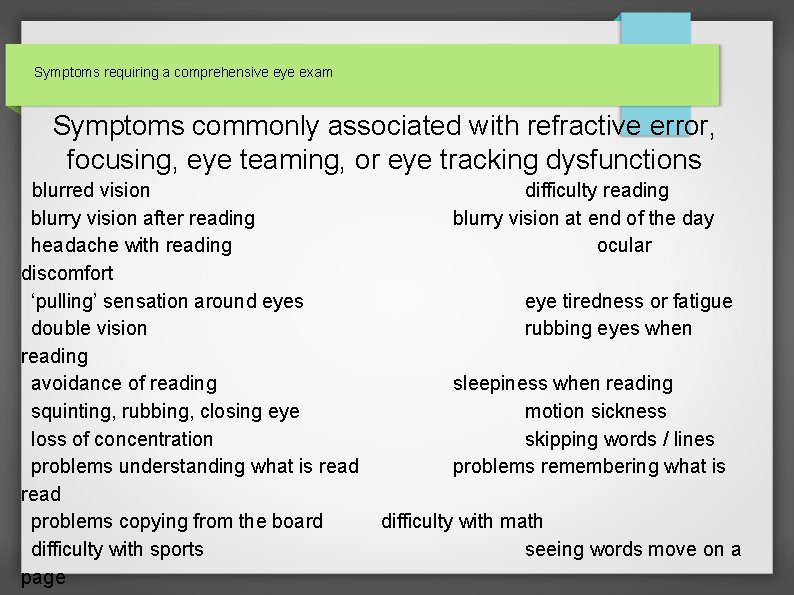
Symptoms requiring a comprehensive eye exam Symptoms commonly associated with refractive error, focusing, eye teaming, or eye tracking dysfunctions blurred vision difficulty reading blurry vision after reading blurry vision at end of the day headache with reading ocular discomfort ‘pulling’ sensation around eyes eye tiredness or fatigue double vision rubbing eyes when reading avoidance of reading sleepiness when reading squinting, rubbing, closing eye motion sickness loss of concentration skipping words / lines problems understanding what is read problems remembering what is read problems copying from the board difficulty with math difficulty with sports seeing words move on a page
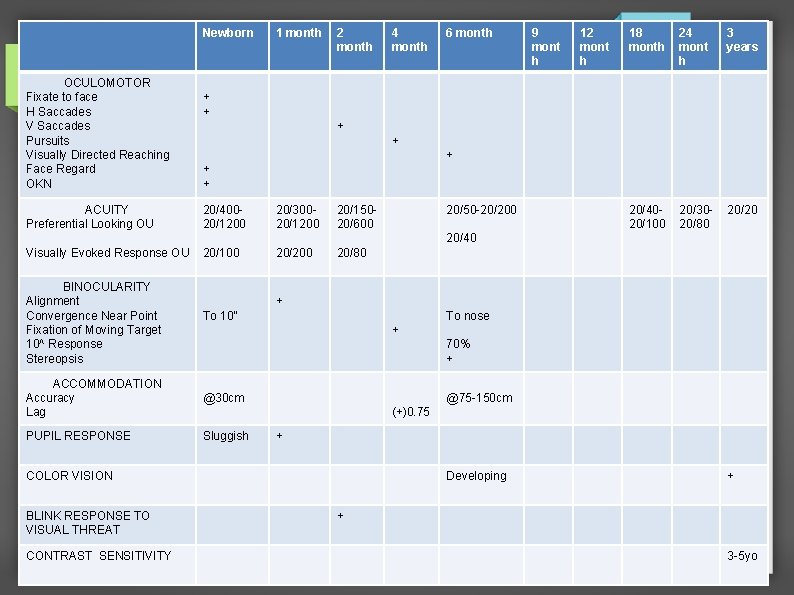
Newborn 1 month 2 month 4 month 6 month Normal Visual Development OCULOMOTOR 9 mont h 12 mont h 18 month 24 mont h 3 years 20/4020/100 20/3020/80 20/20 Fixate to face + H Saccades + V Saccades + By 6 months of age, many portions of visual function are on their way to being fully developed Pursuits + Visually Directed Reaching + Face Regard + OKN + ACUITY Preferential Looking OU 20/40020/1200 20/30020/1200 20/15020/600 20/50 -20/200 20/40 Visually Evoked Response OU 20/100 BINOCULARITY Alignment Convergence Near Point Fixation of Moving Target 10^ Response Stereopsis 20/200 20/80 + To 10” To nose + 70% + ACCOMMODATION Accuracy Lag @30 cm PUPIL RESPONSE Sluggish @75 -150 cm (+)0. 75 + COLOR VISION BLINK RESPONSE TO VISUAL THREAT CONTRAST SENSITIVITY Developing + + 3 -5 yo
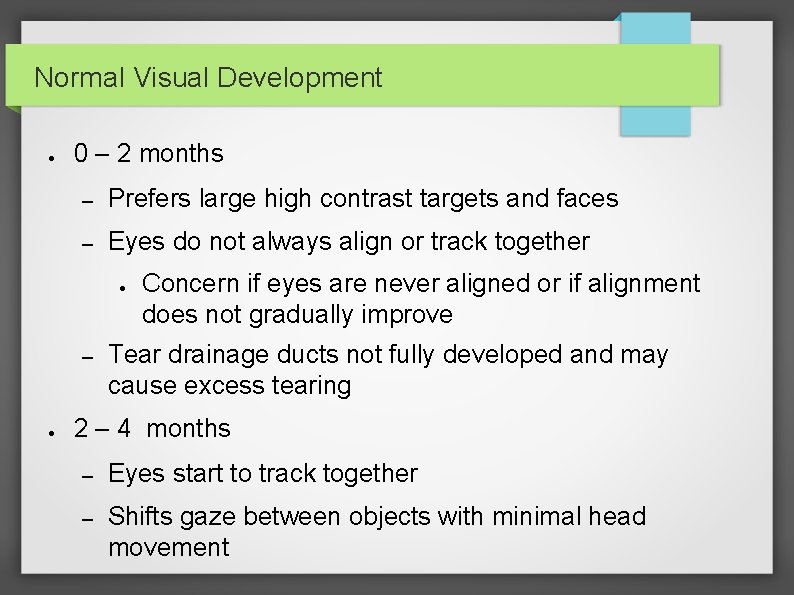
Normal Visual Development ● 0 – 2 months – Prefers large high contrast targets and faces – Eyes do not always align or track together ● – ● Concern if eyes are never aligned or if alignment does not gradually improve Tear drainage ducts not fully developed and may cause excess tearing 2 – 4 months – Eyes start to track together – Shifts gaze between objects with minimal head movement
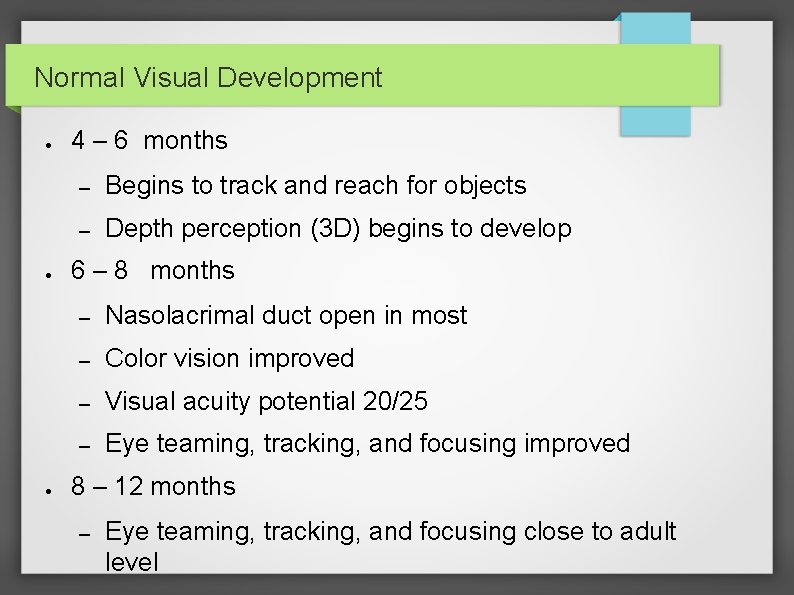
Normal Visual Development ● ● ● 4 – 6 months – Begins to track and reach for objects – Depth perception (3 D) begins to develop 6 – 8 months – Nasolacrimal duct open in most – Color vision improved – Visual acuity potential 20/25 – Eye teaming, tracking, and focusing improved 8 – 12 months – Eye teaming, tracking, and focusing close to adult level
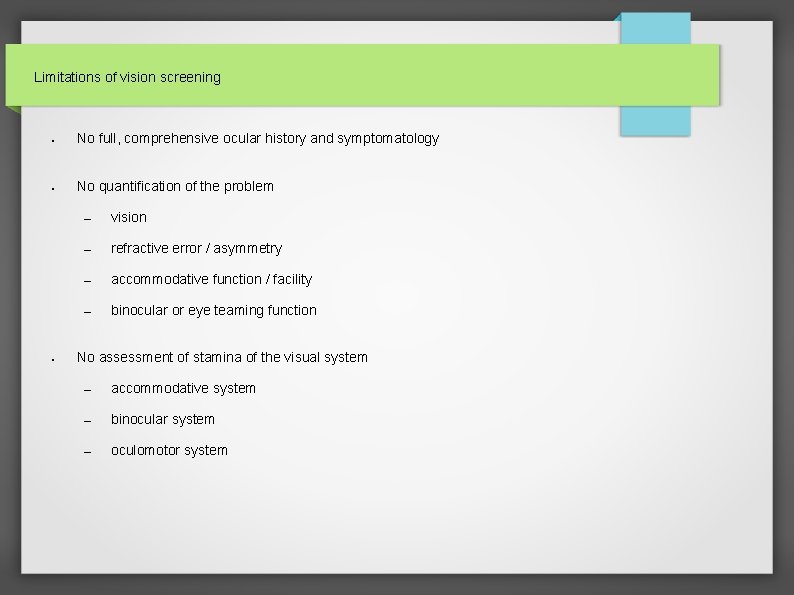
Limitations of vision screening ● No full, comprehensive ocular history and symptomatology ● No quantification of the problem ● – vision – refractive error / asymmetry – accommodative function / facility – binocular or eye teaming function No assessment of stamina of the visual system – accommodative system – binocular system – oculomotor system
Comprehensive Eye Exam vs. Screening
Comprehensive Eye Exam vs. Screening
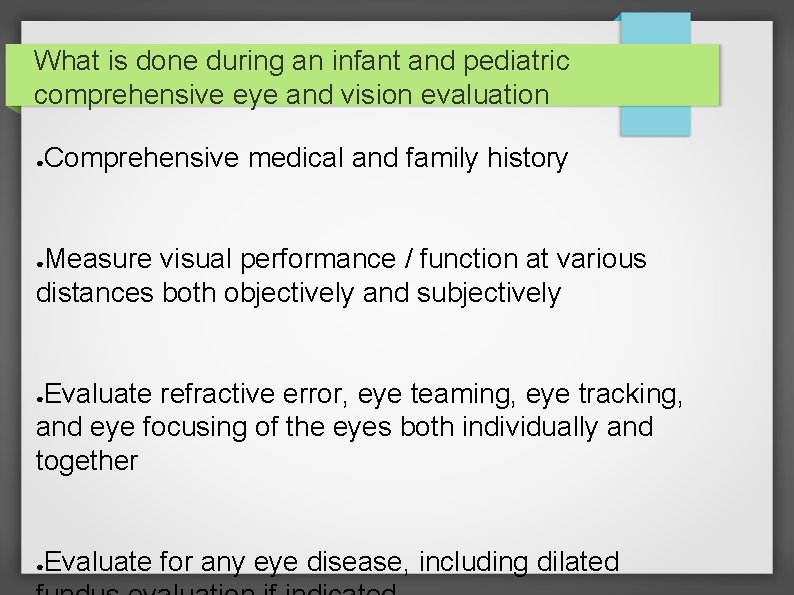
What is done during an infant and pediatric comprehensive eye and vision evaluation Comprehensive medical and family history ● Measure visual performance / function at various distances both objectively and subjectively ● Evaluate refractive error, eye teaming, eye tracking, and eye focusing of the eyes both individually and together ● Evaluate for any eye disease, including dilated ●
What is done during an infant and pediatric comprehensive eye and vision evaluation
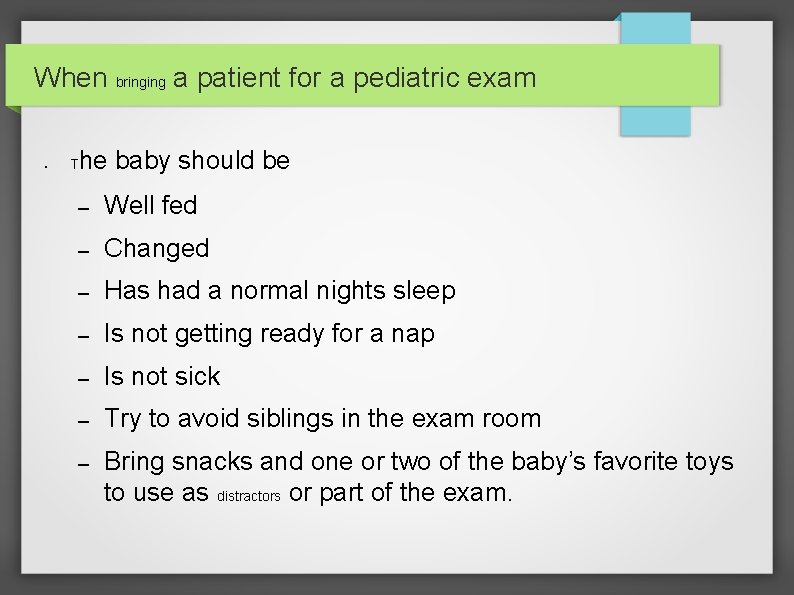
When bringing a patient for a pediatric exam ● T he baby should be – Well fed – Changed – Has had a normal nights sleep – Is not getting ready for a nap – Is not sick – Try to avoid siblings in the exam room – Bring snacks and one or two of the baby’s favorite toys to use as distractors or part of the exam.
For more information or to find a pediatric optometric physician near you visit eyecare. org or njsop. org