
Tallinn University of Technology ESTONIAN OIL SHALE ASH
- Slides: 12
Tallinn University of Technology ESTONIAN OIL SHALE ASH AS RAW MATERIAL FOR MANUFACTURING GLASS CERAMICS Rein KUUSIK Laboratory of Inorganic Materials, Tallinn University of Technology, Tallinn, Estonia Mauro MARAGNONI, Enrico BERNARDO Dipartimento di Ingegneria Industriale, Universita` degli Studi di Padova, Italy rein. kuusik@ttu. ee, mauro. maragnoni@unipd. it, enrico. bernardo@unipd. it
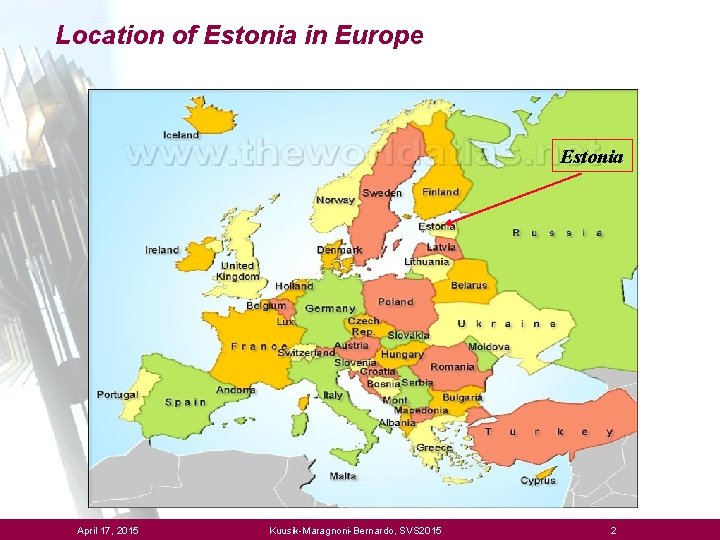
Location of Estonia in Europe Estonia April 17, 2015 Kuusik-Maragnoni-Bernardo, SVS 2015 2
Main Estonian natural resources are phosphorite and oil shale April 17, 2015 Kuusik-Maragnoni-Bernardo, SVS 2015 3
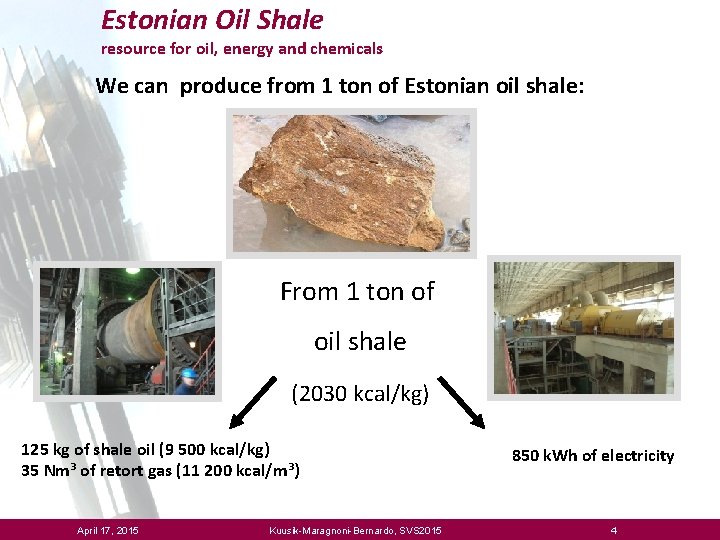
Estonian Oil Shale resource for oil, energy and chemicals We can produce from 1 ton of Estonian oil shale: From 1 ton of oil shale (2030 kcal/kg) 125 kg of shale oil (9 500 kcal/kg) 35 Nm³ of retort gas (11 200 kcal/m³) April 17, 2015 Kuusik-Maragnoni-Bernardo, SVS 2015 850 k. Wh of electricity 4
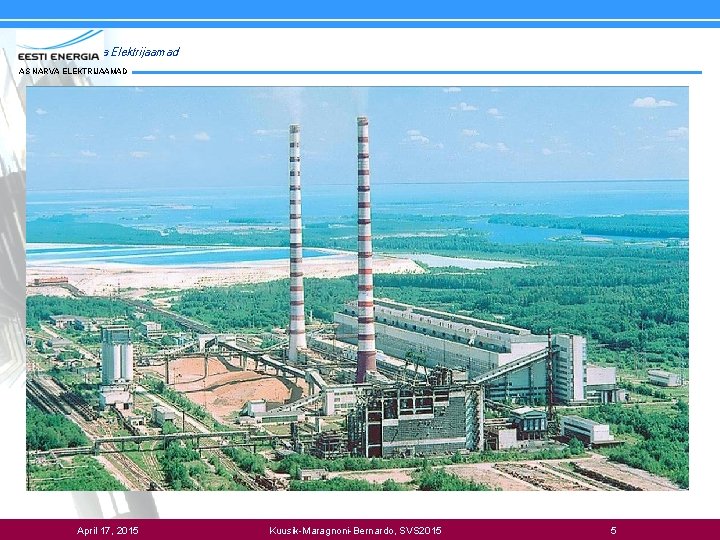
AS Narva Elektrijaamad AS NARVA ELEKTRIJAAMAD April 17, 2015 Kuusik-Maragnoni-Bernardo, SVS 2015 5
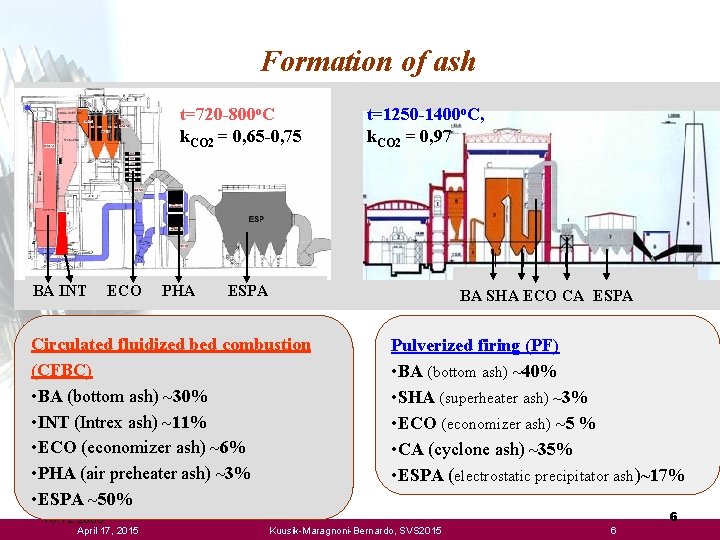
Formation of ash t=720 -800 o. C k. CO 2 = 0, 65 -0, 75 BA INT ECO PHA ESPA BA SHA ECO CA ESPA Circulated fluidized bed combustion (CFBC) • BA (bottom ash) ~30% • INT (Intrex ash) ~11% • ECO (economizer ash) ~6% • PHA (air preheater ash) ~3% • ESPA ~50% 16. 12. 2008 April 17, 2015 t=1250 -1400 o. C, k. CO 2 = 0, 97 Pulverized firing (PF) • BA (bottom ash) ~40% • SHA (superheater ash) ~3% • ECO (economizer ash) ~5 % • CA (cyclone ash) ~35% • ESPA (electrostatic precipitator ash)~17% Kuusik-Maragnoni-Bernardo, SVS 2015 6 6
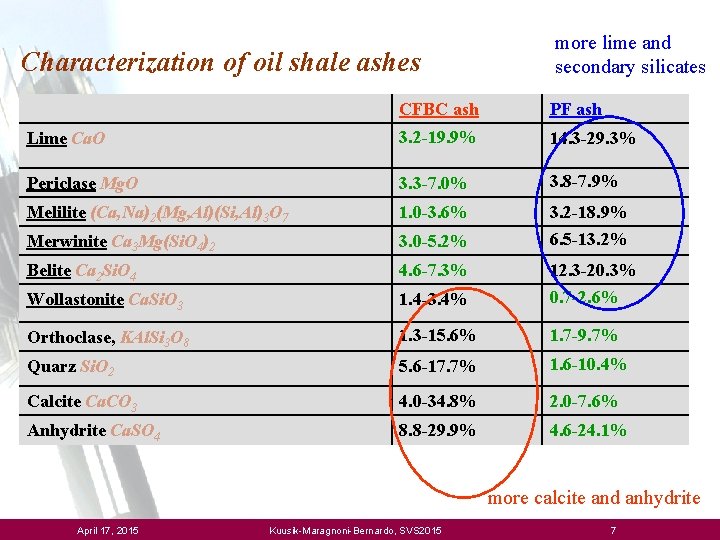
Characterization of oil shale ashes more lime and secondary silicates CFBC ash PF ash Lime Ca. O 3. 2 -19. 9% 14. 3 -29. 3% Periclase Mg. O 3. 3 -7. 0% 3. 8 -7. 9% Melilite (Ca, Na)2(Mg, Al)(Si, Al)3 O 7 1. 0 -3. 6% 3. 2 -18. 9% Merwinite Ca 3 Mg(Si. O 4)2 3. 0 -5. 2% 6. 5 -13. 2% Belite Ca 2 Si. O 4 4. 6 -7. 3% 12. 3 -20. 3% Wollastonite Ca. Si. O 3 1. 4 -3. 4% 0. 7 -2. 6% Orthoclase, KAl. Si 3 O 8 1. 3 -15. 6% 1. 7 -9. 7% Quarz Si. O 2 5. 6 -17. 7% 1. 6 -10. 4% Calcite Ca. CO 3 4. 0 -34. 8% 2. 0 -7. 6% Anhydrite Ca. SO 4 8. 8 -29. 9% 4. 6 -24. 1% more calcite and anhydrite April 17, 2015 Kuusik-Maragnoni-Bernardo, SVS 2015 7
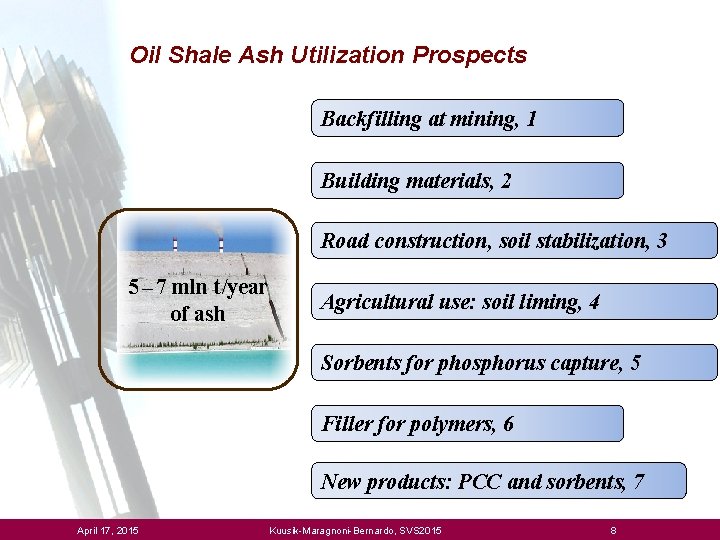
Oil Shale Ash Utilization Prospects Backfilling at mining, 1 Building materials, 2 Road construction, soil stabilization, 3 5 – 7 mln t/year of ash Agricultural use: soil liming, 4 Sorbents for phosphorus capture, 5 Filler for polymers, 6 New products: PCC and sorbents, 7 April 17, 2015 Kuusik-Maragnoni-Bernardo, SVS 2015 8
The present work aims at evidencing the feasibility of a sintering approach for the production of strong and chemically stable glass-ceramics, based on glass frits. The impact of binders (of organic or inorganic nature), used to favour the shaping of fine powders, and recycled glass powders, considered in order to improve the chemical stability of the sintered bodies, has been also discussed. April 17, 2015 Kuusik-Maragnoni-Bernardo, SVS 2015 9
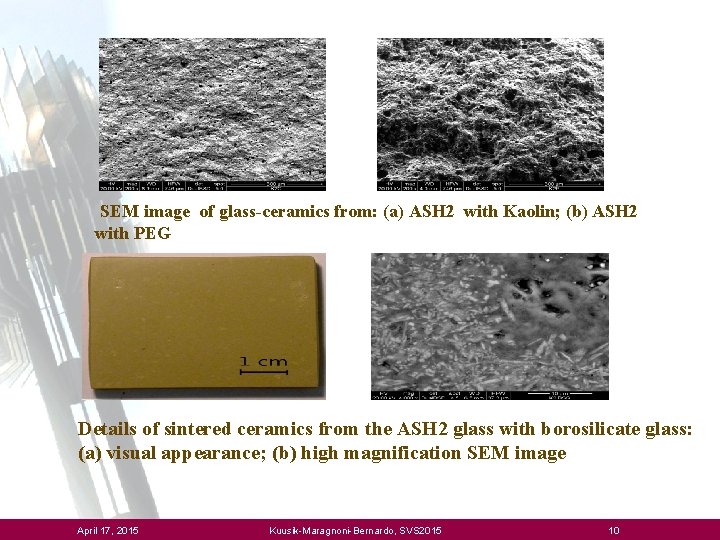
SEM image of glass-ceramics from: (a) ASH 2 with Kaolin; (b) ASH 2 with PEG Details of sintered ceramics from the ASH 2 glass with borosilicate glass: (a) visual appearance; (b) high magnification SEM image April 17, 2015 Kuusik-Maragnoni-Bernardo, SVS 2015 10
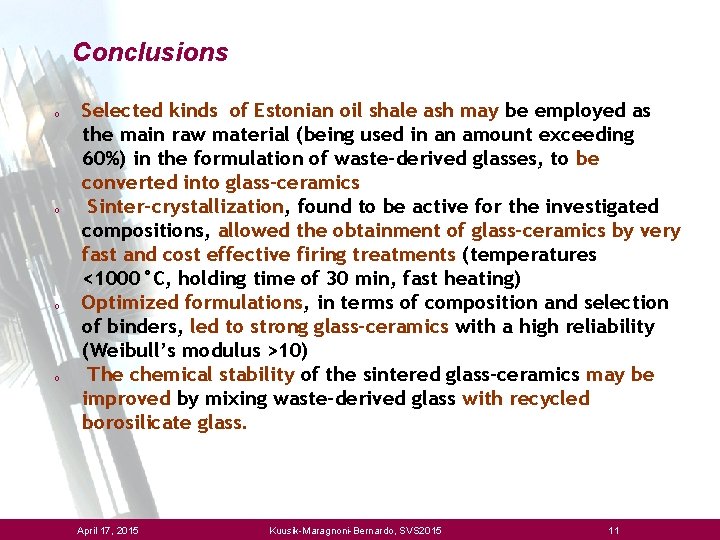
Conclusions o o Selected kinds of Estonian oil shale ash may be employed as the main raw material (being used in an amount exceeding 60%) in the formulation of waste-derived glasses, to be converted into glass-ceramics Sinter-crystallization, found to be active for the investigated compositions, allowed the obtainment of glass-ceramics by very fast and cost effective firing treatments (temperatures <1000°C, holding time of 30 min, fast heating) Optimized formulations, in terms of composition and selection of binders, led to strong glass-ceramics with a high reliability (Weibull’s modulus >10) The chemical stability of the sintered glass-ceramics may be improved by mixing waste-derived glass with recycled borosilicate glass. April 17, 2015 Kuusik-Maragnoni-Bernardo, SVS 2015 11
Thank You! 12 April 17, 2015 Kuusik-Maragnoni-Bernardo, SVS 2015 12