
TALLINN UNIVERSITY MAARIKA NIMMO 2013 Tallinn University Established
TALLINN UNIVERSITY MAARIKA NIMMO 2013
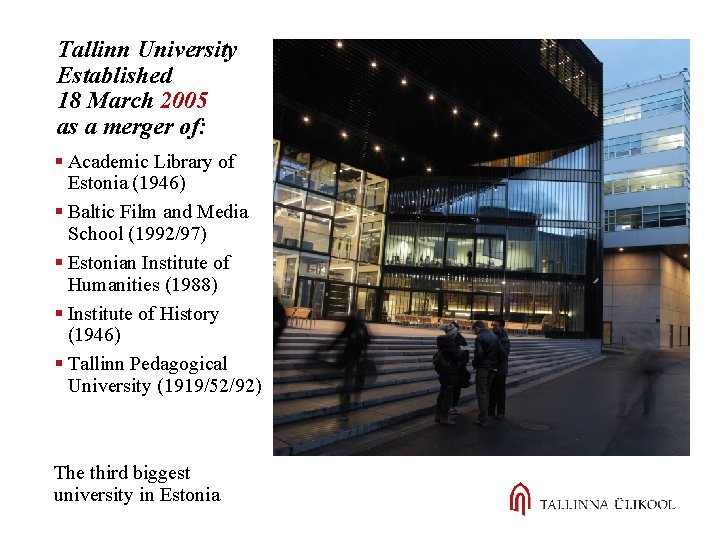
Tallinn University Established 18 March 2005 as a merger of: § Academic Library of Estonia (1946) § Baltic Film and Media School (1992/97) § Estonian Institute of Humanities (1988) § Institute of History (1946) § Tallinn Pedagogical University (1919/52/92) The third biggest university in Estonia
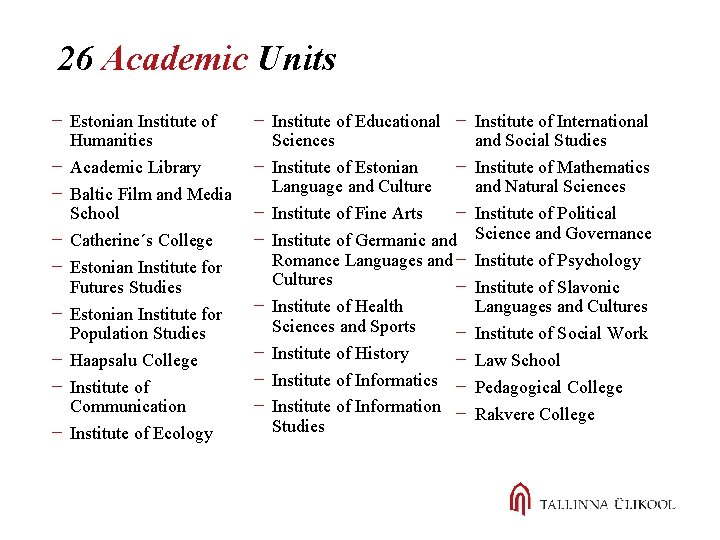
26 Academic Units Estonian Institute of Humanities Academic Library Baltic Film and Media School Catherine´s College Estonian Institute for Futures Studies Estonian Institute for Population Studies Haapsalu College Institute of Communication Institute of Ecology Institute of Educational Sciences Institute of Estonian Language and Culture Institute of Fine Arts Institute of Germanic and Romance Languages and Cultures Institute of Health Sciences and Sports Institute of History Institute of Informatics Institute of Information Studies Institute of International and Social Studies Institute of Mathematics and Natural Sciences Institute of Political Science and Governance Institute of Psychology Institute of Slavonic Languages and Cultures Institute of Social Work Law School Pedagogical College Rakvere College
Main Fields of Research Humanities Social Sciences Natural and Exact Sciences Educational Sciences Health Sciences Law Arts
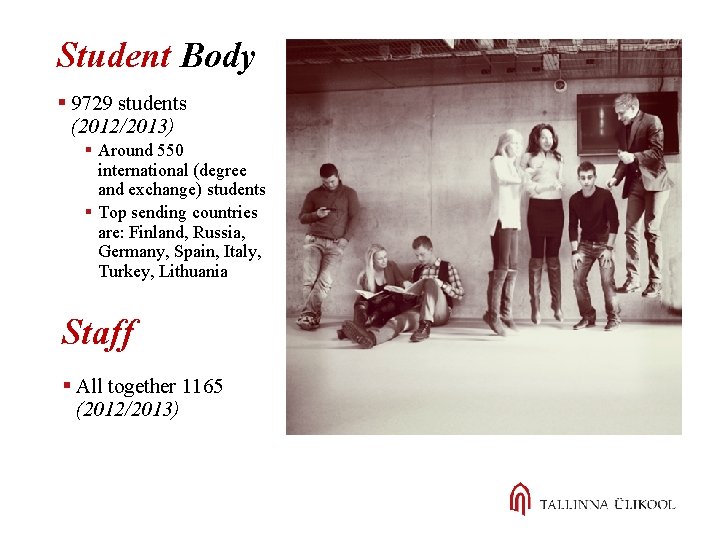
Student Body § 9729 students (2012/2013) § Around 550 international (degree and exchange) students § Top sending countries are: Finland, Russia, Germany, Spain, Italy, Turkey, Lithuania Staff § All together 1165 (2012/2013)
International Activities § 51 cooperation agreements with universities from 28 countries § 600 Erasmus agreements § Participation in Erasmus Mundus projects: ALRAKIS, ALRAKIS 2, BACKIS, HERMES, HUMERIA § Participation in many international networks: EUA, EUACDE, UNICA, BUP, EURAXESS, IAU, EADTU
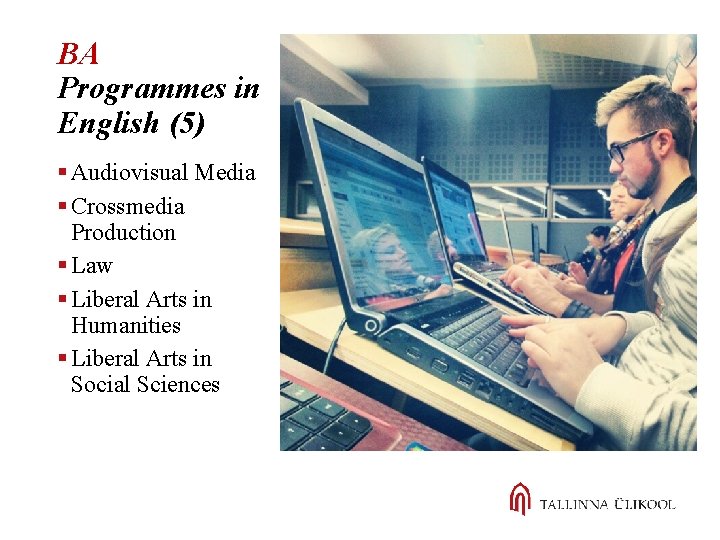
BA Programmes in English (5) § Audiovisual Media § Crossmedia Production § Law § Liberal Arts in Humanities § Liberal Arts in Social Sciences
MA Programmes in English (12) § Anthropology § Audiovisual Media: Documentary Film § Communication Management § Comparative Literature and Cultural Semiotics § Crossmedia Production § Digital Library Learning § Economics and Management of Public Sector § European Studies § Film Arts (next admission 2015) § Human-Computer Interaction § International Business Law § International Relations
Ph. D Programmes (14) § Educational Sciences § Social Work § History § Studies of Cultures § Linguistics § Analytical Biochemistry § Ecology § Information Society Technologies § Physics § Demography § Government and Politics § Information and Communication Science § Psychology § Sociology
Facts and Figures 2012/2013 334 new International Exchange Students (Spain, Italy, Germany, Turkey) 110 new International Degree Students (Finland, Russia, Latvia) 2013/2014 176 new International Exchange Students in the Autumn semester 168 new International Degree Students (Finland, Russia, Turkey)
Approach to internationalisation § Decentralized approach – no International Office § Internationalisation is part of the everyday work of every Institute and Office § Academic Affairs Office works with international students; § Communication and Marketing Office works with international communication and marketing; § Personnel Office works with international staff; § Each Academic Institute works with their international contacts;
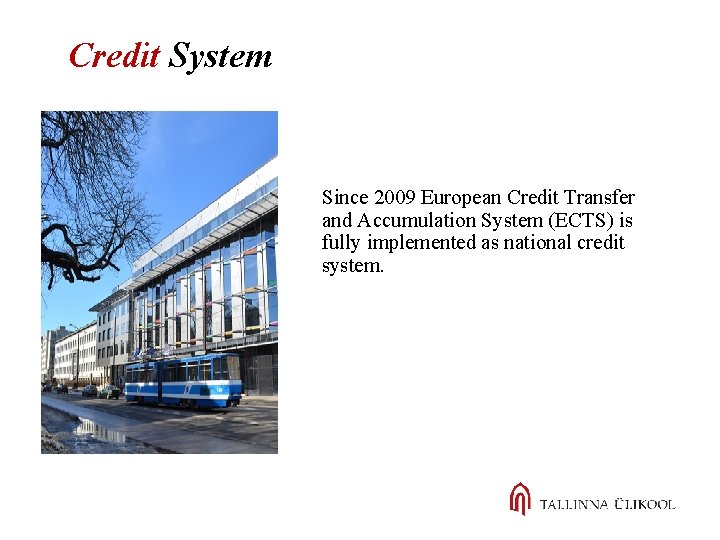
Credit System Since 2009 European Credit Transfer and Accumulation System (ECTS) is fully implemented as national credit system.
Higher Education System The Estonian higher education system consists of three main cycles: The first cycle qualification is Bachelor’s Degree. The nominal length of studies is 3 years and the workload is 180 ECTS. First cycle qualification is also Diploma of professional higher education. It corresponds to a Bachelor’s Degree awarded by universities. The nominal length of studies is 3 to 4. 5 years (180 -270 ECTS credits) The second cycle degree in the Estonian higher education system is Master’s Degree. The nominal length of studies is 1 to 2 years (60120 ECTS) Doctoral programmes represent the third cycle of higher education. The nominal length of doctoral studies is 3 to 4 years (180 -240 ECTS). Long one-cycle programmes are called integrated study programmes with a nominal duration of 5 or 6 years. The two-tier structure applies to most disciplines, with the exception of medicine, pharmacy, dentistry, veterinary medicine, architecture and civil engineering.
Thank you!
- Slides: 14