
Talking to Nonnative Speakers Jessi Jacobsen Investigating languagespecific
Talking to Nonnative Speakers: Jessi Jacobsen Investigating language-specific audience design and cognate use Jessi Jacobsen 05. 06. 17 04. 29. 17
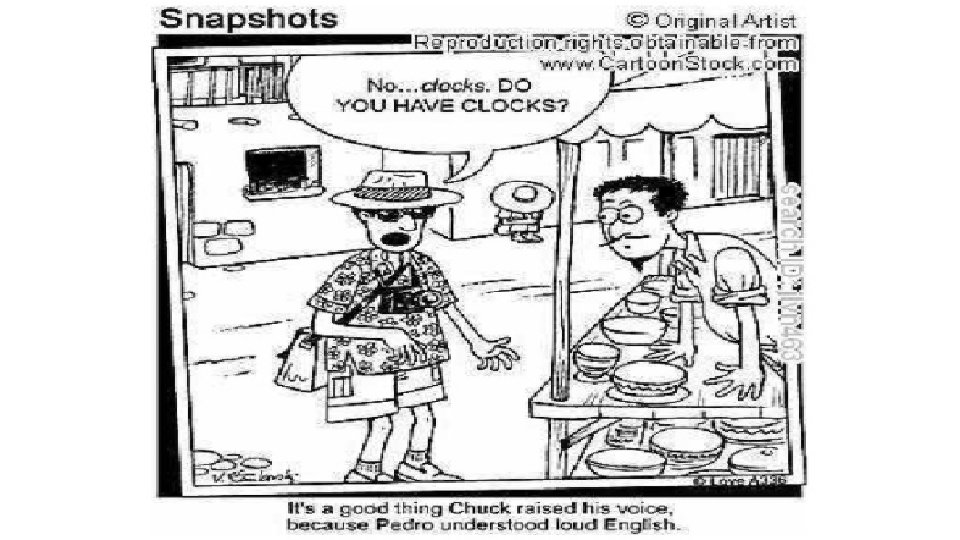
“Foreigner Talk” and Audience Design: • “Foreigner Talk”: • Louder • Slower pace of speech • More repetition
“Foreigner Talk” and Audience Design: • “Foreigner Talk”: • Louder • Slower pace of speech • More repetition • All language general—What about language-specific adaptations?
Cognates: • Psycholinguistic perspective: translation equivalents that share significant phonological/orthographic overlap between languages • Insectos-insects • Sofá-sofa • Prisión-prison • Restaurante-restaurant • Some of the easiest words to learn and remember in a new language (Lotto & de Groot, 1998)
Cognates as Audience Design? • Do native speakers (NS) use more cognates when talking to a nonnative speaker (NNS) than a fellow native speakers?
Experiment 1: Method • Participants: 32 native Spanish speakers (English = nonnative language) • Playing game of telephone • 30 concepts that could be referred to by either a cognate (C; e. g. , insectos) or a non-cognate (NC; e. g. , bichos ) • Incorporated into 4 -sentence story (2 Cs/2 NCs per
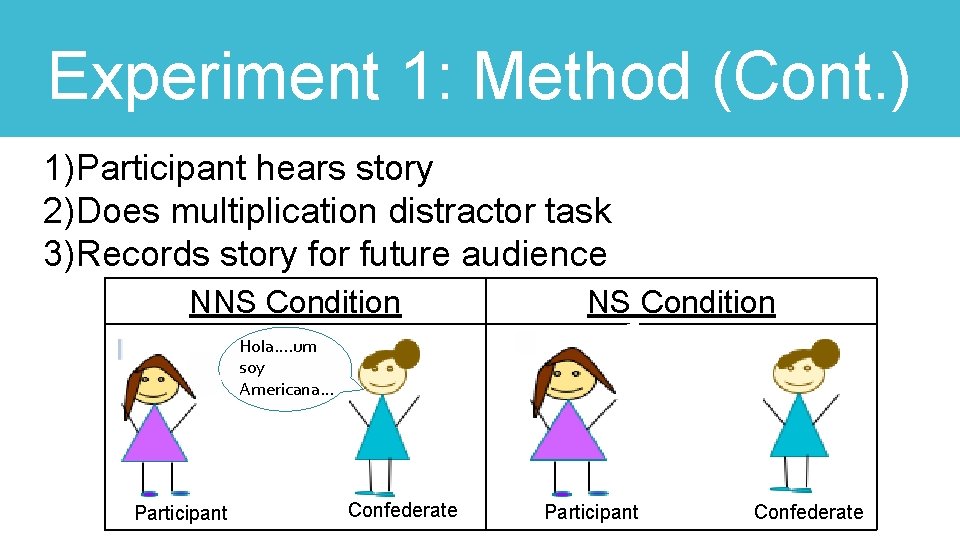
Experiment 1: Method (Cont. ) 1)Participant hears story 2)Does multiplication distractor task 3)Records story for future audience NNS Condition Hola…. um soy Americana. . . Participant Confederate
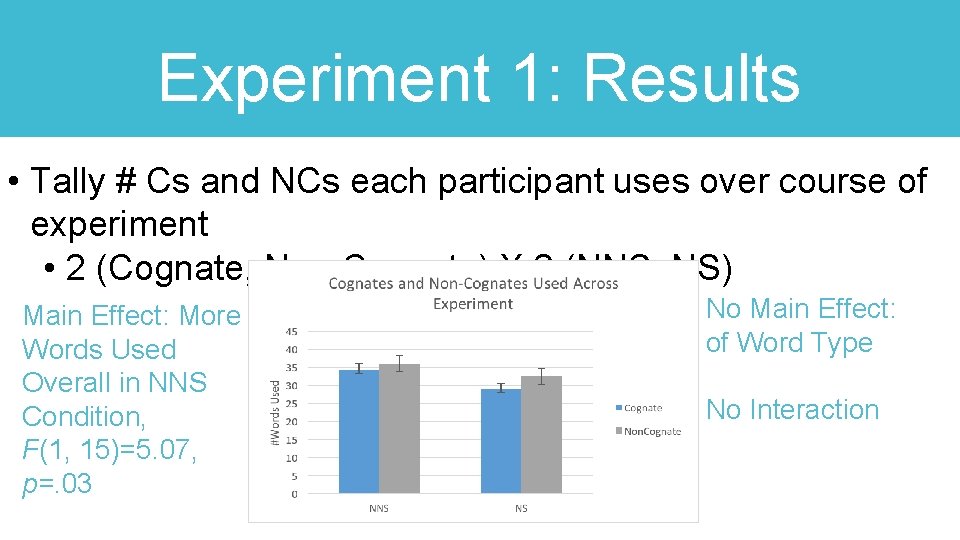
Experiment 1: Results • Tally # Cs and NCs each participant uses over course of experiment • 2 (Cognate, Non-Cognate) X 2 (NNS, NS) Main Effect: More Words Used Overall in NNS Condition, F(1, 15)=5. 07, p=. 03 No Main Effect: of Word Type No Interaction
Experiment 1: Discussions/Limitations • Suggesting that NS do not use more cognates with NNS than fellow NS
Experiment 1: Discussions/Limitations • Suggesting that NS do not use more cognates with NNS than fellow NS • But maybe this task is just weird?
Experiment 1: Discussions/Limitations • Suggesting that NS do not use more cognates with NNS than fellow NS • But maybe this task is just weird? • Forgetting about partner
Experiment 1: Discussions/Limitations • Suggesting that NS do not use more cognates with NNS than fellow NS • But maybe this task is just weird? • Forgetting about partner • Repetition does not require comprehension
Experiment 1: Discussions/Limitations • Suggesting that NS do not use more cognates with NNS than fellow NS • But maybe this task is just weird? • Forgetting about partner • Repetition does not require comprehension • Do the participants know which words are cognates?
Experiment 2: Method • 42 Native English Speakers (all fulfilled Carleton’s language requirement for Spanish) • Referential communication task with 26 items that could be referred to with either a C (e. g. , insects) or an NC (e. g. , bugs)

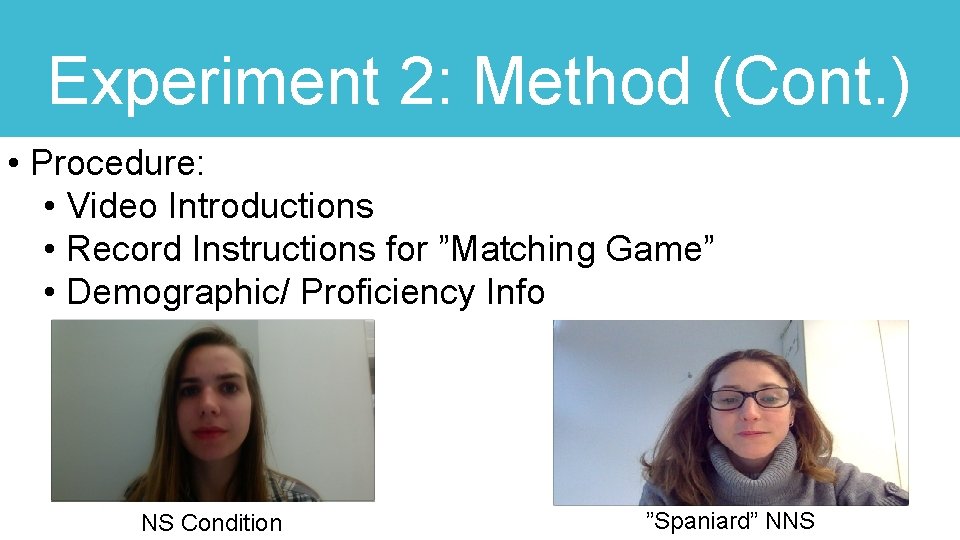
Experiment 2: Method (Cont. ) • Procedure: • Video Introductions • Record Instructions for ”Matching Game” • Demographic/ Proficiency Info NS Condition ”Spaniard” NNS
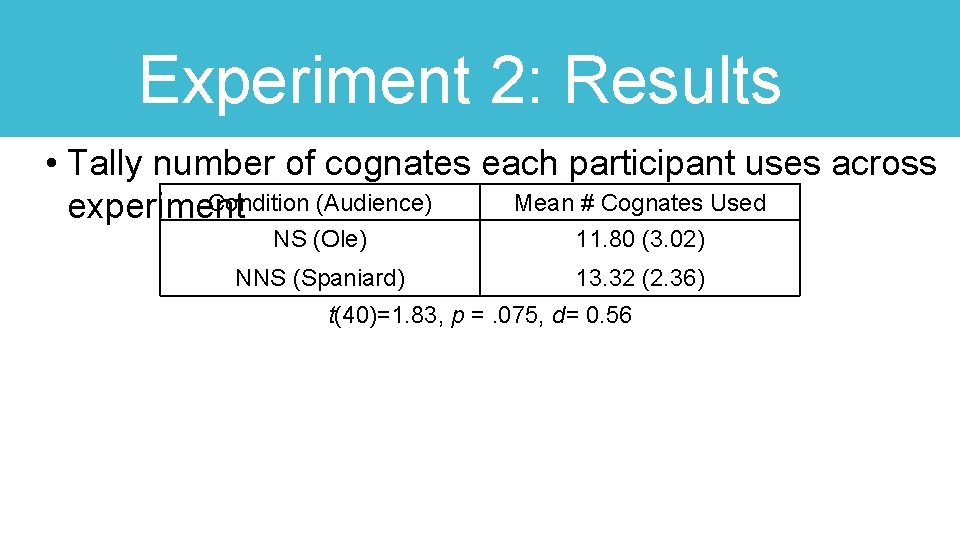
Experiment 2: Results • Tally number of cognates each participant uses across Condition (Audience) Mean # Cognates Used experiment NS (Ole) 11. 80 (3. 02) NNS (Spaniard) 13. 32 (2. 36) t(40)=1. 83, p =. 075, d= 0. 56
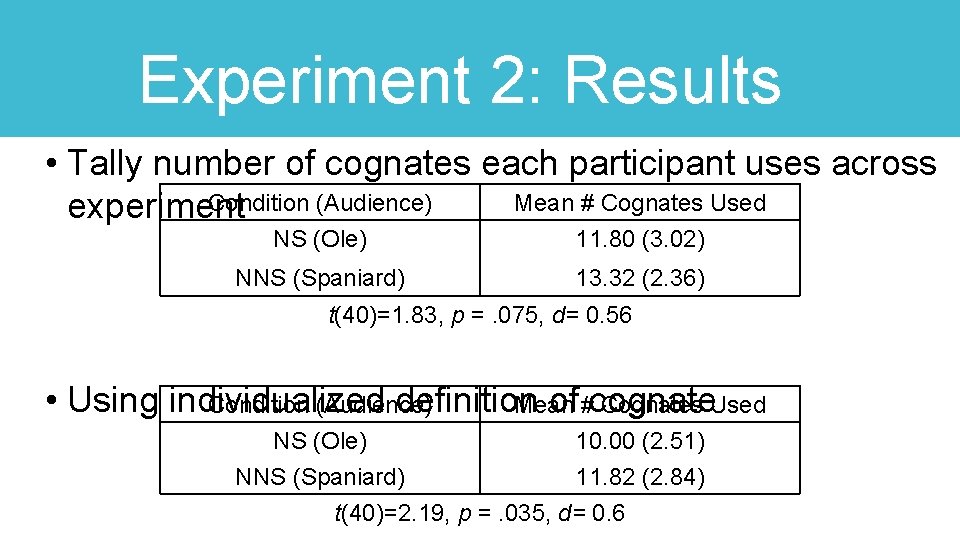
Experiment 2: Results • Tally number of cognates each participant uses across Condition (Audience) Mean # Cognates Used experiment NS (Ole) 11. 80 (3. 02) NNS (Spaniard) 13. 32 (2. 36) t(40)=1. 83, p =. 075, d= 0. 56 • Using individualized definition of #cognate Condition (Audience) Mean Cognates Used NS (Ole) NNS (Spaniard) 10. 00 (2. 51) 11. 82 (2. 84) t(40)=2. 19, p =. 035, d= 0. 6
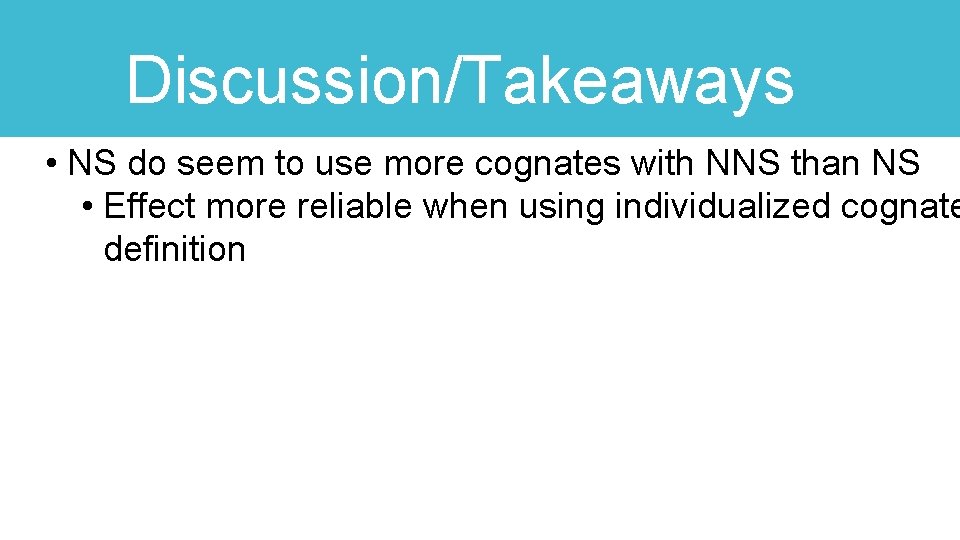
Discussion/Takeaways • NS do seem to use more cognates with NNS than NS • Effect more reliable when using individualized cognate definition
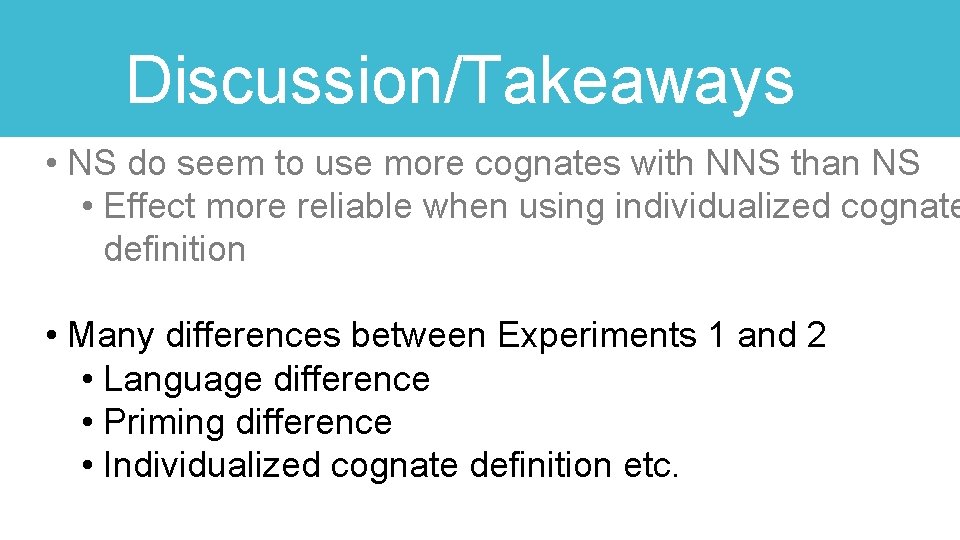
Discussion/Takeaways • NS do seem to use more cognates with NNS than NS • Effect more reliable when using individualized cognate definition • Many differences between Experiments 1 and 2 • Language difference • Priming difference • Individualized cognate definition etc.
Discussion/Takeaways • Future directions • Strategic v. automatic? • Comprehension studies • People can account for language-specific information wh engaging in foreigner talk!!
THANK YOU! • My amazing mentors at Carleton, especially my advisor Mija Van Der Wege, my 2 nd reader Cherlon Ussery, and Cog. Sci Chair Extraordinaire Kathie Galotti. • The wonderfully helpful staff and researchers at the BCBL, especially Jon Andoni Duñabeitia • All my awesome participants

Questions?
- Slides: 24