
Talking Points Student Led Discussion What should they
- Slides: 5
Talking Points / Student Led Discussion What should they look like?
Talking Points • Literally what it sounds like – points you want to make that the class can talk about. • What they can be: – Questions you still have – Questions you want to pose – Comments/thoughts you had while reading – etc.
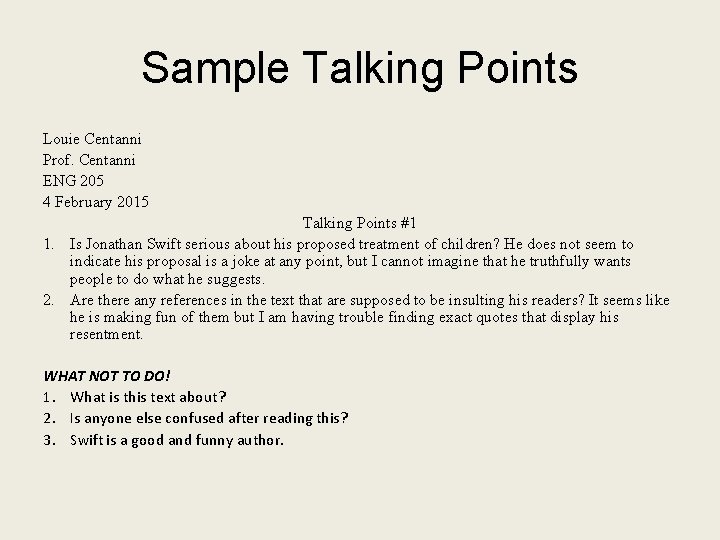
Sample Talking Points Louie Centanni Prof. Centanni ENG 205 4 February 2015 Talking Points #1 1. Is Jonathan Swift serious about his proposed treatment of children? He does not seem to indicate his proposal is a joke at any point, but I cannot imagine that he truthfully wants people to do what he suggests. 2. Are there any references in the text that are supposed to be insulting his readers? It seems like he is making fun of them but I am having trouble finding exact quotes that display his resentment. WHAT NOT TO DO! 1. What is this text about? 2. Is anyone else confused after reading this? 3. Swift is a good and funny author.
Student Led Discussion • At the class session before your SLD, I will collect Talking Points from all of your class members and check them off as “CREDIT” or “NO CREDIT” (i. e. , not doing them). By the end of class, I will hand the stack of papers to your group. They can help you to organize your “lesson. ”
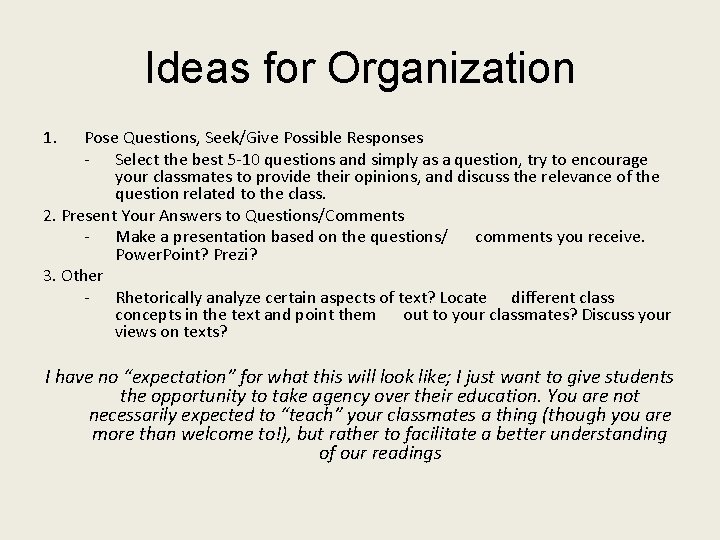
Ideas for Organization 1. Pose Questions, Seek/Give Possible Responses - Select the best 5 -10 questions and simply as a question, try to encourage your classmates to provide their opinions, and discuss the relevance of the question related to the class. 2. Present Your Answers to Questions/Comments - Make a presentation based on the questions/ comments you receive. Power. Point? Prezi? 3. Other - Rhetorically analyze certain aspects of text? Locate different class concepts in the text and point them out to your classmates? Discuss your views on texts? I have no “expectation” for what this will look like; I just want to give students the opportunity to take agency over their education. You are not necessarily expected to “teach” your classmates a thing (though you are more than welcome to!), but rather to facilitate a better understanding of our readings