
Talking Mental Health Chris OSullivan Things to Cover



- Slides: 26
Talking Mental Health Chris O’Sullivan
Things to Cover Today • Introduction to Mental Health • Noticing distress and reaching out appropriately to somebody who isn’t coping • Supporting disclosure and assisting with ongoing concerns, including reasonable adjustments and return to work • Working strategically to improve the nature of work to protect and promote mental wellbeing for all staff.
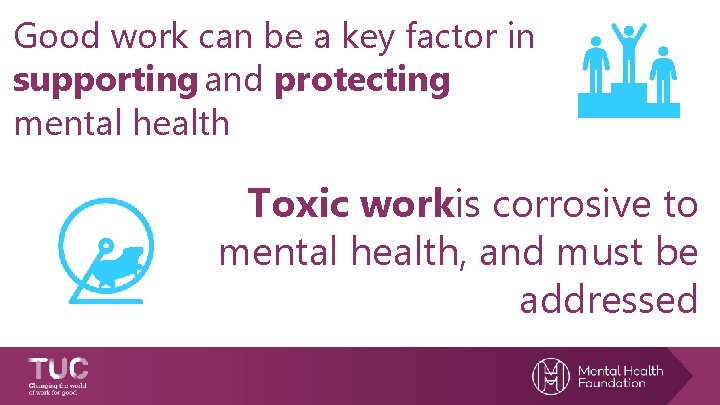
Good work can be a key factor in supporting and protecting mental health Toxic workis corrosive to mental health, and must be addressed
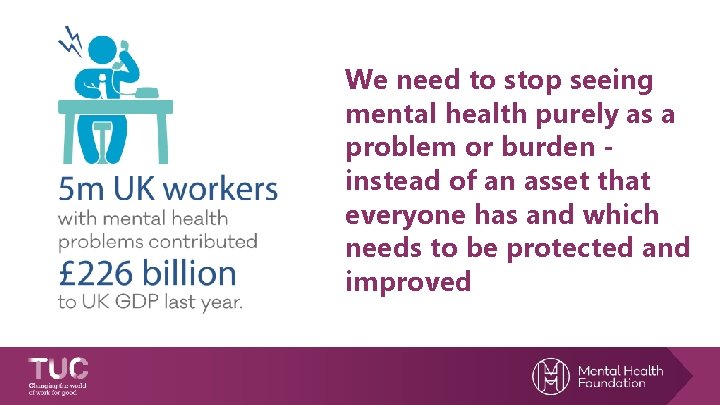
We need to stop seeing mental health purely as a problem or burden instead of an asset that everyone has and which needs to be protected and improved
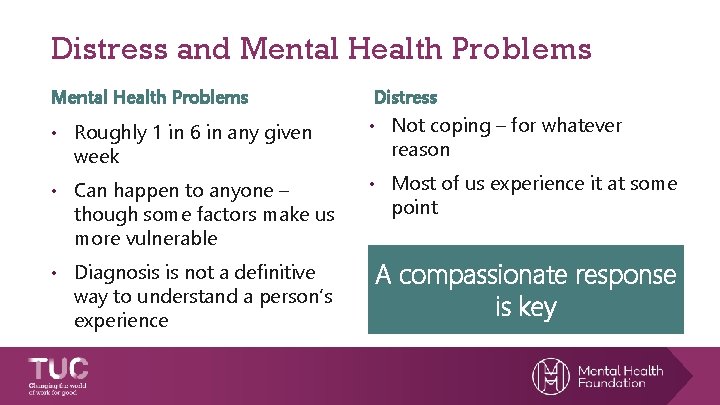
Distress and Mental Health Problems Distress • Roughly 1 in 6 in any given • Not coping – for whatever • Can happen to anyone – • Most of us experience it at some week though some factors make us more vulnerable • Diagnosis is not a definitive way to understand a person’s experience reason point A compassionate response is key
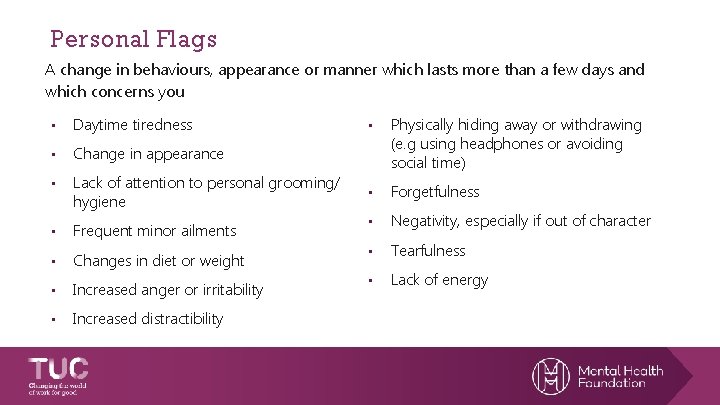
Personal Flags A change in behaviours, appearance or manner which lasts more than a few days and which concerns you • Daytime tiredness • Physically hiding away or withdrawing (e. g using headphones or avoiding social time) • Change in appearance • Lack of attention to personal grooming/ hygiene • Forgetfulness • Frequent minor ailments • Negativity, especially if out of character • Changes in diet or weight • Tearfulness • Increased anger or irritability • Lack of energy • Increased distractibility
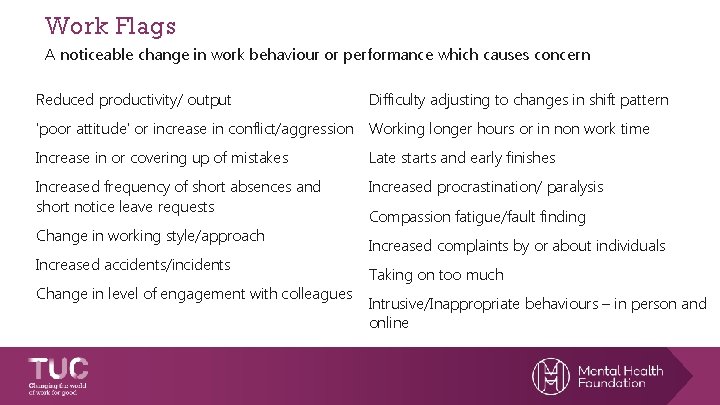
Work Flags A noticeable change in work behaviour or performance which causes concern Reduced productivity/ output Difficulty adjusting to changes in shift pattern 'poor attitude' or increase in conflict/aggression Working longer hours or in non work time Increase in or covering up of mistakes Late starts and early finishes Increased frequency of short absences and short notice leave requests Increased procrastination/ paralysis Change in working style/approach Increased accidents/incidents Change in level of engagement with colleagues Compassion fatigue/fault finding Increased complaints by or about individuals Taking on too much Intrusive/Inappropriate behaviours – in person and online
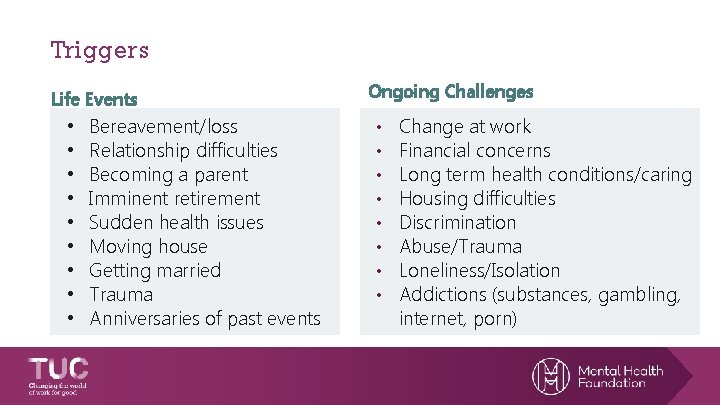
Triggers Life Events • • • Bereavement/loss Relationship difficulties Becoming a parent Imminent retirement Sudden health issues Moving house Getting married Trauma Anniversaries of past events Ongoing Challenges • • Change at work Financial concerns Long term health conditions/caring Housing difficulties Discrimination Abuse/Trauma Loneliness/Isolation Addictions (substances, gambling, internet, porn)
Reaching Out Place and Time Preparation Persistence
Having Difficult Conversations Presence Open questioning Non verbal communication Self-Management Follow-Up Confidentiality
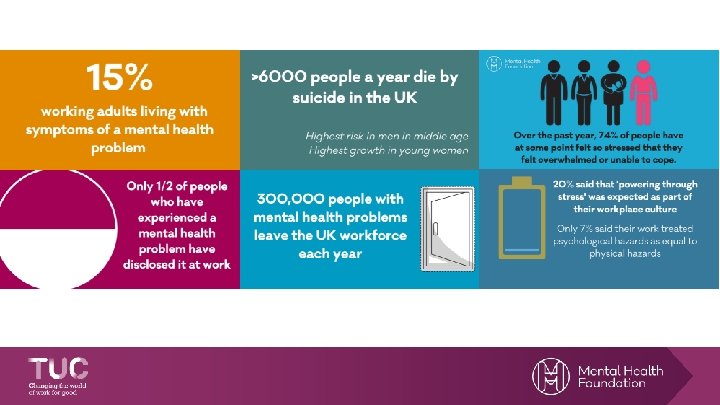
Talking About Suicide 32% of Brits that told us they have been stressed in the last year said that at some point they'd had suicidal thoughts because of that stress. One in 20 of us come to work whilst experiencing suicidal thoughts or feelings. Talking openly and directly about suicide can help prevent suicide – it will not make suicide more likely.
Crisis Signposting • They could contact the Samaritans straight away, for a listening ear they can call 116 123 for free. • You could also help them to call their doctor, or a trusted partner or friend. • If you are concerned for someone’s immediate safety, or they tell you that they plan to end their life imminently, you can call 999 and ask for the police, or take them to an A&E Department. • If you are worried that someone is a risk to themselves, or to others, or unwell to the point that they are losing touch with reality you have a duty of care in the workplace to see that they get help. It’s not enough to send somebody home alone.
Ongoing Supporting people to assert their rights Being present/advocating during dispute, disciplinary and competence processes Duty of Care
Duties and Responsibilities Duty of care to all staff through Health and Safety at Work Act (1974) • To recognise, measure and mitigate against occupational hazards, including psychological hazards To disabled employees, under the Equality Act (2010) • A person must have an impairment that has “a substantial, adverse, and long-term impact on their ability to carry out everyday tasks” • Employer duty provide reasonable adjustments to people with impairments meeting the definition of disability
Reasonable Adjustments An adjustment is intended to level the playing field by removing a barrier to the job arising due to disability (in this case their mental health problem) ‘Reasonable’ is defined by law – circumstances which are ‘unreasonable’ include disproportionate cost or the job being untenable if adapted. Examples: • Varying work patterns to enable a person to avoid rush hour, or get over medication sedation in the morning • Enabling home working or flexible working with appropriate IT equipment, subject to monitoring • Excusing someone from work related eating – like attending conference dinners • Not counting disability related leave towards triggers for review/reduction in pay
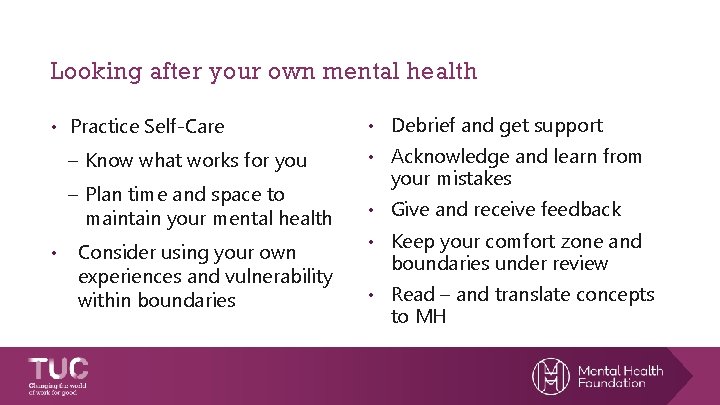
Looking after your own mental health • Practice Self-Care • • Debrief and get support - Know what works for you • Acknowledge and learn from - Plan time and space to maintain your mental health • Give and receive feedback Consider using your own experiences and vulnerability within boundaries your mistakes • Keep your comfort zone and boundaries under review • Read – and translate concepts to MH
Strategy and Prevention
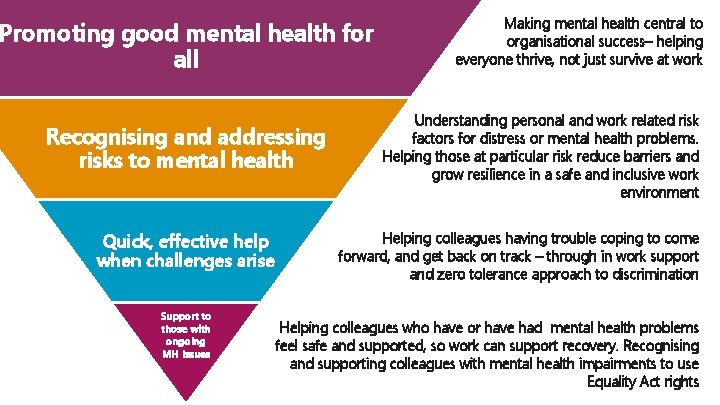
Promoting good mental health for all Recognising and addressing risks to mental health Quick, effective help when challenges arise Support to those with ongoing MH issues Making mental health central to organisational success– helping everyone thrive, not just survive at work Understanding personal and work related risk factors for distress or mental health problems. Helping those at particular risk reduce barriers and grow resilience in a safe and inclusive work environment Helping colleagues having trouble coping to come forward, and get back on track – through in work support and zero tolerance approach to discrimination Helping colleagues who have or have had mental health problems feel safe and supported, so work can support recovery. Recognising and supporting colleagues with mental health impairments to use Equality Act rights
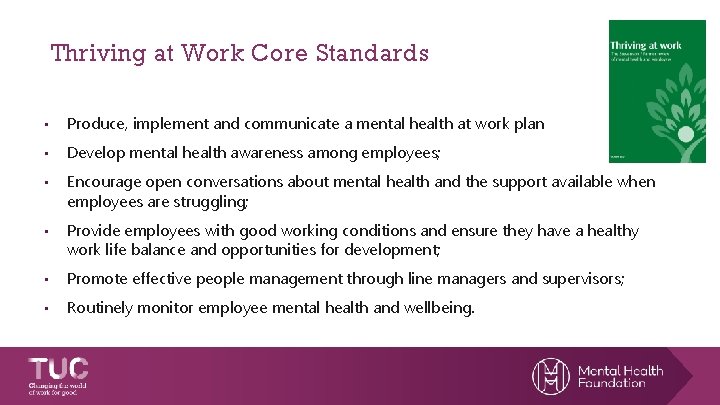
Thriving at Work Core Standards • Produce, implement and communicate a mental health at work plan • Develop mental health awareness among employees; • Encourage open conversations about mental health and the support available when employees are struggling; • Provide employees with good working conditions and ensure they have a healthy work life balance and opportunities for development; • Promote effective people management through line managers and supervisors; • Routinely monitor employee mental health and wellbeing.
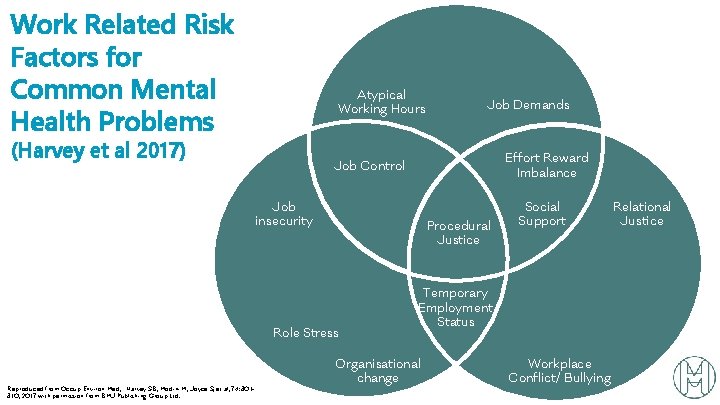
Work Related Risk Factors for Common Mental Health Problems Atypical Working Hours (Harvey et al 2017) Effort Reward Imbalance Job Control Job insecurity Procedural Justice Role Stress Reproduced from Occup Environ Med, Harvey SB, Modini M, Joyce S, et al, 74: 301310, 2017 with permission from BMJ Publishing Group Ltd. Job Demands Social Support Temporary Employment Status Organisational change Workplace Conflict/ Bullying Relational Justice
Mental Health Foundation http: //www. mentalhealth. org. uk/ How To Support Mental Health at Work https: //www. mentalhealth. org. uk/publications/how-support-mental-health-work Added Value – Mental Health As A Workplace Asset https: //www. mentalhealth. org. uk/addedvalue Getting Help https: //www. mentalhealth. org. uk/your-mental-health/getting-help
Other References Thriving at Work – A Review of Mental Health and Employers https: //www. gov. uk/government/publications/thriving-at-work-a-review-of-mental-healthand-employers Minds at Work – Fabians and Community Union https: //fabians. org. uk/publication/minds-at-work/ Acas Framework for Positive Mental Health at Work http: //www. acas. org. uk/index. aspx? articleid=1900 Time to Change (England Wales) See Me (Scotland) https: //www. time-to-change. org. uk/ https: //www. seemescotland. org/