
Talk Story A Mini Speaking Lesson By Shannon
“Talk Story” A Mini Speaking Lesson By: Shannon & Rob
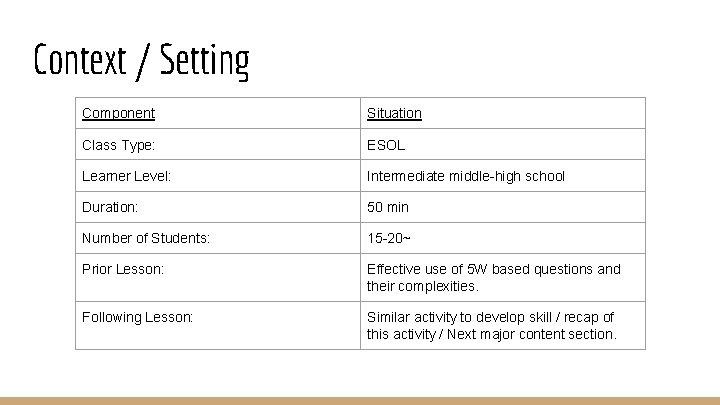
Context / Setting Component Situation Class Type: ESOL Learner Level: Intermediate middle-high school Duration: 50 min Number of Students: 15 -20~ Prior Lesson: Effective use of 5 W based questions and their complexities. Following Lesson: Similar activity to develop skill / recap of this activity / Next major content section.
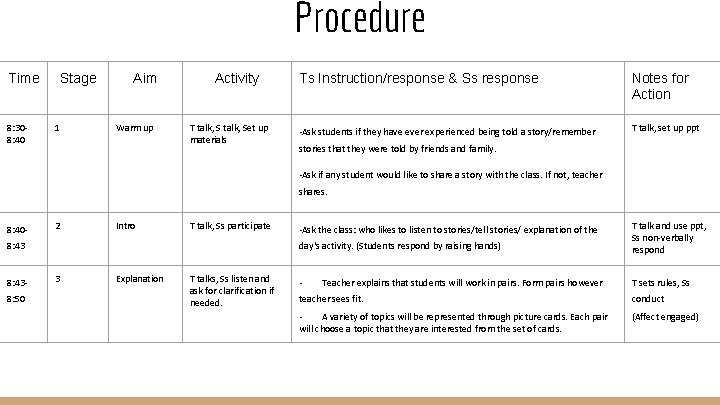
Procedure Time 8: 308: 40 Stage 1 Aim Warm up Activity T talk, Set up materials Ts Instruction/response & Ss response Notes for Action ·Ask students if they have ever experienced being told a story/remember T talk, set up ppt stories that they were told by friends and family. ·Ask if any student would like to share a story with the class. If not, teacher shares. 8: 40 - 2 Intro T talk, Ss participate 8: 438: 50 3 Explanation T talks, Ss listen and ask for clarification if needed. day's activity. (Students respond by raising hands) T talk and use ppt, Ss non-verbally respond · T sets rules, Ss ·Ask the class: who likes to listen to stories/tell stories/ explanation of the Teacher explains that students will work in pairs. Form pairs however teacher sees fit. conduct · A variety of topics will be represented through picture cards. Each pair will choose a topic that they are interested from the set of cards. (Affect engaged)
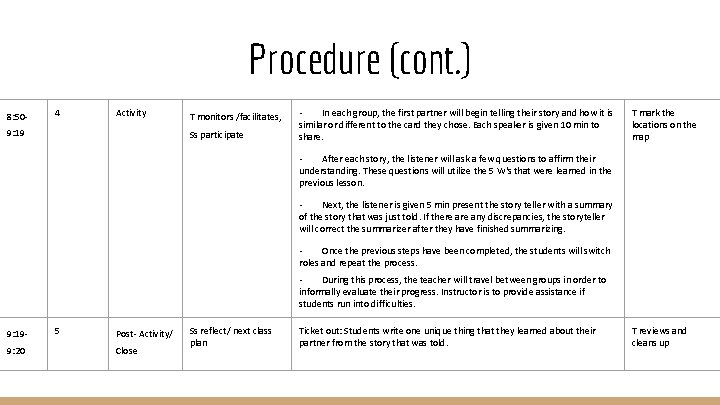
Procedure (cont. ) 8: 50 - 4 Activity 9: 19 T monitors /facilitates, Ss participate · In each group, the first partner will begin telling their story and how it is similar or different to the card they chose. Each speaker is given 10 min to share. T mark the locations on the map · After each story, the listener will ask a few questions to affirm their understanding. These questions will utilize the 5 W's that were learned in the previous lesson. · Next, the listener is given 5 min present the story teller with a summary of the story that was just told. If there any discrepancies, the storyteller will correct the summarizer after they have finished summarizing. · Once the previous steps have been completed, the students will switch roles and repeat the process. · During this process, the teacher will travel between groups in order to informally evaluate their progress. Instructor is to provide assistance if students run into difficulties. 9: 199: 20 5 Post- Activity/ Close Ss reflect/ next class plan Ticket out: Students write one unique thing that they learned about their partner from the story that was told. T reviews and cleans up
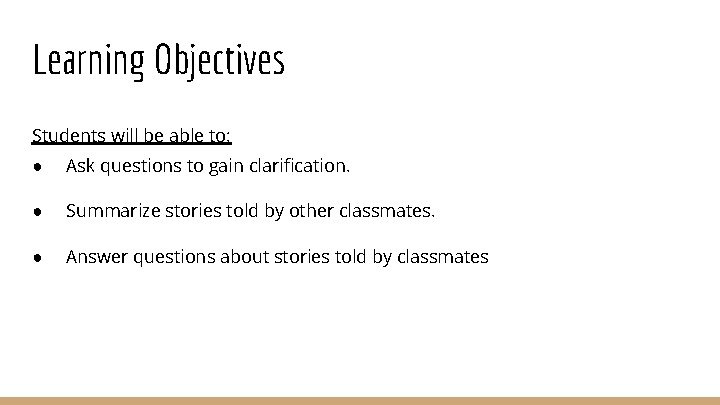
Learning Objectives Students will be able to: ● Ask questions to gain clarification. ● Summarize stories told by other classmates. ● Answer questions about stories told by classmates
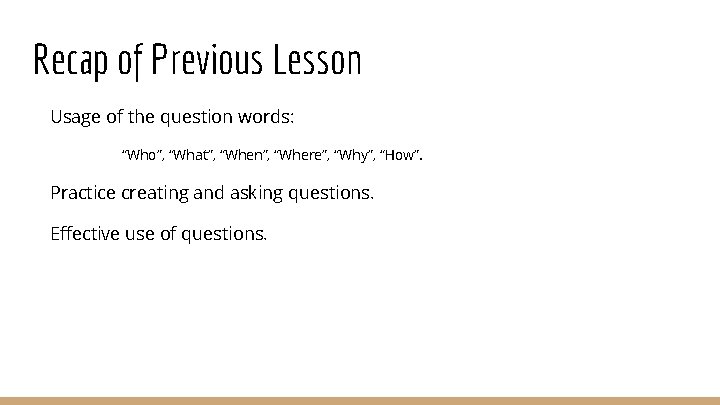
Recap of Previous Lesson Usage of the question words: “Who”, “What”, “When”, “Where”, “Why”, “How”. Practice creating and asking questions. Effective use of questions.

Tell us your story!
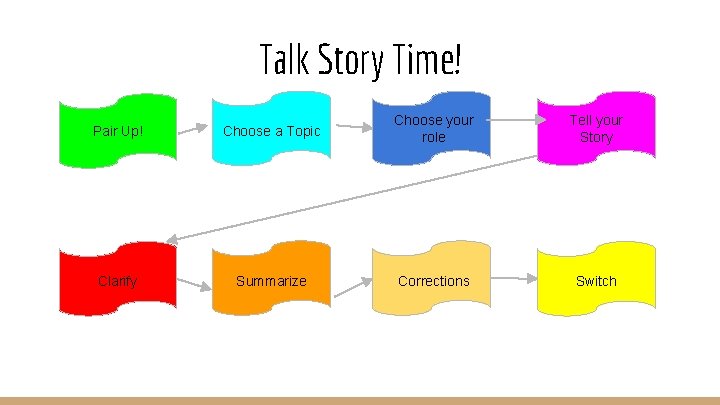
Talk Story Time! Pair Up! Choose a Topic Choose your role Tell your Story Clarify Summarize Corrections Switch
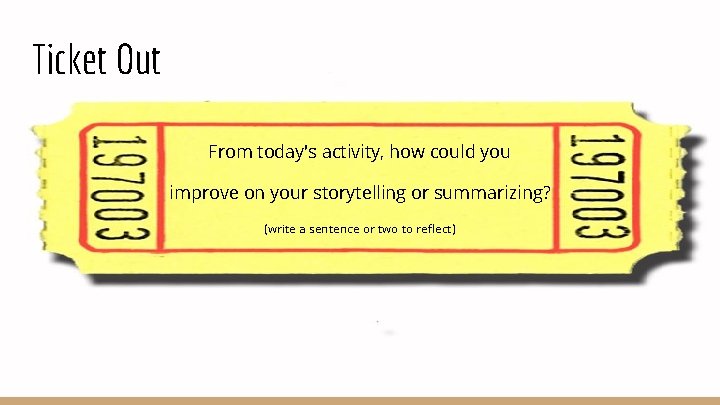
Ticket Out From today's activity, how could you improve on your storytelling or summarizing? (write a sentence or two to reflect)
Assessment & Future Application Speech Performance/Assignments Further complexities of question asking may be addressed. Other lessons that address other speaking concepts that can be scaffolded from this one. Overall communicative competencies are improved so that standards of any future speaking exercises may be raised.
Rationale (1) Retelling is a procedure that enables a student to play a large and active role in reconstructing stories. Usually retelling involves interactive discussion with the teacher, peer or groups and this discussion helps learners to comprehend and recall the discourse they read or listened. (Morrow, 1996). Negotiation of Meaning “The listener can ask [the speaker] for help in the form of requests for clarification or further information and, when [the latter] responds, the fit between the response and what has just been said allows the original speaker to judge how close the listener’s interpretation is to what the speaker intended. In this way, listeners and speakers go through a process of negotiating meaning. ” (Wells, 1987) “From a pedagogical point of view, a storytelling activity offers the possibility of meaningful social interaction among students and between storyteller and teacher. It can also offer storytellers a chance to improve their ability to tell stories effectively, especially when they negotiate meaning through interactions with teachers and peers. ” (Ko, Schallert, & Walters, 2003)
Rationale (2) Integrated skills Speaking needs to be practised in conjunction with other skills (Thornbury, 2005) “Having students talk about the parts of the story they did not understand can also benefit the storytellers. Storytellers may then notice aspects of their tellings that prevented the audience members from understanding their stories, and they may seek to remedy these problems in their retellings. ” (Ko, Schallert, & Walters, 2003) Task-Based Instruction “In task-based instruction, basic pair work and group work are often used to increase student interaction and collaboration. ” (Oxford, 2003) "In task-based instruction, students participate in communicative tasks in English. Tasks are defined as activities that can stand alone as fundamental units and that require comprehending, producing, manipulating, or interacting in authentic language while attention is principally paid to meaning rather than form. ” (Oxford, 2003) Storytelling - is a universal function of language and one of the main ingredients of casual conversation. Through storytelling, learners not only practise an essential skill, but they can also get to know one another. (Thornbury, 2005)
Work Cited Ko, J. , Schallert, D. L. , & Walters, K. (2003). Rethinking scaffolding: Examining negotiation of meaning in an ESL storytelling task. Tesol Quarterly , 37(2), 303 -324. Morrow, L. M. (1985). Retelling stories: A strategy for improving young children's comprehension, concept of story structure, and oral language complexity. The Elementary School Journal , 647 -661. Oxford, R. (2001). Integrated Skills in the ESL/EFL Classroom. ESL magazine , 4(1), 18 -20. Thornbury, S. (2005). How to teach speaking. Harlow: Pearson. Wells, G. (1999). Dialogic inquiry: Toward a sociocultural practice and theory of education. University Press. Cambridge: Cambridge
- Slides: 13